

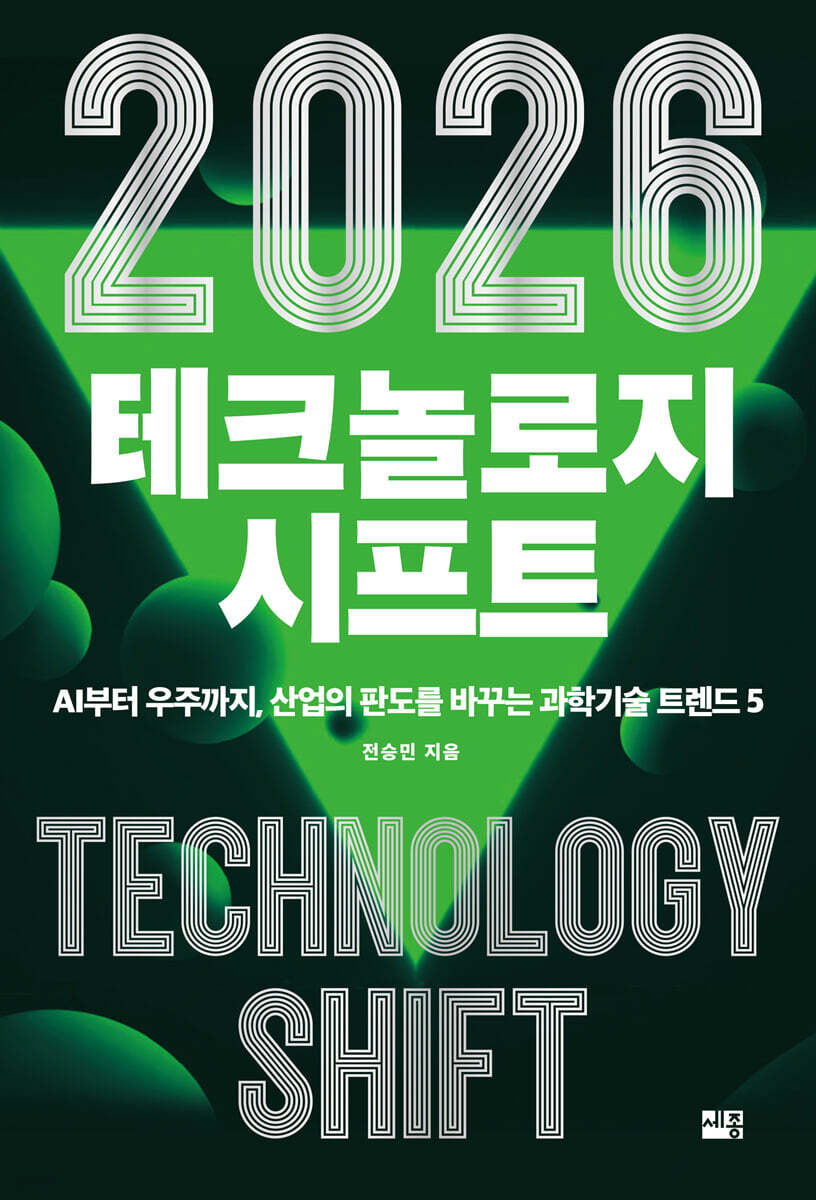
2026 Technology Shift
 |
Description
Book Introduction
“In 2026, five massive technological shifts will determine the direction of human civilization.”
AI, robotics, semiconductors, energy, bio, space—
A science and technology journalist with 20 years of experience tells us,
The Future of Technology and Industry: Five Tech Trends
In this rapidly changing era, reading the flow of change is both a competitive edge and a survival strategy.
"Technology Shift" analyzes the direction in which cutting-edge technologies are moving by examining five major technological trends—AI, robotics, semiconductors, energy, bio, and space—from an "industry perspective."
Author Jeon Seung-min is a leading science journalist who has been documenting changes in science and technology at the forefront for over 20 years.
We explore how AI and robots, the "alien intelligence" that has permeated our world, will change the technological landscape; whether semiconductor integration technology can break through the 1-nanometer barrier; and whether clean fuels like ammonia and hydrogen, the cause of unpleasant bathroom odors, can change the energy system.
We explore how the Hyperloop will open up new airways with the advancement of high-speed transportation and the aviation industry, and how the homes of the future will be "printed" with the advancement of 3D printing architecture.
With the advancement of red biotechnology, which will revolutionize the medical field, white biotechnology, which will realize a carbon-neutral society, and green biotechnology, which is the key to solving climate change and the food crisis, 2026 will mark the starting point of a major bio-transformation.
Unlike existing IT trend books that simply list technological advancements, this book maps the technological landscape in detail and focuses on how it is restructuring industrial structures.
Beyond simple technical explanations, this book's strength lies in its ability to examine how science and technology will be applied in real life, transform future industries, and explore the broader social and economic landscape.
Furthermore, the author does not treat AI, semiconductors, energy, bio, and space industries separately, but views them as a single, intertwined “technology ecosystem.”
Technology is no longer the domain of experts only.
In a rapidly changing era, where understanding the flow of change becomes a personal competitive edge and survival strategy, this book will serve as a reliable guide in preparing for the year 2026.
AI, robotics, semiconductors, energy, bio, space—
A science and technology journalist with 20 years of experience tells us,
The Future of Technology and Industry: Five Tech Trends
In this rapidly changing era, reading the flow of change is both a competitive edge and a survival strategy.
"Technology Shift" analyzes the direction in which cutting-edge technologies are moving by examining five major technological trends—AI, robotics, semiconductors, energy, bio, and space—from an "industry perspective."
Author Jeon Seung-min is a leading science journalist who has been documenting changes in science and technology at the forefront for over 20 years.
We explore how AI and robots, the "alien intelligence" that has permeated our world, will change the technological landscape; whether semiconductor integration technology can break through the 1-nanometer barrier; and whether clean fuels like ammonia and hydrogen, the cause of unpleasant bathroom odors, can change the energy system.
We explore how the Hyperloop will open up new airways with the advancement of high-speed transportation and the aviation industry, and how the homes of the future will be "printed" with the advancement of 3D printing architecture.
With the advancement of red biotechnology, which will revolutionize the medical field, white biotechnology, which will realize a carbon-neutral society, and green biotechnology, which is the key to solving climate change and the food crisis, 2026 will mark the starting point of a major bio-transformation.
Unlike existing IT trend books that simply list technological advancements, this book maps the technological landscape in detail and focuses on how it is restructuring industrial structures.
Beyond simple technical explanations, this book's strength lies in its ability to examine how science and technology will be applied in real life, transform future industries, and explore the broader social and economic landscape.
Furthermore, the author does not treat AI, semiconductors, energy, bio, and space industries separately, but views them as a single, intertwined “technology ecosystem.”
Technology is no longer the domain of experts only.
In a rapidly changing era, where understanding the flow of change becomes a personal competitive edge and survival strategy, this book will serve as a reliable guide in preparing for the year 2026.
- You can preview some of the book's contents.
Preview
index
Recommendation
Introduction: The Easiest Way to Understand the New Era
Shift 1: The World Created by AI and Robots: The "Alien Intelligence" That Permeates Us
How far can large language models (LLMs) scale?
The evolution of "multifunctional artificial intelligence" represented by ChatGPT.
Could the AI explosion lead to the development of AGI (Artificial General Intelligence)?
What the link between LLM and SLM, and the combination of multimodality and AI agents, mean
Is there a separate AI for robots?
The Emergence of Physical AI: The Present and Future of Practical Robotics
How will humanoid and robot-controlled AI change the technological landscape?
- Will the humanoid, which laid the foundation for explosive growth, become the first commercially available?
Learn More 1: Korean AI: Beyond Imitation, Toward Innovation
Learn More 2: Current Status and Challenges of the Domestic and International Robot Industry
Shift 2 Semiconductor and Precision Engineering: The Engines That Power AI and Robotics
Can semiconductor integration technology break through the 1-nanometer barrier?
- The 1nm race will usher in a technological revolution and a new era of physics.
Why is GPU so much attention?
- The GPU Rebellion: From Graphics Chips to National Strategic Assets
Display technology: How far can screens evolve?
- A new world of foldable, curved, and floating displays
How do 'machines' give birth to new industries?
- Impact of advancements in engineering technology on industry
Learn More 1: From Abacuses to Quantum Systems: What Does the Machine Called "Computer" Mean?
Learn More 2: Where is 'smart device' technology headed?
The Roots of Shift 3 Industries: Energy and Chemicals: The Light and Shadow of ESG
Large-Scale Power Generation Technology: What Will Civilization Return To?
Coal-fired and nuclear power generation technologies, the foundation of modern civilization
Can energy supply systems and environmental technologies be balanced?
- In the era of global warming, renewable energy opens up new innovations.
Can hydrogen transform the energy system?
Understanding hydrogen is essential to understanding future energy systems.
Are petrochemicals a legacy of the past or an asset of the future?
- A new survival strategy for the petrochemical industry, the foundation of modern society.
Learn More 1: The Final Energy Puzzle: Nuclear Fusion Technology
Learn More 2: Batteries: The Heart of the Energy Revolution
Shift 4 Bio and Life Technologies: Efforts for a Sustainable Humanity
Biotechnology fused with AI: Where will innovation end?
- The enormous change brought about by the convergence of bio and AI.
How did healthcare become the starting point for the red bio industry?
- The first step to understanding the industry: bio+medical technology
How will the white bio industry reshape the industrial ecosystem?
White Bio, the Link Between Biochemistry and Industry
What impact will the development of green biotechnology have on agriculture and livestock?
The Future of Agriculture and Livestock: The Fundamentals of Making a Living
Learn More 1: Artificial Humans: Will Imagination Become Reality? The Value and Future of Biomechatronics Technology
Learn More 2: Gene Editing: Modern Life Scientists' Most Powerful Weapon
Shift 5: The Space Industry Begins in Space: How Will Satellites, Aviation, Rail, and Housing Transform?
The 'space industry' is expanding beyond Earth. Who will occupy space?
- In the 'New Space' era, space practicality blossoms in the private sector.
Will the aviation industry, which connects the globe, open new skies?
- The future of flight transformed by SAF, hydrogen aircraft, and UAM
Is a 'Hyperloop' that travels underground at 1,000 kilometers per hour really possible?
The future of ultra-high-speed transportation: Hyperloop, autonomous trains, and hydrogen trams.
How will the homes of the future be 'printed'?
From digital twins to 3D printing, innovations in architecture and construction.
Learn More 1: Autonomous Driving: The Future of Cars
Learn More 2: The Metaverse Returns: A Revolution in Virtual Space
Introduction: The Easiest Way to Understand the New Era
Shift 1: The World Created by AI and Robots: The "Alien Intelligence" That Permeates Us
How far can large language models (LLMs) scale?
The evolution of "multifunctional artificial intelligence" represented by ChatGPT.
Could the AI explosion lead to the development of AGI (Artificial General Intelligence)?
What the link between LLM and SLM, and the combination of multimodality and AI agents, mean
Is there a separate AI for robots?
The Emergence of Physical AI: The Present and Future of Practical Robotics
How will humanoid and robot-controlled AI change the technological landscape?
- Will the humanoid, which laid the foundation for explosive growth, become the first commercially available?
Learn More 1: Korean AI: Beyond Imitation, Toward Innovation
Learn More 2: Current Status and Challenges of the Domestic and International Robot Industry
Shift 2 Semiconductor and Precision Engineering: The Engines That Power AI and Robotics
Can semiconductor integration technology break through the 1-nanometer barrier?
- The 1nm race will usher in a technological revolution and a new era of physics.
Why is GPU so much attention?
- The GPU Rebellion: From Graphics Chips to National Strategic Assets
Display technology: How far can screens evolve?
- A new world of foldable, curved, and floating displays
How do 'machines' give birth to new industries?
- Impact of advancements in engineering technology on industry
Learn More 1: From Abacuses to Quantum Systems: What Does the Machine Called "Computer" Mean?
Learn More 2: Where is 'smart device' technology headed?
The Roots of Shift 3 Industries: Energy and Chemicals: The Light and Shadow of ESG
Large-Scale Power Generation Technology: What Will Civilization Return To?
Coal-fired and nuclear power generation technologies, the foundation of modern civilization
Can energy supply systems and environmental technologies be balanced?
- In the era of global warming, renewable energy opens up new innovations.
Can hydrogen transform the energy system?
Understanding hydrogen is essential to understanding future energy systems.
Are petrochemicals a legacy of the past or an asset of the future?
- A new survival strategy for the petrochemical industry, the foundation of modern society.
Learn More 1: The Final Energy Puzzle: Nuclear Fusion Technology
Learn More 2: Batteries: The Heart of the Energy Revolution
Shift 4 Bio and Life Technologies: Efforts for a Sustainable Humanity
Biotechnology fused with AI: Where will innovation end?
- The enormous change brought about by the convergence of bio and AI.
How did healthcare become the starting point for the red bio industry?
- The first step to understanding the industry: bio+medical technology
How will the white bio industry reshape the industrial ecosystem?
White Bio, the Link Between Biochemistry and Industry
What impact will the development of green biotechnology have on agriculture and livestock?
The Future of Agriculture and Livestock: The Fundamentals of Making a Living
Learn More 1: Artificial Humans: Will Imagination Become Reality? The Value and Future of Biomechatronics Technology
Learn More 2: Gene Editing: Modern Life Scientists' Most Powerful Weapon
Shift 5: The Space Industry Begins in Space: How Will Satellites, Aviation, Rail, and Housing Transform?
The 'space industry' is expanding beyond Earth. Who will occupy space?
- In the 'New Space' era, space practicality blossoms in the private sector.
Will the aviation industry, which connects the globe, open new skies?
- The future of flight transformed by SAF, hydrogen aircraft, and UAM
Is a 'Hyperloop' that travels underground at 1,000 kilometers per hour really possible?
The future of ultra-high-speed transportation: Hyperloop, autonomous trains, and hydrogen trams.
How will the homes of the future be 'printed'?
From digital twins to 3D printing, innovations in architecture and construction.
Learn More 1: Autonomous Driving: The Future of Cars
Learn More 2: The Metaverse Returns: A Revolution in Virtual Space
Detailed image

Into the book
We selected key science and technology topics that will lead the world's changes in the present era and aimed to convey the state of technological advancement in language that is as easy to understand as possible.
I have incorporated my own experiences and perspectives into my analysis of how these technologies, which are already upon us, will change in the future one year from now.
It contains my own analysis and predictions on how much science and technology will develop and change in the future right before our eyes, that is, in the year 2026.
Of course, it would be difficult to say that this prediction will necessarily come true.
However, since it is based on the direction of technological flow, it is worth knowing in itself even if it does not receive much attention in economic and industrial terms.
--- p.9
Currently, robotic arms are already widely used in industrial settings, but most of them have only one arm.
It's clear that this is a much less efficient way of working than using both arms (try putting one hand in your pocket and doing something with only the other for 10 minutes and you'll quickly feel the difference).
Due to technological limitations, mainly single-handed robots have been developed and operated.
Although dual-arm models exist, single-arm robots still dominate practical process design.
This is because if the AI uses both arms simultaneously without a sufficient understanding of the laws of physics, the two arms may interfere with each other, which may actually reduce efficiency.
If physical AI is incorporated into this process, there is a very high possibility that a robot that can actively use both hands in conjunction like a human could emerge.
--- p.53~54
OLED technology offers excellent picture quality and, because it does not require a backlight, allows for extremely thin displays.
It is also advantageous in creating 'flexible displays' that can be folded or bent.
As of 2025, it is not easy to find a way to actually manufacture and sell flexible display products, excluding OLED.
However, OLED has a disadvantage in that the internal organic materials are vulnerable to strong energy, and the color gradually changes when used for a long time, causing a 'burn-in' phenomenon.
Technological improvements are underway to minimize these issues. OLEDs can produce a wide range of colors because they incorporate chemicals that represent the three primary colors of light—red, green, and blue—into the light-emitting layer.
This substance is called a "dopant." It is a key material needed to create the "light-emitting layer" that emits light within OLEDs.
The most challenging color here is blue.
Blue light has a short wavelength and high energy, so it easily destroys the molecular bonds of organic materials, causing burn-in.
Therefore, research is ongoing to develop more efficient and longer-lasting blue dopants.
--- p.105~106
Ammonia was originally a type of chemical substance made by reprocessing naphtha (a hydrocarbon mixture obtained when distilling crude oil) or natural gas.
It was used as a raw material in making various substances such as fertilizer and gunpowder.
In the 1960s, when securing fertilizer for food production was crucial in Korea, ammonia plants, along with oil refineries, were one of the key sectors for fostering the country's heavy chemical industry.
But how can hydrogen be stored and transported with this ammonia?
The chemical formula for ammonia is NH₃, which means that there are three hydrogens (H) attached to one nitrogen (N).
If we remove just one nitrogen atom from here, we can make it into hydrogen.
It is the optimal material for extracting hydrogen.
However, ammonia can store twice as much as hydrogen in the same tank.
It can complement the shortcomings of hydrogen, which are difficult to store in large quantities and transport over long distances.
Moreover, ammonia is a substance that has been handled in industrial settings for a long time.
Ammonia storage and transportation infrastructure has been established in refineries and chemical plants, and sufficient technical experience and safety standards for transportation and storage have been secured.
--- p.185
To summarize what we have seen so far, we can see that human biotechnology innovation has evolved in stages.
At first, human genome information was obtained through the technology to 'read' genes, and then gene scissors technology was obtained through the development of the technology to 'edit' genes.
Next, we entered the new field of synthetic biology with the technology to 'write' genes.
We are now entering the stage of prediction (Imagine), a technology that learns from accumulated data to infer the hidden principles of life phenomena, predict future outcomes, and generate new hypotheses.
This is being achieved through convergence with AI technology.
A representative example is 'AlphaFold'.
--- p.224~226
In Korea, the number of local governments choosing 'urban hydrogen electric trams' is increasing, creating a new technological trend.
Unlike existing electric trams, they do not require complex electrical infrastructure such as overhead lines and substations to supply electricity, which reduces initial construction costs and also improves the appearance of the city by eliminating complex wires.
In Korea, Hyundai Rochem is developing the tram, which will generate a total output of 380 kW by connecting four 95 kW fuel cell modules used in the Nexo hydrogen electric vehicle developed by Hyundai Motor Company, an affiliate of the same company.
The design top speed is 70 kilometers per hour, which means it can travel the entire city on a single charge.
This technology is surprisingly well-received, with Egypt's new administrative capital, New Cairo, set to introduce hydrogen-electric trams using this technology in March 2022, and Queensland, Australia, also decided to introduce it in April 2022.
--- p.324~325
Along with the modular approach, another architectural innovation that is gaining attention is the '3D printing architecture' technique.
It is an 'additive manufacturing' technology that uses a giant printer nozzle to squeeze out special cement-based construction materials and build up structures such as walls one layer at a time.
It has the advantage of drastically reducing construction waste by eliminating the need for formwork processes, and making it easy to implement complex curves or irregular designs that are difficult to implement using traditional methods.
This technology is already at the practical stage.
A representative example is the American architectural firm 'Icon', which attracted attention by building a 100-unit 3D-printed housing complex in Texas.
The scope of application is expanding across residential, commercial and public facilities, with two-story houses being built in Australia, villas in India and the world's first 3D-printed train station being built in Japan.
I have incorporated my own experiences and perspectives into my analysis of how these technologies, which are already upon us, will change in the future one year from now.
It contains my own analysis and predictions on how much science and technology will develop and change in the future right before our eyes, that is, in the year 2026.
Of course, it would be difficult to say that this prediction will necessarily come true.
However, since it is based on the direction of technological flow, it is worth knowing in itself even if it does not receive much attention in economic and industrial terms.
--- p.9
Currently, robotic arms are already widely used in industrial settings, but most of them have only one arm.
It's clear that this is a much less efficient way of working than using both arms (try putting one hand in your pocket and doing something with only the other for 10 minutes and you'll quickly feel the difference).
Due to technological limitations, mainly single-handed robots have been developed and operated.
Although dual-arm models exist, single-arm robots still dominate practical process design.
This is because if the AI uses both arms simultaneously without a sufficient understanding of the laws of physics, the two arms may interfere with each other, which may actually reduce efficiency.
If physical AI is incorporated into this process, there is a very high possibility that a robot that can actively use both hands in conjunction like a human could emerge.
--- p.53~54
OLED technology offers excellent picture quality and, because it does not require a backlight, allows for extremely thin displays.
It is also advantageous in creating 'flexible displays' that can be folded or bent.
As of 2025, it is not easy to find a way to actually manufacture and sell flexible display products, excluding OLED.
However, OLED has a disadvantage in that the internal organic materials are vulnerable to strong energy, and the color gradually changes when used for a long time, causing a 'burn-in' phenomenon.
Technological improvements are underway to minimize these issues. OLEDs can produce a wide range of colors because they incorporate chemicals that represent the three primary colors of light—red, green, and blue—into the light-emitting layer.
This substance is called a "dopant." It is a key material needed to create the "light-emitting layer" that emits light within OLEDs.
The most challenging color here is blue.
Blue light has a short wavelength and high energy, so it easily destroys the molecular bonds of organic materials, causing burn-in.
Therefore, research is ongoing to develop more efficient and longer-lasting blue dopants.
--- p.105~106
Ammonia was originally a type of chemical substance made by reprocessing naphtha (a hydrocarbon mixture obtained when distilling crude oil) or natural gas.
It was used as a raw material in making various substances such as fertilizer and gunpowder.
In the 1960s, when securing fertilizer for food production was crucial in Korea, ammonia plants, along with oil refineries, were one of the key sectors for fostering the country's heavy chemical industry.
But how can hydrogen be stored and transported with this ammonia?
The chemical formula for ammonia is NH₃, which means that there are three hydrogens (H) attached to one nitrogen (N).
If we remove just one nitrogen atom from here, we can make it into hydrogen.
It is the optimal material for extracting hydrogen.
However, ammonia can store twice as much as hydrogen in the same tank.
It can complement the shortcomings of hydrogen, which are difficult to store in large quantities and transport over long distances.
Moreover, ammonia is a substance that has been handled in industrial settings for a long time.
Ammonia storage and transportation infrastructure has been established in refineries and chemical plants, and sufficient technical experience and safety standards for transportation and storage have been secured.
--- p.185
To summarize what we have seen so far, we can see that human biotechnology innovation has evolved in stages.
At first, human genome information was obtained through the technology to 'read' genes, and then gene scissors technology was obtained through the development of the technology to 'edit' genes.
Next, we entered the new field of synthetic biology with the technology to 'write' genes.
We are now entering the stage of prediction (Imagine), a technology that learns from accumulated data to infer the hidden principles of life phenomena, predict future outcomes, and generate new hypotheses.
This is being achieved through convergence with AI technology.
A representative example is 'AlphaFold'.
--- p.224~226
In Korea, the number of local governments choosing 'urban hydrogen electric trams' is increasing, creating a new technological trend.
Unlike existing electric trams, they do not require complex electrical infrastructure such as overhead lines and substations to supply electricity, which reduces initial construction costs and also improves the appearance of the city by eliminating complex wires.
In Korea, Hyundai Rochem is developing the tram, which will generate a total output of 380 kW by connecting four 95 kW fuel cell modules used in the Nexo hydrogen electric vehicle developed by Hyundai Motor Company, an affiliate of the same company.
The design top speed is 70 kilometers per hour, which means it can travel the entire city on a single charge.
This technology is surprisingly well-received, with Egypt's new administrative capital, New Cairo, set to introduce hydrogen-electric trams using this technology in March 2022, and Queensland, Australia, also decided to introduce it in April 2022.
--- p.324~325
Along with the modular approach, another architectural innovation that is gaining attention is the '3D printing architecture' technique.
It is an 'additive manufacturing' technology that uses a giant printer nozzle to squeeze out special cement-based construction materials and build up structures such as walls one layer at a time.
It has the advantage of drastically reducing construction waste by eliminating the need for formwork processes, and making it easy to implement complex curves or irregular designs that are difficult to implement using traditional methods.
This technology is already at the practical stage.
A representative example is the American architectural firm 'Icon', which attracted attention by building a 100-unit 3D-printed housing complex in Texas.
The scope of application is expanding across residential, commercial and public facilities, with two-story houses being built in Australia, villas in India and the world's first 3D-printed train station being built in Japan.
--- p.334
Publisher's Review
“What technologies will change the industrial landscape in the next year?”
In a rapidly changing society, those who "read the flow of technology" will lead the future!
A science journalist with 20 years of experience tells us about the future unfolding before our eyes.
From the semiconductor war and the race for GPU supremacy, to innovations in renewable energy, gene-based bio-fusion technology, and new challenges in the space industry, there's a wealth of technology news pouring in every day, but it's not always easy to grasp the flow at a glance.
To survive and get ahead in a rapidly changing society, it's essential to accurately grasp the latest technological trends.
"Technology Shift" is a book that quenches your thirst for this.
"Technology Shift" is a 2026 industry and technology roadmap, encompassing essential cutting-edge technology trends from an industrial perspective, the current state of global cutting-edge technologies, and their future direction. This single volume captures five major technology trends that will shake up global industry and society, spanning AI and robotics, semiconductors and precision engineering, energy and chemistry, biotechnology, and the aerospace industry.
Rather than simply listing new technologies, it also examines their industrial, economic, political, and social ramifications, informing us of what we need to prepare for in this wave of change.
To avoid getting lost in the changing world of technology, quickly grasping the latest trends with this one book will help you prepare for the rapidly changing times and the future.
“He who reads change controls the future.”
The IT tech war that no one can avoid,
The most powerful survival strategy for anyone preparing for the future!
·What tectonic shifts will AI and robots, the unfamiliar intelligence that has permeated our world, bring to the technological landscape?
·Can semiconductor integration technology break through the 1nm barrier?
·Can clean fuels like ammonia and hydrogen change the energy industry?
·How will red, white, and green biotechnology, fused with AI, reshape the industrial ecosystem?
· Will a new sky route open for the aviation industry that connects the globe?
Is AI a companion or a competitor to humanity? Can biotechnology expand human capabilities, or will it create new ethical conflicts? Can the space industry transcend international competition and become a new arena for cooperation? "Technology Shift" poses questions we've been overlooking amidst the rapidly changing technological landscape.
This book addresses these questions in plain language, connecting seemingly vague technological issues to concrete future scenarios.
The multifunctional AI that emerged after ChatGPT evolved into 'multimodal AI' that understands language, images, and voice simultaneously.
Now, we have entered an era where robots can be moved using only natural language commands, without the need for professional manipulation.
2026 will be the first year of full-scale mass production of 2nm semiconductors, and who leads this market will determine national competitiveness.
From renewable energy and next-generation batteries to biotechnology that opens up the possibility of artificial intelligence, and future transportation like the space internet and Hyperloop, this book connects the technologies in news headlines to changes in our lives and industries.
"Technology Shift" was written so that anyone, even non-technical experts, can easily understand science and technology trends.
Through this book, readers can easily understand why AI and robotics are being discussed together now, why the 2nm semiconductor competition is directly linked to national security, and why battery innovation will determine the success or failure of future industries.
For job seekers, industry professionals, entrepreneurs, policymakers, and anyone curious about the future of cutting-edge technology, this book will be the easiest way to prepare for the coming year.
AI, robots, semiconductors, energy, bio, space—
A glance at the technologies that are completely changing the industrial landscape!
"Technology Shift" doesn't simply list new technologies; it specifically identifies how they will transform the industrial landscape and the opportunities and challenges they will bring.
Shift 1. The AI and Robot Revolution: Unfamiliar Intelligence Permeates Our Daily Lives
Giant language models, such as ChatGPT, have begun to understand human language, and Nvidia's "physical AI" has acquired a robotic body.
In an era where artificial intelligence collaborates with human imagination, AI is utilized in various fields such as factories, hospitals, and homes, becoming a new intellectual companion that expands human limitations.
Shift 2.
Semiconductor and precision engineering technologies, the engines of technological civilization
The real key to AI advancement lies not in algorithms, but in hardware.
As the 1nm competition and GPU war rage on, semiconductors are no longer just industrial components but have become 'national strategic assets.'
The convergence of computers, displays, ultra-precision processes, precision engineering, and nanomaterials research is ushering in an era of computation that surpasses human computational capabilities.
Shift 3.
Energy and chemistry, the fuel of civilization, are changing.
The root of industry is energy.
While coal and nuclear power remain dominant, the focus is shifting to renewable energy and battery innovation.
Renewable energy, materials, and carbon capture technologies are becoming essential for industrial survival, and competition for next-generation battery materials is transforming the automotive and electronics markets.
Ammonia, the substance that causes the unpleasant smell in bathrooms, is expected to change the energy system by making up for the shortcoming of hydrogen, which is difficult to transport over long distances.
Shift 4.
Biotechnology and Biotechnology: Efforts for a Sustainable Humanity
Bio-fusion encompassing medicine, industry, and agriculture is the key to determining human sustainability.
Technologies such as gene editing and biomechatronics for artificial humans have already entered the stage of redesigning 'life'.
From red biotechnology, which will revolutionize the medical field, to white biotechnology, which will realize a carbon-neutral society, to green biotechnology, which will be the key to solving climate change and the food crisis, 2026 will mark the starting point of a major bio-transformation.
Shift 5.
How will the space industry, starting in space, transform satellites, aviation, railways, and housing?
From Hyperloop to private space industry, the boundaries between Earth and space are blurring.
Launch vehicles, satellites, and space internet have been elevated to national strategic industries, while hyperloop, autonomous vehicles, and AI-powered construction technologies are revolutionizing terrestrial infrastructure.
The rocket race to the Moon and Mars is not simply a matter of exploration; it is also a competition for supremacy in data, energy, and materials.
A turning point in spatial fusion is approaching, connecting space, land, and virtual reality simultaneously.
Through five major waves, "Technology Shift" demonstrates that "reading the direction of science and technology is essentially preparing for the future." In an era where AI writes novels, robots fry chicken, and the race for semiconductor supremacy directly affects national security, this book vividly depicts the technological civilization that will emerge after 2026, serving as both a cutting-edge science textbook and a survival manual for the future.
In a rapidly changing society, those who "read the flow of technology" will lead the future!
A science journalist with 20 years of experience tells us about the future unfolding before our eyes.
From the semiconductor war and the race for GPU supremacy, to innovations in renewable energy, gene-based bio-fusion technology, and new challenges in the space industry, there's a wealth of technology news pouring in every day, but it's not always easy to grasp the flow at a glance.
To survive and get ahead in a rapidly changing society, it's essential to accurately grasp the latest technological trends.
"Technology Shift" is a book that quenches your thirst for this.
"Technology Shift" is a 2026 industry and technology roadmap, encompassing essential cutting-edge technology trends from an industrial perspective, the current state of global cutting-edge technologies, and their future direction. This single volume captures five major technology trends that will shake up global industry and society, spanning AI and robotics, semiconductors and precision engineering, energy and chemistry, biotechnology, and the aerospace industry.
Rather than simply listing new technologies, it also examines their industrial, economic, political, and social ramifications, informing us of what we need to prepare for in this wave of change.
To avoid getting lost in the changing world of technology, quickly grasping the latest trends with this one book will help you prepare for the rapidly changing times and the future.
“He who reads change controls the future.”
The IT tech war that no one can avoid,
The most powerful survival strategy for anyone preparing for the future!
·What tectonic shifts will AI and robots, the unfamiliar intelligence that has permeated our world, bring to the technological landscape?
·Can semiconductor integration technology break through the 1nm barrier?
·Can clean fuels like ammonia and hydrogen change the energy industry?
·How will red, white, and green biotechnology, fused with AI, reshape the industrial ecosystem?
· Will a new sky route open for the aviation industry that connects the globe?
Is AI a companion or a competitor to humanity? Can biotechnology expand human capabilities, or will it create new ethical conflicts? Can the space industry transcend international competition and become a new arena for cooperation? "Technology Shift" poses questions we've been overlooking amidst the rapidly changing technological landscape.
This book addresses these questions in plain language, connecting seemingly vague technological issues to concrete future scenarios.
The multifunctional AI that emerged after ChatGPT evolved into 'multimodal AI' that understands language, images, and voice simultaneously.
Now, we have entered an era where robots can be moved using only natural language commands, without the need for professional manipulation.
2026 will be the first year of full-scale mass production of 2nm semiconductors, and who leads this market will determine national competitiveness.
From renewable energy and next-generation batteries to biotechnology that opens up the possibility of artificial intelligence, and future transportation like the space internet and Hyperloop, this book connects the technologies in news headlines to changes in our lives and industries.
"Technology Shift" was written so that anyone, even non-technical experts, can easily understand science and technology trends.
Through this book, readers can easily understand why AI and robotics are being discussed together now, why the 2nm semiconductor competition is directly linked to national security, and why battery innovation will determine the success or failure of future industries.
For job seekers, industry professionals, entrepreneurs, policymakers, and anyone curious about the future of cutting-edge technology, this book will be the easiest way to prepare for the coming year.
AI, robots, semiconductors, energy, bio, space—
A glance at the technologies that are completely changing the industrial landscape!
"Technology Shift" doesn't simply list new technologies; it specifically identifies how they will transform the industrial landscape and the opportunities and challenges they will bring.
Shift 1. The AI and Robot Revolution: Unfamiliar Intelligence Permeates Our Daily Lives
Giant language models, such as ChatGPT, have begun to understand human language, and Nvidia's "physical AI" has acquired a robotic body.
In an era where artificial intelligence collaborates with human imagination, AI is utilized in various fields such as factories, hospitals, and homes, becoming a new intellectual companion that expands human limitations.
Shift 2.
Semiconductor and precision engineering technologies, the engines of technological civilization
The real key to AI advancement lies not in algorithms, but in hardware.
As the 1nm competition and GPU war rage on, semiconductors are no longer just industrial components but have become 'national strategic assets.'
The convergence of computers, displays, ultra-precision processes, precision engineering, and nanomaterials research is ushering in an era of computation that surpasses human computational capabilities.
Shift 3.
Energy and chemistry, the fuel of civilization, are changing.
The root of industry is energy.
While coal and nuclear power remain dominant, the focus is shifting to renewable energy and battery innovation.
Renewable energy, materials, and carbon capture technologies are becoming essential for industrial survival, and competition for next-generation battery materials is transforming the automotive and electronics markets.
Ammonia, the substance that causes the unpleasant smell in bathrooms, is expected to change the energy system by making up for the shortcoming of hydrogen, which is difficult to transport over long distances.
Shift 4.
Biotechnology and Biotechnology: Efforts for a Sustainable Humanity
Bio-fusion encompassing medicine, industry, and agriculture is the key to determining human sustainability.
Technologies such as gene editing and biomechatronics for artificial humans have already entered the stage of redesigning 'life'.
From red biotechnology, which will revolutionize the medical field, to white biotechnology, which will realize a carbon-neutral society, to green biotechnology, which will be the key to solving climate change and the food crisis, 2026 will mark the starting point of a major bio-transformation.
Shift 5.
How will the space industry, starting in space, transform satellites, aviation, railways, and housing?
From Hyperloop to private space industry, the boundaries between Earth and space are blurring.
Launch vehicles, satellites, and space internet have been elevated to national strategic industries, while hyperloop, autonomous vehicles, and AI-powered construction technologies are revolutionizing terrestrial infrastructure.
The rocket race to the Moon and Mars is not simply a matter of exploration; it is also a competition for supremacy in data, energy, and materials.
A turning point in spatial fusion is approaching, connecting space, land, and virtual reality simultaneously.
Through five major waves, "Technology Shift" demonstrates that "reading the direction of science and technology is essentially preparing for the future." In an era where AI writes novels, robots fry chicken, and the race for semiconductor supremacy directly affects national security, this book vividly depicts the technological civilization that will emerge after 2026, serving as both a cutting-edge science textbook and a survival manual for the future.
GOODS SPECIFICS
- Date of issue: November 20, 2025
- Page count, weight, size: 348 pages | 516g | 150*220*21mm
- ISBN13: 9791199512405
- ISBN10: 1199512400
You may also like
카테고리
korean


korean

![GQ KOREA Mark (Monthly): December [2025]](http://librairie.coreenne.fr/cdn/shop/files/8ef265dbbfbf186523ed75ba7319009d.jpg?v=1765340328&width=3840)


