

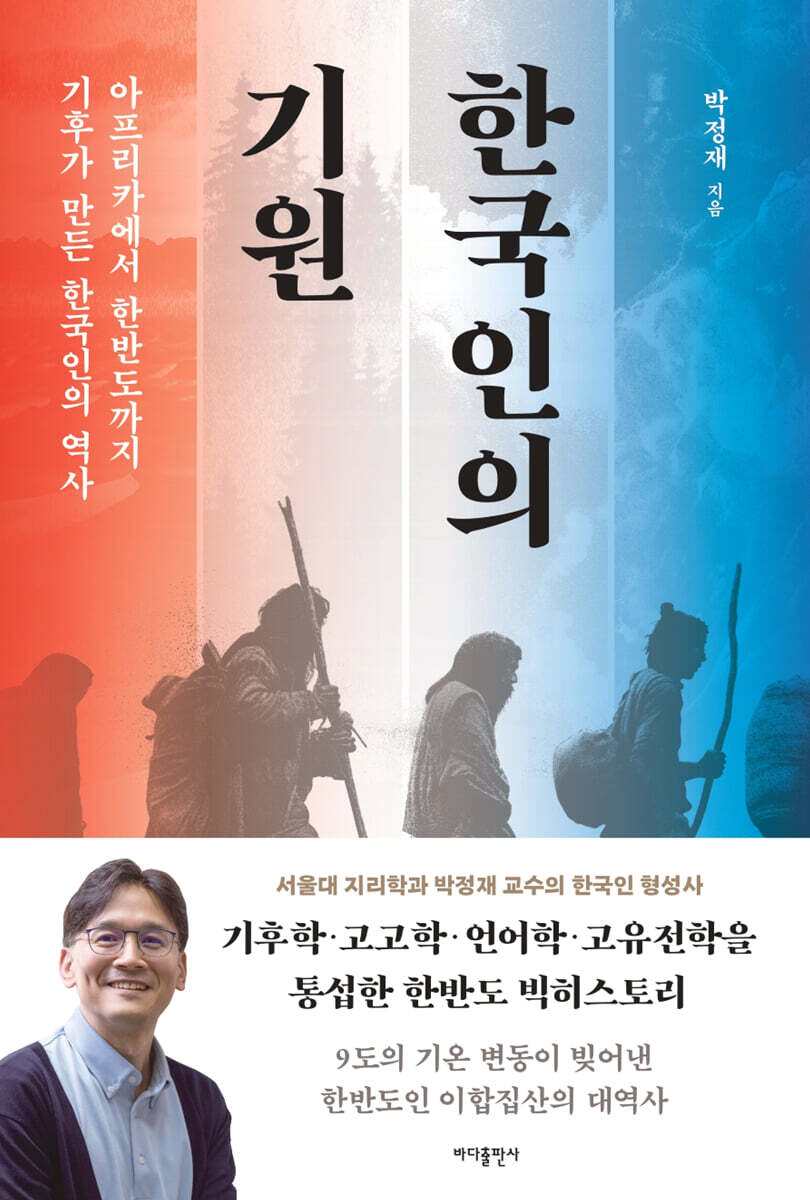
Origin of the Korean people
 |
Description
Book Introduction
The great history of the Korean Peninsula's division and unification brought about by a 9-degree temperature fluctuation Big History of the Korean Peninsula by Professor Park Jeong-jae of the Department of Geography at Seoul National University Who are Koreans and where do they come from? These are questions every Korean has asked at least once, but due to a lack of evidence, no convincing answer has been available until now. But the mood has been changing recently. Advances in paleogenetics have allowed us to paint a broad picture of the route Sapiens took when they left Africa to reach the Korean Peninsula, and paleoclimatological data allows us to make reasonable inferences about why Sapiens migrated rather than settled. Professor Park Jeong-jae of Seoul National University's Department of Geography brings together scattered data from archaeology, history, and linguistics to tell a bold story about the origins of the Korean people, one that no one has ever told before. The author states that the mainstream Korean population was formed by the mixing of climate refugees who came from the north during the 8.2ka event, when the Korean Peninsula became cold, the Middle Bronze Age low-temperature period, the 3.2ka event, the Medieval low-temperature period, and the Iron Age low-temperature period. |
- You can preview some of the book's contents.
Preview
index
Introduction · 5
Key Areas Covered in This Book · 22
Note · 24
Part 1 Out of Africa
Chapter 1: Encounters with Strangers · 31
Traces of Strangers in the Genome │ Neanderthals and Denisovans │ Wandering Homo sapiens │ Out of Africa!
Chapter 2: The Origins of Europeans · 49
Dispersion from West Asia │ Genealogy of European hunter-gatherers │ Paleolithic Venus and ancient North Eurasians │ The first agriculture in human history │ The origin of nomads │ The first nomadic people, Yamnaya and Kurgan │ The Yamnaya who shook Europe │ The Aryans, Dasa, and Pur │ The continued southward expansion of the Aryans │ The origin of the Indo-European language family │ Sapiens in Western Eurasia │ Luca Cavalli-Sforza, the father of genetic geography
Chapter 3: Why Sapiens Went East · 89
Beyond Sundaland to Sahulland │ Hoa Binh, Tianyuan, and Jomon │ From the Amur River to the Korean Peninsula │ Descendants of the Tianyuan lineage who cultivated agriculture │ Why did Sapiens wander in search of unknown lands? │ Reading the traces of humanity left in DNA
Part 2: Vibrant Climate and Human Migration
Chapter 4: The Pulse of Nature · 121
The Pleistocene and Holocene │ The Bitter Cold of the Last Glacial Period │ The Last Glacial Peak │ The Permanent Glacial Period: Nature's Pulse Resumes │ The Younger Dryas and the Agricultural Revolution
Chapter 5: The Blessings of Climate, the Birth of Civilization · 143
Factors driving the Holocene changes │ A gift from heaven │ A severe cold spell brought about by the Atlantic Ocean disturbance │ The Holocene climate optimum │ Spring arrives in West Asia and Europe │ Agricultural culture takes root in East Asia │ The Hongshan culture and the Korean people │ El Niño that shook the latter half of the Holocene │ The collapse of ancient civilizations at the same time
Chapter 6: Human Migration Did Not Stop Even During the Holocene · 185
Abundance Drives Western Eurasian Farmers │ The Karma of the Yamnaya Nomads │ Why Agriculture Was Late to the Korean Peninsula │ The Inside Story of Nomads Who Had to Ride Horses │ Climate and Genetic Mixing
Chapter 7: The Holocene of the Korean Peninsula · 199
The Korean Peninsula at the End of the Last Ice Age │ The Holocene Climate of the Korean Peninsula │ The Value of Dongsuak Oreum in Jeju Island │ The Late Holocene Climate of the Korean Peninsula Confirmed in Jeju Island
Part 3: Sapiens Enter the Korean Peninsula
Chapter 8: From Sundaland to the Amur River · 223
Back north from Sundaland │ The Amur River and the Korean Peninsula │ People fleeing the cold south │ As the ice age approaches, people set out again to find the Amur River │ The extinction of large mammals in Northeast Asia
Chapter 9: The Amur People and the Korean People · 241
A sudden cold snap 8,200 years ago │ The Amur River people head south again │ The Devil's Gate cave people and Koreans
Chapter 10: The Golden Age of the Korean Peninsula · 253
People Without Worries │ In Search of the Origins of the Korean Language │ The Chaos Brought by the End of the Optimal Era
Part 4: The Origins of the Korean People
Chapter 11: Climate Refugees · 275
Periodic cold spells and the plight of the northern peoples │ 500-year climate cycles and waves of migration from Northeast Asia │ The decline of the Shajiadian lower culture │ Climate refugees and the origins of the Songguoli culture │ The Mediterranean Sea, shaken by sea peoples │ The success of the Hittites and iron │ The Great Drought and war
Chapter 12: The Origins of the Japanese · 303
The sudden decline of Songguk-ri culture │ Traces of nomads left on Jeju Island │ Why are Korean and Japanese so different? │ Why did the Scythians go west? │ The Scythians who terrorized the empire │ The cold and chaos of the Spring and Autumn Period and the Warring States Period │ The low temperature period of the Iron Age on the Korean Peninsula │ Were the Huns the ruling class of Silla? │ The Yayoi culture triggered by the climate crisis on the Korean Peninsula │ The Roman Warm Period and the vitality of the empire
Chapter 13: Global Turmoil in the Medieval Low Temperature Period · 343
The Decline in the Number of Sunspots That Shook Rome │ East Asia, Into Great Chaos │ The Great Migration of Europe │ Cold Moves the Barbarians of the Borderlands │ Attila, the Scourge of God │ Attila the Terror and Vandalism │ The Byeokgolje and the Anthropocene on the Korean Peninsula │ The Byeokgolje Controversy │ Why King Jangsu Decided to Move the Capital │ Who Are the Japanese? │ Unanswered Questions Between Koreans and Japanese │ Is It True That Queen Himiko Came Over from the Korean Peninsula...?
Do Gaya people have Jomon DNA? The Divergence and Convergence of East Asian Sapiens
Part 5: Climate and the Future of Koreans
Chapter 14: Climate Shapes Koreans · 403
A Universal Pattern of Cultural Decline │ In Search of the Origins of the Korean People
Chapter 15: Global Warming and the Pulse of Civilization · 417
Warm Climate and the Rise of Civilization │ The Axial Age, the Iron Age Low Temperature Period │ The Trials that Fell After the Roman Warm Period │ The Medieval Warm Period and Goryeo's Confidence │ The Year Without Summer │ The Beginning of Artificial Warming
Chapter 16: The Future of Koreans · 433
The arrival of the Anthropocene │ Gaia heading to the tipping point │ Migration flows heading north again │ Why we should pay attention to Russia, Canada, and the Arctic │ Koreans' scenario for 2100 │ Back to the Amur River │ Back to climate refugees │ The illusion of a single ethnicity │ The power of diversity │ Diplomacy through the eyes of climate
Coming out · 472
Acknowledgments · 481
Image source: 483
References · 485
Key Areas Covered in This Book · 22
Note · 24
Part 1 Out of Africa
Chapter 1: Encounters with Strangers · 31
Traces of Strangers in the Genome │ Neanderthals and Denisovans │ Wandering Homo sapiens │ Out of Africa!
Chapter 2: The Origins of Europeans · 49
Dispersion from West Asia │ Genealogy of European hunter-gatherers │ Paleolithic Venus and ancient North Eurasians │ The first agriculture in human history │ The origin of nomads │ The first nomadic people, Yamnaya and Kurgan │ The Yamnaya who shook Europe │ The Aryans, Dasa, and Pur │ The continued southward expansion of the Aryans │ The origin of the Indo-European language family │ Sapiens in Western Eurasia │ Luca Cavalli-Sforza, the father of genetic geography
Chapter 3: Why Sapiens Went East · 89
Beyond Sundaland to Sahulland │ Hoa Binh, Tianyuan, and Jomon │ From the Amur River to the Korean Peninsula │ Descendants of the Tianyuan lineage who cultivated agriculture │ Why did Sapiens wander in search of unknown lands? │ Reading the traces of humanity left in DNA
Part 2: Vibrant Climate and Human Migration
Chapter 4: The Pulse of Nature · 121
The Pleistocene and Holocene │ The Bitter Cold of the Last Glacial Period │ The Last Glacial Peak │ The Permanent Glacial Period: Nature's Pulse Resumes │ The Younger Dryas and the Agricultural Revolution
Chapter 5: The Blessings of Climate, the Birth of Civilization · 143
Factors driving the Holocene changes │ A gift from heaven │ A severe cold spell brought about by the Atlantic Ocean disturbance │ The Holocene climate optimum │ Spring arrives in West Asia and Europe │ Agricultural culture takes root in East Asia │ The Hongshan culture and the Korean people │ El Niño that shook the latter half of the Holocene │ The collapse of ancient civilizations at the same time
Chapter 6: Human Migration Did Not Stop Even During the Holocene · 185
Abundance Drives Western Eurasian Farmers │ The Karma of the Yamnaya Nomads │ Why Agriculture Was Late to the Korean Peninsula │ The Inside Story of Nomads Who Had to Ride Horses │ Climate and Genetic Mixing
Chapter 7: The Holocene of the Korean Peninsula · 199
The Korean Peninsula at the End of the Last Ice Age │ The Holocene Climate of the Korean Peninsula │ The Value of Dongsuak Oreum in Jeju Island │ The Late Holocene Climate of the Korean Peninsula Confirmed in Jeju Island
Part 3: Sapiens Enter the Korean Peninsula
Chapter 8: From Sundaland to the Amur River · 223
Back north from Sundaland │ The Amur River and the Korean Peninsula │ People fleeing the cold south │ As the ice age approaches, people set out again to find the Amur River │ The extinction of large mammals in Northeast Asia
Chapter 9: The Amur People and the Korean People · 241
A sudden cold snap 8,200 years ago │ The Amur River people head south again │ The Devil's Gate cave people and Koreans
Chapter 10: The Golden Age of the Korean Peninsula · 253
People Without Worries │ In Search of the Origins of the Korean Language │ The Chaos Brought by the End of the Optimal Era
Part 4: The Origins of the Korean People
Chapter 11: Climate Refugees · 275
Periodic cold spells and the plight of the northern peoples │ 500-year climate cycles and waves of migration from Northeast Asia │ The decline of the Shajiadian lower culture │ Climate refugees and the origins of the Songguoli culture │ The Mediterranean Sea, shaken by sea peoples │ The success of the Hittites and iron │ The Great Drought and war
Chapter 12: The Origins of the Japanese · 303
The sudden decline of Songguk-ri culture │ Traces of nomads left on Jeju Island │ Why are Korean and Japanese so different? │ Why did the Scythians go west? │ The Scythians who terrorized the empire │ The cold and chaos of the Spring and Autumn Period and the Warring States Period │ The low temperature period of the Iron Age on the Korean Peninsula │ Were the Huns the ruling class of Silla? │ The Yayoi culture triggered by the climate crisis on the Korean Peninsula │ The Roman Warm Period and the vitality of the empire
Chapter 13: Global Turmoil in the Medieval Low Temperature Period · 343
The Decline in the Number of Sunspots That Shook Rome │ East Asia, Into Great Chaos │ The Great Migration of Europe │ Cold Moves the Barbarians of the Borderlands │ Attila, the Scourge of God │ Attila the Terror and Vandalism │ The Byeokgolje and the Anthropocene on the Korean Peninsula │ The Byeokgolje Controversy │ Why King Jangsu Decided to Move the Capital │ Who Are the Japanese? │ Unanswered Questions Between Koreans and Japanese │ Is It True That Queen Himiko Came Over from the Korean Peninsula...?
Do Gaya people have Jomon DNA? The Divergence and Convergence of East Asian Sapiens
Part 5: Climate and the Future of Koreans
Chapter 14: Climate Shapes Koreans · 403
A Universal Pattern of Cultural Decline │ In Search of the Origins of the Korean People
Chapter 15: Global Warming and the Pulse of Civilization · 417
Warm Climate and the Rise of Civilization │ The Axial Age, the Iron Age Low Temperature Period │ The Trials that Fell After the Roman Warm Period │ The Medieval Warm Period and Goryeo's Confidence │ The Year Without Summer │ The Beginning of Artificial Warming
Chapter 16: The Future of Koreans · 433
The arrival of the Anthropocene │ Gaia heading to the tipping point │ Migration flows heading north again │ Why we should pay attention to Russia, Canada, and the Arctic │ Koreans' scenario for 2100 │ Back to the Amur River │ Back to climate refugees │ The illusion of a single ethnicity │ The power of diversity │ Diplomacy through the eyes of climate
Coming out · 472
Acknowledgments · 481
Image source: 483
References · 485
Detailed image
.jpg)
Publisher's Review
How did African Sapiens become Korean?
The formation of the Korean people, traced through climatology, paleogenetics, archaeology, and linguistics.
Professor Park Jeong-jae of Seoul National University's Department of Geography integrates scattered data from paleogenetics, climatology, archaeology, and linguistics to present a compelling story about the origins of the Korean people.
Until now, Koreans were considered to be similar to Mongolians due to northern influences.
However, recent genomic studies strongly suggest that the northern lineage that influenced Koreans originated in the south, similar to the southern lineage, rather than around the Altai Mountains or Lake Baikal.
In fact, genetically, Koreans are quite different from Mongolians and are closer to people from northeastern China or the Japanese.
Advances in genome research have now provided a foundation for properly tracing the formation of the Korean people, which had previously been limited to vague speculation.
However, genome data alone is not sufficient to trace the formation of the Korean people.
This is because there is not enough genomic data to cover all time periods in detail, and genomic data alone cannot explain why humans chose to move instead of settle down and why their once-splendid civilization declined.
The authors argue that considering paleoclimatic data alongside genomic and archaeological data will reveal the full picture of why Sapiens left Africa for Eurasia and why past Northeast Asian populations abandoned their homelands and migrated south.
The claim that climate has had a decisive influence on the rise and fall of most civilizations in the past is no longer new.
Recently, a lot of high-resolution paleoclimatic data has been produced in our country.
Even if it's not perfect, it's time to tell the story of our origins.
Geographer Professor Park Jeong-jae integrates research from archaeology, history, and linguistics to trace the migration of Sapiens from Africa to the Korean Peninsula.
Within the universal pattern of the rise and fall of civilizations, we trace the formation of the Korean people by examining the history of human migration in East Asia and past climate changes.
Part 1 examines the process by which Homo sapiens formed regional groups after leaving Africa and spreading across Eurasia. Part 2 examines the nature of climate change in the Northern Hemisphere from the peak of the last glacial period, which began 25,000 years ago, to the present, and the impact this has had on human societies in Eurasia.
Parts 3 and 4, which trace the origins of the Korean people in earnest, discuss how and when northern hunter-gatherer and agricultural groups migrated south to the Korean Peninsula to escape climate change, forming the modern Korean people.
Part 5 summarizes the previous content and discusses the future of Koreans in the era of global warming.
Climate refugees who fled south to escape the cold became the roots of the Korean people.
The key word in tracing the origins of Koreans is 'climate refugee.'
Homo sapiens, who started in Africa and moved east, arrived in East Asia approximately 40,000 years ago.
But for a long time, no human footsteps set foot on the Korean Peninsula.
Because it was located on the edge of East Asia and was mostly mountainous, it was not an area that was advantageous for obtaining food.
It was the drop in temperature caused by climate change that led people to these empty lands.
When the extreme cold of the last glacial peak 25,000 years ago arrived, when a sudden cooling occurred in the temperate Holocene climate 8,200 years ago, and when the periodic dry cold spells caused by changes in sea surface temperature and sunspot count in the equatorial western Pacific in the late Holocene came, northerners left their homes and came to the Korean Peninsula.
Based on various data, the author traces when they entered the Korean Peninsula and what traces they left behind for us today.
The modern people who are genetically closest to the ancient people who created the Hongshan Culture or the Shajiadian Culture, the centers of China's proud Liaohe civilization, are none other than Koreans.
Ancient DNA data suggests that Koreans, rather than Han Chinese, were the mainstay of the Liaohe civilization.
Since the Northeast Asian region became cold and dry 5,000 years ago, northern people, especially those from the Liaoxi and Liaodong regions, have steadily migrated to the Korean Peninsula in search of a climate more suitable for agriculture, and some of them even crossed over to Japan.
This influx of climate refugees from the north to the south to escape the cold appears repeatedly in the formation of the Korean people.
And its traces remain intact in the genomes of modern Koreans and Japanese.
Every time northerners moved south, Korean society was engulfed in conflict.
But the advanced culture they brought in had a positive effect.
It appears that rice farming culture was first introduced to the southern part of the Korean Peninsula during the Middle Bronze Age Low Temperature Period, bronze sword culture and primitive Korean language during the Iron Age Low Temperature Period, and Iron Age horse riding culture during the Middle Age Low Temperature Period.
These cultures greatly contributed to the development of the ancient state system of the Korean Peninsula.
The author emphasizes that climate change has shaped us into who we are today by intertwining not only our genes but also our culture.
Who is the protagonist of the Songguk-ri culture, the first rice farming culture on the Korean Peninsula?
Who were the leaders of the Songguk-ri culture, a representative culture of the Middle Bronze Age in Korea and the first rice farming group on the Korean Peninsula? Where did the first people to introduce rice farming to the Korean Peninsula come from? The timing and process by which rice farming culture spread to the peninsula remain unclear.
However, considering the possibility that northern societies would have been embroiled in conflict and that advanced civilizations would have been transmitted to the Korean Peninsula as the climate worsened, the author argues that attention should be paid to the Shajiadian lower class culture.
The Lower Shajiadian culture, a true agricultural society located in the Liao River basin and influenced by the Longshan culture of the Yellow River basin, reached its peak around 3,400 years ago.
This can be confirmed by the increase in the number of residential areas in these areas.
But the cold spell of 3,200 years ago, a 500-year cycle that struck during a time of rapid population growth driven by increased productivity, was unlike any other.
With the sudden cold snap, people from the western and northern regions flocked to the Liao River basin in search of new land.
The people of the lower class of Shajiadian culture, fleeing physical conflict, migrated south along the west coast of the Korean peninsula, settling in a suitable location in the middle and lower reaches of the Geong River. Using their skilled skills, they cultivated rice paddies and soon began producing rice.
The author infers that these people may be the main characters of the Songguk-ri culture, which our academic circles refer to as the first rice farming group on the Korean Peninsula.
Of course, it is possible that the rice farmers of Shandong crossed the West Sea and entered the central region of the Korean Peninsula directly without passing through Liaodong, or that the Songguk-ri culture was formed as farmers who entered from the north gradually absorbed various cultures as they moved south.
However, unlike the Liao River basin 3,200 years ago when a sudden cold snap struck, the number of residential areas in the southern part of the Korean Peninsula increased rapidly, indicating that a large number of northern immigrants were flowing into the Korean Peninsula.
Moreover, the cold weather of 3,200 years ago was so influential that it affected not only the Liao River and the Korean Peninsula, but also the eastern Mediterranean.
Jomon DNA in Gaya?!
In June 2022, an international research team, including a research team from the Ulsan National Institute of Science and Technology, announced the results of a DNA analysis of human bones excavated from the Gaya Daeseong-dong Tomb and the Gimhae Yuha Shell Mound.
The main characters were 22 Gaya people buried between 300 and 500 AD.
The results of their DNA analysis were interesting.
The proportion of Jomon DNA was much higher than expected.
These results suggest that there was frequent exchange between groups living on the southern coast of the Korean Peninsula and Japan for a long time.
People usually think of the Japanese as the people most genetically close to modern Koreans, but that is not actually the case.
The modern people most genetically related to Koreans are the North Chinese.
This is because modern Koreans have almost no Jomon genetic components, but in Japanese, Jomon genes account for about 10% of their genome, which is a significant proportion.
Traces of the Jomon people, which are rarely found in modern Koreans, and the high proportion of Jomon DNA found in the Gaya people.
What do the Japanese really tell us about the origins of the Korean people?
Until now, Kazuro Hanihara's dual structure hypothesis has been accepted as the origin of the Japanese.
The claim is that the Jomon hunter-gatherers who lived in the Japanese archipelago since 16,000 years ago and the rice farmers who came from the Korean Peninsula 3,000 years ago combined to form the current Japanese people.
The author critically examines Kazuro's dual structure hypothesis based on ancient DNA data from Japanese people.
If we examine the actual ancient DNA data of Japanese people, we can see that many people came south from Liaodong and the northern part of the Korean Peninsula, and some of them crossed over to Japan around 2,800 years ago and around the year of Christ.
Modern Japanese people are formed not by a dual structure but by a triple structure.
Of course, since they all originated from Liaoxi or Liaodong and entered the Japanese archipelago via the Korean Peninsula, their teeth are not genetically large.
However, it appears that the Yayoi period immigrants have a relatively high proportion of DNA from the northeastern Chinese group, and the Kofun period immigrants have a relatively high proportion of DNA from the Yellow River Chinese group.
The author finds the cause of this genetic composition in Wiman Joseon.
After Wiman Joseon fell to the Han Dynasty and its refugees spread to the Samhan region in the southern part of the Korean Peninsula, many rebellious people crossed from the Korean Peninsula to Japan whenever society became unstable due to climate change or war, starting around the 3rd century. These rebellious people are said to have led the Kofun period in Japan.
The proportion of Jomon genes in the Japanese population gradually decreased during the Yayoi and Kofun periods.
Modern Japanese are almost genetically identical to people from the Yamato period.
Gojoseon and the Origin of the Korean Language
If the major genetic makeup of modern Japanese people originated from Liaoxi or Liaodong, and if their genetic profiles are almost identical to those of modern Koreans, excluding the proportion of Jomon genes, why are their languages so different that they cannot communicate with each other?
The author compares and examines Robets' hypothesis that proto-Korean was introduced to the Korean Peninsula approximately 6,500 years ago along with the millet/sorghum farming culture, and that proto-Japanese was introduced to the Korean Peninsula approximately 3,300 years ago along with the rice farming culture and then crossed over with the Songguk-ri culture people when they migrated to Kyushu approximately 2,800 years ago, with Whitman's hypothesis that they are related to a group with a nomadic cultural background who entered the Korean Peninsula from the Liaohe region 2,300 years ago carrying the three-shaped bronze sword.
According to Robets' hypothesis, the differences between proto-Korean and Japanese were caused by 3,000 years of spatial isolation between the farmers who remained in the Liaohe region and those who moved into the Korean Peninsula.
But could the farmers who arrived 3,300 years ago have truly crossed over to Japan, maintaining their unique language and without cultural exchange with the people who had already settled there? The author argues that such a claim is unlikely, given the scale and extent of the migration.
The author connects Whitman's hypothesis that the proto-Korean language is related to a group of nomadic cultural backgrounds who entered the Korean peninsula from the Liaohe region 2,300 years ago carrying bronze daggers, with the Twelve Great English Characters group of Liaoxi, which is included in the Shajiadian Upper Culture and is often mentioned because of its relationship with Gojoseon.
2,300 years ago, when the Songguk-ri culture on the Korean Peninsula was in decline due to harsh climate, the Twelve Great Youngja groups were also suffering from climate change.
During the Warring States period, the Yan state came forward with pressure, led by the famous general Jin Gai.
People crossed the Liao River to escape climate change and war, and the Gojoseon society in Liaodong fell into chaos due to the influx of outsiders.
Then, Jin Gae advanced to Liaodong and attacked Gojoseon, which was already weakened, and the Gojoseon people were pushed down to the northwestern part of the Korean Peninsula.
These are the protagonists who left behind relics such as the Sehyeongdonggeom on the Korean Peninsula.
Around the same time, there was also a group of clay pottery that came down along the coast to the southern part of the Korean Peninsula.
The author believes that these people were probably a group that used the original Korean language.
However, both hypotheses explain why the Korean and Japanese languages are so different today, and even the 2,300-year-old origin theory based on Whitman's hypothesis suggests that the arrivals who led the Yamato period around the year before Christ may have spoken proto-Korean, leaving a mystery to be solved.
Research on the origins of the Japanese will, in turn, play a major role in elucidating the origins of the Korean people.
The Heating Korean Peninsula: Koreans' Scenario for 2100
Our ancestors, who made us who we are today, chose to migrate in the past to overcome cold climate conditions.
But as we enter the Anthropocene, we now have to deal with global warming.
Global warming is not something that will happen in the future, but is something that has already arrived and is now something that everyone can feel.
If we fail to respond quickly to global warming and we truly enter a super-glacial era, where will we go?
According to the Korea Meteorological Administration's Scenario SSP3-7.0, when the global average temperature rises by 4.3°C compared to pre-industrial levels by 2100, the Korean Peninsula will rise by 5.9°C, and the South Korean region by 5.4°C.
In other words, if the temperature rises by 3.8°C from the current level, the average temperature in Seoul (currently 12.8°C) will become 16.6°C, similar to the temperature in Seogwipo, and the average temperature in Busan (currently 15°C) will become 18.8°C, similar to the temperature in Fujian Province, China.
Global warming is more frightening because of the increase in abnormal weather events that result from the rise in temperature itself.
If temperatures rise rapidly, numerous problems will arise simultaneously, such as heat waves in summer, droughts and forest fires in winter, rapid declines in crop production, rising sea levels, intensification of typhoons, and sudden heavy rains.
The author argues that, while examining the warming scenario for the Korean Peninsula, domestic and international systems should be managed from a warming perspective.
Internally, efforts are needed to ensure the survival of the Korean Peninsula, including increasing the birth rate and attracting foreigners to ensure diversity, and externally, establishing friendly relations with countries to the north.
Extreme climate change has always created climate refugees, and we are no exception.
The formation of the Korean people, traced through climatology, paleogenetics, archaeology, and linguistics.
Professor Park Jeong-jae of Seoul National University's Department of Geography integrates scattered data from paleogenetics, climatology, archaeology, and linguistics to present a compelling story about the origins of the Korean people.
Until now, Koreans were considered to be similar to Mongolians due to northern influences.
However, recent genomic studies strongly suggest that the northern lineage that influenced Koreans originated in the south, similar to the southern lineage, rather than around the Altai Mountains or Lake Baikal.
In fact, genetically, Koreans are quite different from Mongolians and are closer to people from northeastern China or the Japanese.
Advances in genome research have now provided a foundation for properly tracing the formation of the Korean people, which had previously been limited to vague speculation.
However, genome data alone is not sufficient to trace the formation of the Korean people.
This is because there is not enough genomic data to cover all time periods in detail, and genomic data alone cannot explain why humans chose to move instead of settle down and why their once-splendid civilization declined.
The authors argue that considering paleoclimatic data alongside genomic and archaeological data will reveal the full picture of why Sapiens left Africa for Eurasia and why past Northeast Asian populations abandoned their homelands and migrated south.
The claim that climate has had a decisive influence on the rise and fall of most civilizations in the past is no longer new.
Recently, a lot of high-resolution paleoclimatic data has been produced in our country.
Even if it's not perfect, it's time to tell the story of our origins.
Geographer Professor Park Jeong-jae integrates research from archaeology, history, and linguistics to trace the migration of Sapiens from Africa to the Korean Peninsula.
Within the universal pattern of the rise and fall of civilizations, we trace the formation of the Korean people by examining the history of human migration in East Asia and past climate changes.
Part 1 examines the process by which Homo sapiens formed regional groups after leaving Africa and spreading across Eurasia. Part 2 examines the nature of climate change in the Northern Hemisphere from the peak of the last glacial period, which began 25,000 years ago, to the present, and the impact this has had on human societies in Eurasia.
Parts 3 and 4, which trace the origins of the Korean people in earnest, discuss how and when northern hunter-gatherer and agricultural groups migrated south to the Korean Peninsula to escape climate change, forming the modern Korean people.
Part 5 summarizes the previous content and discusses the future of Koreans in the era of global warming.
Climate refugees who fled south to escape the cold became the roots of the Korean people.
The key word in tracing the origins of Koreans is 'climate refugee.'
Homo sapiens, who started in Africa and moved east, arrived in East Asia approximately 40,000 years ago.
But for a long time, no human footsteps set foot on the Korean Peninsula.
Because it was located on the edge of East Asia and was mostly mountainous, it was not an area that was advantageous for obtaining food.
It was the drop in temperature caused by climate change that led people to these empty lands.
When the extreme cold of the last glacial peak 25,000 years ago arrived, when a sudden cooling occurred in the temperate Holocene climate 8,200 years ago, and when the periodic dry cold spells caused by changes in sea surface temperature and sunspot count in the equatorial western Pacific in the late Holocene came, northerners left their homes and came to the Korean Peninsula.
Based on various data, the author traces when they entered the Korean Peninsula and what traces they left behind for us today.
The modern people who are genetically closest to the ancient people who created the Hongshan Culture or the Shajiadian Culture, the centers of China's proud Liaohe civilization, are none other than Koreans.
Ancient DNA data suggests that Koreans, rather than Han Chinese, were the mainstay of the Liaohe civilization.
Since the Northeast Asian region became cold and dry 5,000 years ago, northern people, especially those from the Liaoxi and Liaodong regions, have steadily migrated to the Korean Peninsula in search of a climate more suitable for agriculture, and some of them even crossed over to Japan.
This influx of climate refugees from the north to the south to escape the cold appears repeatedly in the formation of the Korean people.
And its traces remain intact in the genomes of modern Koreans and Japanese.
Every time northerners moved south, Korean society was engulfed in conflict.
But the advanced culture they brought in had a positive effect.
It appears that rice farming culture was first introduced to the southern part of the Korean Peninsula during the Middle Bronze Age Low Temperature Period, bronze sword culture and primitive Korean language during the Iron Age Low Temperature Period, and Iron Age horse riding culture during the Middle Age Low Temperature Period.
These cultures greatly contributed to the development of the ancient state system of the Korean Peninsula.
The author emphasizes that climate change has shaped us into who we are today by intertwining not only our genes but also our culture.
Who is the protagonist of the Songguk-ri culture, the first rice farming culture on the Korean Peninsula?
Who were the leaders of the Songguk-ri culture, a representative culture of the Middle Bronze Age in Korea and the first rice farming group on the Korean Peninsula? Where did the first people to introduce rice farming to the Korean Peninsula come from? The timing and process by which rice farming culture spread to the peninsula remain unclear.
However, considering the possibility that northern societies would have been embroiled in conflict and that advanced civilizations would have been transmitted to the Korean Peninsula as the climate worsened, the author argues that attention should be paid to the Shajiadian lower class culture.
The Lower Shajiadian culture, a true agricultural society located in the Liao River basin and influenced by the Longshan culture of the Yellow River basin, reached its peak around 3,400 years ago.
This can be confirmed by the increase in the number of residential areas in these areas.
But the cold spell of 3,200 years ago, a 500-year cycle that struck during a time of rapid population growth driven by increased productivity, was unlike any other.
With the sudden cold snap, people from the western and northern regions flocked to the Liao River basin in search of new land.
The people of the lower class of Shajiadian culture, fleeing physical conflict, migrated south along the west coast of the Korean peninsula, settling in a suitable location in the middle and lower reaches of the Geong River. Using their skilled skills, they cultivated rice paddies and soon began producing rice.
The author infers that these people may be the main characters of the Songguk-ri culture, which our academic circles refer to as the first rice farming group on the Korean Peninsula.
Of course, it is possible that the rice farmers of Shandong crossed the West Sea and entered the central region of the Korean Peninsula directly without passing through Liaodong, or that the Songguk-ri culture was formed as farmers who entered from the north gradually absorbed various cultures as they moved south.
However, unlike the Liao River basin 3,200 years ago when a sudden cold snap struck, the number of residential areas in the southern part of the Korean Peninsula increased rapidly, indicating that a large number of northern immigrants were flowing into the Korean Peninsula.
Moreover, the cold weather of 3,200 years ago was so influential that it affected not only the Liao River and the Korean Peninsula, but also the eastern Mediterranean.
Jomon DNA in Gaya?!
In June 2022, an international research team, including a research team from the Ulsan National Institute of Science and Technology, announced the results of a DNA analysis of human bones excavated from the Gaya Daeseong-dong Tomb and the Gimhae Yuha Shell Mound.
The main characters were 22 Gaya people buried between 300 and 500 AD.
The results of their DNA analysis were interesting.
The proportion of Jomon DNA was much higher than expected.
These results suggest that there was frequent exchange between groups living on the southern coast of the Korean Peninsula and Japan for a long time.
People usually think of the Japanese as the people most genetically close to modern Koreans, but that is not actually the case.
The modern people most genetically related to Koreans are the North Chinese.
This is because modern Koreans have almost no Jomon genetic components, but in Japanese, Jomon genes account for about 10% of their genome, which is a significant proportion.
Traces of the Jomon people, which are rarely found in modern Koreans, and the high proportion of Jomon DNA found in the Gaya people.
What do the Japanese really tell us about the origins of the Korean people?
Until now, Kazuro Hanihara's dual structure hypothesis has been accepted as the origin of the Japanese.
The claim is that the Jomon hunter-gatherers who lived in the Japanese archipelago since 16,000 years ago and the rice farmers who came from the Korean Peninsula 3,000 years ago combined to form the current Japanese people.
The author critically examines Kazuro's dual structure hypothesis based on ancient DNA data from Japanese people.
If we examine the actual ancient DNA data of Japanese people, we can see that many people came south from Liaodong and the northern part of the Korean Peninsula, and some of them crossed over to Japan around 2,800 years ago and around the year of Christ.
Modern Japanese people are formed not by a dual structure but by a triple structure.
Of course, since they all originated from Liaoxi or Liaodong and entered the Japanese archipelago via the Korean Peninsula, their teeth are not genetically large.
However, it appears that the Yayoi period immigrants have a relatively high proportion of DNA from the northeastern Chinese group, and the Kofun period immigrants have a relatively high proportion of DNA from the Yellow River Chinese group.
The author finds the cause of this genetic composition in Wiman Joseon.
After Wiman Joseon fell to the Han Dynasty and its refugees spread to the Samhan region in the southern part of the Korean Peninsula, many rebellious people crossed from the Korean Peninsula to Japan whenever society became unstable due to climate change or war, starting around the 3rd century. These rebellious people are said to have led the Kofun period in Japan.
The proportion of Jomon genes in the Japanese population gradually decreased during the Yayoi and Kofun periods.
Modern Japanese are almost genetically identical to people from the Yamato period.
Gojoseon and the Origin of the Korean Language
If the major genetic makeup of modern Japanese people originated from Liaoxi or Liaodong, and if their genetic profiles are almost identical to those of modern Koreans, excluding the proportion of Jomon genes, why are their languages so different that they cannot communicate with each other?
The author compares and examines Robets' hypothesis that proto-Korean was introduced to the Korean Peninsula approximately 6,500 years ago along with the millet/sorghum farming culture, and that proto-Japanese was introduced to the Korean Peninsula approximately 3,300 years ago along with the rice farming culture and then crossed over with the Songguk-ri culture people when they migrated to Kyushu approximately 2,800 years ago, with Whitman's hypothesis that they are related to a group with a nomadic cultural background who entered the Korean Peninsula from the Liaohe region 2,300 years ago carrying the three-shaped bronze sword.
According to Robets' hypothesis, the differences between proto-Korean and Japanese were caused by 3,000 years of spatial isolation between the farmers who remained in the Liaohe region and those who moved into the Korean Peninsula.
But could the farmers who arrived 3,300 years ago have truly crossed over to Japan, maintaining their unique language and without cultural exchange with the people who had already settled there? The author argues that such a claim is unlikely, given the scale and extent of the migration.
The author connects Whitman's hypothesis that the proto-Korean language is related to a group of nomadic cultural backgrounds who entered the Korean peninsula from the Liaohe region 2,300 years ago carrying bronze daggers, with the Twelve Great English Characters group of Liaoxi, which is included in the Shajiadian Upper Culture and is often mentioned because of its relationship with Gojoseon.
2,300 years ago, when the Songguk-ri culture on the Korean Peninsula was in decline due to harsh climate, the Twelve Great Youngja groups were also suffering from climate change.
During the Warring States period, the Yan state came forward with pressure, led by the famous general Jin Gai.
People crossed the Liao River to escape climate change and war, and the Gojoseon society in Liaodong fell into chaos due to the influx of outsiders.
Then, Jin Gae advanced to Liaodong and attacked Gojoseon, which was already weakened, and the Gojoseon people were pushed down to the northwestern part of the Korean Peninsula.
These are the protagonists who left behind relics such as the Sehyeongdonggeom on the Korean Peninsula.
Around the same time, there was also a group of clay pottery that came down along the coast to the southern part of the Korean Peninsula.
The author believes that these people were probably a group that used the original Korean language.
However, both hypotheses explain why the Korean and Japanese languages are so different today, and even the 2,300-year-old origin theory based on Whitman's hypothesis suggests that the arrivals who led the Yamato period around the year before Christ may have spoken proto-Korean, leaving a mystery to be solved.
Research on the origins of the Japanese will, in turn, play a major role in elucidating the origins of the Korean people.
The Heating Korean Peninsula: Koreans' Scenario for 2100
Our ancestors, who made us who we are today, chose to migrate in the past to overcome cold climate conditions.
But as we enter the Anthropocene, we now have to deal with global warming.
Global warming is not something that will happen in the future, but is something that has already arrived and is now something that everyone can feel.
If we fail to respond quickly to global warming and we truly enter a super-glacial era, where will we go?
According to the Korea Meteorological Administration's Scenario SSP3-7.0, when the global average temperature rises by 4.3°C compared to pre-industrial levels by 2100, the Korean Peninsula will rise by 5.9°C, and the South Korean region by 5.4°C.
In other words, if the temperature rises by 3.8°C from the current level, the average temperature in Seoul (currently 12.8°C) will become 16.6°C, similar to the temperature in Seogwipo, and the average temperature in Busan (currently 15°C) will become 18.8°C, similar to the temperature in Fujian Province, China.
Global warming is more frightening because of the increase in abnormal weather events that result from the rise in temperature itself.
If temperatures rise rapidly, numerous problems will arise simultaneously, such as heat waves in summer, droughts and forest fires in winter, rapid declines in crop production, rising sea levels, intensification of typhoons, and sudden heavy rains.
The author argues that, while examining the warming scenario for the Korean Peninsula, domestic and international systems should be managed from a warming perspective.
Internally, efforts are needed to ensure the survival of the Korean Peninsula, including increasing the birth rate and attracting foreigners to ensure diversity, and externally, establishing friendly relations with countries to the north.
Extreme climate change has always created climate refugees, and we are no exception.
GOODS SPECIFICS
- Date of issue: September 6, 2024
- Page count, weight, size: 504 pages | 668g | 152*225*28mm
- ISBN13: 9791166892868
You may also like
카테고리
korean


korean

![ELLE 엘르 스페셜 에디션 A형 : 12월 [2025]](http://librairie.coreenne.fr/cdn/shop/files/b8e27a3de6c9538896439686c6b0e8fb.jpg?v=1766436872&width=3840)


