

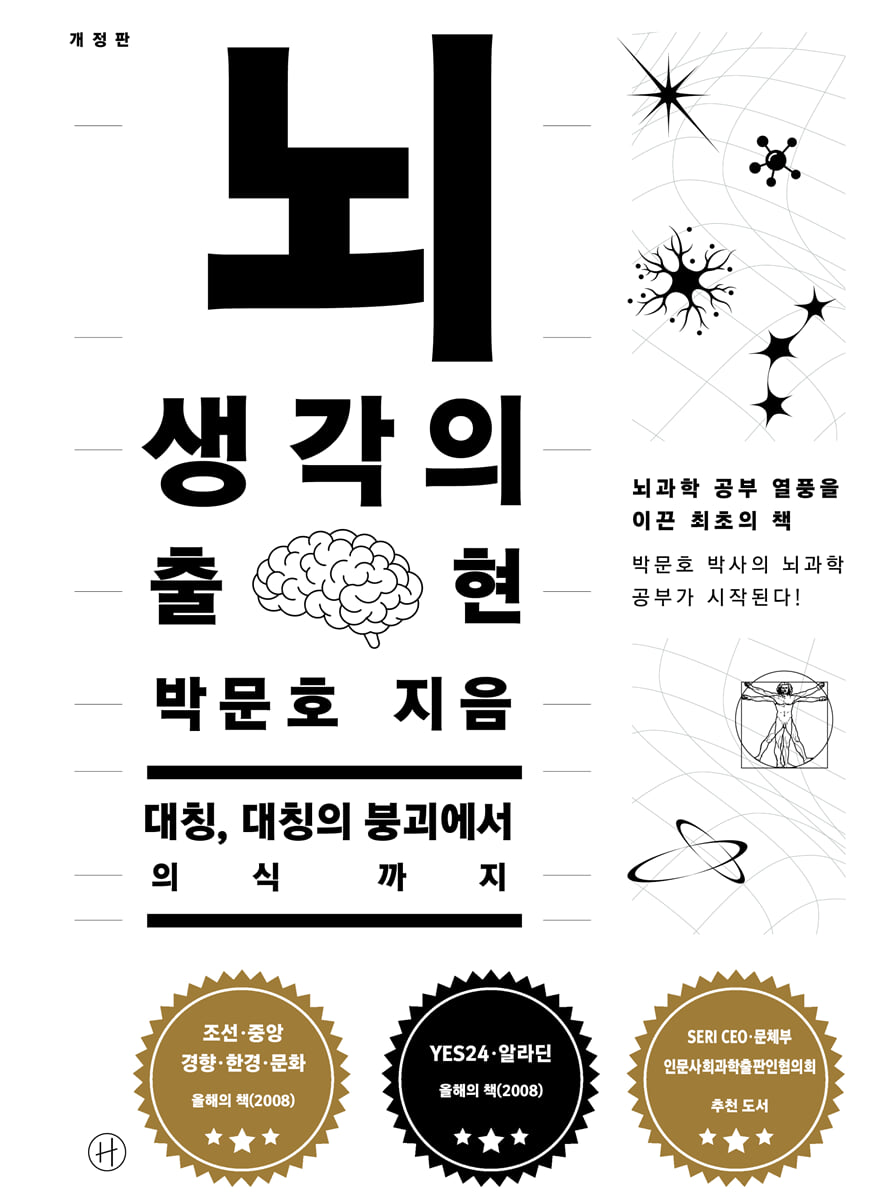
The brain, the emergence of thought
 |
Description
Book Introduction
The revised edition of "The Brain, the Emergence of Thought" has been published!
The first book to spark a craze for studying brain science
Dr. Park Moon-ho's study of brain science begins!
It would not be an exaggeration to say that Dr. Park Moon-ho's "The Brain, the Emergence of Thought" created a craze for studying brain science in Korea after its publication in 2008.
Author Dr. Park Mun-ho has been running the public interest corporation 'Park Mun-ho's World of Natural Science (www.mhpark.co.kr)', which aims to 'make science accessible to the public', for 17 years, and has been conducting natural science studies and exploration activities with over 15,000 members.
Based on his knowledge of natural science and humanities acquired through exploratory reading for over 30 years, he has given lectures in the fields of astronomy, space, life, and brain science at KAIST, Seoul National University, Samsung Economic Research Institute, Classics Academy, and Buddhist TV.
Humanities researchers, who have been exposed to the vast knowledge of natural sciences ranging from the birth of the universe, the birth of life, the invention of death, and the emergence of thought, have been discussing for hours the possibility of a 'new way of thinking' that crosses the humanities and natural sciences.
The study of brain science, which began with the book 『Brain, the Emergence of Thought』, which condensed such thoughts and discussions, continues to deeply captivate readers even 17 years after its publication.
This newly published revised edition features a wider format and sturdier binding to ensure that new readers can keep the book with them for a long time and study comfortably and actively.
Readers will once again be able to enjoy the pleasure of exploring the emergence of life and thought as cosmic phenomena beyond humans and Earth.
The first book to spark a craze for studying brain science
Dr. Park Moon-ho's study of brain science begins!
It would not be an exaggeration to say that Dr. Park Moon-ho's "The Brain, the Emergence of Thought" created a craze for studying brain science in Korea after its publication in 2008.
Author Dr. Park Mun-ho has been running the public interest corporation 'Park Mun-ho's World of Natural Science (www.mhpark.co.kr)', which aims to 'make science accessible to the public', for 17 years, and has been conducting natural science studies and exploration activities with over 15,000 members.
Based on his knowledge of natural science and humanities acquired through exploratory reading for over 30 years, he has given lectures in the fields of astronomy, space, life, and brain science at KAIST, Seoul National University, Samsung Economic Research Institute, Classics Academy, and Buddhist TV.
Humanities researchers, who have been exposed to the vast knowledge of natural sciences ranging from the birth of the universe, the birth of life, the invention of death, and the emergence of thought, have been discussing for hours the possibility of a 'new way of thinking' that crosses the humanities and natural sciences.
The study of brain science, which began with the book 『Brain, the Emergence of Thought』, which condensed such thoughts and discussions, continues to deeply captivate readers even 17 years after its publication.
This newly published revised edition features a wider format and sturdier binding to ensure that new readers can keep the book with them for a long time and study comfortably and actively.
Readers will once again be able to enjoy the pleasure of exploring the emergence of life and thought as cosmic phenomena beyond humans and Earth.
- You can preview some of the book's contents.
Preview
index
In the revised edition
Author's Note for the First Edition
Part 1 | The Universe, Life, and Where Do Thoughts Come From?
Lecture 1: The Symmetry of the Universe is Broken
The Secrets of the Universe Slowly Unravel | Supernova: The Moment of Life's Birth | Supernova Remnants That Reached Earth | When the Universe's Perfect Symmetry Is Broken | Thought Begins from the Breaking of Symmetry
Lecture 2: The Birth of Life
A Cosmic Perspective | The Birth of Cells | Multicellular Organisms Begin Symbiosis | The Emergence of Neurons That Power Multicellular Organisms | Cellular Movements Create Harmony | What Movement Brings
Lecture 3: Life on Earth 3.5 Billion Years Ago
Evolution of Domains | The Essence of Life on Earth: Oxygen | How Prokaryotes Evolved into Eukaryotes | Life: A Variation Beginning with DNA
Neurons that exercise in the quadruple zone
Plants make starch, animals make neural voltage pulses | Nerve cells + synapses + nerve cells = ? | Synapses of habituation, sensitization, and learning | Enjoying movement through axon myelination | Nerve cells, from sensation to movement
The Road to Consciousness 5
From Primary to Higher Consciousness | Sensory Information, Looped | Information Categorized into Comparisons, Predictions, and Judgments | Perceive and Act
Lecture 6: The Great Migration of Neurotransmitters
The Origin of the Neuron Cell Skeleton | Three Protein Chains That Make Up the Neuron Cell Skeleton | Neurotransmitters Travel Along Microtubules | Glial Cells: Facilitating the Smooth Movement of Neurotransmitters
Lesson 7: The Synaptic Membrane: Where Thought Begins
The basic conditions of survival | ATP synthase, creating bioenergy | ATP circulates, the river of DNA flows | ATP, moving mitochondria | Let's abandon our pretentious attitude and return to the cell.
Part 2 | The Human Brain: How Thoughts Are Created
Lesson 8: Brain Development and Brain Structure
A Comprehensive Mapping of the Brain | What Our Brain Looks Like | How the Brain Forms | The Brain That Develops Around the Tract
Lesson 9: The Brain Becomes an Imagination Machine
A virtual machine trapped in the skull | Five regions | The frontal lobe, the motor programmer | The basal ganglia, which select motor output | The thalamus, the transmitter of sensory signals | The evolution of the brain in fish, amphibians, reptiles, birds, and mammals
10 Spinal Cords: From Fine Senses to Sophisticated Movements
Evolution of the Motor System | Structure of the Spinal Cord | Sensation in Detail: The Posterior Fibroblast | Viewing the Spinal Cord Through Development | Ascending or Descending?
Lesson 11: The Brainstem System of Awakening and Sleep
To sense is to exist | To become 'well' exercised | The brainstem reticular formation that determines the state of consciousness | From the brainstem reticular formation to the spinal pyramidal tract
Lesson 12: The Cerebellum: From Movement Planning to Execution
The Cerebellum's Three Roles | Purkinje Cells Are the Heart of the Cerebellar System | Controlling Movement Through Internal Circuits
Part 3 | The Brain, Senses, and Thought: How Humans Move
Lesson 13: Vision and the Brain
The Phenomenon of 'Seeing' | The Retina, Receiving Light | The Light Receptive Field | How Visual Information is Processed | Focusing on the Fovea | From Pinhole Eye to Camera Eye
Lesson 14: Listening, Hearing, and the Brain
The Evolution of Hearing | The Structure of the Inner Ear | The Collaboration of Hair Cells | How We Perceive Sound | Vibrations, Vestibulospinal Reflexes, and the Emergence of Thought
Lesson 15: Feeling, the Emotional Brain 1
Sensitivity to the senses | Processes of feeling and emotion | The trigeminal nerve of touch | Hallucinations, auditory hallucinations, visual hallucinations, and dyscognition | Visual illusions
Predicting the Round of 16: The Emotional Brain 2
Information Receptors for Existence, Information Processors for Life | Pain and Pleasure, Motivation, Drive, and Awareness | Predicting Based on Basic Reflexes | From Fluctuations to Goal-Directed Complex Systems | The Path of Prediction | Overcoming Pain through Prediction
Lesson 17: Moving, the Brain and Exercise
Movement is Consciousness | When Muscles and Nerves Meet | How Muscle Cell Movement Leads to Thought | The ATP Synthesis Machine That Moves Muscles
Lesson 18: Being Conscious, the Brain and Consciousness
Various Approaches to Consciousness | The Basic Conditions of Thought | Stage 1 of Thought: The Evolution of the Talamo-Cortical System | Stage 2 of Thought: The Development of Value-Category Memory | Stage 3 of Thought: The Evolutionary Connection of the Talamo-Cortical System and the Brainstem-Limbic System
Lesson 19: Dreaming, Brain and Dreams
The Dream Ascending Activation System | The Dream Suppression System | Neuromodulators Create Dreams | The Evolution of Dreams | Why Dreams Must Be Dreams
Lecture 20: Realizing Beyond Reality: The Brain and Transcendental Consciousness
There's a hierarchy in the brain system | The hierarchy of the human brain system | When inhibitory circuits are activated, the self disappears | Andrew Newberg's meditative brain
Lesson 21: Thinking Creatively: The Brain and Creativity
What Makes Creative People Different? | Where Does Creativity Come From? | The World of Creativity = The World of Feelings | The Amount of Information Changes the Quality of Creativity
Part 4 | The Creative Brain: Symmetry Breaks and Thought Expands
22. In a world where symmetry is broken
After the Big Bang | Life arose from a break in symmetry | Mitochondria, the creators of life on Earth | ATP synthesis machines, the energy source of life | The invention of death
Lecture 23: Beautiful Microcosmos
How the Particles That Make Up the Universe Connect to the Forces of the Universe | The World of Cosmic Particles | Five Equations for Understanding the Physical World | Symmetry in Particle Physics | The World of Light: E=mc2
Lesson 24: The Evolution of Thought Through Voluntary Symmetry Breaking
Transforming Learning, Memory, and Thinking | Breaking the Symmetry of the Brain and the Symmetry of Thought
References
List of photos and diagrams
Search
Author's Note for the First Edition
Part 1 | The Universe, Life, and Where Do Thoughts Come From?
Lecture 1: The Symmetry of the Universe is Broken
The Secrets of the Universe Slowly Unravel | Supernova: The Moment of Life's Birth | Supernova Remnants That Reached Earth | When the Universe's Perfect Symmetry Is Broken | Thought Begins from the Breaking of Symmetry
Lecture 2: The Birth of Life
A Cosmic Perspective | The Birth of Cells | Multicellular Organisms Begin Symbiosis | The Emergence of Neurons That Power Multicellular Organisms | Cellular Movements Create Harmony | What Movement Brings
Lecture 3: Life on Earth 3.5 Billion Years Ago
Evolution of Domains | The Essence of Life on Earth: Oxygen | How Prokaryotes Evolved into Eukaryotes | Life: A Variation Beginning with DNA
Neurons that exercise in the quadruple zone
Plants make starch, animals make neural voltage pulses | Nerve cells + synapses + nerve cells = ? | Synapses of habituation, sensitization, and learning | Enjoying movement through axon myelination | Nerve cells, from sensation to movement
The Road to Consciousness 5
From Primary to Higher Consciousness | Sensory Information, Looped | Information Categorized into Comparisons, Predictions, and Judgments | Perceive and Act
Lecture 6: The Great Migration of Neurotransmitters
The Origin of the Neuron Cell Skeleton | Three Protein Chains That Make Up the Neuron Cell Skeleton | Neurotransmitters Travel Along Microtubules | Glial Cells: Facilitating the Smooth Movement of Neurotransmitters
Lesson 7: The Synaptic Membrane: Where Thought Begins
The basic conditions of survival | ATP synthase, creating bioenergy | ATP circulates, the river of DNA flows | ATP, moving mitochondria | Let's abandon our pretentious attitude and return to the cell.
Part 2 | The Human Brain: How Thoughts Are Created
Lesson 8: Brain Development and Brain Structure
A Comprehensive Mapping of the Brain | What Our Brain Looks Like | How the Brain Forms | The Brain That Develops Around the Tract
Lesson 9: The Brain Becomes an Imagination Machine
A virtual machine trapped in the skull | Five regions | The frontal lobe, the motor programmer | The basal ganglia, which select motor output | The thalamus, the transmitter of sensory signals | The evolution of the brain in fish, amphibians, reptiles, birds, and mammals
10 Spinal Cords: From Fine Senses to Sophisticated Movements
Evolution of the Motor System | Structure of the Spinal Cord | Sensation in Detail: The Posterior Fibroblast | Viewing the Spinal Cord Through Development | Ascending or Descending?
Lesson 11: The Brainstem System of Awakening and Sleep
To sense is to exist | To become 'well' exercised | The brainstem reticular formation that determines the state of consciousness | From the brainstem reticular formation to the spinal pyramidal tract
Lesson 12: The Cerebellum: From Movement Planning to Execution
The Cerebellum's Three Roles | Purkinje Cells Are the Heart of the Cerebellar System | Controlling Movement Through Internal Circuits
Part 3 | The Brain, Senses, and Thought: How Humans Move
Lesson 13: Vision and the Brain
The Phenomenon of 'Seeing' | The Retina, Receiving Light | The Light Receptive Field | How Visual Information is Processed | Focusing on the Fovea | From Pinhole Eye to Camera Eye
Lesson 14: Listening, Hearing, and the Brain
The Evolution of Hearing | The Structure of the Inner Ear | The Collaboration of Hair Cells | How We Perceive Sound | Vibrations, Vestibulospinal Reflexes, and the Emergence of Thought
Lesson 15: Feeling, the Emotional Brain 1
Sensitivity to the senses | Processes of feeling and emotion | The trigeminal nerve of touch | Hallucinations, auditory hallucinations, visual hallucinations, and dyscognition | Visual illusions
Predicting the Round of 16: The Emotional Brain 2
Information Receptors for Existence, Information Processors for Life | Pain and Pleasure, Motivation, Drive, and Awareness | Predicting Based on Basic Reflexes | From Fluctuations to Goal-Directed Complex Systems | The Path of Prediction | Overcoming Pain through Prediction
Lesson 17: Moving, the Brain and Exercise
Movement is Consciousness | When Muscles and Nerves Meet | How Muscle Cell Movement Leads to Thought | The ATP Synthesis Machine That Moves Muscles
Lesson 18: Being Conscious, the Brain and Consciousness
Various Approaches to Consciousness | The Basic Conditions of Thought | Stage 1 of Thought: The Evolution of the Talamo-Cortical System | Stage 2 of Thought: The Development of Value-Category Memory | Stage 3 of Thought: The Evolutionary Connection of the Talamo-Cortical System and the Brainstem-Limbic System
Lesson 19: Dreaming, Brain and Dreams
The Dream Ascending Activation System | The Dream Suppression System | Neuromodulators Create Dreams | The Evolution of Dreams | Why Dreams Must Be Dreams
Lecture 20: Realizing Beyond Reality: The Brain and Transcendental Consciousness
There's a hierarchy in the brain system | The hierarchy of the human brain system | When inhibitory circuits are activated, the self disappears | Andrew Newberg's meditative brain
Lesson 21: Thinking Creatively: The Brain and Creativity
What Makes Creative People Different? | Where Does Creativity Come From? | The World of Creativity = The World of Feelings | The Amount of Information Changes the Quality of Creativity
Part 4 | The Creative Brain: Symmetry Breaks and Thought Expands
22. In a world where symmetry is broken
After the Big Bang | Life arose from a break in symmetry | Mitochondria, the creators of life on Earth | ATP synthesis machines, the energy source of life | The invention of death
Lecture 23: Beautiful Microcosmos
How the Particles That Make Up the Universe Connect to the Forces of the Universe | The World of Cosmic Particles | Five Equations for Understanding the Physical World | Symmetry in Particle Physics | The World of Light: E=mc2
Lesson 24: The Evolution of Thought Through Voluntary Symmetry Breaking
Transforming Learning, Memory, and Thinking | Breaking the Symmetry of the Brain and the Symmetry of Thought
References
List of photos and diagrams
Search
Detailed image

Into the book
“The four forces of the universe were differentiated from the perfect symmetry of the early universe, and among them, the one related to our life phenomenon is electromagnetic interaction.
The interrelationships between the forces that emerged were sufficiently elucidated by 20th century physics.
These forces gave rise to the solar and terrestrial systems, leading to the emergence of life and consciousness.
In fact, the first phenomenon associated with life here is a supernova explosion.
Star formation begins when the shock wave of a supernova explosion condenses interstellar matter.
And modern astronomy believes that many of the heavy elements formed when supernovae exploded were directly involved in the formation of the Earth and the emergence of life on it.
In short, as astronomer Donald Goldsmith put it in his book Supernova, “Supernova do it all.”
“A supernova created our solar system, created our Earth, and perhaps even led to the evolution of life on Earth, leading to the emergence of consciousness, which is trying to figure out what a supernova is.”
--- p.48 「Lecture 1.
The symmetry of the universe is broken
“In fact, 95% of our brain activity is unconscious.
It is calculated unconsciously.
Only 5% of cognitive processes rise to the level of consciousness.
So, the claim that Einstein only used 10% of his brain is not credible.
There are internet sites that refute this theory by historically tracing and revealing why it became common sense, using a lot of data, and even from a neuroscientific perspective, it is a meaningless story.
A large proportion of unconscious brain activity is computations performed in the cerebellum.
The cerebellum thoroughly calculates and provides information such as positional sense and tactile sense that occurs whenever the nerve fibers of the muscles move, and information that the brain must refer to when exercising.
And it regulates muscle tension.
We can perform quick and precise movements on a curved surface because our entire body can always maintain balance with respect to the surface.
The cerebellum is surprisingly capable of maintaining balance, making continuous movement possible.
What did you call consciousness, thought? "Evolutionarily internalized movements."
Movement has been internalized evolutionarily, and a different dimension of movement has emerged.
In other words, the movement in the imagination is manifested in humans.
“This imaginary movement is our thinking process.”
--- p.243~244 「Lecture 12.
The Cerebellum: From Motor Planning to Execution
“Creativity or ingenuity.
It's a major concern of our time.
There is a growing interest in creativity not only in the educational field but also throughout society.
What exactly is creativity? We need to view it broadly, from the perspective of a biological adaptive response to a changing environment.
(…) Emotions and memories use largely the same circuits.
So emotions and memories reinforce each other, and some emotions help with memory retrieval.
People who are rich in emotions have excellent memories.
And people with excellent memories become good learners.
At the level of feeling, at the level of consciousness, we use memory information located throughout the brain.
Why is it that the state of consciousness that emerges only through feeling is so powerful? Yes, that's right.
This is because the state of consciousness, which accounts for only 5% of the brain's total functions, creates new and unique outputs by connecting past memories in various new ways and using imagination and reasoning to solve problems caused by uncertain inputs.
That kind of brain ability is called creativity.
New and unique output is synonymous with creativity.
What are imagination and reasoning? When we reach a level of consciousness driven by feelings, we can predict the future by connecting the current input with memories stored in various regions of the cerebral cortex.
Ultimately, it becomes possible to view the past, present, and future in an integrated manner at the conscious level.
The past, the present we have entered, and the future of our inference are all happening simultaneously in one state of mind.
So we can deal with uncertain inputs.”
--- p.388~397 「Lecture 21.
Think Creatively, Brain and Creativity
“A unique form that only exists in one or two out of 100 people is the learning-led type.
These are people who actively study even after graduating from school.
Most of us learn through reading.
The learning memory of these people who live towards an open system rises steeply.
Flexibility, judgment, and vision become outstanding.
In a learning-driven person, belief memory is controlled by the power of balanced knowledge, so blindness becomes a positive force that drives in the right direction.
How can we become such flexible, judgmental, and visionary, learning-driven individuals? First, we must raise our level of knowledge.
If your base camp is low, it will be harder to reach the summit.
As your total knowledge increases through persistent learning, that is, as the basis for your judgment increases, your predictions about life become more accurate.
You must invest time and energy in acquiring advanced knowledge of the natural sciences.
To understand the brain, we need to expand our understanding to quantum mechanics and relativity, which explain both material systems and space-time.
Second, you need to ask questions and let them grow.
Questions are not to be asked carelessly.
There is a saying that our ancestors have said since ancient times.
“To attain enlightenment, you must have a large mass of doubt and a strong inner energy.” When you carelessly expose a mass of doubt or simply resolve it, you lose the motivation to study and learn.
Such questions are difficult to even create, and once you acquire them, you must internally increase the intensity of your questions for at least 5 or 10 years to use them as a driving force for learning.
When you begin to see an object through the power of questioning, the question will eventually find its own answer.
(…) Target quantity is important.
Once a threshold is crossed, quantity turns into quality.
If we were to measure that threshold in books, it would be around 3,000 volumes.
Natural sciences vs. humanities, 7 to 3.
If you read about 3,000 books obsessively until you reach your 50s, the information will become linked to each other and changes will occur within the information.
“Quantity turns into quality.”
The interrelationships between the forces that emerged were sufficiently elucidated by 20th century physics.
These forces gave rise to the solar and terrestrial systems, leading to the emergence of life and consciousness.
In fact, the first phenomenon associated with life here is a supernova explosion.
Star formation begins when the shock wave of a supernova explosion condenses interstellar matter.
And modern astronomy believes that many of the heavy elements formed when supernovae exploded were directly involved in the formation of the Earth and the emergence of life on it.
In short, as astronomer Donald Goldsmith put it in his book Supernova, “Supernova do it all.”
“A supernova created our solar system, created our Earth, and perhaps even led to the evolution of life on Earth, leading to the emergence of consciousness, which is trying to figure out what a supernova is.”
--- p.48 「Lecture 1.
The symmetry of the universe is broken
“In fact, 95% of our brain activity is unconscious.
It is calculated unconsciously.
Only 5% of cognitive processes rise to the level of consciousness.
So, the claim that Einstein only used 10% of his brain is not credible.
There are internet sites that refute this theory by historically tracing and revealing why it became common sense, using a lot of data, and even from a neuroscientific perspective, it is a meaningless story.
A large proportion of unconscious brain activity is computations performed in the cerebellum.
The cerebellum thoroughly calculates and provides information such as positional sense and tactile sense that occurs whenever the nerve fibers of the muscles move, and information that the brain must refer to when exercising.
And it regulates muscle tension.
We can perform quick and precise movements on a curved surface because our entire body can always maintain balance with respect to the surface.
The cerebellum is surprisingly capable of maintaining balance, making continuous movement possible.
What did you call consciousness, thought? "Evolutionarily internalized movements."
Movement has been internalized evolutionarily, and a different dimension of movement has emerged.
In other words, the movement in the imagination is manifested in humans.
“This imaginary movement is our thinking process.”
--- p.243~244 「Lecture 12.
The Cerebellum: From Motor Planning to Execution
“Creativity or ingenuity.
It's a major concern of our time.
There is a growing interest in creativity not only in the educational field but also throughout society.
What exactly is creativity? We need to view it broadly, from the perspective of a biological adaptive response to a changing environment.
(…) Emotions and memories use largely the same circuits.
So emotions and memories reinforce each other, and some emotions help with memory retrieval.
People who are rich in emotions have excellent memories.
And people with excellent memories become good learners.
At the level of feeling, at the level of consciousness, we use memory information located throughout the brain.
Why is it that the state of consciousness that emerges only through feeling is so powerful? Yes, that's right.
This is because the state of consciousness, which accounts for only 5% of the brain's total functions, creates new and unique outputs by connecting past memories in various new ways and using imagination and reasoning to solve problems caused by uncertain inputs.
That kind of brain ability is called creativity.
New and unique output is synonymous with creativity.
What are imagination and reasoning? When we reach a level of consciousness driven by feelings, we can predict the future by connecting the current input with memories stored in various regions of the cerebral cortex.
Ultimately, it becomes possible to view the past, present, and future in an integrated manner at the conscious level.
The past, the present we have entered, and the future of our inference are all happening simultaneously in one state of mind.
So we can deal with uncertain inputs.”
--- p.388~397 「Lecture 21.
Think Creatively, Brain and Creativity
“A unique form that only exists in one or two out of 100 people is the learning-led type.
These are people who actively study even after graduating from school.
Most of us learn through reading.
The learning memory of these people who live towards an open system rises steeply.
Flexibility, judgment, and vision become outstanding.
In a learning-driven person, belief memory is controlled by the power of balanced knowledge, so blindness becomes a positive force that drives in the right direction.
How can we become such flexible, judgmental, and visionary, learning-driven individuals? First, we must raise our level of knowledge.
If your base camp is low, it will be harder to reach the summit.
As your total knowledge increases through persistent learning, that is, as the basis for your judgment increases, your predictions about life become more accurate.
You must invest time and energy in acquiring advanced knowledge of the natural sciences.
To understand the brain, we need to expand our understanding to quantum mechanics and relativity, which explain both material systems and space-time.
Second, you need to ask questions and let them grow.
Questions are not to be asked carelessly.
There is a saying that our ancestors have said since ancient times.
“To attain enlightenment, you must have a large mass of doubt and a strong inner energy.” When you carelessly expose a mass of doubt or simply resolve it, you lose the motivation to study and learn.
Such questions are difficult to even create, and once you acquire them, you must internally increase the intensity of your questions for at least 5 or 10 years to use them as a driving force for learning.
When you begin to see an object through the power of questioning, the question will eventually find its own answer.
(…) Target quantity is important.
Once a threshold is crossed, quantity turns into quality.
If we were to measure that threshold in books, it would be around 3,000 volumes.
Natural sciences vs. humanities, 7 to 3.
If you read about 3,000 books obsessively until you reach your 50s, the information will become linked to each other and changes will occur within the information.
“Quantity turns into quality.”
--- p.475~477 「Lecture 24.
"Thought Evolves Through Voluntary Symmetry Breaking"
"Thought Evolves Through Voluntary Symmetry Breaking"
Publisher's Review
"The Brain: The Emergence of Thought": Ushering in an Era of Brain Science Studies
― A vast scientific narrative leading to the birth of the universe, life, and thought.
― Selected as 'Book of the Year' by major national daily newspapers, Yes24, and Aladdin.
― The ultimate guide to brain science, a field that has been perceived as unfamiliar and difficult by the public.
Dr. Park Moon-ho's first book, "The Brain: The Emergence of Thought," is a systematic reorganization of a vast amount of knowledge he gained from five years of lectures from 2004 to 2008, to share with the public.
Dr. Park Moon-ho not only encompassed the thoughts of various neurophilosophers, postmodern philosophy, and scientific thinking in biology, particle physics, quantum mechanics, and relativity, but also consistently organized the meaning and content of that knowledge from a neuroscience perspective.
Above all, by explaining scientific thinking, which can be difficult and rigid, into words, it opened up a new world for those who yearn for a different dimension of thought and imagination.
This is why so many people have responded to this book, which clearly weaves a vast scientific narrative leading to the birth of the universe, life, and thought.
Those who attended the Buddhist TV lectures that formed the basis of this book posted numerous comments about the lectures after the broadcast, and as word of mouth spread, expectations for the book grew.
When the book finally came out, many readers who had been waiting eagerly read it and gave it rave reviews, and as a result, it was selected as the 'Book of the Year' by the Chosun Ilbo, JoongAng Ilbo, Kyunghyang Shinmun, Korea Economic Daily, Munhwa Ilbo, and online bookstores Yes24 and Aladdin.
Its value was also widely recognized as it was selected as a recommended book by SERI CEO, the Ministry of Culture, Sports and Tourism, and the Association of Publishers of Humanities and Social Sciences.
Until then, no other book had presented brain science, which had been perceived as unfamiliar and difficult to the public, in such a concise and comprehensive manner. Therefore, countless readers were able to immerse themselves in the world of brain science by reading this book.
Beyond the physiological structure of the brain, "The Brain, the Emergence of Thought" broadens the horizon of thought from consciousness to the universe, and is still loved today as the best guide to brain science.
Immerse yourself in the study of brain science again with this revised edition, released after 17 years.
― A popular neuroscience book that still holds both depth and freshness even when reread now.
― Reborn with a wider format and stronger binding
― The fun of realizing that understanding the brain is understanding the universe.
《The Brain, the Emergence of Thought》, which explores the macroscopic system that transcends humans and the Earth, leading to the birth of the universe and life, and the emergence of thought, is a popular book on brain science that combines depth and freshness even when read again, as it looks into the history of natural science across 3.8 billion years of space and time.
On a macro level, we will observe through the lens of a space telescope how life emerged in the 3.8 billion years of space we have been exploring, and on a micro level, we will observe in microscopic detail how thoughts and consciousness emerge and function in our brains.
The revised edition of "Brain, the Emergence of Thought," published at the request of readers who began studying brain science with this book, has been expanded to a crown size (170*235mm) larger than the new national size (153*224mm) and has been made more solid through hardcover binding.
As the format has been expanded, you can examine the abundant illustrations in the book more vividly, and the spacious layout allows you to study more comfortably.
Through this, not only readers who are new to this book, but also those who have long been immersed in the world of neuroscience through this book will be able to look at the book with a fresh perspective.
"The Brain, the Emergence of Thought," which examines the development and evolution of the brain and how emotions, memories, thoughts, and creativity emerged during the evolution of the human brain, provides a sense of intellectual elevation as one realizes that understanding the brain is tantamount to understanding the universe.
We hope you will once again experience the joy of entering the world of brain science with this revised edition of "The Brain: The Emergence of Thought," which combines scientific and humanistic knowledge.
― A vast scientific narrative leading to the birth of the universe, life, and thought.
― Selected as 'Book of the Year' by major national daily newspapers, Yes24, and Aladdin.
― The ultimate guide to brain science, a field that has been perceived as unfamiliar and difficult by the public.
Dr. Park Moon-ho's first book, "The Brain: The Emergence of Thought," is a systematic reorganization of a vast amount of knowledge he gained from five years of lectures from 2004 to 2008, to share with the public.
Dr. Park Moon-ho not only encompassed the thoughts of various neurophilosophers, postmodern philosophy, and scientific thinking in biology, particle physics, quantum mechanics, and relativity, but also consistently organized the meaning and content of that knowledge from a neuroscience perspective.
Above all, by explaining scientific thinking, which can be difficult and rigid, into words, it opened up a new world for those who yearn for a different dimension of thought and imagination.
This is why so many people have responded to this book, which clearly weaves a vast scientific narrative leading to the birth of the universe, life, and thought.
Those who attended the Buddhist TV lectures that formed the basis of this book posted numerous comments about the lectures after the broadcast, and as word of mouth spread, expectations for the book grew.
When the book finally came out, many readers who had been waiting eagerly read it and gave it rave reviews, and as a result, it was selected as the 'Book of the Year' by the Chosun Ilbo, JoongAng Ilbo, Kyunghyang Shinmun, Korea Economic Daily, Munhwa Ilbo, and online bookstores Yes24 and Aladdin.
Its value was also widely recognized as it was selected as a recommended book by SERI CEO, the Ministry of Culture, Sports and Tourism, and the Association of Publishers of Humanities and Social Sciences.
Until then, no other book had presented brain science, which had been perceived as unfamiliar and difficult to the public, in such a concise and comprehensive manner. Therefore, countless readers were able to immerse themselves in the world of brain science by reading this book.
Beyond the physiological structure of the brain, "The Brain, the Emergence of Thought" broadens the horizon of thought from consciousness to the universe, and is still loved today as the best guide to brain science.
Immerse yourself in the study of brain science again with this revised edition, released after 17 years.
― A popular neuroscience book that still holds both depth and freshness even when reread now.
― Reborn with a wider format and stronger binding
― The fun of realizing that understanding the brain is understanding the universe.
《The Brain, the Emergence of Thought》, which explores the macroscopic system that transcends humans and the Earth, leading to the birth of the universe and life, and the emergence of thought, is a popular book on brain science that combines depth and freshness even when read again, as it looks into the history of natural science across 3.8 billion years of space and time.
On a macro level, we will observe through the lens of a space telescope how life emerged in the 3.8 billion years of space we have been exploring, and on a micro level, we will observe in microscopic detail how thoughts and consciousness emerge and function in our brains.
The revised edition of "Brain, the Emergence of Thought," published at the request of readers who began studying brain science with this book, has been expanded to a crown size (170*235mm) larger than the new national size (153*224mm) and has been made more solid through hardcover binding.
As the format has been expanded, you can examine the abundant illustrations in the book more vividly, and the spacious layout allows you to study more comfortably.
Through this, not only readers who are new to this book, but also those who have long been immersed in the world of neuroscience through this book will be able to look at the book with a fresh perspective.
"The Brain, the Emergence of Thought," which examines the development and evolution of the brain and how emotions, memories, thoughts, and creativity emerged during the evolution of the human brain, provides a sense of intellectual elevation as one realizes that understanding the brain is tantamount to understanding the universe.
We hope you will once again experience the joy of entering the world of brain science with this revised edition of "The Brain: The Emergence of Thought," which combines scientific and humanistic knowledge.
GOODS SPECIFICS
- Date of issue: September 15, 2025
- Format: Hardcover book binding method guide
- Page count, weight, size: 504 pages | 170*235*35mm
- ISBN13: 9791170873235
- ISBN10: 1170873235
You may also like
카테고리
korean


korean

![GQ KOREA Mark (Monthly): December [2025]](http://librairie.coreenne.fr/cdn/shop/files/8ef265dbbfbf186523ed75ba7319009d.jpg?v=1765340328&width=3840)


