

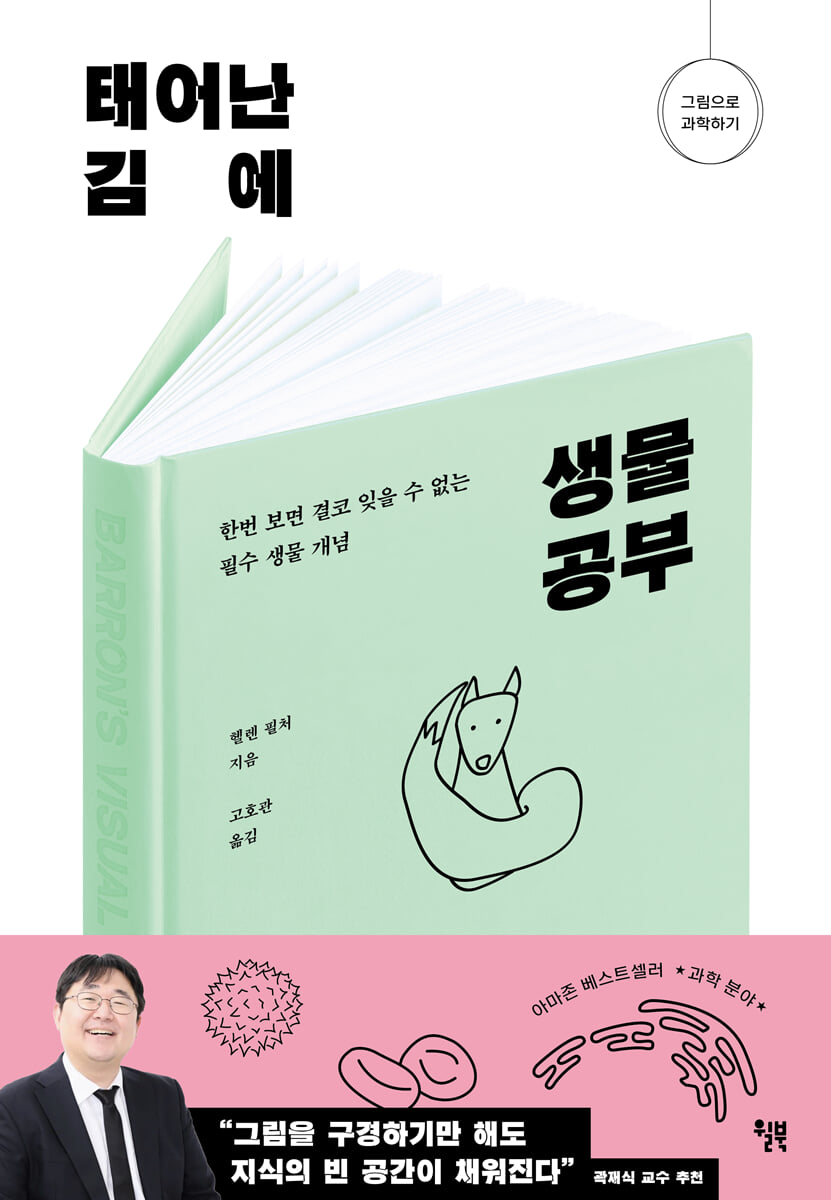
Since I'm born, I'll study biology
 |
Description
Book Introduction
A never-before-seen science book for visual learners
A visual dictionary that provides a simple and clear picture of scientific concepts at a glance.
In this age of technology and science, the "Biology" series, a basic science curriculum that will take charge of your scientific literacy, is here.
Professor Kwak Jae-sik recommends, “Just looking at the paintings fills the gaps in your knowledge.”
Science is the basic knowledge of our generation.
Every day, new technologies based on science are introduced, and everyone, knowingly or unknowingly, adapts to these technologies and lives with them.
This is why scientific literacy is more important than ever.
Even the hottest news and emerging investment information can be difficult to properly understand without a scientific background.
But science has the impression of being difficult and complicated.
Many people who try to understand science well give up because of unfamiliar and difficult terms, concepts, and formulas that are difficult to understand even after reading them.
That's because the way we've approached science so far has been wrong.
It is more effective to study science through pictures than through text.
"Study Biology While You're at It" is the second book in the "Science with Pictures" series, and is a book that uses pictures to teach the basic concepts of the scientific field of biology.
It focused on infographics rather than text.
Thousands of words are compressed into a single picture, and the author, a bestselling author with a PhD in cell biology and a fellow of the Royal Society, has carefully selected and organized essential biological concepts, from cell composition to DNA and CRISPR.
This book is more user-friendly, informative, and accurate than any other book, so that even adults who want to understand biology again or students who want to major in biotechnology can easily study on their own.
Let's travel through the world of living things by following the pictures and arrows.
As Professor Kwak Jae-sik said, you will have the 'thrilling experience' of realizing concepts you didn't know exactly what they meant while casually looking at the paintings.
A visual dictionary that provides a simple and clear picture of scientific concepts at a glance.
In this age of technology and science, the "Biology" series, a basic science curriculum that will take charge of your scientific literacy, is here.
Professor Kwak Jae-sik recommends, “Just looking at the paintings fills the gaps in your knowledge.”
Science is the basic knowledge of our generation.
Every day, new technologies based on science are introduced, and everyone, knowingly or unknowingly, adapts to these technologies and lives with them.
This is why scientific literacy is more important than ever.
Even the hottest news and emerging investment information can be difficult to properly understand without a scientific background.
But science has the impression of being difficult and complicated.
Many people who try to understand science well give up because of unfamiliar and difficult terms, concepts, and formulas that are difficult to understand even after reading them.
That's because the way we've approached science so far has been wrong.
It is more effective to study science through pictures than through text.
"Study Biology While You're at It" is the second book in the "Science with Pictures" series, and is a book that uses pictures to teach the basic concepts of the scientific field of biology.
It focused on infographics rather than text.
Thousands of words are compressed into a single picture, and the author, a bestselling author with a PhD in cell biology and a fellow of the Royal Society, has carefully selected and organized essential biological concepts, from cell composition to DNA and CRISPR.
This book is more user-friendly, informative, and accurate than any other book, so that even adults who want to understand biology again or students who want to major in biotechnology can easily study on their own.
Let's travel through the world of living things by following the pictures and arrows.
As Professor Kwak Jae-sik said, you will have the 'thrilling experience' of realizing concepts you didn't know exactly what they meant while casually looking at the paintings.
- You can preview some of the book's contents.
Preview
index
introduction
1 Fundamentals of Biology
What is life?
Chemistry of Life
Molecules in living things
biological research
[Watch Again]
2 cells
Fundamentals of Cells
microscope
Cell structure
Eukaryotic cells vs. prokaryotic cells
cell division
Cell transport
Stem cells and differentiation
Cell organization
[Watch Again]
3 Genetics
DNA
oil field
reproduction
Gender determination
mutation
gene editing
Genetics and environment
[Watch Again]
4 Evolution
Charles Darwin and the voyage of the Beagle
Evolution by natural selection
extinction
Evidence of evolution
human evolution
[Watch Again]
5 Classification of living things
The importance of classification
classification
prokaryotes
eukaryotes
Classification of animals
virus
[Watch Again]
6 Metabolism
Chemical reactions and pathways
enzyme
metabolic rate
Metabolic regulation
breathing
photosynthesis
[Watch Again]
7 Structure and Function of Plants
transpiration
vascular system
Plant growth
Leaf structure
plant hormones
Plant deficiencies, diseases, and defenses
[Watch Again]
8 Human Structure and Function
human organ systems
homeostasis
nervous system
brain
sense organs
endocrine system
digestive system
circulatory and respiratory systems
skeletal and muscular systems
[Watch Again]
9 Human Health and Disease
health inequalities
Epidemic
non-communicable diseases
Medicine and Disease
Lifestyle and Health
[Watch Again]
10 Ecology
ecosystem
interdependence
The impact of the environment on living things
adaptation
competition
Keystone species
Global cycle of elements
[Watch Again]
11 Biology of the 21st Century
Anthropocene
Earth's danger limit
greenhouse effect
climate change
Biodiversity loss and extinction
[Watch Again]
1 Fundamentals of Biology
What is life?
Chemistry of Life
Molecules in living things
biological research
[Watch Again]
2 cells
Fundamentals of Cells
microscope
Cell structure
Eukaryotic cells vs. prokaryotic cells
cell division
Cell transport
Stem cells and differentiation
Cell organization
[Watch Again]
3 Genetics
DNA
oil field
reproduction
Gender determination
mutation
gene editing
Genetics and environment
[Watch Again]
4 Evolution
Charles Darwin and the voyage of the Beagle
Evolution by natural selection
extinction
Evidence of evolution
human evolution
[Watch Again]
5 Classification of living things
The importance of classification
classification
prokaryotes
eukaryotes
Classification of animals
virus
[Watch Again]
6 Metabolism
Chemical reactions and pathways
enzyme
metabolic rate
Metabolic regulation
breathing
photosynthesis
[Watch Again]
7 Structure and Function of Plants
transpiration
vascular system
Plant growth
Leaf structure
plant hormones
Plant deficiencies, diseases, and defenses
[Watch Again]
8 Human Structure and Function
human organ systems
homeostasis
nervous system
brain
sense organs
endocrine system
digestive system
circulatory and respiratory systems
skeletal and muscular systems
[Watch Again]
9 Human Health and Disease
health inequalities
Epidemic
non-communicable diseases
Medicine and Disease
Lifestyle and Health
[Watch Again]
10 Ecology
ecosystem
interdependence
The impact of the environment on living things
adaptation
competition
Keystone species
Global cycle of elements
[Watch Again]
11 Biology of the 21st Century
Anthropocene
Earth's danger limit
greenhouse effect
climate change
Biodiversity loss and extinction
[Watch Again]
Detailed image

Into the book
The Earth is teeming with life.
This book covers everything about biology, the study of life.
From the driest deserts to the richest rainforests, from the depths of the ocean to the top of the atmosphere, life forms are truly diverse, and studying them can help us understand both the Earth and ourselves.
---From the "first sentence"
Anyone interested in biology and the world around us can read 『Study Biology While You're at It』.
Even complex content and scientific terms are explained in detail and clearly.
This book was written from the perspective that anyone can understand any content as long as they approach it in the right way.
Some people learn much better through pictures.
These people remember information better when presented visually.
If you like to learn in a visual way, you'll benefit even more from this book.
Because any facts and concepts are expressed as concisely as possible in pictures and diagrams.
A significant amount of text has been turned into a single picture.
The illustrations are colorful, the explanations are informative and concise.
--- p.8
DNA is also a polymer.
A polymer is a molecule made up of many similar basic units linked together. DNA is made up of repeating basic units called nucleotides.
It is arranged in a special way, so it can have a unique structure that is unique to DNA.
--- p.39
The cells that make up living things are always busy performing thousands of important chemical reactions.
Metabolism refers to all chemical reactions that occur within an organism.
The proteins that control the reaction are called enzymes.
Many metabolic processes, such as those involved in energy production, are characteristics shared by multiple populations.
On the other hand, there are metabolisms that only a few species can perform.
For example, photosynthesis is a function that only green plants, algae, and certain bacteria have.
--- p.93
Living things do not live alone.
We live by interacting with other living beings and the physical environment.
Ecology is the study of these ecosystems.
It teaches us how all life is interconnected and how changes in one part of the ecosystem can have far-reaching repercussions.
Living things exist within complex food webs.
There is active competition there, but living things adapt to the environment and survive and reproduce with their own unique characteristics.
Meanwhile, important chemicals like nitrogen and carbon cycle globally and enable life to exist.
Let's take a peek into these complex relationships and recycling processes.
This book covers everything about biology, the study of life.
From the driest deserts to the richest rainforests, from the depths of the ocean to the top of the atmosphere, life forms are truly diverse, and studying them can help us understand both the Earth and ourselves.
---From the "first sentence"
Anyone interested in biology and the world around us can read 『Study Biology While You're at It』.
Even complex content and scientific terms are explained in detail and clearly.
This book was written from the perspective that anyone can understand any content as long as they approach it in the right way.
Some people learn much better through pictures.
These people remember information better when presented visually.
If you like to learn in a visual way, you'll benefit even more from this book.
Because any facts and concepts are expressed as concisely as possible in pictures and diagrams.
A significant amount of text has been turned into a single picture.
The illustrations are colorful, the explanations are informative and concise.
--- p.8
DNA is also a polymer.
A polymer is a molecule made up of many similar basic units linked together. DNA is made up of repeating basic units called nucleotides.
It is arranged in a special way, so it can have a unique structure that is unique to DNA.
--- p.39
The cells that make up living things are always busy performing thousands of important chemical reactions.
Metabolism refers to all chemical reactions that occur within an organism.
The proteins that control the reaction are called enzymes.
Many metabolic processes, such as those involved in energy production, are characteristics shared by multiple populations.
On the other hand, there are metabolisms that only a few species can perform.
For example, photosynthesis is a function that only green plants, algae, and certain bacteria have.
--- p.93
Living things do not live alone.
We live by interacting with other living beings and the physical environment.
Ecology is the study of these ecosystems.
It teaches us how all life is interconnected and how changes in one part of the ecosystem can have far-reaching repercussions.
Living things exist within complex food webs.
There is active competition there, but living things adapt to the environment and survive and reproduce with their own unique characteristics.
Meanwhile, important chemicals like nitrogen and carbon cycle globally and enable life to exist.
Let's take a peek into these complex relationships and recycling processes.
--- p.156
Publisher's Review
Because the world is full of science,
If we're going to do this, let's become people who know science.
Every day, new technologies based on science are introduced, and everyone, knowingly or unknowingly, adapts to these technologies and lives with them.
This is why scientific literacy is more important than ever.
Even the hottest news and emerging investment information are difficult to properly understand without a scientific background.
Just having a basic scientific knowledge will completely change your perspective on the world.
Knowing science allows you to accurately identify and anticipate what you need in life, reduce unnecessary mistakes, and live more proactively and efficiently.
But haven't you ever tried to study science only to give up because of unfamiliar terminology, concepts, and formulas that were difficult to understand? It's because you've missed out on fundamental concepts, leaving gaps in your knowledge.
Only by having a solid understanding of the fundamental principles of science can you understand and apply new discoveries or new materials introduced in Nature or Science to your own life.
"Biology Study While You're at It" contains all the basic information and tools you need to explore the world of biology.
All it takes is a little curiosity: “Since I’m born, why not learn about living things?”
Because science must be studied through pictures!
Mind maps, flowcharts, and high-quality infographics
A brand new science book for visual learners
Do you ever organize your learning by taking notes or drawing pictures in your head? More than half of the population are visual learners, learning more effectively from visual aids like diagrams, pictures, and videos than from text or audio.
It is said that many people who excel in science and engineering fields are visual learners.
'Science with Pictures' is a series developed by Barron's, a renowned American educational book company, to enable 'visual learners' of all ages to study science on their own.
It features refreshing illustrations and clear explanations from expert professors.
Just by focusing on pictures instead of text, learning efficiency is noticeably improved.
Because dozens of lines of text are compressed into a single image, understanding the concept becomes faster, and because the screen is stored in the mind like taking a screenshot, it is not easily forgotten.
This series is known to be particularly suitable for adults who have trouble concentrating, or for teenagers who have a good understanding but find it difficult to study seriously.
First of all, it contains only the most important scientific information among numerous scientific data, and it is designed to naturally draw attention to the core with refreshing infographics.
The examples are familiar from everyday life, and the explanations are short, friendly, and clear.
『Study Biology While You're at It』 is a book from the 'Science Through Pictures' series about life sciences that deals with the Earth and ourselves.
Starting with the question, "What is life?", the author, a Fellow of the Royal Society of the UK who has contributed to Nature and The Guardian, and is also famous as a TEDx speaker, has carefully selected and organized essential biological concepts, from the basic units of life such as DNA and cells to the principles of cutting-edge biotechnology such as CRISPR.
From elementary school students to adults,
So that everyone can enjoy science
"Study Biology While You're at It" is a book for anyone who is curious about biology and wants to learn about it systematically.
From elementary school students who are just learning about the field of biology, to middle and high school students who want to study life sciences systematically, to students preparing for college entrance exams who dream of entering science and engineering universities, to people who didn't like life sciences in school but have become interested in them again as adults, biology is explained using simple, intuitive expressions and examples from everyday life so that anyone can easily understand.
Key concepts for each topic, including cells, DNA, genetics, hormones, human organ systems, and ecology, were selected and organized into 1-4 pages.
No matter which page you open, the exciting world of biology unfolds before you.
At the end of each chapter, the content covered in that chapter is summarized in the form of a mind map.
It guides you through the relationship between individual concepts and terms and helps you draw the big picture of 'biology'.
It's a good book to read from the beginning, but it's also a good book to keep on a corner of your desk and look up related topics when watching science documentaries or YouTube videos, or whenever news about new technologies comes out.
Just looking at the paintings without the burden of studying provides a sense of intellectual stimulation.
Let's travel the world of science through pictures with "Study Biology While You're at It."
If we're going to do this, let's become people who know science.
Every day, new technologies based on science are introduced, and everyone, knowingly or unknowingly, adapts to these technologies and lives with them.
This is why scientific literacy is more important than ever.
Even the hottest news and emerging investment information are difficult to properly understand without a scientific background.
Just having a basic scientific knowledge will completely change your perspective on the world.
Knowing science allows you to accurately identify and anticipate what you need in life, reduce unnecessary mistakes, and live more proactively and efficiently.
But haven't you ever tried to study science only to give up because of unfamiliar terminology, concepts, and formulas that were difficult to understand? It's because you've missed out on fundamental concepts, leaving gaps in your knowledge.
Only by having a solid understanding of the fundamental principles of science can you understand and apply new discoveries or new materials introduced in Nature or Science to your own life.
"Biology Study While You're at It" contains all the basic information and tools you need to explore the world of biology.
All it takes is a little curiosity: “Since I’m born, why not learn about living things?”
Because science must be studied through pictures!
Mind maps, flowcharts, and high-quality infographics
A brand new science book for visual learners
Do you ever organize your learning by taking notes or drawing pictures in your head? More than half of the population are visual learners, learning more effectively from visual aids like diagrams, pictures, and videos than from text or audio.
It is said that many people who excel in science and engineering fields are visual learners.
'Science with Pictures' is a series developed by Barron's, a renowned American educational book company, to enable 'visual learners' of all ages to study science on their own.
It features refreshing illustrations and clear explanations from expert professors.
Just by focusing on pictures instead of text, learning efficiency is noticeably improved.
Because dozens of lines of text are compressed into a single image, understanding the concept becomes faster, and because the screen is stored in the mind like taking a screenshot, it is not easily forgotten.
This series is known to be particularly suitable for adults who have trouble concentrating, or for teenagers who have a good understanding but find it difficult to study seriously.
First of all, it contains only the most important scientific information among numerous scientific data, and it is designed to naturally draw attention to the core with refreshing infographics.
The examples are familiar from everyday life, and the explanations are short, friendly, and clear.
『Study Biology While You're at It』 is a book from the 'Science Through Pictures' series about life sciences that deals with the Earth and ourselves.
Starting with the question, "What is life?", the author, a Fellow of the Royal Society of the UK who has contributed to Nature and The Guardian, and is also famous as a TEDx speaker, has carefully selected and organized essential biological concepts, from the basic units of life such as DNA and cells to the principles of cutting-edge biotechnology such as CRISPR.
From elementary school students to adults,
So that everyone can enjoy science
"Study Biology While You're at It" is a book for anyone who is curious about biology and wants to learn about it systematically.
From elementary school students who are just learning about the field of biology, to middle and high school students who want to study life sciences systematically, to students preparing for college entrance exams who dream of entering science and engineering universities, to people who didn't like life sciences in school but have become interested in them again as adults, biology is explained using simple, intuitive expressions and examples from everyday life so that anyone can easily understand.
Key concepts for each topic, including cells, DNA, genetics, hormones, human organ systems, and ecology, were selected and organized into 1-4 pages.
No matter which page you open, the exciting world of biology unfolds before you.
At the end of each chapter, the content covered in that chapter is summarized in the form of a mind map.
It guides you through the relationship between individual concepts and terms and helps you draw the big picture of 'biology'.
It's a good book to read from the beginning, but it's also a good book to keep on a corner of your desk and look up related topics when watching science documentaries or YouTube videos, or whenever news about new technologies comes out.
Just looking at the paintings without the burden of studying provides a sense of intellectual stimulation.
Let's travel the world of science through pictures with "Study Biology While You're at It."
GOODS SPECIFICS
- Date of issue: June 14, 2024
- Page count, weight, size: 192 pages | 578g | 178*257*17mm
- ISBN13: 9791155817230
- ISBN10: 1155817230
You may also like
카테고리
korean


korean

![ELLE 엘르 스페셜 에디션 A형 : 12월 [2025]](http://librairie.coreenne.fr/cdn/shop/files/b8e27a3de6c9538896439686c6b0e8fb.jpg?v=1766436872&width=3840)


