

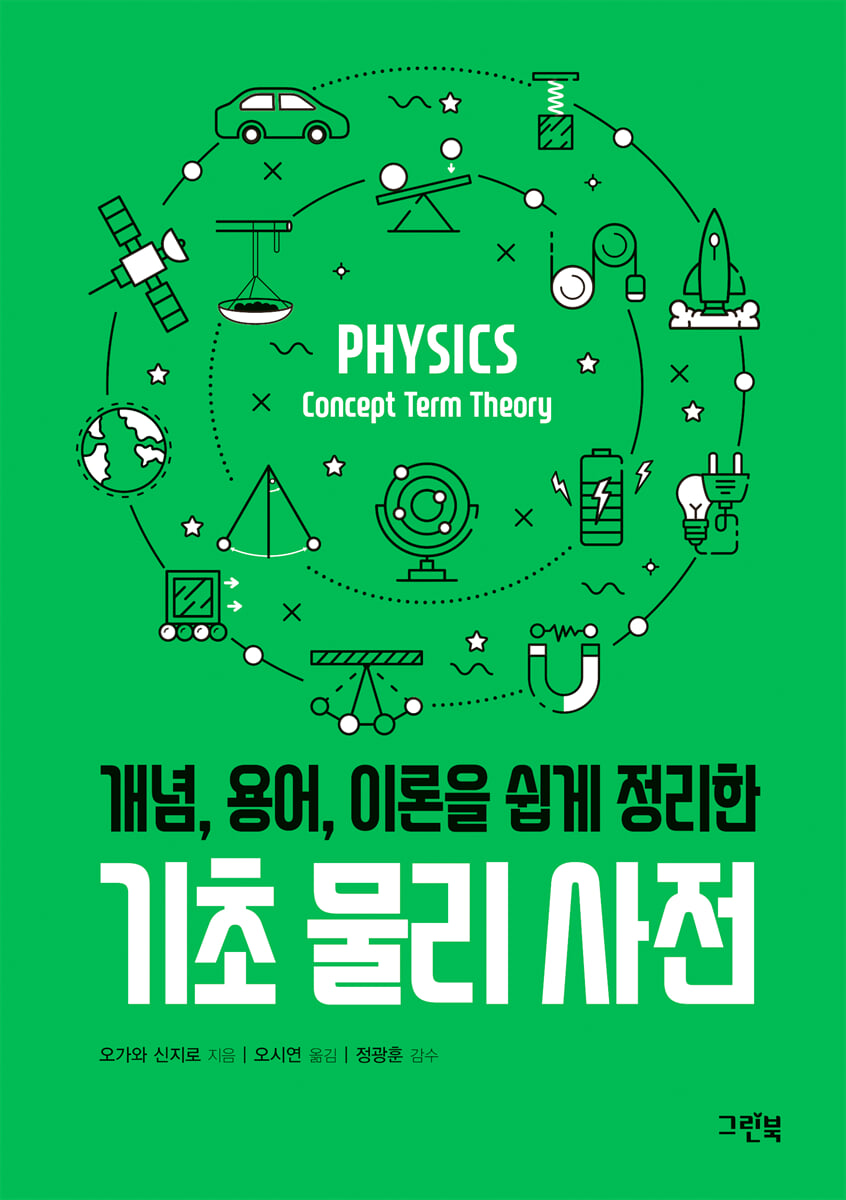
Basic Physics Dictionary
 |
Description
Book Introduction
From gravity to radioactivity, the fundamentals of physics are covered in one volume.
A steady seller in the youth and science fields, the Green Book Science Dictionary series is a new release.
A comprehensive science book has been published, containing essential knowledge of physics, the foundation of today's natural sciences.
The seventh book in the Green Book 'Science Dictionary' series is 'A Dictionary of Basic Physics: An Easy-to-Understand Guide to Concepts, Terms, and Theories.'
This book systematically conveys useful scientific knowledge, retaining the strengths of the science dictionary series that has established itself as a bestseller for youth and science, receiving rave reviews from numerous readers.
The purpose of writing this book, 'learning physics and learning certain laws from real-world phenomena,' goes beyond simple scientific study and becomes a source of new ideas and a way to view the world from a new perspective.
In addition to the concepts found in physics textbooks, it is full of interesting laws and theories that will completely satisfy your scientific curiosity and wonder.
The structure in which the contents are introduced one after another further increases interest.
The book begins by asking a different question.
From outlandish questions like how many balloons are needed to fly in the sky and how to throw a baseball so that it circles the Earth, to trivial thoughts that you might have wondered about at least once, such as why cream puffs rise and how to catch a pencil rolling on a desk, the book provides rich answers to these questions through physics phenomena.
It is an enjoyable read for everyone, from middle and high school students who want to learn the basics of physics to adult readers who want to rediscover the joy of physics.
It is also good for teachers to connect it to class content.
Let's start studying physics with fun with the "Basic Physics Dictionary," a physics textbook that can be used as a reference book or as a general science book.
A steady seller in the youth and science fields, the Green Book Science Dictionary series is a new release.
A comprehensive science book has been published, containing essential knowledge of physics, the foundation of today's natural sciences.
The seventh book in the Green Book 'Science Dictionary' series is 'A Dictionary of Basic Physics: An Easy-to-Understand Guide to Concepts, Terms, and Theories.'
This book systematically conveys useful scientific knowledge, retaining the strengths of the science dictionary series that has established itself as a bestseller for youth and science, receiving rave reviews from numerous readers.
The purpose of writing this book, 'learning physics and learning certain laws from real-world phenomena,' goes beyond simple scientific study and becomes a source of new ideas and a way to view the world from a new perspective.
In addition to the concepts found in physics textbooks, it is full of interesting laws and theories that will completely satisfy your scientific curiosity and wonder.
The structure in which the contents are introduced one after another further increases interest.
The book begins by asking a different question.
From outlandish questions like how many balloons are needed to fly in the sky and how to throw a baseball so that it circles the Earth, to trivial thoughts that you might have wondered about at least once, such as why cream puffs rise and how to catch a pencil rolling on a desk, the book provides rich answers to these questions through physics phenomena.
It is an enjoyable read for everyone, from middle and high school students who want to learn the basics of physics to adult readers who want to rediscover the joy of physics.
It is also good for teachers to connect it to class content.
Let's start studying physics with fun with the "Basic Physics Dictionary," a physics textbook that can be used as a reference book or as a general science book.
- You can preview some of the book's contents.
Preview
index
Author's Note
Chapter 1: Various Forces and Motions
1-1 Who has it harder among those carrying the palanquin?
- Gravity and center of gravity, vector equilibrium and moment equilibrium
1-2 Can a child help his mother?
- The net force of two forces with different directions, the composition, decomposition, and components of force
1-3 Can you move the bookshelves without knocking them over?
- Balance of forces acting on a rigid body, normal force, friction force
1-4 How much must a rubber band be stretched before it breaks?
- Elasticity and Hooke's law, action-reaction law
1-5 Can you fly in the sky with a balloon?
- Buoyancy and Archimedes' principle, pressure of gases or liquids
1-6 What forces are at work?
Chapter 2 Motion of Objects
2-1 Can the turtle beat the rabbit?
- Position change and velocity, velocity change and acceleration, uniform straight line motion
2-2 What is the speed of a transport ship in space?
- Relative velocity, uniform linear motion, uniformly accelerated motion, inertial coordinate system
2-3 What is the speed of the boat?
- Vector composition and decomposition, velocity and speed
2-4 Why do fat particles move?
- Brownian motion, law of acceleration, law of inertia
2-5 How can I catch a rolling pencil?
- Newton's third law of motion, equations of motion
2-6 Why did the bag start moving?
- Inertial force, inertia, inertial coordinate system and acceleration coordinate system
Can you win the 2-7 ball throwing contest?
- Falling motion, parabolic motion, free fall, acceleration due to gravity
2-8 Do heavier objects fall faster?
- Application of equations of motion, air resistance, terminal velocity
2-9 Which box is more likely to get crushed?
- Application of the equations of motion, the law of action and reaction
Chapter 3 Heat and Energy
3-1 Will the fastball fly better?
- Momentum, impulse
3-2 Can you guess the speed before the collision?
- Law of conservation of momentum, location of center of gravity
3-3 If the body is strong, will the movement after a collision be different?
- Work and energy, kinetic energy, inelastic and elastic collisions, energy loss, coefficient of restitution
3-4 How fast does a roller coaster accelerate?
- Potential energy, conservation of mechanical energy, work and work rate
3-5 What happens when you dive from 39km above the ground?
- Universal gravitation, law of conservation of mechanical energy, second cosmic velocity
3-6 How do I keep my coffee from getting cold?
- Heat and temperature, thermal energy, specific heat and heat capacity, thermal conduction and insulation, convection and radiation
3-7 Why does cream puff rise?
- Ideal gas state equation, absolute temperature, amount of substance, standard state
Will the temperature of the tire change if I inflate it with 3-8 air?
- First law of thermodynamics, gas constant, Boltzmann constant, adiabatic compression, internal energy
3-9 How does an air conditioner cool a room?
- Heat pump, isothermal change, adiabatic change, adiabatic compression, thermal efficiency of heat engines
· Window on Physics_The Secret of a Warm Home
Chapter 4 Recurring Phenomena
4-1 Can you throw a fastball that circles the Earth?
- Velocity, angular velocity, centripetal acceleration, centripetal force, period of uniform circular motion, first cosmic velocity
4-2 Does a satellite have gravity?
- Inertial force, centrifugal force
4-3 How does the height of the Ferris wheel change?
- Displacement, velocity, acceleration, phase, and angular frequency of simple vibration
4-4 Which exercises are simple repetitive exercises?
- Period and restoring force of the pendulum
How to distinguish between 4-5 sounds?
- Audible sounds, beats, superposition and interference of waves
· Window on Physics_Galileo's Finger
Chapter 5: Characteristics of Waves
5-1 Can you hear it before it shows up?
- Wave propagation speed, longitudinal and transverse waves, wave front and wavelength, wave source and medium, natural light and polarization
5-2 Can you hear the original sound exactly the same?
- Doppler effect, wave speed, frequency, wavelength
5-3 Where is the cat hiding?
- Diffraction, scattering, and reflection of waves, the law of reflection and virtual images, and Huygens' principle
5-4 How can I catch fish well?
- Law of refraction, critical angle and refractive index of total reflection, dispersion of light
5-5 What is the difference between presbyopia and hyperopia?
- Convex lens, concave lens, focal length, real image, virtual image
5-6 How deep are the ear holes?
- Standing wave, traveling wave, natural frequency, resonance, free-end reflection, fixed-end reflection
5-7 What is the evidence that light is a wave?
- Diffraction and interference of light, Young's interference experiment, diffraction grating, Bragg condition
5-8 Is there a limit to how weak the light can be?
- Light quantum theory, photoelectric effect, Compton effect, wave-particle duality, Planck constant, wave nature of electrons, matter waves
· Window on Physics_Scientific techniques shown in pictures
Chapter 6 Electricity and Magnetism
6-1 Will lightning fall or rise?
- Electrostatic induction, elementary charge, electrostatic force and electric field/potential, Gauss's law, Coulomb's law
6-2 What is stored in the battery?
- Electric circuits, Kirchhoff's laws, voltage drop, Joule heating, power consumption, electrical resistance, Ohm's law, free electron model
6-3 How does the touchscreen work?
- Capacitor, electrostatic induction, electrostatic shielding, dielectric, dielectric polarization
6-4 How can you know your direction without a compass?
- Magnetic field, geomagnetism, magnetic flux density, Lorentz force, Hall effect, motor, magnetic field that creates current, magnetic permeability
6-5 Where is the power supply for the IC card?
- Electromagnetic induction, self-induction, mutual induction, Lenz's law, Faraday's law, induced electromotive force, eddy current
6-6 How do I calculate my electricity bill?
- AC generation and frequency, transformers, properties of AC circuits, electromagnetic wave generation, semiconductors, diodes
· Window of Physics_Blue Grotto of Capri
Chapter 7 Structure of the Nucleus
7-1 Who was the first person to see an atom?
- Atomic structure, isotopes, energy levels, emission spectra, absorption spectra, and specific X-rays
7-2 How much energy can be extracted from a nucleus?
- Mass-energy equivalence principle, mass defect, nuclear fission, nuclear fusion, binding energy, electron volt
7-3 Can we protect ourselves from radiation?
- Radioisotopes, radioactivity, radiation, half-life, radioactive decay, ionization
· Window on Physics_Proper Use of Nuclear Energy
Search
Chapter 1: Various Forces and Motions
1-1 Who has it harder among those carrying the palanquin?
- Gravity and center of gravity, vector equilibrium and moment equilibrium
1-2 Can a child help his mother?
- The net force of two forces with different directions, the composition, decomposition, and components of force
1-3 Can you move the bookshelves without knocking them over?
- Balance of forces acting on a rigid body, normal force, friction force
1-4 How much must a rubber band be stretched before it breaks?
- Elasticity and Hooke's law, action-reaction law
1-5 Can you fly in the sky with a balloon?
- Buoyancy and Archimedes' principle, pressure of gases or liquids
1-6 What forces are at work?
Chapter 2 Motion of Objects
2-1 Can the turtle beat the rabbit?
- Position change and velocity, velocity change and acceleration, uniform straight line motion
2-2 What is the speed of a transport ship in space?
- Relative velocity, uniform linear motion, uniformly accelerated motion, inertial coordinate system
2-3 What is the speed of the boat?
- Vector composition and decomposition, velocity and speed
2-4 Why do fat particles move?
- Brownian motion, law of acceleration, law of inertia
2-5 How can I catch a rolling pencil?
- Newton's third law of motion, equations of motion
2-6 Why did the bag start moving?
- Inertial force, inertia, inertial coordinate system and acceleration coordinate system
Can you win the 2-7 ball throwing contest?
- Falling motion, parabolic motion, free fall, acceleration due to gravity
2-8 Do heavier objects fall faster?
- Application of equations of motion, air resistance, terminal velocity
2-9 Which box is more likely to get crushed?
- Application of the equations of motion, the law of action and reaction
Chapter 3 Heat and Energy
3-1 Will the fastball fly better?
- Momentum, impulse
3-2 Can you guess the speed before the collision?
- Law of conservation of momentum, location of center of gravity
3-3 If the body is strong, will the movement after a collision be different?
- Work and energy, kinetic energy, inelastic and elastic collisions, energy loss, coefficient of restitution
3-4 How fast does a roller coaster accelerate?
- Potential energy, conservation of mechanical energy, work and work rate
3-5 What happens when you dive from 39km above the ground?
- Universal gravitation, law of conservation of mechanical energy, second cosmic velocity
3-6 How do I keep my coffee from getting cold?
- Heat and temperature, thermal energy, specific heat and heat capacity, thermal conduction and insulation, convection and radiation
3-7 Why does cream puff rise?
- Ideal gas state equation, absolute temperature, amount of substance, standard state
Will the temperature of the tire change if I inflate it with 3-8 air?
- First law of thermodynamics, gas constant, Boltzmann constant, adiabatic compression, internal energy
3-9 How does an air conditioner cool a room?
- Heat pump, isothermal change, adiabatic change, adiabatic compression, thermal efficiency of heat engines
· Window on Physics_The Secret of a Warm Home
Chapter 4 Recurring Phenomena
4-1 Can you throw a fastball that circles the Earth?
- Velocity, angular velocity, centripetal acceleration, centripetal force, period of uniform circular motion, first cosmic velocity
4-2 Does a satellite have gravity?
- Inertial force, centrifugal force
4-3 How does the height of the Ferris wheel change?
- Displacement, velocity, acceleration, phase, and angular frequency of simple vibration
4-4 Which exercises are simple repetitive exercises?
- Period and restoring force of the pendulum
How to distinguish between 4-5 sounds?
- Audible sounds, beats, superposition and interference of waves
· Window on Physics_Galileo's Finger
Chapter 5: Characteristics of Waves
5-1 Can you hear it before it shows up?
- Wave propagation speed, longitudinal and transverse waves, wave front and wavelength, wave source and medium, natural light and polarization
5-2 Can you hear the original sound exactly the same?
- Doppler effect, wave speed, frequency, wavelength
5-3 Where is the cat hiding?
- Diffraction, scattering, and reflection of waves, the law of reflection and virtual images, and Huygens' principle
5-4 How can I catch fish well?
- Law of refraction, critical angle and refractive index of total reflection, dispersion of light
5-5 What is the difference between presbyopia and hyperopia?
- Convex lens, concave lens, focal length, real image, virtual image
5-6 How deep are the ear holes?
- Standing wave, traveling wave, natural frequency, resonance, free-end reflection, fixed-end reflection
5-7 What is the evidence that light is a wave?
- Diffraction and interference of light, Young's interference experiment, diffraction grating, Bragg condition
5-8 Is there a limit to how weak the light can be?
- Light quantum theory, photoelectric effect, Compton effect, wave-particle duality, Planck constant, wave nature of electrons, matter waves
· Window on Physics_Scientific techniques shown in pictures
Chapter 6 Electricity and Magnetism
6-1 Will lightning fall or rise?
- Electrostatic induction, elementary charge, electrostatic force and electric field/potential, Gauss's law, Coulomb's law
6-2 What is stored in the battery?
- Electric circuits, Kirchhoff's laws, voltage drop, Joule heating, power consumption, electrical resistance, Ohm's law, free electron model
6-3 How does the touchscreen work?
- Capacitor, electrostatic induction, electrostatic shielding, dielectric, dielectric polarization
6-4 How can you know your direction without a compass?
- Magnetic field, geomagnetism, magnetic flux density, Lorentz force, Hall effect, motor, magnetic field that creates current, magnetic permeability
6-5 Where is the power supply for the IC card?
- Electromagnetic induction, self-induction, mutual induction, Lenz's law, Faraday's law, induced electromotive force, eddy current
6-6 How do I calculate my electricity bill?
- AC generation and frequency, transformers, properties of AC circuits, electromagnetic wave generation, semiconductors, diodes
· Window of Physics_Blue Grotto of Capri
Chapter 7 Structure of the Nucleus
7-1 Who was the first person to see an atom?
- Atomic structure, isotopes, energy levels, emission spectra, absorption spectra, and specific X-rays
7-2 How much energy can be extracted from a nucleus?
- Mass-energy equivalence principle, mass defect, nuclear fission, nuclear fusion, binding energy, electron volt
7-3 Can we protect ourselves from radiation?
- Radioisotopes, radioactivity, radiation, half-life, radioactive decay, ionization
· Window on Physics_Proper Use of Nuclear Energy
Search
Detailed image

Publisher's Review
A steady seller in the youth and science fields, the Green Book Science Dictionary series is a new release.
A comprehensive science book has been published, containing essential knowledge of physics, the foundation of today's natural sciences.
This is the seventh book in the Green Book 'Science Dictionary' series, 'A Dictionary of Basic Physics: Concepts, Terms, and Theories Organized Easily'.
This book systematically conveys useful scientific knowledge, retaining the strengths of the science dictionary series that has established itself as a bestseller for youth and science, receiving rave reviews from numerous readers.
The purpose of writing this book, 'learning physics and learning certain laws from real-world phenomena,' goes beyond simple scientific study and becomes a source of new ideas and a way to view the world from a new perspective.
In addition to the concepts found in physics textbooks, it is full of interesting laws and theories that will completely satisfy your scientific curiosity and wonder.
The structure in which the contents are introduced one after another further increases interest.
The book begins by asking a different question.
From outlandish questions like how many balloons are needed to fly in the sky and how to throw a baseball so that it circles the Earth, to trivial thoughts that you might have wondered about at least once, such as why cream puffs rise and how to catch a pencil rolling on a desk, the book provides rich answers to these questions through physics phenomena.
It is an enjoyable read for everyone, from middle and high school students who want to learn the basics of physics to adult readers who want to rediscover the joy of physics.
It is also good for teachers to connect it to class content.
Let's start studying physics with fun with "Dictionary of Basic Physics," a physics textbook that can be used as a reference book or as a general science book.
From the forces and motion of objects to nuclear fusion and radioactivity, all the basics of physics in one book!
Chapter 1, 'Various Forces and Motion', examines various forces acting on objects, including gravity, normal force, friction, and buoyancy.
You can learn basic concepts that you need to know before studying physics, such as vectors and moments, composition, decomposition, and components of force, and net force.
You can also learn familiar terms like the law of action and reaction and Archimedes' principle through fun examples like stretching a rubber band and flying a balloon.
In Chapter 2, 'Motion of Objects', we will learn about motions that explain the movement of objects, such as uniform rectilinear motion, uniformly accelerated motion, and parabolic motion.
For example, in a race between a tortoise and a hare, the speeds of the two animals can be plotted as speed-time graphs to calculate the distance traveled, and the speed and acceleration can be found through the slopes of the speed-time graph and position-time graph, which ultimately allows the tortoise to know the distance it takes to catch up with the hare.
This leads us to a description of uniform rectilinear motion.
Chapter 3, "Heat and Energy," delves deeper into the motion of objects, broadening the scope to include collisions between two cars, the acceleration of a roller coaster, and a dive from 39 kilometers above the ground.
This book also examines various movements based on energy, which is called the 'currency of the scientific world', and examines it through the movement of heat such as heat conduction, convection, and radiation.
It can also solve everyday questions, such as how to make coffee cool less quickly and how air conditioners work.
Chapter 4, 'Repeated Phenomena', examines the repeated motion of objects, such as uniform circular motion and simple vibration.
If you know uniform circular motion, which refers to motion that rotates at a constant speed, you can calculate the speed at which a satellite orbits the Earth without falling and the change in speed according to the height of a Ferris wheel.
The noise-cancelling function of earphones can also be understood through the superposition and interference of waves.
In Chapter 5, 'Characteristics of Waves', we will learn about the basic structure of waves, types of waves such as longitudinal and transverse waves, and the principles of sound and light.
It introduces concepts discovered by numerous scientists, such as the Doppler effect, Huygens' principle, the Compton effect, Young's interference experiment, and Einstein's quantum theory of light, and raises various questions, such as why the sound of an ambulance siren sounds different depending on the location, how to find where a cat is hiding in a room by its meowing, and how to properly catch a fish in water.
Chapter 6, "Electricity and Magnetism," delves into various concepts related to electricity and magnetism, including electrostatic force, electric fields, electric circuits, electrostatic induction, and the Lorentz force. This will provide an opportunity to learn basic electrical knowledge, including how IC cards work, how electricity is delivered to each household, and how to calculate electricity bills.
Finally, in Chapter 7, 'Structure of the Nucleus,' we examine the 'mass-energy equivalence principle,' which states that energy is released in proportion to the mass lost through nuclear fission or nuclear fusion, and examine the principles of the terrifying hydrogen bomb and nuclear weapons, as well as the dangers of radiation.
Understanding phenomena through physics reveals the future.
Why did SpaceX's recent large-scale spacecraft launch fail? Many things in the world are more interesting when you understand their physics.
Physics is the most fundamental science that surrounds us, encompassing many fields, from hidden phenomena such as force, motion, and energy to things we experience in our daily lives, such as light, sound, and electricity.
As Elon Musk emphasized, "Let's learn physics and change the world," physics provides the foundation for innovation in all future fields.
For readers who want to study physics in depth, this book explains the principles through equations of motion, equations of state, and gas constants, and summarizes them again in the 'Relationships Using Literal Expressions' section at the end.
Additionally, you can learn it as if you were reviewing it by gradually expanding the main concepts through several tables of contents.
The 'Window of Physics' section at the end of the book introduces the previously covered topics in an interesting way through anecdotes from the author's own experiences.
The author, who has taught physics to a wide range of audiences, from middle and high school students to college students, has put a lot of effort into helping readers maintain their interest in physics and learn consistently.
For example, Boyle-Charles' law, which appears when explaining why cream puffs rise, becomes the basis for understanding the first law of thermodynamics, which appears immediately thereafter.
In this way, this book allows students to broaden their thinking beyond the textbook, and adults to delve deeper into the physics they learned in school.
With the increasing importance of physics due to advanced scientific advancements, the "Dictionary of Basic Physics," which "organizes concepts, terms, and theories in an easy-to-understand manner," will help you properly understand and apply physics.
A comprehensive science book has been published, containing essential knowledge of physics, the foundation of today's natural sciences.
This is the seventh book in the Green Book 'Science Dictionary' series, 'A Dictionary of Basic Physics: Concepts, Terms, and Theories Organized Easily'.
This book systematically conveys useful scientific knowledge, retaining the strengths of the science dictionary series that has established itself as a bestseller for youth and science, receiving rave reviews from numerous readers.
The purpose of writing this book, 'learning physics and learning certain laws from real-world phenomena,' goes beyond simple scientific study and becomes a source of new ideas and a way to view the world from a new perspective.
In addition to the concepts found in physics textbooks, it is full of interesting laws and theories that will completely satisfy your scientific curiosity and wonder.
The structure in which the contents are introduced one after another further increases interest.
The book begins by asking a different question.
From outlandish questions like how many balloons are needed to fly in the sky and how to throw a baseball so that it circles the Earth, to trivial thoughts that you might have wondered about at least once, such as why cream puffs rise and how to catch a pencil rolling on a desk, the book provides rich answers to these questions through physics phenomena.
It is an enjoyable read for everyone, from middle and high school students who want to learn the basics of physics to adult readers who want to rediscover the joy of physics.
It is also good for teachers to connect it to class content.
Let's start studying physics with fun with "Dictionary of Basic Physics," a physics textbook that can be used as a reference book or as a general science book.
From the forces and motion of objects to nuclear fusion and radioactivity, all the basics of physics in one book!
Chapter 1, 'Various Forces and Motion', examines various forces acting on objects, including gravity, normal force, friction, and buoyancy.
You can learn basic concepts that you need to know before studying physics, such as vectors and moments, composition, decomposition, and components of force, and net force.
You can also learn familiar terms like the law of action and reaction and Archimedes' principle through fun examples like stretching a rubber band and flying a balloon.
In Chapter 2, 'Motion of Objects', we will learn about motions that explain the movement of objects, such as uniform rectilinear motion, uniformly accelerated motion, and parabolic motion.
For example, in a race between a tortoise and a hare, the speeds of the two animals can be plotted as speed-time graphs to calculate the distance traveled, and the speed and acceleration can be found through the slopes of the speed-time graph and position-time graph, which ultimately allows the tortoise to know the distance it takes to catch up with the hare.
This leads us to a description of uniform rectilinear motion.
Chapter 3, "Heat and Energy," delves deeper into the motion of objects, broadening the scope to include collisions between two cars, the acceleration of a roller coaster, and a dive from 39 kilometers above the ground.
This book also examines various movements based on energy, which is called the 'currency of the scientific world', and examines it through the movement of heat such as heat conduction, convection, and radiation.
It can also solve everyday questions, such as how to make coffee cool less quickly and how air conditioners work.
Chapter 4, 'Repeated Phenomena', examines the repeated motion of objects, such as uniform circular motion and simple vibration.
If you know uniform circular motion, which refers to motion that rotates at a constant speed, you can calculate the speed at which a satellite orbits the Earth without falling and the change in speed according to the height of a Ferris wheel.
The noise-cancelling function of earphones can also be understood through the superposition and interference of waves.
In Chapter 5, 'Characteristics of Waves', we will learn about the basic structure of waves, types of waves such as longitudinal and transverse waves, and the principles of sound and light.
It introduces concepts discovered by numerous scientists, such as the Doppler effect, Huygens' principle, the Compton effect, Young's interference experiment, and Einstein's quantum theory of light, and raises various questions, such as why the sound of an ambulance siren sounds different depending on the location, how to find where a cat is hiding in a room by its meowing, and how to properly catch a fish in water.
Chapter 6, "Electricity and Magnetism," delves into various concepts related to electricity and magnetism, including electrostatic force, electric fields, electric circuits, electrostatic induction, and the Lorentz force. This will provide an opportunity to learn basic electrical knowledge, including how IC cards work, how electricity is delivered to each household, and how to calculate electricity bills.
Finally, in Chapter 7, 'Structure of the Nucleus,' we examine the 'mass-energy equivalence principle,' which states that energy is released in proportion to the mass lost through nuclear fission or nuclear fusion, and examine the principles of the terrifying hydrogen bomb and nuclear weapons, as well as the dangers of radiation.
Understanding phenomena through physics reveals the future.
Why did SpaceX's recent large-scale spacecraft launch fail? Many things in the world are more interesting when you understand their physics.
Physics is the most fundamental science that surrounds us, encompassing many fields, from hidden phenomena such as force, motion, and energy to things we experience in our daily lives, such as light, sound, and electricity.
As Elon Musk emphasized, "Let's learn physics and change the world," physics provides the foundation for innovation in all future fields.
For readers who want to study physics in depth, this book explains the principles through equations of motion, equations of state, and gas constants, and summarizes them again in the 'Relationships Using Literal Expressions' section at the end.
Additionally, you can learn it as if you were reviewing it by gradually expanding the main concepts through several tables of contents.
The 'Window of Physics' section at the end of the book introduces the previously covered topics in an interesting way through anecdotes from the author's own experiences.
The author, who has taught physics to a wide range of audiences, from middle and high school students to college students, has put a lot of effort into helping readers maintain their interest in physics and learn consistently.
For example, Boyle-Charles' law, which appears when explaining why cream puffs rise, becomes the basis for understanding the first law of thermodynamics, which appears immediately thereafter.
In this way, this book allows students to broaden their thinking beyond the textbook, and adults to delve deeper into the physics they learned in school.
With the increasing importance of physics due to advanced scientific advancements, the "Dictionary of Basic Physics," which "organizes concepts, terms, and theories in an easy-to-understand manner," will help you properly understand and apply physics.
GOODS SPECIFICS
- Date of issue: May 22, 2023
- Page count, weight, size: 376 pages | 628g | 148*210*30mm
- ISBN13: 9788955884371
You may also like
카테고리
korean


korean

![GQ KOREA Mark (Monthly): December [2025]](http://librairie.coreenne.fr/cdn/shop/files/8ef265dbbfbf186523ed75ba7319009d.jpg?v=1765340328&width=3840)


