

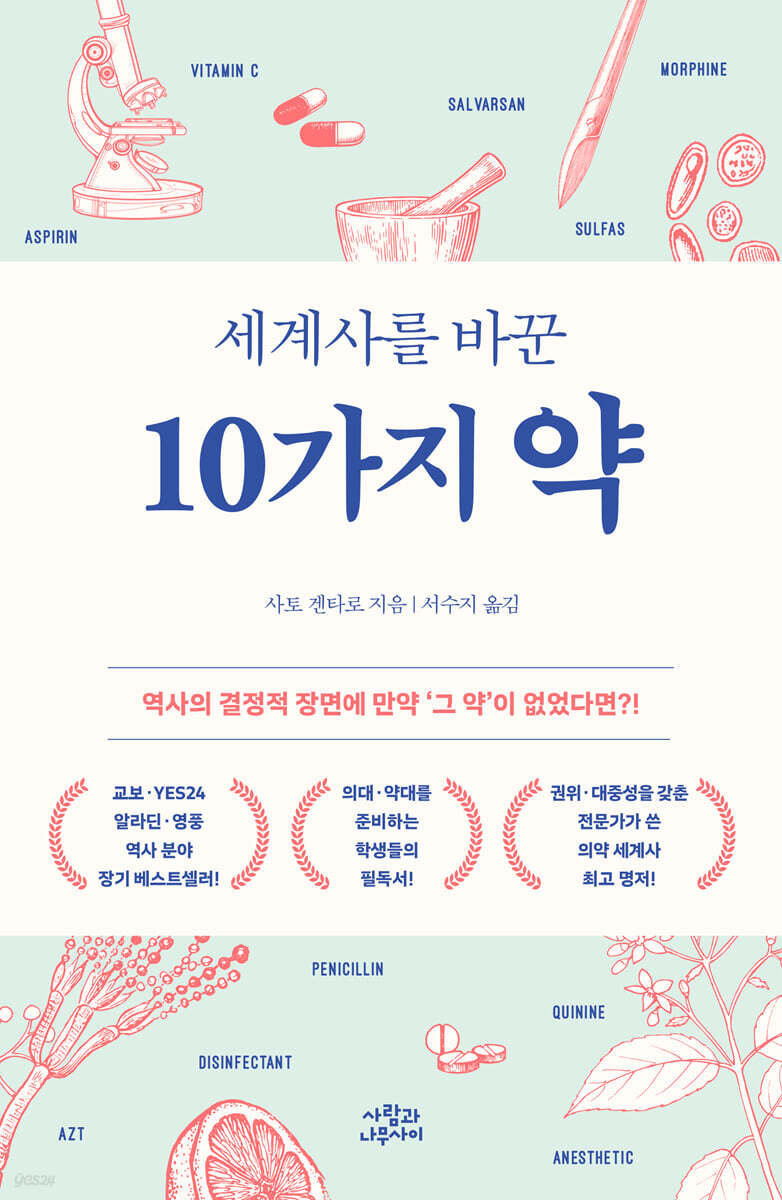
10 Drugs That Changed World History
 |
Description
Book Introduction
Human history is a history of struggles between disease and medicine!
What if 'that medicine' wasn't there at that crucial moment in history...?!
There is a saying, “There are no ifs in history.”
Is that really the case? I think it's beneficial to look at history from various perspectives, and even go a step further and let your imagination run wild by asking, "What if it had happened this way back then?"
This is because the 'what if' that comes from human imagination is like a source of energy that not only does not destroy history, but rather makes it richer and more exciting.
Let's be curious and substitute 'what if' into a decisive scene in human history.
What if the great navigators and explorers Vasco da Gama and Magellan had known about vitamin C?
They might have traveled the world and discovered more new worlds without losing most of their sailors to scurvy.
If that had been the case, their home countries, Portugal and Spain, would likely have gained enormous wealth from the spice trade and conquered the world.
Moreover, if that had been the case, Britain would not have even appeared on the stage of history with the splendid name of the 'British Empire', and the world map we see today would look completely different.
What if the Jesuit powder quinine had not been delivered to the Kangxi Emperor's personal physician when he was on the verge of death from malaria?
Emperor Kangxi, considered one of the greatest monarchs in Chinese history, would not have been born.
If that had been the case, the Qing Dynasty would not have reached its peak, with the reigns of Emperor Yongzheng and Emperor Qianlong being the most brilliant rulers, and the landscape of Asia and even the entire world would have changed.
What if Ehrlich's team had given up on their syphilis treatment after failing their 605th compound?
Syphilis, one of the most feared diseases that not only took countless lives but also once put humanity in mortal danger, may still be afflicting people today.
Also, aren't modern people still suffering terribly, just like the medieval people who suffered double and triple the pain from the absurd treatment called 'mercury therapy'?
"10 Drugs That Changed World History" interprets human history as a history of struggle between the spear of "disease" and the shield of "medicine."
This book is packed with fascinating and informative stories about ten diseases that have posed a critical threat to many nations and societies, and ten drugs that have saved humanity from these terrifying threats at critical junctures.
What if 'that medicine' wasn't there at that crucial moment in history...?!
There is a saying, “There are no ifs in history.”
Is that really the case? I think it's beneficial to look at history from various perspectives, and even go a step further and let your imagination run wild by asking, "What if it had happened this way back then?"
This is because the 'what if' that comes from human imagination is like a source of energy that not only does not destroy history, but rather makes it richer and more exciting.
Let's be curious and substitute 'what if' into a decisive scene in human history.
What if the great navigators and explorers Vasco da Gama and Magellan had known about vitamin C?
They might have traveled the world and discovered more new worlds without losing most of their sailors to scurvy.
If that had been the case, their home countries, Portugal and Spain, would likely have gained enormous wealth from the spice trade and conquered the world.
Moreover, if that had been the case, Britain would not have even appeared on the stage of history with the splendid name of the 'British Empire', and the world map we see today would look completely different.
What if the Jesuit powder quinine had not been delivered to the Kangxi Emperor's personal physician when he was on the verge of death from malaria?
Emperor Kangxi, considered one of the greatest monarchs in Chinese history, would not have been born.
If that had been the case, the Qing Dynasty would not have reached its peak, with the reigns of Emperor Yongzheng and Emperor Qianlong being the most brilliant rulers, and the landscape of Asia and even the entire world would have changed.
What if Ehrlich's team had given up on their syphilis treatment after failing their 605th compound?
Syphilis, one of the most feared diseases that not only took countless lives but also once put humanity in mortal danger, may still be afflicting people today.
Also, aren't modern people still suffering terribly, just like the medieval people who suffered double and triple the pain from the absurd treatment called 'mercury therapy'?
"10 Drugs That Changed World History" interprets human history as a history of struggle between the spear of "disease" and the shield of "medicine."
This book is packed with fascinating and informative stories about ten diseases that have posed a critical threat to many nations and societies, and ten drugs that have saved humanity from these terrifying threats at critical junctures.
- You can preview some of the book's contents.
Preview
index
Author's Preface_ If That Medicine Had Not Been There Back Then
01 When and how were medicines created?
Monkeys and insects also use drugs?
The era of disastrous 'junk medicine'
Is the elixir of immortality, 'Geumdan', the main culprit behind the fall of the Tang Dynasty?
The immortal composer Schubert is said to have died from mercury poisoning used to treat syphilis.
Why statistical advances have had a decisive impact on assessing drug efficacy
02 Vitamin C, the great drug that shaped the course of world history
What did seamen fear more than storms or pirates during the Age of Exploration?
Why scurvy prevention methods remained undiscovered for hundreds of years
James Lind, the hero who forever ended the tragedy of scurvy
If vitamin C had been discovered earlier, the British Empire might never have existed?
The story of the discovery of vitamin C, considered a "Christian Holy Grail" by early 20th-century scientists.
Why the great chemist Linus Pauling became obsessed with vitamin C research in his later years.
03 Quinine, a specific drug for malaria, a disease that killed half of humanity
Quinine, the drug that saved the life of Emperor Kangxi, China's greatest general.
Malaria overthrew absolute rulers Tutankhamun and Alexander the Great.
Malaria, the greatest contributor to saving the Western Roman Empire from the threat of the Huns
Why Quinine Was Called "Jesuit Powder"
The story of the genius boy chemist William Perkin and his artificial synthesis of quinine.
Malaria: The Game Changer in the Pacific War
Malaria: A New Threat to Humanity in the 21st Century
04 Morphine, a drug with two faces: an angel and a devil
Traces of poppy cultivation have been discovered in a Neolithic site in Switzerland.
Why Opium Addicts Surge During the American Civil War
Morphine, a 40-atom mass with the power to destroy the complex systems of the human body.
If only the Chinese had known the toxicity and harmful effects of opium, along with its medicinal properties.
The British government used opium to offset its astronomical trade deficit with the Qing Dynasty.
The Birth of the 'Devil' Called Heroin
Morphine, a drug with two faces: an angel and a devil
05 Anesthetics, the drugs that put an end to the fight against pain
Pain: A Critical Obstacle to Medical Progress
Seishu Hanaoka's Tsusensan prescription, which made general anesthesia surgery possible
Who deserves the title of 'the first developer of anesthesia technology in history'?
Chloroform, the anesthetic that helped Queen Victoria achieve painless childbirth
The Greatest Mystery Surrounding Anesthesia in History: Michael Jackson's Death
The Mystery of Anesthesia Still Unsolved
06 The protagonist who transformed the hospital into a sanitary space, disinfectant
Puerperal fever: A small cause that secretly changed human history
The Semmelweis Handwashing Method Reduces Maternal Mortality Rates
Why the 19th-Century Medical Community Rejected the Semmelweis Hypothesis
British surgeon Joseph Lister becomes synonymous with antisepsis.
07 Salvarsan, the savior who defeated the cursed sexually transmitted disease, syphilis
At one point in the 16th century, one in three Parisians had syphilis?
Syphilis, a disease that even the world-famous hero Tokugawa Ieyasu trembled in fear
Treating syphilis by infecting a syphilis patient with malaria?
A 'great' discovery born from an 'absurd' mistake
The Birth of Salvarsan, the Savior of Syphilis Patients
08 Sulfa drugs, an effective weapon against bacterial infections
Two gunshots that started World War I, which resulted in 10 million casualties
An infectious disease is more terrifying than a million troops in war.
A breeding ground for all kinds of pathogens, poor trenches
The Birth of Sulfad: The Most Effective Weapon Against Bacterial Infections
Sulfamethoxazole, the miracle drug that saved 500,000 lives in the United States alone in 1941
Was the fall of the Nazi regime due to sulfa drugs?
Are sulfa drugs the pacemaker of penicillin?
09 Penicillin, an ordinary yet great drug that changed world history
The birth of penicillin, one of the greatest inventions of the 20th century.
A Surprising Discovery Born from Alexander Fleming's Runny Nose
What if blue mold spores hadn't flown into Fleming's laboratory one day in September 1928?
Penicillin, a gift from God to mankind through Fleming
Why Penicillin is Difficult to Commercialize
Penicillin Rewrites World History
Who was the first person in the world whose life was saved by penicillin?
Fleming saved Churchill's life twice?
Cartoon character Dr. Jin and penicillin
The emergence of "resistant bacteria"—bacteria that survive antibiotic treatment.
10 The world's most loved drug, aspirin
Aspirin, the best-selling drug in history
Aspirin was born from a willow tree?
"The only thing that soothes unbearable pain is aspirin."
Bayer vs.
Bayer
The mystery of aspirin revealed after 70 years
Aspirin also helps prevent Alzheimer's?
11 Anti-HIV drugs and AIDS treatments that saved humanity from the devil's anchor
Why the AIDS Treatment Developer Never Won a Nobel Prize
A strange disease that plunged the world into a crucible of fear
The AIDS patient from the Philippines who turned the Japanese archipelago upside down
The endless battle over pathogenic viruses
AIDS is a trap set by the devil to trap humanity?
The story of the Japanese doctor who first developed an AIDS treatment.
A fight that's not over yet
Author's Note
01 When and how were medicines created?
Monkeys and insects also use drugs?
The era of disastrous 'junk medicine'
Is the elixir of immortality, 'Geumdan', the main culprit behind the fall of the Tang Dynasty?
The immortal composer Schubert is said to have died from mercury poisoning used to treat syphilis.
Why statistical advances have had a decisive impact on assessing drug efficacy
02 Vitamin C, the great drug that shaped the course of world history
What did seamen fear more than storms or pirates during the Age of Exploration?
Why scurvy prevention methods remained undiscovered for hundreds of years
James Lind, the hero who forever ended the tragedy of scurvy
If vitamin C had been discovered earlier, the British Empire might never have existed?
The story of the discovery of vitamin C, considered a "Christian Holy Grail" by early 20th-century scientists.
Why the great chemist Linus Pauling became obsessed with vitamin C research in his later years.
03 Quinine, a specific drug for malaria, a disease that killed half of humanity
Quinine, the drug that saved the life of Emperor Kangxi, China's greatest general.
Malaria overthrew absolute rulers Tutankhamun and Alexander the Great.
Malaria, the greatest contributor to saving the Western Roman Empire from the threat of the Huns
Why Quinine Was Called "Jesuit Powder"
The story of the genius boy chemist William Perkin and his artificial synthesis of quinine.
Malaria: The Game Changer in the Pacific War
Malaria: A New Threat to Humanity in the 21st Century
04 Morphine, a drug with two faces: an angel and a devil
Traces of poppy cultivation have been discovered in a Neolithic site in Switzerland.
Why Opium Addicts Surge During the American Civil War
Morphine, a 40-atom mass with the power to destroy the complex systems of the human body.
If only the Chinese had known the toxicity and harmful effects of opium, along with its medicinal properties.
The British government used opium to offset its astronomical trade deficit with the Qing Dynasty.
The Birth of the 'Devil' Called Heroin
Morphine, a drug with two faces: an angel and a devil
05 Anesthetics, the drugs that put an end to the fight against pain
Pain: A Critical Obstacle to Medical Progress
Seishu Hanaoka's Tsusensan prescription, which made general anesthesia surgery possible
Who deserves the title of 'the first developer of anesthesia technology in history'?
Chloroform, the anesthetic that helped Queen Victoria achieve painless childbirth
The Greatest Mystery Surrounding Anesthesia in History: Michael Jackson's Death
The Mystery of Anesthesia Still Unsolved
06 The protagonist who transformed the hospital into a sanitary space, disinfectant
Puerperal fever: A small cause that secretly changed human history
The Semmelweis Handwashing Method Reduces Maternal Mortality Rates
Why the 19th-Century Medical Community Rejected the Semmelweis Hypothesis
British surgeon Joseph Lister becomes synonymous with antisepsis.
07 Salvarsan, the savior who defeated the cursed sexually transmitted disease, syphilis
At one point in the 16th century, one in three Parisians had syphilis?
Syphilis, a disease that even the world-famous hero Tokugawa Ieyasu trembled in fear
Treating syphilis by infecting a syphilis patient with malaria?
A 'great' discovery born from an 'absurd' mistake
The Birth of Salvarsan, the Savior of Syphilis Patients
08 Sulfa drugs, an effective weapon against bacterial infections
Two gunshots that started World War I, which resulted in 10 million casualties
An infectious disease is more terrifying than a million troops in war.
A breeding ground for all kinds of pathogens, poor trenches
The Birth of Sulfad: The Most Effective Weapon Against Bacterial Infections
Sulfamethoxazole, the miracle drug that saved 500,000 lives in the United States alone in 1941
Was the fall of the Nazi regime due to sulfa drugs?
Are sulfa drugs the pacemaker of penicillin?
09 Penicillin, an ordinary yet great drug that changed world history
The birth of penicillin, one of the greatest inventions of the 20th century.
A Surprising Discovery Born from Alexander Fleming's Runny Nose
What if blue mold spores hadn't flown into Fleming's laboratory one day in September 1928?
Penicillin, a gift from God to mankind through Fleming
Why Penicillin is Difficult to Commercialize
Penicillin Rewrites World History
Who was the first person in the world whose life was saved by penicillin?
Fleming saved Churchill's life twice?
Cartoon character Dr. Jin and penicillin
The emergence of "resistant bacteria"—bacteria that survive antibiotic treatment.
10 The world's most loved drug, aspirin
Aspirin, the best-selling drug in history
Aspirin was born from a willow tree?
"The only thing that soothes unbearable pain is aspirin."
Bayer vs.
Bayer
The mystery of aspirin revealed after 70 years
Aspirin also helps prevent Alzheimer's?
11 Anti-HIV drugs and AIDS treatments that saved humanity from the devil's anchor
Why the AIDS Treatment Developer Never Won a Nobel Prize
A strange disease that plunged the world into a crucible of fear
The AIDS patient from the Philippines who turned the Japanese archipelago upside down
The endless battle over pathogenic viruses
AIDS is a trap set by the devil to trap humanity?
The story of the Japanese doctor who first developed an AIDS treatment.
A fight that's not over yet
Author's Note
Detailed image

Into the book
In ancient Mesopotamia, a list of 550 medicinal herbs was recorded on clay tablets from around 4000 to 3000 BC.
If you look closely at the contents of the medicine, you will doubt your own eyes.
All sorts of substances that would be considered trash, let alone medicine, by today's common sense are boldly recorded, such as cow dung, horse dung, rotten meat and fat, burnt wool, and pig earwax.
Why was such a list of "junk drugs" recorded? It's closely tied to the thoughts, beliefs, and religious views of the people of that time.
They believed that illness was a bad phenomenon caused by demons invading the body.
Therefore, it was believed that in order to drive out the demons from the body, one had to use foul substances that the demons disliked, such as feces or urine of foul-smelling animals, rotten meat, and even pig's earwax.
In this respect, ancient Egypt, which achieved a high level of civilization, is no exception.
All kinds of 'junk medicine' existed in ancient Egypt.
In fact, there are records in official documents of administering strange substances that make one feel sick just hearing about them, such as animal blood or feces, mold on bread or trees, into patients' bodies.
Exorcism drugs, which are said to drive out demons, were also actively used in surgical operations.
Evidence of this remains intact in ancient Egyptian and Incan ruins.
Several mummies with holes in their skulls were excavated at the site.
Archaeologists believe the hole was surgically drilled to drive out a demon that had entered the head.
Judging by the fact that there are still traces of wounds healed on the bones around the hole, it seems that he lived with a hole in his head for some time.
--- p.24~25
Captain Cook used a special method that took advantage of the psychology of his crew.
He only included sauerkraut on the menu for his own staff and other executives.
Then he instructed his executives to show him how deliciously he was eating sauerkraut.
As he had predicted, loud protests began to erupt among the sailors, demanding, "Give us some sauerkraut too!"
It wasn't even a week later.
Captain Cook was a man who had a keen understanding of human psychology and knew how to manipulate it skillfully.
The anecdote above is also one of those representative examples.
He accurately perceived the psychology of the sailors and dealt with them wisely, successfully completing the long voyage without a single death from scurvy.
As a result, he achieved remarkable feats such as discovering the Hawaiian Islands, surveying New Zealand, and becoming the first European to enter the Antarctic Circle.
History is not without its hypotheticals, but how different would world history have been if Vasco da Gama and Magellan had known how to prevent scurvy, like Captain Cook? Perhaps they could have traveled the globe without loss of life, discovering even more new lands.
Their home countries, Spain and Portugal, likely gained enormous wealth from the spice trade and conquered the world.
Britain might not have even appeared on the stage of history under the splendid name of the 'British Empire'.
--- p.48~49
However, the Vatican is originally a swampy area, perfect for mosquito breeding.
The cathedral, built on a swamp, was teeming with people who were all ready to eat, making it a feast for mosquitoes.
The conclave itself created the perfect environment for malaria to spread.
One of the tragic victims of malaria was Pope Damasus II, who was elected in 1048.
He died of malaria just 23 days after being elected Pope.
There are even more severe cases.
In 1590, Urban VII died less than two weeks after being elected Pope.
With this, he achieved the record for the shortest papal reign in history.
The greatest tragedy occurred during the 1623 conclave.
Ten of the cardinals who gathered for the election contracted malaria, and eight of them died.
Moreover, the people were thrown into chaos when Cardinal Borghese, who was the most powerful candidate, became seriously ill and gave up his candidacy.
Urban VIII, who was ultimately elected, also contracted malaria, but somehow survived and avoided the crisis of a re-election.
Perhaps the other cardinals were relieved, thinking that thanks to him, they had escaped malaria. Malaria's "Vatican love" is almost heartbreaking.
This is because all of the popes who left their mark on history, including Innocent III, Alexander VI, Julius II, and Leo X, died from this disease (there were several more, but there are also many theories that they were assassinated).
Of the approximately 130 popes since the 10th century for whom relatively reliable records remain, it is said that malaria or fever is the cause of death for more than 22 popes.
It seems that even the 'agent of God' could not avoid the threat of malaria.
--- p.72~73
The person who showed deep friendship by saying that he would not mind giving up his life for Yoshitsugu was none other than Ishida Mitsunari.
It was at a tea party when the warriors were drinking tea and chatting.
Pus dripped from the boil on Yoshitsugu's face into the teacup.
At a tea gathering where people share a cup of tea and bond, no one volunteered to drink tea with pus in it.
Then Mitsunari stepped forward and emptied his teacup without any hesitation.
This is a famous anecdote that shows the deep friendship between two people.
When the Battle of Sekigahara broke out, Yoshitsugu's condition worsened, but he went to fight despite his illness at the urging of his close friend Mitsunari.
Yoshitsugu fought at the center of the Western Army, but was defeated by Kobayakawa Hideaki's betrayal and committed suicide.
The death of Otani Yoshitsugu caused an uproar in the entire camp he belonged to, and it was the direct cause of the Western Army's general offensive.
Meanwhile, Tokugawa Ieyasu, who commanded the Eastern Army, is said to have been extremely cautious on a daily basis, even avoiding prostitutes for fear of syphilis.
In that sense, it is possible that the map for unifying the world was already decided by a disease called syphilis.
--- p.155
In 1922, Fleming discovered this handy substance in an unexpected place.
It was from his own snot.
He diluted a drop of his own nasal mucus and dropped it into a culture medium that was so overgrown with bacteria that it was cloudy.
Then, a strange phenomenon occurred: the bacteria died and the culture medium became transparent in just a few minutes.
How on earth did Fleming discover this curious phenomenon? When Fleming sneezed, mucus splashed onto the petri dish where he was cultivating bacteria.
The next day, when I checked the chalet, I found that 'only the area around the nasal mucus did not have bacteria growing.'
However, there is no definitive evidence that this discovery was truly as dramatic as it was.
There is even a theory that it is a story created by a later biographer.
In any case, Fleming discovered that this antiseptic ingredient was also contained in tears, saliva, and serum.
He assumed that the ingredient was an enzyme and named this sterilizing ingredient 'Lysoteam', meaning 'decomposing enzyme'.
However, contrary to Fleming's expectations, the resort team showed no promise in using it as a treatment for diseases.
The resort team only killed a few harmless bacteria and was unable to fight off highly pathogenic bacteria such as typhoid, streptococcus, and pneumococcus.
If you think about it carefully, this is an obvious result.
If the human body had a powerful antibacterial system, no one would get infected.
Fleming reported his discovery of the rhizome at a conference, but scholars were lukewarm to the idea that nasal mucus could kill harmless bacteria.
However, the discovery of the resort team had important implications later on.
This is because Fleming not only realized the existence of substances with antibacterial properties, but also saw with his own eyes what would happen to bacteria if those substances were present.
Originally, Fleming loved experiments such as culturing bacteria, to the point of saying, “I play with germs,” and he was a person who found joy in observation.
The phenomenon of ‘antibacterial action’ was clearly engraved in his mind.
--- p.189~190
Penicillin is known for its influence on world history, and many anecdotes about it are told.
I would like to introduce some of the interesting anecdotes.
Who was the first person in the world whose life was saved by penicillin? The prevailing theory is that it was Tokugawa Ieyasu.
Tokugawa Ieyasu was injured in the Battle of Komaki-Nagakute (a battle fought in 1584 during the late Sengoku period between Toyotomi Hideyoshi's faction and Oda Nobukatsu and Tokugawa Ieyasu's faction) and a bacteria presumed to be Staphylococcus aureus entered the wound, causing a large boil to form on his back.
Ieyasu's condition worsened day by day.
However, one of Ieyasu's vassals, who had been watching his lord's condition with concern, went to the Kasamori Inari Shrine in Osaka and received a pill of medicine that was said to be effective against boils.
At the time, the Kasamori Inari Shrine was a shrine dedicated to the 'god of boils', and was a place where people suffering from boils and various other diseases, including syphilis, would visit in the belief in the god's power.
It is said that when the blue mold-infested pill received from the shrine was applied to the patient's back, pus gushed out of the boil, the swelling went down, and the patient was cured.
Some people claim that Ieyasu was cured thanks to the penicillin contained in the blue mold.
It's not entirely impossible in theory, but it's hard to believe that the blue mold could have created enough penicillin to eradicate the bacteria that had multiplied in Ieyasu's body by simply applying a small amount of ointment.
Wouldn't it be enough to just accept Ieyasu's penicillin legend as an 'interesting story'?
If you look closely at the contents of the medicine, you will doubt your own eyes.
All sorts of substances that would be considered trash, let alone medicine, by today's common sense are boldly recorded, such as cow dung, horse dung, rotten meat and fat, burnt wool, and pig earwax.
Why was such a list of "junk drugs" recorded? It's closely tied to the thoughts, beliefs, and religious views of the people of that time.
They believed that illness was a bad phenomenon caused by demons invading the body.
Therefore, it was believed that in order to drive out the demons from the body, one had to use foul substances that the demons disliked, such as feces or urine of foul-smelling animals, rotten meat, and even pig's earwax.
In this respect, ancient Egypt, which achieved a high level of civilization, is no exception.
All kinds of 'junk medicine' existed in ancient Egypt.
In fact, there are records in official documents of administering strange substances that make one feel sick just hearing about them, such as animal blood or feces, mold on bread or trees, into patients' bodies.
Exorcism drugs, which are said to drive out demons, were also actively used in surgical operations.
Evidence of this remains intact in ancient Egyptian and Incan ruins.
Several mummies with holes in their skulls were excavated at the site.
Archaeologists believe the hole was surgically drilled to drive out a demon that had entered the head.
Judging by the fact that there are still traces of wounds healed on the bones around the hole, it seems that he lived with a hole in his head for some time.
--- p.24~25
Captain Cook used a special method that took advantage of the psychology of his crew.
He only included sauerkraut on the menu for his own staff and other executives.
Then he instructed his executives to show him how deliciously he was eating sauerkraut.
As he had predicted, loud protests began to erupt among the sailors, demanding, "Give us some sauerkraut too!"
It wasn't even a week later.
Captain Cook was a man who had a keen understanding of human psychology and knew how to manipulate it skillfully.
The anecdote above is also one of those representative examples.
He accurately perceived the psychology of the sailors and dealt with them wisely, successfully completing the long voyage without a single death from scurvy.
As a result, he achieved remarkable feats such as discovering the Hawaiian Islands, surveying New Zealand, and becoming the first European to enter the Antarctic Circle.
History is not without its hypotheticals, but how different would world history have been if Vasco da Gama and Magellan had known how to prevent scurvy, like Captain Cook? Perhaps they could have traveled the globe without loss of life, discovering even more new lands.
Their home countries, Spain and Portugal, likely gained enormous wealth from the spice trade and conquered the world.
Britain might not have even appeared on the stage of history under the splendid name of the 'British Empire'.
--- p.48~49
However, the Vatican is originally a swampy area, perfect for mosquito breeding.
The cathedral, built on a swamp, was teeming with people who were all ready to eat, making it a feast for mosquitoes.
The conclave itself created the perfect environment for malaria to spread.
One of the tragic victims of malaria was Pope Damasus II, who was elected in 1048.
He died of malaria just 23 days after being elected Pope.
There are even more severe cases.
In 1590, Urban VII died less than two weeks after being elected Pope.
With this, he achieved the record for the shortest papal reign in history.
The greatest tragedy occurred during the 1623 conclave.
Ten of the cardinals who gathered for the election contracted malaria, and eight of them died.
Moreover, the people were thrown into chaos when Cardinal Borghese, who was the most powerful candidate, became seriously ill and gave up his candidacy.
Urban VIII, who was ultimately elected, also contracted malaria, but somehow survived and avoided the crisis of a re-election.
Perhaps the other cardinals were relieved, thinking that thanks to him, they had escaped malaria. Malaria's "Vatican love" is almost heartbreaking.
This is because all of the popes who left their mark on history, including Innocent III, Alexander VI, Julius II, and Leo X, died from this disease (there were several more, but there are also many theories that they were assassinated).
Of the approximately 130 popes since the 10th century for whom relatively reliable records remain, it is said that malaria or fever is the cause of death for more than 22 popes.
It seems that even the 'agent of God' could not avoid the threat of malaria.
--- p.72~73
The person who showed deep friendship by saying that he would not mind giving up his life for Yoshitsugu was none other than Ishida Mitsunari.
It was at a tea party when the warriors were drinking tea and chatting.
Pus dripped from the boil on Yoshitsugu's face into the teacup.
At a tea gathering where people share a cup of tea and bond, no one volunteered to drink tea with pus in it.
Then Mitsunari stepped forward and emptied his teacup without any hesitation.
This is a famous anecdote that shows the deep friendship between two people.
When the Battle of Sekigahara broke out, Yoshitsugu's condition worsened, but he went to fight despite his illness at the urging of his close friend Mitsunari.
Yoshitsugu fought at the center of the Western Army, but was defeated by Kobayakawa Hideaki's betrayal and committed suicide.
The death of Otani Yoshitsugu caused an uproar in the entire camp he belonged to, and it was the direct cause of the Western Army's general offensive.
Meanwhile, Tokugawa Ieyasu, who commanded the Eastern Army, is said to have been extremely cautious on a daily basis, even avoiding prostitutes for fear of syphilis.
In that sense, it is possible that the map for unifying the world was already decided by a disease called syphilis.
--- p.155
In 1922, Fleming discovered this handy substance in an unexpected place.
It was from his own snot.
He diluted a drop of his own nasal mucus and dropped it into a culture medium that was so overgrown with bacteria that it was cloudy.
Then, a strange phenomenon occurred: the bacteria died and the culture medium became transparent in just a few minutes.
How on earth did Fleming discover this curious phenomenon? When Fleming sneezed, mucus splashed onto the petri dish where he was cultivating bacteria.
The next day, when I checked the chalet, I found that 'only the area around the nasal mucus did not have bacteria growing.'
However, there is no definitive evidence that this discovery was truly as dramatic as it was.
There is even a theory that it is a story created by a later biographer.
In any case, Fleming discovered that this antiseptic ingredient was also contained in tears, saliva, and serum.
He assumed that the ingredient was an enzyme and named this sterilizing ingredient 'Lysoteam', meaning 'decomposing enzyme'.
However, contrary to Fleming's expectations, the resort team showed no promise in using it as a treatment for diseases.
The resort team only killed a few harmless bacteria and was unable to fight off highly pathogenic bacteria such as typhoid, streptococcus, and pneumococcus.
If you think about it carefully, this is an obvious result.
If the human body had a powerful antibacterial system, no one would get infected.
Fleming reported his discovery of the rhizome at a conference, but scholars were lukewarm to the idea that nasal mucus could kill harmless bacteria.
However, the discovery of the resort team had important implications later on.
This is because Fleming not only realized the existence of substances with antibacterial properties, but also saw with his own eyes what would happen to bacteria if those substances were present.
Originally, Fleming loved experiments such as culturing bacteria, to the point of saying, “I play with germs,” and he was a person who found joy in observation.
The phenomenon of ‘antibacterial action’ was clearly engraved in his mind.
--- p.189~190
Penicillin is known for its influence on world history, and many anecdotes about it are told.
I would like to introduce some of the interesting anecdotes.
Who was the first person in the world whose life was saved by penicillin? The prevailing theory is that it was Tokugawa Ieyasu.
Tokugawa Ieyasu was injured in the Battle of Komaki-Nagakute (a battle fought in 1584 during the late Sengoku period between Toyotomi Hideyoshi's faction and Oda Nobukatsu and Tokugawa Ieyasu's faction) and a bacteria presumed to be Staphylococcus aureus entered the wound, causing a large boil to form on his back.
Ieyasu's condition worsened day by day.
However, one of Ieyasu's vassals, who had been watching his lord's condition with concern, went to the Kasamori Inari Shrine in Osaka and received a pill of medicine that was said to be effective against boils.
At the time, the Kasamori Inari Shrine was a shrine dedicated to the 'god of boils', and was a place where people suffering from boils and various other diseases, including syphilis, would visit in the belief in the god's power.
It is said that when the blue mold-infested pill received from the shrine was applied to the patient's back, pus gushed out of the boil, the swelling went down, and the patient was cured.
Some people claim that Ieyasu was cured thanks to the penicillin contained in the blue mold.
It's not entirely impossible in theory, but it's hard to believe that the blue mold could have created enough penicillin to eradicate the bacteria that had multiplied in Ieyasu's body by simply applying a small amount of ointment.
Wouldn't it be enough to just accept Ieyasu's penicillin legend as an 'interesting story'?
--- p.199~200
Publisher's Review
Human history is a history of struggles between disease and medicine!
What if 'that medicine' wasn't there at that crucial moment in history...?!
『10 Medicines That Changed World History』, published by Saramnamu Publishing, interprets human history as a history of struggle between the spear of 'disease' and the shield of 'medicine'.
This book is packed with fascinating and informative stories about ten diseases that have posed a critical threat to many nations and societies, and ten drugs that have saved humanity from these terrifying threats at critical junctures.
From the author's perspective, human history is a history of struggles between disease and medicine.
When deadly diseases like scurvy, malaria, syphilis, and AIDS appeared on the stage of history and threatened humanity like sharp spears, drugs like vitamin C, quinine, salvarsan, and AZT miraculously appeared and served as strong shields.
People say, “There are no ifs in history,” but if you let your imagination run wild and ask, “What if it had happened this way back then?” history becomes more exciting and vivid.
Let's substitute 'what if' into some scenes from human history.
What if Vasco da Gama and Magellan had known about vitamin C during the Age of Exploration in the 16th century?
Vasco da Gama and Magellan may have traveled the world and discovered more new worlds.
If that had been the case, their home countries, Portugal and Spain, would likely have gained enormous wealth from the spice trade and conquered the world.
Moreover, if that had been the case, Britain would not have appeared on the stage of history with the splendid name of the 'British Empire', and the world map we see today would have looked completely different.
In the late 18th century, a hero emerged who would forever end the tragedy of scurvy.
That person is James Lind, a surgeon in the British Navy.
Through persistent and persistent experimentation using oranges, apples, lemons, and other ingredients, Lind succeeded in developing a cure for scurvy.
Lind's cure for scurvy was nothing less than a diet rich in fruits and vegetables, rich in vitamin C.
Later, Captain James Cook successfully circumnavigated the world by wisely utilizing the 'diet based on fruits and vegetables, including vitamin C' developed by Lind.
Sailors of that time feared scurvy more than strong winds or pirate attacks, but Captain Cook was able to complete his voyage safely without losing a single sailor thanks to his 'vitamin C prevention method.'
And his great voyage became the starting point for laying the foundation for the 19th century 'nation on which the sun never sets', Britain.
What if the Jesuit powder quinine had not been delivered to the Kangxi Emperor's personal physician when he was on the verge of death from malaria?
Emperor Kangxi, considered one of the greatest monarchs in Chinese history, would not have been born.
If that had been the case, Emperor Yongzheng and Emperor Qianlong, who were also recognized as wise rulers, would not have appeared on the historical stage, and the map of the Qing Dynasty, Asia, and the world would have changed.
Emperor Kangxi ascended to the throne at the young age of eight and reigned for 61 years, achieving many great achievements and remaining one of the greatest rulers in Chinese history.
It is no exaggeration to say that the foundation of the Qing Dynasty, which lasted for nearly 300 years, was almost entirely laid by him.
Before Emperor Kangxi could even fully spread his wings, he encountered a fatal crisis that almost brought about his end.
It was because he contracted malaria during an expedition he went on at the age of forty.
Because of that, he was once in a critical condition, but luckily, he was able to save his life thanks to a special medicine presented by a Jesuit missionary.
It is the drug quinine, also known as the 'Jesuit's powder'.
As a side note, it is said that the crown prince, who came to visit his father, who was suffering from a serious illness, was not worried about the emperor's health, but was overjoyed at the thought that he would soon ascend to the throne.
Emperor Kangxi, who miraculously recovered from his illness, was disappointed in the Crown Prince's small capacity and, in addition to his human regret, passed the throne to his other son.
The one who inherited the throne from the Kangxi Emperor was another great general, the Yongzheng Emperor, and the emperor who succeeded him was the Qianlong Emperor, who also rose to the ranks of great generals.
Why was quinine called "the Jesuit's powder"? It was brought to various continents, including Europe and Asia, by missionaries who set out to spread the gospel in the Americas during the Age of Exploration.
Quinine, which spread throughout the world, saved the lives of many people, including King Charles II of England and Emperor Kangxi of the Qing Dynasty.
Thanks to this miraculous powder, the conclave to elect a new pope in 1655 was able to conclude safely without a single casualty from malaria, even though it lasted for a full three months.
Considering that in 1623, 30 years earlier, 10 of the cardinals gathered for the conclave to elect the pope contracted malaria, 8 of them died, and the final Pope, Urban VIII, almost died from malaria, one can see how great a job the Jesuit powder, quinine, had done.
What if Ehrlich's team had given up on their syphilis treatment after failing their 605th compound?
Syphilis, one of the most feared diseases that not only took countless lives but also once put humanity in mortal danger, may still be afflicting people today.
Also, aren't modern people still suffering terribly, just like the medieval people who suffered double and triple the pain from the absurd treatment called 'mercury therapy'?
Syphilis is a terrible disease.
Many famous kings, including Charles VIII of France, Francis I of France, and Henry VIII of England, died from this disease, and at one point it was so severe that one-third of Parisians were affected by it.
Syphilis, which had swept across Europe, spread around the southern tip of Africa and reached China via India and the Malay Peninsula, thanks to syphilis patients entering Vasco da Gama's fleet.
And then, around the early 16th century, it landed in Japan and became a symbol of fear for many.
An interesting episode from this era has been handed down, the story of Tokugawa Ieyasu, who overcame the extreme chaos of the Warring States period and achieved the feat of unifying the country.
It is said that the great hero Ieyasu was so cautious that he did not even go near prostitutes for fear of syphilis.
For hundreds of years, humanity has struggled to find a cure for this dangerous disease, syphilis.
At one time, the sap of the eucalyptus tree, native to Central America, was considered to be effective and was highly prized.
Mercury therapy also became popular as rumors spread that mercury was a cure for syphilis.
As a result, many people lost their lives to heart failure, dehydration, and suffocation, or those who were lucky enough to survive suffered from liver and kidney damage and suffered side effects such as anemia.
Even in the 20th century, a series of dangerous treatments appeared, including the outrageous treatment developed by Austrian doctor Julius Wagner-Jauregg, which 'caused syphilis patients to develop malaria.'
Ehrlich's research team succeeded in developing a groundbreaking treatment for syphilis.
The Ehrlich research team, which had already achieved worldwide fame for its numerous achievements in infectious diseases, included a Japanese exchange student named Sahachiro Hata.
Ehrlich had deep confidence in his disciple, who possessed extensive medical knowledge, outstanding experimental skills, and remarkable perseverance.
Shortly before Hata joined Ehrlich's research team, the syphilis pathogen was discovered and a culture method was reported to the academic world.
Ehrlich's research team focused on this disease that has plagued humanity for hundreds of years.
Ehrlich tasked Hata with testing the compound he had created on syphilis.
After persistently conducting experiments, Hata finally seized his opportunity in the 606th compound experiment.
Just one drop of this compound, which contains arsenic, completely eradicated the syphilis pathogen from the blood of laboratory rabbits.
After about a month, the syphilis boils were completely cured, and the rabbit regained its health.
Clinical trials have been conducted and its effectiveness on humans has been proven.
It was a historic moment when the dreaded disease syphilis was finally conquered.
The 606th arsenic compound developed by the Ehrlich research team, thanks to the dedication and perseverance of Sahachiro Hata, was named 'Salvarsan', a name derived from the Latin word 'Salvator', meaning 'savior'.
When and how did medicine come into existence?
When did the history of medicine begin? While we can speculate based on various records, research data, and circumstantial evidence, no one can say exactly when or how medicine was invented.
What is clear is that the discovery and use of medicine likely began a very long time ago, even before the birth of mankind.
This might raise the following question:
'If medicine existed before the birth of mankind, does that mean that animals other than humans also used medicine?' Yes.
The author of this book says that medicine was not exclusive to humans.
Let's look at examples of animals other than humans who have 'discovered' and 'utilized' medicine.
A representative example is the capuchin monkey, which lives in South America.
When these monkeys find a songbird, they quickly grab it and rub it all over their bodies.
This is because they have learned that applying benzoquinone, a chemical released by songbirds, to their bodies will keep snakes and other pests away.
Clever creatures that know how to 'discover' and 'use' medicine can also be found in the insect world.
The firefly larva is one of those smart ones.
How does he "discover" and "utilize" the drug? An insect called a scorpion fly lays eggs in a caterpillar, and the hatched larvae develop inside the caterpillar's body.
When the larvae eventually turn into pupae, the parasitic fly larvae eat away at the host's outer skin and emerge into the outside world.
In this way, the guy lives in a terrifying way that reminds us of science fiction or horror movies like “Alien.”
The parasitized party, that is, the host moth larva, is not helplessly eaten by the parasitic fly larva.
When parasitic flies lay eggs on the body of firefly larvae, they seek out and eat poisonous plants such as Conium, a plant they do not normally eat.
It is said that moth larvae that eat poisonous plants like this have a much higher survival rate than those that do not eat poisonous plants.
In other words, the firefly larvae use 'herbs' to get rid of parasites that have nested inside their bodies.
There are countless other examples of wild animals instinctively seeking out and using medicine in nature.
It is highly likely that early humans used so-called 'medicine' since the time they were called apes or Australopithecines.
The era of disastrous 'junk medicine'
“It seems that mankind invented writing, clay, paper, and other writing tools to record poisons and medicines,” said Shinji Funayama, author of “The World History of Poisons and Medicines” and professor at a Japanese pharmaceutical university.
In fact, early civilizations wrote down the characteristics and uses of various medicines and poisons on writing instruments such as papyrus and clay tablets.
For people of this era, information about what to eat to cause illness and what medicine to take to cure it might have been considered far more important than recording the names of kings or the victories and defeats of wars. So, what specific substances did early humans use as medicines? Surprisingly, the records are overflowing with absurd examples that make you wonder, "Who on earth would have thought to use such things as medicine?"
For example, in ancient Mesopotamia, a list of 550 medicinal substances was recorded on clay tablets from around 4000 to 3000 BC, including cow and horse dung, rotten meat and fat, burnt wool, and pig earwax.
These are substances that are considered nothing more than trash, let alone medicine, by today's common sense.
Even ancient Egypt, which achieved a high level of civilization, was no exception, and there are records in official documents of administering strange substances such as animal blood, feces, bread, and mold on trees into patients' bodies.
So why did the Mesopotamians and ancient Egyptians use and even record "waste medicine"? This is closely tied to the beliefs and religious views of the people of that time.
They believed that disease was a bad phenomenon caused by the devil invading the body.
Therefore, it was believed that in order to drive out the demons from the body, one had to use foul substances that the demons disliked, such as stinking animal dung or urine, rotten meat, and even pig earwax.
This evil practice of 'junk medicine' disappeared from history during the era of Hippocrates, the 'sage of medicine'.
This can be seen as evidence that disease is a natural phenomenon and not the work of the devil.
At every critical juncture, he saves humanity from a life-or-death crisis.
The story of a great drug that changed the course of world history.
ㆍVitamin C ─ During the Age of Exploration, scurvy was more fatal to sailors than strong storms or pirate attacks.
The discovery of vitamin C freed mankind forever from the terrible tragedy of scurvy.
In the late 18th century, Captain James Cook successfully circumnavigated the globe, contributing to Britain's rise to global prominence.
Vitamin C was the greatest contributor to the success of Cook's voyage.
ㆍQuinine - The disease that took the lives of King Tutankhamun, Alexander the Great, Dante, and Cromwell.
A disease that has struck down countless popes and cardinals.
A disease that has killed nearly half of all humans ever born.
It's malaria.
What saved humanity from the threat of this disease was quinine, made from the bark of the cinchona tree growing in the highlands of Peru.
ㆍMorphine - A lump of 40 atoms, morphine has freed mankind from terrible pain.
But if used incorrectly, it can become a scary drug that destroys lives.
The Opium Wars between the Qing and British in the 19th century, caused by morphine, changed the course of world history.
If even one atom of morphine had been different, wouldn't the world map have been completely different?
ㆍSalvarsan ─ Salvarsan, the 606th arsenic compound developed by Sahachiro Hata of the Ehrlich research team with indomitable will and incredible persistence.
The name is derived from the Latin word 'Salvator', which means 'savior'.
Mercury, which humans used for hundreds of years as a treatment for syphilis, had disastrous results.
First released in 1910, Salvarsan eliminated the dangerous counterfeit mercury drug from the drug list and saved countless syphilis patients from the swamp of death.
ㆍPenicillin ─ Penicillin was developed in 1928 by Scottish microbiologist Alexander Fleming.
It is considered one of the most important drugs that changed human history, along with vitamin C.
Penicillin, a miracle drug made by cultivating a special blue mold, saved more than 500,000 lives in the United States alone in 1941 and cured countless other illnesses.
Aspirin - What is the best-selling drug in human history? The pain reliever and anti-inflammatory aspirin.
The production volume is equivalent to 100 billion 5,000mg tablets, which is equivalent to one and a half round trips from the Earth to the Moon.
First released in 1899, aspirin enjoyed immense popularity during the 1920s and 1930s, a time of extreme stress following World War I, and has been recorded by historians as the "Aspirin Age."
What if 'that medicine' wasn't there at that crucial moment in history...?!
『10 Medicines That Changed World History』, published by Saramnamu Publishing, interprets human history as a history of struggle between the spear of 'disease' and the shield of 'medicine'.
This book is packed with fascinating and informative stories about ten diseases that have posed a critical threat to many nations and societies, and ten drugs that have saved humanity from these terrifying threats at critical junctures.
From the author's perspective, human history is a history of struggles between disease and medicine.
When deadly diseases like scurvy, malaria, syphilis, and AIDS appeared on the stage of history and threatened humanity like sharp spears, drugs like vitamin C, quinine, salvarsan, and AZT miraculously appeared and served as strong shields.
People say, “There are no ifs in history,” but if you let your imagination run wild and ask, “What if it had happened this way back then?” history becomes more exciting and vivid.
Let's substitute 'what if' into some scenes from human history.
What if Vasco da Gama and Magellan had known about vitamin C during the Age of Exploration in the 16th century?
Vasco da Gama and Magellan may have traveled the world and discovered more new worlds.
If that had been the case, their home countries, Portugal and Spain, would likely have gained enormous wealth from the spice trade and conquered the world.
Moreover, if that had been the case, Britain would not have appeared on the stage of history with the splendid name of the 'British Empire', and the world map we see today would have looked completely different.
In the late 18th century, a hero emerged who would forever end the tragedy of scurvy.
That person is James Lind, a surgeon in the British Navy.
Through persistent and persistent experimentation using oranges, apples, lemons, and other ingredients, Lind succeeded in developing a cure for scurvy.
Lind's cure for scurvy was nothing less than a diet rich in fruits and vegetables, rich in vitamin C.
Later, Captain James Cook successfully circumnavigated the world by wisely utilizing the 'diet based on fruits and vegetables, including vitamin C' developed by Lind.
Sailors of that time feared scurvy more than strong winds or pirate attacks, but Captain Cook was able to complete his voyage safely without losing a single sailor thanks to his 'vitamin C prevention method.'
And his great voyage became the starting point for laying the foundation for the 19th century 'nation on which the sun never sets', Britain.
What if the Jesuit powder quinine had not been delivered to the Kangxi Emperor's personal physician when he was on the verge of death from malaria?
Emperor Kangxi, considered one of the greatest monarchs in Chinese history, would not have been born.
If that had been the case, Emperor Yongzheng and Emperor Qianlong, who were also recognized as wise rulers, would not have appeared on the historical stage, and the map of the Qing Dynasty, Asia, and the world would have changed.
Emperor Kangxi ascended to the throne at the young age of eight and reigned for 61 years, achieving many great achievements and remaining one of the greatest rulers in Chinese history.
It is no exaggeration to say that the foundation of the Qing Dynasty, which lasted for nearly 300 years, was almost entirely laid by him.
Before Emperor Kangxi could even fully spread his wings, he encountered a fatal crisis that almost brought about his end.
It was because he contracted malaria during an expedition he went on at the age of forty.
Because of that, he was once in a critical condition, but luckily, he was able to save his life thanks to a special medicine presented by a Jesuit missionary.
It is the drug quinine, also known as the 'Jesuit's powder'.
As a side note, it is said that the crown prince, who came to visit his father, who was suffering from a serious illness, was not worried about the emperor's health, but was overjoyed at the thought that he would soon ascend to the throne.
Emperor Kangxi, who miraculously recovered from his illness, was disappointed in the Crown Prince's small capacity and, in addition to his human regret, passed the throne to his other son.
The one who inherited the throne from the Kangxi Emperor was another great general, the Yongzheng Emperor, and the emperor who succeeded him was the Qianlong Emperor, who also rose to the ranks of great generals.
Why was quinine called "the Jesuit's powder"? It was brought to various continents, including Europe and Asia, by missionaries who set out to spread the gospel in the Americas during the Age of Exploration.
Quinine, which spread throughout the world, saved the lives of many people, including King Charles II of England and Emperor Kangxi of the Qing Dynasty.
Thanks to this miraculous powder, the conclave to elect a new pope in 1655 was able to conclude safely without a single casualty from malaria, even though it lasted for a full three months.
Considering that in 1623, 30 years earlier, 10 of the cardinals gathered for the conclave to elect the pope contracted malaria, 8 of them died, and the final Pope, Urban VIII, almost died from malaria, one can see how great a job the Jesuit powder, quinine, had done.
What if Ehrlich's team had given up on their syphilis treatment after failing their 605th compound?
Syphilis, one of the most feared diseases that not only took countless lives but also once put humanity in mortal danger, may still be afflicting people today.
Also, aren't modern people still suffering terribly, just like the medieval people who suffered double and triple the pain from the absurd treatment called 'mercury therapy'?
Syphilis is a terrible disease.
Many famous kings, including Charles VIII of France, Francis I of France, and Henry VIII of England, died from this disease, and at one point it was so severe that one-third of Parisians were affected by it.
Syphilis, which had swept across Europe, spread around the southern tip of Africa and reached China via India and the Malay Peninsula, thanks to syphilis patients entering Vasco da Gama's fleet.
And then, around the early 16th century, it landed in Japan and became a symbol of fear for many.
An interesting episode from this era has been handed down, the story of Tokugawa Ieyasu, who overcame the extreme chaos of the Warring States period and achieved the feat of unifying the country.
It is said that the great hero Ieyasu was so cautious that he did not even go near prostitutes for fear of syphilis.
For hundreds of years, humanity has struggled to find a cure for this dangerous disease, syphilis.
At one time, the sap of the eucalyptus tree, native to Central America, was considered to be effective and was highly prized.
Mercury therapy also became popular as rumors spread that mercury was a cure for syphilis.
As a result, many people lost their lives to heart failure, dehydration, and suffocation, or those who were lucky enough to survive suffered from liver and kidney damage and suffered side effects such as anemia.
Even in the 20th century, a series of dangerous treatments appeared, including the outrageous treatment developed by Austrian doctor Julius Wagner-Jauregg, which 'caused syphilis patients to develop malaria.'
Ehrlich's research team succeeded in developing a groundbreaking treatment for syphilis.
The Ehrlich research team, which had already achieved worldwide fame for its numerous achievements in infectious diseases, included a Japanese exchange student named Sahachiro Hata.
Ehrlich had deep confidence in his disciple, who possessed extensive medical knowledge, outstanding experimental skills, and remarkable perseverance.
Shortly before Hata joined Ehrlich's research team, the syphilis pathogen was discovered and a culture method was reported to the academic world.
Ehrlich's research team focused on this disease that has plagued humanity for hundreds of years.
Ehrlich tasked Hata with testing the compound he had created on syphilis.
After persistently conducting experiments, Hata finally seized his opportunity in the 606th compound experiment.
Just one drop of this compound, which contains arsenic, completely eradicated the syphilis pathogen from the blood of laboratory rabbits.
After about a month, the syphilis boils were completely cured, and the rabbit regained its health.
Clinical trials have been conducted and its effectiveness on humans has been proven.
It was a historic moment when the dreaded disease syphilis was finally conquered.
The 606th arsenic compound developed by the Ehrlich research team, thanks to the dedication and perseverance of Sahachiro Hata, was named 'Salvarsan', a name derived from the Latin word 'Salvator', meaning 'savior'.
When and how did medicine come into existence?
When did the history of medicine begin? While we can speculate based on various records, research data, and circumstantial evidence, no one can say exactly when or how medicine was invented.
What is clear is that the discovery and use of medicine likely began a very long time ago, even before the birth of mankind.
This might raise the following question:
'If medicine existed before the birth of mankind, does that mean that animals other than humans also used medicine?' Yes.
The author of this book says that medicine was not exclusive to humans.
Let's look at examples of animals other than humans who have 'discovered' and 'utilized' medicine.
A representative example is the capuchin monkey, which lives in South America.
When these monkeys find a songbird, they quickly grab it and rub it all over their bodies.
This is because they have learned that applying benzoquinone, a chemical released by songbirds, to their bodies will keep snakes and other pests away.
Clever creatures that know how to 'discover' and 'use' medicine can also be found in the insect world.
The firefly larva is one of those smart ones.
How does he "discover" and "utilize" the drug? An insect called a scorpion fly lays eggs in a caterpillar, and the hatched larvae develop inside the caterpillar's body.
When the larvae eventually turn into pupae, the parasitic fly larvae eat away at the host's outer skin and emerge into the outside world.
In this way, the guy lives in a terrifying way that reminds us of science fiction or horror movies like “Alien.”
The parasitized party, that is, the host moth larva, is not helplessly eaten by the parasitic fly larva.
When parasitic flies lay eggs on the body of firefly larvae, they seek out and eat poisonous plants such as Conium, a plant they do not normally eat.
It is said that moth larvae that eat poisonous plants like this have a much higher survival rate than those that do not eat poisonous plants.
In other words, the firefly larvae use 'herbs' to get rid of parasites that have nested inside their bodies.
There are countless other examples of wild animals instinctively seeking out and using medicine in nature.
It is highly likely that early humans used so-called 'medicine' since the time they were called apes or Australopithecines.
The era of disastrous 'junk medicine'
“It seems that mankind invented writing, clay, paper, and other writing tools to record poisons and medicines,” said Shinji Funayama, author of “The World History of Poisons and Medicines” and professor at a Japanese pharmaceutical university.
In fact, early civilizations wrote down the characteristics and uses of various medicines and poisons on writing instruments such as papyrus and clay tablets.
For people of this era, information about what to eat to cause illness and what medicine to take to cure it might have been considered far more important than recording the names of kings or the victories and defeats of wars. So, what specific substances did early humans use as medicines? Surprisingly, the records are overflowing with absurd examples that make you wonder, "Who on earth would have thought to use such things as medicine?"
For example, in ancient Mesopotamia, a list of 550 medicinal substances was recorded on clay tablets from around 4000 to 3000 BC, including cow and horse dung, rotten meat and fat, burnt wool, and pig earwax.
These are substances that are considered nothing more than trash, let alone medicine, by today's common sense.
Even ancient Egypt, which achieved a high level of civilization, was no exception, and there are records in official documents of administering strange substances such as animal blood, feces, bread, and mold on trees into patients' bodies.
So why did the Mesopotamians and ancient Egyptians use and even record "waste medicine"? This is closely tied to the beliefs and religious views of the people of that time.
They believed that disease was a bad phenomenon caused by the devil invading the body.
Therefore, it was believed that in order to drive out the demons from the body, one had to use foul substances that the demons disliked, such as stinking animal dung or urine, rotten meat, and even pig earwax.
This evil practice of 'junk medicine' disappeared from history during the era of Hippocrates, the 'sage of medicine'.
This can be seen as evidence that disease is a natural phenomenon and not the work of the devil.
At every critical juncture, he saves humanity from a life-or-death crisis.
The story of a great drug that changed the course of world history.
ㆍVitamin C ─ During the Age of Exploration, scurvy was more fatal to sailors than strong storms or pirate attacks.
The discovery of vitamin C freed mankind forever from the terrible tragedy of scurvy.
In the late 18th century, Captain James Cook successfully circumnavigated the globe, contributing to Britain's rise to global prominence.
Vitamin C was the greatest contributor to the success of Cook's voyage.
ㆍQuinine - The disease that took the lives of King Tutankhamun, Alexander the Great, Dante, and Cromwell.
A disease that has struck down countless popes and cardinals.
A disease that has killed nearly half of all humans ever born.
It's malaria.
What saved humanity from the threat of this disease was quinine, made from the bark of the cinchona tree growing in the highlands of Peru.
ㆍMorphine - A lump of 40 atoms, morphine has freed mankind from terrible pain.
But if used incorrectly, it can become a scary drug that destroys lives.
The Opium Wars between the Qing and British in the 19th century, caused by morphine, changed the course of world history.
If even one atom of morphine had been different, wouldn't the world map have been completely different?
ㆍSalvarsan ─ Salvarsan, the 606th arsenic compound developed by Sahachiro Hata of the Ehrlich research team with indomitable will and incredible persistence.
The name is derived from the Latin word 'Salvator', which means 'savior'.
Mercury, which humans used for hundreds of years as a treatment for syphilis, had disastrous results.
First released in 1910, Salvarsan eliminated the dangerous counterfeit mercury drug from the drug list and saved countless syphilis patients from the swamp of death.
ㆍPenicillin ─ Penicillin was developed in 1928 by Scottish microbiologist Alexander Fleming.
It is considered one of the most important drugs that changed human history, along with vitamin C.
Penicillin, a miracle drug made by cultivating a special blue mold, saved more than 500,000 lives in the United States alone in 1941 and cured countless other illnesses.
Aspirin - What is the best-selling drug in human history? The pain reliever and anti-inflammatory aspirin.
The production volume is equivalent to 100 billion 5,000mg tablets, which is equivalent to one and a half round trips from the Earth to the Moon.
First released in 1899, aspirin enjoyed immense popularity during the 1920s and 1930s, a time of extreme stress following World War I, and has been recorded by historians as the "Aspirin Age."
GOODS SPECIFICS
- Date of issue: August 15, 2025
- Page count, weight, size: 251 pages | 432g | 141*215*20mm
- ISBN13: 9791194096221
- ISBN10: 1194096220
You may also like
카테고리
korean


korean

![GQ KOREA Mark (Monthly): December [2025]](http://librairie.coreenne.fr/cdn/shop/files/8ef265dbbfbf186523ed75ba7319009d.jpg?v=1765340328&width=3840)


