

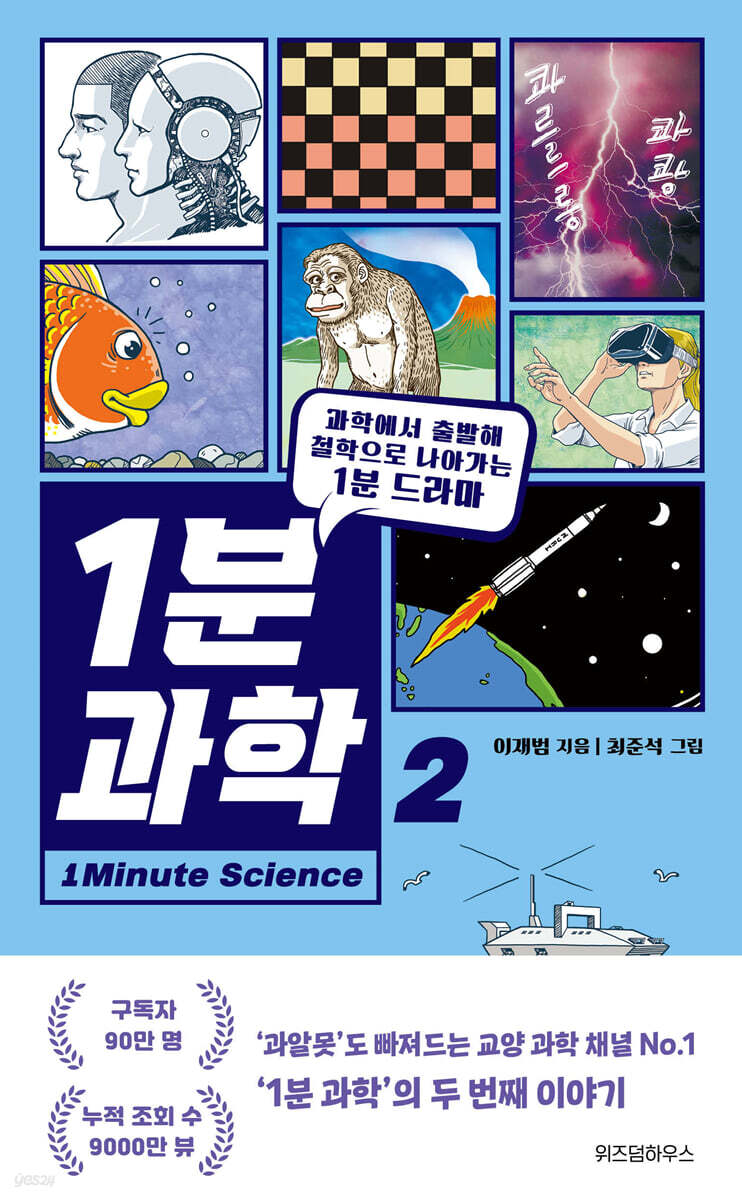
1 Minute Science 2
 |
Description
Book Introduction
South Korea No.
1 The popular science channel '1 Minute Science' is back!
A moving encounter between science and philosophy that will make even T's heart swell!
The second book of the popular science channel "1 Minute Science," which became a bestseller immediately after its publication in 2020 and received a flood of requests for the series, has been published by Wisdom House.
The channel has now surpassed 900,000 subscribers and 90 million cumulative views, establishing itself as a YouTube channel that the public trusts and watches, to the point that people click 'Like' and watch videos as soon as they receive a notification.
While the previous work, "1 Minute Science," presented scientific common sense that anyone can easily enjoy, covering a wide range of topics from everyday life to the universe, Volume 2 contains 14 thrilling 1-minute dramas that start from science and move on to philosophy.
From theories about mosquitoes, depression, and love to the philosophy of artificial intelligence, God, and virtual worlds, it delves into depth and provides insights essential for our times.
1 The popular science channel '1 Minute Science' is back!
A moving encounter between science and philosophy that will make even T's heart swell!
The second book of the popular science channel "1 Minute Science," which became a bestseller immediately after its publication in 2020 and received a flood of requests for the series, has been published by Wisdom House.
The channel has now surpassed 900,000 subscribers and 90 million cumulative views, establishing itself as a YouTube channel that the public trusts and watches, to the point that people click 'Like' and watch videos as soon as they receive a notification.
While the previous work, "1 Minute Science," presented scientific common sense that anyone can easily enjoy, covering a wide range of topics from everyday life to the universe, Volume 2 contains 14 thrilling 1-minute dramas that start from science and move on to philosophy.
From theories about mosquitoes, depression, and love to the philosophy of artificial intelligence, God, and virtual worlds, it delves into depth and provides insights essential for our times.
- You can preview some of the book's contents.
Preview
index
introduction
01.
Mosquitoes: An Intruder Essential to the Ecosystem
02.
Depression: Did depression exist hundreds of thousands of years ago?
03.
Pet Dogs: Why Dogs Became Friends with Humans
04.
Love: How Scientists Explain It
05.
Deja Vu: Is this a dream or reality?
06.
Fighting: The Most Violent Animals on Earth
07.
Armpit Hair: Why We Have Hair in Our Armpits
08.
The Dream of Artificial Intelligence: Will AI Dream Like Humans?
09.
Singularity: A Being Superior to Humanity Arrives
10.
Utopia: A Fantasy World Brought to You by Robots
11.
Why Buy: What's Real?
12.
Lies: Top 10 Persistent Lies in Science
13.
New God: A Being Who Knows Me Better Than I Know Myself
14.
Simulation: Infinite Virtual Worlds
References
01.
Mosquitoes: An Intruder Essential to the Ecosystem
02.
Depression: Did depression exist hundreds of thousands of years ago?
03.
Pet Dogs: Why Dogs Became Friends with Humans
04.
Love: How Scientists Explain It
05.
Deja Vu: Is this a dream or reality?
06.
Fighting: The Most Violent Animals on Earth
07.
Armpit Hair: Why We Have Hair in Our Armpits
08.
The Dream of Artificial Intelligence: Will AI Dream Like Humans?
09.
Singularity: A Being Superior to Humanity Arrives
10.
Utopia: A Fantasy World Brought to You by Robots
11.
Why Buy: What's Real?
12.
Lies: Top 10 Persistent Lies in Science
13.
New God: A Being Who Knows Me Better Than I Know Myself
14.
Simulation: Infinite Virtual Worlds
References
Detailed image

Into the book
When "1 Minute Science" was published, we couldn't have predicted such a drastic change.
Artificial intelligence is replacing human roles in a wide range of fields, and its scope will expand rapidly in the future.
These changes raise the fundamental question: What is a human being?
What kind of beings are we, and what should we do in the future?
--- p.6
In the fiercely competitive animal kingdom, if an individual lost interest in daily life, had no will to hunt, wanted to be alone, or even lost their appetite or sex drive, survival and reproduction would be impossible.
Therefore, the 'depression' that modern people suffer from seems like an evolutionary paradox.
So most people consider depression a mental illness that has emerged recently and is common in modern people.
But this perception of depression begins to change with two scientists.
--- p.26~29
The reason we listen to music is not to hear the end.
If that were the case, only the fastest players would be needed.
The same goes for space.
It has no purpose and, like music, it does not exist for an end.
The universe does not want any outcome.
But what have we been told since we were young? Go to college, get a job, make money, get promoted, get married.
Dedicate your life to a virtual goal.
So how do we wake up from the virtual world and return to the real one? Here's a hint.
--- p.210~212
It is said that the younger you are, the faster you learn new things and are good at randomly memorizing things, but the older brain also has many advantages of its own.
As we age, we become more logical in our speech, thanks to our better judgment and fluent speaking skills.
Considering that most successful people are actually over 40, there's no need to worry about your brain becoming rigid.
Young brains learn quickly, older brains use them wisely.
--- p.230
But algorithms don't forget, and their judgments don't waver depending on the weather or mood.
It's about not making mistakes.
It is said that the Facebook algorithm already knows better than the person concerned about how much they drink, smoke, and how well they have connected with others.
Do you know what this means?
--- p.254
Is this world truly made of information? The Bible says that God created humans in his own image.
Perhaps the god who created this world really does have human form.
Artificial intelligence is replacing human roles in a wide range of fields, and its scope will expand rapidly in the future.
These changes raise the fundamental question: What is a human being?
What kind of beings are we, and what should we do in the future?
--- p.6
In the fiercely competitive animal kingdom, if an individual lost interest in daily life, had no will to hunt, wanted to be alone, or even lost their appetite or sex drive, survival and reproduction would be impossible.
Therefore, the 'depression' that modern people suffer from seems like an evolutionary paradox.
So most people consider depression a mental illness that has emerged recently and is common in modern people.
But this perception of depression begins to change with two scientists.
--- p.26~29
The reason we listen to music is not to hear the end.
If that were the case, only the fastest players would be needed.
The same goes for space.
It has no purpose and, like music, it does not exist for an end.
The universe does not want any outcome.
But what have we been told since we were young? Go to college, get a job, make money, get promoted, get married.
Dedicate your life to a virtual goal.
So how do we wake up from the virtual world and return to the real one? Here's a hint.
--- p.210~212
It is said that the younger you are, the faster you learn new things and are good at randomly memorizing things, but the older brain also has many advantages of its own.
As we age, we become more logical in our speech, thanks to our better judgment and fluent speaking skills.
Considering that most successful people are actually over 40, there's no need to worry about your brain becoming rigid.
Young brains learn quickly, older brains use them wisely.
--- p.230
But algorithms don't forget, and their judgments don't waver depending on the weather or mood.
It's about not making mistakes.
It is said that the Facebook algorithm already knows better than the person concerned about how much they drink, smoke, and how well they have connected with others.
Do you know what this means?
--- p.254
Is this world truly made of information? The Bible says that God created humans in his own image.
Perhaps the god who created this world really does have human form.
--- p.286
Publisher's Review
“I got dizzy waiting for volume 2!”
“The more you read, the more you get sucked in, giving you goosebumps!”
-The second story of '1 Minute Science' that even 'science idiots' can get into?
When we say 'philosophy', people often think of thick books and difficult topics, and it is considered a field that is difficult to approach.
However, recently, the thoughts of philosophers Schopenhauer and Nietzsche have been receiving attention and are enjoying explosive popularity in the domestic book market, creating an unexpected 'philosopher fever'.
Accordingly, there is an analysis that people are interested in 'philosophy that adds depth to thought and provides wisdom for life in a reality where the anxiety and suffering index of society is high.'
Of course, ancient philosophy may sound like empty teachings because it is difficult to consistently apply it to the present age. However, the essence of life is similar in the grand scheme of things, so useful teachings from that era can serve as special guidance for us.
Science, too, has been neglected by the public for quite some time in that regard.
Whenever I started talking about the universe, human evolution, or quantum mechanics, I would start to feel sleepy.
But the landscape changed with the emergence of a YouTube channel that successfully shattered the stereotype that science is boring.
"Why has science advanced so much? Because it's so much fun!" Launched in 2016, "1 Minute Science" has maintained its position as the undisputed leader in Korea's science YouTube scene. Four years after publishing "1 Minute Science" in 2020, "1 Minute Science 2" is now available to the public.
In the digital ecosystem where short, stimulating short-form content is the trend, '1 Minute Science' has consistently maintained 'quality over quantity' and has been greatly loved by the public for nearly 10 years.
Living up to the title of 'YouTuber who lowered the barrier to studying science', he is armed with a unique storytelling that even science novice can get into, and as if responding to the request for a series, he came to us with a solid and dense 'real science' story.
“With this level of quality, isn’t this a philosophy channel rather than a science channel?”
“After watching the video, I feel like a philosopher who has realized the truth of life!”
When we are swept away by the speed of the world and lose our direction, we must study science!
From mosquitoes to artificial intelligence, it's time to hear the science stories we need most right now.
If you look at the recent responses from subscribers to '1 Minute Science', the word 'philosophy' is frequently seen.
It is a topic that goes beyond the typical scope of scientific stories, to the point where one might ask, "Isn't this a philosophy channel disguised as a science channel?" and elicits admiration.
It comes in without thinking through the algorithm and makes you do something unexpected.
If the previous work, "1 Minute Science," captivated the public with a wide range of scientific stories, from everyday knowledge like coffee, cats, and social media to profound topics like genes, time, and evolution, the second volume presents an even more upgraded story.
It captivatingly explores ideas that are easily dismissed as fantasy, such as artificial intelligence, virtual worlds, algorithms, and simulations, and creates a strange sense of empathy that "I'm not the only one."
And then, it starts to ask serious questions that are in touch with reality.
It poses weighty questions like, "What if an era emerges in which artificial intelligence surpasses humans?", "What is real in this world?", and "What if there is something that knows me better than I know myself?"
Here, we logically explain, drawing on scientific evidence, by summoning contemporary scientists and philosophers, dispel vague and baseless anxieties, and present forward-looking perspectives as alternatives for better choices.
In the process, some people receive solid advice that helps them let go of the worries of life, and some receive vague comfort.
There is no clear answer, but it helps each person find the answer they have decided on in their heart and organizes the scientific knowledge tangled in their head.
Especially in today's rapidly changing society, we are facing unprecedented crises and experiencing the very foundations of our lives being shaken.
In times like these, we need to look not only at what's right in front of us, but also take a step back from life and take an objective view.
In that sense, science has become an essential discipline in modern society, contrary to the stigma it had previously held of being useless.
Through this one-minute drama that teaches the philosophy of life through science, we hope to realize that science is not some distant discipline unrelated to our lives.
Through the window of science, I hope you will gain curiosity and new perspectives on everyday events, and have the valuable experience of firmly holding onto the shaky roots of life.
“The more you read, the more you get sucked in, giving you goosebumps!”
-The second story of '1 Minute Science' that even 'science idiots' can get into?
When we say 'philosophy', people often think of thick books and difficult topics, and it is considered a field that is difficult to approach.
However, recently, the thoughts of philosophers Schopenhauer and Nietzsche have been receiving attention and are enjoying explosive popularity in the domestic book market, creating an unexpected 'philosopher fever'.
Accordingly, there is an analysis that people are interested in 'philosophy that adds depth to thought and provides wisdom for life in a reality where the anxiety and suffering index of society is high.'
Of course, ancient philosophy may sound like empty teachings because it is difficult to consistently apply it to the present age. However, the essence of life is similar in the grand scheme of things, so useful teachings from that era can serve as special guidance for us.
Science, too, has been neglected by the public for quite some time in that regard.
Whenever I started talking about the universe, human evolution, or quantum mechanics, I would start to feel sleepy.
But the landscape changed with the emergence of a YouTube channel that successfully shattered the stereotype that science is boring.
"Why has science advanced so much? Because it's so much fun!" Launched in 2016, "1 Minute Science" has maintained its position as the undisputed leader in Korea's science YouTube scene. Four years after publishing "1 Minute Science" in 2020, "1 Minute Science 2" is now available to the public.
In the digital ecosystem where short, stimulating short-form content is the trend, '1 Minute Science' has consistently maintained 'quality over quantity' and has been greatly loved by the public for nearly 10 years.
Living up to the title of 'YouTuber who lowered the barrier to studying science', he is armed with a unique storytelling that even science novice can get into, and as if responding to the request for a series, he came to us with a solid and dense 'real science' story.
“With this level of quality, isn’t this a philosophy channel rather than a science channel?”
“After watching the video, I feel like a philosopher who has realized the truth of life!”
When we are swept away by the speed of the world and lose our direction, we must study science!
From mosquitoes to artificial intelligence, it's time to hear the science stories we need most right now.
If you look at the recent responses from subscribers to '1 Minute Science', the word 'philosophy' is frequently seen.
It is a topic that goes beyond the typical scope of scientific stories, to the point where one might ask, "Isn't this a philosophy channel disguised as a science channel?" and elicits admiration.
It comes in without thinking through the algorithm and makes you do something unexpected.
If the previous work, "1 Minute Science," captivated the public with a wide range of scientific stories, from everyday knowledge like coffee, cats, and social media to profound topics like genes, time, and evolution, the second volume presents an even more upgraded story.
It captivatingly explores ideas that are easily dismissed as fantasy, such as artificial intelligence, virtual worlds, algorithms, and simulations, and creates a strange sense of empathy that "I'm not the only one."
And then, it starts to ask serious questions that are in touch with reality.
It poses weighty questions like, "What if an era emerges in which artificial intelligence surpasses humans?", "What is real in this world?", and "What if there is something that knows me better than I know myself?"
Here, we logically explain, drawing on scientific evidence, by summoning contemporary scientists and philosophers, dispel vague and baseless anxieties, and present forward-looking perspectives as alternatives for better choices.
In the process, some people receive solid advice that helps them let go of the worries of life, and some receive vague comfort.
There is no clear answer, but it helps each person find the answer they have decided on in their heart and organizes the scientific knowledge tangled in their head.
Especially in today's rapidly changing society, we are facing unprecedented crises and experiencing the very foundations of our lives being shaken.
In times like these, we need to look not only at what's right in front of us, but also take a step back from life and take an objective view.
In that sense, science has become an essential discipline in modern society, contrary to the stigma it had previously held of being useless.
Through this one-minute drama that teaches the philosophy of life through science, we hope to realize that science is not some distant discipline unrelated to our lives.
Through the window of science, I hope you will gain curiosity and new perspectives on everyday events, and have the valuable experience of firmly holding onto the shaky roots of life.
GOODS SPECIFICS
- Date of issue: September 2, 2024
- Page count, weight, size: 292 pages | 440g | 130*210*20mm
- ISBN13: 9791171712694
- ISBN10: 1171712693
You may also like
카테고리
korean


korean

![GQ KOREA Mark (Monthly): December [2025]](http://librairie.coreenne.fr/cdn/shop/files/8ef265dbbfbf186523ed75ba7319009d.jpg?v=1765340328&width=3840)


