

The Evolution of Collaboration (40th Anniversary Special Edition)
 |
Description
Book Introduction
Success lies not in suppressing and defeating others, but in fostering cooperation. Scientifically proves that altruism based on reciprocity can evolve naturally. "The Evolution of Cooperation" became instantly famous as a groundbreaking computer simulation of the prisoner's dilemma, and since its first edition in 1984, it has had a tremendous influence on various fields including science, society, politics, economics, and literature, until the publication of the revised edition in 2006 and the special 40th anniversary edition in 2024. According to evolutionary theory, life evolves through competition, and pure altruism cannot evolve. Yet, how can we explain the abundance of mutual cooperation and goodwill in both the biological world and human society? A long-standing question for humanity was answered in 1984. Professor Axelrod held a computer competition based on the prisoner's dilemma game, pitting various strategies against each other. As a result, surprisingly, the ultimate winner was the simplest and most collaborative program, Tit for Tat (TFT: an eye for an eye, a tooth for a tooth). Based on this, it was 'mathematically' proven that cooperation arises naturally without coercion. The important point here is that the relationship between the two entities is long-lasting. In long-term relationships, it is more beneficial to be helpful than greedy. The author convinces readers of the benefits of Titpotat and suggests that they share it with those around them. "The Evolution of Cooperation" is a must-read for anyone interested in sociology, political science, biology, or game theory. |
- You can preview some of the book's contents.
Preview
Detailed image
Into the book
In this way, the world of the vile is invaded by a group of tit-for-tat.
That's not too difficult either.
Let's picture this situation.
Let's say a business professor teaches his students to be cooperative and reciprocate cooperation when they join a company.
If students really do this, and they aren't too scattered (so that they have a high enough chance of meeting and collaborating with other graduates who have taken the class), they will find that what they learn is beneficial.
--- p.97∼98
As Christmas approached, friendship blossomed between the two sides.
Of course, the command center frowned.
In the months that followed, impromptu ceasefires were often achieved by shouting or signaling (…) The system of coexistence and co-prosperity that emerged in the rigors of trench warfare during World War I demonstrates that friendship is not necessary for cooperation based on reciprocity to emerge.
--- p.110
Ongoing interaction ensures that cooperation based on reciprocity is stably established.
We offer three categories of advice on how to promote this type of cooperation.
First, we will make the future more important than the present. Second, we will change the size of the rewards for the four possible outcomes. Third, we will teach values that can promote cooperation, as well as facts and tips about them.
That's not too difficult either.
Let's picture this situation.
Let's say a business professor teaches his students to be cooperative and reciprocate cooperation when they join a company.
If students really do this, and they aren't too scattered (so that they have a high enough chance of meeting and collaborating with other graduates who have taken the class), they will find that what they learn is beneficial.
--- p.97∼98
As Christmas approached, friendship blossomed between the two sides.
Of course, the command center frowned.
In the months that followed, impromptu ceasefires were often achieved by shouting or signaling (…) The system of coexistence and co-prosperity that emerged in the rigors of trench warfare during World War I demonstrates that friendship is not necessary for cooperation based on reciprocity to emerge.
--- p.110
Ongoing interaction ensures that cooperation based on reciprocity is stably established.
We offer three categories of advice on how to promote this type of cooperation.
First, we will make the future more important than the present. Second, we will change the size of the rewards for the four possible outcomes. Third, we will teach values that can promote cooperation, as well as facts and tips about them.
--- p.165
Publisher's Review
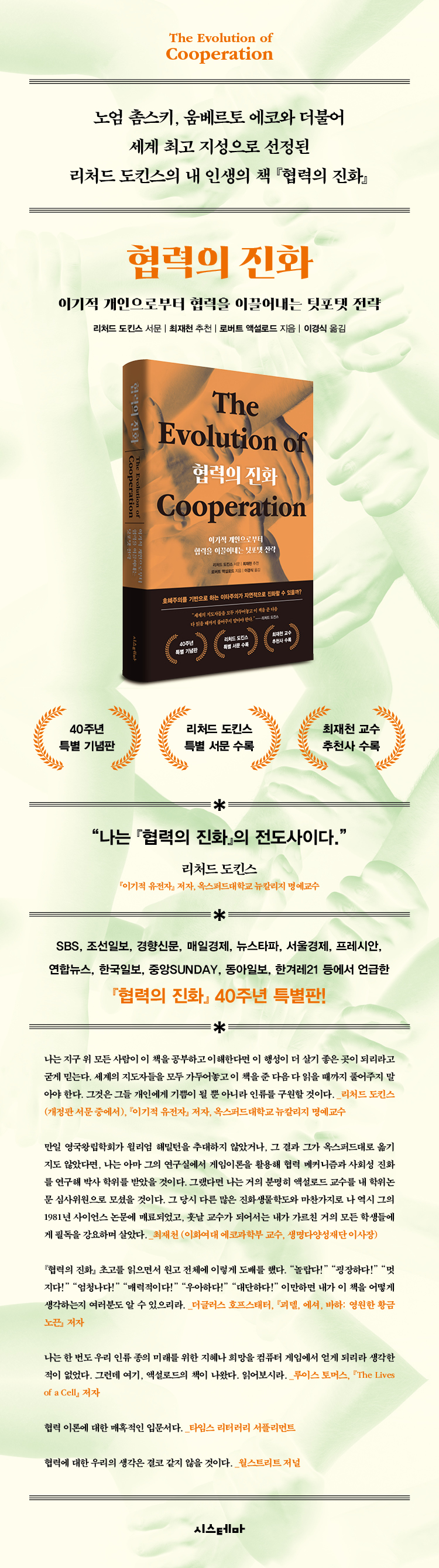
★ I am an evangelist for 『The Evolution of Cooperation』.
-Richard Dawkins
★ Winner of the Newcomb Cleveland Award from the American Association for the Advancement of Science
★ MacArthur Award Winner
★ Richard Dawkins' 'The Book of My Life'
★ Special edition of the 40th anniversary of 『Evolution of Cooperation』 mentioned in SBS, Chosun Ilbo, Kyunghyang Shinmun, Maeil Business Newspaper, Newstapa, Seoul Economic Daily, Pressian, Yonhap News, Hankook Ilbo, JoongAng Sunday, Dong-A Ilbo, Hankyoreh 21, etc.
The best strategy for success in a selfish society is to elicit cooperation from others.
According to the logic of Darwin's theory of evolution, altruism and sacrifice for others cannot evolve.
All life competes for limited resources, and individuals who sacrifice their own survival and reproduction for others cannot pass on their genes to future generations, so altruism cannot logically evolve.
(Darwin himself was concerned about the self-sacrifice of social creatures such as bees for the benefit of the group.) So some biologists developed the theory of group selection, which states that species that learned behavior patterns of refraining from reproduction for the benefit of the group were naturally selected.
This was a subject of academic controversy as it contradicted Darwin's theory of individual-centered natural selection.
Then, in the 1960s, William Hamilton explained how altruistic behavior could evolve among selfish individuals with his "kin selection theory."
Since social creatures are relatives who share genes with each other, it makes no difference from a genetic standpoint if several siblings or cousins reproduce instead of me.
Altruistic behavior is nothing more than selfishness at the genetic level.
A concise expression of this concept is Richard Dawkins' 'The Selfish Gene', which states that individuals are nothing more than temporary survival machines for passing on genes to the next generation, and that it is not the group or the individual, but the genes that are naturally selected.
However, in nature, there are many examples of non-blood relatives restraining their selfishness and cooperating with other individuals or species.
This pure altruism was explained in the 1970s by sociologist Robert Trivers as 'reciprocity theory'.
Reciprocity is the concept of 'I'll scratch your back this time, so next time you scratch mine', and many examples supporting this have been found in nature.
Richard Dawkins praises it as "a worthy replacement for the Bible."
Robert Axelrod was the first person to scientifically prove that altruism based on reciprocity can evolve naturally.
Axelrod caused a sensation in the academic world in 1981 when he published a paper in Science showing the mechanism by which cooperation emerges based on the results of research using computer tournaments, and his 1984 book, The Evolution of Cooperation, which was written to explain this to the general public, became a must-read for those interested in game theory, evolutionary biology, sociology, political science, and psychology.
The foreword by Richard Dawkins testifies to the book's immense influence.
Axelrod's papers are currently cited approximately 400 times a year and this number is sure to continue to increase.
A mathematical analysis of human behavior: the prisoner's dilemma
When several people go to a restaurant, each ordering their favorite food and splitting the bill, it is advantageous for everyone to order the more expensive food, and as a result, everyone ends up spending more.
This is a case of the 'tragedy of the commons', where villagers who graze their livestock on empty pastures each gain more by grazing more livestock, ultimately leading to the devastation of the pastures.
A dilemma is a game in which a logically correct decision for an individual brings disaster to the group, and the mathematical version of this is the 'prisoner's dilemma' game.
A classic example of the prisoner's dilemma game is when accomplices A and B are being interrogated.
If both remain silent and keep their word, they will receive a 1-year sentence (3-point reward). If one of them betrays and confesses, the one who confesses will be released (5 points) and the one who keeps their word will receive a 5-year sentence (0 points). If both betray and confess, they will receive a 3-year sentence (1 point).
Logically speaking, in this case, whether the other person cooperates (loyalty) or betrays, it is to my advantage to betray.
Therefore, both A and B decide to betray, and as a result, they suffer a loss compared to when they cooperated.
If betrayal were a rational conclusion, how could the countless forms of trust and cooperation in human society and nature have evolved? Why don't large coral reef fish, which benefit from the services of cleaner fish before being eaten, kill two birds with one stone? Examples include the mutualisms between different species, such as sea anemones and fish, or aphids and ants.
Titfortat, winner of the iterated prisoner's dilemma computer tournament
The answer lies in the longevity of their relationship.
If you're playing just one game, betrayal might be the most rational decision, but if you're playing against the same opponent repeatedly, the story changes.
What strategy yields the highest score in the iterated Prisoner's Dilemma game? Robert Axelrod asked various game theory experts to submit programs to play the Prisoner's Dilemma game. He held a tournament where 14 programs competed against each other. Surprisingly, the winner was the simplest strategy, called "tit-for-tat."
Tit-Po-Tat is the first to show favor to the opponent (cooperate), never betrays first, immediately retaliates with betrayal when the opponent betrays, always responds with cooperation when the opponent cooperates, and has the tolerance to forgive the opponent's betrayal after a single punishment.
If you are dealing with a partner that you plan to trade with for a long period of time, the tit-for-tat strategy is most beneficial.
How can we promote cooperation in a selfish society?
Many complex situations that arise in relationships not only between individuals but also between groups and nations are ultimately summarized as prisoner's dilemma game situations.
Axelrod suggests four optimal strategies in repeated prisoner's dilemma situations.
First, don't be jealous.
Second, don't betray first.
Third, repay the favor, whether it be cooperation or betrayal.
Fourth, don't be too clever.
The prisoner's dilemma is not a zero-sum game, and it's okay if the other person does better than you.
In fact, if the other person does well, I can do well too.
If the other person isn't as good as me, it means I haven't cooperated enough.
Also, if the opponent cannot predict my next move, cooperation cannot occur.
It should be simple so that the opponent can figure out my strategy quickly.
Since Titfortat just copies the opponent's strategy, after playing a few games you will realize that if you cooperate, Titfortat will automatically cooperate.
So there is no reason to choose betrayal and get a bad score.
As Richard Dawkins argues, “We should lock up all the world’s leaders, give them this book, and keep them until they’ve read it.” Then the world would be a more peaceful place.
-Richard Dawkins
★ Winner of the Newcomb Cleveland Award from the American Association for the Advancement of Science
★ MacArthur Award Winner
★ Richard Dawkins' 'The Book of My Life'
★ Special edition of the 40th anniversary of 『Evolution of Cooperation』 mentioned in SBS, Chosun Ilbo, Kyunghyang Shinmun, Maeil Business Newspaper, Newstapa, Seoul Economic Daily, Pressian, Yonhap News, Hankook Ilbo, JoongAng Sunday, Dong-A Ilbo, Hankyoreh 21, etc.
The best strategy for success in a selfish society is to elicit cooperation from others.
According to the logic of Darwin's theory of evolution, altruism and sacrifice for others cannot evolve.
All life competes for limited resources, and individuals who sacrifice their own survival and reproduction for others cannot pass on their genes to future generations, so altruism cannot logically evolve.
(Darwin himself was concerned about the self-sacrifice of social creatures such as bees for the benefit of the group.) So some biologists developed the theory of group selection, which states that species that learned behavior patterns of refraining from reproduction for the benefit of the group were naturally selected.
This was a subject of academic controversy as it contradicted Darwin's theory of individual-centered natural selection.
Then, in the 1960s, William Hamilton explained how altruistic behavior could evolve among selfish individuals with his "kin selection theory."
Since social creatures are relatives who share genes with each other, it makes no difference from a genetic standpoint if several siblings or cousins reproduce instead of me.
Altruistic behavior is nothing more than selfishness at the genetic level.
A concise expression of this concept is Richard Dawkins' 'The Selfish Gene', which states that individuals are nothing more than temporary survival machines for passing on genes to the next generation, and that it is not the group or the individual, but the genes that are naturally selected.
However, in nature, there are many examples of non-blood relatives restraining their selfishness and cooperating with other individuals or species.
This pure altruism was explained in the 1970s by sociologist Robert Trivers as 'reciprocity theory'.
Reciprocity is the concept of 'I'll scratch your back this time, so next time you scratch mine', and many examples supporting this have been found in nature.
Richard Dawkins praises it as "a worthy replacement for the Bible."
Robert Axelrod was the first person to scientifically prove that altruism based on reciprocity can evolve naturally.
Axelrod caused a sensation in the academic world in 1981 when he published a paper in Science showing the mechanism by which cooperation emerges based on the results of research using computer tournaments, and his 1984 book, The Evolution of Cooperation, which was written to explain this to the general public, became a must-read for those interested in game theory, evolutionary biology, sociology, political science, and psychology.
The foreword by Richard Dawkins testifies to the book's immense influence.
Axelrod's papers are currently cited approximately 400 times a year and this number is sure to continue to increase.
A mathematical analysis of human behavior: the prisoner's dilemma
When several people go to a restaurant, each ordering their favorite food and splitting the bill, it is advantageous for everyone to order the more expensive food, and as a result, everyone ends up spending more.
This is a case of the 'tragedy of the commons', where villagers who graze their livestock on empty pastures each gain more by grazing more livestock, ultimately leading to the devastation of the pastures.
A dilemma is a game in which a logically correct decision for an individual brings disaster to the group, and the mathematical version of this is the 'prisoner's dilemma' game.
A classic example of the prisoner's dilemma game is when accomplices A and B are being interrogated.
If both remain silent and keep their word, they will receive a 1-year sentence (3-point reward). If one of them betrays and confesses, the one who confesses will be released (5 points) and the one who keeps their word will receive a 5-year sentence (0 points). If both betray and confess, they will receive a 3-year sentence (1 point).
Logically speaking, in this case, whether the other person cooperates (loyalty) or betrays, it is to my advantage to betray.
Therefore, both A and B decide to betray, and as a result, they suffer a loss compared to when they cooperated.
If betrayal were a rational conclusion, how could the countless forms of trust and cooperation in human society and nature have evolved? Why don't large coral reef fish, which benefit from the services of cleaner fish before being eaten, kill two birds with one stone? Examples include the mutualisms between different species, such as sea anemones and fish, or aphids and ants.
Titfortat, winner of the iterated prisoner's dilemma computer tournament
The answer lies in the longevity of their relationship.
If you're playing just one game, betrayal might be the most rational decision, but if you're playing against the same opponent repeatedly, the story changes.
What strategy yields the highest score in the iterated Prisoner's Dilemma game? Robert Axelrod asked various game theory experts to submit programs to play the Prisoner's Dilemma game. He held a tournament where 14 programs competed against each other. Surprisingly, the winner was the simplest strategy, called "tit-for-tat."
Tit-Po-Tat is the first to show favor to the opponent (cooperate), never betrays first, immediately retaliates with betrayal when the opponent betrays, always responds with cooperation when the opponent cooperates, and has the tolerance to forgive the opponent's betrayal after a single punishment.
If you are dealing with a partner that you plan to trade with for a long period of time, the tit-for-tat strategy is most beneficial.
How can we promote cooperation in a selfish society?
Many complex situations that arise in relationships not only between individuals but also between groups and nations are ultimately summarized as prisoner's dilemma game situations.
Axelrod suggests four optimal strategies in repeated prisoner's dilemma situations.
First, don't be jealous.
Second, don't betray first.
Third, repay the favor, whether it be cooperation or betrayal.
Fourth, don't be too clever.
The prisoner's dilemma is not a zero-sum game, and it's okay if the other person does better than you.
In fact, if the other person does well, I can do well too.
If the other person isn't as good as me, it means I haven't cooperated enough.
Also, if the opponent cannot predict my next move, cooperation cannot occur.
It should be simple so that the opponent can figure out my strategy quickly.
Since Titfortat just copies the opponent's strategy, after playing a few games you will realize that if you cooperate, Titfortat will automatically cooperate.
So there is no reason to choose betrayal and get a bad score.
As Richard Dawkins argues, “We should lock up all the world’s leaders, give them this book, and keep them until they’ve read it.” Then the world would be a more peaceful place.
GOODS SPECIFICS
- Date of issue: May 20, 2024
- Format: Hardcover book binding method guide
- Page count, weight, size: 308 pages | 554g | 140*210*20mm
- ISBN13: 9791198695444
- ISBN10: 1198695447
You may also like
카테고리
korean


korean

![GQ KOREA Mark (Monthly): December [2025]](http://librairie.coreenne.fr/cdn/shop/files/8ef265dbbfbf186523ed75ba7319009d.jpg?v=1765340328&width=3840)


