

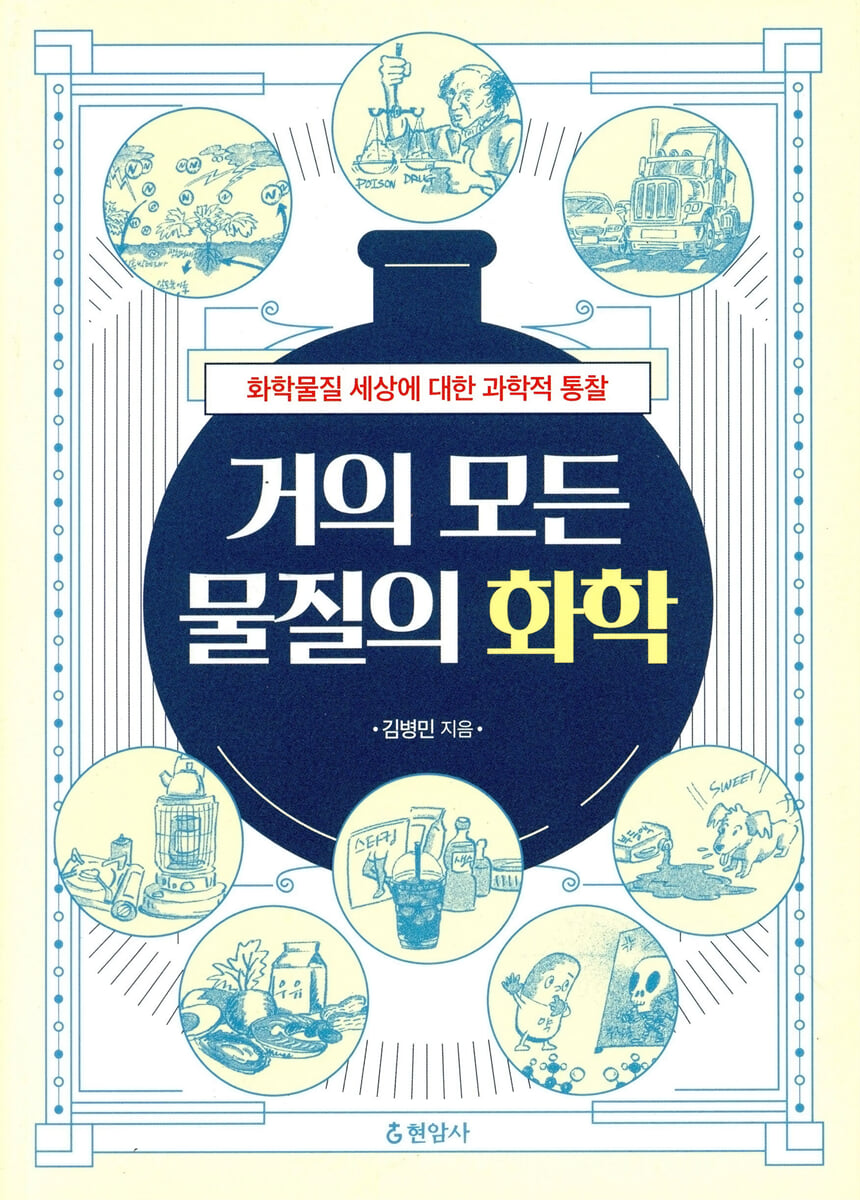
Chemistry of almost all substances
 |
Description
Book Introduction
Chemistry and chemicals, which used to feel complicated and difficult amidst the overflowing information,
The world looks completely different once you know its true nature!
A book that protects our precious daily lives in a world of chemicals while also making us think about the future beyond!
Although we live in a world made of matter and a civilization created by matter, we do not truly know the true nature of matter.
Chemistry, which explains the substance, feels like a particularly high wall compared to other scientific fields.
When most people think of 'chemistry', they associate it with 'difficult' and 'dangerous', and they think of words like 'artificial' and 'synthetic', as well as 'factory' and 'toxic', which are the opposites of 'natural' or 'natural'.
There is a widespread perception that chemistry is difficult, dangerous, and harmful.
But few disciplines dominate our lives as much as chemistry.
Chemistry is much closer to our lives than any other scientific discipline, and it is a discipline that connects predictable theories with wondrous realities in the advancement of human knowledge.
We must now move beyond viewing chemistry as a subject that only discusses whether something is harmful or not.
Human history has continued to this day, with matter creating civilization and civilization again creating matter, and chemistry explains almost all the substances that have passed through human history.
Perhaps it is scientific insight into the world of chemicals that allows us to fundamentally understand the world we live in and realize what is essential to overcoming the crises brought about by the various environmental changes on Earth.
This book covers almost everything about the chemicals that created the world we live in.
By revealing the nature and identity of chemicals, as well as the widespread misconceptions and truths surrounding them, this book changes our perspective on chemistry, allows us to approach chemicals correctly, and provides a new understanding of the world.
Starting with atoms and molecules, the origins of matter, it covers the process of creating matter, the properties of matter, new materials and civilizations created by mankind, the successes and failures of people in the process, environmental problems in the plastic world, and specific suggestions for the future.
Except for scientists and experts, few people have a solid understanding of the scientific facts about chemistry and chemicals and their effects.
Even experts who are supposed to know this don't know everything.
That's why accidents are so frequent and there's a lot of misinformation.
When thinking about events and phenomena, most people tend to obtain information and form their own perspectives through information distribution networks and web-like social networks rather than approaching them logically or scientifically.
In particular, ghost stories and misinformation can grow and spread uncontrollably in such a vulnerable system.
In such a situation, this book helps us understand chemistry properly and adopt an appropriate attitude toward substances, rather than looking for the villains of chemicals.
The essence of this book is to approach chemicals as more familiar substances rather than objects of suspicion and fear, and to gain insight into their nature by understanding them.
This book aims to help readers develop the mental muscle to discern right from wrong without feeling fear from the information mixed together like bibimbap on the Internet or broadcast media, and to think together about what lies beyond what is hidden by the selfishness of humanity.
The world looks completely different once you know its true nature!
A book that protects our precious daily lives in a world of chemicals while also making us think about the future beyond!
Although we live in a world made of matter and a civilization created by matter, we do not truly know the true nature of matter.
Chemistry, which explains the substance, feels like a particularly high wall compared to other scientific fields.
When most people think of 'chemistry', they associate it with 'difficult' and 'dangerous', and they think of words like 'artificial' and 'synthetic', as well as 'factory' and 'toxic', which are the opposites of 'natural' or 'natural'.
There is a widespread perception that chemistry is difficult, dangerous, and harmful.
But few disciplines dominate our lives as much as chemistry.
Chemistry is much closer to our lives than any other scientific discipline, and it is a discipline that connects predictable theories with wondrous realities in the advancement of human knowledge.
We must now move beyond viewing chemistry as a subject that only discusses whether something is harmful or not.
Human history has continued to this day, with matter creating civilization and civilization again creating matter, and chemistry explains almost all the substances that have passed through human history.
Perhaps it is scientific insight into the world of chemicals that allows us to fundamentally understand the world we live in and realize what is essential to overcoming the crises brought about by the various environmental changes on Earth.
This book covers almost everything about the chemicals that created the world we live in.
By revealing the nature and identity of chemicals, as well as the widespread misconceptions and truths surrounding them, this book changes our perspective on chemistry, allows us to approach chemicals correctly, and provides a new understanding of the world.
Starting with atoms and molecules, the origins of matter, it covers the process of creating matter, the properties of matter, new materials and civilizations created by mankind, the successes and failures of people in the process, environmental problems in the plastic world, and specific suggestions for the future.
Except for scientists and experts, few people have a solid understanding of the scientific facts about chemistry and chemicals and their effects.
Even experts who are supposed to know this don't know everything.
That's why accidents are so frequent and there's a lot of misinformation.
When thinking about events and phenomena, most people tend to obtain information and form their own perspectives through information distribution networks and web-like social networks rather than approaching them logically or scientifically.
In particular, ghost stories and misinformation can grow and spread uncontrollably in such a vulnerable system.
In such a situation, this book helps us understand chemistry properly and adopt an appropriate attitude toward substances, rather than looking for the villains of chemicals.
The essence of this book is to approach chemicals as more familiar substances rather than objects of suspicion and fear, and to gain insight into their nature by understanding them.
This book aims to help readers develop the mental muscle to discern right from wrong without feeling fear from the information mixed together like bibimbap on the Internet or broadcast media, and to think together about what lies beyond what is hidden by the selfishness of humanity.
- You can preview some of the book's contents.
Preview
index
preface
Chapter 1: Understanding Materials
1.
Substances that were known but not properly known
2.
A modern-day alchemist who forgot ethics
3.
Discussing the toxicity of chemicals
4.
Atoms and elements
5.
Chemistry is the story of electrons
6.
A world made with just over 100 ingredients
7.
Coexistence of zinc and mercury
Chapter 2: Understanding Matter
1.
Why are substances created?
2.
Matter only changes shape; the material does not disappear.
3.
A substance that has had a great influence on human civilization
4.
Molecular architecture of arrangement and combination
5.
Chemistry that resembles human desire
6.
Take out Earth's time
7.
The emergence of new materials
8.
The nature of matter
Chapter 3: Creating New Materials
1.
Starting with one carbon - methane, chloroform, methanol
2.
Stop Boiling Fire Ants - Formaldehyde and Formic Acid
3.
Two carbons meet - ethane, ethylene, acetylene
4.
God's Drops, Ethanol
5.
Poison and Vinegar - Acetaldehyde and Acetic Acid
6.
When three carbons meet - isopropyl alcohol, acetone, and an aquarium
7.
Drinking and applying car coolant? - Propylene Glycol
8.
Four or more hydrocarbons - Development of the petrochemical industry
9.
The chemical journey to obtain fuel
10.
Molecular architecture where structure creates function
Chapter 4: Materials That Don't Disappear
1.
The history of plastic begins with billiard balls
2.
Polymer that resembles dalgona
3.
Good Plastic vs. Bad Plastic? - Polyethylene
4.
A plastic that is both hard and soft - polyvinyl chloride
5.
A plastic more attractive than metal - polyacetylene
6.
A plastic as transparent as glass - polyethylene terephthalate
7.
Hot is okay - Plastics for various purposes
8.
Plastics on the Frontlines of the Pandemic: The Light and Shadows of Polypropylene
9.
Careful polymer - polystyrene
10.
Plastics and Endocrine Disruptors - Polycarbonate
11.
Silent Counterattack
Chapter 5: Eating is also material
1.
Molecular Biological Considerations on Food
2.
The chemistry of fermentation that moves the world
3.
The irrational confrontation between natural substances and artificial compounds
4.
More fear than necessary, more reassurance than necessary
5.
Protein folding and unfolding
6.
A healthy mind resides in a healthy body.
7.
Medicine and poison are brothers
8.
There is no miracle drug.
Chapter 6: Chemistry of Almost All Matter
1.
Chemistry is affinity
2.
Development of the inorganic chemical industry
3.
Experience heaven and hell
4.
Chemistry is the study of reactions
5.
Explaining chemistry and biology
6.
Mimic nature
7.
Starting with dyes and synthesizing drugs
8.
Another material that mankind is obsessed with: rubber
9.
The Two Faces of Humanity Disguised as 'Sustainability'
Chapter 7: New Materials, New Civilizations
1.
Drawing with the sun
2.
Dominance in the graphene market
3.
China, resembling Thanos, and the throne of display technology
4.
Hydrogen, an extension of fossil fuels
5.
Finding answers from nature
In closing
References
Search
Chapter 1: Understanding Materials
1.
Substances that were known but not properly known
2.
A modern-day alchemist who forgot ethics
3.
Discussing the toxicity of chemicals
4.
Atoms and elements
5.
Chemistry is the story of electrons
6.
A world made with just over 100 ingredients
7.
Coexistence of zinc and mercury
Chapter 2: Understanding Matter
1.
Why are substances created?
2.
Matter only changes shape; the material does not disappear.
3.
A substance that has had a great influence on human civilization
4.
Molecular architecture of arrangement and combination
5.
Chemistry that resembles human desire
6.
Take out Earth's time
7.
The emergence of new materials
8.
The nature of matter
Chapter 3: Creating New Materials
1.
Starting with one carbon - methane, chloroform, methanol
2.
Stop Boiling Fire Ants - Formaldehyde and Formic Acid
3.
Two carbons meet - ethane, ethylene, acetylene
4.
God's Drops, Ethanol
5.
Poison and Vinegar - Acetaldehyde and Acetic Acid
6.
When three carbons meet - isopropyl alcohol, acetone, and an aquarium
7.
Drinking and applying car coolant? - Propylene Glycol
8.
Four or more hydrocarbons - Development of the petrochemical industry
9.
The chemical journey to obtain fuel
10.
Molecular architecture where structure creates function
Chapter 4: Materials That Don't Disappear
1.
The history of plastic begins with billiard balls
2.
Polymer that resembles dalgona
3.
Good Plastic vs. Bad Plastic? - Polyethylene
4.
A plastic that is both hard and soft - polyvinyl chloride
5.
A plastic more attractive than metal - polyacetylene
6.
A plastic as transparent as glass - polyethylene terephthalate
7.
Hot is okay - Plastics for various purposes
8.
Plastics on the Frontlines of the Pandemic: The Light and Shadows of Polypropylene
9.
Careful polymer - polystyrene
10.
Plastics and Endocrine Disruptors - Polycarbonate
11.
Silent Counterattack
Chapter 5: Eating is also material
1.
Molecular Biological Considerations on Food
2.
The chemistry of fermentation that moves the world
3.
The irrational confrontation between natural substances and artificial compounds
4.
More fear than necessary, more reassurance than necessary
5.
Protein folding and unfolding
6.
A healthy mind resides in a healthy body.
7.
Medicine and poison are brothers
8.
There is no miracle drug.
Chapter 6: Chemistry of Almost All Matter
1.
Chemistry is affinity
2.
Development of the inorganic chemical industry
3.
Experience heaven and hell
4.
Chemistry is the study of reactions
5.
Explaining chemistry and biology
6.
Mimic nature
7.
Starting with dyes and synthesizing drugs
8.
Another material that mankind is obsessed with: rubber
9.
The Two Faces of Humanity Disguised as 'Sustainability'
Chapter 7: New Materials, New Civilizations
1.
Drawing with the sun
2.
Dominance in the graphene market
3.
China, resembling Thanos, and the throne of display technology
4.
Hydrogen, an extension of fossil fuels
5.
Finding answers from nature
In closing
References
Search
Into the book
In science, there is a most important condition for a hypothesis to become a theory.
Only when no errors appear in the process of all experiments and proofs does it become a theory and a law.
Even if it is established as a theory, if even one error appears later, the theory ends in failure.
When dealing with scientific products such as chemicals, both scientists and managers must have a scientific attitude.
Chemistry, especially when it involves chemicals, is not a harmless field.
Because of this, we must ask ourselves how we should behave ethically in situations where we must handle material.
The same goes for consumers.
--- p.32
Our human body is a complex and sophisticated system, but sometimes it behaves in unexpected ways.
Parabens, which are preservatives, and bisphenol A, a chemical substance, can cause adverse reactions in the body because they are similar to the sex hormone estrogen.
But even simple elements, not chemicals made up of complex molecules, can be harmful to us.
If that element is not one that makes up our bodies, then something unexpected will definitely happen.
--- p.68
It is no exaggeration to say that chemistry is the story of electrons.
It could be said that chemistry is all about elements stealing and being stolen, giving up and gaining electrons.
We call this a 'reaction' and the result a 'change'.
Through these reactions, reactants change, new products are created, and the world is formed.
Likewise, harmful chemicals enter our bodies and react with our bodies through electrons to maintain a stable state.
If the chemical itself is very stable, it will not react even if it enters the body.
--- p.89
The energy sources used by mankind are precious resources created on Earth through chemical processes over millions of years.
We may never be able to make coal again.
This is because coal was created at a time when there were no microorganisms capable of breaking down plant lignin.
It wouldn't be much different from oil.
Simply put, coal and oil are products of photosynthesis that retain the energy that the sun poured onto the Earth in the past.
The Industrial Revolution is the event that occurred when humans began to extract this material from the earth's crust and use it as energy.
It is an event that brought back the past, that is, an event in which humanity discovered the secrets of the earth.
From this time on, mankind grew up enjoying the convenience of feeding on the dark nutrients of the earth, just like sucking on a mother's milk.
Intoxicated with growth, we have constantly pumped carbon buried in the crust into the atmosphere.
I did it without much thought about what the consequences would be.
Fossil fuels and heat engines are the keys that unlocked the catastrophe that caused the climate crisis.
--- p.148
Krill is said to be food for whales, a marine creature.
Whales are creatures that have gone through two brutal eras.
Before the advent of fossil fuels in the 19th century, it was responsible for the supply of fuel, and after World War II, it suffered from the rapid increase in plastic.
But I would like to ask the question, is it really necessary to take away their food?
Whales that wash up on shore and die have more plastic in their stomachs than krill.
Most of them are polymers created by humans.
--- p.251
Let's take a moment to look at our lives today.
Before going to work, I stop by a coffee shop and buy a refreshing iced Americano.
The credit card you take out to pay is made of a material known as polyvinyl chloride, also known as PVC.
The clear, hard plastic that the coffee is made of is called polyethylene terephthalate, which we are more familiar with by its abbreviation, PET.
The straw is made of polypropylene.
Even the cell phone that you can't take your eyes off of while drinking coffee contains various polymer substances.
The fast food restaurant I visited for lunch was a veritable mess of polymers.
Disposable spoons are made of polypropylene, containers are made of polystyrene, and the inside of paper cups used to wrap food or hold drinks is coated with polyethylene or polycarbonate to block moisture.
There are chemicals in the various detergents we use to wash our bodies before leaving the house, and there are also microscopic plastics in cosmetics.
And the clothes and shoes that we wear so well contain polyester and polyurethane.
If the names of substances are different, their chemical structures, components, and functions are different.
But they are all substances that start from olefin.
--- p.269
Our cells do not accept strange shapes that they have never encountered before and try to expel them somehow.
If these substances remain and are not excreted, they become toxic.
However, if the structure is similar to the substances used in our body, the body may accept it even if it is an unfamiliar substance.
In this way, unfamiliar substances are delivered along the route of the substances originally used, and when they reach their destination, the various organs, they are unable to use the substances properly, so the body's organs cannot function properly.
In particular, external substances that resemble hormones are called endocrine disruptors.
--- p.320
What is the lifespan of plastic?
It is shocking to see the lifetime of a material when it is properly used in everyday life.
The average lifespan is only 20 minutes.
It only takes a minute to make a product.
However, it takes hundreds of years for this material to completely disappear from the Earth, and even strong materials can take more than 500 years.
The material is currently being used by humans and will exist into the future.
In that future, there are no current humans.
So, plastic materials should be addressed as an issue of environmental justice.
Because it is an unjust medium that allows our generation to enjoy the benefits while leaving future generations to shoulder the damage and responsibility.
--- p.332
Chemists often fail to consider how the substances they create will behave with other substances.
So, it is difficult to completely control how the target substance will react to the world.
So once a material is synthesized, it undergoes sufficient testing to ensure it meets the standards.
All compounds around us, including medicines, dyes, and detergents, are created through this process.
Even so, since humans interact with nature, substances that are beyond the scope of control often appear.
--- p.458
We know very well that everything that makes up this world is made up of chemicals, but we are not interested in the nature of those substances or why they were created.
Ultimately, the fear that comes from not knowing creates hatred and misunderstanding.
Most people just want to know what's wrong and what simple, actionable solutions they can implement to get out of crisis and danger.
Because I think that's all I have to do is avoid it.
But unfortunately, avoiding it is not the answer.
Avoidance is the act of leaving everything to the next generation.
The world will change only when we change ourselves.
This is why we need to know exactly what matter is, why it came into existence, and how to use it.
Only when no errors appear in the process of all experiments and proofs does it become a theory and a law.
Even if it is established as a theory, if even one error appears later, the theory ends in failure.
When dealing with scientific products such as chemicals, both scientists and managers must have a scientific attitude.
Chemistry, especially when it involves chemicals, is not a harmless field.
Because of this, we must ask ourselves how we should behave ethically in situations where we must handle material.
The same goes for consumers.
--- p.32
Our human body is a complex and sophisticated system, but sometimes it behaves in unexpected ways.
Parabens, which are preservatives, and bisphenol A, a chemical substance, can cause adverse reactions in the body because they are similar to the sex hormone estrogen.
But even simple elements, not chemicals made up of complex molecules, can be harmful to us.
If that element is not one that makes up our bodies, then something unexpected will definitely happen.
--- p.68
It is no exaggeration to say that chemistry is the story of electrons.
It could be said that chemistry is all about elements stealing and being stolen, giving up and gaining electrons.
We call this a 'reaction' and the result a 'change'.
Through these reactions, reactants change, new products are created, and the world is formed.
Likewise, harmful chemicals enter our bodies and react with our bodies through electrons to maintain a stable state.
If the chemical itself is very stable, it will not react even if it enters the body.
--- p.89
The energy sources used by mankind are precious resources created on Earth through chemical processes over millions of years.
We may never be able to make coal again.
This is because coal was created at a time when there were no microorganisms capable of breaking down plant lignin.
It wouldn't be much different from oil.
Simply put, coal and oil are products of photosynthesis that retain the energy that the sun poured onto the Earth in the past.
The Industrial Revolution is the event that occurred when humans began to extract this material from the earth's crust and use it as energy.
It is an event that brought back the past, that is, an event in which humanity discovered the secrets of the earth.
From this time on, mankind grew up enjoying the convenience of feeding on the dark nutrients of the earth, just like sucking on a mother's milk.
Intoxicated with growth, we have constantly pumped carbon buried in the crust into the atmosphere.
I did it without much thought about what the consequences would be.
Fossil fuels and heat engines are the keys that unlocked the catastrophe that caused the climate crisis.
--- p.148
Krill is said to be food for whales, a marine creature.
Whales are creatures that have gone through two brutal eras.
Before the advent of fossil fuels in the 19th century, it was responsible for the supply of fuel, and after World War II, it suffered from the rapid increase in plastic.
But I would like to ask the question, is it really necessary to take away their food?
Whales that wash up on shore and die have more plastic in their stomachs than krill.
Most of them are polymers created by humans.
--- p.251
Let's take a moment to look at our lives today.
Before going to work, I stop by a coffee shop and buy a refreshing iced Americano.
The credit card you take out to pay is made of a material known as polyvinyl chloride, also known as PVC.
The clear, hard plastic that the coffee is made of is called polyethylene terephthalate, which we are more familiar with by its abbreviation, PET.
The straw is made of polypropylene.
Even the cell phone that you can't take your eyes off of while drinking coffee contains various polymer substances.
The fast food restaurant I visited for lunch was a veritable mess of polymers.
Disposable spoons are made of polypropylene, containers are made of polystyrene, and the inside of paper cups used to wrap food or hold drinks is coated with polyethylene or polycarbonate to block moisture.
There are chemicals in the various detergents we use to wash our bodies before leaving the house, and there are also microscopic plastics in cosmetics.
And the clothes and shoes that we wear so well contain polyester and polyurethane.
If the names of substances are different, their chemical structures, components, and functions are different.
But they are all substances that start from olefin.
--- p.269
Our cells do not accept strange shapes that they have never encountered before and try to expel them somehow.
If these substances remain and are not excreted, they become toxic.
However, if the structure is similar to the substances used in our body, the body may accept it even if it is an unfamiliar substance.
In this way, unfamiliar substances are delivered along the route of the substances originally used, and when they reach their destination, the various organs, they are unable to use the substances properly, so the body's organs cannot function properly.
In particular, external substances that resemble hormones are called endocrine disruptors.
--- p.320
What is the lifespan of plastic?
It is shocking to see the lifetime of a material when it is properly used in everyday life.
The average lifespan is only 20 minutes.
It only takes a minute to make a product.
However, it takes hundreds of years for this material to completely disappear from the Earth, and even strong materials can take more than 500 years.
The material is currently being used by humans and will exist into the future.
In that future, there are no current humans.
So, plastic materials should be addressed as an issue of environmental justice.
Because it is an unjust medium that allows our generation to enjoy the benefits while leaving future generations to shoulder the damage and responsibility.
--- p.332
Chemists often fail to consider how the substances they create will behave with other substances.
So, it is difficult to completely control how the target substance will react to the world.
So once a material is synthesized, it undergoes sufficient testing to ensure it meets the standards.
All compounds around us, including medicines, dyes, and detergents, are created through this process.
Even so, since humans interact with nature, substances that are beyond the scope of control often appear.
--- p.458
We know very well that everything that makes up this world is made up of chemicals, but we are not interested in the nature of those substances or why they were created.
Ultimately, the fear that comes from not knowing creates hatred and misunderstanding.
Most people just want to know what's wrong and what simple, actionable solutions they can implement to get out of crisis and danger.
Because I think that's all I have to do is avoid it.
But unfortunately, avoiding it is not the answer.
Avoidance is the act of leaving everything to the next generation.
The world will change only when we change ourselves.
This is why we need to know exactly what matter is, why it came into existence, and how to use it.
--- p.508
Publisher's Review
Humidifier disinfectant incident and pesticide-laced egg incident
In the relatively recent past 30 years of our modern history, there have been incidents that took numerous lives at once.
The collapse of the Sampoong Department Store in 1995, the Daegu subway fire in 2003, and the sinking of the Sewol ferry in 2014 were disasters that resulted in hundreds of deaths.
But there is an incident that has claimed more lives than the combined number of deaths from the accidents just mentioned.
The 'humidifier disinfectant incident' has had victims since 1995, but the damage was only recognized in 2011.
According to the results of a precise estimate of the scale of damage caused by humidifier disinfectants by the Special Investigation Committee on Social Disasters (hereinafter referred to as the Special Committee) in July 2020, the number of users of the product at the time reached 6.27 million (at least 5.74 million considering the margin of error).
Of these, approximately 670,000 people were affected (at least 610,000 considering the margin of error), and approximately 520,000 people are reported to have developed new symptoms or diseases due to the humidifier disinfectant.
Among the 520,000 people, it is estimated that about 150,000 people had their pre-existing conditions worsen, and about 14,000 people died after receiving hospital treatment.
Despite these astonishing figures, only 6,817 people reported damage, which is only 1 percent of the number of victims estimated by the special committee.
These figures indicate that many victims of humidifier disinfectant are not fully aware of their damage, and that many are still suffering from illnesses without even knowing the cause.
As of 2020, there were 4,114 officially confirmed victims and 995 deaths.
The humidifier disinfectant incident is a well-known incident, but the extent of the damage and its cause are not clearly known, and as time passes, it is fading from our memories.
Although no direct damage was incurred at the time, it caused fear and aversion to chemicals (aka chemophobia) in most consumers who used the same product.
There is another incident that has brought about chemophobia in succession.
This is the pesticide-laced egg incident of 2017.
At the time, the government implemented drastic distribution controls, which caused eggs to disappear from supermarkets all at once, making it difficult to find eggs on the table for a while.
At the heart of both incidents are chemicals.
These are fungicide and insecticide substances called polyhexamethylene guanidine (PHMG) and fipronil.
Disinfectants are substances designed to eliminate microorganisms such as bacteria, and pesticides are substances designed to kill and eliminate pests.
Although the object and purpose are clear, a substance that deviates from its established use and usage takes on a different face.
Other chemicals found in humidifiers, including PHMG, chloromethylisothiazolinone (CMIT) and methylisothiazolinone (MIT), are recommended for use in trace amounts to kill or prevent the growth of bacteria in manufactured products such as detergents and beauty products, and then be thoroughly removed.
The problem is that these substances are being used in a product called a humidifier, outside of their intended use and usage.
A humidifier is a product that sprays lumps of water molecules called water vapor into an indoor space to control humidity.
Disinfectant substances can enter the human body through the respiratory system via water molecules and air.
Ultimately, inhalation toxicity could be sufficiently predicted.
However, companies manufactured the products without sufficient consideration of the inhalation toxicity of disinfectants, the government approved them, and consumers used them without knowing the ingredients, which led to the disaster.
As a result of the learning effect from the humidifier disinfectant incident, everyone had no choice but to react sensitively to the pesticide-contaminated egg incident.
The government, the poultry industry, and even consumers were thrown into confusion.
The acceptable level of fipronil residue in eggs is 0.02 ppm.
However, 0.0363 ppm was detected at the problematic farm.
So, what was the problem with the detection of fipronil in eggs and its concentration? To cut to the chase, pesticides are inherently harmful, but consuming one or two eggs a day doesn't pose a significant risk to the human body.
An interesting fact is that this fipronil is a substance that already exists and is permitted in other foods.
It's not like a substance that shouldn't be used suddenly appeared around us one day.
Ironically, the acceptable levels of fipronil in other foods are often higher than in eggs, which has been the subject of controversy.
Pipronyl was a substance that was already well known to mankind, but was not well known to consumers.
However, a substance that was thought not to exist in eggs was discovered.
Epidemiological investigation results showed that pesticides sprayed on poultry farms to maintain a clean breeding environment were transferred to eggs through the chickens' bodies.
But if we look at the detection volume alone, there was no need to be so noisy and scary.
Of course, the government should have quickly implemented appropriate disposal of distributed eggs and follow-up measures for poultry farms, regardless of the level of risk.
However, the government and the media drove the entire nation into chemical fear by listing difficult-to-understand figures and units as if eating eggs would cause serious harm.
The fear was entirely on the consumer's side.
The two cases mentioned above are similar but subtly different.
One is something that happened without you knowing, while the other is something that happened knowingly.
But as a consumer, it was something that I couldn't know anything about.
A time when questions are needed
The ingredient lists on various products that surround us are filled with the names of unknown chemicals.
It is definitely not an unknown substance.
It is a substance that companies that produce products know all too well.
As a scientist who studies chemistry, I don't know everything about every substance, but I know their general functions.
However, the general consumer is unaware of the identity and function of these chemicals.
Anxiety comes from not knowing.
So perhaps it's natural to feel anxious, and the accidents we face in reality turn that anxiety into fear and disgust.
When this happens, consumers feel helpless. Feeling helpless in the face of terms like PHMG and fipronil is understandable.
However, we do not want to know the chemical composition and properties of chemicals or the allowable levels in detail.
Even if I hear various figures, I can't figure it out.
Above all, what consumers want to know most is, 'Is that substance really safe?'
The sad part is that no one asked themselves this simple question.
We live in an age where questions have been lost.
The question may seem awkward when faced with the words growth and efficiency.
But now, we have to ask ourselves, 'Will this be like the humidifier disinfectant incident?', 'Is it safe to spray it like this?'
It is a puzzle that requires us to retrieve the fragments of events that are fading from our memories, reassemble them, and match them to the scene unfolding before our eyes.
This is the lesson learned from past experience.
In the relatively recent past 30 years of our modern history, there have been incidents that took numerous lives at once.
The collapse of the Sampoong Department Store in 1995, the Daegu subway fire in 2003, and the sinking of the Sewol ferry in 2014 were disasters that resulted in hundreds of deaths.
But there is an incident that has claimed more lives than the combined number of deaths from the accidents just mentioned.
The 'humidifier disinfectant incident' has had victims since 1995, but the damage was only recognized in 2011.
According to the results of a precise estimate of the scale of damage caused by humidifier disinfectants by the Special Investigation Committee on Social Disasters (hereinafter referred to as the Special Committee) in July 2020, the number of users of the product at the time reached 6.27 million (at least 5.74 million considering the margin of error).
Of these, approximately 670,000 people were affected (at least 610,000 considering the margin of error), and approximately 520,000 people are reported to have developed new symptoms or diseases due to the humidifier disinfectant.
Among the 520,000 people, it is estimated that about 150,000 people had their pre-existing conditions worsen, and about 14,000 people died after receiving hospital treatment.
Despite these astonishing figures, only 6,817 people reported damage, which is only 1 percent of the number of victims estimated by the special committee.
These figures indicate that many victims of humidifier disinfectant are not fully aware of their damage, and that many are still suffering from illnesses without even knowing the cause.
As of 2020, there were 4,114 officially confirmed victims and 995 deaths.
The humidifier disinfectant incident is a well-known incident, but the extent of the damage and its cause are not clearly known, and as time passes, it is fading from our memories.
Although no direct damage was incurred at the time, it caused fear and aversion to chemicals (aka chemophobia) in most consumers who used the same product.
There is another incident that has brought about chemophobia in succession.
This is the pesticide-laced egg incident of 2017.
At the time, the government implemented drastic distribution controls, which caused eggs to disappear from supermarkets all at once, making it difficult to find eggs on the table for a while.
At the heart of both incidents are chemicals.
These are fungicide and insecticide substances called polyhexamethylene guanidine (PHMG) and fipronil.
Disinfectants are substances designed to eliminate microorganisms such as bacteria, and pesticides are substances designed to kill and eliminate pests.
Although the object and purpose are clear, a substance that deviates from its established use and usage takes on a different face.
Other chemicals found in humidifiers, including PHMG, chloromethylisothiazolinone (CMIT) and methylisothiazolinone (MIT), are recommended for use in trace amounts to kill or prevent the growth of bacteria in manufactured products such as detergents and beauty products, and then be thoroughly removed.
The problem is that these substances are being used in a product called a humidifier, outside of their intended use and usage.
A humidifier is a product that sprays lumps of water molecules called water vapor into an indoor space to control humidity.
Disinfectant substances can enter the human body through the respiratory system via water molecules and air.
Ultimately, inhalation toxicity could be sufficiently predicted.
However, companies manufactured the products without sufficient consideration of the inhalation toxicity of disinfectants, the government approved them, and consumers used them without knowing the ingredients, which led to the disaster.
As a result of the learning effect from the humidifier disinfectant incident, everyone had no choice but to react sensitively to the pesticide-contaminated egg incident.
The government, the poultry industry, and even consumers were thrown into confusion.
The acceptable level of fipronil residue in eggs is 0.02 ppm.
However, 0.0363 ppm was detected at the problematic farm.
So, what was the problem with the detection of fipronil in eggs and its concentration? To cut to the chase, pesticides are inherently harmful, but consuming one or two eggs a day doesn't pose a significant risk to the human body.
An interesting fact is that this fipronil is a substance that already exists and is permitted in other foods.
It's not like a substance that shouldn't be used suddenly appeared around us one day.
Ironically, the acceptable levels of fipronil in other foods are often higher than in eggs, which has been the subject of controversy.
Pipronyl was a substance that was already well known to mankind, but was not well known to consumers.
However, a substance that was thought not to exist in eggs was discovered.
Epidemiological investigation results showed that pesticides sprayed on poultry farms to maintain a clean breeding environment were transferred to eggs through the chickens' bodies.
But if we look at the detection volume alone, there was no need to be so noisy and scary.
Of course, the government should have quickly implemented appropriate disposal of distributed eggs and follow-up measures for poultry farms, regardless of the level of risk.
However, the government and the media drove the entire nation into chemical fear by listing difficult-to-understand figures and units as if eating eggs would cause serious harm.
The fear was entirely on the consumer's side.
The two cases mentioned above are similar but subtly different.
One is something that happened without you knowing, while the other is something that happened knowingly.
But as a consumer, it was something that I couldn't know anything about.
A time when questions are needed
The ingredient lists on various products that surround us are filled with the names of unknown chemicals.
It is definitely not an unknown substance.
It is a substance that companies that produce products know all too well.
As a scientist who studies chemistry, I don't know everything about every substance, but I know their general functions.
However, the general consumer is unaware of the identity and function of these chemicals.
Anxiety comes from not knowing.
So perhaps it's natural to feel anxious, and the accidents we face in reality turn that anxiety into fear and disgust.
When this happens, consumers feel helpless. Feeling helpless in the face of terms like PHMG and fipronil is understandable.
However, we do not want to know the chemical composition and properties of chemicals or the allowable levels in detail.
Even if I hear various figures, I can't figure it out.
Above all, what consumers want to know most is, 'Is that substance really safe?'
The sad part is that no one asked themselves this simple question.
We live in an age where questions have been lost.
The question may seem awkward when faced with the words growth and efficiency.
But now, we have to ask ourselves, 'Will this be like the humidifier disinfectant incident?', 'Is it safe to spray it like this?'
It is a puzzle that requires us to retrieve the fragments of events that are fading from our memories, reassemble them, and match them to the scene unfolding before our eyes.
This is the lesson learned from past experience.
GOODS SPECIFICS
- Publication date: May 30, 2022
- Page count, weight, size: 568 pages | 920g | 150*210*35mm
- ISBN13: 9788932320960
- ISBN10: 8932320969
You may also like
카테고리
korean


korean

![GQ KOREA Mark (Monthly): December [2025]](http://librairie.coreenne.fr/cdn/shop/files/8ef265dbbfbf186523ed75ba7319009d.jpg?v=1765340328&width=3840)


