

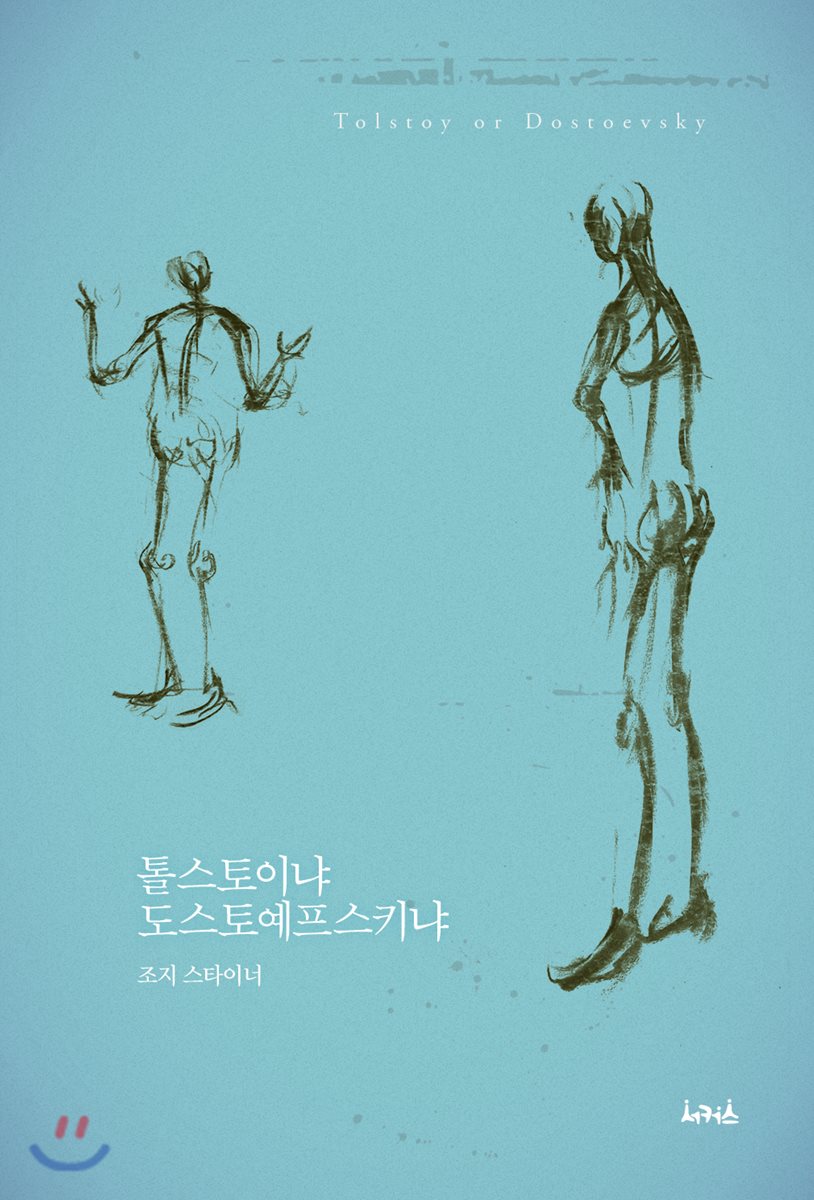
Tolstoy or Dostoevsky
 |
Description
Book Introduction
Tolstoy or Dostoevsky deals head-on with the literary, philosophical, and theological achievements of two Russian writers who achieved the pinnacle of prose fiction in Western literary history.
Steiner asserts that the works of these two Russian giants stand tall among the pinnacles of Western fiction, vastly surpassing the masterpieces of Balzac, Dickens, and Flaubert.
Tolstoy is 'epic' enough to be associated with Homer, and no one has depicted human life, both domestic and heroic, so perfectly.
And Dostoevsky is the greatest and most polyphonic playwright since Shakespeare, and no one has delved so deeply into the human soul.
The epic grandeur of Tolstoy's novels and the fantastic and revelatory intensity of Dostoevsky's novels are the highest achievements of prose fiction.
Steiner examines the relationship between the literature of Tolstoy and Dostoevsky, which took place in Russia, a periphery of Western literature, and the Western literary tradition, linking it to the influence of Homer, Dante, Shakespeare, Racine, Corneille, Schiller, Balzac, Dickens, Flaubert, and the masters of the Gothic novel, and examines the literary achievements of these two giants by moving across literature, history, and theology.
Steiner asserts that the works of these two Russian giants stand tall among the pinnacles of Western fiction, vastly surpassing the masterpieces of Balzac, Dickens, and Flaubert.
Tolstoy is 'epic' enough to be associated with Homer, and no one has depicted human life, both domestic and heroic, so perfectly.
And Dostoevsky is the greatest and most polyphonic playwright since Shakespeare, and no one has delved so deeply into the human soul.
The epic grandeur of Tolstoy's novels and the fantastic and revelatory intensity of Dostoevsky's novels are the highest achievements of prose fiction.
Steiner examines the relationship between the literature of Tolstoy and Dostoevsky, which took place in Russia, a periphery of Western literature, and the Western literary tradition, linking it to the influence of Homer, Dante, Shakespeare, Racine, Corneille, Schiller, Balzac, Dickens, Flaubert, and the masters of the Gothic novel, and examines the literary achievements of these two giants by moving across literature, history, and theology.
- You can preview some of the book's contents.
Preview
index
Preface to the Second Edition
Chapter 1
Chapter 2
Chapter 3
Chapter 4
References
index
Translator's Note
Chapter 1
Chapter 2
Chapter 3
Chapter 4
References
index
Translator's Note
Into the book
There are too many books that fail to enrich our consciousness or become a source of life, instead luring us into a world of easy, shallow, and temporary comfort.
But the task of dealing with such books belongs to the book reviewer, not to the critic's meditative and re-creative skills.
“100 Masterpieces” No, there are more than a thousand masterpieces.
But the number is not endless.
Unlike book reviewers or literary historians, critics should be interested only in masterpieces.
His primary function is not to distinguish between good and bad, but to distinguish between good and best.
The oral world begins with admiration.
It sometimes steps back from the text and examines its moral purpose.
It also considers literature not as an isolated entity, but as situated at the center of the workings of historical and political forces.
Above all, the scope and nature of oral criticism are philosophical.
Generalizing this idea leads to the belief that Sartre expressed in his Faulknerian theory.
That is, “the technique of the novel always guides to the metaphysics of the novelist.”
A work of art is a collection of mythological systems of thought, a heroic effort of the human soul to impose order and interpretation on disorderly experience.
The flowering of the 19th-century Russian novel could be considered one of the three great triumphs in the history of Western literature.
The other two can be said to be the era of the Athenian playwrights and Plato and the era of Shakespeare.
In these three periods, the Western mind plunged into darkness through poetic intuition, and at the same time the light of human nature was condensed.
Tolstoy and Dostoevsky, in addition to their creative writing, also engaged in political theory, theology, and historical research, an extravagance that is often dismissed as the eccentric pastimes of genius or an example of the strange blindness often inherited by great minds.
Even when it became an object of serious interest, philosophy remained philosophy and novels remained novels.
But in mature art, technique and metaphysics are two sides of a single whole.
As with Dante, in Tolstoy and Dostoevsky poetry and metaphysics, the impulse to creation and the impulse to systematic knowledge, respond alternately to the pressures of experience, and these two are inseparable.
Herein lies a fundamental distinction between Western and Russian 19th-century novels.
The tradition of Balzac, Dickens, and Flaubert was secular.
The art of Tolstoy and Dostoevsky was religious.
It stemmed from a climate steeped in religious experience and the belief that Russia was destined to play a prominent role in the impending apocalypse.
Tolstoy and Dostoevsky, no less than Aeschylus or Milton, were men whose genius was entrusted to the hands of the living God.
For them, as for Kierkegaard, the fate of man was either this or that.
Tolstoy rejected his own novels in the belief that didacticism should take precedence over all else.
But he knew that War and Peace, Anna Karenina, and the other great novellas would still stand tall.
So Tolstoy found solace in his own explicitly moralistic plays, and continued to argue that Shakespeare had distorted and betrayed the proper function of drama.
Tolstoy is completely unconcerned with the question of why it is the playwright's responsibility to provide morality and "guidance for life."
He had staked enormously on his stubborn effort to impose consistent principles on his life, to insist that he had always been a hedgehog.
The 19th century's dream of creating a tragic form comparable in sublimity and coherence to classical and Renaissance drama found its fulfillment in music.
It is perfectly achieved in the solemnity and sorrow of Beethoven's quartet, Schubert's C major quintet, Verdi's [Otello], and above all, [Tristan und Isolde].
The great ambition to “resurrect” poetic tragedy seized the Romantic movement, but it remained unrealized.
As theatre regained its vitality with Ibsen and Chekhov, the old forms of heroism were irretrievably altered.
But the 19th century produced a great tragedy in the person of Dostoevsky.
Our minds, which had been advancing along the lines of King Lear and Phedre, stopped suddenly as they reached The Idiot, The Possessed, and The Brothers Karamazov.
As Vyacheslav Ivanov put it in his search for a definitive image, Dostoevsky is “Russian Shakespeare.”
That is, more than any novelist of comparable scale to Dostoevsky, his sensibility, his style of imagination, his use of language, etc., are connected to drama.
The relationship between Dostoevsky and drama is similar to that between Tolstoy and epic poetry, both in its centrality and in its influence.
This characterizes his genius so strongly that it is compared to that of Tolstoy.
He had a habit of imitating the gestures of his characters while writing, much like Dickens, a gesture that revealed his playwright's temperament.
As is clear from 『Oresteia』, 『Oedipus』, 『Hamlet』, and 『Macbeth』, murder and the tragic form have been in harmony since ancient times.
Perhaps, as anthropologists have said, the very origins of drama are imbued with a faint but indelible memory of sacrificial rites.
Perhaps the pendulum swing from murder to punishment uniquely represents the progress from disorder to reconciliation and balance, a progression that immediately evokes our own thoughts about tragedy.
Moreover, murder ends privacy.
In other words, in the assassin's house, the door can be opened at any time.
He has only three walls, which means he lives “on stage.”
Dostoevsky perceived time from the perspective of a playwright.
In his notes for Crime and Punishment, he asked, “What is time?” and answered:
“Time does not exist.
Time is a series of numbers.
“Time is the relationship between beings and non-being.” It was an instinct for him to concentrate and harmonize countless entangled actions in a minimal amount of time.
This concentration creates a feeling of nightmare.
That is, the feeling of language and gestures after removing everything that relieves and delays.
Dostoevsky pondered for a long time how to end The Idiot.
In one conception, Nastasya marries Myshkin, in another she runs away to a brothel on their wedding night, and in a third she marries Rogozhin.
However, another variation has Nastasya befriending Aglaya and arranging her marriage to the Duke, and even considering the possibility of Aglaya becoming Mishkin's mistress.
The very fact that he cannot make a decision like this shows how profound and free Dostoevsky's imagination is.
While Tolstoy treated his characters with omnipotence and ruthlessness, as if God were ruling over them, Dostoevsky, like all true playwrights, seems to have listened with an inner ear to the dynamics of independent and unpredictable behavior.
A look at the notes to "The Idiot" reveals that motifs and themes recur frequently in Dostoevsky's novels (Proust argued that all of Dostoevsky's novels could be titled "Crime and Punishment").
As initially conceived, “The Idiot” not only embodies many of Stavrogin’s traits, but also perfectly matches the protagonist of “The Possessed” in that he is secretly married and publicly humiliated.
Even looking at the later conception, it seems that Myshkin is supported by “a group” of children.
They play a crucial role in the plot development and help reveal Myshkin's true nature.
This again becomes the story of Alyosha in the epilogue of The Brothers Karamazov.
The law of conservation of mass seems to exist not only in nature but also in the poetics of creation.
Although the autobiographical tendencies of Dostoevsky's novels are important, they should not be exaggerated.
In a letter to Strahov in February 1869, the novelist asserts:
“If I were to describe my own view of art, it would be as follows.
“That is, what most people see as fantastic and ununiversal, I see as the deepest essence of truth,” he added.
“Isn’t my fantastic ‘idiot’ actually the most everyday truth?” Dostoevsky was a metaphysician of the extreme.
It would also be wrong to divide Tolstoy's life into three periods: a period of literary creation and the decades surrounding that period of philosophical and religious activity.
In Tolstoy, the two formative forces cannot be separated, so the moralist and the poet coexisted closely together, opening up a painful path of creation.
Religious and artistic impulses struggled for dominance throughout his career.
This conflict was at its most acute around the time Tolstoy was writing Anna Karenina.
His large soul would at one moment lean toward the life of imagination, and at the next succumb to what Ibsen called the “demands of the ideal.”
We get the impression that only physical activity and the violent release of bodily energy gave Tolstoy peace and balance.
Only by consuming my body could I temporarily calm the raging debate in my mind.
By March 1855, Tolstoy had formed a clear set of ideas that would dominate him until the moment of his death.
He conceived the “great ideal” of building a new religion suited to the present state of humanity.
Although it was a religion of Christ, it was a religion free from dogma and mysticism, and instead of promising future bliss, it was a religion that gave bliss on earth.
This was Tolstoy's creed, and the works written and published after 1880 merely clothed this creed in its guise.
In Dostoevsky's novels, the images and situations, the names and speech habits of the characters, the terms used in general, and the nature of the actions are overwhelmingly and dramatically religious.
Dostoevsky portrays characters in a crisis between faith and denial, and it is often through denial that the characters witness the emergence of God most powerfully.
“Anyone who tries to deal with the religious element in Dostoevsky’s work soon realizes that this theme encompasses Dostoevsky’s entire world.” This assertion does not apply to Tolstoy.
War and Peace and Anna Karenina can be read as pioneers of historical and social novels, and their philosophical and religious implications are only vaguely perceived.
In our time, this conflict has erupted with implicit violence.
The "thousand-year" National Socialist Reich and the classless Soviet communist state—even though these too will ultimately disappear—have become the eschatological vision and new goal of the long-held millenarian doctrine.
This eschatology is secular because it denies God.
But the vision that underpins it is that of all millennial utopian movements.
In other words, humans must either create a good life here on earth or endure their share of suffering in a journey that is often chaotic, unjust, and incomprehensible between the two poles of darkness.
The kingdom of God must be realized as a kingdom of man: this is the theology of totalitarian utopia.
Whether this theology will overcome its imperfect and divided opponents seems an unavoidable question in this troubled century.
To put the question another way, who offers a truer picture of human nature and a more prophetic account of history, Tolstoy or Dostoevsky?
Tolstoy's genius was that of a prophet and a religious reformer, not that of a theologian in the traditional, professional sense, as Berdyaev thinks.
Tolstoy despised the rituals and eucharistic rites of the established church and considered theological debates, which had been conducted in a formal and historically sanctified manner, to be useless sophistry.
He was strongly influenced by the spirit of iconoclasm, as in Rousseau and Nietzsche.
Therefore, as an artist and religious teacher, he had a constant interest in the nature of social behavior and in the establishment of concise and rational norms for world affairs.
He sought to view Christianity as “neither a divine revelation nor a historical phenomenon, but a teaching that gives us meaning in life.”
As one recent critic put it, Tolstoy created a gospel “emptied of the irrational, stripped of metaphysical and mystical visions, stripped of metaphor and symbol, stripped of miracles and sometimes even of allegory of miracles.”
As a result, Tolstoy was able to break away from the iconography that dominated Russian thought and deal with religious subjects.
A profound and fundamental philosophy is being described.
Dostoevsky's protagonists are intoxicated by ideology and consumed by the flames of language.
This does not mean that they are allegorical types or personifications.
With the exception of Shakespeare, no one has more perfectly captured the complex dynamics of life.
This means that while other people live off of love and hate, characters like Raskolnikov, Myshkin, Kirillov, Versilov, and Ivan Karamazov live off of ideas.
While other humans burn oxygen, they burn thoughts.
But the task of dealing with such books belongs to the book reviewer, not to the critic's meditative and re-creative skills.
“100 Masterpieces” No, there are more than a thousand masterpieces.
But the number is not endless.
Unlike book reviewers or literary historians, critics should be interested only in masterpieces.
His primary function is not to distinguish between good and bad, but to distinguish between good and best.
The oral world begins with admiration.
It sometimes steps back from the text and examines its moral purpose.
It also considers literature not as an isolated entity, but as situated at the center of the workings of historical and political forces.
Above all, the scope and nature of oral criticism are philosophical.
Generalizing this idea leads to the belief that Sartre expressed in his Faulknerian theory.
That is, “the technique of the novel always guides to the metaphysics of the novelist.”
A work of art is a collection of mythological systems of thought, a heroic effort of the human soul to impose order and interpretation on disorderly experience.
The flowering of the 19th-century Russian novel could be considered one of the three great triumphs in the history of Western literature.
The other two can be said to be the era of the Athenian playwrights and Plato and the era of Shakespeare.
In these three periods, the Western mind plunged into darkness through poetic intuition, and at the same time the light of human nature was condensed.
Tolstoy and Dostoevsky, in addition to their creative writing, also engaged in political theory, theology, and historical research, an extravagance that is often dismissed as the eccentric pastimes of genius or an example of the strange blindness often inherited by great minds.
Even when it became an object of serious interest, philosophy remained philosophy and novels remained novels.
But in mature art, technique and metaphysics are two sides of a single whole.
As with Dante, in Tolstoy and Dostoevsky poetry and metaphysics, the impulse to creation and the impulse to systematic knowledge, respond alternately to the pressures of experience, and these two are inseparable.
Herein lies a fundamental distinction between Western and Russian 19th-century novels.
The tradition of Balzac, Dickens, and Flaubert was secular.
The art of Tolstoy and Dostoevsky was religious.
It stemmed from a climate steeped in religious experience and the belief that Russia was destined to play a prominent role in the impending apocalypse.
Tolstoy and Dostoevsky, no less than Aeschylus or Milton, were men whose genius was entrusted to the hands of the living God.
For them, as for Kierkegaard, the fate of man was either this or that.
Tolstoy rejected his own novels in the belief that didacticism should take precedence over all else.
But he knew that War and Peace, Anna Karenina, and the other great novellas would still stand tall.
So Tolstoy found solace in his own explicitly moralistic plays, and continued to argue that Shakespeare had distorted and betrayed the proper function of drama.
Tolstoy is completely unconcerned with the question of why it is the playwright's responsibility to provide morality and "guidance for life."
He had staked enormously on his stubborn effort to impose consistent principles on his life, to insist that he had always been a hedgehog.
The 19th century's dream of creating a tragic form comparable in sublimity and coherence to classical and Renaissance drama found its fulfillment in music.
It is perfectly achieved in the solemnity and sorrow of Beethoven's quartet, Schubert's C major quintet, Verdi's [Otello], and above all, [Tristan und Isolde].
The great ambition to “resurrect” poetic tragedy seized the Romantic movement, but it remained unrealized.
As theatre regained its vitality with Ibsen and Chekhov, the old forms of heroism were irretrievably altered.
But the 19th century produced a great tragedy in the person of Dostoevsky.
Our minds, which had been advancing along the lines of King Lear and Phedre, stopped suddenly as they reached The Idiot, The Possessed, and The Brothers Karamazov.
As Vyacheslav Ivanov put it in his search for a definitive image, Dostoevsky is “Russian Shakespeare.”
That is, more than any novelist of comparable scale to Dostoevsky, his sensibility, his style of imagination, his use of language, etc., are connected to drama.
The relationship between Dostoevsky and drama is similar to that between Tolstoy and epic poetry, both in its centrality and in its influence.
This characterizes his genius so strongly that it is compared to that of Tolstoy.
He had a habit of imitating the gestures of his characters while writing, much like Dickens, a gesture that revealed his playwright's temperament.
As is clear from 『Oresteia』, 『Oedipus』, 『Hamlet』, and 『Macbeth』, murder and the tragic form have been in harmony since ancient times.
Perhaps, as anthropologists have said, the very origins of drama are imbued with a faint but indelible memory of sacrificial rites.
Perhaps the pendulum swing from murder to punishment uniquely represents the progress from disorder to reconciliation and balance, a progression that immediately evokes our own thoughts about tragedy.
Moreover, murder ends privacy.
In other words, in the assassin's house, the door can be opened at any time.
He has only three walls, which means he lives “on stage.”
Dostoevsky perceived time from the perspective of a playwright.
In his notes for Crime and Punishment, he asked, “What is time?” and answered:
“Time does not exist.
Time is a series of numbers.
“Time is the relationship between beings and non-being.” It was an instinct for him to concentrate and harmonize countless entangled actions in a minimal amount of time.
This concentration creates a feeling of nightmare.
That is, the feeling of language and gestures after removing everything that relieves and delays.
Dostoevsky pondered for a long time how to end The Idiot.
In one conception, Nastasya marries Myshkin, in another she runs away to a brothel on their wedding night, and in a third she marries Rogozhin.
However, another variation has Nastasya befriending Aglaya and arranging her marriage to the Duke, and even considering the possibility of Aglaya becoming Mishkin's mistress.
The very fact that he cannot make a decision like this shows how profound and free Dostoevsky's imagination is.
While Tolstoy treated his characters with omnipotence and ruthlessness, as if God were ruling over them, Dostoevsky, like all true playwrights, seems to have listened with an inner ear to the dynamics of independent and unpredictable behavior.
A look at the notes to "The Idiot" reveals that motifs and themes recur frequently in Dostoevsky's novels (Proust argued that all of Dostoevsky's novels could be titled "Crime and Punishment").
As initially conceived, “The Idiot” not only embodies many of Stavrogin’s traits, but also perfectly matches the protagonist of “The Possessed” in that he is secretly married and publicly humiliated.
Even looking at the later conception, it seems that Myshkin is supported by “a group” of children.
They play a crucial role in the plot development and help reveal Myshkin's true nature.
This again becomes the story of Alyosha in the epilogue of The Brothers Karamazov.
The law of conservation of mass seems to exist not only in nature but also in the poetics of creation.
Although the autobiographical tendencies of Dostoevsky's novels are important, they should not be exaggerated.
In a letter to Strahov in February 1869, the novelist asserts:
“If I were to describe my own view of art, it would be as follows.
“That is, what most people see as fantastic and ununiversal, I see as the deepest essence of truth,” he added.
“Isn’t my fantastic ‘idiot’ actually the most everyday truth?” Dostoevsky was a metaphysician of the extreme.
It would also be wrong to divide Tolstoy's life into three periods: a period of literary creation and the decades surrounding that period of philosophical and religious activity.
In Tolstoy, the two formative forces cannot be separated, so the moralist and the poet coexisted closely together, opening up a painful path of creation.
Religious and artistic impulses struggled for dominance throughout his career.
This conflict was at its most acute around the time Tolstoy was writing Anna Karenina.
His large soul would at one moment lean toward the life of imagination, and at the next succumb to what Ibsen called the “demands of the ideal.”
We get the impression that only physical activity and the violent release of bodily energy gave Tolstoy peace and balance.
Only by consuming my body could I temporarily calm the raging debate in my mind.
By March 1855, Tolstoy had formed a clear set of ideas that would dominate him until the moment of his death.
He conceived the “great ideal” of building a new religion suited to the present state of humanity.
Although it was a religion of Christ, it was a religion free from dogma and mysticism, and instead of promising future bliss, it was a religion that gave bliss on earth.
This was Tolstoy's creed, and the works written and published after 1880 merely clothed this creed in its guise.
In Dostoevsky's novels, the images and situations, the names and speech habits of the characters, the terms used in general, and the nature of the actions are overwhelmingly and dramatically religious.
Dostoevsky portrays characters in a crisis between faith and denial, and it is often through denial that the characters witness the emergence of God most powerfully.
“Anyone who tries to deal with the religious element in Dostoevsky’s work soon realizes that this theme encompasses Dostoevsky’s entire world.” This assertion does not apply to Tolstoy.
War and Peace and Anna Karenina can be read as pioneers of historical and social novels, and their philosophical and religious implications are only vaguely perceived.
In our time, this conflict has erupted with implicit violence.
The "thousand-year" National Socialist Reich and the classless Soviet communist state—even though these too will ultimately disappear—have become the eschatological vision and new goal of the long-held millenarian doctrine.
This eschatology is secular because it denies God.
But the vision that underpins it is that of all millennial utopian movements.
In other words, humans must either create a good life here on earth or endure their share of suffering in a journey that is often chaotic, unjust, and incomprehensible between the two poles of darkness.
The kingdom of God must be realized as a kingdom of man: this is the theology of totalitarian utopia.
Whether this theology will overcome its imperfect and divided opponents seems an unavoidable question in this troubled century.
To put the question another way, who offers a truer picture of human nature and a more prophetic account of history, Tolstoy or Dostoevsky?
Tolstoy's genius was that of a prophet and a religious reformer, not that of a theologian in the traditional, professional sense, as Berdyaev thinks.
Tolstoy despised the rituals and eucharistic rites of the established church and considered theological debates, which had been conducted in a formal and historically sanctified manner, to be useless sophistry.
He was strongly influenced by the spirit of iconoclasm, as in Rousseau and Nietzsche.
Therefore, as an artist and religious teacher, he had a constant interest in the nature of social behavior and in the establishment of concise and rational norms for world affairs.
He sought to view Christianity as “neither a divine revelation nor a historical phenomenon, but a teaching that gives us meaning in life.”
As one recent critic put it, Tolstoy created a gospel “emptied of the irrational, stripped of metaphysical and mystical visions, stripped of metaphor and symbol, stripped of miracles and sometimes even of allegory of miracles.”
As a result, Tolstoy was able to break away from the iconography that dominated Russian thought and deal with religious subjects.
A profound and fundamental philosophy is being described.
Dostoevsky's protagonists are intoxicated by ideology and consumed by the flames of language.
This does not mean that they are allegorical types or personifications.
With the exception of Shakespeare, no one has more perfectly captured the complex dynamics of life.
This means that while other people live off of love and hate, characters like Raskolnikov, Myshkin, Kirillov, Versilov, and Ivan Karamazov live off of ideas.
While other humans burn oxygen, they burn thoughts.
--- From the text
Publisher's Review
An unprecedented masterpiece in 20th-century Western criticism, featuring two great giants: Tolstoy and Dostoevsky.
'The smartest man in the world', 'the polymath of polymaths', 'Renaissance man', 'a man well-versed in all cultures from the pre-Socratic era to the post-modern era', 'the greatest critic of the 20th century who changed the concept of criticism'.
When we collect the words used to describe George Steiner, they all reveal a reverence for the heights to which a human intellect has reached.
Within the Western intellectual tradition, few have been as well-versed in the traditions and achievements of Western literature as George Steiner, and have defended them with such uncompromising tenacity.
His admiration for literature and the arts, which began when he read Homer in its original form at the age of six, continued throughout his life as he continued to revere the canonical works of mankind.
Tolstoy or Dostoevsky is George Steiner's first critical work, published in 1960 while he was a research fellow at Princeton University, and is his representative work that brought him to the attention of literary circles on both sides of the Atlantic.
Since then, Steiner has published over 40 dense books on literature, language, and philosophy over the course of 40 years, but as the author himself reveals in the preface to this book, “All of my work and teachings spring from the first sentence of Tolstoy or Dostoevsky: ‘Literary criticism must begin with a debt of love,’” This work is a milestone for Steiner’s future writing activities and has become a classic of criticism.
Tolstoy or Dostoevsky deals head-on with the literary, philosophical, and theological achievements of two Russian writers who achieved the pinnacle of prose fiction in Western literary history.
Steiner asserts that the works of these two Russian giants stand tall among the pinnacles of Western fiction, vastly surpassing the masterpieces of Balzac, Dickens, and Flaubert.
Tolstoy is 'epic' enough to be associated with Homer, and no one has depicted human life, both domestic and heroic, so perfectly.
And Dostoevsky is the greatest and most polyphonic playwright since Shakespeare, and no one has delved so deeply into the human soul.
The epic grandeur of Tolstoy's novels and the fantastic and revelatory intensity of Dostoevsky's novels are the highest achievements of prose fiction.
Steiner examines the relationship between the literature of Tolstoy and Dostoevsky, which took place in Russia, a periphery of Western literature, and the Western literary tradition, linking it to the influence of Homer, Dante, Shakespeare, Racine, Corneille, Schiller, Balzac, Dickens, Flaubert, and the masters of the Gothic novel, and examines the literary achievements of these two giants by moving across literature, history, and theology.
The two giants, Tolstoy and Dostoevsky, are so compelling that one is tempted to compare them, says author Steiner, but it quickly becomes clear that he did not write this masterpiece simply out of curiosity.
In addition to highlighting the literary achievements of the two novelists, the author's own experience of the tragic world history of the 20th century casts a shadow over his own existential motivation for writing this book.
Steiner identifies their theology as the core of the excellence that makes these two novelists surpass all other novelists.
The two giants, Tolstoy and Dostoevsky, created the third great triumphal period in the history of Western literature, following the era of Plato, the Greek tragedians, and Shakespeare, in which 'all the light of human nature was concentrated at once.'
However, the two people lived in the same space called Russia at the same time and never met in their lifetimes, and the theology of the two people in an irreconcilable conflict is the background here.
Tolstoy's theology, which sought to establish a new Christian religion that sought bliss on earth where dogma and mysticism were eliminated, and Dostoevsky's theology, which sought to follow Christ even if it meant being branded a heretic, clash head-on in the famous scene of the Grand Inquisitor in The Brothers Karamazov.
The theological confrontation between Tolstoy and Dostoevsky offers a new perspective on the tragedies brought about by the secular utopian movements of the 20th century—Nazism, fascism, and Russian communism.
Count Tolstoy, a haughty local baron, was enshrined by Marxist critics in the pantheon of revolutionaries as a spokesman for proletarian nationalism, while Dostoevsky, a condemned radical and survivor of the Siberian exile, was exiled from the 'homeland of the proletariat'.
What does this paradox tell us?
Steiner's exploration of the theology of Tolstoy and Dostoevsky raises the weighty question of why humanity's age-old fantasy of realizing a utopia on earth was transformed into a nightmare through the practical utopian movement of the 20th century.
George Steiner began his critical career by advocating for "old criticism" during the era when "new criticism" was in the spotlight. (The subtitle of this book is "An Essay from an Old Critical Perspective.") While new criticism advocated for the autonomy and deconstruction of the text, the concept of poetic language, and the "death of the author," old criticism begins with admiration and, rather than viewing literature as an isolated entity, emphasizes the existential and temporal identity of the author within a historical and social context.
In a relativistic age dominated by tastes and trends, Steiner asks whether it is anachronistic to establish a new standard for absolute canon, but he counters by asking whether relativism ultimately breeds disorder.
And for Steiner, the exploration of the metaphysical-theological dimension that has given Western literature the concept of canon is also an exploration of the core of the novel.
George Steiner reveals the full impact and grandeur of the literature of Tolstoy and Dostoevsky more fully than anyone before him.
Readers will be able to experience the rare experience of criticism not only being an object of admiration but also of being moved.
'The smartest man in the world', 'the polymath of polymaths', 'Renaissance man', 'a man well-versed in all cultures from the pre-Socratic era to the post-modern era', 'the greatest critic of the 20th century who changed the concept of criticism'.
When we collect the words used to describe George Steiner, they all reveal a reverence for the heights to which a human intellect has reached.
Within the Western intellectual tradition, few have been as well-versed in the traditions and achievements of Western literature as George Steiner, and have defended them with such uncompromising tenacity.
His admiration for literature and the arts, which began when he read Homer in its original form at the age of six, continued throughout his life as he continued to revere the canonical works of mankind.
Tolstoy or Dostoevsky is George Steiner's first critical work, published in 1960 while he was a research fellow at Princeton University, and is his representative work that brought him to the attention of literary circles on both sides of the Atlantic.
Since then, Steiner has published over 40 dense books on literature, language, and philosophy over the course of 40 years, but as the author himself reveals in the preface to this book, “All of my work and teachings spring from the first sentence of Tolstoy or Dostoevsky: ‘Literary criticism must begin with a debt of love,’” This work is a milestone for Steiner’s future writing activities and has become a classic of criticism.
Tolstoy or Dostoevsky deals head-on with the literary, philosophical, and theological achievements of two Russian writers who achieved the pinnacle of prose fiction in Western literary history.
Steiner asserts that the works of these two Russian giants stand tall among the pinnacles of Western fiction, vastly surpassing the masterpieces of Balzac, Dickens, and Flaubert.
Tolstoy is 'epic' enough to be associated with Homer, and no one has depicted human life, both domestic and heroic, so perfectly.
And Dostoevsky is the greatest and most polyphonic playwright since Shakespeare, and no one has delved so deeply into the human soul.
The epic grandeur of Tolstoy's novels and the fantastic and revelatory intensity of Dostoevsky's novels are the highest achievements of prose fiction.
Steiner examines the relationship between the literature of Tolstoy and Dostoevsky, which took place in Russia, a periphery of Western literature, and the Western literary tradition, linking it to the influence of Homer, Dante, Shakespeare, Racine, Corneille, Schiller, Balzac, Dickens, Flaubert, and the masters of the Gothic novel, and examines the literary achievements of these two giants by moving across literature, history, and theology.
The two giants, Tolstoy and Dostoevsky, are so compelling that one is tempted to compare them, says author Steiner, but it quickly becomes clear that he did not write this masterpiece simply out of curiosity.
In addition to highlighting the literary achievements of the two novelists, the author's own experience of the tragic world history of the 20th century casts a shadow over his own existential motivation for writing this book.
Steiner identifies their theology as the core of the excellence that makes these two novelists surpass all other novelists.
The two giants, Tolstoy and Dostoevsky, created the third great triumphal period in the history of Western literature, following the era of Plato, the Greek tragedians, and Shakespeare, in which 'all the light of human nature was concentrated at once.'
However, the two people lived in the same space called Russia at the same time and never met in their lifetimes, and the theology of the two people in an irreconcilable conflict is the background here.
Tolstoy's theology, which sought to establish a new Christian religion that sought bliss on earth where dogma and mysticism were eliminated, and Dostoevsky's theology, which sought to follow Christ even if it meant being branded a heretic, clash head-on in the famous scene of the Grand Inquisitor in The Brothers Karamazov.
The theological confrontation between Tolstoy and Dostoevsky offers a new perspective on the tragedies brought about by the secular utopian movements of the 20th century—Nazism, fascism, and Russian communism.
Count Tolstoy, a haughty local baron, was enshrined by Marxist critics in the pantheon of revolutionaries as a spokesman for proletarian nationalism, while Dostoevsky, a condemned radical and survivor of the Siberian exile, was exiled from the 'homeland of the proletariat'.
What does this paradox tell us?
Steiner's exploration of the theology of Tolstoy and Dostoevsky raises the weighty question of why humanity's age-old fantasy of realizing a utopia on earth was transformed into a nightmare through the practical utopian movement of the 20th century.
George Steiner began his critical career by advocating for "old criticism" during the era when "new criticism" was in the spotlight. (The subtitle of this book is "An Essay from an Old Critical Perspective.") While new criticism advocated for the autonomy and deconstruction of the text, the concept of poetic language, and the "death of the author," old criticism begins with admiration and, rather than viewing literature as an isolated entity, emphasizes the existential and temporal identity of the author within a historical and social context.
In a relativistic age dominated by tastes and trends, Steiner asks whether it is anachronistic to establish a new standard for absolute canon, but he counters by asking whether relativism ultimately breeds disorder.
And for Steiner, the exploration of the metaphysical-theological dimension that has given Western literature the concept of canon is also an exploration of the core of the novel.
George Steiner reveals the full impact and grandeur of the literature of Tolstoy and Dostoevsky more fully than anyone before him.
Readers will be able to experience the rare experience of criticism not only being an object of admiration but also of being moved.
GOODS SPECIFICS
- Date of issue: May 1, 2019
- Page count, weight, size: 584 pages | 536g | 128*190*35mm
- ISBN13: 9791187295310
- ISBN10: 1187295310
You may also like
카테고리
korean


korean

![GQ KOREA Mark (Monthly): December [2025]](http://librairie.coreenne.fr/cdn/shop/files/8ef265dbbfbf186523ed75ba7319009d.jpg?v=1765340328&width=3840)


