

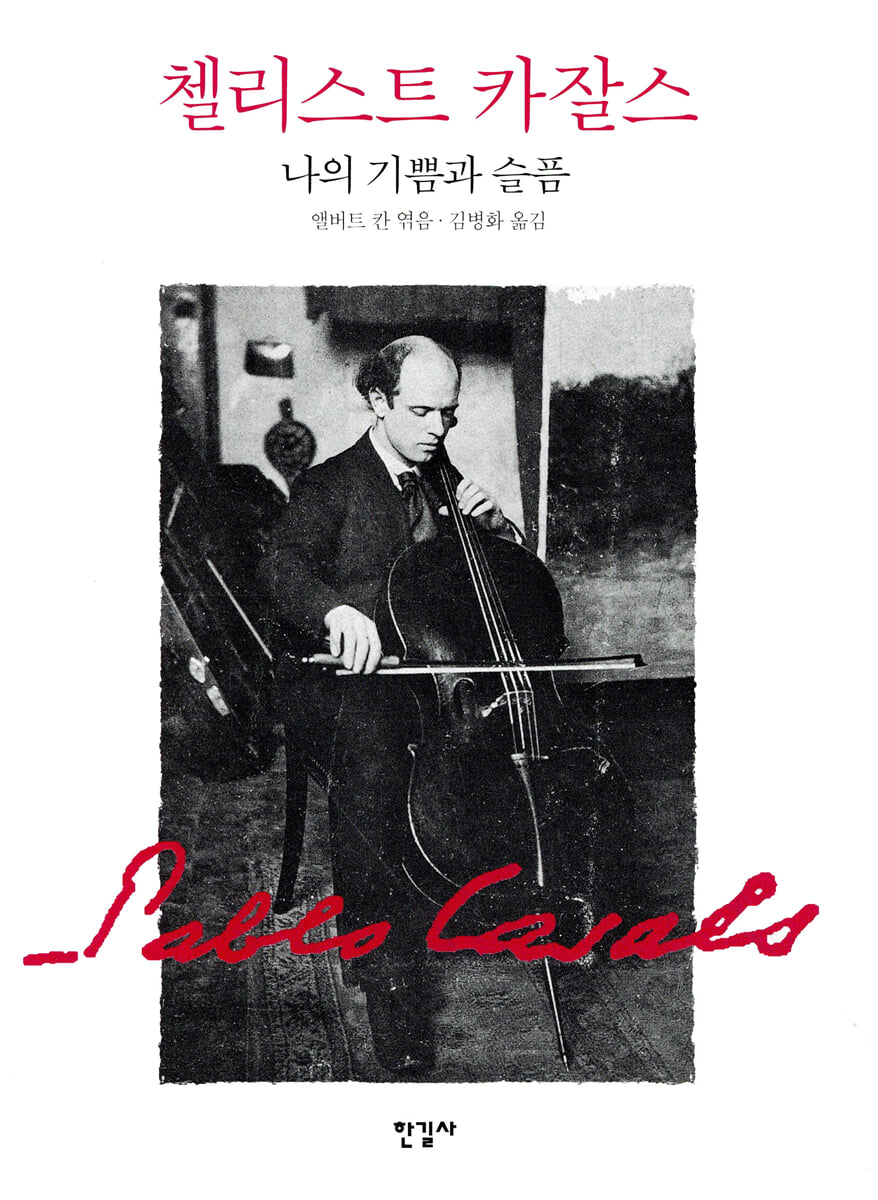
Cellist Casals, My Joys and Sorrows
 |
Description
Book Introduction
“Any insult to human dignity is an insult to me.
“Does human rights matter less to artists than to ordinary people?” - Pablo Casals
Pablo Casals (1876-1973) dictated and Albert E.
Kahn's 『Cellist Casals, My Joys and Sorrows』 is a book that contains the life of a Catalan artist who experienced World War I and II and the Spanish Civil War with his whole body.
Casals, who lived for a long time, about a century, did everything he could as an artist to protect human values during three wars that shocked modern history.
Casals, who said that “an artist’s life cannot be separated from his ideology,” did not hesitate to take actions that might be perceived as political.
The values he pursued were born from love for humanity and life, free from personal greed.
Casals's intense life, based on love, gives readers the courage and hope to live.
A master cellist who rediscovered Bach's unaccompanied cello suites, known as the 'Old Testament of cello performance', and developed an innovative cello fingering method.
A republican who knew how to see the value of labor and respect the individual's personality.
The countless contexts and depths contained in his every word carry weight and resonance far beyond the content of a few pages or words.
“Does human rights matter less to artists than to ordinary people?” - Pablo Casals
Pablo Casals (1876-1973) dictated and Albert E.
Kahn's 『Cellist Casals, My Joys and Sorrows』 is a book that contains the life of a Catalan artist who experienced World War I and II and the Spanish Civil War with his whole body.
Casals, who lived for a long time, about a century, did everything he could as an artist to protect human values during three wars that shocked modern history.
Casals, who said that “an artist’s life cannot be separated from his ideology,” did not hesitate to take actions that might be perceived as political.
The values he pursued were born from love for humanity and life, free from personal greed.
Casals's intense life, based on love, gives readers the courage and hope to live.
A master cellist who rediscovered Bach's unaccompanied cello suites, known as the 'Old Testament of cello performance', and developed an innovative cello fingering method.
A republican who knew how to see the value of labor and respect the individual's personality.
The countless contexts and depths contained in his every word carry weight and resonance far beyond the content of a few pages or words.
- You can preview some of the book's contents.
Preview
index
Why I'm So Moved by His Music │ Cellist Yang Seong-won
In front of Casals' portrait │ Compiled by Albert Kahn
Life without retirement
The world of music opens up
Bach, the fountain of my soul
Pilgrimage of Youth and Poverty
Get off the ground and stand up
Entering the White House with a cello
Human figures
Casals' appearance during the interview
Casals refuses to play today
Who is this music for?
The setting sun over my homeland, Spain
The Shadow of Fascism
My weapon, the cello
Silence! I'm talking about principles.
Peace in a manger
Casals Chronology 1876–1973
Casals' Immortal Albums
Why Do You Make Music? │ Translated by Kim Byeong-hwa
Search
In front of Casals' portrait │ Compiled by Albert Kahn
Life without retirement
The world of music opens up
Bach, the fountain of my soul
Pilgrimage of Youth and Poverty
Get off the ground and stand up
Entering the White House with a cello
Human figures
Casals' appearance during the interview
Casals refuses to play today
Who is this music for?
The setting sun over my homeland, Spain
The Shadow of Fascism
My weapon, the cello
Silence! I'm talking about principles.
Peace in a manger
Casals Chronology 1876–1973
Casals' Immortal Albums
Why Do You Make Music? │ Translated by Kim Byeong-hwa
Search
Into the book
I turned ninety-three on my last birthday (December 29, 1969).
--- First sentence
I couldn't just get lost in the music anymore.
At that time, and since then, I felt that music, or any form of art, could not provide the answer in itself.
Music should serve a purpose.
It must become part of something bigger than itself, part of humanity.
In fact, the core of my opinion on contemporary music, that it lacks humanity, lies in the above judgment.
Musicians are human too.
It's your attitude towards life that's more important than the music itself.
Also, those two things cannot be separated from each other.
--- p.76
The conversation with Bergson was particularly interesting.
…one topic we talked about a lot was intuition.
Of course, he wrote a lot on the subject.
He was particularly curious about the role of intuition in music.
For me, intuition has been a crucial factor in both composing and performing music.
--- p.134
He had a younger sister who was a medical student, a strong-looking, beautiful, and determined woman in her twenties.
He was a man of outstanding intelligence and vivid self-expression.
Her name was Gertrude.
Of course, at that time, Gertrude Stein was not yet a world-famous celebrity.
--- p.147
We were practicing at the hotel before the concert, and we didn't realize how much time had passed until it was time to start the concert.
When it was time to start, I hurriedly changed into my performance clothes, but my foot got caught while pulling on my pants.
I was so high on medicine that I kicked my foot hard, and suddenly my trouser leg ripped open and my foot went right through it! I almost fainted.
--- pp.158-159
As I was drawing the bow to the string to produce the first note, I suddenly and horribly felt the bow slipping out of my fingers.
I was desperately trying to catch it properly, but my movements were too rough.
The bow was knocked out of his hand, and as he looked on in horror and despair, it flew over the heads of the audience in the first row.
Not a single pin drop could be heard in the concert hall.
--- p.173
I was in Paris when the war broke out.
The whole city went wild.
I think there must have been some awareness that it was a terrible disaster that would engulf the entire country.
But it wasn't.
On the contrary, it was a wild, festival-like atmosphere.
Bands played military music, flags waved from every window, and pompous speeches about honor and patriotism were delivered! What a terrifying parade it was!
--- p.228
I know there are people who don't love animals.
But I think that's because they don't know much about animals.
Or maybe it's because I really didn't look at them properly.
…sometimes animals do not trust people and are afraid of them, but that is because people have treated them arrogantly and indifferently.
--- p.267
I heard that my house in San Salvador was taken over by fascist troops.
I couldn't get the terrible thoughts out of my head.
Thoughts came rushing in like waves.
I felt like I was going to drown in it.
I sat in my room, pulled down all the blinds, and just stared into the darkness.
Perhaps he was trying to find some kind of oblivion in the darkness that could free him from his suffering.
…I was probably on the verge of going crazy or on the verge of death.
I really didn't want to live.
--- p.309
It is natural for anyone to love their country.
But why should that love stop at the border?
--- First sentence
I couldn't just get lost in the music anymore.
At that time, and since then, I felt that music, or any form of art, could not provide the answer in itself.
Music should serve a purpose.
It must become part of something bigger than itself, part of humanity.
In fact, the core of my opinion on contemporary music, that it lacks humanity, lies in the above judgment.
Musicians are human too.
It's your attitude towards life that's more important than the music itself.
Also, those two things cannot be separated from each other.
--- p.76
The conversation with Bergson was particularly interesting.
…one topic we talked about a lot was intuition.
Of course, he wrote a lot on the subject.
He was particularly curious about the role of intuition in music.
For me, intuition has been a crucial factor in both composing and performing music.
--- p.134
He had a younger sister who was a medical student, a strong-looking, beautiful, and determined woman in her twenties.
He was a man of outstanding intelligence and vivid self-expression.
Her name was Gertrude.
Of course, at that time, Gertrude Stein was not yet a world-famous celebrity.
--- p.147
We were practicing at the hotel before the concert, and we didn't realize how much time had passed until it was time to start the concert.
When it was time to start, I hurriedly changed into my performance clothes, but my foot got caught while pulling on my pants.
I was so high on medicine that I kicked my foot hard, and suddenly my trouser leg ripped open and my foot went right through it! I almost fainted.
--- pp.158-159
As I was drawing the bow to the string to produce the first note, I suddenly and horribly felt the bow slipping out of my fingers.
I was desperately trying to catch it properly, but my movements were too rough.
The bow was knocked out of his hand, and as he looked on in horror and despair, it flew over the heads of the audience in the first row.
Not a single pin drop could be heard in the concert hall.
--- p.173
I was in Paris when the war broke out.
The whole city went wild.
I think there must have been some awareness that it was a terrible disaster that would engulf the entire country.
But it wasn't.
On the contrary, it was a wild, festival-like atmosphere.
Bands played military music, flags waved from every window, and pompous speeches about honor and patriotism were delivered! What a terrifying parade it was!
--- p.228
I know there are people who don't love animals.
But I think that's because they don't know much about animals.
Or maybe it's because I really didn't look at them properly.
…sometimes animals do not trust people and are afraid of them, but that is because people have treated them arrogantly and indifferently.
--- p.267
I heard that my house in San Salvador was taken over by fascist troops.
I couldn't get the terrible thoughts out of my head.
Thoughts came rushing in like waves.
I felt like I was going to drown in it.
I sat in my room, pulled down all the blinds, and just stared into the darkness.
Perhaps he was trying to find some kind of oblivion in the darkness that could free him from his suffering.
…I was probably on the verge of going crazy or on the verge of death.
I really didn't want to live.
--- p.309
It is natural for anyone to love their country.
But why should that love stop at the border?
--- p.390
Publisher's Review
Pablo Casals (1876-1973) dictated and Albert E.
Kahn's 『Cellist Casals, My Joys and Sorrows』 is a book that contains the life of a Catalan artist who experienced World War I and II and the Spanish Civil War with his whole body.
Casals, who lived for a long time, about a century, did everything he could as an artist to protect human values during three wars that shocked modern history.
Pablo Casals, the artist who loved life
“If you can continue to work and constantly feel the beauty of the world around you, you will come to understand that growing older does not necessarily mean getting old.
…I am more deeply moved by many things than ever before, and life becomes more wonderful as time goes by.”_Page 29
The opening chapter of the book, “Life Without Retirement,” expresses Casals’s joy in life from the very title.
Every moment we are thrown into life until it ends in death.
There can be no such thing as 'retirement' in life, as even a brief rest and a moment to catch one's breath constitute a part of life.
This is the ultimate task given to us.
The reason Casals was able to not give up on himself and those around him in the midst of a turbulent era that shook the world was probably because he respected life itself and knew its beauty.
In an age where old age is given negative value and productivity becomes the reason for existence, Casals's voice sounds even more urgent.
Opening a new paradigm in cello performance
There is an adjective that always follows Pablo Casals' name.
It is 'Bach's Unaccompanied Cello Suites'.
In 1890, at the age of thirteen, Casals fatefully encountered the sheet music for Bach's unaccompanied cello suites in an antique music bookstore in Barcelona that he visited with his father.
This suite, consisting of 6 songs and 36 movements, had been treated as a series of isolated cello exercises until Casals.
However, Casals discovered the organic beauty of the suite only when he played all six pieces as a whole, and he did not perform it officially until he was twenty-five, after practicing for over ten years.
This piece, filled solely with the melody of the cello strings without any accompaniment, demands a solid skill from the performer, to the point of making the performer feel as if he or she has been 'stripped bare'.
An artist who faced the seriousness head on and acted optimistically
“What they are saying is that I need to understand the intricacies of diplomacy.
“You have to wait for things to happen in order.”_Page 342
It is easy for an individual to feel helpless in the face of massive social trends.
Especially when it is directly linked to politics, it hits an even bigger wall.
Casals, who was in the midst of the two world wars and the interwar Spanish Civil War, was a man who, while acutely aware of these limitations, set out to find what he had to do.
In 1936, a rehearsal of Beethoven's Ninth Symphony was underway at the Montjuïc Palace in Barcelona, the same place where the proclamation of the Second Spanish Republic was celebrated.
Just before the last movement began, a man ran onto the stage.
He handed Casals an envelope.
Inside was a telegram warning that fascist troops were advancing on Barcelona and that they should stop playing immediately and evacuate.
The musicians finished their performance as a farewell to each other in the face of the grim news and dispersed into the eerie streets.
“The only weapons I have, as always, are my cello and my baton.
During the civil war, I used that weapon to the fullest extent to support the causes I believed in, freedom and democracy.
…I traveled extensively, holding charity concerts to raise money for food, clothing, and medical assistance.”_298-299
During the horrific civil war, Casals served as honorary president of the Committee of Musicians Supporting Democracy in Spain, raising funds through charity concerts and performing at special concerts for the Children's Rescue Foundation, drawing global attention to the civil war.
After the end of World War II, he became deeply disappointed with the world's attitude towards the fascist Franco regime and declared that he would no longer perform publicly, going into seclusion in Prades.
His search for practical solutions within his own context gives us the courage to act now that we have realized that the most personal is political.
“I decided that there was only one thing I had to do at this critical time.
… a way of protesting wholeheartedly and making it clear that you are in complete agreement.”_Page 342
“I also knew that it would have virtually no influence on the direction of the country’s policies.
In the end, it's just one person's actions.
But there was no other way to act.
“Everyone has to live in their own way.”_Page 345
An artist who knew the value of labor
In 1920, Casals founded the Pau Casals Orchestra.
Although it began with a national desire to create music for the Catalan people, he saw the orchestra's success as the realization of another belief.
“It is true that I am an artist, but when you look at the process of realizing art, I am also a manual laborer.
I've been like that my whole life.”_Page 98
Casals' childhood was closely intertwined with the lives of workers.
The Café Toast, where he earned money playing the cello as a child, was frequented by nearby workers, and Casals must have naturally learned from their enjoyment of classical music that anyone can appreciate culture if given the chance.
It was no coincidence that Casals, who felt the personal dignity of each worker through personal interactions, came up with music for them.
“If you think about it, aren’t they the ones who created most of our country’s wealth?
“But why should they be unable to enjoy our country’s cultural heritage?”_Page 253
“The idea of giving a free concert didn’t really appeal to me.
I knew that workers also had pride,
Because I knew that if it looked like a good deed, they would never accept it.”_Page 253
Casals founded the Workers' Concert Association, which consisted solely of workers, and held concerts exclusively for them.
The membership fee was about $1, which was an affordable fee and enough to make workers feel they were exercising their rights fairly.
Casals proposed that the association publish a musical periodical, Fruicions, which would give the workers an opportunity to establish their own musical foundation rather than simply be consumers.
Afterwards, the association grew strong enough to organize its own music library and music school.
Casals, the human being, expressed in his unadorned and honest voice.
Despite three wars and the hardships of his time studying in Paris, Casals's artistic career was relatively successful.
At first glance, it may seem like the smooth road to life of an unapproachable genius: his father, who was an artist, his mother, who recognized his son's potential and paved the way for him to become an artist; the cello, which he met as if by fate while performing on the street; Josep Garcia, his great first teacher; the owner of Café Toast, who gave young Casals the authority to plan performance programs and the experience of enjoying music; and the meeting with Count de Morphy, who provided him with generous mental and material support.
However, Casals' honest voice has a charm that makes even ordinary people empathize with his life, separate from his musical achievements.
Especially in the scene where he confesses his anxiety before a concert, we can vaguely guess at Casals' 'human' side and the weight that a master of a field must bear.
“That was 80 years ago, but even now, the anxiety before a concert is something I can’t seem to overcome.
That's always torture.
Before going on stage, my chest hurts as if something is stabbing it.
It's really painful.
The thought of playing in front of others is still a nightmare.”_Page 67
“Oddly enough, the first thought that came to mind as I looked at my bloody fingers was, ‘Oh, thank goodness, I won’t have to play the cello again.’
… In fact, dedicating one's life to art is a kind of slavery.
And, needless to say, I always feel terrible anxiety before a performance.”_pp. 146-147
The lingering joy and sorrow of Casals
If we look at the life of 'Pablo Casals' as a symphony, it can be said to be composed of the first movement (childhood) in which he discovered his potential as an artist, the second movement (studying abroad) in which he laid the foundation for that, the third movement (concert tour) in which he steadily built his reputation as an artist, and finally the fourth movement (late years) in which he made the most of his efforts to create a better world.
It would be absurd to summarize Casals' life of nearly 100 years in a single book.
But, as he himself said, “Music is not something that can be turned on like a faucet and then quickly turned off, but something that must be approached with one’s entire self,” Casals seems to have succeeded in revealing himself as a whole even in this book, “Casals the Cellist, My Joys and Sorrows.”
The countless contexts and depths contained in his every word carry weight and resonance far beyond the content of a few pages or words.
“The only achievement we can claim is the talent we were born with.
It's about what it's used for."_Page 54
Kahn's 『Cellist Casals, My Joys and Sorrows』 is a book that contains the life of a Catalan artist who experienced World War I and II and the Spanish Civil War with his whole body.
Casals, who lived for a long time, about a century, did everything he could as an artist to protect human values during three wars that shocked modern history.
Pablo Casals, the artist who loved life
“If you can continue to work and constantly feel the beauty of the world around you, you will come to understand that growing older does not necessarily mean getting old.
…I am more deeply moved by many things than ever before, and life becomes more wonderful as time goes by.”_Page 29
The opening chapter of the book, “Life Without Retirement,” expresses Casals’s joy in life from the very title.
Every moment we are thrown into life until it ends in death.
There can be no such thing as 'retirement' in life, as even a brief rest and a moment to catch one's breath constitute a part of life.
This is the ultimate task given to us.
The reason Casals was able to not give up on himself and those around him in the midst of a turbulent era that shook the world was probably because he respected life itself and knew its beauty.
In an age where old age is given negative value and productivity becomes the reason for existence, Casals's voice sounds even more urgent.
Opening a new paradigm in cello performance
There is an adjective that always follows Pablo Casals' name.
It is 'Bach's Unaccompanied Cello Suites'.
In 1890, at the age of thirteen, Casals fatefully encountered the sheet music for Bach's unaccompanied cello suites in an antique music bookstore in Barcelona that he visited with his father.
This suite, consisting of 6 songs and 36 movements, had been treated as a series of isolated cello exercises until Casals.
However, Casals discovered the organic beauty of the suite only when he played all six pieces as a whole, and he did not perform it officially until he was twenty-five, after practicing for over ten years.
This piece, filled solely with the melody of the cello strings without any accompaniment, demands a solid skill from the performer, to the point of making the performer feel as if he or she has been 'stripped bare'.
An artist who faced the seriousness head on and acted optimistically
“What they are saying is that I need to understand the intricacies of diplomacy.
“You have to wait for things to happen in order.”_Page 342
It is easy for an individual to feel helpless in the face of massive social trends.
Especially when it is directly linked to politics, it hits an even bigger wall.
Casals, who was in the midst of the two world wars and the interwar Spanish Civil War, was a man who, while acutely aware of these limitations, set out to find what he had to do.
In 1936, a rehearsal of Beethoven's Ninth Symphony was underway at the Montjuïc Palace in Barcelona, the same place where the proclamation of the Second Spanish Republic was celebrated.
Just before the last movement began, a man ran onto the stage.
He handed Casals an envelope.
Inside was a telegram warning that fascist troops were advancing on Barcelona and that they should stop playing immediately and evacuate.
The musicians finished their performance as a farewell to each other in the face of the grim news and dispersed into the eerie streets.
“The only weapons I have, as always, are my cello and my baton.
During the civil war, I used that weapon to the fullest extent to support the causes I believed in, freedom and democracy.
…I traveled extensively, holding charity concerts to raise money for food, clothing, and medical assistance.”_298-299
During the horrific civil war, Casals served as honorary president of the Committee of Musicians Supporting Democracy in Spain, raising funds through charity concerts and performing at special concerts for the Children's Rescue Foundation, drawing global attention to the civil war.
After the end of World War II, he became deeply disappointed with the world's attitude towards the fascist Franco regime and declared that he would no longer perform publicly, going into seclusion in Prades.
His search for practical solutions within his own context gives us the courage to act now that we have realized that the most personal is political.
“I decided that there was only one thing I had to do at this critical time.
… a way of protesting wholeheartedly and making it clear that you are in complete agreement.”_Page 342
“I also knew that it would have virtually no influence on the direction of the country’s policies.
In the end, it's just one person's actions.
But there was no other way to act.
“Everyone has to live in their own way.”_Page 345
An artist who knew the value of labor
In 1920, Casals founded the Pau Casals Orchestra.
Although it began with a national desire to create music for the Catalan people, he saw the orchestra's success as the realization of another belief.
“It is true that I am an artist, but when you look at the process of realizing art, I am also a manual laborer.
I've been like that my whole life.”_Page 98
Casals' childhood was closely intertwined with the lives of workers.
The Café Toast, where he earned money playing the cello as a child, was frequented by nearby workers, and Casals must have naturally learned from their enjoyment of classical music that anyone can appreciate culture if given the chance.
It was no coincidence that Casals, who felt the personal dignity of each worker through personal interactions, came up with music for them.
“If you think about it, aren’t they the ones who created most of our country’s wealth?
“But why should they be unable to enjoy our country’s cultural heritage?”_Page 253
“The idea of giving a free concert didn’t really appeal to me.
I knew that workers also had pride,
Because I knew that if it looked like a good deed, they would never accept it.”_Page 253
Casals founded the Workers' Concert Association, which consisted solely of workers, and held concerts exclusively for them.
The membership fee was about $1, which was an affordable fee and enough to make workers feel they were exercising their rights fairly.
Casals proposed that the association publish a musical periodical, Fruicions, which would give the workers an opportunity to establish their own musical foundation rather than simply be consumers.
Afterwards, the association grew strong enough to organize its own music library and music school.
Casals, the human being, expressed in his unadorned and honest voice.
Despite three wars and the hardships of his time studying in Paris, Casals's artistic career was relatively successful.
At first glance, it may seem like the smooth road to life of an unapproachable genius: his father, who was an artist, his mother, who recognized his son's potential and paved the way for him to become an artist; the cello, which he met as if by fate while performing on the street; Josep Garcia, his great first teacher; the owner of Café Toast, who gave young Casals the authority to plan performance programs and the experience of enjoying music; and the meeting with Count de Morphy, who provided him with generous mental and material support.
However, Casals' honest voice has a charm that makes even ordinary people empathize with his life, separate from his musical achievements.
Especially in the scene where he confesses his anxiety before a concert, we can vaguely guess at Casals' 'human' side and the weight that a master of a field must bear.
“That was 80 years ago, but even now, the anxiety before a concert is something I can’t seem to overcome.
That's always torture.
Before going on stage, my chest hurts as if something is stabbing it.
It's really painful.
The thought of playing in front of others is still a nightmare.”_Page 67
“Oddly enough, the first thought that came to mind as I looked at my bloody fingers was, ‘Oh, thank goodness, I won’t have to play the cello again.’
… In fact, dedicating one's life to art is a kind of slavery.
And, needless to say, I always feel terrible anxiety before a performance.”_pp. 146-147
The lingering joy and sorrow of Casals
If we look at the life of 'Pablo Casals' as a symphony, it can be said to be composed of the first movement (childhood) in which he discovered his potential as an artist, the second movement (studying abroad) in which he laid the foundation for that, the third movement (concert tour) in which he steadily built his reputation as an artist, and finally the fourth movement (late years) in which he made the most of his efforts to create a better world.
It would be absurd to summarize Casals' life of nearly 100 years in a single book.
But, as he himself said, “Music is not something that can be turned on like a faucet and then quickly turned off, but something that must be approached with one’s entire self,” Casals seems to have succeeded in revealing himself as a whole even in this book, “Casals the Cellist, My Joys and Sorrows.”
The countless contexts and depths contained in his every word carry weight and resonance far beyond the content of a few pages or words.
“The only achievement we can claim is the talent we were born with.
It's about what it's used for."_Page 54
GOODS SPECIFICS
- Publication date: July 12, 2021
- Format: Hardcover book binding method guide
- Page count, weight, size: 428 pages | 704g | 147*202*30mm
- ISBN13: 9788935668670
- ISBN10: 8935668672
You may also like
카테고리
korean


korean

![GQ KOREA Mark (Monthly): December [2025]](http://librairie.coreenne.fr/cdn/shop/files/8ef265dbbfbf186523ed75ba7319009d.jpg?v=1765340328&width=3840)


