

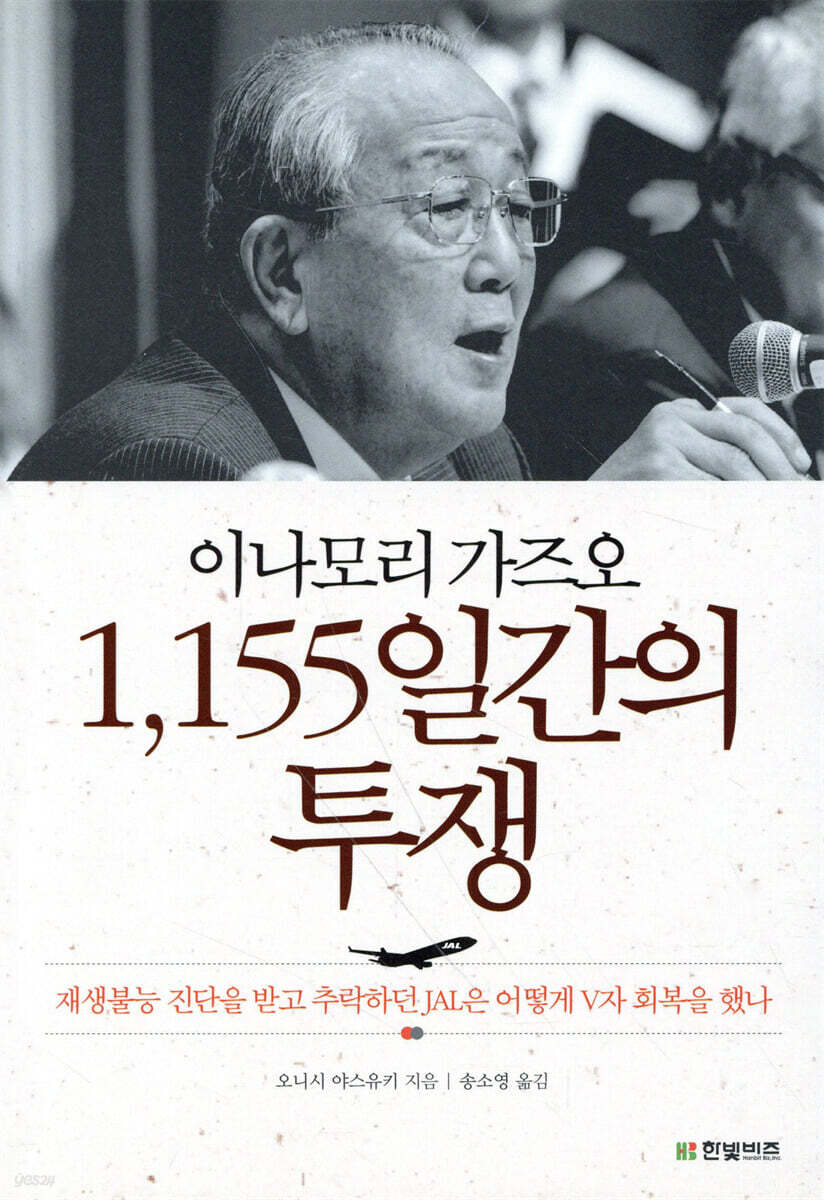
Kazuo Inamori's 1,155-Day Struggle
 |
Description
Book Introduction
"Be sure to check it out, this is management."
Kazuo Inamori, the founder and honorary chairman of Japan's leading company Kyocera, is known as the "living god of management."
He is considered one of the "Three Greatest Entrepreneurs of Japan" along with Konosuke Matsushita (founder of Matsushita Electric Group) and Soichiro Honda (founder of Honda Motor Company). "Kazuo Inamori's 1,155-Day Struggle" vividly records the 1,155-day struggle he endured until he resigned from his position as director in March 2013, from when he took office as chairman of JAL at a time when the company was applying for the Corporate Reorganization Act after its first bankruptcy, to when he achieved a dramatic V-shaped recovery, including turning the company into a profit in just one year and relisting it on the stock market after two years and eight months.
Kazuo Inamori, who founded KDDI to fight against the monopoly in the telecommunications market, served as its chairman, and then stepped down from the front line as its chief advisor, made a surprise return to his current position in 2010.
He was called in as a relief pitcher for Japan Airlines (JAL), Japan's representative airline, when JAL went bankrupt for the first time.
Although he strongly declined, he eventually took on the JAL revitalization project due to concerns about the future of the employees who survived the restructuring, concerns that the airline market would become a monopoly after JAL's bankruptcy, and the need to prevent the negative impact of JAL's bankruptcy on the Japanese economy.
And he jumped in with three of his close associates and transformed the company's structure in just 1,155 days, making it a competitive company.
Another reason Kazuo Inamori took on JAL's revitalization was to leave a final message, like a testament, to his junior managers as a senior executive. He believed that seeing a seemingly hopeless company like JAL revitalize itself would inspire younger managers, who would then say, "If JAL did it, then we can too."
Kazuo Inamori's wish will also be a valid message to Korean managers.
- You can preview some of the book's contents.
Preview
index
prolog
1. Strength Test
I can't trust you with even a single penny!
Even if the company goes bankrupt, the plane still flies.
Just keep your place like an ornament?!
Differences between manufacturing and service industries
I don't have time to listen to sermons on spiritualism.
Is Kazuo Inamori's ability genuine?
Can the 'chick corps' manage properly?
Take control of JAL's cockpit
2 There are no taboo words in management.
The purpose of management is to pursue employee happiness.
In the after party, towels are flying around
The conflict between 'Labor Management' and 'No-No' is overflowing with strange documents.
I'd be willing to give up my life
How can we rebuild after losing the trust of our temples?
I saw sincerity in your angry expression
3. Taking over JAL, which I hated
Without entrepreneurs, JAL won't change.
The three-pronged appeal of Seiji Maehara, Minister of Land, Infrastructure, Transport and Tourism
Ichiro Ozawa and Kazuo Inamori
A bankruptcy lawyer with exceptional skills
The determination contained in a poem by Kazuo Inamori
Only a Korean medicine doctor can restore physical strength.
Regeneration is possible when struggling managers and investors join hands.
Kazuo Inamori speaks at the Davos Forum
Fairness demanded by ANA
Make 'obvious truths' the norm of your life.
4 Monopoly is evil
ANA may be acquired by JAL
Anti-monopoly blood boils
Sony and Recruit also showed interest in participating in the telecommunications industry.
The handicap of having to prefix 0077
The business is thorough
Saving JAL, the airline I hated so much
backlash against the privileged
The sense of life is common
5 This is management
A great plan and an even better excuse
Every number has a reason
Read the story hidden in the listed numbers
SkyTeam or Oneworld?
Protecting our customers' privileges is our top priority.
Think carefully until you can admit it
I gave up my life as a pilot
Machines break down and humans make mistakes.
The idea of lifting the fulcrum of the seesaw
A weak sense of camaraderie won't save a company.
6 The Power of Amoeba Management
The Amoeba Life of Evangelist Naoyuki Morita
Humans have an instinct to chase numbers.
The path to a safe turnaround
All employees are managers
Calculate the profit and loss per flight the next day.
Wash and use oily gloves
The paradox of a necessary service running at a loss
Overcoming the Boeing 787 Problem
Decide for yourself and speak for yourself
Faster reflexes to event risks
Pricing is management
7th Division Four Jingu Army
A ghost department with no employees
Kazuo Inamori's closest associates
'Ameba' and 'management philosophy' are the two wings of an airplane.
Excellent management science that has infiltrated JAL
8 A persistent fool is better than a fool
Organizations inevitably become bloated and people become bureaucratized.
Create a dead end in your mind
Create products that inspire
The duty of a representative to protect the family
It is the temple that carries out the plan
Things we have to solve with our own hands
The determination of an entrepreneur's wife
Epilogue
Into the book
I can't trust you with even a single penny!
While the executive officer was explaining the budget execution of about 1 billion yen, Kazuo Inamori suddenly cut him off.
“I can’t entrust you with even a single penny, let alone 1 billion yen!”
For a moment, the air in the conference room froze.
This budget proposal has not been a particularly problematic amount or agenda item at previous JAL management meetings.
Approval of budget execution was merely a formality.
'What the hell is the problem?'
All 30 people, including executives and a court-appointed trustee to manage JAL's assets, passed away.
The executive, who did not know English, barely gathered the courage to make a weak attempt at rebuttal.
“I’m sorry, Mr. Chairman, but this matter has already been approved by the budget.”
It was a response worse than not doing anything.
"Do you think you can always get a raise if you raise the budget? That's completely wrong."
Kazuo Inamori pounded on the desk, his anger growing cold.
“If it were your own money, would you be able to pour 1 billion yen into this business?”
“No, that’s…….”
The executive officer trailed off.
"Whose money do you think that 1 billion yen belongs to? The company's money? No! Isn't it the profit our employees toiled to create in these difficult times, when the company is in trouble?"
"yes."
“You are not qualified to use that money.
“Go back.”
From this day on, the word 'budget' disappeared from JAL.
The word 'budget' contains the bureaucratic mindset that if you just write it down, you can 'unconditionally accept it and use it.'
This is the mindset Kazuo Inamori hates the most. In all JAL internal documents, the word "budget" has been replaced with "plan."
How can we rebuild after losing the trust of our temples?
JAL's management, with its complex history of labor-management relations, became suspicious of the union, and distrust deepened, and the union also distrusted management.
'Is labor-management cooperation really possible?
Kazuo Inamori said this to Yoshiharu Ueki, the president who had such feelings.
“If management aims for ‘employee happiness,’ wouldn’t the final destination of labor and management be the same?
If your goals are the same, you'll be able to communicate.
“You just need to have a thorough discussion with the union.”
JAL management, which has been in a long-term labor-management conflict, has developed the habit of viewing employees as union members.
They thought that if they told the employees the numbers related to management, the information would leak to the union and be used as a pretext for a dispute.
JAL management, who misunderstood a passage from the Analects that says, "You can make people follow you, but you cannot make them understand all the principles," developed a habit of thinking, "If you want people to follow you, you must never tell them and keep it hidden."
Kazuo Inamori's Amoeba management is the opposite of this.
The core of amoeba management is to divide the company's thousands or tens of thousands of employees into hundreds of small groups (amoebas) so that each small group can see at a glance the 'profits and losses of today's work.'
When you provide accurate information, people on the ground can think for themselves and take appropriate action without having to wait for instructions from above.
‘Making people aware of the principles’ is the first step in Kazuo Inamori’s management.
A great plan and an even better excuse
The performance report meeting resembles a sparring session in a gym.
If you explain the reason for the increased costs by saying, "The accounting for delivery was not properly done, so the amount paid this month increased," you will be met with a dismissive response, "Isn't that because the work process is messed up?"
If you explain, “It’s about 5 billion yen,” you’ll be reprimanded, “Approximately isn’t a number,” and if you say, “It’s about 80 percent,” you’ll be reprimanded, “Don’t use the word ‘approximately.’”
All the bureaucratic adjectives that JAL executives often use have been repelled.
Planes cannot fly when there is a typhoon, and business customers decrease when the economy is bad.
It is not difficult for airlines to find excuses for poor performance, such as exchange rate fluctuations and soaring crude oil prices.
If they fail to achieve their "great plan," they mobilize all these elements to create an "excuse even better than the plan." The JAL elite resembled bureaucrats in a central government office.
But Kazuo Inamori absolutely hated excuses and bureaucracy. Every time a JAL executive used a peculiar bureaucratic adjective, he would point it out and correct it.
It is very similar to how Hisashi Shinto, who came to be the president of the privatized NTT, scolded employees for repeatedly using adjectives from the Nippon Telegraph and Telephone Corporation days, saying, “No more Nippon Telegraph and Telephone Corporation words!”
This was a kind of ideological reform.
Management is not magic.
“I want to quickly drain the pus and speed up the reconstruction project.”
In the summer of 2012, the president of a major electronics company shocked the world by saying this at a press conference after recruiting thousands of early retirees.
“We were pus.”
Not only is it an unbearable pain for employees who turn their backs on the company, as if their insides were being cut out, but the remaining employees also lack motivation under a CEO who only sees employees as costs.
A year later, the company's reconstruction project was delayed without any progress, and its management situation worsened.
However, the CEO is not the only one who thinks of 'employees = cost'.
There is a widespread trend of people praising companies for drastically reducing their workforce, saying that their stock prices will rise and that it was a "courageous decision."
There are also shady companies that gather middle-aged and older employees in one office and don't give them any work, eventually leading them to say, "I'm quitting."
In this world, Kazuo Inamori, who asserts that “employees are family” and “management is about making families happy,” may be a social outcast.
Even members of the Corporate Regeneration Support Organization, a partner in the reconstruction effort, initially had different opinions about Kazuo Inamori's claim of "pursuing employee happiness."
“JAL’s current bankruptcy is causing harm to many corporate stakeholders, including financial institutions and shareholders.
“It is dangerous to say, ‘The happiness of employees is the most important thing,’ at a time like this.” However, Kazuo Inamori did not back down, saying that the happiness of employees was the most important thing, no matter what anyone said.
--- From the text
Publisher's Review
Kazuo Inamori, the living god of management
JAL leaves a final message to managers and employees through replay.
Kazuo Inamori, the living god of management
Kazuo Inamori, the founder and honorary chairman of Kyocera, a leading Japanese company, is a world-renowned manager known as the “living god of management.”
He is considered one of the "Three Greatest Entrepreneurs of Japan" along with Konosuke Matsushita (founder of Matsushita Electric Group) and Soichiro Honda (founder of Honda Motor Company), and is one of the most respected businessmen in Japan.
Kazuo Inamori, who founded KDDI to fight against the monopoly in the telecommunications market, served as its chairman, and then stepped down from the front line as its chief advisor, made a surprise return to his current position in 2010.
He was called in as a relief pitcher for Japan Airlines (JAL), Japan's representative airline, when JAL went bankrupt for the first time.
Kazuo Inamori, who had received repeated requests from the political and business world, strongly declined, citing his advanced age, his negative perception of JAL, and the dissuasion of those around him.
However, he ended up taking on the JAL revitalization project due to concerns about the future of the employees who survived the restructuring, concerns that the airline market would become a monopoly after JAL's bankruptcy, and the need to prevent the negative impact of JAL's bankruptcy on the Japanese economy.
This book is a record of Kazuo Inamori's 1,155-day struggle from the time he took office as JAL's chairman when the company filed for corporate rehabilitation after its first bankruptcy, to the dramatic V-shaped recovery it achieved, including turning a profit in just one year and relisting on the stock market in just two years and eight months, until he resigned from his position as director in March 2013.
JAL, which even experts had branded as impossible to regenerate
After the airline's first bankruptcy, Kazuo Inamori took over as chairman, but JAL's future remained uncertain. JAL was considered "Japan's most insolvent company," branded beyond repair by industry insiders, market participants, and even its own employees.
Kazuo Inamori, with only three close associates, jumped into an organization more bureaucratic than bureaucrats, an organization demanding better treatment amidst persistent deficits, an organization that recorded the largest bankruptcy in Japan with astronomical debt, and transformed the company's constitution and rebuilt it into a competitive company in just 1,155 days.
How did Kazuo Inamori lead JAL, which no one believed would recover, to a dramatic V-shaped recovery in just 1,155 days?
If we trace Kazuo Inamori's 1,155-day journey, we can see that his management was neither a miracle nor magic, but rather a matter of taking the obvious for granted.
Kazuo Inamori began by telling the employees of Japan Airlines, Japan's most elite group, things that could be found in elementary school moral textbooks like "Do not lie" and "Do not deceive others," and then helped them acquire practical skills needed for work, such as how to write a slip or conduct a meeting.
As we started to change the detailed tasks, the work attitude of JAL employees completely changed.
However, because he was demanding something that was too obvious, the employees' complaints and opposition continued endlessly, and Kazuo Inamori continued to fight to achieve what was obvious.
As JAL gradually began to accept and understand Kazuo Inamori's demands, it began to make a dramatic V-shaped recovery.
Kazuo Inamori's last words to his junior managers
Another reason Kazuo Inamori took charge of JAL's revitalization was to leave a final message, like a will, as a senior manager to his junior managers.
Kazuo Inamori believed that seeing a company like JAL, which was beyond rescue, revive itself would motivate younger managers who were in trouble, saying, "If JAL did it, then of course we can do it."
Kazuo Inamori's wish will also be a valid message to Korean managers.
The following is an excerpt from the press conference where Kazuo Inamori resigned from his position as JAL director.
“I think corporate leaders need to lead their companies with a stronger will.
Management requires the same fighting spirit as martial arts.
It is difficult to manage without passion.
I hope that managers will burn with fighting spirit and the determination to make their companies strong at all costs.”
GOODS SPECIFICS
- Date of publication: December 10, 2013
- Format: Hardcover book binding method guide
- Page count, weight, size: 272 pages | 426g | 148*210*20mm
- ISBN13: 9788994120300
- ISBN10: 8994120300
You may also like
카테고리
korean


korean


