

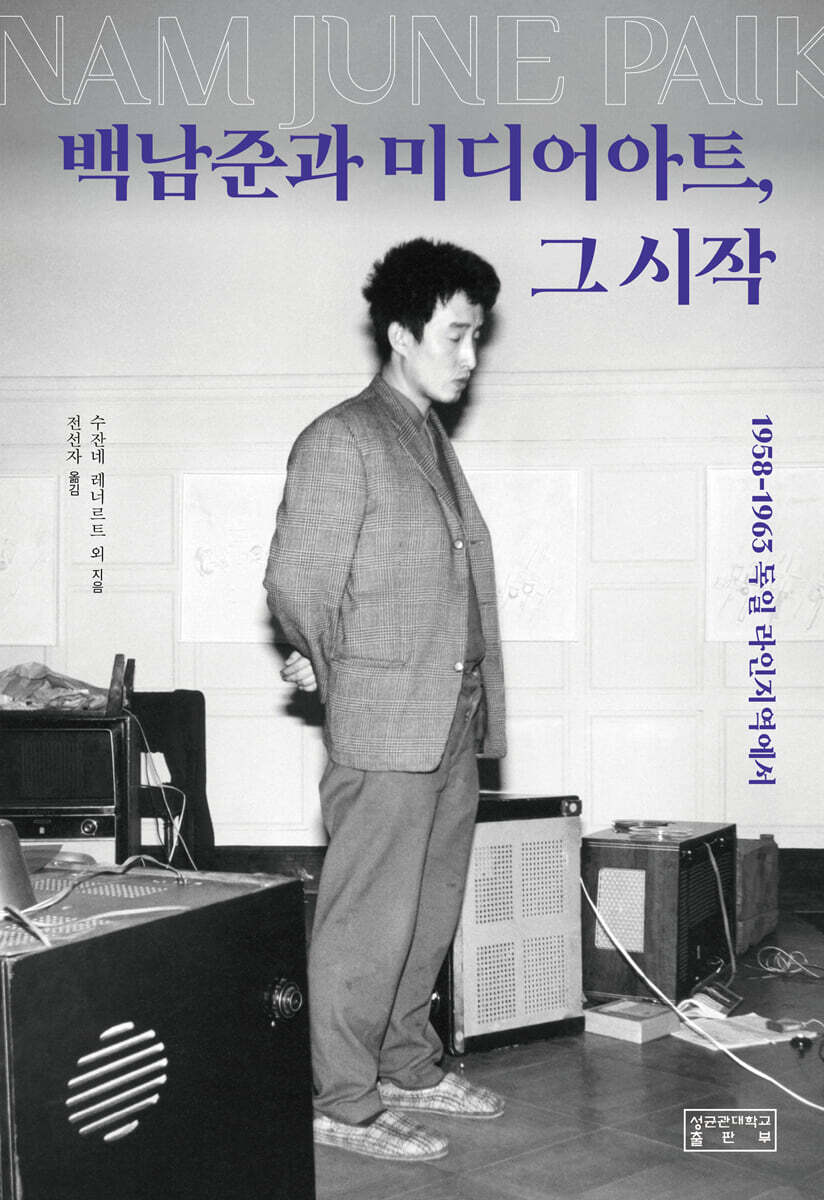
Nam June Paik and Media Art: The Beginning
 |
Description
Book Introduction
Meeting Nam June Paik in the Rhine region of Germany, 1958-1963
World-renowned artist Nam June Paik (1932-2006).
Most people remember Nam June Paik as a middle-aged man who gained international fame as a founder of media art and appeared in various media both domestically and internationally.
However, a valuable book has been published that allows us to encounter the beginnings of the media art of the young Nam June Paik, a time when we were not familiar with it.
Whether the sun rose or the wind blew, whether it snowed or rained, the period (1957-1963) that Nam June Paik spent in the area around the Rhine River in Germany was a crucial period in his life in forming his identity as an artist.
Nonetheless, research on this early period of Nam June Paik's art remains largely barren.
This period was the time when Nam June Paik laid the most important foundation as an artist, and research on this period delves into the most essential essence of Nam June Paik's artistic philosophy and media art.
Fortunately, a wave of research on this period began in the Rhine region in 2005.
At the 2005 Cologne Art Fair [ART COLOGNE] (October 28, 2005 - November 1, 2005), an exhibition was held under the theme of 'Nam June Paik's Early Years in the Rhine Region.'
Under the leadership of the Central Archive of the International Association of Fine Arts Trades (aka ZADIK), the exhibition included recordings from the Central Archive and the collection of Mary Bauermeister, housed in the Cologne City Archives, including all concerts with Nam June Paik in Cologne, Düsseldorf, Wuppertal, and Bonn. In addition, with the cooperation of the West German Broadcasting (WDR), excerpts from Nam June Paik's video creations were screened.
This marks the first time that these 'historical works' from Nam June Paik's early years have been revealed to the public at the Cologne Art Fair.
And immediately in the same year, the contents of the exhibition were published as a book titled “Nam June Paik and Media Art, The Beginning (Nam June Paiks fruhe Jahre im Rheinland).”
This book has been published in Korean, meeting readers in my home country for the first time.
World-renowned artist Nam June Paik (1932-2006).
Most people remember Nam June Paik as a middle-aged man who gained international fame as a founder of media art and appeared in various media both domestically and internationally.
However, a valuable book has been published that allows us to encounter the beginnings of the media art of the young Nam June Paik, a time when we were not familiar with it.
Whether the sun rose or the wind blew, whether it snowed or rained, the period (1957-1963) that Nam June Paik spent in the area around the Rhine River in Germany was a crucial period in his life in forming his identity as an artist.
Nonetheless, research on this early period of Nam June Paik's art remains largely barren.
This period was the time when Nam June Paik laid the most important foundation as an artist, and research on this period delves into the most essential essence of Nam June Paik's artistic philosophy and media art.
Fortunately, a wave of research on this period began in the Rhine region in 2005.
At the 2005 Cologne Art Fair [ART COLOGNE] (October 28, 2005 - November 1, 2005), an exhibition was held under the theme of 'Nam June Paik's Early Years in the Rhine Region.'
Under the leadership of the Central Archive of the International Association of Fine Arts Trades (aka ZADIK), the exhibition included recordings from the Central Archive and the collection of Mary Bauermeister, housed in the Cologne City Archives, including all concerts with Nam June Paik in Cologne, Düsseldorf, Wuppertal, and Bonn. In addition, with the cooperation of the West German Broadcasting (WDR), excerpts from Nam June Paik's video creations were screened.
This marks the first time that these 'historical works' from Nam June Paik's early years have been revealed to the public at the Cologne Art Fair.
And immediately in the same year, the contents of the exhibition were published as a book titled “Nam June Paik and Media Art, The Beginning (Nam June Paiks fruhe Jahre im Rheinland).”
This book has been published in Korean, meeting readers in my home country for the first time.
index
Attached to the publication_____Günter Herzog
Paste on the translation_____ wire
Nam June Paik's early years in the Rhine region (1958-1963)_____Susanne Rennert
Chronology (1958-1968)_____Susanne Rennert
Archives_____Brigitte Jacobs
Record 1.
Nam June Paik's Homage to John Cage, November 13, 1959, Gallery 22
Record 2.
Marie Bauermeister Atelier, Lindgasse, Cologne, 1960
Record 3.
Karlheinz Stockhausen's "The Freaks," Theater am Dom, Cologne, 26 October–6 November 1961
Record 4.
Kleines Sommerfest-Apres John Cage, Parnass Gallery, Wuppertal, June 9, 1962, works and performances by George Maciunas, Benjamin Patterson, and others
Record 5.
Neo-Dada in Music, June 16, 1962, Kammerspiele, Düsseldorf
Record 6.
Exposition of Music - Electronic Television, Nam June Paik, Parnass Gallery, Wuppertal, March 11–20, 1963
Record 7.
Zwirner Galerie, Cologne, May 22, 1965
Record 8.
〈24-Stunden-Happening〉, Parnass Galerie, Wuppertal, June 5, 1965
Record 9.
Aachen Gallery, Aachen, July 25, 1966
supplement
Appendix 1.
Music Review "Accidental Music," January 6/7, 1959, Jayu Shinmun_____Nam June Paik
Appendix 2.
Nam June Paik's Media Art: Rhineland, Germany & New York _____ Jeon Seon-ja
Paste on the translation_____ wire
Nam June Paik's early years in the Rhine region (1958-1963)_____Susanne Rennert
Chronology (1958-1968)_____Susanne Rennert
Archives_____Brigitte Jacobs
Record 1.
Nam June Paik's Homage to John Cage, November 13, 1959, Gallery 22
Record 2.
Marie Bauermeister Atelier, Lindgasse, Cologne, 1960
Record 3.
Karlheinz Stockhausen's "The Freaks," Theater am Dom, Cologne, 26 October–6 November 1961
Record 4.
Kleines Sommerfest-Apres John Cage, Parnass Gallery, Wuppertal, June 9, 1962, works and performances by George Maciunas, Benjamin Patterson, and others
Record 5.
Neo-Dada in Music, June 16, 1962, Kammerspiele, Düsseldorf
Record 6.
Exposition of Music - Electronic Television, Nam June Paik, Parnass Gallery, Wuppertal, March 11–20, 1963
Record 7.
Zwirner Galerie, Cologne, May 22, 1965
Record 8.
〈24-Stunden-Happening〉, Parnass Galerie, Wuppertal, June 5, 1965
Record 9.
Aachen Gallery, Aachen, July 25, 1966
supplement
Appendix 1.
Music Review "Accidental Music," January 6/7, 1959, Jayu Shinmun_____Nam June Paik
Appendix 2.
Nam June Paik's Media Art: Rhineland, Germany & New York _____ Jeon Seon-ja
Publisher's Review
Encountering the young Nam June Paik through text, chronology, and records
This book consists of text, chronology, and records.
The author of this book, Susanne Rennert, considers the period from 1958 to 1963 as Nam June Paik's youth, and clearly explains, through precise data, how Nam June Paik pursued new art, resisting existing conventions and rules, alone or with his Fluxus colleagues in the Rhine region of Germany during these early years.
The phrase she used as the subject of her text was “Count the waves of the Rhine on a sunny day.
On sunny days, count the waves of the Rhine.
“On windy days, count the waves of the Rhine.” is a metaphor for Nam June Paik’s early activities.
This phrase was quoted by Nam June Paik in the June 1962 calendar (Wuppertal: Calendar Publishing).
This is reminiscent of his younger days when he constantly experimented with various artistic methods.
Following the text, the author wrote a chronology covering the period from 1958 to 1968.
And with excerpts from specialized books, interviews, and newspaper articles that serve as specific sources, it makes us realize that the Rhine region at that time was a landmark in the history of art.
Finally, Brigitte Jacobs organizes the archives (1958-1968) into nine stages to demonstrate the evolution of Nam June Paik's art.
The composition of the records in a temporal structure shows the empirical details as if Nam June Paik's actions were once again 'raw' and present 'here and now.'
In this way, readers can vividly feel these changes and follow his steps.
In particular, these records allow us to directly witness the artistic revolution that took place in the Rhine region at that time.
So, all of these records had to be translated, and the originals and translations were juxtaposed to enable Korean readers to participate in the cultural phenomenon that took place in the Rhine region in the 1960s.
However, Nam June Paik's music critique, "The Accidental Music" (published in the Jayu Shinmun, January 6/7, 1959, Seoul) is not included here.
Since only the title was mentioned in the comments, the content has been added here through the translator's efforts.
It would certainly be of great help to readers if the contents of this review were supplemented here.
This review, written in Korean, foreshadows the musical changes that took place in his career after September 1958.
Because the value of this text is infinite, the translator has translated the original text from the 1950s into a contemporary and contemporary style and included it, along with an English translation, as an appendix at the end of this book.
The Birth of a New History: The Exhibition of Music - Electronic Television
The most astonishingly brilliant peak in the artistic process of Nam June Paik, the founder of media art, was, of course, the exhibition “Exposition of Music – Electronic Television” held at the Parnass Gallery in Wuppertal in March 1963.
This “amazing event” can be considered a “historic achievement.”
This historic execution was first carried out in the German Rhine region.
We now call these work characteristics and results media art.
From the mid-1960s to the 1980s, it was called video art, but Nam June Paik never agreed with the concept of 'video art'.
From the beginning, he used the subject of 'electronic television' because he used television as an electronic medium.
He also proposed 'electronic television', which corresponded to and served as a parallel concept to the 'electronic music' that already existed at the time.
Joseph Beuys, a German artist and core member of Fluxus, who saw the exhibition, said of Nam June Paik that he “expressed endless respect,” but at the time, very few people understood the exhibition.
The artistic concepts of “indeterminism, freedom, random access” (this text 52) and “variability” and “communication” expressed in these works were actually half a century ahead of their time.
Therefore, this exhibition was not an area that anyone could easily understand.
Even now, to understand the “amazing interests of Nam June Paik” at the time, research and materials on the artist’s early activities are essential.
A new platform for art and culture, the Rhine region
At that time, Allied forces were stationed in Germany, a defeated country.
These allies, unusually, each country brought its own broadcasting station for its young soldiers.
These stations needed better content for younger listeners.
So all broadcasting stations bought and broadcast even experimental works.
This gave experimental artists a "freedom" and "opportunity" unparalleled anywhere else in the world, and immediately opened up the possibility of endless artistic integration and fusion, crossing boundaries between artistic disciplines along with cultural diversity.
The Rhine region was truly a platform for newly created art and culture.
Here, Nam June Paik pondered and experimented with countless 'waves of the Rhine' to find harmony between his oriental thinking and Western traditional culture, even as it clashed with them.
Nam June Paik's artistic career spanned from music to performance art and electronic media.
There was a turning point at each step.
The documents included in this book clearly show Nam June Paik's journey from performance art to electronic media.
Nevertheless, for Nam June Paik, music, an art of time, was always fundamental.
So, musical principles can be seen in Nam June Paik's media art work.
That is, it is to structure time by using the sensory experience acquired from Nam June Paik's unique performance art, 'performance music', which 'utilizes the method of visualization' and 'various media simultaneously'.
Time has always been the most important theme to him.
And this basic artistic capacity was realized through the various artistic activities that Nam June Paik experimented with in the Rhine region of Germany from 1958 to 1963.
But ultimately, as this book shows, his work contains crucial developmental stages from music through action (Aktion) and Fluxus to media.
The late 1950s and early 1960s, especially in Europe, were a period of openness characterized by international awakening and uprising.
At this time, he was desperately looking for an experimental environment that would transform his ideas.
Yet his exploration of existential questions is (in contrast to his later work) sometimes unadorned, sometimes extreme.
At the time, the art world was heralding a period of transition, a deconstruction of the classical concept of the work, a strong push towards conceptualization and actionism, and a tendency to move between genres.
These things were very evident in the Rhine region.
Again, these events in this area were clearly demonstrating the demonstration, just as a graduated test tube clearly shows the boundaries of the scale.
This book consists of text, chronology, and records.
The author of this book, Susanne Rennert, considers the period from 1958 to 1963 as Nam June Paik's youth, and clearly explains, through precise data, how Nam June Paik pursued new art, resisting existing conventions and rules, alone or with his Fluxus colleagues in the Rhine region of Germany during these early years.
The phrase she used as the subject of her text was “Count the waves of the Rhine on a sunny day.
On sunny days, count the waves of the Rhine.
“On windy days, count the waves of the Rhine.” is a metaphor for Nam June Paik’s early activities.
This phrase was quoted by Nam June Paik in the June 1962 calendar (Wuppertal: Calendar Publishing).
This is reminiscent of his younger days when he constantly experimented with various artistic methods.
Following the text, the author wrote a chronology covering the period from 1958 to 1968.
And with excerpts from specialized books, interviews, and newspaper articles that serve as specific sources, it makes us realize that the Rhine region at that time was a landmark in the history of art.
Finally, Brigitte Jacobs organizes the archives (1958-1968) into nine stages to demonstrate the evolution of Nam June Paik's art.
The composition of the records in a temporal structure shows the empirical details as if Nam June Paik's actions were once again 'raw' and present 'here and now.'
In this way, readers can vividly feel these changes and follow his steps.
In particular, these records allow us to directly witness the artistic revolution that took place in the Rhine region at that time.
So, all of these records had to be translated, and the originals and translations were juxtaposed to enable Korean readers to participate in the cultural phenomenon that took place in the Rhine region in the 1960s.
However, Nam June Paik's music critique, "The Accidental Music" (published in the Jayu Shinmun, January 6/7, 1959, Seoul) is not included here.
Since only the title was mentioned in the comments, the content has been added here through the translator's efforts.
It would certainly be of great help to readers if the contents of this review were supplemented here.
This review, written in Korean, foreshadows the musical changes that took place in his career after September 1958.
Because the value of this text is infinite, the translator has translated the original text from the 1950s into a contemporary and contemporary style and included it, along with an English translation, as an appendix at the end of this book.
The Birth of a New History: The Exhibition of Music - Electronic Television
The most astonishingly brilliant peak in the artistic process of Nam June Paik, the founder of media art, was, of course, the exhibition “Exposition of Music – Electronic Television” held at the Parnass Gallery in Wuppertal in March 1963.
This “amazing event” can be considered a “historic achievement.”
This historic execution was first carried out in the German Rhine region.
We now call these work characteristics and results media art.
From the mid-1960s to the 1980s, it was called video art, but Nam June Paik never agreed with the concept of 'video art'.
From the beginning, he used the subject of 'electronic television' because he used television as an electronic medium.
He also proposed 'electronic television', which corresponded to and served as a parallel concept to the 'electronic music' that already existed at the time.
Joseph Beuys, a German artist and core member of Fluxus, who saw the exhibition, said of Nam June Paik that he “expressed endless respect,” but at the time, very few people understood the exhibition.
The artistic concepts of “indeterminism, freedom, random access” (this text 52) and “variability” and “communication” expressed in these works were actually half a century ahead of their time.
Therefore, this exhibition was not an area that anyone could easily understand.
Even now, to understand the “amazing interests of Nam June Paik” at the time, research and materials on the artist’s early activities are essential.
A new platform for art and culture, the Rhine region
At that time, Allied forces were stationed in Germany, a defeated country.
These allies, unusually, each country brought its own broadcasting station for its young soldiers.
These stations needed better content for younger listeners.
So all broadcasting stations bought and broadcast even experimental works.
This gave experimental artists a "freedom" and "opportunity" unparalleled anywhere else in the world, and immediately opened up the possibility of endless artistic integration and fusion, crossing boundaries between artistic disciplines along with cultural diversity.
The Rhine region was truly a platform for newly created art and culture.
Here, Nam June Paik pondered and experimented with countless 'waves of the Rhine' to find harmony between his oriental thinking and Western traditional culture, even as it clashed with them.
Nam June Paik's artistic career spanned from music to performance art and electronic media.
There was a turning point at each step.
The documents included in this book clearly show Nam June Paik's journey from performance art to electronic media.
Nevertheless, for Nam June Paik, music, an art of time, was always fundamental.
So, musical principles can be seen in Nam June Paik's media art work.
That is, it is to structure time by using the sensory experience acquired from Nam June Paik's unique performance art, 'performance music', which 'utilizes the method of visualization' and 'various media simultaneously'.
Time has always been the most important theme to him.
And this basic artistic capacity was realized through the various artistic activities that Nam June Paik experimented with in the Rhine region of Germany from 1958 to 1963.
But ultimately, as this book shows, his work contains crucial developmental stages from music through action (Aktion) and Fluxus to media.
The late 1950s and early 1960s, especially in Europe, were a period of openness characterized by international awakening and uprising.
At this time, he was desperately looking for an experimental environment that would transform his ideas.
Yet his exploration of existential questions is (in contrast to his later work) sometimes unadorned, sometimes extreme.
At the time, the art world was heralding a period of transition, a deconstruction of the classical concept of the work, a strong push towards conceptualization and actionism, and a tendency to move between genres.
These things were very evident in the Rhine region.
Again, these events in this area were clearly demonstrating the demonstration, just as a graduated test tube clearly shows the boundaries of the scale.
GOODS SPECIFICS
- Date of issue: April 4, 2022
- Page count, weight, size: 216 pages | 578g | 165*240*20mm
- ISBN13: 9791155505281
- ISBN10: 115550528X
You may also like
카테고리
korean


korean

![GQ KOREA Mark (Monthly): December [2025]](http://librairie.coreenne.fr/cdn/shop/files/8ef265dbbfbf186523ed75ba7319009d.jpg?v=1765340328&width=3840)


