

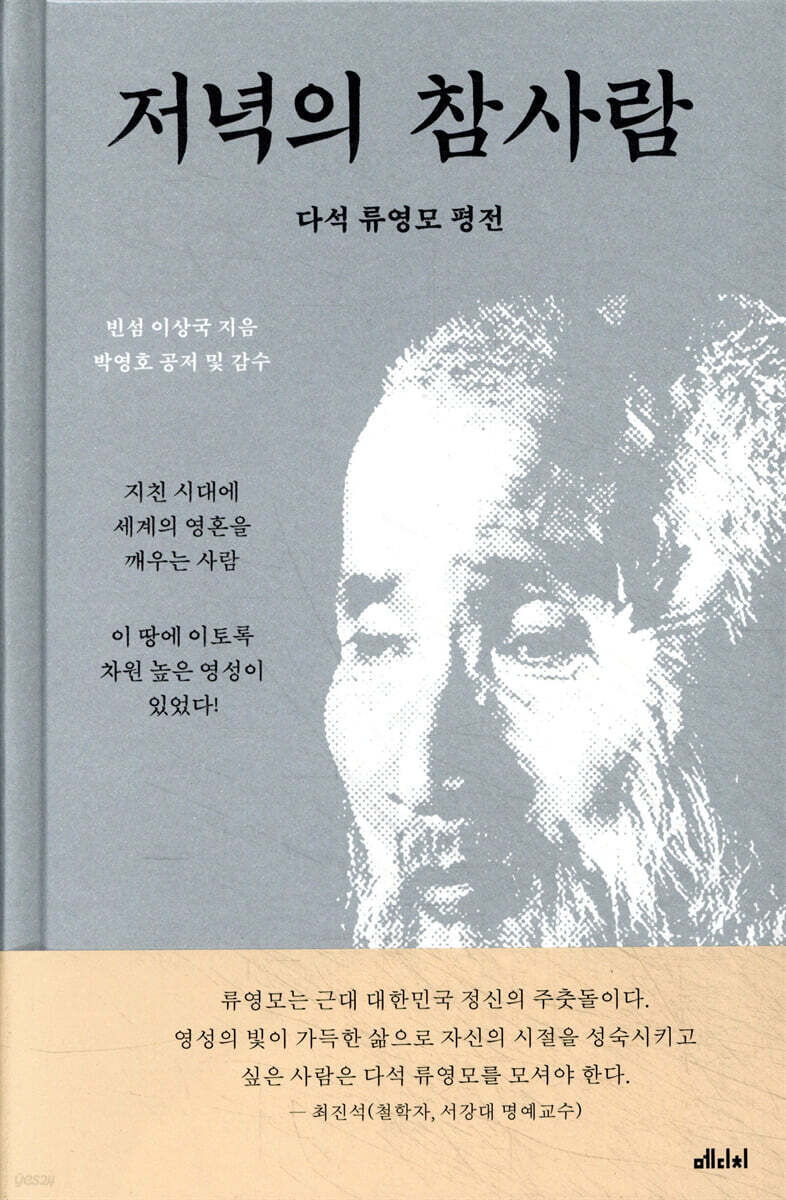
The true man of the evening
 |
Description
Book Introduction
Ryu Yeong-mo, a great philosopher who awakened Korean spiritual values and the meaning of life. At the 2008 World Congress of Philosophers, Ham Seok-heon and Ryu Yeong-mo were introduced as modern philosophers representing Korea. While Ham Seok-heon is a familiar name to the public, Ryu Yeong-mo is a somewhat unfamiliar name. However, Ryu Yeong-mo was the teacher of Ham Seok-heon, a representative of the 'Seal' ideology, and the teacher of Kim Kyo-shin, who carried out the independence movement through Christianity during the Japanese colonial period, and was a unique pioneer who laid the spiritual foundation for the democratization, industrialization, and religious value movements in Korea. Recently, there has been a growing enthusiasm for Ryu Young-mo and a desire to learn from him among intellectuals. Where does Ryu Young-mo's presence, which satisfies the intellectual thirst and spiritual hunger of this society, come from? I am curious about Ryu Young-mo's life and thoughts. The answer to that question is contained in this book. According to the author, Ryu Yeong-mo is Korea's greatest thinker and a great spiritual teacher who proposed a revolution in life and inner self. He reflected on the spirituality of the East and the West, awakened the true nature of Christianity, and practiced the 'life of the soul.' After accidentally encountering the ideas of Dasok and falling into a 'Dasok fever', the author realized that Ryu Young-mo was a visionary who helped him rediscover the true function and meaning of religion in the era of the COVID-19 pandemic and was a unique model of K-spirituality. This book is the honest and passionate confession of the author of 'Daseoksalgi' who wants to introduce us to the life and thoughts of Dasok Ryu Yeong-mo, a great philosopher who awakened Korean spiritual values and the meaning of life. |
- You can preview some of the book's contents.
Preview
index
At the beginning_ This is human
Recommendation_ I danced around in the early morning
Part 1: Moving forward one inch every day
1.
I am a commoner
2.
Have you studied?
3.
The opening of the soul
4.
Getting one inch closer every day
Part 2: Life in the Flesh
5.
A beautiful and calm relationship that will last a hundred years
6.
One meal a day, one meal a day
7.
Change your body
8.
A healthy body is essential for spiritual growth.
9.
Look up at the stars quietly
10.
Encountering carnal desires in a dark dream
Part 3: The Hope of Teaching
11.
Meet Lee Seung-hoon's Osan School
12.
Relationships Made at Osan School - Lee Seung-hoon and Yeo Jun
13.
Tolstoy and Pilgrim's Progress
14.
March 1st Movement and Osan School
15.
Another connection: Choi Nam-seon and Ryu Dal-young
16. The path of teaching that continued at the YMCA
Part 4: Fateful Bond: Kanzo Uchimura, Kyo-shin Kim, and Seok-heon Ham
17.
The irreverent man Kanzo Uchimura
18.
Jesus came to teach each of us
19.
A road we walked together, but apart, by Kim Kyo-shin
20.
God's new albatross, Ham Seok-heon and Ryu Yeong-mo
21.
attitude toward the country
Part 5: Tolstoy of Bukhansan and the Saints of Gwangju
22.
How do people become human?
23.
Outside Jahamun Gate, Tolstoy on Bukhansan Mountain
24.
Boiled mayfly fish pieces
25.
Saints of the City of Light - Lee Se-jong
26.
Saints of the City of Light - Lee Hyeon-pil
27.
See the contemplation of God
28.
Where is God?
Part 6: Christianity in the East
29.
God in Hangul, the "Saint of Our Language"
30.
'Truth' and seed thought
31.
God without body and spirit
32.
The Way of Jesus and the Way of the Tea Ceremony
33.
Buddha, Lao Tzu, and Confucius all point to God.
34.
The Amazing 'Nothingness', Nozawa and the Tea Ceremony
35.
Ryu Yeong-mo's 'Lao-tzu Theology'
36.
Doctrine of the Mean, living by the word of God
37.
What a sweet void?
38.
Heaven and earth are one within man.
39.
Dasok's Christian faith that touches God's will
Part 7 Evening Cross
40.
Japan's rule will naturally disappear.
41.
There is more to humans than just food.
42.
1950, the sixtieth birthday and war
43.
The one who comes after me
44.
I'm going somewhere
45.
900 million breaths held
Recommendation_ I danced around in the early morning
Part 1: Moving forward one inch every day
1.
I am a commoner
2.
Have you studied?
3.
The opening of the soul
4.
Getting one inch closer every day
Part 2: Life in the Flesh
5.
A beautiful and calm relationship that will last a hundred years
6.
One meal a day, one meal a day
7.
Change your body
8.
A healthy body is essential for spiritual growth.
9.
Look up at the stars quietly
10.
Encountering carnal desires in a dark dream
Part 3: The Hope of Teaching
11.
Meet Lee Seung-hoon's Osan School
12.
Relationships Made at Osan School - Lee Seung-hoon and Yeo Jun
13.
Tolstoy and Pilgrim's Progress
14.
March 1st Movement and Osan School
15.
Another connection: Choi Nam-seon and Ryu Dal-young
16. The path of teaching that continued at the YMCA
Part 4: Fateful Bond: Kanzo Uchimura, Kyo-shin Kim, and Seok-heon Ham
17.
The irreverent man Kanzo Uchimura
18.
Jesus came to teach each of us
19.
A road we walked together, but apart, by Kim Kyo-shin
20.
God's new albatross, Ham Seok-heon and Ryu Yeong-mo
21.
attitude toward the country
Part 5: Tolstoy of Bukhansan and the Saints of Gwangju
22.
How do people become human?
23.
Outside Jahamun Gate, Tolstoy on Bukhansan Mountain
24.
Boiled mayfly fish pieces
25.
Saints of the City of Light - Lee Se-jong
26.
Saints of the City of Light - Lee Hyeon-pil
27.
See the contemplation of God
28.
Where is God?
Part 6: Christianity in the East
29.
God in Hangul, the "Saint of Our Language"
30.
'Truth' and seed thought
31.
God without body and spirit
32.
The Way of Jesus and the Way of the Tea Ceremony
33.
Buddha, Lao Tzu, and Confucius all point to God.
34.
The Amazing 'Nothingness', Nozawa and the Tea Ceremony
35.
Ryu Yeong-mo's 'Lao-tzu Theology'
36.
Doctrine of the Mean, living by the word of God
37.
What a sweet void?
38.
Heaven and earth are one within man.
39.
Dasok's Christian faith that touches God's will
Part 7 Evening Cross
40.
Japan's rule will naturally disappear.
41.
There is more to humans than just food.
42.
1950, the sixtieth birthday and war
43.
The one who comes after me
44.
I'm going somewhere
45.
900 million breaths held
Into the book
Ryu Young-mo only emphasized autonomous faith.
He argued that every believer must meet God alone.
Where is God?
God can be anywhere, but what is important is that he is in the human being as the ‘soul (holy spirit)’.
This is the 'Eolna' that Ryu Young-mo is talking about.
Although it exists in the thoughts of each individual human being, it is a medium that connects the individual with God.
Ryu Young-mo warned against religions that seek to replace encounters with God with encounters with humans.
He stated that faith is nothing more than a sole encounter between God and me, and is merely an autonomous act of self-discovery.
The reason churches in this era are holding gatherings and events in defiance of government quarantine guidelines is not because of their devout faith.
This is because religion has become a business and has turned into a group's power, and it is for non-religious reasons that it cannot suddenly change its basis for survival.
Let's look back.
COVID-19 has exposed the true face of religion and forced us to acknowledge its distorted nature.
Ryu Young-mo diagnosed that the very aspect of religion has led to the tragedy of religion not carrying out its true purpose.
It's not a problem with the coronavirus, it's just an exposure of the problems that religion has.
Ryu Young-mo was a pioneer in this respect as well.
--- p.8-9
Mencius says this to Liu Yingmo:
“He who gives his heart to his work will know his own nature, and if he knows his own nature, he will know heaven.
Preserving one's own mind and cultivating one's character is the way to serve Heaven.
“To cultivate oneself and wait without worrying about dying early or living long is the way to preserve and establish the mandate of Heaven.” Mencius again speaks of life as follows:
“Life is a command from heaven.
Although there is nothing that is not a command from heaven, we must accept the righteous life given to us in accordance with the natural order.
He who knows the commandments of heaven does not stand beneath a falling wall.
“He who dies after fulfilling his way is a righteous life; he who dies as a punishment is not a righteous life.” (Mencius, Chapter 46, Part 1 of True Truth)
In a time when the country was collapsing, when it seemed as if all life was crumbling, the boy Ryu Yeong-mo lived for years buried in the strong commands and teachings of Mencius.
This became an essential material for the 'explosion' that occurred when he encountered Christianity and felt a spiritual upheaval.
He said this while lecturing on the Mencius:
“I think that both Zhuangzi and Mencius were influenced by the Holy Spirit.
You can't know the nature of things like that without going through the Holy Spirit.
Mencius and Zhuangzi were men of the Holy Spirit, so they saw through it.
These are people who have seen everything there is to see.
One day, I opened the Mencius and came across all these sayings. I read through them and was horrified.
“I wonder if Mencius was such a profound and profound person.”
--- p.48
Buddhism calls greed, anger, and ignorance the three poisons of human nature.
Ryu Young-mo said that this is the beastly nature of humans.
Beasts eat, mate, and growl.
If a human being falls into this nature, he cannot escape from being a beast.
This is consistent with what zoologists call the animal instincts: feeding, gnawing, and sex.
It can be said that the thought of the century is based on the rediscovery of the concept of exploration.
Sigmund Freud explored the world of human consciousness and unconsciousness through the study of the mind, or carnal desires.
It was Karl Marx who focused on greed (appetite) and jin (growl, anger).
Based on this perspective, he redesigned how the world should change, creating a socialist ideology that changed the century.
Their ideas are based on the premise that human desire is a condition of the body and consciousness.
Ryu Young-mo also acknowledged this.
Are greed, jealousy, and ignorance really the three poisons?
From the beast's perspective, isn't that the basis for survival and reproduction?
You could say that there are three virtues rather than three poisons.
It can be said that people have survived for ten thousand years because they had the ability to seek wisdom.
Because that beastly nature allowed the human race to survive and reproduce.
It cannot be denied that greed is the foundation of human survival.
However, Dasok says that the basic 'function' of exploration must be controlled, and humans must aim for something further from there.
--- p.109
Marcel Proust, the French novelist famous for his work In Search of Lost Time, declared, “Tolstoy is a holy god,” and Vladimir Ilyich Lenin, who led the Russian Revolution, evaluated him as “a huge rock, a tremendous giant.”
Even Einstein, arguably the world's most famous scientist, said, "There is no prophet more important to our time than Tolstoy."
Although the many praises heaped upon Tolstoy, both contemporary and later, were primarily based on his literature, it was Ryu Yeong-mo who truly recognized that the true nature of his greatness lay in his religious thought.
At that time, Joseon intellectuals encountered 'Tolstoy's reflections on Christianity', which were flowing in at almost the same speed as Western orthodox Christian faith.
Tolstoy was a remarkable religious thinker and practitioner.
He was a 'saint' who breathed life into the 20th century and a spiritual teacher who opened new eyes to those who questioned the doctrinal faith of Christianity.
When Lee Gwang-su came to Osan School in March 1910, Tolstoy was deeply engraved in his mind at the age of 18.
Before coming to Osan School, Lee Gwang-su graduated from the middle school department of Meiji Gakuin in Tokyo, Japan.
At that time, he was reading a book by Tolstoy that his Japanese classmate, Yamasaki, had.
When I returned to Korea from Japan, I brought all of Tolstoy's complete works with me.
When I came to Osan School, I brought Tolstoy's Gospel of Unification with me and taught it to the students.
The Tolstoy memorial service in November of that year must have been greatly influenced by the nine months of education provided by ‘Teacher Lee Gwang-su.’
That day, the students were not paying tribute to an outstanding Russian writer, but to a great saint who had lived in their time.
--- p.151-152
Ham Seok-heon's thought emphasizes the vitality and subjectivity of faith.
I emphasized my growing faith and valued the God that exists within my heart.
This is also the essence of autonomous faith and seed spirit that Ryu Young-mo demonstrated through practice.
The idea of believing in Christ rather than Jesus is also Ryu Yeong-mo's teaching.
Jesus is a human being who received the spirituality of Christ.
What we should emulate is not the physical Jesus, but the spiritual Jesus.
That is what Christ is.
This kind of thinking gives rise to the question of the atonement belief that Jesus shed his blood for mankind and the worship of the flesh of Jesus on the cross.
Ham Seok-heon said that he moved from emphasizing the cross that he looked at to the cross that he personally carried.
This is also what Master Ryu Yeong-mo said.
While Ham Seok-heon came out into the world and played the role of a 'fighter' who brought about Korean democracy, Ryu Yeong-mo entered a lonely but powerful path of thought through seclusion and asceticism, engaging in conversation with God.
This advance of 'Eolna', fueled by the flame of self-belief and fierce thought, was unique to Ryu Young-mo.
Although Ryu Yeong-mo and Ham Seok-heon maintained mutual admiration for each other, their ideological conclusions differed considerably.
Ham Seok-heon contributed to the evolution of the world by creating trends in the times and enforcing religious beliefs through community practice, but he could not fully access the "spiritual space" of Ryu Yeong-mo, who pioneered religious thought in this land.
Unlike Master Ryu Yeong-mo, Ham Seok-heon does not see the face of the ‘God’ who is present as the Holy Spirit.
Ryu Yeong-mo's cosmological thinking, his unique ontology and existential consciousness revealed in Gaonjikgi, his profound exploration of the Holy Spirit, his discovery, interpretation, and presentation of a unique language for conceptualizing thought, and his resolute and practical discernment of the human body are nowhere to be found.
--- p.246-247
Ryu Young-mo liked Gwangju.
It was also a result of that feeling that we named it by the Korean name, Bitgoeul.
Ham Seok-heon made the word "Bitgoeul", coined by his teacher, into a popular word by using it frequently.
The reason he used the word 'city of light' was not simply to convey the universal meaning of a town with beautiful natural light, but to convey the special meaning of a spiritual city with outstanding spiritual light.
Gwangju is the place where the spiritual vein of Honam, which continues from Lee Se-jong, Choi Heung-jong, and Lee Hyeon-pil, emerged as a world-class spirit in modern Korean history, and can be called the mecca of the 'ascetic, self-sacrificing, and practical Christian movement.'
Ryu Young-mo wanted to live in Gwangju and considered the city's spirituality special.
Ryu Yeong-mo also called Mt. Mudeungsan ‘Eupdeung-eopdeungmoe’.
Mudeung can mean 'the highest' or 'indefinable', but it can also be said to contain the spirit of equality and transcendence without discrimination in grades, rather than simply referring to height.
'Updeung' is a flat, wide back that a mother extends to carry a young child.
A back wider than the chest is called 'updeung'.
The words ‘Bitgoeul’ and ‘Eotdeungmoe’ cannot but encapsulate the high ‘religiousness’ of Gwangju.
--- p.320
Perhaps he went to Kim Kyo-shin, who had lived with the orthodox faith, to testify about what the ‘true Christianity’ he had been pursuing was.
Jesus was born with the Holy Spirit, and after going through temptation in the wilderness and redemption on the cross, he was recognized as the Son of Man.
The process of parsing is clear.
However, Christianity after this was structured as a belief system centered around reaffirming faith in God.
My encounter with God was not an epiphany that would overcome me, but rather a daily practice that proved my unwavering faith.
The church was also the medium that led the daily life of that belief.
Ryu Yeong-mo deviated from that orthodoxy and experienced a 'Pasa Iljin' like Jesus 38 years after his initiation.
《Bible Joseon》 was also the center of the belief system that symbolized the ‘orthodoxy’ of Joseon Christianity at the time.
Informing Kim Kyo-shin and the Bible Chosun of the 'victory' of non-orthodox faiths was an act of revealing to the world that Ryu Yeong-mo's religious beliefs were correct.
No need for a hundred words of explanation.
What evidence could be more important than this?
However, after reading Ryu Yeong-mo's writing, Kim Kyo-shin seemed unable to guess his intention.
However, I was surprised by the fact that Ryu Yeong-mo called Jesus Lord in the text, so I said this.
“How did this adult come to call Jesus Lord?” The members of the Bible Chosun were mistaken in thinking that Ryu Yeong-mo had returned to their orthodox faith.
The one he called 'Lord' was the soul of God sent to me.
It was exactly what entered Jesus' heart and Ryu Yeong-mo's heart.
'Lord' refers to the Word and the Holy Spirit, and is not the limited meaning of 'Lord' that refers to Jesus as the Savior in the Orthodox faith.
It was foolish to misunderstand Ryu Yeong-mo's victory report as a surrender document.
--- p.366
This is a poem of paradox that reveals that what we consider important and great, such as ‘light’, ‘awakening’, ‘life’, and ‘muchness’, are more essential and greater: ‘darkness’, ‘sleep’, ‘death’, and ‘oneness’.
It is also a hint that allows us to examine where Ryu Young-mo's thoughts come from.
We believe that light overcomes darkness.
In urban civilization, light certainly seems stronger.
But in the pitch-black night of the primordial night, darkness is more powerful than light.
Even the lights flicker and I feel anxious as if I will be swallowed up by the darkness.
In the darkness of space, light is faint and fleeting.
The stars in the night sky just blink as if they will disappear into the darkness.
Dasok's theory of darkness is a product of the recognition that the brightness of this world is not the essence, but darkness is the great embrace that encompasses the universe.
Evening is the threshold of darkness.
When the light faded and darkness settled in, Ryu Yeong-mo believed he would have the opportunity to communicate with the Absolute.
The praise to God was the hymn of the evening.
Sejong Seokshin, the way to believe in the evening when life ends, the evening was a time to smell the sacred, get close to the sacred, and become like the sacred.
He argued that every believer must meet God alone.
Where is God?
God can be anywhere, but what is important is that he is in the human being as the ‘soul (holy spirit)’.
This is the 'Eolna' that Ryu Young-mo is talking about.
Although it exists in the thoughts of each individual human being, it is a medium that connects the individual with God.
Ryu Young-mo warned against religions that seek to replace encounters with God with encounters with humans.
He stated that faith is nothing more than a sole encounter between God and me, and is merely an autonomous act of self-discovery.
The reason churches in this era are holding gatherings and events in defiance of government quarantine guidelines is not because of their devout faith.
This is because religion has become a business and has turned into a group's power, and it is for non-religious reasons that it cannot suddenly change its basis for survival.
Let's look back.
COVID-19 has exposed the true face of religion and forced us to acknowledge its distorted nature.
Ryu Young-mo diagnosed that the very aspect of religion has led to the tragedy of religion not carrying out its true purpose.
It's not a problem with the coronavirus, it's just an exposure of the problems that religion has.
Ryu Young-mo was a pioneer in this respect as well.
--- p.8-9
Mencius says this to Liu Yingmo:
“He who gives his heart to his work will know his own nature, and if he knows his own nature, he will know heaven.
Preserving one's own mind and cultivating one's character is the way to serve Heaven.
“To cultivate oneself and wait without worrying about dying early or living long is the way to preserve and establish the mandate of Heaven.” Mencius again speaks of life as follows:
“Life is a command from heaven.
Although there is nothing that is not a command from heaven, we must accept the righteous life given to us in accordance with the natural order.
He who knows the commandments of heaven does not stand beneath a falling wall.
“He who dies after fulfilling his way is a righteous life; he who dies as a punishment is not a righteous life.” (Mencius, Chapter 46, Part 1 of True Truth)
In a time when the country was collapsing, when it seemed as if all life was crumbling, the boy Ryu Yeong-mo lived for years buried in the strong commands and teachings of Mencius.
This became an essential material for the 'explosion' that occurred when he encountered Christianity and felt a spiritual upheaval.
He said this while lecturing on the Mencius:
“I think that both Zhuangzi and Mencius were influenced by the Holy Spirit.
You can't know the nature of things like that without going through the Holy Spirit.
Mencius and Zhuangzi were men of the Holy Spirit, so they saw through it.
These are people who have seen everything there is to see.
One day, I opened the Mencius and came across all these sayings. I read through them and was horrified.
“I wonder if Mencius was such a profound and profound person.”
--- p.48
Buddhism calls greed, anger, and ignorance the three poisons of human nature.
Ryu Young-mo said that this is the beastly nature of humans.
Beasts eat, mate, and growl.
If a human being falls into this nature, he cannot escape from being a beast.
This is consistent with what zoologists call the animal instincts: feeding, gnawing, and sex.
It can be said that the thought of the century is based on the rediscovery of the concept of exploration.
Sigmund Freud explored the world of human consciousness and unconsciousness through the study of the mind, or carnal desires.
It was Karl Marx who focused on greed (appetite) and jin (growl, anger).
Based on this perspective, he redesigned how the world should change, creating a socialist ideology that changed the century.
Their ideas are based on the premise that human desire is a condition of the body and consciousness.
Ryu Young-mo also acknowledged this.
Are greed, jealousy, and ignorance really the three poisons?
From the beast's perspective, isn't that the basis for survival and reproduction?
You could say that there are three virtues rather than three poisons.
It can be said that people have survived for ten thousand years because they had the ability to seek wisdom.
Because that beastly nature allowed the human race to survive and reproduce.
It cannot be denied that greed is the foundation of human survival.
However, Dasok says that the basic 'function' of exploration must be controlled, and humans must aim for something further from there.
--- p.109
Marcel Proust, the French novelist famous for his work In Search of Lost Time, declared, “Tolstoy is a holy god,” and Vladimir Ilyich Lenin, who led the Russian Revolution, evaluated him as “a huge rock, a tremendous giant.”
Even Einstein, arguably the world's most famous scientist, said, "There is no prophet more important to our time than Tolstoy."
Although the many praises heaped upon Tolstoy, both contemporary and later, were primarily based on his literature, it was Ryu Yeong-mo who truly recognized that the true nature of his greatness lay in his religious thought.
At that time, Joseon intellectuals encountered 'Tolstoy's reflections on Christianity', which were flowing in at almost the same speed as Western orthodox Christian faith.
Tolstoy was a remarkable religious thinker and practitioner.
He was a 'saint' who breathed life into the 20th century and a spiritual teacher who opened new eyes to those who questioned the doctrinal faith of Christianity.
When Lee Gwang-su came to Osan School in March 1910, Tolstoy was deeply engraved in his mind at the age of 18.
Before coming to Osan School, Lee Gwang-su graduated from the middle school department of Meiji Gakuin in Tokyo, Japan.
At that time, he was reading a book by Tolstoy that his Japanese classmate, Yamasaki, had.
When I returned to Korea from Japan, I brought all of Tolstoy's complete works with me.
When I came to Osan School, I brought Tolstoy's Gospel of Unification with me and taught it to the students.
The Tolstoy memorial service in November of that year must have been greatly influenced by the nine months of education provided by ‘Teacher Lee Gwang-su.’
That day, the students were not paying tribute to an outstanding Russian writer, but to a great saint who had lived in their time.
--- p.151-152
Ham Seok-heon's thought emphasizes the vitality and subjectivity of faith.
I emphasized my growing faith and valued the God that exists within my heart.
This is also the essence of autonomous faith and seed spirit that Ryu Young-mo demonstrated through practice.
The idea of believing in Christ rather than Jesus is also Ryu Yeong-mo's teaching.
Jesus is a human being who received the spirituality of Christ.
What we should emulate is not the physical Jesus, but the spiritual Jesus.
That is what Christ is.
This kind of thinking gives rise to the question of the atonement belief that Jesus shed his blood for mankind and the worship of the flesh of Jesus on the cross.
Ham Seok-heon said that he moved from emphasizing the cross that he looked at to the cross that he personally carried.
This is also what Master Ryu Yeong-mo said.
While Ham Seok-heon came out into the world and played the role of a 'fighter' who brought about Korean democracy, Ryu Yeong-mo entered a lonely but powerful path of thought through seclusion and asceticism, engaging in conversation with God.
This advance of 'Eolna', fueled by the flame of self-belief and fierce thought, was unique to Ryu Young-mo.
Although Ryu Yeong-mo and Ham Seok-heon maintained mutual admiration for each other, their ideological conclusions differed considerably.
Ham Seok-heon contributed to the evolution of the world by creating trends in the times and enforcing religious beliefs through community practice, but he could not fully access the "spiritual space" of Ryu Yeong-mo, who pioneered religious thought in this land.
Unlike Master Ryu Yeong-mo, Ham Seok-heon does not see the face of the ‘God’ who is present as the Holy Spirit.
Ryu Yeong-mo's cosmological thinking, his unique ontology and existential consciousness revealed in Gaonjikgi, his profound exploration of the Holy Spirit, his discovery, interpretation, and presentation of a unique language for conceptualizing thought, and his resolute and practical discernment of the human body are nowhere to be found.
--- p.246-247
Ryu Young-mo liked Gwangju.
It was also a result of that feeling that we named it by the Korean name, Bitgoeul.
Ham Seok-heon made the word "Bitgoeul", coined by his teacher, into a popular word by using it frequently.
The reason he used the word 'city of light' was not simply to convey the universal meaning of a town with beautiful natural light, but to convey the special meaning of a spiritual city with outstanding spiritual light.
Gwangju is the place where the spiritual vein of Honam, which continues from Lee Se-jong, Choi Heung-jong, and Lee Hyeon-pil, emerged as a world-class spirit in modern Korean history, and can be called the mecca of the 'ascetic, self-sacrificing, and practical Christian movement.'
Ryu Young-mo wanted to live in Gwangju and considered the city's spirituality special.
Ryu Yeong-mo also called Mt. Mudeungsan ‘Eupdeung-eopdeungmoe’.
Mudeung can mean 'the highest' or 'indefinable', but it can also be said to contain the spirit of equality and transcendence without discrimination in grades, rather than simply referring to height.
'Updeung' is a flat, wide back that a mother extends to carry a young child.
A back wider than the chest is called 'updeung'.
The words ‘Bitgoeul’ and ‘Eotdeungmoe’ cannot but encapsulate the high ‘religiousness’ of Gwangju.
--- p.320
Perhaps he went to Kim Kyo-shin, who had lived with the orthodox faith, to testify about what the ‘true Christianity’ he had been pursuing was.
Jesus was born with the Holy Spirit, and after going through temptation in the wilderness and redemption on the cross, he was recognized as the Son of Man.
The process of parsing is clear.
However, Christianity after this was structured as a belief system centered around reaffirming faith in God.
My encounter with God was not an epiphany that would overcome me, but rather a daily practice that proved my unwavering faith.
The church was also the medium that led the daily life of that belief.
Ryu Yeong-mo deviated from that orthodoxy and experienced a 'Pasa Iljin' like Jesus 38 years after his initiation.
《Bible Joseon》 was also the center of the belief system that symbolized the ‘orthodoxy’ of Joseon Christianity at the time.
Informing Kim Kyo-shin and the Bible Chosun of the 'victory' of non-orthodox faiths was an act of revealing to the world that Ryu Yeong-mo's religious beliefs were correct.
No need for a hundred words of explanation.
What evidence could be more important than this?
However, after reading Ryu Yeong-mo's writing, Kim Kyo-shin seemed unable to guess his intention.
However, I was surprised by the fact that Ryu Yeong-mo called Jesus Lord in the text, so I said this.
“How did this adult come to call Jesus Lord?” The members of the Bible Chosun were mistaken in thinking that Ryu Yeong-mo had returned to their orthodox faith.
The one he called 'Lord' was the soul of God sent to me.
It was exactly what entered Jesus' heart and Ryu Yeong-mo's heart.
'Lord' refers to the Word and the Holy Spirit, and is not the limited meaning of 'Lord' that refers to Jesus as the Savior in the Orthodox faith.
It was foolish to misunderstand Ryu Yeong-mo's victory report as a surrender document.
--- p.366
This is a poem of paradox that reveals that what we consider important and great, such as ‘light’, ‘awakening’, ‘life’, and ‘muchness’, are more essential and greater: ‘darkness’, ‘sleep’, ‘death’, and ‘oneness’.
It is also a hint that allows us to examine where Ryu Young-mo's thoughts come from.
We believe that light overcomes darkness.
In urban civilization, light certainly seems stronger.
But in the pitch-black night of the primordial night, darkness is more powerful than light.
Even the lights flicker and I feel anxious as if I will be swallowed up by the darkness.
In the darkness of space, light is faint and fleeting.
The stars in the night sky just blink as if they will disappear into the darkness.
Dasok's theory of darkness is a product of the recognition that the brightness of this world is not the essence, but darkness is the great embrace that encompasses the universe.
Evening is the threshold of darkness.
When the light faded and darkness settled in, Ryu Yeong-mo believed he would have the opportunity to communicate with the Absolute.
The praise to God was the hymn of the evening.
Sejong Seokshin, the way to believe in the evening when life ends, the evening was a time to smell the sacred, get close to the sacred, and become like the sacred.
--- p.482
Publisher's Review
The breath of God that has come near us!
The life and thought of Ryu Yeong-mo, a true master of modern Korean thought.
The 2008 World Congress of Philosophers was held in Korea.
The theme of the conference was 'Rethinking Philosophy Today'.
This competition has the significance of encompassing Eastern philosophy into an event that has previously focused on Western philosophy.
The philosophers we put forward at this conference were Joseon Confucian scholars Yi Hwang, Yi I, Song Si-yeol, and Jeong Yak-yong, as well as the modern and contemporary thinker Ryu Yeong-mo and his disciple Ham Seok-heon.
There may be some people tilting their heads at this point.
For most people, only the philosophers other than Ryu Yeong-mo will be familiar names.
But Ryu Young-mo is a name we must remember.
The author wrote this book in the hope that the life and thoughts of Ryu Yeong-mo, a true master of modern Korean thought, would become widely known, and that many people would gain wisdom and enlightenment through his teachings.
Who was Daseok Ryu Yeong-mo? He was the most respected teacher of Ham Seok-heon, who taught him the meaning of "seed" (씨알), which constitutes the concept of Korean democratization. He was the teacher looked up to by Kim Kyo-shin, who fought for independence through Christianity during the Japanese colonial period, and he gave lectures at the YMCA for 30 years to make Christianity a true religion. He was an unrivaled pioneer who laid the spiritual foundation for the Korean democratization-industrialization-religious value movement. He supported the relief movement for the poor, orphans, and the sick in Gwangju during the Japanese colonial period and the Korean War, and named the area "Bitgoeul." He was called the "Bukhansan Saint" for his practical life of living in seclusion at the foot of Mt. Bukhan and donating all his wealth to help others.
A closer look at the trajectory of his life reveals why he is regarded as a unique pioneer who laid the spiritual foundation for the Korean democratization, industrialization, and religious value movements, and why intellectuals are so enthusiastic about him.
Ryu Young-mo's "Daseok (多夕) thought" is being rediscovered in the realms of modern thought and theology, and is receiving renewed attention as a meaningful "K-spirituality" in the age of mental decline and loss of values in the COVID-19 era.
God can be anywhere, but what is important is that he is in the human being as the ‘soul (holy spirit)’.
This is the 'Eolna' that Ryu Young-mo is talking about.
Although it exists in the thoughts of each individual human being, it is a medium that connects the individual with God.
Ryu Young-mo warned against religions that seek to replace encounters with God with encounters with humans.
Faith is nothing more than a sole encounter between God and me, and it is an autonomous act of self-discovery.
The reason churches in this era are pushing ahead with gatherings and events in defiance of government quarantine guidelines is not because of their faith, but because religion has become a business and has transformed into collective power, making it impossible to suddenly change the basis of its survival.
Ryu Young-mo diagnosed that the very aspect of religion has led to the tragedy of religion not carrying out its true purpose.
It's not a problem with the coronavirus, it's just an exposure of the problems that religion has.
Ryu Young-mo was a pioneer in this respect as well.
Professor Choi Jin-seok, a leading figure in Korean philosophy, said in his recommendation, “Ryu Yeong-mo is the cornerstone of the spirit of modern Korea, and anyone who wishes to mature their time with a life filled with the light of spirituality should seek out Ryu Yeong-mo.”
Dasuk Ryu Yeong-mo is Korea's greatest thinker and a great spiritual teacher who proposed a revolution in life and inner self.
He reflected on the spirituality of the East and the West, awakened the true nature of Christianity, and practiced the 'life of the soul.'
In the midst of the chaos of the COVID-19 pandemic and the great transition of digital civilization, we cannot help but possess the greatest "valuable assets of thought and spirituality."
Could there be a greater blessing than his presence during the Japanese colonial period, the Korean War, and the military regime's rule, a time of suffering and chaos for the Korean people?
The life and thought of Ryu Yeong-mo, a true master of modern Korean thought.
The 2008 World Congress of Philosophers was held in Korea.
The theme of the conference was 'Rethinking Philosophy Today'.
This competition has the significance of encompassing Eastern philosophy into an event that has previously focused on Western philosophy.
The philosophers we put forward at this conference were Joseon Confucian scholars Yi Hwang, Yi I, Song Si-yeol, and Jeong Yak-yong, as well as the modern and contemporary thinker Ryu Yeong-mo and his disciple Ham Seok-heon.
There may be some people tilting their heads at this point.
For most people, only the philosophers other than Ryu Yeong-mo will be familiar names.
But Ryu Young-mo is a name we must remember.
The author wrote this book in the hope that the life and thoughts of Ryu Yeong-mo, a true master of modern Korean thought, would become widely known, and that many people would gain wisdom and enlightenment through his teachings.
Who was Daseok Ryu Yeong-mo? He was the most respected teacher of Ham Seok-heon, who taught him the meaning of "seed" (씨알), which constitutes the concept of Korean democratization. He was the teacher looked up to by Kim Kyo-shin, who fought for independence through Christianity during the Japanese colonial period, and he gave lectures at the YMCA for 30 years to make Christianity a true religion. He was an unrivaled pioneer who laid the spiritual foundation for the Korean democratization-industrialization-religious value movement. He supported the relief movement for the poor, orphans, and the sick in Gwangju during the Japanese colonial period and the Korean War, and named the area "Bitgoeul." He was called the "Bukhansan Saint" for his practical life of living in seclusion at the foot of Mt. Bukhan and donating all his wealth to help others.
A closer look at the trajectory of his life reveals why he is regarded as a unique pioneer who laid the spiritual foundation for the Korean democratization, industrialization, and religious value movements, and why intellectuals are so enthusiastic about him.
Ryu Young-mo's "Daseok (多夕) thought" is being rediscovered in the realms of modern thought and theology, and is receiving renewed attention as a meaningful "K-spirituality" in the age of mental decline and loss of values in the COVID-19 era.
God can be anywhere, but what is important is that he is in the human being as the ‘soul (holy spirit)’.
This is the 'Eolna' that Ryu Young-mo is talking about.
Although it exists in the thoughts of each individual human being, it is a medium that connects the individual with God.
Ryu Young-mo warned against religions that seek to replace encounters with God with encounters with humans.
Faith is nothing more than a sole encounter between God and me, and it is an autonomous act of self-discovery.
The reason churches in this era are pushing ahead with gatherings and events in defiance of government quarantine guidelines is not because of their faith, but because religion has become a business and has transformed into collective power, making it impossible to suddenly change the basis of its survival.
Ryu Young-mo diagnosed that the very aspect of religion has led to the tragedy of religion not carrying out its true purpose.
It's not a problem with the coronavirus, it's just an exposure of the problems that religion has.
Ryu Young-mo was a pioneer in this respect as well.
Professor Choi Jin-seok, a leading figure in Korean philosophy, said in his recommendation, “Ryu Yeong-mo is the cornerstone of the spirit of modern Korea, and anyone who wishes to mature their time with a life filled with the light of spirituality should seek out Ryu Yeong-mo.”
Dasuk Ryu Yeong-mo is Korea's greatest thinker and a great spiritual teacher who proposed a revolution in life and inner self.
He reflected on the spirituality of the East and the West, awakened the true nature of Christianity, and practiced the 'life of the soul.'
In the midst of the chaos of the COVID-19 pandemic and the great transition of digital civilization, we cannot help but possess the greatest "valuable assets of thought and spirituality."
Could there be a greater blessing than his presence during the Japanese colonial period, the Korean War, and the military regime's rule, a time of suffering and chaos for the Korean people?
GOODS SPECIFICS
- Publication date: August 23, 2021
- Format: Hardcover book binding method guide
- Page count, weight, size: 488 pages | 772g | 145*220*30mm
- ISBN13: 9791157062416
- ISBN10: 1157062415
You may also like
카테고리
korean


korean

![GQ KOREA Mark (Monthly): December [2025]](http://librairie.coreenne.fr/cdn/shop/files/8ef265dbbfbf186523ed75ba7319009d.jpg?v=1765340328&width=3840)


