

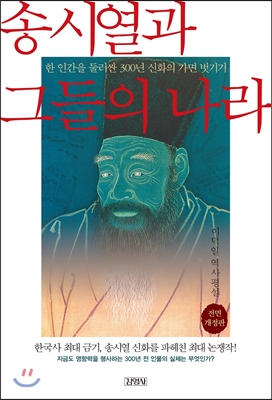
Song Si-yeol and their country
 |
Description
Book Introduction
Uncovering the Myth of Song Si-yeol
Historian Lee Deok-il traces the tragic truth with a profound historical consciousness.
What is the true identity of a figure from 300 years ago who still exerts influence today?
This book is a completely revised edition of “Song Si-yeol and Their Country,” which became a bestseller and created a great deal of buzz upon its publication in 2000.
It sparked controversy with its rigorous description of Song Si-yeol and was evaluated as presenting a new perspective on popular history books.
The content and photos of the first edition have been revised and supplemented, and the text has been printed in full color to add vividness.
In this book, the author has stripped away the mask of the 300-year-old myth of Song Si-yeol, which had been previously off-limits.
Unlike the previous writings on Song Si-yeol, this is not the kind of writing that makes him a saint and thereby makes them both better off.
This is a history book that traces the tragic reality by bringing him down to the position of a human being and a politician who must bear the debt for the ruin of the era in which he lived, and making him the subject of objective analysis.
We also examined in detail the arguments of Song Si-yeol, who represented the interests of the literati and the Tang dynasty, and his political opponents Yun Hyo, Heo Mok, Yun Seon-do, Lee Gyeong-seok, and Kim Yuk, and what changes Joseon history was demanding at the time.
Historian Lee Deok-il traces the tragic truth with a profound historical consciousness.
What is the true identity of a figure from 300 years ago who still exerts influence today?
This book is a completely revised edition of “Song Si-yeol and Their Country,” which became a bestseller and created a great deal of buzz upon its publication in 2000.
It sparked controversy with its rigorous description of Song Si-yeol and was evaluated as presenting a new perspective on popular history books.
The content and photos of the first edition have been revised and supplemented, and the text has been printed in full color to add vividness.
In this book, the author has stripped away the mask of the 300-year-old myth of Song Si-yeol, which had been previously off-limits.
Unlike the previous writings on Song Si-yeol, this is not the kind of writing that makes him a saint and thereby makes them both better off.
This is a history book that traces the tragic reality by bringing him down to the position of a human being and a politician who must bear the debt for the ruin of the era in which he lived, and making him the subject of objective analysis.
We also examined in detail the arguments of Song Si-yeol, who represented the interests of the literati and the Tang dynasty, and his political opponents Yun Hyo, Heo Mok, Yun Seon-do, Lee Gyeong-seok, and Kim Yuk, and what changes Joseon history was demanding at the time.
- You can preview some of the book's contents.
Preview
index
Preface to the Revised Edition
At the beginning of the book
Introduction
Part 1: In the Land of Shaking Confucianism
How dare the peasants look down on the nobles?
Part 2: The Injo Restoration and the Roots of Its Tragedy
The tragedies of the Westerners' coup and the Injo Restoration
Prince Sohyeon, the frustration of his progressiveness and openness
Part 3: The Age of the Northern Expedition, the Age of the Great Eastern Law
Northern Expedition: Words or Actions?
I would rather lose the peasants than the scholars.
King Hyojong, a pro-mu advocate, and Song Si-yeol, a pro-mu advocate
The dream of the Northern Expedition has faded
Ascending to the throne does not mean inheriting the family line - Yesong Debate
Even if you are a king, aren't you a borrower?
The term "deficit" does not apply to the king.
What is the difference between the lineage and the direct lineage?
How dare you interpret it differently from the runner?
The fight that took place at Onyang Palace
Why is it different from 15 years ago?
Part 5: Party interests take precedence over national interests.
Only the teacher knows, but the king does not.
Is your father important or is your teacher important?
If you lose power, you lose everything.
How can we resolve the resentment of the men?
How can a prince born in Namin become king?
King Sukjong's anger
Outgoing post
Materials and books that directly helped me write this book
At the beginning of the book
Introduction
Part 1: In the Land of Shaking Confucianism
How dare the peasants look down on the nobles?
Part 2: The Injo Restoration and the Roots of Its Tragedy
The tragedies of the Westerners' coup and the Injo Restoration
Prince Sohyeon, the frustration of his progressiveness and openness
Part 3: The Age of the Northern Expedition, the Age of the Great Eastern Law
Northern Expedition: Words or Actions?
I would rather lose the peasants than the scholars.
King Hyojong, a pro-mu advocate, and Song Si-yeol, a pro-mu advocate
The dream of the Northern Expedition has faded
Ascending to the throne does not mean inheriting the family line - Yesong Debate
Even if you are a king, aren't you a borrower?
The term "deficit" does not apply to the king.
What is the difference between the lineage and the direct lineage?
How dare you interpret it differently from the runner?
The fight that took place at Onyang Palace
Why is it different from 15 years ago?
Part 5: Party interests take precedence over national interests.
Only the teacher knows, but the king does not.
Is your father important or is your teacher important?
If you lose power, you lose everything.
How can we resolve the resentment of the men?
How can a prince born in Namin become king?
King Sukjong's anger
Outgoing post
Materials and books that directly helped me write this book
Into the book
To be honest, when I first wrote “Song Si-yeol and Their Country,” I had no idea that this dogma’s power to define reality was so deep and wide, and that it was internalized throughout our society.
The ideology of Zhu Xi, which Song Si-yeol absolutized, wiped out the seeds of other ideologies, including Yangmingism and Catholicism.
Song Si-yeol and the Noron faction seized power under the pretext of creating a world based on Zhu Xi's teachings and distorted Zhu Xi's teachings into a religious doctrine.
Song Si-yeol himself had to drink poison and end his life during this process, but the Zhu Xi absolutist system he created, that is, the long-term ruling system of the Noron faction, succeeded in confining even the king within that category.
The zero-sum game, where everything is lost if one does not seize power, has confused means and ends, and Zhu Xi's teachings are reduced to mere formalities.
Ultimately, the last Noron leader, Lee Wan-yong, became so corrupt that he sold out the country to Japan.
And after liberation, they failed to liquidate pro-Japanese elements and still held power in reality.
--- p.6
As I revisited the manuscript for republishing this book, many thoughts came to mind.
Since then, I have continued to study steadily, and my understanding of that era as well as the present has broadened in breadth and depth.
Nevertheless, I thought it would be a good idea to maintain the same sense of problem that I had when I first decided to write this book.
Although quite a bit of time has passed since the first publication, the author's suffering has not subsided, but rather has worsened. This is evidence that our society has not yet reached the top.
I sincerely hope that this book will continue to play a small role in dismantling the many dogmas that still weigh down Korean society and in moving toward a normal society.
--- p.7
The moment of death is the best example of a person's life, but I have never found an example that shows a person's life as well as Song Si-yeol's death.
He was 83 years old, the age at which he was sentenced to death by drinking poison.
In Joseon, except for the reign of King Sukjong, there was no precedent for executing a minister for reasons other than treason.
Joseon was a country that treated its ministers favorably, to the point that it did not even conduct interrogations unless there was treason.
However, the reason Song Si-yeol was killed was not treason.
The charge for the 83-year-old man's death was vague: 'being the leader of criminals.'
Here, the 'sinners' refer to the Seoin (西人), or more narrowly, the Noron (老論) faction.
The fact that he was killed as a criminal, a traitor of the Noron faction, clearly shows that his death was related to factional strife.
--- p.19
When Uam Song Si-yeol was born and growing up, the ruling class of Joseon, the literati, was facing its greatest crisis since the founding of the country.
Song Si-yeol was born in the 40th year of King Seonjo's reign (1607).
It was the year that Ryu Seong-ryong, the leader of the Nam-in faction who had fallen from power, passed away alone.
The Imjin War broke out 15 years before that.
The Imjin War, which occurred in 1592, exactly 200 years after the founding of Joseon, fundamentally shook the Joseon ruling system centered on the aristocracy.
The Japanese army invaded Joseon on April 14, 1592, the 25th year of King Seonjo's reign.
Just two weeks later, on April 29, the Joseon court decided to abandon Seoul and flee to Pyongyang, and King Seonjo left the palace at dawn the next day.
When the king fled before the enemy even appeared rather than putting all his efforts into defending the capital, rumors that “the country will surely fall” spread not only among the people but also among the yangban scholars.
--- p.26
The reason they made Yehak the mainstream of Joseon Neo-Confucianism was because the peasants' opposition to the literati class was so great at the time.
Peasants no longer considered the aristocracy a privileged class.
This was a social trend and a historical development, because it showed that society could no longer be maintained under the ruling system of the literati.
However, they developed Yehak into the mainstream of Joseon Neo-Confucianism in order to neutralize the peasants' opposition to the aristocrats and continue to enjoy their vested interests as the ruling class of society.
The ideology of Zhu Xi, which Song Si-yeol absolutized, wiped out the seeds of other ideologies, including Yangmingism and Catholicism.
Song Si-yeol and the Noron faction seized power under the pretext of creating a world based on Zhu Xi's teachings and distorted Zhu Xi's teachings into a religious doctrine.
Song Si-yeol himself had to drink poison and end his life during this process, but the Zhu Xi absolutist system he created, that is, the long-term ruling system of the Noron faction, succeeded in confining even the king within that category.
The zero-sum game, where everything is lost if one does not seize power, has confused means and ends, and Zhu Xi's teachings are reduced to mere formalities.
Ultimately, the last Noron leader, Lee Wan-yong, became so corrupt that he sold out the country to Japan.
And after liberation, they failed to liquidate pro-Japanese elements and still held power in reality.
--- p.6
As I revisited the manuscript for republishing this book, many thoughts came to mind.
Since then, I have continued to study steadily, and my understanding of that era as well as the present has broadened in breadth and depth.
Nevertheless, I thought it would be a good idea to maintain the same sense of problem that I had when I first decided to write this book.
Although quite a bit of time has passed since the first publication, the author's suffering has not subsided, but rather has worsened. This is evidence that our society has not yet reached the top.
I sincerely hope that this book will continue to play a small role in dismantling the many dogmas that still weigh down Korean society and in moving toward a normal society.
--- p.7
The moment of death is the best example of a person's life, but I have never found an example that shows a person's life as well as Song Si-yeol's death.
He was 83 years old, the age at which he was sentenced to death by drinking poison.
In Joseon, except for the reign of King Sukjong, there was no precedent for executing a minister for reasons other than treason.
Joseon was a country that treated its ministers favorably, to the point that it did not even conduct interrogations unless there was treason.
However, the reason Song Si-yeol was killed was not treason.
The charge for the 83-year-old man's death was vague: 'being the leader of criminals.'
Here, the 'sinners' refer to the Seoin (西人), or more narrowly, the Noron (老論) faction.
The fact that he was killed as a criminal, a traitor of the Noron faction, clearly shows that his death was related to factional strife.
--- p.19
When Uam Song Si-yeol was born and growing up, the ruling class of Joseon, the literati, was facing its greatest crisis since the founding of the country.
Song Si-yeol was born in the 40th year of King Seonjo's reign (1607).
It was the year that Ryu Seong-ryong, the leader of the Nam-in faction who had fallen from power, passed away alone.
The Imjin War broke out 15 years before that.
The Imjin War, which occurred in 1592, exactly 200 years after the founding of Joseon, fundamentally shook the Joseon ruling system centered on the aristocracy.
The Japanese army invaded Joseon on April 14, 1592, the 25th year of King Seonjo's reign.
Just two weeks later, on April 29, the Joseon court decided to abandon Seoul and flee to Pyongyang, and King Seonjo left the palace at dawn the next day.
When the king fled before the enemy even appeared rather than putting all his efforts into defending the capital, rumors that “the country will surely fall” spread not only among the people but also among the yangban scholars.
--- p.26
The reason they made Yehak the mainstream of Joseon Neo-Confucianism was because the peasants' opposition to the literati class was so great at the time.
Peasants no longer considered the aristocracy a privileged class.
This was a social trend and a historical development, because it showed that society could no longer be maintained under the ruling system of the literati.
However, they developed Yehak into the mainstream of Joseon Neo-Confucianism in order to neutralize the peasants' opposition to the aristocrats and continue to enjoy their vested interests as the ruling class of society.
--- p.42
Publisher's Review
The most controversial work that delves into the myth of Song Si-yeol, the greatest taboo in Korean history.
“Is he the greatest saint Joseon has ever produced, or a narrow-minded politician who ruined an era?”
Song Si-yeol, the greatest factionalist of Joseon, the subject of the most heated controversy in history, mentioned more than 3,000 times in the Annals of the Joseon Dynasty.
He conceived a tragedy in Joseon and Korean history.
What is the secret behind the Song Si-yeol myth, which has persisted for over 300 years? What is his true nature, caught between the extremes of praise and curses, as both saint and devil? The Seoin faction's coup, the Injo Restoration, was the root of this tragedy.
The frustration of Prince Sohyeon, the sudden death of King Hyojong, the Northern Expedition King, the controversy surrounding the rites and ceremonies, and the suspicious death of King Hyeonjong…
The era in which Song Si-yeol lived was one of the most intense partisan strife and a time when fundamental changes in the social system were needed.
Song Si-yeol died by drinking poison at the age of 83.
Except for the reign of King Sukjong, there was no precedent of executing a minister for anything other than treason, and in Joseon, where ministers were treated favorably to the point of not even being interrogated, he was put to death under the vague charge of being the “leader of criminals.”
However, after his death, with the return of the Noron faction to power, he was enshrined alongside Confucius in the Sungkyunkwan Confucian Shrine, the greatest honor for a Confucian scholar, and enjoyed the honor of being called Songzi, along with Confucius, Mencius, and Zhu Xi, becoming a legend in our history.
As with most myths, which are exaggerated or significantly fabricated, Song Si-yeol is no exception.
In this book, the author has stripped away the mask of the 300-year-old myth of Song Si-yeol, which had been previously off-limits.
Unlike the previous writings on Song Si-yeol, this is not the kind of writing that makes him a saint and thereby makes them both better off.
This is a history book that traces the tragic reality by bringing him down to the position of a human being and a politician who must bear the debt for the ruin of the era in which he lived, and making him the subject of objective analysis.
We also examined in detail the arguments of Song Si-yeol, who represented the interests of the literati and the Tang dynasty, and his political opponents Yun Hyo, Heo Mok, Yun Seon-do, Lee Gyeong-seok, and Kim Yuk, and what changes Joseon history was demanding at the time.
Song Si-yeol and the history of Joseon they created, and the shadow of Korean history that followed from them
“What is the true identity of a figure from 300 years ago who still exerts influence today?”
When I first said I would write this book, many of my acquaintances tried to dissuade me.
It was because I thought I could get hurt.
It was more than 300 years after the 15th year of King Sukjong's reign (1689), when Uam Song Si-yeol took poison and died.
Could the story of a person who died in the late 17th century still be so hurtful to a 21st-century person? Such events, unimaginable in any normal civilized nation, were, and still are, a reality in our society.
This also shows that the social structure of the 17th century is still being inherited in some parts of our society.
Since the book was first published, many things have happened that the author's acquaintances had feared, and the fact that it was even burned at the stake alone gives us an idea of the various events surrounding the book.
However, the controversy surrounding this book is still ongoing.
As Confucianism degenerated into Confucianism, many tragedies occurred. This is actually the core of the controversy surrounding Song Si-yeol, and it was this issue that inspired the author to write this book.
The purpose was to examine the impact that Confucianism, which was transformed into Confucianism, had on our history and our current society.
As Confucius's learning degenerated into dogma, as he passed away in an unfortunate situation without ever having the opportunity to express his own ideas, numerous incidents occurred that Confucius would never have dreamed of.
To be more precise, it was not Confucius's thoughts that became dogma, but the thoughts of Zhu Xi (朱熹: 1130-1200, Zhu Xi), who interpreted Confucius' thoughts from the perspective of medieval Chinese, that became dogma.
Although Ju Hee was a scholar and politician who was unable to achieve his goals during his lifetime, he was deified in Joseon by the Zhu Xi scholars led by Song Si-yeol.
As Song Si-yeol deified Ju Hee, he himself was elevated to a similar status by his disciples.
The system of Confucianism as the sole ideology turned the late Joseon Dynasty society into a theocratic state that was out of touch with the times.
However, the purpose of this book is not to criticize Song Si-yeol, but to seriously reflect on the era he led and to look at the present era through him.
The countless praises he received from his comrades and the countless curses he received from his enemies are merely data for reading the times and assessing the influence he is having on our society today.
Was Song Si-yeol truly worthy of extreme praise, or of extreme condemnation? Was the era he led worthy of respect by later generations, or merely deserving of denunciation? Or was it somewhere between praise and condemnation? By shedding new light on the people and the state of Joseon at a time when fundamental change was being demanded, we can shed light on our own times, plagued by regionalism, irrational debate, and conflict.
“Is he the greatest saint Joseon has ever produced, or a narrow-minded politician who ruined an era?”
Song Si-yeol, the greatest factionalist of Joseon, the subject of the most heated controversy in history, mentioned more than 3,000 times in the Annals of the Joseon Dynasty.
He conceived a tragedy in Joseon and Korean history.
What is the secret behind the Song Si-yeol myth, which has persisted for over 300 years? What is his true nature, caught between the extremes of praise and curses, as both saint and devil? The Seoin faction's coup, the Injo Restoration, was the root of this tragedy.
The frustration of Prince Sohyeon, the sudden death of King Hyojong, the Northern Expedition King, the controversy surrounding the rites and ceremonies, and the suspicious death of King Hyeonjong…
The era in which Song Si-yeol lived was one of the most intense partisan strife and a time when fundamental changes in the social system were needed.
Song Si-yeol died by drinking poison at the age of 83.
Except for the reign of King Sukjong, there was no precedent of executing a minister for anything other than treason, and in Joseon, where ministers were treated favorably to the point of not even being interrogated, he was put to death under the vague charge of being the “leader of criminals.”
However, after his death, with the return of the Noron faction to power, he was enshrined alongside Confucius in the Sungkyunkwan Confucian Shrine, the greatest honor for a Confucian scholar, and enjoyed the honor of being called Songzi, along with Confucius, Mencius, and Zhu Xi, becoming a legend in our history.
As with most myths, which are exaggerated or significantly fabricated, Song Si-yeol is no exception.
In this book, the author has stripped away the mask of the 300-year-old myth of Song Si-yeol, which had been previously off-limits.
Unlike the previous writings on Song Si-yeol, this is not the kind of writing that makes him a saint and thereby makes them both better off.
This is a history book that traces the tragic reality by bringing him down to the position of a human being and a politician who must bear the debt for the ruin of the era in which he lived, and making him the subject of objective analysis.
We also examined in detail the arguments of Song Si-yeol, who represented the interests of the literati and the Tang dynasty, and his political opponents Yun Hyo, Heo Mok, Yun Seon-do, Lee Gyeong-seok, and Kim Yuk, and what changes Joseon history was demanding at the time.
Song Si-yeol and the history of Joseon they created, and the shadow of Korean history that followed from them
“What is the true identity of a figure from 300 years ago who still exerts influence today?”
When I first said I would write this book, many of my acquaintances tried to dissuade me.
It was because I thought I could get hurt.
It was more than 300 years after the 15th year of King Sukjong's reign (1689), when Uam Song Si-yeol took poison and died.
Could the story of a person who died in the late 17th century still be so hurtful to a 21st-century person? Such events, unimaginable in any normal civilized nation, were, and still are, a reality in our society.
This also shows that the social structure of the 17th century is still being inherited in some parts of our society.
Since the book was first published, many things have happened that the author's acquaintances had feared, and the fact that it was even burned at the stake alone gives us an idea of the various events surrounding the book.
However, the controversy surrounding this book is still ongoing.
As Confucianism degenerated into Confucianism, many tragedies occurred. This is actually the core of the controversy surrounding Song Si-yeol, and it was this issue that inspired the author to write this book.
The purpose was to examine the impact that Confucianism, which was transformed into Confucianism, had on our history and our current society.
As Confucius's learning degenerated into dogma, as he passed away in an unfortunate situation without ever having the opportunity to express his own ideas, numerous incidents occurred that Confucius would never have dreamed of.
To be more precise, it was not Confucius's thoughts that became dogma, but the thoughts of Zhu Xi (朱熹: 1130-1200, Zhu Xi), who interpreted Confucius' thoughts from the perspective of medieval Chinese, that became dogma.
Although Ju Hee was a scholar and politician who was unable to achieve his goals during his lifetime, he was deified in Joseon by the Zhu Xi scholars led by Song Si-yeol.
As Song Si-yeol deified Ju Hee, he himself was elevated to a similar status by his disciples.
The system of Confucianism as the sole ideology turned the late Joseon Dynasty society into a theocratic state that was out of touch with the times.
However, the purpose of this book is not to criticize Song Si-yeol, but to seriously reflect on the era he led and to look at the present era through him.
The countless praises he received from his comrades and the countless curses he received from his enemies are merely data for reading the times and assessing the influence he is having on our society today.
Was Song Si-yeol truly worthy of extreme praise, or of extreme condemnation? Was the era he led worthy of respect by later generations, or merely deserving of denunciation? Or was it somewhere between praise and condemnation? By shedding new light on the people and the state of Joseon at a time when fundamental change was being demanded, we can shed light on our own times, plagued by regionalism, irrational debate, and conflict.
GOODS SPECIFICS
- Date of issue: August 5, 2016
- Page count, weight, size: 408 pages | 700g | 152*225*25mm
- ISBN13: 9788934975373
- ISBN10: 8934975377
You may also like
카테고리
korean


korean

![GQ KOREA Mark (Monthly): December [2025]](http://librairie.coreenne.fr/cdn/shop/files/8ef265dbbfbf186523ed75ba7319009d.jpg?v=1765340328&width=3840)


