

Haven't you seen it?
 |
Description
Book Introduction
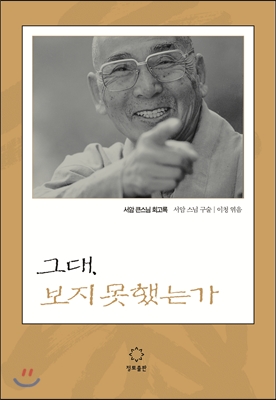
A message to modern people in need of healing The story of Seoam Seunim's practice and enlightenment, a compass for finding your heart in a time of chaos. A person who answered ten thousand questions in one word. One action is worth a thousand words. Someone who values you more. This book is the memoir of the great monk Seoam, and is a book compiled by author Lee Cheong based on the content that the great monk personally told. You can vividly witness the journey of the great monk Seoam, his ordination, practice, and his search for truth and enlightenment, and also hear his voice regarding the resignation of the head monk, which occurred during the process of religious order reform. The great monk Seoam. Korea's greatest Zen monk. I lived my whole life as a practitioner. There is a famous anecdote about how he pledged to study with his fellow monks at Chilbul-am in Jirisan and devoted himself to it, saying, "I'm willing to die studying." In 1978, he was appointed as the head monk of Bongamsa Temple and prohibited the entry of general tourists, promoting strict family practice and making Bongam Seonwon a special Seonwon of the Jogye Order. He was elected the 8th head of the Jogye Order of Korean Buddhism in December 1993, but resigned and left the order in April 1994, after 140 days in office. The monk, who spent his entire life studying and preaching based on Zen practice, is also well known for his 'Life Zen Dharma Talks' that are easy for the general public to understand. The monk always used public transportation and lived a frugal and simple life. The example of the great monk who practiced it with his body still serves as a model for practitioners today. The reason for publishing a memoir containing the great monk Seoam's practice and enlightenment on the 10th anniversary of his death is to offer a new alternative to modern people who are struggling with spiritual happiness despite their increasingly prosperous lives, and to provide a refreshing feeling like refreshing water. I hope that his humble life and words of enlightenment will provide an opportunity for us to reflect on our own lives. Watch the video 'Haven't You Seen' *Click* |
- You can preview some of the book's contents.
Preview
index
[Starting the story] Teaching and sharing the truth that cannot be taught
Chapter 1: Tell me a word about yourself.
Who am I
Don't kill the weather
First Encounter with Death
Hunger of the flesh and hunger of the mind
Where is Buddha now?
From today on, you are a servant of Seoaksa Temple.
Leaving home and practicing at Kim Yongsa Temple
The thirst and hunger in my heart
Studying abroad in Japan
Life in Japan, where survival was more important than studying
I was neither a salaried worker nor a businessman.
Poverty leaves scars on the body
Homecoming
new life
Resurrection is the life gained again
Monks Cheongdam and Seongcheol - the last remaining monks
The story of Monk Cheongdam
Chapter 2: Risking Your Life to Find the Way
liberation
Buddhist Youth Movement
Seeing the gentle heart in the caves of Gyeryongsan Mountain
Chilbulam Temple, where I began my studies with the determination to die
Encountering the Korean War at Gyeryongsan Mountain
Wonjeoksa Temple during the Korean War
The monks gathered at Wonjeoksa Temple
Wonjeoksa Temple, where the majestic Dharma lineage stands
Supporting the Wonjeoksa Temple through begging and alms
Protecting a Millennium-Old Temple from the Crisis of Logging
For the reconstruction of Bongamsa Temple
The heads of Yangsan Park
Bongamsa Temple, cultivated with the spirit of a practitioner
Blocking access to the mountain gate and protecting the millennium-old temple
The living wind of Bongamsa Temple
Chapter 3: The Lost Buddha
Bhikkhus, the center of modern and contemporary Korean Buddhism
The eradication of Japanese Buddhism and the collusion of political power
The regret of not being able to purify the body
Please work hard for Gyeongbuk Buddhism.
The problem is people
Wearing the hat of the Director General
Jogyesa Temple as a training center
The October 27th Incident is a shameful event.
Elect Monk Seongcheol as the head monk
Rely on the law, not on people.
Inaugurated as the 8th head of the Jogye Order
Beginning Buddhist reform
Violence only breeds more violence.
Jongjeong becomes the target of reform
A vote of no confidence in the Supreme Court and its resignation
From a slave to a free man
free man
Chapter 4: What Was I Before I Was Born?
Resting the mind is Zen.
Zen is the path to freedom
Where was your life before you were in your mother's womb?
Being a monk is not a profession.
First, the organization must be stable and have proper leadership.
Leave worldly desires behind and come to prose.
The greatest gift given to a monk
Are the soul and body one or two?
Where does our life end?
Nirvana is realizing that life is inherently empty.
The seeds of Buddha and sentient beings are no different.
How can there be only one thousand seven hundred police officers?
All eighty-four thousand dharma gates are but one voice to awaken the mind.
Japanese Zen
What topic did you choose to study?
Overcoming the fear of death is the main topic
If you ask and I answer, that is Buddha.
Chapter 5: Live Without Shaking
How was God born?
God is dead
What is Religion
Human-centered fundamental truth
Who can live life for you?
A person who can make life bloom with happiness
Material civilization that has lost the balance between humans, society, and nature
Age of Uncertainty
In search of the lost root of the mind
Self-discovery that returns to the original state of mind
Zen meditation, telling us how to wake up from a dream
Self-image before the body was formed
Are you the master of your own life or a thief?
Awareness of eternal life
How to not be shaken by any boundaries
Rely on yourself and make the truth your teacher.
Chapter 6: US Departments and Indian Departments
Religious freedom and religious egoism
We must transcend religion and politics.
A future Buddhism blossoming from painful wounds
The world of monks must be transparent.
Illegality is alive and well, flowing and acting.
The precepts are a vessel that contains the Buddha's teachings and enlightenment.
The practitioner's food and the monk Biryong's wall song
I have never been picky about food or interested in it.
Receiving this food is to achieve the goal of enlightenment.
A monk is a person who earns money
American Buddha, find freedom
US and Indian ministries
Warm southern country, Geoje Island
Chapter 7: The Final Conversation
Seoam, the Zen monk of non-action
Meeting in Geojedo
When do you plan to hit the road?
How to circulate
Mugwort soup
A prison-like defense, a defense-like prison
Cut off the desire for food
The ultimate Tao is not difficult.
Buddha and sentient beings are very different.
freshwater whales
[Closing the story] Drawing the Great Monk _ Lee Cheong
Seoam Honggeun Daejongsa Haengjang
Chapter 1: Tell me a word about yourself.
Who am I
Don't kill the weather
First Encounter with Death
Hunger of the flesh and hunger of the mind
Where is Buddha now?
From today on, you are a servant of Seoaksa Temple.
Leaving home and practicing at Kim Yongsa Temple
The thirst and hunger in my heart
Studying abroad in Japan
Life in Japan, where survival was more important than studying
I was neither a salaried worker nor a businessman.
Poverty leaves scars on the body
Homecoming
new life
Resurrection is the life gained again
Monks Cheongdam and Seongcheol - the last remaining monks
The story of Monk Cheongdam
Chapter 2: Risking Your Life to Find the Way
liberation
Buddhist Youth Movement
Seeing the gentle heart in the caves of Gyeryongsan Mountain
Chilbulam Temple, where I began my studies with the determination to die
Encountering the Korean War at Gyeryongsan Mountain
Wonjeoksa Temple during the Korean War
The monks gathered at Wonjeoksa Temple
Wonjeoksa Temple, where the majestic Dharma lineage stands
Supporting the Wonjeoksa Temple through begging and alms
Protecting a Millennium-Old Temple from the Crisis of Logging
For the reconstruction of Bongamsa Temple
The heads of Yangsan Park
Bongamsa Temple, cultivated with the spirit of a practitioner
Blocking access to the mountain gate and protecting the millennium-old temple
The living wind of Bongamsa Temple
Chapter 3: The Lost Buddha
Bhikkhus, the center of modern and contemporary Korean Buddhism
The eradication of Japanese Buddhism and the collusion of political power
The regret of not being able to purify the body
Please work hard for Gyeongbuk Buddhism.
The problem is people
Wearing the hat of the Director General
Jogyesa Temple as a training center
The October 27th Incident is a shameful event.
Elect Monk Seongcheol as the head monk
Rely on the law, not on people.
Inaugurated as the 8th head of the Jogye Order
Beginning Buddhist reform
Violence only breeds more violence.
Jongjeong becomes the target of reform
A vote of no confidence in the Supreme Court and its resignation
From a slave to a free man
free man
Chapter 4: What Was I Before I Was Born?
Resting the mind is Zen.
Zen is the path to freedom
Where was your life before you were in your mother's womb?
Being a monk is not a profession.
First, the organization must be stable and have proper leadership.
Leave worldly desires behind and come to prose.
The greatest gift given to a monk
Are the soul and body one or two?
Where does our life end?
Nirvana is realizing that life is inherently empty.
The seeds of Buddha and sentient beings are no different.
How can there be only one thousand seven hundred police officers?
All eighty-four thousand dharma gates are but one voice to awaken the mind.
Japanese Zen
What topic did you choose to study?
Overcoming the fear of death is the main topic
If you ask and I answer, that is Buddha.
Chapter 5: Live Without Shaking
How was God born?
God is dead
What is Religion
Human-centered fundamental truth
Who can live life for you?
A person who can make life bloom with happiness
Material civilization that has lost the balance between humans, society, and nature
Age of Uncertainty
In search of the lost root of the mind
Self-discovery that returns to the original state of mind
Zen meditation, telling us how to wake up from a dream
Self-image before the body was formed
Are you the master of your own life or a thief?
Awareness of eternal life
How to not be shaken by any boundaries
Rely on yourself and make the truth your teacher.
Chapter 6: US Departments and Indian Departments
Religious freedom and religious egoism
We must transcend religion and politics.
A future Buddhism blossoming from painful wounds
The world of monks must be transparent.
Illegality is alive and well, flowing and acting.
The precepts are a vessel that contains the Buddha's teachings and enlightenment.
The practitioner's food and the monk Biryong's wall song
I have never been picky about food or interested in it.
Receiving this food is to achieve the goal of enlightenment.
A monk is a person who earns money
American Buddha, find freedom
US and Indian ministries
Warm southern country, Geoje Island
Chapter 7: The Final Conversation
Seoam, the Zen monk of non-action
Meeting in Geojedo
When do you plan to hit the road?
How to circulate
Mugwort soup
A prison-like defense, a defense-like prison
Cut off the desire for food
The ultimate Tao is not difficult.
Buddha and sentient beings are very different.
freshwater whales
[Closing the story] Drawing the Great Monk _ Lee Cheong
Seoam Honggeun Daejongsa Haengjang
Publisher's Review
Seoam, the spiritual mentor who provided a turning point in the life of Venerable Beopryun.
“Look, there is a man sitting quietly under the ridge of a rice paddy,
If you purify your mind,
That person is the one,
That's the temple.
And that is Buddhism.”
In his youth, Venerable Pomnyun, who had been deeply concerned about the reality of the Buddhist world, met a monk named Noh at a small temple in Los Angeles, USA in the 1980s.
Monk Beopryun, hearing the story of Nosun, awakens to his own life, which had been immersed in the name of the Buddhist movement, and faces a turning point in his life.
This monk was none other than the 8th head of the Jogye Order and the greatest Zen monk in Korea, the great monk Seoam.
There are many adjectives used to describe the great monk Seoam, such as the former head of the Jogye Order and Josil of Bongamsa Temple, the best Zen temple in Korea, but the one word that can describe the life of the great monk Seoam is freedom and principle.
After being diagnosed with severe pulmonary tuberculosis while studying abroad in Japan and returning to Korea, the great monk Seoam devoted himself to monastic life with the determination to dedicate his life to Kim Yongsa Temple, where he first became a monk.
The monk, who had been diligently practicing, realized, looking at his own body, that 'life is the mind, and there is no door to life and death outside of my mind.'
After that, the monk lived his entire life by one principle.
The principle was that 'even if you do something to alleviate the suffering of living beings, if you do it in a manner that is in accordance with the Buddhist law, it is no different from practicing meditation in the mountains. Even if you sit in the mountains and practice meditation alone, if you do not forget the suffering of all living beings, you will not be separated from the practice of compassion.'
With these principles, he took on any task that the world, the religious order, and the Buddhist community wanted and performed his duties selflessly.
Then, when the environment was not conducive to properly carrying out the given duties, he threw away that 'position' without any regrets and returned to his duty as a performer.
From his time as the head of the Gyeongbuk Jongmuwon after liberation, to the position of the head of the Jogye Order, chairman of the council of elders, and head priest, the monk repeatedly took on positions without deviating from this principle, and then resigned without hesitation and returned to being a monk.
With one fundamental principle of Buddhism, the monk lived his entire life as a free person, not bound by clan, role, or religious order.
Zen in Life: How to Find Your Mind
The monk, who studied and preached based on his lifelong practice of Zen, is known for his ‘Dharma talk on daily life Zen’ that is easy for the general public to understand.
This is because the importance of practice in daily life was emphasized in the line.
“Goodness is not something that exists somewhere else, but is something that is realized within our lives.
The monk's teaching was that "the line of life is to find one's true self 24 hours a day, moving one's hands and feet, crying and laughing, and talking with neighbors in daily life."
We live busy lives.
I am always busy thinking and acting, but I am not aware of my current self.
For modern people who live without realizing their true nature, Buddhism reveals the true nature of the mind and helps people realize the true nature of their own minds.
And the method of realizing one's own mind is called Zen.
So, goodness is not something that only monks need, but something that everyone needs.
And he says that Zen is not the exclusive property of Buddhism.
He said that Zen and Zen life are ways for modern people, who are unable to escape from a mental world stained with chaos and pain, to discover their true selves.
The misunderstandings and truths surrounding the sect dispute, withdrawal from the sect, and departure from the sect.
Monk Seoam pointed out that the violence that was brought in after liberation with the aim of purifying Japanese-influenced Korean Buddhism is still a fundamental factor hindering the development of Buddhism to this day.
Even if the cause and justification are right, if the method is problematic, then it is not justified from a Buddhist perspective.
The monk's intention was that even if it is not physical, showing off the power of the masses through fasting or gatherings and pushing forward with force is violence, and that violent solutions are worldly methods and not Buddhist teachings.
During the 1994 reform, they denied and tried to block the solution through public power and violence.
The public was divided into my side and your side, and in the process of gathering public power, there was a misunderstanding that 'Monk Seoam is not on our side' and he was driven to be a 'target of reform'.
Seoam Seunim resigned from the post of head and left the order, presenting Buddhist principles for non-Buddhist methods.
In light of the misevaluation and distortion of this series of circumstances, as we mark the 10th anniversary of the death of Venerable Seoam, Venerable Seoam's resignation from the position of chief priest and departure from the order should be re-evaluated as the greatest honor for a practitioner protecting the Buddhist law.
That old man lived like that and died like that.
Before entering nirvana, the disciples who were serving the monk earnestly asked him to say a word, and the monk said a word.
“Say that old man lived like that and died like that.”
These are not verses or sermons, they are just ordinary words.
However, it was the most Buddhist-like word that encompassed and criticized all of Buddhism in this world, including Buddha.
In a world where anything that reaches a lofty, complex, and subtle level is valued, the monk's simple words seem to be a sarcastic comment on this state of affairs.
The reason for publishing a memoir containing the great monk Seoam's practice and enlightenment on the 10th anniversary of his death is to offer a new alternative to modern people who are struggling with spiritual happiness despite their increasingly prosperous lives, and to provide a refreshing feeling like refreshing water.
I hope that his humble life and words of enlightenment will provide an opportunity for us to reflect on our own lives.
“Look, there is a man sitting quietly under the ridge of a rice paddy,
If you purify your mind,
That person is the one,
That's the temple.
And that is Buddhism.”
In his youth, Venerable Pomnyun, who had been deeply concerned about the reality of the Buddhist world, met a monk named Noh at a small temple in Los Angeles, USA in the 1980s.
Monk Beopryun, hearing the story of Nosun, awakens to his own life, which had been immersed in the name of the Buddhist movement, and faces a turning point in his life.
This monk was none other than the 8th head of the Jogye Order and the greatest Zen monk in Korea, the great monk Seoam.
There are many adjectives used to describe the great monk Seoam, such as the former head of the Jogye Order and Josil of Bongamsa Temple, the best Zen temple in Korea, but the one word that can describe the life of the great monk Seoam is freedom and principle.
After being diagnosed with severe pulmonary tuberculosis while studying abroad in Japan and returning to Korea, the great monk Seoam devoted himself to monastic life with the determination to dedicate his life to Kim Yongsa Temple, where he first became a monk.
The monk, who had been diligently practicing, realized, looking at his own body, that 'life is the mind, and there is no door to life and death outside of my mind.'
After that, the monk lived his entire life by one principle.
The principle was that 'even if you do something to alleviate the suffering of living beings, if you do it in a manner that is in accordance with the Buddhist law, it is no different from practicing meditation in the mountains. Even if you sit in the mountains and practice meditation alone, if you do not forget the suffering of all living beings, you will not be separated from the practice of compassion.'
With these principles, he took on any task that the world, the religious order, and the Buddhist community wanted and performed his duties selflessly.
Then, when the environment was not conducive to properly carrying out the given duties, he threw away that 'position' without any regrets and returned to his duty as a performer.
From his time as the head of the Gyeongbuk Jongmuwon after liberation, to the position of the head of the Jogye Order, chairman of the council of elders, and head priest, the monk repeatedly took on positions without deviating from this principle, and then resigned without hesitation and returned to being a monk.
With one fundamental principle of Buddhism, the monk lived his entire life as a free person, not bound by clan, role, or religious order.
Zen in Life: How to Find Your Mind
The monk, who studied and preached based on his lifelong practice of Zen, is known for his ‘Dharma talk on daily life Zen’ that is easy for the general public to understand.
This is because the importance of practice in daily life was emphasized in the line.
“Goodness is not something that exists somewhere else, but is something that is realized within our lives.
The monk's teaching was that "the line of life is to find one's true self 24 hours a day, moving one's hands and feet, crying and laughing, and talking with neighbors in daily life."
We live busy lives.
I am always busy thinking and acting, but I am not aware of my current self.
For modern people who live without realizing their true nature, Buddhism reveals the true nature of the mind and helps people realize the true nature of their own minds.
And the method of realizing one's own mind is called Zen.
So, goodness is not something that only monks need, but something that everyone needs.
And he says that Zen is not the exclusive property of Buddhism.
He said that Zen and Zen life are ways for modern people, who are unable to escape from a mental world stained with chaos and pain, to discover their true selves.
The misunderstandings and truths surrounding the sect dispute, withdrawal from the sect, and departure from the sect.
Monk Seoam pointed out that the violence that was brought in after liberation with the aim of purifying Japanese-influenced Korean Buddhism is still a fundamental factor hindering the development of Buddhism to this day.
Even if the cause and justification are right, if the method is problematic, then it is not justified from a Buddhist perspective.
The monk's intention was that even if it is not physical, showing off the power of the masses through fasting or gatherings and pushing forward with force is violence, and that violent solutions are worldly methods and not Buddhist teachings.
During the 1994 reform, they denied and tried to block the solution through public power and violence.
The public was divided into my side and your side, and in the process of gathering public power, there was a misunderstanding that 'Monk Seoam is not on our side' and he was driven to be a 'target of reform'.
Seoam Seunim resigned from the post of head and left the order, presenting Buddhist principles for non-Buddhist methods.
In light of the misevaluation and distortion of this series of circumstances, as we mark the 10th anniversary of the death of Venerable Seoam, Venerable Seoam's resignation from the position of chief priest and departure from the order should be re-evaluated as the greatest honor for a practitioner protecting the Buddhist law.
That old man lived like that and died like that.
Before entering nirvana, the disciples who were serving the monk earnestly asked him to say a word, and the monk said a word.
“Say that old man lived like that and died like that.”
These are not verses or sermons, they are just ordinary words.
However, it was the most Buddhist-like word that encompassed and criticized all of Buddhism in this world, including Buddha.
In a world where anything that reaches a lofty, complex, and subtle level is valued, the monk's simple words seem to be a sarcastic comment on this state of affairs.
The reason for publishing a memoir containing the great monk Seoam's practice and enlightenment on the 10th anniversary of his death is to offer a new alternative to modern people who are struggling with spiritual happiness despite their increasingly prosperous lives, and to provide a refreshing feeling like refreshing water.
I hope that his humble life and words of enlightenment will provide an opportunity for us to reflect on our own lives.
GOODS SPECIFICS
- Date of issue: April 7, 2013
- Page count, weight, size: 444 pages | 600g | 153*224*30mm
- ISBN13: 9788985961738
- ISBN10: 898596173X
You may also like
카테고리
korean


korean

![GQ KOREA Mark (Monthly): December [2025]](http://librairie.coreenne.fr/cdn/shop/files/8ef265dbbfbf186523ed75ba7319009d.jpg?v=1765340328&width=3840)


