

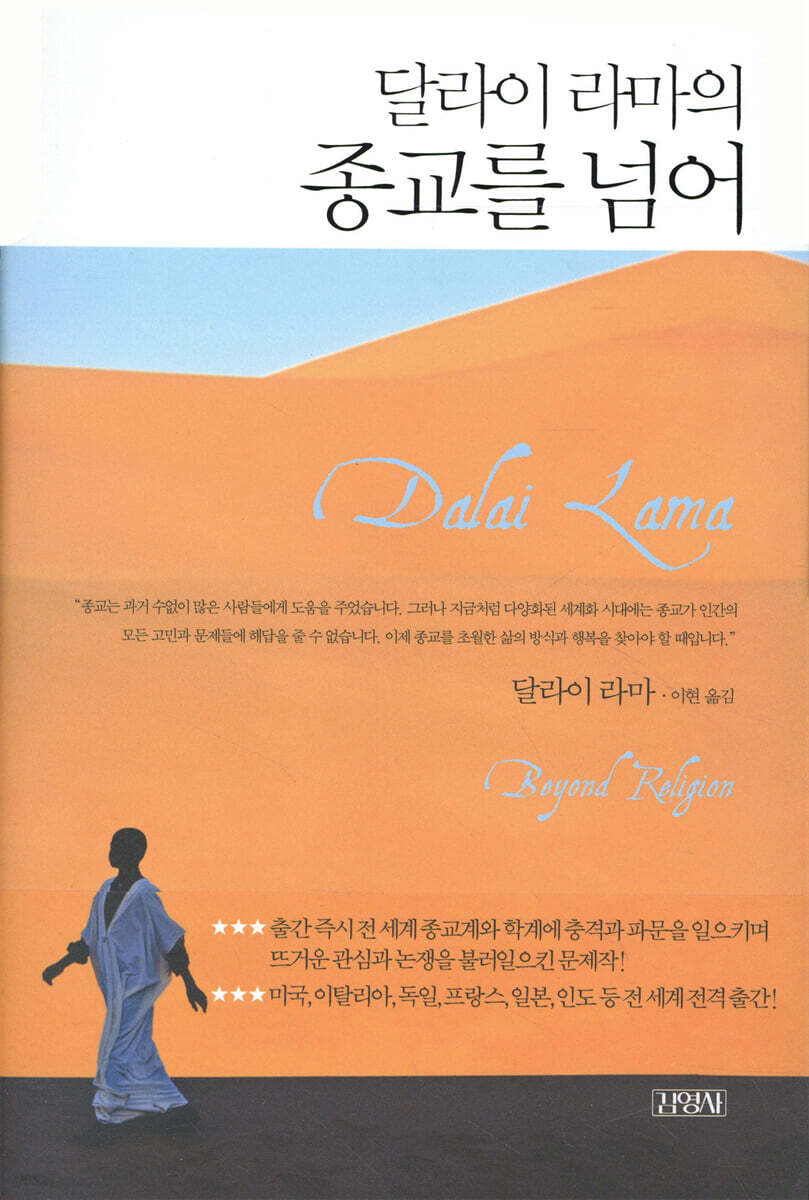
Beyond the Dalai Lama's Religion
 |
Description
Book Introduction
Religion can no longer lead the future.
Now is the time for a new alternative!
The 14th Dalai Lama, Tenzin Gyatso, has been moving the hearts of people around the world with his compassion and love, fighting against the violence of the Chinese authorities throughout his life since he was discovered as an incarnation of the Dalai Lama in his childhood.
A message of profound transformation, he delivers as he looks upon the rapidly changing and diversifying 21st century! Born from the anguish of the countless religions yet unable to resolve human concerns and problems, he offers a new way of life and a path to happiness for humanity's precious future.
It shows the ultimate destination of the Dalai Lama's thought, who lived a great life in deep spirituality.
The Dalai Lama, whose name means 'a teacher of great virtue as vast as the vast sea', refers to the religious and political leader of Tibet.
The author of this book, Tenzin Gyatso, is the 14th Dalai Lama.
The Dalai Lama (Tenzin Gyatso) calls himself 'an old man now' (p. 6) and 'the longest-staying guest in India' (p. 6).
He looked back on his past life, which was more difficult and painful than anyone else's, and presented the result of his long-term thoughts on the peaceful continuation of humanity.
Although he lived his entire life as the greatest religious leader, he could not stop the constant war.
The reality that they were closing their hearts to each other and only fanning the flames of hatred must have tormented him.
In 2011, when he stepped down as Tibet's political leader, he acknowledged the limitations of religion in real society and called for an alternative to lead the post-religious world.
It consists of two chapters, and in Chapter 1, the Dalai Lama preaches about ‘present-worldism.’
He urges that people, whether religious or not, should share tolerance and respect for one another, and that this requires a recognition of reality beyond religion and an individual's inner awakening.
In Chapter 2, the Dalai Lama considers effective methods for fostering compassion and inner values and putting them into practice, and writes about the result of this process: mind education.
If you can let go of your own emotions, such as anger or jealousy, and be considerate of others and do good deeds, this will become a source of inner confidence and lead to great joy.
It also provides detailed information on meditation practices that can transform your daily life.
Now is the time for a new alternative!
The 14th Dalai Lama, Tenzin Gyatso, has been moving the hearts of people around the world with his compassion and love, fighting against the violence of the Chinese authorities throughout his life since he was discovered as an incarnation of the Dalai Lama in his childhood.
A message of profound transformation, he delivers as he looks upon the rapidly changing and diversifying 21st century! Born from the anguish of the countless religions yet unable to resolve human concerns and problems, he offers a new way of life and a path to happiness for humanity's precious future.
It shows the ultimate destination of the Dalai Lama's thought, who lived a great life in deep spirituality.
The Dalai Lama, whose name means 'a teacher of great virtue as vast as the vast sea', refers to the religious and political leader of Tibet.
The author of this book, Tenzin Gyatso, is the 14th Dalai Lama.
The Dalai Lama (Tenzin Gyatso) calls himself 'an old man now' (p. 6) and 'the longest-staying guest in India' (p. 6).
He looked back on his past life, which was more difficult and painful than anyone else's, and presented the result of his long-term thoughts on the peaceful continuation of humanity.
Although he lived his entire life as the greatest religious leader, he could not stop the constant war.
The reality that they were closing their hearts to each other and only fanning the flames of hatred must have tormented him.
In 2011, when he stepped down as Tibet's political leader, he acknowledged the limitations of religion in real society and called for an alternative to lead the post-religious world.
It consists of two chapters, and in Chapter 1, the Dalai Lama preaches about ‘present-worldism.’
He urges that people, whether religious or not, should share tolerance and respect for one another, and that this requires a recognition of reality beyond religion and an individual's inner awakening.
In Chapter 2, the Dalai Lama considers effective methods for fostering compassion and inner values and putting them into practice, and writes about the result of this process: mind education.
If you can let go of your own emotions, such as anger or jealousy, and be considerate of others and do good deeds, this will become a source of inner confidence and lead to great joy.
It also provides detailed information on meditation practices that can transform your daily life.
- You can preview some of the book's contents.
Preview
index
Ⅰ.
A New Vision of Worldly Morality
1.
Can't morality and religion be separated?
2.
We are all one
3.
In search of happiness
4.
Compassion, creating happiness
5.
merciful justice
6.
Why Discernment Is Needed
7.
Morality of the world we live in together
Ⅱ.
From head to heart
Change starts with me
8.
How to practice morality
9.
Break free from the chains of emotion
10.
What values do we need?
11.
Mindfulness Practice to Transform Your Life
A New Vision of Worldly Morality
1.
Can't morality and religion be separated?
2.
We are all one
3.
In search of happiness
4.
Compassion, creating happiness
5.
merciful justice
6.
Why Discernment Is Needed
7.
Morality of the world we live in together
Ⅱ.
From head to heart
Change starts with me
8.
How to practice morality
9.
Break free from the chains of emotion
10.
What values do we need?
11.
Mindfulness Practice to Transform Your Life
Into the book
What we need today is an approach to morality that is non-religious and equally acceptable to both believers and non-believers.
That is worldly morality.
It may seem strange that such remarks come from someone who has lived in monk's attire since childhood.
But I don't see any contradiction here.
My religion, Buddhism, teaches us to work for the benefit and happiness of all sentient beings.
And beyond my own religion, I believe that reaching out to people of other faiths or no religion at all is no different. ---p.14
Bihar is a particularly densely populated and poor region in northern India.
My old friend, the Governor of Bihar, expressed his conviction in a wonderful speech.
With the blessings of Buddha, Bihar will now prosper.
When it was my turn to speak, I said, half-jokingly:
If Bihar's prosperity depended solely on the Buddha's protection, it should have flourished long ago! After all, Bihar is one of the most sacred places for Buddhists.
Because historically, there is Bodh Gaya where Buddha is said to have attained complete enlightenment.
For true change, we need more than just the Buddha's protection and prayers.
Although the Buddha's protection is powerful.
We also need action, and that will only happen through the efforts of governors and those like them! ---p.24
A few years ago, while visiting Spain, I met a Christian monk who had spent five years as a hermit behind a monastery.
When asked what he had been doing all that time, he replied that he had been meditating on love.
When he said this in English even more imperfect than mine, I saw in his eyes a deep emotion that needed no more words.
Here's an example of someone who lived alone but didn't feel lonely.
Above all, it is warmth and compassion that connect us to others.
Even people who seem to have many friends and followers can feel quite isolated.
I often remind them that the only antidote to such loneliness is their own inner attitude.
That inner attitude is one of affection, consideration, and warmth toward humanity. ---p.64
In this age of globalization, it is time to realize that our lives are deeply interconnected and that our actions have a global dimension.
Doing so would be in the best interest of the greater human community, and in our own best interests as well.
On the other hand, if we focus solely on our own inner development and neglect the wider world's problems, or even if we recognize them, remain indifferent to solving them, we have overlooked something fundamental.
Indifference is itself a form of selfishness.
If our approach to morality is to be truly meaningful, it must naturally involve concern for the world.
This is the principle of global responsibility, a core part of my teachings on how to approach worldly morality. ---p.120
The purpose of the mind training techniques I have described so far is to make us more calm, more compassionate, and more discerning human beings, especially from a worldly moral perspective.
But there are other ways to benefit your day-to-day life.
Especially as we progress further, we develop a certain level of stability in our minds, and we become less and less overly excited or depressed.
Therefore, our practice helps us protect ourselves from the stress of experiencing the ups and downs of life too intensely.
That doesn't mean it's mind-numbing.
What I mean is to restrain excess.
That is worldly morality.
It may seem strange that such remarks come from someone who has lived in monk's attire since childhood.
But I don't see any contradiction here.
My religion, Buddhism, teaches us to work for the benefit and happiness of all sentient beings.
And beyond my own religion, I believe that reaching out to people of other faiths or no religion at all is no different. ---p.14
Bihar is a particularly densely populated and poor region in northern India.
My old friend, the Governor of Bihar, expressed his conviction in a wonderful speech.
With the blessings of Buddha, Bihar will now prosper.
When it was my turn to speak, I said, half-jokingly:
If Bihar's prosperity depended solely on the Buddha's protection, it should have flourished long ago! After all, Bihar is one of the most sacred places for Buddhists.
Because historically, there is Bodh Gaya where Buddha is said to have attained complete enlightenment.
For true change, we need more than just the Buddha's protection and prayers.
Although the Buddha's protection is powerful.
We also need action, and that will only happen through the efforts of governors and those like them! ---p.24
A few years ago, while visiting Spain, I met a Christian monk who had spent five years as a hermit behind a monastery.
When asked what he had been doing all that time, he replied that he had been meditating on love.
When he said this in English even more imperfect than mine, I saw in his eyes a deep emotion that needed no more words.
Here's an example of someone who lived alone but didn't feel lonely.
Above all, it is warmth and compassion that connect us to others.
Even people who seem to have many friends and followers can feel quite isolated.
I often remind them that the only antidote to such loneliness is their own inner attitude.
That inner attitude is one of affection, consideration, and warmth toward humanity. ---p.64
In this age of globalization, it is time to realize that our lives are deeply interconnected and that our actions have a global dimension.
Doing so would be in the best interest of the greater human community, and in our own best interests as well.
On the other hand, if we focus solely on our own inner development and neglect the wider world's problems, or even if we recognize them, remain indifferent to solving them, we have overlooked something fundamental.
Indifference is itself a form of selfishness.
If our approach to morality is to be truly meaningful, it must naturally involve concern for the world.
This is the principle of global responsibility, a core part of my teachings on how to approach worldly morality. ---p.120
The purpose of the mind training techniques I have described so far is to make us more calm, more compassionate, and more discerning human beings, especially from a worldly moral perspective.
But there are other ways to benefit your day-to-day life.
Especially as we progress further, we develop a certain level of stability in our minds, and we become less and less overly excited or depressed.
Therefore, our practice helps us protect ourselves from the stress of experiencing the ups and downs of life too intensely.
That doesn't mean it's mind-numbing.
What I mean is to restrain excess.
---p.233~234
Publisher's Review
'What is needed for human happiness in this rapidly changing globalized era?
What has religion done for the world, and what should it do?'
A new path to happiness proposed by the Dalai Lama for the precious future of humanity!
In Korean society, where so many religions coexist that it is called a religious department store, religion has a large and small impact on a person's life.
Countless religions, from indigenous beliefs to Christianity, have caused various problems and frequent inter-religious conflicts, which sometimes escalate into social problems.
The Dalai Lama's Beyond Religion points out that inter-religious conflict is a major obstacle to the peace and happiness of humanity and explores alternatives.
Since the beginning of history, religion has played a major role in addressing human fears and anxieties.
However, religions that originated and spread in specific regions could not create universal ethics for all of humanity, and instead, in areas where different religions met, destruction and massacre through war inevitably followed.
However, for us living in a rapidly changing modern society with the amazing advancement of science and technology, blindly believing in one religion and following only its values creates a bigger problem.
Today, when the entire world is connected as one network, regional or religious distinctions have no meaning.
The Dalai Lama emphasizes that we should not judge the world based on one morality or one religion, but rather flexibly accept the world's rapid changes, respect each other's diversity, and have an open mind.
This is the only wise way to heal the social unrest and division caused by conflict and to ensure human survival in the rapidly changing 21st century.
Beyond Religion: The Dalai Lama offers a true guide to life, offering warm reflections on peace and happiness in an age of anxiety and chaos.
“Actually, I think prayer has tremendous psychological benefits.
However, we must accept that the tangible results of prayer are often difficult to see.
It is clear that prayer falls short of what modern science has achieved in terms of achieving certain and direct results.
When I was very sick a few years ago, it was a definite comfort to know that people were praying for me.
But I must confess, a greater comfort was the fact that the hospital where I was being treated had the most up-to-date equipment!” (p. 24)
The realization that the world's religions cannot solve human suffering and problems,
A sincere confession from the greatest religious leader at the end of his life!
The Dalai Lama, whose name means 'a teacher of great virtue as vast as the vast sea', refers to the religious and political leader of Tibet.
The author of this book, Tenzin Gyatso, is the 14th Dalai Lama.
The Dalai Lama (Tenzin Gyatso) calls himself 'an old man now' (p. 6) and 'the longest-staying guest in India' (p. 6).
But he is not heavy or dark.
He does not seem to have the arduous life of living in India for over 50 years, dedicating himself to the independence and future of his homeland, Tibet.
His voice is warm, acknowledging that even money and desire are important for human happiness.
A leader who enjoys joking with a childlike face, a low voice demanding independence through non-violent means, saying that he does not hate the Chinese either.
That's why he is respected and loved by people all over the world.
He looked back on his past life, which was more difficult and painful than anyone else's, and presented the result of his long-term thoughts on the peaceful continuation of humanity.
Although he lived his entire life as the greatest religious leader, he could not stop the constant war.
The reality that they were closing their hearts to each other and only fanning the flames of hatred must have tormented him.
In 2011, when he stepped down as Tibet's political leader, he acknowledged the limitations of religion in real society and called for an alternative to lead the post-religious world.
It is not something that can be achieved by emotionally hating or ignoring those who are different from me.
Face reality.
And regardless of religion, only when we understand each other's religions and cultures and extend a warm hand first can we achieve coexistence across the globe, beyond individual happiness.
The Dalai Lama is a living saint who is respected and loved by people all over the world.
The profound thoughts and brilliant insight gained from the octogenarian master's life are impressive, as is his insight into the value and role of religion, as well as his insights and advice on how to live beyond religion.
《The Dalai Lama's Beyond Religion》 is composed of two chapters, and in Chapter 1, the Dalai Lama preaches about 'present-worldism.'
He urges that people, both religious and non-religious, should share tolerance and respect for one another, and that this requires a recognition of reality beyond religion and an individual's inner awakening.
It is said that if we break away from the long-held idea that religion is morality and focus on the fundamental human spirituality that is more fundamental than religion, and understand each other with compassion and love, which are the original values of religion, a peaceful and happy future is possible.
Based on the recognition that we are all one, we respect all that is necessary for happiness (money, health, friendship, peace of mind, compassion, etc.), and emphasize the importance of compassion as the foundation of moral and spiritual happiness and the basis for understanding justice.
In Chapter 2, the Dalai Lama writes about the education of the mind, which is the result of his reflections on effective methods for fostering compassion and inner values and putting them into practice.
Mindfulness begins with mindfulness, awareness, and awareness of our own actions (thoughts, words, and deeds).
If you can free yourself from your own emotions, such as anger or jealousy, and be considerate of others and do good deeds, this will become a source of inner confidence and lead to great joy.
It also provides detailed information on meditation practices that can transform your daily life.
The important thing is that when we pursue our own selfishness, we must be 'wisely selfish' rather than 'foolishly selfish'.
Being foolishly selfish means pursuing our own interests narrowly and myopically.
Being wisely selfish means taking a broader perspective and realizing that our own personal interests depend on the well-being of everyone in the long run.
(…) Compassion is a wonder of human nature, a precious inner resource, and the foundation of happiness and harmony in our society.
Therefore, if we seek our own happiness, we must practice compassion.
And if you seek the happiness of others, you must practice compassion even then! (pp. 76-77)
What has religion done for the world, and what should it do?'
A new path to happiness proposed by the Dalai Lama for the precious future of humanity!
In Korean society, where so many religions coexist that it is called a religious department store, religion has a large and small impact on a person's life.
Countless religions, from indigenous beliefs to Christianity, have caused various problems and frequent inter-religious conflicts, which sometimes escalate into social problems.
The Dalai Lama's Beyond Religion points out that inter-religious conflict is a major obstacle to the peace and happiness of humanity and explores alternatives.
Since the beginning of history, religion has played a major role in addressing human fears and anxieties.
However, religions that originated and spread in specific regions could not create universal ethics for all of humanity, and instead, in areas where different religions met, destruction and massacre through war inevitably followed.
However, for us living in a rapidly changing modern society with the amazing advancement of science and technology, blindly believing in one religion and following only its values creates a bigger problem.
Today, when the entire world is connected as one network, regional or religious distinctions have no meaning.
The Dalai Lama emphasizes that we should not judge the world based on one morality or one religion, but rather flexibly accept the world's rapid changes, respect each other's diversity, and have an open mind.
This is the only wise way to heal the social unrest and division caused by conflict and to ensure human survival in the rapidly changing 21st century.
Beyond Religion: The Dalai Lama offers a true guide to life, offering warm reflections on peace and happiness in an age of anxiety and chaos.
“Actually, I think prayer has tremendous psychological benefits.
However, we must accept that the tangible results of prayer are often difficult to see.
It is clear that prayer falls short of what modern science has achieved in terms of achieving certain and direct results.
When I was very sick a few years ago, it was a definite comfort to know that people were praying for me.
But I must confess, a greater comfort was the fact that the hospital where I was being treated had the most up-to-date equipment!” (p. 24)
The realization that the world's religions cannot solve human suffering and problems,
A sincere confession from the greatest religious leader at the end of his life!
The Dalai Lama, whose name means 'a teacher of great virtue as vast as the vast sea', refers to the religious and political leader of Tibet.
The author of this book, Tenzin Gyatso, is the 14th Dalai Lama.
The Dalai Lama (Tenzin Gyatso) calls himself 'an old man now' (p. 6) and 'the longest-staying guest in India' (p. 6).
But he is not heavy or dark.
He does not seem to have the arduous life of living in India for over 50 years, dedicating himself to the independence and future of his homeland, Tibet.
His voice is warm, acknowledging that even money and desire are important for human happiness.
A leader who enjoys joking with a childlike face, a low voice demanding independence through non-violent means, saying that he does not hate the Chinese either.
That's why he is respected and loved by people all over the world.
He looked back on his past life, which was more difficult and painful than anyone else's, and presented the result of his long-term thoughts on the peaceful continuation of humanity.
Although he lived his entire life as the greatest religious leader, he could not stop the constant war.
The reality that they were closing their hearts to each other and only fanning the flames of hatred must have tormented him.
In 2011, when he stepped down as Tibet's political leader, he acknowledged the limitations of religion in real society and called for an alternative to lead the post-religious world.
It is not something that can be achieved by emotionally hating or ignoring those who are different from me.
Face reality.
And regardless of religion, only when we understand each other's religions and cultures and extend a warm hand first can we achieve coexistence across the globe, beyond individual happiness.
The Dalai Lama is a living saint who is respected and loved by people all over the world.
The profound thoughts and brilliant insight gained from the octogenarian master's life are impressive, as is his insight into the value and role of religion, as well as his insights and advice on how to live beyond religion.
《The Dalai Lama's Beyond Religion》 is composed of two chapters, and in Chapter 1, the Dalai Lama preaches about 'present-worldism.'
He urges that people, both religious and non-religious, should share tolerance and respect for one another, and that this requires a recognition of reality beyond religion and an individual's inner awakening.
It is said that if we break away from the long-held idea that religion is morality and focus on the fundamental human spirituality that is more fundamental than religion, and understand each other with compassion and love, which are the original values of religion, a peaceful and happy future is possible.
Based on the recognition that we are all one, we respect all that is necessary for happiness (money, health, friendship, peace of mind, compassion, etc.), and emphasize the importance of compassion as the foundation of moral and spiritual happiness and the basis for understanding justice.
In Chapter 2, the Dalai Lama writes about the education of the mind, which is the result of his reflections on effective methods for fostering compassion and inner values and putting them into practice.
Mindfulness begins with mindfulness, awareness, and awareness of our own actions (thoughts, words, and deeds).
If you can free yourself from your own emotions, such as anger or jealousy, and be considerate of others and do good deeds, this will become a source of inner confidence and lead to great joy.
It also provides detailed information on meditation practices that can transform your daily life.
The important thing is that when we pursue our own selfishness, we must be 'wisely selfish' rather than 'foolishly selfish'.
Being foolishly selfish means pursuing our own interests narrowly and myopically.
Being wisely selfish means taking a broader perspective and realizing that our own personal interests depend on the well-being of everyone in the long run.
(…) Compassion is a wonder of human nature, a precious inner resource, and the foundation of happiness and harmony in our society.
Therefore, if we seek our own happiness, we must practice compassion.
And if you seek the happiness of others, you must practice compassion even then! (pp. 76-77)
GOODS SPECIFICS
- Date of publication: February 12, 2013
- Format: Hardcover book binding method guide
- Page count, weight, size: 248 pages | 472g | 135*205*20mm
- ISBN13: 9788934962106
- ISBN10: 8934962100
You may also like
카테고리
korean


korean

![GQ KOREA Mark (Monthly): December [2025]](http://librairie.coreenne.fr/cdn/shop/files/8ef265dbbfbf186523ed75ba7319009d.jpg?v=1765340328&width=3840)


