

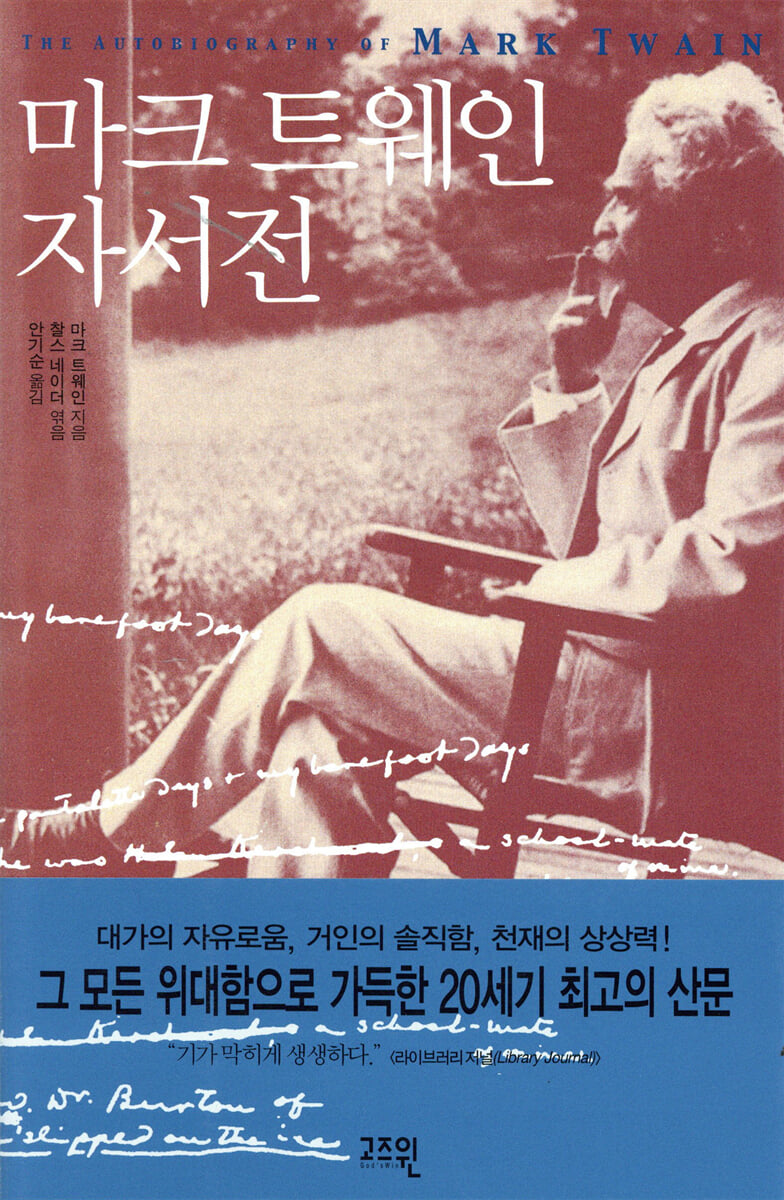
Mark Twain's Autobiography
 |
Description
Book Introduction
"The Autobiography of Mark Twain" is the autobiography of Mark Twain, the undisputed genius storyteller. Even now, half a century after its publication, it is still called one of the "100 Best Non-Fiction Books of the 20th Century" and is consistently read in the English-speaking world. This autobiography, edited by Charles Nader, is a masterpiece.
Unlike typical autobiographies, Mark Twain did not write his manuscript systematically with chronological order in mind, but rather wrote based on anecdotes that came to him from day to day. Therefore, even after passing through the editor's hands, his autobiography was not organized in perfect chronological order.
However, the anecdotal writing has the advantage of allowing each anecdote to be described and narrated more vividly, and this structure is perceived as unique, like the freedom of the author Mark Twain.
Mark Twain's masterful side, fully demonstrated in his autobiography, is humor, satire, and paradox.
This is an autobiography that allows you to feel Mark Twain's humanity, which is not light or vulgar humor, but rather a philosophy of humor and a free spirit's pride that is not bound by anything, through nonsensical paradoxes.
Unlike typical autobiographies, Mark Twain did not write his manuscript systematically with chronological order in mind, but rather wrote based on anecdotes that came to him from day to day. Therefore, even after passing through the editor's hands, his autobiography was not organized in perfect chronological order.
However, the anecdotal writing has the advantage of allowing each anecdote to be described and narrated more vividly, and this structure is perceived as unique, like the freedom of the author Mark Twain.
Mark Twain's masterful side, fully demonstrated in his autobiography, is humor, satire, and paradox.
This is an autobiography that allows you to feel Mark Twain's humanity, which is not light or vulgar humor, but rather a philosophy of humor and a free spirit's pride that is not bound by anything, through nonsensical paradoxes.
index
Preface_Mark Twain
Editor's Preface_Charles Nader
Mark Twain's Autobiography
Translator's Note
Mark Twain Chronology
Search
Editor's Preface_Charles Nader
Mark Twain's Autobiography
Translator's Note
Mark Twain Chronology
Search
Into the book
Finally, a proper method for writing an 'autobiography' has occurred to me.
It is not about starting at a specific point in life, but about wandering through life, guided by free will. ---p.14
My intention with my autobiography is that, when it is published after my death, it will serve as a model for all future autobiographies. ---p.15
Howells asked if I intended to make the autobiography into a series.
I intended to do so, but I said that if I lived long enough, the number of volumes of my autobiography would be so great that it would fill a city and require state intervention, and that no billionaire would have the luxury of buying the complete works without paying in installments during his lifetime. ---p.16
When I was younger, I could remember anything that happened, whether it actually happened or not.
But now our brain functions are gradually declining, and soon we will only remember things that never happened.
This kind of decline is a sad thing, but it will come to us all someday. ---p.55-56
Since Bliss is dead, I can't resolve the issue of him scamming me for 10 years.
…my bitter feelings towards him gradually faded and disappeared.
I only feel pity.
But if I could send a fan to fan the flames of hell even more, I would do so. ---p.341
It was about halfway through The Adventures of Tom Sawyer.
When I had written about 400 pages of the manuscript, the story suddenly stopped and refused to move forward.
Even as the days changed, the situation remained the same.
I was discouraged, troubled, and endlessly appalled.
…the reason was simple.
The tank was depleted.
…I left the manuscript in a corner of my desk for two years, and then one day I took it out and read the last part.
At that time, I made the astonishing discovery that the tank, which had been dry, would fill up again on its own just by leaving it alone.
…I was then so well-stocked with material that I could continue writing, and so I was able to complete The Adventures of Tom Sawyer without any difficulty.
Since then, whenever I'm writing a book and my tank is running low, I don't hesitate and just push the manuscript to a corner.
Because I know full well that within two or three years, the tank will be filled again without any effort, and I can complete the work easily and simply. ---p.384
From the time my father died on March 24, 1847, when I was over eleven years old, until the end of 1856, I worked unsteadily, grumbling and shivering, when no one was watching.
If you look at the records, I worked like this for about 10 years.
I'm almost 73 now and I believe I haven't done anything since then.
Except for the two or three years I spent lazily working as a reporter in a Pacific coast city with a great and honorable name.
If so, it would be practically correct to say that when I ran away from the printing house fifty years ago, I ceased to be a worker forever.
…because writing books and magazines has always been play, never work.
I enjoyed this as if it were billiards. ---p.411-412
It is my belief that a person's temperament is an indomitable law and should be respected even if no one agrees.
…some human beings have so few evil traits that they are undetectable, while others have noble traits that stand out.
Then we praise that person for that great trait.
It can't be anything but funny.
The person did not create the characteristics he possessed, nor did he build them up within himself.
Because that characteristic is a law given to him by God, he cannot help but submit to it no matter how much he struggles.
Sometimes there are born killers or villains.
People of the world pour all kinds of criticism on them.
But they too were merely obeying the laws of their own nature.
Even if you had tried to rebel, you would have failed.
…it is my conviction that the human race is not a suitable target for harsh words and bitter criticism, but rather that the most justifiable emotion appropriate to human beings is pity.
Because humans neither created nor planned their own weaknesses and follies. ---p.426
At a banquet hosted by a group called the "End of the World Club" last winter, the chairman, a retired senior military officer, declared in a loud, passionate voice: "We are Anglo-Saxons."
“Anglo-Saxons just take what they want,” he declared.
…to translate this soldier's great words into plain English, the British and Americans are thieves, robbers, and pirates.
We are proud of what we have brought together.”
Of all the British and Americans present, not one had the decency to stand up and say that he was ashamed of being Anglo-Saxon and of being a member of the human race. ---p.459-460
For a long, long time, once a year, without fail, I have felt a sharp pain from an old wound buried deep in my heart.
…I know, informally, that I have been the most widely popular literary figure produced in America for a generation.
It is also unofficially well known that throughout that period, the novelist occupied an unrivaled position at the top of his profession.
So, it was a yearly torment for me to witness American universities awarding 250 degrees to people of little consequence who would be forgotten in ten years, while not giving me a single degree! ---p.464-465
People think I'm weird because I wear white all summer and winter.
I am an odd person because I like to wear clean clothes in this dirty world.
…all clothes get dirty in one day.
It's as dirty as a person's hands would be if they went a day without washing them.
… it looks good to wear black attire at a banquet.
However, these suits are more like real estate than movable property.
We carry so much dust that we could plant seeds and grow crops here. ---p.491
Now Jin is lying over there and I am sitting here.
…while busily writing to keep my heart from breaking.
How dazzling is the sunlight pouring down from the surrounding hills! It seems as if it's mocking my misfortune.
74 years old 24 days ago, 74 years old yesterday.
Who can guess my age today?
It is not about starting at a specific point in life, but about wandering through life, guided by free will. ---p.14
My intention with my autobiography is that, when it is published after my death, it will serve as a model for all future autobiographies. ---p.15
Howells asked if I intended to make the autobiography into a series.
I intended to do so, but I said that if I lived long enough, the number of volumes of my autobiography would be so great that it would fill a city and require state intervention, and that no billionaire would have the luxury of buying the complete works without paying in installments during his lifetime. ---p.16
When I was younger, I could remember anything that happened, whether it actually happened or not.
But now our brain functions are gradually declining, and soon we will only remember things that never happened.
This kind of decline is a sad thing, but it will come to us all someday. ---p.55-56
Since Bliss is dead, I can't resolve the issue of him scamming me for 10 years.
…my bitter feelings towards him gradually faded and disappeared.
I only feel pity.
But if I could send a fan to fan the flames of hell even more, I would do so. ---p.341
It was about halfway through The Adventures of Tom Sawyer.
When I had written about 400 pages of the manuscript, the story suddenly stopped and refused to move forward.
Even as the days changed, the situation remained the same.
I was discouraged, troubled, and endlessly appalled.
…the reason was simple.
The tank was depleted.
…I left the manuscript in a corner of my desk for two years, and then one day I took it out and read the last part.
At that time, I made the astonishing discovery that the tank, which had been dry, would fill up again on its own just by leaving it alone.
…I was then so well-stocked with material that I could continue writing, and so I was able to complete The Adventures of Tom Sawyer without any difficulty.
Since then, whenever I'm writing a book and my tank is running low, I don't hesitate and just push the manuscript to a corner.
Because I know full well that within two or three years, the tank will be filled again without any effort, and I can complete the work easily and simply. ---p.384
From the time my father died on March 24, 1847, when I was over eleven years old, until the end of 1856, I worked unsteadily, grumbling and shivering, when no one was watching.
If you look at the records, I worked like this for about 10 years.
I'm almost 73 now and I believe I haven't done anything since then.
Except for the two or three years I spent lazily working as a reporter in a Pacific coast city with a great and honorable name.
If so, it would be practically correct to say that when I ran away from the printing house fifty years ago, I ceased to be a worker forever.
…because writing books and magazines has always been play, never work.
I enjoyed this as if it were billiards. ---p.411-412
It is my belief that a person's temperament is an indomitable law and should be respected even if no one agrees.
…some human beings have so few evil traits that they are undetectable, while others have noble traits that stand out.
Then we praise that person for that great trait.
It can't be anything but funny.
The person did not create the characteristics he possessed, nor did he build them up within himself.
Because that characteristic is a law given to him by God, he cannot help but submit to it no matter how much he struggles.
Sometimes there are born killers or villains.
People of the world pour all kinds of criticism on them.
But they too were merely obeying the laws of their own nature.
Even if you had tried to rebel, you would have failed.
…it is my conviction that the human race is not a suitable target for harsh words and bitter criticism, but rather that the most justifiable emotion appropriate to human beings is pity.
Because humans neither created nor planned their own weaknesses and follies. ---p.426
At a banquet hosted by a group called the "End of the World Club" last winter, the chairman, a retired senior military officer, declared in a loud, passionate voice: "We are Anglo-Saxons."
“Anglo-Saxons just take what they want,” he declared.
…to translate this soldier's great words into plain English, the British and Americans are thieves, robbers, and pirates.
We are proud of what we have brought together.”
Of all the British and Americans present, not one had the decency to stand up and say that he was ashamed of being Anglo-Saxon and of being a member of the human race. ---p.459-460
For a long, long time, once a year, without fail, I have felt a sharp pain from an old wound buried deep in my heart.
…I know, informally, that I have been the most widely popular literary figure produced in America for a generation.
It is also unofficially well known that throughout that period, the novelist occupied an unrivaled position at the top of his profession.
So, it was a yearly torment for me to witness American universities awarding 250 degrees to people of little consequence who would be forgotten in ten years, while not giving me a single degree! ---p.464-465
People think I'm weird because I wear white all summer and winter.
I am an odd person because I like to wear clean clothes in this dirty world.
…all clothes get dirty in one day.
It's as dirty as a person's hands would be if they went a day without washing them.
… it looks good to wear black attire at a banquet.
However, these suits are more like real estate than movable property.
We carry so much dust that we could plant seeds and grow crops here. ---p.491
Now Jin is lying over there and I am sitting here.
…while busily writing to keep my heart from breaking.
How dazzling is the sunlight pouring down from the surrounding hills! It seems as if it's mocking my misfortune.
74 years old 24 days ago, 74 years old yesterday.
Who can guess my age today?
---p.495
Publisher's Review
The History of Mark Twain's Autobiography
There are three books published claiming to be Mark Twain's 'autobiography'.
The first book to appear was a two-volume autobiography by Albert Bigelow Payne, published in 1924.
In 1940, Bernard Devoto published a new autobiography that addressed the shortcomings of Payne's version.
These two autobiographies did not use the entire manuscript of Mark Twain's autobiography and were not well received for their composition.
Charles Nader explains his editing method in the preface, noting the strengths and weaknesses of the two previous autobiographies (pp. 28-33). According to this, Charles Nader's edition of Mark Twain's autobiography was based on the entire manuscript, with some manuscripts omitted at the editor's discretion, and each manuscript was arranged in rough chronological order and divided into chapters.
Even now, half a century after its publication, the autobiography of Mark Twain is still consistently read in the English-speaking world and is considered one of the "100 best non-fiction books of the 20th century." This is the Charles Nader edition of the autobiography.
Mark Twain's signature humor and paradox
He said, 'The hidden source of humor is not joy, but sadness.
As can be seen from his statement that 'there is no humor in heaven', he had a philosophy about humor.
Moreover, his paradox is never absurd.
You can laugh at it and say it's nonsense, but you can clearly see what he's trying to say and you know that it holds some truth.
Satire and criticism that goes beyond simple laughter
Criticism and satire of the world are also essential elements.
Since the late 19th century, Twain has been known to have written many critical pieces about American civilization.
The human side of Mark Twain expressed frankly and without reservation
As mentioned earlier, Twain decided to publish this autobiography posthumously in order to pour out everything inside him.
Perhaps that's why he speaks frankly and honestly about everything.
In particular, he has been defrauded and harmed by many people, to the point where he says, "Of all the people created by God, there is no one who has been defrauded as much as I have," and he is quite honest about the people who deceived him.
He also does not hesitate to criticize unconventional figures.
It's about not hiding your feelings.
The following examples of college degrees illustrate Mark Twain's vulnerable side as a human being and his honest expression of his feelings.
The Origin of the Pen Name 'Mark Twain' - Inimitable Wit and Confidence
Mark Twain's real name is Samuel Langhorne Clemens.
The scene where he introduces the reason he came to use the pen name Mark Twain is full of wit, humor, and satire, making it feel truly unique.
Here again, we can sense his confidence and pride in what he does, and looking at his autobiography as a whole, we can see that he always had pride in himself.
Composition contents
The Living Tom Sawyer - Mark Twain's Childhood
Chapters 1-11, 14, and 15 are comprised of childhood events.
Especially from Chapter 8 onwards, it feels like rereading The Adventures of Tom Sawyer.
No, it's more vivid and fun than that.
Reading the anecdotes about hypnosis in Chapter 11 and the measles anecdotes at the end of Chapter 15 leaves me speechless about the remarkable man that was Mark Twain.
A vivid account of his life, from being a printer's apprentice, to a journalist, to a miner, to a waterway guide, to a world-renowned author.
Chapter 16 shows Twain dropping out of school and jumping into the workforce after his father's death.
Looking at the parts where he reminisces about his life, we can see at a glance his cheerful and optimistic personality and his natural talent as a writer.
We can't leave out talking about family.
Twain's human side as a husband and father is movingly portrayed in his meeting with his wife Libby (Chapter 36), his eldest daughter Susie's biography of her father (Chapters 40 and 41), and the deaths of loved ones (Chapters 66-71 and 79).
In particular, the last chapter, Chapter 79, which Twain gave to Paine as the final manuscript of his autobiography, is considered the most impressive part by many English-speaking readers as it conveys the heartbreaking feeling of losing a loved one.
There are three books published claiming to be Mark Twain's 'autobiography'.
The first book to appear was a two-volume autobiography by Albert Bigelow Payne, published in 1924.
In 1940, Bernard Devoto published a new autobiography that addressed the shortcomings of Payne's version.
These two autobiographies did not use the entire manuscript of Mark Twain's autobiography and were not well received for their composition.
Charles Nader explains his editing method in the preface, noting the strengths and weaknesses of the two previous autobiographies (pp. 28-33). According to this, Charles Nader's edition of Mark Twain's autobiography was based on the entire manuscript, with some manuscripts omitted at the editor's discretion, and each manuscript was arranged in rough chronological order and divided into chapters.
Even now, half a century after its publication, the autobiography of Mark Twain is still consistently read in the English-speaking world and is considered one of the "100 best non-fiction books of the 20th century." This is the Charles Nader edition of the autobiography.
Mark Twain's signature humor and paradox
He said, 'The hidden source of humor is not joy, but sadness.
As can be seen from his statement that 'there is no humor in heaven', he had a philosophy about humor.
Moreover, his paradox is never absurd.
You can laugh at it and say it's nonsense, but you can clearly see what he's trying to say and you know that it holds some truth.
Satire and criticism that goes beyond simple laughter
Criticism and satire of the world are also essential elements.
Since the late 19th century, Twain has been known to have written many critical pieces about American civilization.
The human side of Mark Twain expressed frankly and without reservation
As mentioned earlier, Twain decided to publish this autobiography posthumously in order to pour out everything inside him.
Perhaps that's why he speaks frankly and honestly about everything.
In particular, he has been defrauded and harmed by many people, to the point where he says, "Of all the people created by God, there is no one who has been defrauded as much as I have," and he is quite honest about the people who deceived him.
He also does not hesitate to criticize unconventional figures.
It's about not hiding your feelings.
The following examples of college degrees illustrate Mark Twain's vulnerable side as a human being and his honest expression of his feelings.
The Origin of the Pen Name 'Mark Twain' - Inimitable Wit and Confidence
Mark Twain's real name is Samuel Langhorne Clemens.
The scene where he introduces the reason he came to use the pen name Mark Twain is full of wit, humor, and satire, making it feel truly unique.
Here again, we can sense his confidence and pride in what he does, and looking at his autobiography as a whole, we can see that he always had pride in himself.
Composition contents
The Living Tom Sawyer - Mark Twain's Childhood
Chapters 1-11, 14, and 15 are comprised of childhood events.
Especially from Chapter 8 onwards, it feels like rereading The Adventures of Tom Sawyer.
No, it's more vivid and fun than that.
Reading the anecdotes about hypnosis in Chapter 11 and the measles anecdotes at the end of Chapter 15 leaves me speechless about the remarkable man that was Mark Twain.
A vivid account of his life, from being a printer's apprentice, to a journalist, to a miner, to a waterway guide, to a world-renowned author.
Chapter 16 shows Twain dropping out of school and jumping into the workforce after his father's death.
Looking at the parts where he reminisces about his life, we can see at a glance his cheerful and optimistic personality and his natural talent as a writer.
We can't leave out talking about family.
Twain's human side as a husband and father is movingly portrayed in his meeting with his wife Libby (Chapter 36), his eldest daughter Susie's biography of her father (Chapters 40 and 41), and the deaths of loved ones (Chapters 66-71 and 79).
In particular, the last chapter, Chapter 79, which Twain gave to Paine as the final manuscript of his autobiography, is considered the most impressive part by many English-speaking readers as it conveys the heartbreaking feeling of losing a loved one.
GOODS SPECIFICS
- Date of publication: November 23, 2007
- Format: Paperback book binding method guide
- Page count, weight, size: 512 pages | 720g | 153*224*35mm
- ISBN13: 9788991319998
- ISBN10: 8991319998
You may also like
카테고리
korean


korean

![GQ KOREA Mark (Monthly): December [2025]](http://librairie.coreenne.fr/cdn/shop/files/8ef265dbbfbf186523ed75ba7319009d.jpg?v=1765340328&width=3840)


