

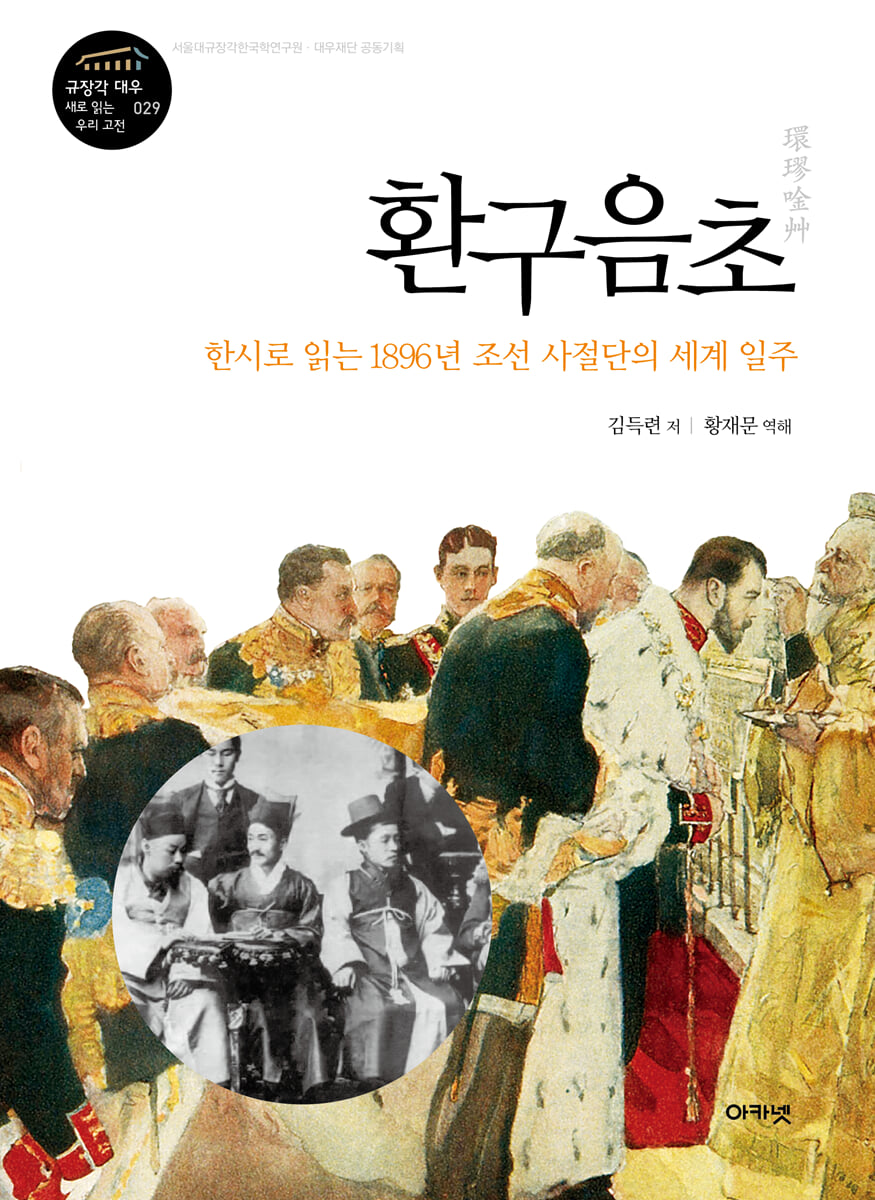
Hwan-gu-eum-cho
 |
Description
Book Introduction
In 1896, the King of Joseon took refuge in the Russian embassy.
In this rapidly changing situation, the coronation of the new Emperor Nicholas II was held in Moscow, the capital of Russia.
The delegation heading to Russia, the "neighboring country" that had gained the Maritime Province through the Treaty of Beijing, was led by Minister Extraordinary and Plenipotentiary Min Yeong-hwan, and consisted of Yun Chi-ho, Kim Deuk-ryeon, and Kim Do-il.
They left behind several public and private records over a period of seven months, among which 『Hwangu Eumcho』 is a travelogue written in the form of Chinese poetry by Kim Deuk-ryeon, who was in charge of the Chinese interpretation, and was recited while 'circling the Earth.'
How did the diplomatic mission that traveled the world to attend the coronation of the Russian Emperor encounter the latest Western civilization and institutions? Let's explore the seven-month journey through eight countries, from the Qing Dynasty and Japan to America and Europe, and finally to Moscow and St. Petersburg, through poetry and commentary.
In this rapidly changing situation, the coronation of the new Emperor Nicholas II was held in Moscow, the capital of Russia.
The delegation heading to Russia, the "neighboring country" that had gained the Maritime Province through the Treaty of Beijing, was led by Minister Extraordinary and Plenipotentiary Min Yeong-hwan, and consisted of Yun Chi-ho, Kim Deuk-ryeon, and Kim Do-il.
They left behind several public and private records over a period of seven months, among which 『Hwangu Eumcho』 is a travelogue written in the form of Chinese poetry by Kim Deuk-ryeon, who was in charge of the Chinese interpretation, and was recited while 'circling the Earth.'
How did the diplomatic mission that traveled the world to attend the coronation of the Russian Emperor encounter the latest Western civilization and institutions? Let's explore the seven-month journey through eight countries, from the Qing Dynasty and Japan to America and Europe, and finally to Moscow and St. Petersburg, through poetry and commentary.
- You can preview some of the book's contents.
Preview
index
Publisher: Dedicated to the publication of the series 'Re-reading Our Classics at Kyujanggak Daewoo'
Translator's Note: A New World Seen from a Journey to Russia, 1896
introduction
Preface
First Preface: Hong Hyeon-bo
Second Preface: Kim Seok-jun
Third Preface: Choi Seong-hak
Part 1: Leaving Joseon
1.
Going on a business trip and seeing my parents
2.
To bid farewell to the king
3.
Recited at Mapo Naru's farewell party
4.
At the crossroads, hum a song and give it to the friendly collaborator.
5.
Take a steamer from Incheon Port and head straight to Shanghai.
Part 2: Crossing the Pacific via Qing China and Japan
6.
anchored in Shanghai
7.
Make a joke while eating food
8.
Arrive at Nagasaki Port
9.
Passing through Shimonoseki
10.
Stopped briefly in Kobe
11.
Arrive in Yokohama
12.
Take the train into Tokyo
13.
Stay overnight at our official residence, recite it, and show it to Secretary Yu Chan.
14.
Watching the sunrise over the Pacific Ocean
15.
The ship rocks violently all night, causing the traveler to worry.
Part 3: Passing through various countries in America and Europe
16.
Get on board Vancouver Port
17.
Take the train east from Canada for about nine thousand miles
18.
Crossing the Great Plains
19.
Passing through Lake Superior
20.
The wealth and glamour of New York City is difficult to describe in words or writing.
21.
Recited at the New York Electrical Exposition
22.
On a ship crossing the Atlantic
23.
Sailing nine thousand miles across the Atlantic, arriving at the port of Liverpool
24.
Entering London, the capital of England
25.
From London to Flushing
26.
Passing through the German capital Berlin
27.
Poland's old capital
In Moscow, where the 4th coronation ceremony is held
28.
Reach the Russian border
29.
Arrive in Moscow and see the Russian Emperor's family
30.
Entering the Russian palace and presenting a letter and gifts
31.
Attend the coronation of the Russian Emperor on May 26th
32.
Light up the entire city for three nights
33.
Watch a night performance at the palace
34.
A feast for all people
35.
Recording dreams at the Moscow embassy
36.
Recited at the Moscow Embassy
37.
Western Beauty Song
38.
Thinking of a friend from Hanyang on a moonlit night at the Moscow embassy
39.
Coming back from the military ceremony and making a long song
Part 5: Encountering the cultural heritage of St. Petersburg
40.
St. Petersburg Jukjisa 33rd floor
41.
There is a flower called "forget-me-not" in the Russian capital.
42.
Dano Day
43.
Watch the sunset
44.
I felt it at the St. Petersburg embassy
45.
Enjoy the sunset view on the Neva River
46.
I received a letter from home on the 11th day of the 4th lunar month by mail on the 5th day of the 6th lunar month.
47.
Post a poem in the form of a poem for the account construction
48.
Respectfully responding to the 'small praise' of the account construction company
49.
Visit the observatory in Golbino Village and climb the mountain to build it.
50.
July 7th in the solar calendar
51.
Welcoming the gentlemen Min Kyung-sik and Joo Seok-myeon
52.
Enjoying the breeze on Yelagin Island, singing along with Soseok and Wolsan
53.
A poem about the animals I first saw at the zoo
Part 6 Staying in St. Petersburg
54.
Written by chance at the guest house
55.
Before returning home, he wrote a poem and gave it to Soseok and Wolsan.
56.
To the Minister of the Russian Navy
57.
Sending my condolences to Paris
58.
To be cool when you see signs of pollution
Part 7: Crossing Siberia and Arriving at Primorsky Krai
59.
Leaving St. Petersburg
60.
Passing through Moscow again
61.
Stay in Hasinju to visit the museum
62.
Visit the museum
63.
Ride a hot air balloon
64.
Depart at night on a steamboat heading southeast on the Volga River.
65.
Take the train and enter the Siberian Road
66.
I am in another country and cannot attend my grandmother's funeral.
67.
Write your feelings and submit them to the Friendship Association
68.
Built on September 9th in the solar calendar, in the middle of a Siberian mountain road.
69.
The Siberian Railway was cut off in the middle, so I had to travel by carriage.
70.
Seeing the nomadic Mongolians
71.
Arriving at the Irkutsk Governor-General's Office
72.
Crossing Lake Baikal
73.
Take the Hualun ferry from Heilongjiang to Vladivostok
74.
Arriving at the Khabarovsk Governor-General's Office
75.
A Song of Remembrance from Heilongjiang, Remembering Gwangcheon Gong, Who Participated in the Construction of the Baekdu Mountain Boundary Monument
76.
Arriving in Vladivostok
77.
Hearing the news of Sehyung Dangjil being appointed as the head of Wonsan Post Office
78.
Write a poem to the capital of our country's refugees
Part 8: Return to Joseon
79.
Anchored in Busan at dawn
80.
Anchored at Incheon Port
81.
Return to see your parents after receiving your orders
82.
Reunite with relatives and friends and reminisce
epilogue
First remarks: Han Kyung-ri
Second remarks: Seo Hyung-don
Third remark: Go Young-cheol
Fourth remark: Seo Sang-gyo
Fifth Postscript (Poem): Park I-yang
Sixth Postscript: Lee Jung-ha
Seventh Postscript: Song Young-dae
Americas
References
Translator's Note: A New World Seen from a Journey to Russia, 1896
introduction
Preface
First Preface: Hong Hyeon-bo
Second Preface: Kim Seok-jun
Third Preface: Choi Seong-hak
Part 1: Leaving Joseon
1.
Going on a business trip and seeing my parents
2.
To bid farewell to the king
3.
Recited at Mapo Naru's farewell party
4.
At the crossroads, hum a song and give it to the friendly collaborator.
5.
Take a steamer from Incheon Port and head straight to Shanghai.
Part 2: Crossing the Pacific via Qing China and Japan
6.
anchored in Shanghai
7.
Make a joke while eating food
8.
Arrive at Nagasaki Port
9.
Passing through Shimonoseki
10.
Stopped briefly in Kobe
11.
Arrive in Yokohama
12.
Take the train into Tokyo
13.
Stay overnight at our official residence, recite it, and show it to Secretary Yu Chan.
14.
Watching the sunrise over the Pacific Ocean
15.
The ship rocks violently all night, causing the traveler to worry.
Part 3: Passing through various countries in America and Europe
16.
Get on board Vancouver Port
17.
Take the train east from Canada for about nine thousand miles
18.
Crossing the Great Plains
19.
Passing through Lake Superior
20.
The wealth and glamour of New York City is difficult to describe in words or writing.
21.
Recited at the New York Electrical Exposition
22.
On a ship crossing the Atlantic
23.
Sailing nine thousand miles across the Atlantic, arriving at the port of Liverpool
24.
Entering London, the capital of England
25.
From London to Flushing
26.
Passing through the German capital Berlin
27.
Poland's old capital
In Moscow, where the 4th coronation ceremony is held
28.
Reach the Russian border
29.
Arrive in Moscow and see the Russian Emperor's family
30.
Entering the Russian palace and presenting a letter and gifts
31.
Attend the coronation of the Russian Emperor on May 26th
32.
Light up the entire city for three nights
33.
Watch a night performance at the palace
34.
A feast for all people
35.
Recording dreams at the Moscow embassy
36.
Recited at the Moscow Embassy
37.
Western Beauty Song
38.
Thinking of a friend from Hanyang on a moonlit night at the Moscow embassy
39.
Coming back from the military ceremony and making a long song
Part 5: Encountering the cultural heritage of St. Petersburg
40.
St. Petersburg Jukjisa 33rd floor
41.
There is a flower called "forget-me-not" in the Russian capital.
42.
Dano Day
43.
Watch the sunset
44.
I felt it at the St. Petersburg embassy
45.
Enjoy the sunset view on the Neva River
46.
I received a letter from home on the 11th day of the 4th lunar month by mail on the 5th day of the 6th lunar month.
47.
Post a poem in the form of a poem for the account construction
48.
Respectfully responding to the 'small praise' of the account construction company
49.
Visit the observatory in Golbino Village and climb the mountain to build it.
50.
July 7th in the solar calendar
51.
Welcoming the gentlemen Min Kyung-sik and Joo Seok-myeon
52.
Enjoying the breeze on Yelagin Island, singing along with Soseok and Wolsan
53.
A poem about the animals I first saw at the zoo
Part 6 Staying in St. Petersburg
54.
Written by chance at the guest house
55.
Before returning home, he wrote a poem and gave it to Soseok and Wolsan.
56.
To the Minister of the Russian Navy
57.
Sending my condolences to Paris
58.
To be cool when you see signs of pollution
Part 7: Crossing Siberia and Arriving at Primorsky Krai
59.
Leaving St. Petersburg
60.
Passing through Moscow again
61.
Stay in Hasinju to visit the museum
62.
Visit the museum
63.
Ride a hot air balloon
64.
Depart at night on a steamboat heading southeast on the Volga River.
65.
Take the train and enter the Siberian Road
66.
I am in another country and cannot attend my grandmother's funeral.
67.
Write your feelings and submit them to the Friendship Association
68.
Built on September 9th in the solar calendar, in the middle of a Siberian mountain road.
69.
The Siberian Railway was cut off in the middle, so I had to travel by carriage.
70.
Seeing the nomadic Mongolians
71.
Arriving at the Irkutsk Governor-General's Office
72.
Crossing Lake Baikal
73.
Take the Hualun ferry from Heilongjiang to Vladivostok
74.
Arriving at the Khabarovsk Governor-General's Office
75.
A Song of Remembrance from Heilongjiang, Remembering Gwangcheon Gong, Who Participated in the Construction of the Baekdu Mountain Boundary Monument
76.
Arriving in Vladivostok
77.
Hearing the news of Sehyung Dangjil being appointed as the head of Wonsan Post Office
78.
Write a poem to the capital of our country's refugees
Part 8: Return to Joseon
79.
Anchored in Busan at dawn
80.
Anchored at Incheon Port
81.
Return to see your parents after receiving your orders
82.
Reunite with relatives and friends and reminisce
epilogue
First remarks: Han Kyung-ri
Second remarks: Seo Hyung-don
Third remark: Go Young-cheol
Fourth remark: Seo Sang-gyo
Fifth Postscript (Poem): Park I-yang
Sixth Postscript: Lee Jung-ha
Seventh Postscript: Song Young-dae
Americas
References
Into the book
If someone were to discover a blind mystification or idealization of Western civilization in 『Hwangu Eumcho』 and 『Hwangu Ilrok』, that too could be accepted as a sentiment, but it might be the result of not being able to properly read between the lines of the diary or the expressions in the poetry.
In order to properly understand what he saw and felt during “A Journey Around the World,” we must first faithfully examine the poem itself within the context of the time.
--- From the "Translator's Note"
Kim Seok-jun said that even if the world has changed, traveling to places like Japan, the United States, or the United Kingdom can still be called "crude oil," that is, traveling far.
However, after seeing Kim Deuk-ryeon's travels, he said that only a trip of 70,000 li through 8 countries, a trip around the world, can be called 'crude oil'.
As the world changes, all standards change as well.
--- From the commentary on the "Preface"
Yun Chi-ho wrote in his diary on April 11th that Stein called Kim Deuk-ryeon “a drunkard (Mr.
It was recorded that he gave Kim Deuk-ryeon the nickname “Fish”, and he also referred to him by this nickname in his later diaries.
Yun Chi-ho seemed to have some sympathy for this nickname of drinking like a fish, but it is easy to guess that it was associated with a largely negative impression.
--- From "Commentary on Poem 28"
Above all, the title ‘Lady’s Journey’ may remind one of Du Fu’s representative works, ‘Lady’s Journey’.
Du Fu's "Women's Journey" is a work that satirizes the extravagance and obscenity of Yang Guozhong and the Yang Guifei sisters. Therefore, if "Women's Journey" refers to Western women as beautiful or gorgeous, it may contain satire or irony.
--- From "Commentary on Poem 37"
Here, we can see that Min Yeong-hwan's idea of the purpose of 『Hwangu Eumcho』 and 『Hwangu Ilrok』 is to "load on the front cart (載前車)."
Loading on the front cart means 'mirror of the front cart', which comes from the idiom 'the cart behind uses the sight of the cart in front overturning as a mirror'.
Kim Deuk-ryeon received Min Yeong-hwan's poem and probably felt grateful for his recognition.
--- From "Commentary on Poem 47"
In this year, Joseon began using the Gregorian calendar for the first time, and Russia began using the Russian calendar, that is, the Julian calendar rather than the Gregorian calendar.
In Joseon, the lunar calendar was still used in everyday life, so the Joseon delegation had to be able to use all three calendars.
--- From "Commentary on Poem 50"
Song Young-dae's perception may be taking the opposite direction from Kim Deuk-ryeon's.
Of course, it can be said that Kim Deuk-ryeon still held a viewpoint that favored Neo-Confucianism, but this is because he took a relatively flexible viewpoint, as can be seen in his repeated confirmation that traditional geographical knowledge was incorrect.
In order to properly understand what he saw and felt during “A Journey Around the World,” we must first faithfully examine the poem itself within the context of the time.
--- From the "Translator's Note"
Kim Seok-jun said that even if the world has changed, traveling to places like Japan, the United States, or the United Kingdom can still be called "crude oil," that is, traveling far.
However, after seeing Kim Deuk-ryeon's travels, he said that only a trip of 70,000 li through 8 countries, a trip around the world, can be called 'crude oil'.
As the world changes, all standards change as well.
--- From the commentary on the "Preface"
Yun Chi-ho wrote in his diary on April 11th that Stein called Kim Deuk-ryeon “a drunkard (Mr.
It was recorded that he gave Kim Deuk-ryeon the nickname “Fish”, and he also referred to him by this nickname in his later diaries.
Yun Chi-ho seemed to have some sympathy for this nickname of drinking like a fish, but it is easy to guess that it was associated with a largely negative impression.
--- From "Commentary on Poem 28"
Above all, the title ‘Lady’s Journey’ may remind one of Du Fu’s representative works, ‘Lady’s Journey’.
Du Fu's "Women's Journey" is a work that satirizes the extravagance and obscenity of Yang Guozhong and the Yang Guifei sisters. Therefore, if "Women's Journey" refers to Western women as beautiful or gorgeous, it may contain satire or irony.
--- From "Commentary on Poem 37"
Here, we can see that Min Yeong-hwan's idea of the purpose of 『Hwangu Eumcho』 and 『Hwangu Ilrok』 is to "load on the front cart (載前車)."
Loading on the front cart means 'mirror of the front cart', which comes from the idiom 'the cart behind uses the sight of the cart in front overturning as a mirror'.
Kim Deuk-ryeon received Min Yeong-hwan's poem and probably felt grateful for his recognition.
--- From "Commentary on Poem 47"
In this year, Joseon began using the Gregorian calendar for the first time, and Russia began using the Russian calendar, that is, the Julian calendar rather than the Gregorian calendar.
In Joseon, the lunar calendar was still used in everyday life, so the Joseon delegation had to be able to use all three calendars.
--- From "Commentary on Poem 50"
Song Young-dae's perception may be taking the opposite direction from Kim Deuk-ryeon's.
Of course, it can be said that Kim Deuk-ryeon still held a viewpoint that favored Neo-Confucianism, but this is because he took a relatively flexible viewpoint, as can be seen in his repeated confirmation that traditional geographical knowledge was incorrect.
--- From "Commentary on Song Yeong-dae's Preface"
Publisher's Review
Joseon's first record of a world tour, recorded in a poem over 120 years ago.
Through Qing China and Japan, America and Europe, to Moscow and St. Petersburg
The experiences and impressions from the 7-month trip to Russia across 8 countries are expressed in sensual poetry.
“My journey is long and grand, / All that I see and hear is strange.
I traveled forty thousand miles across three continents, / and also asked about customs.
“As I wrote and wrote, I was able to get some poetry.”
『Hwangu Eumcho (環球吟艸)』 is a travel poetry collection written by Joseon interpreter Kim Deuk-ryeon while traveling around the world in 1896, as its meaning suggests, “a poem written while traveling around the world.”
The author, Kim Deuk-ryeon, was part of the delegation led by Minister Min Yeong-hwan, who was dispatched as a special envoy to the coronation of the new Russian Emperor Nicholas II on May 26, 1896.
The Joseon delegation traveled 68,365 ri (approximately 26,848 kilometers) through eight countries, including China, Japan, the United States, England, the Netherlands, Germany, Russia, and Mongolia, for approximately seven months.
It was an unprecedentedly long journey in Joseon history.
『Hwangu Eumcho』 is a collection of poems that captures the vivid emotions of Joseon intellectuals who directly witnessed and felt the rapidly changing modern civilization. It also has historical value as it is the first record of a Joseon person's world tour, which took place over 120 years ago.
In this book, 『Hwangu Eumcho』 is compared with Min Yeong-hwan's 『Haecheon Chubeom』, Kim Deuk-ryeon's 『Hwangu Ilrok』, which are official records of the diplomatic mission, and 『Yun Chi-ho's Diary』, which is a private record, and detailed commentary is added.
By reading these records together, we can compare what each of the three characters saw and felt, clarifying the meaning of unclear passages in the poem and gaining a three-dimensional understanding of the events of the time.
Professor Hwang Jae-moon, the translator, meticulously reviewed the various records of the delegation and related documents to correct errors in previous translations and provide detailed explanations of the historical background and original texts to aid readers' understanding.
In this way, 『Hwangu Eumcho』, a 'new reading of our classics' published by Kyujanggak Daewoo, which comprehensively examines public and private records, goes beyond simple old records and provides an opportunity to think about how to accept new civilizations and how to preserve our identity in a rapidly changing era.
The complex perspectives of Joseon intellectuals who encountered modern civilization
A mixture of admiration for the new civilization and concern for the turbulent homeland…
Providing an opportunity to read the current reality in a rapidly changing era.
“Fortunately, I was able to complete my mission thanks to the help of the Emperor,
“It is shameful that I have no plan to relieve my difficulties.”
So how does the Joseon delegation's experience of enlightened civilization manifest in their poetry? In 1896, Joseon adopted the Gregorian calendar for the first time, and the delegation had to consider both the lunar calendar in common use and the Russian Julian calendar.
Furthermore, when we recall that they were not allowed to enter the chapel where the coronation was held because they decided not to remove their hats in order to observe Joseon law, we can infer the rapidly changing circumstances of the times and the complex perspectives of Joseon intellectuals.
The first thing that catches the eye is a poem that sensually expresses the appreciation of new cultures and unfamiliar landscapes.
Kim Deuk-ryeon was amazed by the telephone, saying, “The sound of a bell ringing in the wall is calling instead of a person, and the words transmitted through the box are exactly like a voice.” After watching a movie at a movie theater in St. Petersburg, he described his surprise at the advanced technology of the West in detail, saying, “People can dance and run like chariots, moving as if they were real, going and coming back.”
Regarding bicycles, “Why bother driving a cart with your own horse?
“I can go as fast or as slow as I want,” he said, expressing the efficiency of Western civilization in poetic terms.
After visiting the Electrical Exposition in New York, he expressed his wonder at the new technology, saying, “Everything in the world is made of electricity.”
Throughout the poetry collection, the complex feelings of an intellectual concerned about the fate of his country in the midst of imperialist competition are permeated.
These poems are not simply travel records, as they were written while performing official duties as an envoy.
Especially when passing through Warsaw, the capital of Poland, “Poland was once a respectable country, but now it is a province of Russia.
… In a land that was once bustling with singing and dancing, only red flowers remain, standing in silence,” he sang, comparing the tragic reality of Poland, which was suffering from the pain of national ruin, to ‘fallen flowers.’
The reality of Poland must have been a great alarm to the diplomatic mission that left for Russia during the time of the Aguan Pacheon.
Also, on his way back to Joseon, Kim Deuk-ryeon saw the poor compatriots he met in Siberia and the Maritime Province and said, “It’s sad.
Those tens of thousands of refugees.
You seem to find it easy to sell your body every day.
Even if I escape from the corrupt and tyrannical government, how can I live in this unfamiliar wasteland?” he said, expressing his sorrow and sorrow for his compatriots who are struggling to live in a foreign land, as well as his longing for his homeland.
A journey into poetry, enhanced by the "gorgeous" writing style.
About 100 poems that balance factual delivery and expression of sentiment…
Rich commentary to guide you through three-dimensional reading
“Wherever the will goes, the brush follows, as if I had personally gone to that land.
The feeling of inadequacy that arose from not having been to Europe before has been satisfied.
“The frustration that arose from not being able to keep up with Russia has been alleviated.”
It is not easy to talk about a travelogue in poetry.
This is because poetry is not a genre that can be satisfied with just recording the facts themselves.
However, critics praise Kim Deuk-ryeon's skill in overcoming these difficulties.
In his preface, Go Young-cheol evaluated the realm of knowledge by saying, “It is realistic on the inside and splendid on the outside, and the skillful craftsmanship and realistic intention are in harmony.”
Seo Sang-gyo admires the literary achievement of “Hwangu Eumcho,” saying, “All the people and things I have seen in the world are captured in the tip of my brush, but it is almost as if they were written by Jo Hwa-ong, so there is nothing that is not exquisite.”
In particular, the expressive power of the poem is noted by critiquing three phrases as examples of famous phrases.
Among the 100 or so poems, many focus on objective expression based on personal experience, but the poet balanced out emotions, thoughts, and opinions in his poems, creating a text that can be read three-dimensionally.
Also, because the format is short quatrains or verses, it may be difficult to convey the content sufficiently by simply translating the Chinese poem into modern Korean.
The translator accurately and richly conveys the experiences and impressions of the delegation by fully explaining the unique grammar and format of Chinese poetry and various historical records.
* The 'Gyujanggak Daewoo Reading Our Classics in a New Way' series is a project to read classics in a new way jointly carried out by the Seoul National University Kyujanggak Institute for Korean Studies and the Daewoo Foundation.
Through Qing China and Japan, America and Europe, to Moscow and St. Petersburg
The experiences and impressions from the 7-month trip to Russia across 8 countries are expressed in sensual poetry.
“My journey is long and grand, / All that I see and hear is strange.
I traveled forty thousand miles across three continents, / and also asked about customs.
“As I wrote and wrote, I was able to get some poetry.”
『Hwangu Eumcho (環球吟艸)』 is a travel poetry collection written by Joseon interpreter Kim Deuk-ryeon while traveling around the world in 1896, as its meaning suggests, “a poem written while traveling around the world.”
The author, Kim Deuk-ryeon, was part of the delegation led by Minister Min Yeong-hwan, who was dispatched as a special envoy to the coronation of the new Russian Emperor Nicholas II on May 26, 1896.
The Joseon delegation traveled 68,365 ri (approximately 26,848 kilometers) through eight countries, including China, Japan, the United States, England, the Netherlands, Germany, Russia, and Mongolia, for approximately seven months.
It was an unprecedentedly long journey in Joseon history.
『Hwangu Eumcho』 is a collection of poems that captures the vivid emotions of Joseon intellectuals who directly witnessed and felt the rapidly changing modern civilization. It also has historical value as it is the first record of a Joseon person's world tour, which took place over 120 years ago.
In this book, 『Hwangu Eumcho』 is compared with Min Yeong-hwan's 『Haecheon Chubeom』, Kim Deuk-ryeon's 『Hwangu Ilrok』, which are official records of the diplomatic mission, and 『Yun Chi-ho's Diary』, which is a private record, and detailed commentary is added.
By reading these records together, we can compare what each of the three characters saw and felt, clarifying the meaning of unclear passages in the poem and gaining a three-dimensional understanding of the events of the time.
Professor Hwang Jae-moon, the translator, meticulously reviewed the various records of the delegation and related documents to correct errors in previous translations and provide detailed explanations of the historical background and original texts to aid readers' understanding.
In this way, 『Hwangu Eumcho』, a 'new reading of our classics' published by Kyujanggak Daewoo, which comprehensively examines public and private records, goes beyond simple old records and provides an opportunity to think about how to accept new civilizations and how to preserve our identity in a rapidly changing era.
The complex perspectives of Joseon intellectuals who encountered modern civilization
A mixture of admiration for the new civilization and concern for the turbulent homeland…
Providing an opportunity to read the current reality in a rapidly changing era.
“Fortunately, I was able to complete my mission thanks to the help of the Emperor,
“It is shameful that I have no plan to relieve my difficulties.”
So how does the Joseon delegation's experience of enlightened civilization manifest in their poetry? In 1896, Joseon adopted the Gregorian calendar for the first time, and the delegation had to consider both the lunar calendar in common use and the Russian Julian calendar.
Furthermore, when we recall that they were not allowed to enter the chapel where the coronation was held because they decided not to remove their hats in order to observe Joseon law, we can infer the rapidly changing circumstances of the times and the complex perspectives of Joseon intellectuals.
The first thing that catches the eye is a poem that sensually expresses the appreciation of new cultures and unfamiliar landscapes.
Kim Deuk-ryeon was amazed by the telephone, saying, “The sound of a bell ringing in the wall is calling instead of a person, and the words transmitted through the box are exactly like a voice.” After watching a movie at a movie theater in St. Petersburg, he described his surprise at the advanced technology of the West in detail, saying, “People can dance and run like chariots, moving as if they were real, going and coming back.”
Regarding bicycles, “Why bother driving a cart with your own horse?
“I can go as fast or as slow as I want,” he said, expressing the efficiency of Western civilization in poetic terms.
After visiting the Electrical Exposition in New York, he expressed his wonder at the new technology, saying, “Everything in the world is made of electricity.”
Throughout the poetry collection, the complex feelings of an intellectual concerned about the fate of his country in the midst of imperialist competition are permeated.
These poems are not simply travel records, as they were written while performing official duties as an envoy.
Especially when passing through Warsaw, the capital of Poland, “Poland was once a respectable country, but now it is a province of Russia.
… In a land that was once bustling with singing and dancing, only red flowers remain, standing in silence,” he sang, comparing the tragic reality of Poland, which was suffering from the pain of national ruin, to ‘fallen flowers.’
The reality of Poland must have been a great alarm to the diplomatic mission that left for Russia during the time of the Aguan Pacheon.
Also, on his way back to Joseon, Kim Deuk-ryeon saw the poor compatriots he met in Siberia and the Maritime Province and said, “It’s sad.
Those tens of thousands of refugees.
You seem to find it easy to sell your body every day.
Even if I escape from the corrupt and tyrannical government, how can I live in this unfamiliar wasteland?” he said, expressing his sorrow and sorrow for his compatriots who are struggling to live in a foreign land, as well as his longing for his homeland.
A journey into poetry, enhanced by the "gorgeous" writing style.
About 100 poems that balance factual delivery and expression of sentiment…
Rich commentary to guide you through three-dimensional reading
“Wherever the will goes, the brush follows, as if I had personally gone to that land.
The feeling of inadequacy that arose from not having been to Europe before has been satisfied.
“The frustration that arose from not being able to keep up with Russia has been alleviated.”
It is not easy to talk about a travelogue in poetry.
This is because poetry is not a genre that can be satisfied with just recording the facts themselves.
However, critics praise Kim Deuk-ryeon's skill in overcoming these difficulties.
In his preface, Go Young-cheol evaluated the realm of knowledge by saying, “It is realistic on the inside and splendid on the outside, and the skillful craftsmanship and realistic intention are in harmony.”
Seo Sang-gyo admires the literary achievement of “Hwangu Eumcho,” saying, “All the people and things I have seen in the world are captured in the tip of my brush, but it is almost as if they were written by Jo Hwa-ong, so there is nothing that is not exquisite.”
In particular, the expressive power of the poem is noted by critiquing three phrases as examples of famous phrases.
Among the 100 or so poems, many focus on objective expression based on personal experience, but the poet balanced out emotions, thoughts, and opinions in his poems, creating a text that can be read three-dimensionally.
Also, because the format is short quatrains or verses, it may be difficult to convey the content sufficiently by simply translating the Chinese poem into modern Korean.
The translator accurately and richly conveys the experiences and impressions of the delegation by fully explaining the unique grammar and format of Chinese poetry and various historical records.
* The 'Gyujanggak Daewoo Reading Our Classics in a New Way' series is a project to read classics in a new way jointly carried out by the Seoul National University Kyujanggak Institute for Korean Studies and the Daewoo Foundation.
GOODS SPECIFICS
- Date of issue: October 24, 2025
- Format: Hardcover book binding method guide
- Page count, weight, size: 612 pages | 152*214*35mm
- ISBN13: 9788957338582
- ISBN10: 8957338586
You may also like
카테고리
korean


korean

![GQ KOREA Mark (Monthly): December [2025]](http://librairie.coreenne.fr/cdn/shop/files/8ef265dbbfbf186523ed75ba7319009d.jpg?v=1765340328&width=3840)


