

Naked Korean History: Joseon
 |
Description
Book Introduction
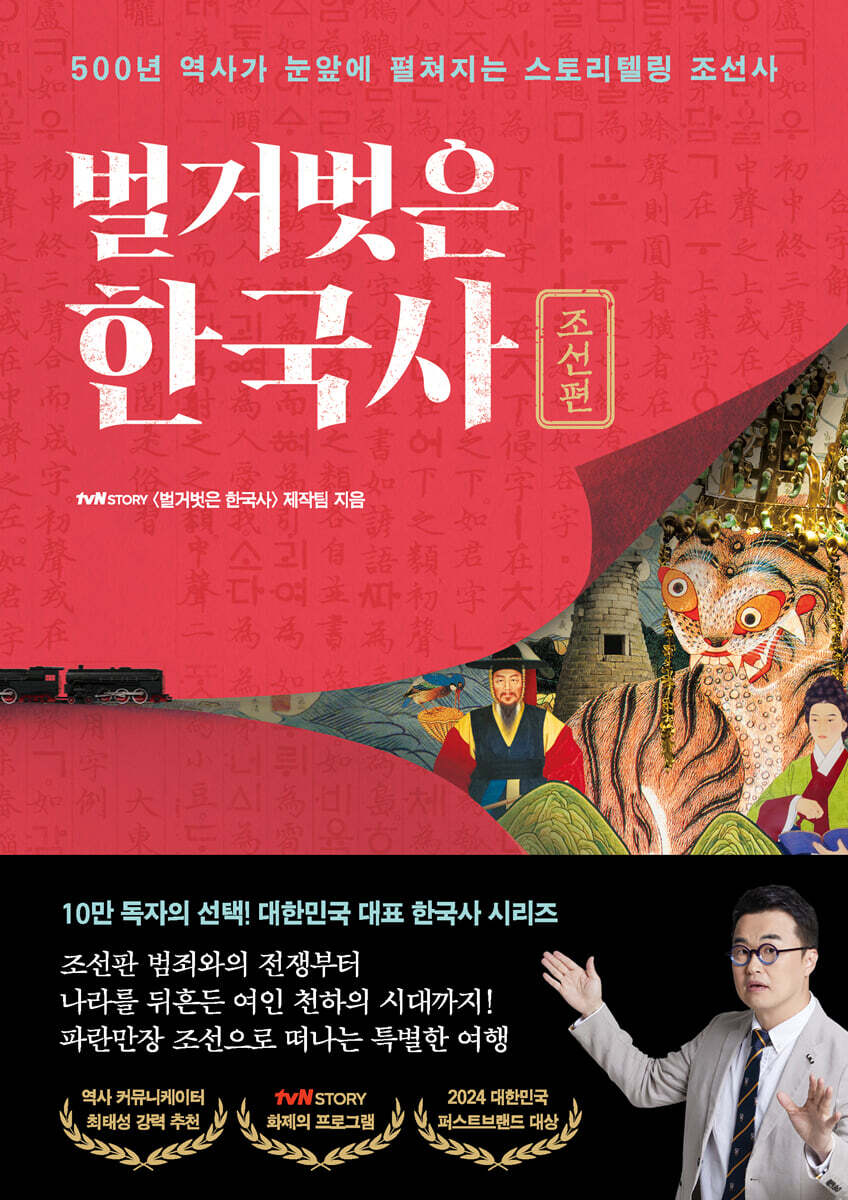
The representative Korean history series, "Naked Korean History," which has captivated 100,000 readers.
The first story of the new beginning, 'Sidaepyeon', Joseon!
“If we expose the decisive event that changed the fate of Joseon,
“The flow of 500 years of history is captured!”
The representative Korean history series of the Republic of Korea, 『Naked Korean History』, announces the start of its ‘period’ with the story of Joseon.
tvN STORY's "Naked Korean History," which has established itself as a long-running history education program with the love of viewers, won the Cultural Entertainment Award at the 2024 Korea First Brand Awards, solidifying its position as the best Korean history program in the country.
The "Naked Korean History" series, which selects must-know stories from those introduced on TV, has also been selected by 100,000 readers and has received praise for its in-depth knowledge, clear commentary, and immersive storytelling.
The newly published 『Naked Korean History: Joseon』 maintains the strengths of its predecessors while presenting a new, broader perspective that covers the entire Joseon Dynasty.
Although Joseon history is the closest in time and has abundant records, it is a familiar history, but it is not easy to understand the chronological relationship and grasp the flow.
Because 500 years is such a long time, it feels like there is so much to know.
This book summarizes the context of Joseon history from the founding of Joseon in 1392 to the Gyeongsul National Shame of 1910 through eight representative stories of Joseon.
From Hwang Hui, the renowned prime minister who laid the foundation for the nation by serving four kings in the early Joseon Dynasty, to Heungseon Daewongun, who did not hesitate to become a servant to make his son king, 500 years of Joseon history unfold before your eyes as you follow the decisive scenes that changed the fate of Joseon.
Even those who thought they knew Joseon well, or who thought Joseon history was complex and difficult, will gain a deeper understanding of the rise and fall of the Joseon era after encountering Joseon's fascinating backstory.
The first story of the new beginning, 'Sidaepyeon', Joseon!
“If we expose the decisive event that changed the fate of Joseon,
“The flow of 500 years of history is captured!”
The representative Korean history series of the Republic of Korea, 『Naked Korean History』, announces the start of its ‘period’ with the story of Joseon.
tvN STORY's "Naked Korean History," which has established itself as a long-running history education program with the love of viewers, won the Cultural Entertainment Award at the 2024 Korea First Brand Awards, solidifying its position as the best Korean history program in the country.
The "Naked Korean History" series, which selects must-know stories from those introduced on TV, has also been selected by 100,000 readers and has received praise for its in-depth knowledge, clear commentary, and immersive storytelling.
The newly published 『Naked Korean History: Joseon』 maintains the strengths of its predecessors while presenting a new, broader perspective that covers the entire Joseon Dynasty.
Although Joseon history is the closest in time and has abundant records, it is a familiar history, but it is not easy to understand the chronological relationship and grasp the flow.
Because 500 years is such a long time, it feels like there is so much to know.
This book summarizes the context of Joseon history from the founding of Joseon in 1392 to the Gyeongsul National Shame of 1910 through eight representative stories of Joseon.
From Hwang Hui, the renowned prime minister who laid the foundation for the nation by serving four kings in the early Joseon Dynasty, to Heungseon Daewongun, who did not hesitate to become a servant to make his son king, 500 years of Joseon history unfold before your eyes as you follow the decisive scenes that changed the fate of Joseon.
Even those who thought they knew Joseon well, or who thought Joseon history was complex and difficult, will gain a deeper understanding of the rise and fall of the Joseon era after encountering Joseon's fascinating backstory.
- You can preview some of the book's contents.
Preview
index
Introduction: Let's go on a special journey together.
Recommended Reading: A Time to Encounter a Crucial Scene in 500 Years of Joseon History_Choi Tae-seong
Part 1: Early Joseon Dynasty: The Founding of a New Nation and the Strengthening of Joseon's Royal Authority
Chapter 1: The Naked Prime Minister
: Hwang Hui, the longest-serving prime minister who captured the hearts of Joseon kings --- Lee Gyu-cheol
Chapter 2: The Naked Gye-Yu Jeongnan
: How Kingmaker Han Myeong-hoe Changed Joseon's King --- Song Woong-seop
Chapter 3: The Naked Woman of the World
How Queen Munjeong Gained Absolute Power --- Song Woong-seop
Chapter 4: The Naked Im Kkeok-jeong Rebellion
The Truth About Im Kkeok-jeong, One of the Three Greatest Bandits of Joseon Dynasty, Known as a Righteous Man --- Han Hee-sook
Part 2: The Late Joseon Dynasty: A Time of Political Turmoil That Rocked the Korean Peninsula
Chapter 5: The Naked Monarch of Turbulent Times
: Why was Gwanghaegun, the hero of the Imjin War, driven out? --- Succession Beom
Chapter 6: The Naked Joseon Cinderella
: The End of Jang Hee-bin, the Court Lady Who Wanted to Become Queen --- Kim Beom
Chapter 7: The Naked Silhak Scholar
How Jeong Yak-yong Made King Jeongjo's Ideal a Reality --- Yoon Seok-ho
Chapter 8: The Naked Daewongun
Hong Mun-gi, the father of King Gojong, who reigned as the king above kings, Heungseon Daewongun
Recommended Reading: A Time to Encounter a Crucial Scene in 500 Years of Joseon History_Choi Tae-seong
Part 1: Early Joseon Dynasty: The Founding of a New Nation and the Strengthening of Joseon's Royal Authority
Chapter 1: The Naked Prime Minister
: Hwang Hui, the longest-serving prime minister who captured the hearts of Joseon kings --- Lee Gyu-cheol
Chapter 2: The Naked Gye-Yu Jeongnan
: How Kingmaker Han Myeong-hoe Changed Joseon's King --- Song Woong-seop
Chapter 3: The Naked Woman of the World
How Queen Munjeong Gained Absolute Power --- Song Woong-seop
Chapter 4: The Naked Im Kkeok-jeong Rebellion
The Truth About Im Kkeok-jeong, One of the Three Greatest Bandits of Joseon Dynasty, Known as a Righteous Man --- Han Hee-sook
Part 2: The Late Joseon Dynasty: A Time of Political Turmoil That Rocked the Korean Peninsula
Chapter 5: The Naked Monarch of Turbulent Times
: Why was Gwanghaegun, the hero of the Imjin War, driven out? --- Succession Beom
Chapter 6: The Naked Joseon Cinderella
: The End of Jang Hee-bin, the Court Lady Who Wanted to Become Queen --- Kim Beom
Chapter 7: The Naked Silhak Scholar
How Jeong Yak-yong Made King Jeongjo's Ideal a Reality --- Yoon Seok-ho
Chapter 8: The Naked Daewongun
Hong Mun-gi, the father of King Gojong, who reigned as the king above kings, Heungseon Daewongun
Detailed image

Into the book
Why is Joseon so familiar and fascinating to us? Because it's the closest and most comprehensive historical record.
However, on the other hand, because the process of its collapse is also well known, there is also a perception that Joseon was a poor country.
Is that really true? If Joseon had fought as often as we think, inflicting suffering on its people, would it have lasted for 500 years? Even among Chinese dynasties, none lasted longer than Joseon.
This also means that Joseon had its own system.
It was because the country had a strong system in place that it was able to endure for 500 years.
--- p.6~7, from “Recommended article _ Time to meet the decisive scene of 500 years of Joseon history”
When Hwang Hui turned 76, he submitted his resignation three times.
He requested his resignation once, saying that the boil wouldn't stop bleeding and that he was dizzy, and again, saying that he was so forgetful that he couldn't even remember what he said.
And in the winter of 1438 he submitted his third resignation.
What reason did you hear this time?
When thunder and lightning struck heavily in the winter, he asked to be dismissed, saying that the bad weather was due to his lack of virtue despite being in a high position.
Sejong replied, “The bad weather is due to the fault of the person.
So, he refused the request to resign, saying, “Don’t forgive me, but tell me to work harder.”
--- p.41~42, from “Chapter 1: The Naked Prime Minister _ Hwang Hui, the longest-serving prime minister who captured the hearts of Joseon kings”
The whole story of this brutal incident was as follows.
First of all, since there were many gates in the palace, when the court officials entered the first gate, they did not allow the servants to enter and had the court officials pass through the gate alone.
And when they entered the second gate, they confirmed their identities and killed those who sided with Kim Jong-seo and Prince Anpyeong.
Here too, Han Myeong-hoe's unique strategy is hidden.
We devised and implemented a method to remove the ministers quickly and secretly with a minimum number of people.
Han Myeong-hoe's persistent plan did not end here.
Those who were on the 'kill' list but could not come to the palace due to circumstances were killed by sending soldiers to their location.
Not only at home, but also at the construction site, the ministers who were working there were killed by sending soldiers directly to the site.
The list of people to be killed was not just a list of names of people to be eliminated, but a kind of killing scenario that was meticulously and perfectly planned, including the method of their elimination.
--- p.65~66, from “Chapter 2: The Naked Gye-Yu Rebellion - How Kingmaker Han Myeong-hoe Changed the King of Joseon”
Here's a fun fact:
The practice of the Queen Dowager lowering her foot when administering state affairs was first implemented during the reign of Queen Munjeong.
Queen Jeonghui, the grandmother of King Seongjong and wife of King Sejo, who had been regent before Queen Munjeong, did not appear in person at the side hall.
He received reports and made decisions on important matters from his own residence.
Queen Munjeong carried out a regency that was on a whole different level than before.
It was the first time in Joseon that the king came out to the Pyeonjeon to personally handle state affairs and run the government.
He even attended the 'Gyeongyeon', where the king and his subjects studied and discussed state affairs.
It is said that Queen Munjeong strongly expressed her opinions in the meeting with the ministers.
He stepped up and led the discussion and strongly suppressed criticism.
Queen Munjeong, who had been through many ups and downs during the reign of King Jungjong, a time of constant incidents and accidents, had extensive political experience and held the highest position in the royal family.
As mentioned earlier, she was a rare woman with Confucian qualities and a strong innate personality, so it was not easy for her subjects to express opposing opinions.
p.105, from “Chapter 3: The Naked Woman of the World - How Queen Munjeong Gained Absolute Power”
About a month after Gwanghaegun became crown prince, something shocking happened.
King Seonjo told his son, King Gwanghaegun, that the country was in a critical situation due to the Imjin War and that they should divide the government and rule it.
This is called a division by using the words ‘divide’ and ‘coordination group’.
The Joseon court was divided in two. What could have been King Seonjo's intention? He even summoned his officials and spoke to them.
“It is okay to die in the land of the emperor, but I cannot die at the hands of the Japanese.”
He said that he could not die at the hands of the Japanese pirates, so he would leave Joseon and go into exile in the Ming Dynasty, which he called the land of the emperor.
So, what Seonjo was talking about was not dividing the Joseon government in two, but rather he was saying that he would go to the safer Ming Dynasty to take refuge, and that his son, Gwanghaegun, would remain in Joseon and take responsibility for the country that was engulfed in war.
--- p.174~175, from “Chapter 5: The Naked Monarch of Turbulent Times - Why was King Gwanghaegun, the hero of the Imjin War, driven out?”
In addition, Jeong Yak-yong also created other tools, the 'Yeong Hyeong-geo' and the 'Nokro'.
A wheelbarrow was a cart that could easily transport stones by using the principle of a lever.
It is believed that the potter's wheel was used to lift small stones and timber high, a tool similar to a crane today.
All of these machines were imbued with the spirit of the Silhak scholars who wanted to alleviate the people's hardships even a little.
Suwon Hwaseong, a Joseon-era new city where Jeong Yak-yong's talents were fully demonstrated! What did it look like? Looking at the "Hwaseong Jeondo," we can see a large wall surrounding the city, with the king's temporary palace located in the upper center.
Even now, it is a very large and well-planned city.
However, on the other hand, because the process of its collapse is also well known, there is also a perception that Joseon was a poor country.
Is that really true? If Joseon had fought as often as we think, inflicting suffering on its people, would it have lasted for 500 years? Even among Chinese dynasties, none lasted longer than Joseon.
This also means that Joseon had its own system.
It was because the country had a strong system in place that it was able to endure for 500 years.
--- p.6~7, from “Recommended article _ Time to meet the decisive scene of 500 years of Joseon history”
When Hwang Hui turned 76, he submitted his resignation three times.
He requested his resignation once, saying that the boil wouldn't stop bleeding and that he was dizzy, and again, saying that he was so forgetful that he couldn't even remember what he said.
And in the winter of 1438 he submitted his third resignation.
What reason did you hear this time?
When thunder and lightning struck heavily in the winter, he asked to be dismissed, saying that the bad weather was due to his lack of virtue despite being in a high position.
Sejong replied, “The bad weather is due to the fault of the person.
So, he refused the request to resign, saying, “Don’t forgive me, but tell me to work harder.”
--- p.41~42, from “Chapter 1: The Naked Prime Minister _ Hwang Hui, the longest-serving prime minister who captured the hearts of Joseon kings”
The whole story of this brutal incident was as follows.
First of all, since there were many gates in the palace, when the court officials entered the first gate, they did not allow the servants to enter and had the court officials pass through the gate alone.
And when they entered the second gate, they confirmed their identities and killed those who sided with Kim Jong-seo and Prince Anpyeong.
Here too, Han Myeong-hoe's unique strategy is hidden.
We devised and implemented a method to remove the ministers quickly and secretly with a minimum number of people.
Han Myeong-hoe's persistent plan did not end here.
Those who were on the 'kill' list but could not come to the palace due to circumstances were killed by sending soldiers to their location.
Not only at home, but also at the construction site, the ministers who were working there were killed by sending soldiers directly to the site.
The list of people to be killed was not just a list of names of people to be eliminated, but a kind of killing scenario that was meticulously and perfectly planned, including the method of their elimination.
--- p.65~66, from “Chapter 2: The Naked Gye-Yu Rebellion - How Kingmaker Han Myeong-hoe Changed the King of Joseon”
Here's a fun fact:
The practice of the Queen Dowager lowering her foot when administering state affairs was first implemented during the reign of Queen Munjeong.
Queen Jeonghui, the grandmother of King Seongjong and wife of King Sejo, who had been regent before Queen Munjeong, did not appear in person at the side hall.
He received reports and made decisions on important matters from his own residence.
Queen Munjeong carried out a regency that was on a whole different level than before.
It was the first time in Joseon that the king came out to the Pyeonjeon to personally handle state affairs and run the government.
He even attended the 'Gyeongyeon', where the king and his subjects studied and discussed state affairs.
It is said that Queen Munjeong strongly expressed her opinions in the meeting with the ministers.
He stepped up and led the discussion and strongly suppressed criticism.
Queen Munjeong, who had been through many ups and downs during the reign of King Jungjong, a time of constant incidents and accidents, had extensive political experience and held the highest position in the royal family.
As mentioned earlier, she was a rare woman with Confucian qualities and a strong innate personality, so it was not easy for her subjects to express opposing opinions.
p.105, from “Chapter 3: The Naked Woman of the World - How Queen Munjeong Gained Absolute Power”
About a month after Gwanghaegun became crown prince, something shocking happened.
King Seonjo told his son, King Gwanghaegun, that the country was in a critical situation due to the Imjin War and that they should divide the government and rule it.
This is called a division by using the words ‘divide’ and ‘coordination group’.
The Joseon court was divided in two. What could have been King Seonjo's intention? He even summoned his officials and spoke to them.
“It is okay to die in the land of the emperor, but I cannot die at the hands of the Japanese.”
He said that he could not die at the hands of the Japanese pirates, so he would leave Joseon and go into exile in the Ming Dynasty, which he called the land of the emperor.
So, what Seonjo was talking about was not dividing the Joseon government in two, but rather he was saying that he would go to the safer Ming Dynasty to take refuge, and that his son, Gwanghaegun, would remain in Joseon and take responsibility for the country that was engulfed in war.
--- p.174~175, from “Chapter 5: The Naked Monarch of Turbulent Times - Why was King Gwanghaegun, the hero of the Imjin War, driven out?”
In addition, Jeong Yak-yong also created other tools, the 'Yeong Hyeong-geo' and the 'Nokro'.
A wheelbarrow was a cart that could easily transport stones by using the principle of a lever.
It is believed that the potter's wheel was used to lift small stones and timber high, a tool similar to a crane today.
All of these machines were imbued with the spirit of the Silhak scholars who wanted to alleviate the people's hardships even a little.
Suwon Hwaseong, a Joseon-era new city where Jeong Yak-yong's talents were fully demonstrated! What did it look like? Looking at the "Hwaseong Jeondo," we can see a large wall surrounding the city, with the king's temporary palace located in the upper center.
Even now, it is a very large and well-planned city.
--- p.260~261, from “Chapter 7: The Naked Silhak Scholar - How Jeong Yak-yong Made Jeongjo’s Ideals a Reality”
Publisher's Review
tvN STORY's signature educational entertainment program, "Naked Korean History," has caught the attention of
The true story of Joseon, a familiar but unknown story!
Joseon History: A Storytelling You Won't Forget Once You Read It
What historical period is most often depicted in dramas and movies? It's probably Joseon.
Many Joseon figures, such as King Sejong, Jang Hui-bin, Prince Suyang, and Im Kkeok-jeong, have been exposed to the media numerous times, so it is easy to think that Joseon history is already a familiar story.
Is that really true? Known as a deposed tyrant by his subjects, Gwanghaegun, as crown prince, struggled to save the nation from the chaos of the Imjin War and rallied the people, earning him heroic treatment.
Thanks to this, the title of honor, which is given to praise the king's achievements, is the longest among those given to Joseon kings during their reign.
Every Korean has probably learned about Joseon history at least once, but when it comes to recalling it, confidence is lost.
This is because I approached history as knowledge to be memorized rather than as an interesting story.
tvN STORY's signature program, "Naked Korean History," focuses on the essence of "history as a story," and tells the story of not only representative scenes from our history but also the hidden stories within those scenes in an exciting way.
Reading the story of the so-called "Joseon War on Crime," in which King Myeongjong declared his intention to capture the great thief Im Kkeok-jeong, we gain a comprehensive understanding not only of the corrupt power elite but also of the class system and Confucian ideology that dominated Joseon society at the time.
Also, if you immerse yourself in the drama and learn about the story of Jang Hui-bin, famous as the Cinderella of Joseon, you will come to understand the politics of the Hwan-guk era during King Sukjong's reign.
The maps, photographs, and historical documents specially added to the book help readers understand Joseon history in context, even if they lack background knowledge.
In addition, due to time constraints, the program was enriched with content that could not be shown on the broadcast, after review by a history expert.
This will be a historical textbook that provides a pleasant experience to readers who want to understand the flow of Korean history by clearly understanding the stories they have encountered in countless dramas and movies with historical materials.
The story of how Han Myeong-hoe, a mere courtier, created three generations of kings.
The process by which Jeong Yak-yong made King Jeongjo's ideal of a Joseon Renaissance a reality...
Reflecting on a Better Tomorrow Through the Lights and Shadows of 500 Years of Joseon History
- Why did the kings of Joseon continue to seek out Hwang Hui?
- How did Han Myeong-hoe, who was just a commoner, create three generations of kings?
- How did Queen Munjeong take control of the court in a male-dominated society?
- What is the truth about Im Kkeok-jeong, one of the three greatest bandits of Joseon, known as a righteous thief?
- Why was King Gwanghaegun, who was loved by the people, driven from the throne?
- Why is Jang Hui-bin, the Cinderella of Joseon, remembered as a legendary villainess?
- How did the genius scholar Jeong Yak-yong make King Jeongjo's ideals a reality?
- How did Heungseon Daewongun, who acted like a fool, gain absolute power?
This book carefully selects and presents three-dimensional stories of events and people that can help us gain a deeper understanding of Joseon history.
The process of Joseon's collapse is also well known, and is often associated with a negative image.
Accordingly, Choi Tae-seong, the guide for the “Naked Korean History” tour, says that Joseon was able to endure for 500 years because it created and maintained a strong system as a nation.
Just as a person cannot maintain a healthy body forever, Joseon, which had a healthy system in operation, also gasped for breath and disappeared while facing various situations of chaos and crisis.
When we truly understand the true story of Joseon, we will understand the ideology and zeitgeist that Joseon sought to uphold as a dynastic state, and we will be able to view the moments of glory and decline that resulted from it more deeply and accurately than before.
The reason we learn history is to dream of a better world through stories of the past.
Han Myeong-hoe was favored by the king as a meritorious subject of the Jeongnan incident, became the king's brother-in-law, and made three generations of kings. However, because of the sins he committed while alive, after death he was punished by having his grave dug up and his head beheaded.
The history we write today will one day be evaluated by future generations.
Therefore, the attitude of wanting to learn from history is also a determination and courage to become better.
This is precisely why we must study and remember the story of Joseon, not dismiss it as just a faded tale of the past.
A journey to Joseon, a treasure trove of living stories, lies before us.
Let's open the bookshelf with anticipation and courage.
By learning from stories from hundreds of years ago, thinking historically, and transforming historical knowledge into wisdom for living today, we will face a better tomorrow.
The true story of Joseon, a familiar but unknown story!
Joseon History: A Storytelling You Won't Forget Once You Read It
What historical period is most often depicted in dramas and movies? It's probably Joseon.
Many Joseon figures, such as King Sejong, Jang Hui-bin, Prince Suyang, and Im Kkeok-jeong, have been exposed to the media numerous times, so it is easy to think that Joseon history is already a familiar story.
Is that really true? Known as a deposed tyrant by his subjects, Gwanghaegun, as crown prince, struggled to save the nation from the chaos of the Imjin War and rallied the people, earning him heroic treatment.
Thanks to this, the title of honor, which is given to praise the king's achievements, is the longest among those given to Joseon kings during their reign.
Every Korean has probably learned about Joseon history at least once, but when it comes to recalling it, confidence is lost.
This is because I approached history as knowledge to be memorized rather than as an interesting story.
tvN STORY's signature program, "Naked Korean History," focuses on the essence of "history as a story," and tells the story of not only representative scenes from our history but also the hidden stories within those scenes in an exciting way.
Reading the story of the so-called "Joseon War on Crime," in which King Myeongjong declared his intention to capture the great thief Im Kkeok-jeong, we gain a comprehensive understanding not only of the corrupt power elite but also of the class system and Confucian ideology that dominated Joseon society at the time.
Also, if you immerse yourself in the drama and learn about the story of Jang Hui-bin, famous as the Cinderella of Joseon, you will come to understand the politics of the Hwan-guk era during King Sukjong's reign.
The maps, photographs, and historical documents specially added to the book help readers understand Joseon history in context, even if they lack background knowledge.
In addition, due to time constraints, the program was enriched with content that could not be shown on the broadcast, after review by a history expert.
This will be a historical textbook that provides a pleasant experience to readers who want to understand the flow of Korean history by clearly understanding the stories they have encountered in countless dramas and movies with historical materials.
The story of how Han Myeong-hoe, a mere courtier, created three generations of kings.
The process by which Jeong Yak-yong made King Jeongjo's ideal of a Joseon Renaissance a reality...
Reflecting on a Better Tomorrow Through the Lights and Shadows of 500 Years of Joseon History
- Why did the kings of Joseon continue to seek out Hwang Hui?
- How did Han Myeong-hoe, who was just a commoner, create three generations of kings?
- How did Queen Munjeong take control of the court in a male-dominated society?
- What is the truth about Im Kkeok-jeong, one of the three greatest bandits of Joseon, known as a righteous thief?
- Why was King Gwanghaegun, who was loved by the people, driven from the throne?
- Why is Jang Hui-bin, the Cinderella of Joseon, remembered as a legendary villainess?
- How did the genius scholar Jeong Yak-yong make King Jeongjo's ideals a reality?
- How did Heungseon Daewongun, who acted like a fool, gain absolute power?
This book carefully selects and presents three-dimensional stories of events and people that can help us gain a deeper understanding of Joseon history.
The process of Joseon's collapse is also well known, and is often associated with a negative image.
Accordingly, Choi Tae-seong, the guide for the “Naked Korean History” tour, says that Joseon was able to endure for 500 years because it created and maintained a strong system as a nation.
Just as a person cannot maintain a healthy body forever, Joseon, which had a healthy system in operation, also gasped for breath and disappeared while facing various situations of chaos and crisis.
When we truly understand the true story of Joseon, we will understand the ideology and zeitgeist that Joseon sought to uphold as a dynastic state, and we will be able to view the moments of glory and decline that resulted from it more deeply and accurately than before.
The reason we learn history is to dream of a better world through stories of the past.
Han Myeong-hoe was favored by the king as a meritorious subject of the Jeongnan incident, became the king's brother-in-law, and made three generations of kings. However, because of the sins he committed while alive, after death he was punished by having his grave dug up and his head beheaded.
The history we write today will one day be evaluated by future generations.
Therefore, the attitude of wanting to learn from history is also a determination and courage to become better.
This is precisely why we must study and remember the story of Joseon, not dismiss it as just a faded tale of the past.
A journey to Joseon, a treasure trove of living stories, lies before us.
Let's open the bookshelf with anticipation and courage.
By learning from stories from hundreds of years ago, thinking historically, and transforming historical knowledge into wisdom for living today, we will face a better tomorrow.
GOODS SPECIFICS
- Date of issue: March 13, 2024
- Page count, weight, size: 304 pages | 514g | 152*215*16mm
- ISBN13: 9791193401095
- ISBN10: 1193401097
You may also like
카테고리
korean


korean

![GQ KOREA Mark (Monthly): December [2025]](http://librairie.coreenne.fr/cdn/shop/files/8ef265dbbfbf186523ed75ba7319009d.jpg?v=1765340328&width=3840)


