

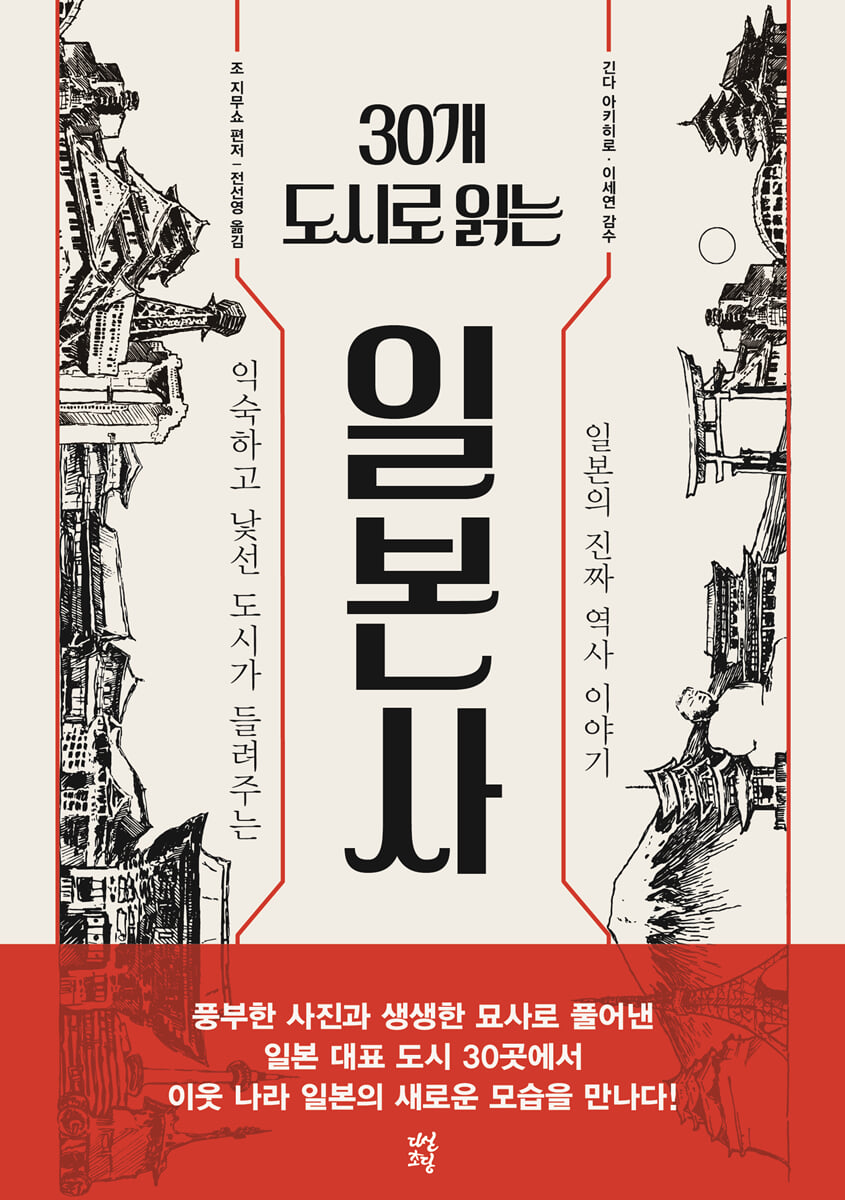
Japanese History in 30 Cities
 |
Description
Book Introduction
Of course, Japanese history
Stories and culture alive and breathing throughout the city!
An essential historical travel book in just one volume!
From Japanese mythology to the 21st century, the vast history of Japan is deeply and richly unraveled through the histories of 30 cities.
As the saying goes, “Cities are works of history,” Japanese history has been formed with cities as its backdrop.
Therefore, examining the history of Japan's 30 representative cities to understand their current appearance is an effective way to understand not only the overall context of Japanese history but also Japan today.
It covers a wide range of cities, including familiar ones like Kyoto, Nara, and Tokyo, which have served as the centers of Japan since ancient times, as well as cities with unfamiliar names like Imai, Yamaguchi, and Matsuyama, but which are essential for understanding Japan.
This book will be an excellent guide for anyone who wants to study difficult and unfamiliar Japanese history through the familiar keyword of cities, and for anyone who wants to build their knowledge of Japanese history by traveling through 30 cities with abundant photos and maps.
The deep and diverse stories told by Japanese cities will provide an experience that delves into not only Japanese history but also the history intertwined with Korea.
Moreover, you will discover new aspects of cities you thought you knew well, and you will find charms that are no longer unfamiliar in cities you were not familiar with.
Stories and culture alive and breathing throughout the city!
An essential historical travel book in just one volume!
From Japanese mythology to the 21st century, the vast history of Japan is deeply and richly unraveled through the histories of 30 cities.
As the saying goes, “Cities are works of history,” Japanese history has been formed with cities as its backdrop.
Therefore, examining the history of Japan's 30 representative cities to understand their current appearance is an effective way to understand not only the overall context of Japanese history but also Japan today.
It covers a wide range of cities, including familiar ones like Kyoto, Nara, and Tokyo, which have served as the centers of Japan since ancient times, as well as cities with unfamiliar names like Imai, Yamaguchi, and Matsuyama, but which are essential for understanding Japan.
This book will be an excellent guide for anyone who wants to study difficult and unfamiliar Japanese history through the familiar keyword of cities, and for anyone who wants to build their knowledge of Japanese history by traveling through 30 cities with abundant photos and maps.
The deep and diverse stories told by Japanese cities will provide an experience that delves into not only Japanese history but also the history intertwined with Korea.
Moreover, you will discover new aspects of cities you thought you knew well, and you will find charms that are no longer unfamiliar in cities you were not familiar with.
- You can preview some of the book's contents.
Preview
index
At first
Map of 30 Japanese cities
Part 1 Hokkaido
01 Sapporo_A symbol of Japan's pioneering history that blossomed on the land of indigenous peoples.
02 Hakodate_Hokkaido's gateway with a splendid night view
Part 2 Tohoku Region
03 Tosaminato_A medieval trading city that prospered under the Ando family.
04 Hiraizumi_The utopia of the Oshu Fujiwara clan that dominated Tohoku
05 Sendai_The "Forest City" Embracing Date Masamune's Wishes
06 Aizuwakamatsu_The pride of the Tohoku region, imbued with the spirit of the samurai
Part 3 Kanto Region
07 Utsunomiya_A strategic location with three faces: politics, economy, and culture.
08 Tokyo_The city of blood, sweat, and tears of Ieyasu, who unified the country.
09 Yokohama: A cultural gateway that embraced and transmitted Western modern culture.
10 Kamakura: A natural fortress steeped in history and literature
11 Odawara_ The palace of the Sengoku Hojo clan that lasted 100 years
Part 4: Jubu Province
12 Swa: The "Switzerland of the East," Where Faith and High-Tech Industry Coexist
13 Niigata: An international trade port that extends beyond Japan to the world
14 Kanazawa_A UNESCO Creative City that Grew from a Temple
15 Nagoya_Japan's first new city, filled with a vibrant culture
Part 5 Kansai Region
16 Ise_The city of the gods where all the tributes of Japan are gathered
17 Nara_The beginning of 1,300 years of history chosen by the emperor
18 Imai_A financial center that prospered through overland transit trade
19 Osaka_Japan's leading economic center, founded by Hideyoshi
20 Sakai: The 'Venice of the East' that developed through merchant autonomy
21 Kyoto: A Thousand-Year-Old City Preserving Japan
22 Kobe: An international city where exotic romance and the pain of earthquakes coexist.
Part 6 Chugoku Region
23 Hiroshima_Japan's largest commercial area obscured by the atomic bomb
24 Tomonoura_A small fishing village that inspired Hayao Miyazaki
25 Yamaguchi: The "Kyoto of the West," Where Ouchi Culture Flourished
Part 7 Shikoku Region
26 Matsuyama_Shikoku's hot spring town loved by Natsume Soseki
Part 8 Kyushu Region
27 Fukuoka: A trading hub where Korean and Chinese history and culture live and breathe.
28 Nagasaki: A World Within Japan, the Origin of Western Culture and Religion
29 Kagoshima: The spiritual home of the Meiji Restoration that changed Japan
Part 9 Okinawa Region
30 Naha_The capital city that preserves the culture and spirit of the 400-year-old Ryukyu Kingdom
Key References
Map References
Sources of illustrations used in each section
Map of 30 Japanese cities
Part 1 Hokkaido
01 Sapporo_A symbol of Japan's pioneering history that blossomed on the land of indigenous peoples.
02 Hakodate_Hokkaido's gateway with a splendid night view
Part 2 Tohoku Region
03 Tosaminato_A medieval trading city that prospered under the Ando family.
04 Hiraizumi_The utopia of the Oshu Fujiwara clan that dominated Tohoku
05 Sendai_The "Forest City" Embracing Date Masamune's Wishes
06 Aizuwakamatsu_The pride of the Tohoku region, imbued with the spirit of the samurai
Part 3 Kanto Region
07 Utsunomiya_A strategic location with three faces: politics, economy, and culture.
08 Tokyo_The city of blood, sweat, and tears of Ieyasu, who unified the country.
09 Yokohama: A cultural gateway that embraced and transmitted Western modern culture.
10 Kamakura: A natural fortress steeped in history and literature
11 Odawara_ The palace of the Sengoku Hojo clan that lasted 100 years
Part 4: Jubu Province
12 Swa: The "Switzerland of the East," Where Faith and High-Tech Industry Coexist
13 Niigata: An international trade port that extends beyond Japan to the world
14 Kanazawa_A UNESCO Creative City that Grew from a Temple
15 Nagoya_Japan's first new city, filled with a vibrant culture
Part 5 Kansai Region
16 Ise_The city of the gods where all the tributes of Japan are gathered
17 Nara_The beginning of 1,300 years of history chosen by the emperor
18 Imai_A financial center that prospered through overland transit trade
19 Osaka_Japan's leading economic center, founded by Hideyoshi
20 Sakai: The 'Venice of the East' that developed through merchant autonomy
21 Kyoto: A Thousand-Year-Old City Preserving Japan
22 Kobe: An international city where exotic romance and the pain of earthquakes coexist.
Part 6 Chugoku Region
23 Hiroshima_Japan's largest commercial area obscured by the atomic bomb
24 Tomonoura_A small fishing village that inspired Hayao Miyazaki
25 Yamaguchi: The "Kyoto of the West," Where Ouchi Culture Flourished
Part 7 Shikoku Region
26 Matsuyama_Shikoku's hot spring town loved by Natsume Soseki
Part 8 Kyushu Region
27 Fukuoka: A trading hub where Korean and Chinese history and culture live and breathe.
28 Nagasaki: A World Within Japan, the Origin of Western Culture and Religion
29 Kagoshima: The spiritual home of the Meiji Restoration that changed Japan
Part 9 Okinawa Region
30 Naha_The capital city that preserves the culture and spirit of the 400-year-old Ryukyu Kingdom
Key References
Map References
Sources of illustrations used in each section
Detailed image
.jpg)
Into the book
"A lake that has the elegance of a thin pearl oyster filled with water, but feels fleeting." - This is how Osamu Dazai described Lake Chusan in his autobiographical novel, "Tsugaru 津?"
Jusanho is a brackish lake adjacent to the East Sea, consisting of a mixture of fresh water and salt water.
Due to its characteristics, the radish is a specialty product, and recently, the radish ramen made with the abundant radish has become famous as a specialty dish.
---From "Tosaminato: A Medieval Trading City that Prospered Under the Ando Family"
The Spanish ambassador, Sebastián Vizcaino, visited Sendai Castle the year after its completion and commented in his book, “Gold and Silver Island Exploration Report,” that it was “one of the finest and most durable castles in Japan.”
---From "Sendai_The 'Forest City' Containing Date Masamune's Wishes"
Hideyoshi had his eyes set on Edo, which had once been prosperous.
The intention behind giving this land to Ieyasu may have been to check the various daimyō of Ou? Ue who had not yet submitted to the Toyotomi clan, or it may have been to see in Edo the potential to become a large city like Osaka, the "city of water."
At least, it is currently assumed that it was not a demotion as commonly believed.
---From "Tokyo: The City of Blood, Sweat, and Tears of Ieyasu, Who Unified the World"
Of all the cities of medieval Japan, the one most famous in European society at the time was not Tokyo or Hakata, but Sakai.
Gaspar Villera, a Portuguese missionary who visited Japan in 1556, introduced Sakai as the “Venice of the East” in his book, and it is said that its name was also written on world maps of the time.
---From "Sakai_The Venice of the East" that developed through the autonomy of merchants
The Joseon envoy dispatched by the Joseon king to Edo also used Tomonoura as a transit point.
Around 1690 during the Genroku period, a guest house was built adjacent to the main hall of Fujinji Temple in Tomochotomo, and was used as a guest house for the Joseon diplomatic mission.
In 1711, Lee Bang-eon, an official of the Joseon Tongsinsa, visited Japan and praised the view from the guest house overlooking Benten Island and Sensui Island floating in the Seto Inland Sea as “the most beautiful place in Japan.” In 1748, Hong Gye-hui, who visited Japan as an envoy of the Tongsinsa, named this guest house Daejoru?潮?.
Jusanho is a brackish lake adjacent to the East Sea, consisting of a mixture of fresh water and salt water.
Due to its characteristics, the radish is a specialty product, and recently, the radish ramen made with the abundant radish has become famous as a specialty dish.
---From "Tosaminato: A Medieval Trading City that Prospered Under the Ando Family"
The Spanish ambassador, Sebastián Vizcaino, visited Sendai Castle the year after its completion and commented in his book, “Gold and Silver Island Exploration Report,” that it was “one of the finest and most durable castles in Japan.”
---From "Sendai_The 'Forest City' Containing Date Masamune's Wishes"
Hideyoshi had his eyes set on Edo, which had once been prosperous.
The intention behind giving this land to Ieyasu may have been to check the various daimyō of Ou? Ue who had not yet submitted to the Toyotomi clan, or it may have been to see in Edo the potential to become a large city like Osaka, the "city of water."
At least, it is currently assumed that it was not a demotion as commonly believed.
---From "Tokyo: The City of Blood, Sweat, and Tears of Ieyasu, Who Unified the World"
Of all the cities of medieval Japan, the one most famous in European society at the time was not Tokyo or Hakata, but Sakai.
Gaspar Villera, a Portuguese missionary who visited Japan in 1556, introduced Sakai as the “Venice of the East” in his book, and it is said that its name was also written on world maps of the time.
---From "Sakai_The Venice of the East" that developed through the autonomy of merchants
The Joseon envoy dispatched by the Joseon king to Edo also used Tomonoura as a transit point.
Around 1690 during the Genroku period, a guest house was built adjacent to the main hall of Fujinji Temple in Tomochotomo, and was used as a guest house for the Joseon diplomatic mission.
In 1711, Lee Bang-eon, an official of the Joseon Tongsinsa, visited Japan and praised the view from the guest house overlooking Benten Island and Sensui Island floating in the Seto Inland Sea as “the most beautiful place in Japan.” In 1748, Hong Gye-hui, who visited Japan as an envoy of the Tongsinsa, named this guest house Daejoru?潮?.
---From "Tomonoura - A Small Fishing Village That Inspired Hayao Miyazaki"
Publisher's Review
Discover a new side of Japan, a neighboring country you never knew existed, through 30 cities!
"Reading Japanese History through 30 Cities" begins with the idea of approaching history through cities in an easy and interesting way.
Cities have always been the central stage of history.
Cities, the centers of politics, economy, art, and academia, are essential spaces for understanding a country.
It covers a wide range of cities that are familiar to Koreans, such as Tokyo, Osaka, and Hokkaido, as well as unfamiliar but essential cities such as Tosaminato, Aizuwakamatsu, and Tomonoura.
The 30 articles covering 30 cities were carefully selected and reviewed by experts from each city, providing essential historical knowledge to understand the overall context of Japanese history, in an optimal length that can be easily read, memorized, and studied at any time.
Breaking free from the stereotype that Japanese history is unfamiliar and difficult, the book systematically unfolds the main flow of Japanese history, using the city as a setting, the space we live in today.
Let's fill up on knowledge with a vivid historical travel book that is more like a trip than a trip!
"Tokyo, where I have fond memories of my first trip abroad. When did Tokyo become a world-class city?"
Hashima Island, also known as Gunkanjima Island to Koreans.
Why is Hashima Island in Nagasaki?'
'Tokyo has Tokyo Station, Kyoto has Kyoto Station, but why is Fukuoka's Hakata Station and not Fukuoka Station?'
A city I thought I knew well, a city I encountered on countless trips to Japan, a small city I always wanted to visit.
You can open the book and read about any city.
Historical knowledge will be densely packed, including alliances and betrayals among characters that occurred in a single city, major wars that changed the regime, and cultural heritages left behind for future generations.
By taking a historical tour of one city a day, you will not only discover the major trends of Japanese history, but also the hidden stories of each city and the fascinating lives of the people involved there.
Moreover, you will discover new aspects of cities you thought you knew well, and you will find charms that are no longer unfamiliar in cities you were not familiar with.
These stories of Japanese cities, which you may have been curious about but never heard of anywhere else, will take you on a journey through a new world of Japanese history.
"Reading Japanese History through 30 Cities" begins with the idea of approaching history through cities in an easy and interesting way.
Cities have always been the central stage of history.
Cities, the centers of politics, economy, art, and academia, are essential spaces for understanding a country.
It covers a wide range of cities that are familiar to Koreans, such as Tokyo, Osaka, and Hokkaido, as well as unfamiliar but essential cities such as Tosaminato, Aizuwakamatsu, and Tomonoura.
The 30 articles covering 30 cities were carefully selected and reviewed by experts from each city, providing essential historical knowledge to understand the overall context of Japanese history, in an optimal length that can be easily read, memorized, and studied at any time.
Breaking free from the stereotype that Japanese history is unfamiliar and difficult, the book systematically unfolds the main flow of Japanese history, using the city as a setting, the space we live in today.
Let's fill up on knowledge with a vivid historical travel book that is more like a trip than a trip!
"Tokyo, where I have fond memories of my first trip abroad. When did Tokyo become a world-class city?"
Hashima Island, also known as Gunkanjima Island to Koreans.
Why is Hashima Island in Nagasaki?'
'Tokyo has Tokyo Station, Kyoto has Kyoto Station, but why is Fukuoka's Hakata Station and not Fukuoka Station?'
A city I thought I knew well, a city I encountered on countless trips to Japan, a small city I always wanted to visit.
You can open the book and read about any city.
Historical knowledge will be densely packed, including alliances and betrayals among characters that occurred in a single city, major wars that changed the regime, and cultural heritages left behind for future generations.
By taking a historical tour of one city a day, you will not only discover the major trends of Japanese history, but also the hidden stories of each city and the fascinating lives of the people involved there.
Moreover, you will discover new aspects of cities you thought you knew well, and you will find charms that are no longer unfamiliar in cities you were not familiar with.
These stories of Japanese cities, which you may have been curious about but never heard of anywhere else, will take you on a journey through a new world of Japanese history.
GOODS SPECIFICS
- Publication date: November 15, 2021
- Page count, weight, size: 408 pages | 676g | 148*210*30mm
- ISBN13: 9791130677965
- ISBN10: 1130677966
You may also like
카테고리
korean


korean

![GQ KOREA Mark (Monthly): December [2025]](http://librairie.coreenne.fr/cdn/shop/files/8ef265dbbfbf186523ed75ba7319009d.jpg?v=1765340328&width=3840)


