

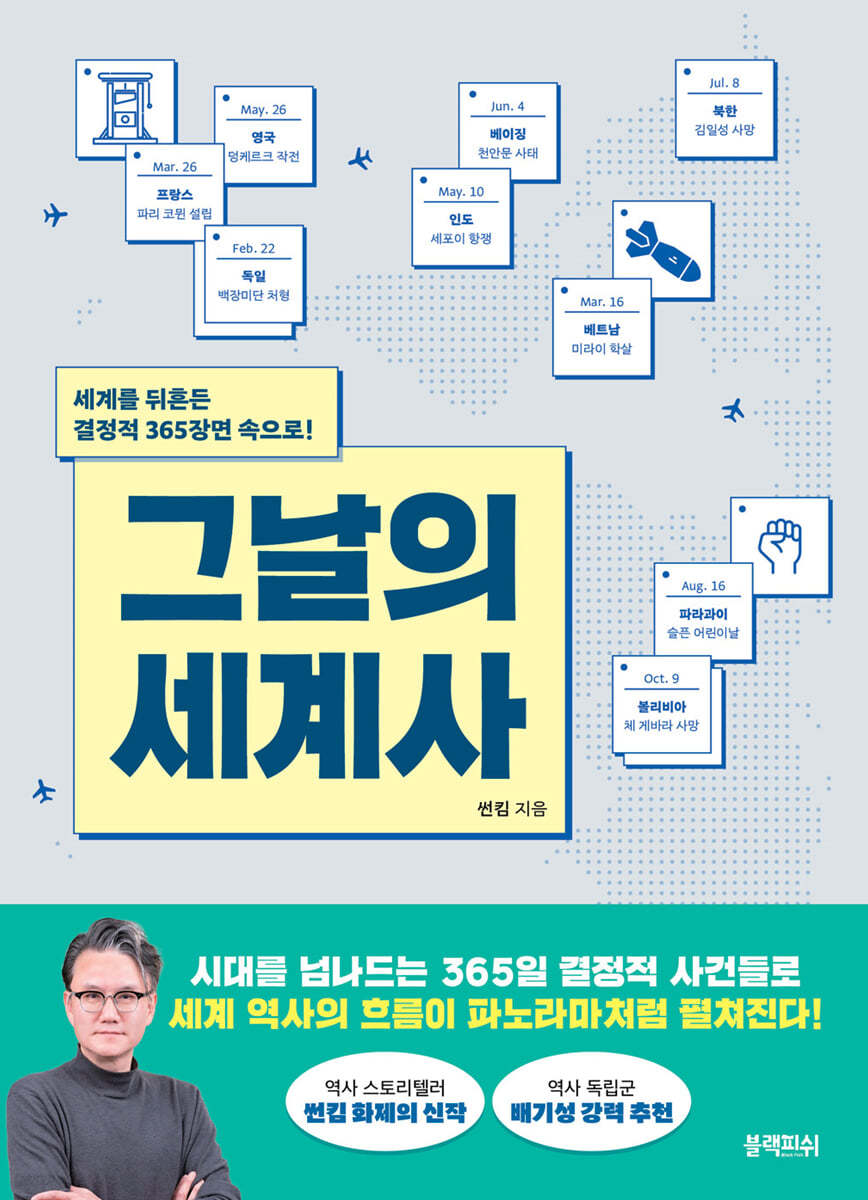
World History of That Day
 |
Description
Book Introduction
"The flow of world history unfolds like a panorama."
Explore world history with 365 major events!
Essential history that transcends time and space, clear one chapter a day.
Sun Kim, the undisputed master of historical storytelling, has delivered a cinematic, immersive experience of history. "World History of That Day" takes you on a journey through time, immersing you in the meaningful events of each day of the year.
From January 1st to December 31st, it covers not only weighty historical events connected to today, such as the heroes and dictators who shook history, and the stories of those who stayed behind but ultimately changed the world, but also topics that are closely related to our daily lives, such as ramen, Labor Day, and soccer.
Sun Kim, who has provided us with the world history knowledge we need today with his sharp perspective and entertaining storytelling in his bestsellers, “Sun Kim’s Complete Conquest of World History” and “Sun Kim’s Unstoppable World History,” has transformed into a world history travel guide in this book.
From the United States to Mozambique, it travels across the globe and historical sites from BC to the 21st century, immersing you in the events of that day.
Through the stories of how humans lived on this Earth in the past, we can reflect on the preciousness of the present we live in today.
It is not simply a record of events, but contains the author's profound interpretation and a message worth pondering.
It is also meaningful that it highlights not only well-known heroes and dictators such as King George VI who stood up to Hitler during World War II, Che Guevara, the revolutionary who succeeded in the Cuban Revolution, and Pol Pot who massacred millions of his own people and turned Cambodia into a killing field, but also relatively obscured historical heroes such as Mary Seacole, a black nurse who was almost forgotten along with Florence Nightingale, and Rosa Parks, the woman who ignited the civil rights movement in the United States before the famous Reverend Martin Luther King Jr.
The daily manuscripts, which are easy to read one a day, are filled with the joy of reading history in its entirety and fresh knowledge.
Let's take a 5-minute journey into the world history of that day every day.
As you read the historical narrative told with the author's characteristic wit and sharp wit, you will gain knowledge and refinement, broaden your perspective on the world, and have the surprising experience of seeing the fragments of world history connected together.
We will naturally come to realize that today is precious because of yesterday, and that this is why we must learn history.
Explore world history with 365 major events!
Essential history that transcends time and space, clear one chapter a day.
Sun Kim, the undisputed master of historical storytelling, has delivered a cinematic, immersive experience of history. "World History of That Day" takes you on a journey through time, immersing you in the meaningful events of each day of the year.
From January 1st to December 31st, it covers not only weighty historical events connected to today, such as the heroes and dictators who shook history, and the stories of those who stayed behind but ultimately changed the world, but also topics that are closely related to our daily lives, such as ramen, Labor Day, and soccer.
Sun Kim, who has provided us with the world history knowledge we need today with his sharp perspective and entertaining storytelling in his bestsellers, “Sun Kim’s Complete Conquest of World History” and “Sun Kim’s Unstoppable World History,” has transformed into a world history travel guide in this book.
From the United States to Mozambique, it travels across the globe and historical sites from BC to the 21st century, immersing you in the events of that day.
Through the stories of how humans lived on this Earth in the past, we can reflect on the preciousness of the present we live in today.
It is not simply a record of events, but contains the author's profound interpretation and a message worth pondering.
It is also meaningful that it highlights not only well-known heroes and dictators such as King George VI who stood up to Hitler during World War II, Che Guevara, the revolutionary who succeeded in the Cuban Revolution, and Pol Pot who massacred millions of his own people and turned Cambodia into a killing field, but also relatively obscured historical heroes such as Mary Seacole, a black nurse who was almost forgotten along with Florence Nightingale, and Rosa Parks, the woman who ignited the civil rights movement in the United States before the famous Reverend Martin Luther King Jr.
The daily manuscripts, which are easy to read one a day, are filled with the joy of reading history in its entirety and fresh knowledge.
Let's take a 5-minute journey into the world history of that day every day.
As you read the historical narrative told with the author's characteristic wit and sharp wit, you will gain knowledge and refinement, broaden your perspective on the world, and have the surprising experience of seeing the fragments of world history connected together.
We will naturally come to realize that today is precious because of yesterday, and that this is why we must learn history.
- You can preview some of the book's contents.
Preview
index
prolog
Recommendation
january
february
March
april
May
June
July
August
September
october
November
december
Search
Recommendation
january
february
March
april
May
June
July
August
September
october
November
december
Search
Detailed image
.jpg)
Into the book
I sometimes search for things that happened in the past on my birthday, July 10th.
For example, July 10, 1592, the year the Imjin War broke out, and July 10, 1492, the year Queen Isabella unified Spain.
So, without fail, on the day I was born, something happened on this Earth, transcending time and space, even if it wasn't something huge.
And then you realize.
The fact that while the 365 days of the year come and go to us, something has happened, is happening now, and will continue to happen in this world every day.
---From the "Prologue"
On March 8, 1944, the Imphal Operation, the worst battle of attrition and a war of attrition in Japanese history, began.
(……) The problem was that the Japanese commander who commanded the operation was a man named Renya Mutaguchi, who had written many dark chapters in the history of the Japanese military.
The worst was the Imphal operation.
'We Japanese are herbivores, so we don't need to be fed.
As a result of using famous sayings such as, "You can eat grass in the jungle (actual remarks)," and "You can use the supplies you need by looting them from the enemy (actual remarks)," out of the 90,000 Japanese soldiers who participated in this operation, a whopping 70,000 were killed or injured in the jungle.
Of course, not a single Japanese soldier arrived at Imphal.
This shovel operation makes me think again about this saying.
'An incompetent commander is more fearsome than a brave enemy.'
---From "March 8th"
On April 15, 1998, Cambodian dictator and dictator Pol Pot died.
He massacred more than 2 million of his own people.
Born in 1925 to a poor Cambodian farmer, Pol Pot launched the "Down with the dynasty! Long live communism!" movement, believing that "it was the royal family and the royal family that made Cambodian farmers miserable! And the way to do it was communism!"
(……) In 1973, Pol Pot wins the civil war and establishes the Khmer Rouge regime.
And then the soap opera begins.
In the name of creating an ideal communist society, he begins to kill off all the former royalists, the capitalist rich, the educated, and anyone else he doesn't like.
They kill people because they wear glasses, they kill people because their hands are too soft (because they don't farm)... ... They massacre a whopping 2 million people.
It must have been so bad that Cambodia was called the Killing Fields at the time.
There is also a movie of the same name.
---From "April 15th"
On May 14, 1881, Mary Seacole, a black Jamaican nurse, died.
The Crimean War, in which Nightingale participated as a nurse.
When Mary heard that there was a shortage of nurses during the war, she left her hometown of Jamaica and went to England.
To join the war as a British nurse.
However, the British authorities refused Mary's application to become a nurse each time, using the excuse that 'all nurse positions were full.'
The real reason was that a black man from the British colony of Jamaica could not be allowed to treat white soldiers.
Mary was not disappointed and flew directly to Crimea, bypassing the British authorities.
And he uses his own money to build a field hospital and treat wounded soldiers.
---From "May 14th"
On August 16, 1869, thousands of children were massacred in Paraguay.
So this day is Children's Day in Paraguay.
(……) Paraguay's desire to advance to the sea causes war.
At the same time as three surrounding countries: Uruguay, Brazil, and Argentina.
What on earth were they thinking? Of course, Paraguay was completely stripped of its assets.
It got to the point where adult males sent into battle were almost dying.
In fact, 90% of adult males were killed.
The Paraguayan government is taking some ridiculous action here.
They put fake beards on children's noses, dressed them up like adults, and sent them into battle.
For example, July 10, 1592, the year the Imjin War broke out, and July 10, 1492, the year Queen Isabella unified Spain.
So, without fail, on the day I was born, something happened on this Earth, transcending time and space, even if it wasn't something huge.
And then you realize.
The fact that while the 365 days of the year come and go to us, something has happened, is happening now, and will continue to happen in this world every day.
---From the "Prologue"
On March 8, 1944, the Imphal Operation, the worst battle of attrition and a war of attrition in Japanese history, began.
(……) The problem was that the Japanese commander who commanded the operation was a man named Renya Mutaguchi, who had written many dark chapters in the history of the Japanese military.
The worst was the Imphal operation.
'We Japanese are herbivores, so we don't need to be fed.
As a result of using famous sayings such as, "You can eat grass in the jungle (actual remarks)," and "You can use the supplies you need by looting them from the enemy (actual remarks)," out of the 90,000 Japanese soldiers who participated in this operation, a whopping 70,000 were killed or injured in the jungle.
Of course, not a single Japanese soldier arrived at Imphal.
This shovel operation makes me think again about this saying.
'An incompetent commander is more fearsome than a brave enemy.'
---From "March 8th"
On April 15, 1998, Cambodian dictator and dictator Pol Pot died.
He massacred more than 2 million of his own people.
Born in 1925 to a poor Cambodian farmer, Pol Pot launched the "Down with the dynasty! Long live communism!" movement, believing that "it was the royal family and the royal family that made Cambodian farmers miserable! And the way to do it was communism!"
(……) In 1973, Pol Pot wins the civil war and establishes the Khmer Rouge regime.
And then the soap opera begins.
In the name of creating an ideal communist society, he begins to kill off all the former royalists, the capitalist rich, the educated, and anyone else he doesn't like.
They kill people because they wear glasses, they kill people because their hands are too soft (because they don't farm)... ... They massacre a whopping 2 million people.
It must have been so bad that Cambodia was called the Killing Fields at the time.
There is also a movie of the same name.
---From "April 15th"
On May 14, 1881, Mary Seacole, a black Jamaican nurse, died.
The Crimean War, in which Nightingale participated as a nurse.
When Mary heard that there was a shortage of nurses during the war, she left her hometown of Jamaica and went to England.
To join the war as a British nurse.
However, the British authorities refused Mary's application to become a nurse each time, using the excuse that 'all nurse positions were full.'
The real reason was that a black man from the British colony of Jamaica could not be allowed to treat white soldiers.
Mary was not disappointed and flew directly to Crimea, bypassing the British authorities.
And he uses his own money to build a field hospital and treat wounded soldiers.
---From "May 14th"
On August 16, 1869, thousands of children were massacred in Paraguay.
So this day is Children's Day in Paraguay.
(……) Paraguay's desire to advance to the sea causes war.
At the same time as three surrounding countries: Uruguay, Brazil, and Argentina.
What on earth were they thinking? Of course, Paraguay was completely stripped of its assets.
It got to the point where adult males sent into battle were almost dying.
In fact, 90% of adult males were killed.
The Paraguayan government is taking some ridiculous action here.
They put fake beards on children's noses, dressed them up like adults, and sent them into battle.
---From "August 16th"
Publisher's Review
* A new work by Sun Kim, a unique historical storyteller
* Highly recommended by historian Bae Ki-seong
* Read the world history of each day through the decisive events of 365 days!
“There has never been a single day that wasn't historic.”
365 days of decisive events across time
“I thought, what if we organize the most meaningful and important events that have happened so far in the 365 days of the year, which are fair to everyone, into a single timetable?” _From the prologue
What happened there that day? When learning history, you've probably had the difficult experience of wondering why there are so many events and so many dates to memorize.
Yes, that's right.
On any given day, something always happens on this planet, and a lot of it happens, and it happens again today.
It is impossible to grasp all the events that have occurred over the countless days that have passed so far.
So, some of the things that were deemed important were recorded as 'history' and we can know them today.
Even though it is a selection, the amount is so vast that history feels difficult.
Especially world history.
You may also question whether it is really necessary to know about past events now.
What if we changed our thinking this way? Think of the ancients as fellow human beings.
Aren't you curious about the stories of our fellow humans on this lonely planet in this vast universe? Sun Kim, a historical storyteller, poses the question, "If we in Korea are experiencing happiness today, wouldn't someone in Egypt, North Africa, a thousand years ago, have felt the same happiness?" He invites us to embark on a journey through history to discover how our fellow humans lived each day.
This is how the trip goes.
It is to organize all 365 days of the year into a single timetable by assigning meaningful and important events related to that day in the past.
That schedule is this book, “World History of That Day.”
Let's embark on a journey into world history that day, with the solid historical commentary of Sun Kim, who boasts historical knowledge accumulated on the spot and a pleasant yet sharp wit.
“What happened there that day?”
The story of the day that shook the world
- February 22nd, the tragedy of the anti-Nazi group White Rose
- May 14, Mary Seacole of Jamaica, almost forgotten by the Angel in White
- June 14, Che Guevara, the revolutionary who risked his life to fight against the dictatorship
- October 20, in the words of Muammar Gaddafi, who ruled Libya with an iron fist.
Author Sun Kim, who has presented the experience of reading history in an easy and fun way through many bestselling historical works, including “Sun Kim’s Unstoppable World History,” has transformed into a historical travel guide in his new work “World History of That Day.”
The author, who is also active as a domestic and international history tour commentator, unfolds behind-the-scenes stories in this book, traveling across various countries and almost every period of history, including the United States, Europe, Africa, South America, the Roman Empire, and the Ottoman Empire.
From January 1st to December 31st, it covers not only weighty historical events connected to today and people who left their mark on world history, but also topics that are closely related to our daily lives, such as the world's first 'instant ramen', 'cola' which was a military supply during World War II, and the war that started because of real 'soccer'.
From selecting the major historical events of the day to the author's insightful interpretation and message on how we should view them and what we should learn from them, it is deeply meaningful.
It sheds light on historical heroes who have been forgotten, such as Mary Seacole, a black nurse who was almost forgotten after being buried under the Nightingale, and the countless people who resisted the oppression of dictators with their bare bodies. It also actively brings to light important events that may seem unrelated to us at first glance, such as the Yalta Conference and the Russo-Japanese War, but which actually determined the fate of our country, helping us to read them anew within the flow of world history.
Moreover, it shows that all historical events are interconnected, allowing us to grasp the complex context of world history.
For example, the article 'November 9' tells the story of the fall of the Berlin Wall on that day in 1989, and the article 'November 28', a few weeks later, tells the story of the Velvet Revolution in Czechoslovakia that took place that same year.
Do you see the connection between these two events? The fall of the Berlin Wall was a momentous event, symbolizing the end of Germany's division and the end of the Cold War, and had a profound impact throughout Eastern Europe.
Not long after the fall of the Berlin Wall, the people of Czechoslovakia, then a communist country, took to the streets, shouting, "Let's have democracy too."
That's the Velvet Revolution.
“The flow of world history unfolds like a panorama!”
A special world history tour that will broaden your thinking
As you turn this book one page a day, you will realize that history is not a single, independent event, but a series of events that continue to this day and have a profound impact on our lives.
Through the stories of our fellow humans living on this Earth in the past, we can reflect on the preciousness of each day that we take for granted.
It is understandable that the strength to live today and the wisdom to anticipate the future can be gained through insight into history.
If you have encountered world history that was too heavy or difficult, now is the time to encounter Sun Kim's world history.
Let's take a 5-minute journey into the world history of that day every day.
As you immerse yourself in the historical narrative told with the author's characteristically intelligent and humorous wit, you will gain knowledge and refinement, broaden your perspective on the world, and have the delightful experience of seeing the fragments of world history connected together.
* Highly recommended by historian Bae Ki-seong
* Read the world history of each day through the decisive events of 365 days!
“There has never been a single day that wasn't historic.”
365 days of decisive events across time
“I thought, what if we organize the most meaningful and important events that have happened so far in the 365 days of the year, which are fair to everyone, into a single timetable?” _From the prologue
What happened there that day? When learning history, you've probably had the difficult experience of wondering why there are so many events and so many dates to memorize.
Yes, that's right.
On any given day, something always happens on this planet, and a lot of it happens, and it happens again today.
It is impossible to grasp all the events that have occurred over the countless days that have passed so far.
So, some of the things that were deemed important were recorded as 'history' and we can know them today.
Even though it is a selection, the amount is so vast that history feels difficult.
Especially world history.
You may also question whether it is really necessary to know about past events now.
What if we changed our thinking this way? Think of the ancients as fellow human beings.
Aren't you curious about the stories of our fellow humans on this lonely planet in this vast universe? Sun Kim, a historical storyteller, poses the question, "If we in Korea are experiencing happiness today, wouldn't someone in Egypt, North Africa, a thousand years ago, have felt the same happiness?" He invites us to embark on a journey through history to discover how our fellow humans lived each day.
This is how the trip goes.
It is to organize all 365 days of the year into a single timetable by assigning meaningful and important events related to that day in the past.
That schedule is this book, “World History of That Day.”
Let's embark on a journey into world history that day, with the solid historical commentary of Sun Kim, who boasts historical knowledge accumulated on the spot and a pleasant yet sharp wit.
“What happened there that day?”
The story of the day that shook the world
- February 22nd, the tragedy of the anti-Nazi group White Rose
- May 14, Mary Seacole of Jamaica, almost forgotten by the Angel in White
- June 14, Che Guevara, the revolutionary who risked his life to fight against the dictatorship
- October 20, in the words of Muammar Gaddafi, who ruled Libya with an iron fist.
Author Sun Kim, who has presented the experience of reading history in an easy and fun way through many bestselling historical works, including “Sun Kim’s Unstoppable World History,” has transformed into a historical travel guide in his new work “World History of That Day.”
The author, who is also active as a domestic and international history tour commentator, unfolds behind-the-scenes stories in this book, traveling across various countries and almost every period of history, including the United States, Europe, Africa, South America, the Roman Empire, and the Ottoman Empire.
From January 1st to December 31st, it covers not only weighty historical events connected to today and people who left their mark on world history, but also topics that are closely related to our daily lives, such as the world's first 'instant ramen', 'cola' which was a military supply during World War II, and the war that started because of real 'soccer'.
From selecting the major historical events of the day to the author's insightful interpretation and message on how we should view them and what we should learn from them, it is deeply meaningful.
It sheds light on historical heroes who have been forgotten, such as Mary Seacole, a black nurse who was almost forgotten after being buried under the Nightingale, and the countless people who resisted the oppression of dictators with their bare bodies. It also actively brings to light important events that may seem unrelated to us at first glance, such as the Yalta Conference and the Russo-Japanese War, but which actually determined the fate of our country, helping us to read them anew within the flow of world history.
Moreover, it shows that all historical events are interconnected, allowing us to grasp the complex context of world history.
For example, the article 'November 9' tells the story of the fall of the Berlin Wall on that day in 1989, and the article 'November 28', a few weeks later, tells the story of the Velvet Revolution in Czechoslovakia that took place that same year.
Do you see the connection between these two events? The fall of the Berlin Wall was a momentous event, symbolizing the end of Germany's division and the end of the Cold War, and had a profound impact throughout Eastern Europe.
Not long after the fall of the Berlin Wall, the people of Czechoslovakia, then a communist country, took to the streets, shouting, "Let's have democracy too."
That's the Velvet Revolution.
“The flow of world history unfolds like a panorama!”
A special world history tour that will broaden your thinking
As you turn this book one page a day, you will realize that history is not a single, independent event, but a series of events that continue to this day and have a profound impact on our lives.
Through the stories of our fellow humans living on this Earth in the past, we can reflect on the preciousness of each day that we take for granted.
It is understandable that the strength to live today and the wisdom to anticipate the future can be gained through insight into history.
If you have encountered world history that was too heavy or difficult, now is the time to encounter Sun Kim's world history.
Let's take a 5-minute journey into the world history of that day every day.
As you immerse yourself in the historical narrative told with the author's characteristically intelligent and humorous wit, you will gain knowledge and refinement, broaden your perspective on the world, and have the delightful experience of seeing the fragments of world history connected together.
GOODS SPECIFICS
- Date of issue: December 26, 2024
- Page count, weight, size: 416 pages | 578g | 152*210*26mm
- ISBN13: 9788968334900
- ISBN10: 8968334900
You may also like
카테고리
korean


korean

![ELLE 엘르 스페셜 에디션 A형 : 12월 [2025]](http://librairie.coreenne.fr/cdn/shop/files/b8e27a3de6c9538896439686c6b0e8fb.jpg?v=1766436872&width=3840)


