

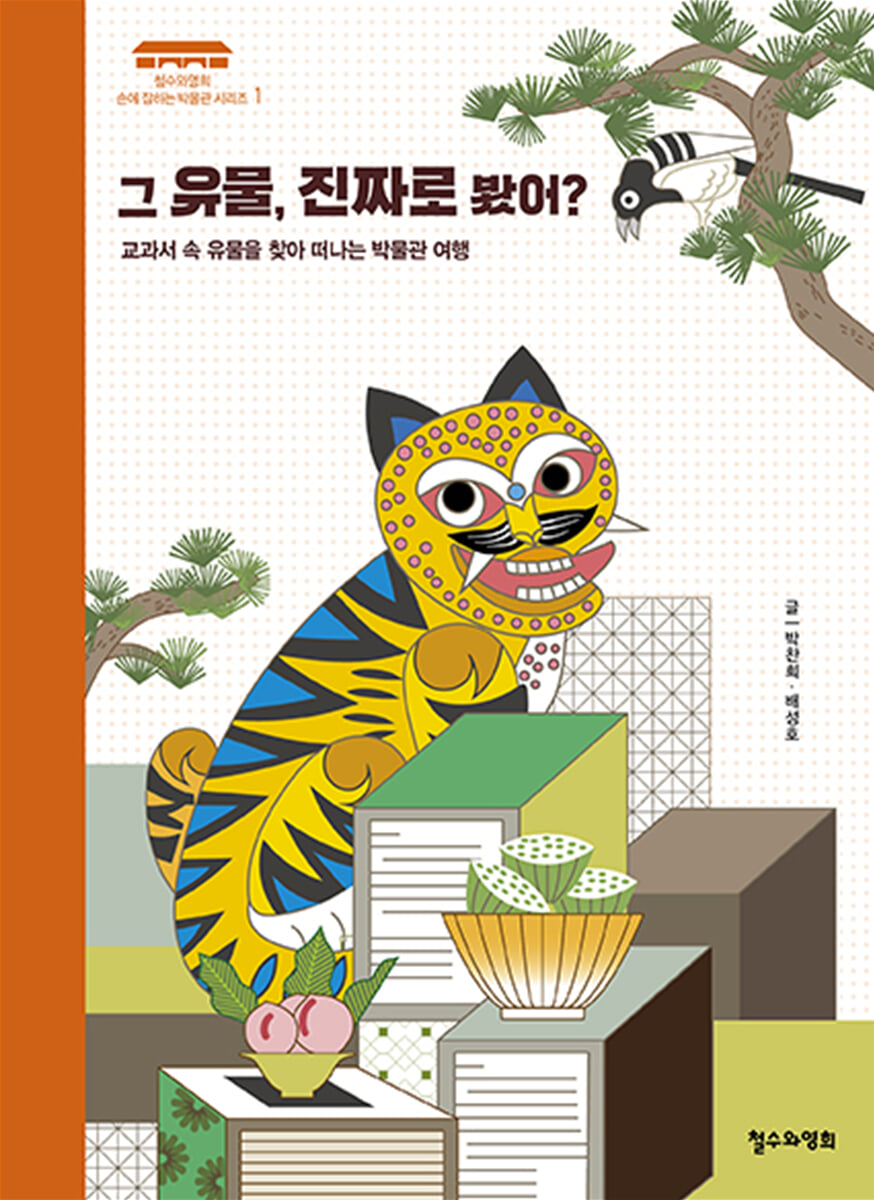
Did you really see that relic?
 |
Description
Book Introduction
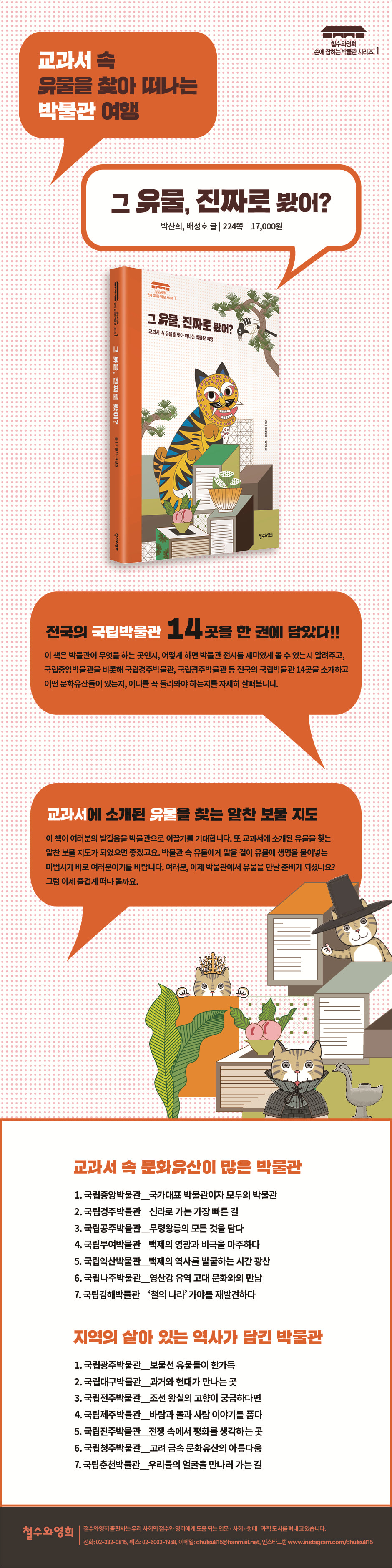
14 national museums across the country in one volume!!
- A treasure map filled with artifacts introduced in textbooks
What kind of people work at the museum?
Are you saying that not all museum artifacts are real?
Is there a reason to display relics in the pitch-black darkness?
Is there a secret to enjoying the exhibition?
This book explains what a museum is and how to enjoy museum exhibits.
We introduce 14 national museums across the country, including the National Museum of Korea, Gyeongju National Museum, and Gwangju National Museum, and take a closer look at the cultural heritage sites and must-see spots.
- A treasure map filled with artifacts introduced in textbooks
What kind of people work at the museum?
Are you saying that not all museum artifacts are real?
Is there a reason to display relics in the pitch-black darkness?
Is there a secret to enjoying the exhibition?
This book explains what a museum is and how to enjoy museum exhibits.
We introduce 14 national museums across the country, including the National Museum of Korea, Gyeongju National Museum, and Gwangju National Museum, and take a closer look at the cultural heritage sites and must-see spots.
- You can preview some of the book's contents.
Preview
index
Preface: Becoming Friends with Artifacts in Museums
Chapter 1.
You can have a fun trip to the museum?
1.
What does a museum do?
2.
You can travel the world at a museum?
3.
If you go to a museum, you can see artifacts from textbooks?
4.
When and how were our country's museums created?
5.
What kind of people work at the museum?
6.
Can you time travel in a museum?
Chapter 2.
I'm curious about the hidden story inside the museum.
1.
Are you saying that not all museum artifacts are real?
2.
Is there a reason for exhibiting in the pitch-black darkness?
3.
Why are there so many things you shouldn't do in museums?
4.
The bronze mirror is a mirror, so why doesn't it reflect my face?
5.
What is the difference between permanent and special exhibitions?
6.
Is there a secret to enjoying the exhibition?
Chapter 3.
Which museum has a lot of cultural heritage from textbooks?
1.
National Museum of Korea: A national museum and a museum for all
2.
Gyeongju National Museum_The fastest way to Silla
3.
National Gongju Museum: Everything about King Muryeong's Tomb
4.
National Buyeo Museum: Facing the Glory and Tragedy of Baekje
5.
National Iksan Museum: A mine of time unearthing the history of Baekje
6.
Naju National Museum: Encountering the Ancient Culture of the Yeongsan River Basin
7.
National Gimhae Museum: Rediscovering Gaya, the "Iron Kingdom"
Chapter 4.
Where can I go to learn about the living history of a region?
1.
National Gwangju Museum_ Full of treasure ship artifacts
2.
Daegu National Museum: Where the Past and Present Meet
3.
National Jeonju Museum_If you are curious about the hometown of the Joseon royal family
4.
Jeju National Museum: Embracing the Stories of Wind, Stone, and People
5.
National Jinju Museum: A Place to Reflect on Peace in the Midst of War
6.
National Cheonju Museum: The Beauty of Goryeo Metal Cultural Heritage
7.
National Chuncheon Museum_On the way to meet our faces
Chapter 1.
You can have a fun trip to the museum?
1.
What does a museum do?
2.
You can travel the world at a museum?
3.
If you go to a museum, you can see artifacts from textbooks?
4.
When and how were our country's museums created?
5.
What kind of people work at the museum?
6.
Can you time travel in a museum?
Chapter 2.
I'm curious about the hidden story inside the museum.
1.
Are you saying that not all museum artifacts are real?
2.
Is there a reason for exhibiting in the pitch-black darkness?
3.
Why are there so many things you shouldn't do in museums?
4.
The bronze mirror is a mirror, so why doesn't it reflect my face?
5.
What is the difference between permanent and special exhibitions?
6.
Is there a secret to enjoying the exhibition?
Chapter 3.
Which museum has a lot of cultural heritage from textbooks?
1.
National Museum of Korea: A national museum and a museum for all
2.
Gyeongju National Museum_The fastest way to Silla
3.
National Gongju Museum: Everything about King Muryeong's Tomb
4.
National Buyeo Museum: Facing the Glory and Tragedy of Baekje
5.
National Iksan Museum: A mine of time unearthing the history of Baekje
6.
Naju National Museum: Encountering the Ancient Culture of the Yeongsan River Basin
7.
National Gimhae Museum: Rediscovering Gaya, the "Iron Kingdom"
Chapter 4.
Where can I go to learn about the living history of a region?
1.
National Gwangju Museum_ Full of treasure ship artifacts
2.
Daegu National Museum: Where the Past and Present Meet
3.
National Jeonju Museum_If you are curious about the hometown of the Joseon royal family
4.
Jeju National Museum: Embracing the Stories of Wind, Stone, and People
5.
National Jinju Museum: A Place to Reflect on Peace in the Midst of War
6.
National Cheonju Museum: The Beauty of Goryeo Metal Cultural Heritage
7.
National Chuncheon Museum_On the way to meet our faces
Detailed image
Into the book
When you actually see an artifact you've only seen in pictures in textbooks, you can feel a vivid emotion that pictures alone can't fully convey.
You can better understand the size, shape, and material of the artifacts, and you can even touch some artifacts directly through replicas.
Because you can view it from various directions, you can also examine details that are not easily visible in textbooks.
--- From the text
Who is the museum's star? The museum displays artifacts that brighten the exhibition hall.
This shining relic is the star of the museum.
However, the fact that these artifacts are displayed in the exhibition halls and that visitors can comfortably visit the museum is possible because of the people who work diligently behind the scenes.
--- From the text
There are fun ways to explore various parts of our country.
The idea is to visit the national museums in each region.
National museums representing each region have various attractions that reflect the region's history, culture, and characteristics.
By visiting the national museums representing each region, you can soon embark on a special journey to experience the history and culture of every corner of our country.
--- From the text
Because national museums are so large, one way to explore them is to go on a treasure hunt to find artifacts.
The process of finding the artifacts in the museum is also quite fun.
If you find an artifact, examine it closely.
It is important to look at not only the front of the relic, but also the sides and back.
If you have some free time, try to find an artifact that resembles you among the artifacts you saw that day.
It would be nice to find artifacts featuring children and teenagers.
--- From the text
It is widely known that Kim Jeong-ho climbed Mt. Baekdu seven times and traveled the entire country three times to create the Daedongyeojido, but this story is not true.
The creation of the Daedongyeojido was possible thanks to the accumulated knowledge and map-making technology of the Joseon Dynasty.
Kim Jeong-ho was able to create the Daedongyeojido, which was accurate and fit for purpose, based on abundant basic data and various information.
--- From the text
After the excavation of Cheonmachong was completed, the interior was changed so that people could enter the tomb and inspect it.
Inside the tomb, a large room was made of wood, and a coffin containing the body was placed inside, along with various items placed around it.
Inside the coffin, a gold crown was placed near the face, and a necklace was placed just below the gold crown.
So, isn't it a bit odd that the lower part of the crown was found on the neck? For it to be found like this, the crown should have been covering the face, not the head.
Some people, after observing this appearance, argue that the gold crown was not something worn on the head while alive, but rather a funeral item that covered the face of the dead.
--- From the text
There is a legend surrounding the King Seongdeok Shingong.
When he kept failing to make a bell, his mother put the child she had donated into the molten metal to finish it. Every time the bell rang, the child would resent his mother and say, “I’m sorry, I’m sorry.”
Because of the terrible legend, the King Seongdeok Shingong was nicknamed the Emile Bell, and this nickname is more famous than its original name.
But this legend was created during the Japanese colonial period.
It is difficult to believe that such a terrible thing could have been done in a compassionate Buddhism.
The Japanese used terrible legends for their colonial rule.
In other words, they were trying to spread the idea that no matter how unfair the Japanese orders were, they had to be followed unconditionally.
So, it would be difficult to call this species the Emile species.
--- From the text
In the Gaya tombs, not only bird-shaped pottery but also pottery resembling various objects were discovered.
They come in various shapes, such as houses, boats, straw shoes, cart wheels, horn cups, and animals.
The boat-shaped pottery is used when encountering water in another world, and the house-shaped pottery is usually a granary, meaning that you will eat your fill in the other world as well.
Wheels and straw sandals are both deeply connected to movement, so they probably mean a safe journey to another world.
--- From the text
The departure and destination of the Shinan Line were known thanks to a wooden tablet discovered among the relics.
The wooden tablets, which were pieces of wood on which writing was written, contained information such as the name of the item, quantity, recipient, and sender, much like today's waybills.
Through this, we were able to learn that maritime trade was active in East Asia and also about the artifacts from the Shinan Ship.
--- From the text
The bronze mirror has a bluish patina.
When it was first created, it would have been a shiny golden color.
The front side was polished to a shiny shine and used as a mirror, and the back side was engraved with various patterns.
If you look at the front of a bronze mirror, the surface is so smooth that you can see your face reflected in it.
This mirror could be used to look into one's face as it is today, but it also had a symbolic function of transmitting the light of heaven.
--- From the text
Recently, foreigners have started to take notice of Gat.
Foreigners who watched the movie "K-Pop Demon Hunters" that aired in 2025 were completely captivated by God's charm.
Hats are sold on foreign online shopping sites like Amazon, and foreigners who come to Korea wear hats and go to the palace.
Now, the hat has changed from a symbol of the Joseon Dynasty's yangban class to an object symbolizing Korean culture.
--- From the text
This is a record from the 『Revised Annals of King Seonjo』 in 1592, when the Imjin War broke out.
When reclaiming Gyeongju Castle, which had been occupied by the Japanese army during the Imjin War, the Bigyeokjincheonroe was used.
It was used in many battles, including the Battle of Jinju and the Battle of Haengju.
A leader of the volunteer army said, “There is no method of suppressing the Japanese that surpasses the Bigeokjincheonroe.”
If Japan had muskets, Joseon had bigeokjincheonroe.
You can better understand the size, shape, and material of the artifacts, and you can even touch some artifacts directly through replicas.
Because you can view it from various directions, you can also examine details that are not easily visible in textbooks.
--- From the text
Who is the museum's star? The museum displays artifacts that brighten the exhibition hall.
This shining relic is the star of the museum.
However, the fact that these artifacts are displayed in the exhibition halls and that visitors can comfortably visit the museum is possible because of the people who work diligently behind the scenes.
--- From the text
There are fun ways to explore various parts of our country.
The idea is to visit the national museums in each region.
National museums representing each region have various attractions that reflect the region's history, culture, and characteristics.
By visiting the national museums representing each region, you can soon embark on a special journey to experience the history and culture of every corner of our country.
--- From the text
Because national museums are so large, one way to explore them is to go on a treasure hunt to find artifacts.
The process of finding the artifacts in the museum is also quite fun.
If you find an artifact, examine it closely.
It is important to look at not only the front of the relic, but also the sides and back.
If you have some free time, try to find an artifact that resembles you among the artifacts you saw that day.
It would be nice to find artifacts featuring children and teenagers.
--- From the text
It is widely known that Kim Jeong-ho climbed Mt. Baekdu seven times and traveled the entire country three times to create the Daedongyeojido, but this story is not true.
The creation of the Daedongyeojido was possible thanks to the accumulated knowledge and map-making technology of the Joseon Dynasty.
Kim Jeong-ho was able to create the Daedongyeojido, which was accurate and fit for purpose, based on abundant basic data and various information.
--- From the text
After the excavation of Cheonmachong was completed, the interior was changed so that people could enter the tomb and inspect it.
Inside the tomb, a large room was made of wood, and a coffin containing the body was placed inside, along with various items placed around it.
Inside the coffin, a gold crown was placed near the face, and a necklace was placed just below the gold crown.
So, isn't it a bit odd that the lower part of the crown was found on the neck? For it to be found like this, the crown should have been covering the face, not the head.
Some people, after observing this appearance, argue that the gold crown was not something worn on the head while alive, but rather a funeral item that covered the face of the dead.
--- From the text
There is a legend surrounding the King Seongdeok Shingong.
When he kept failing to make a bell, his mother put the child she had donated into the molten metal to finish it. Every time the bell rang, the child would resent his mother and say, “I’m sorry, I’m sorry.”
Because of the terrible legend, the King Seongdeok Shingong was nicknamed the Emile Bell, and this nickname is more famous than its original name.
But this legend was created during the Japanese colonial period.
It is difficult to believe that such a terrible thing could have been done in a compassionate Buddhism.
The Japanese used terrible legends for their colonial rule.
In other words, they were trying to spread the idea that no matter how unfair the Japanese orders were, they had to be followed unconditionally.
So, it would be difficult to call this species the Emile species.
--- From the text
In the Gaya tombs, not only bird-shaped pottery but also pottery resembling various objects were discovered.
They come in various shapes, such as houses, boats, straw shoes, cart wheels, horn cups, and animals.
The boat-shaped pottery is used when encountering water in another world, and the house-shaped pottery is usually a granary, meaning that you will eat your fill in the other world as well.
Wheels and straw sandals are both deeply connected to movement, so they probably mean a safe journey to another world.
--- From the text
The departure and destination of the Shinan Line were known thanks to a wooden tablet discovered among the relics.
The wooden tablets, which were pieces of wood on which writing was written, contained information such as the name of the item, quantity, recipient, and sender, much like today's waybills.
Through this, we were able to learn that maritime trade was active in East Asia and also about the artifacts from the Shinan Ship.
--- From the text
The bronze mirror has a bluish patina.
When it was first created, it would have been a shiny golden color.
The front side was polished to a shiny shine and used as a mirror, and the back side was engraved with various patterns.
If you look at the front of a bronze mirror, the surface is so smooth that you can see your face reflected in it.
This mirror could be used to look into one's face as it is today, but it also had a symbolic function of transmitting the light of heaven.
--- From the text
Recently, foreigners have started to take notice of Gat.
Foreigners who watched the movie "K-Pop Demon Hunters" that aired in 2025 were completely captivated by God's charm.
Hats are sold on foreign online shopping sites like Amazon, and foreigners who come to Korea wear hats and go to the palace.
Now, the hat has changed from a symbol of the Joseon Dynasty's yangban class to an object symbolizing Korean culture.
--- From the text
This is a record from the 『Revised Annals of King Seonjo』 in 1592, when the Imjin War broke out.
When reclaiming Gyeongju Castle, which had been occupied by the Japanese army during the Imjin War, the Bigyeokjincheonroe was used.
It was used in many battles, including the Battle of Jinju and the Battle of Haengju.
A leader of the volunteer army said, “There is no method of suppressing the Japanese that surpasses the Bigeokjincheonroe.”
If Japan had muskets, Joseon had bigeokjincheonroe.
--- From the text
Publisher's Review
14 national museums across the country in one volume!!
- A treasure map filled with artifacts introduced in textbooks
What kind of people work at the museum?
Are you saying that not all museum artifacts are real?
Is there a reason to display relics in the pitch-black darkness?
Is there a secret to enjoying the exhibition?
This book explains what a museum is and how to enjoy museum exhibits.
We introduce 14 national museums across the country, including the National Museum of Korea, Gyeongju National Museum, and Gwangju National Museum, and take a closer look at the cultural heritage sites and must-see spots.
Meanwhile, the museum contains information that you may be curious about or need to know about museums, such as who works there, why museums exhibit replicas instead of originals, and how to make exhibitions more enjoyable, through various examples and stories, so that you can easily understand them.
In addition to serving as a treasure map for finding artifacts introduced in textbooks, it also provides an interesting introduction to representative cultural heritages such as the Bronze Age with Farming Patterns at the National Museum of Korea, the Divine Bell of King Seongdeok at the Gyeongju National Museum, and the Gold Crown of King Muryeong at the Gongju National Museum, along with the stories behind each artifact.
The author says that textbooks contain many artifacts that highlight our country's history and culture, and that by visiting museums and examining these artifacts in person, one can imagine and speculate about how history flowed, what people in the past thought, how they lived, and what kind of culture they enjoyed.
Furthermore, he says that the artifacts passed down by the ancients are a precious and valuable bridge that connects the past and the present, guiding us back to the past. Therefore, the moment you see the artifacts in a museum, the magic of being transported back to that era begins.
This book, which explores the ins and outs of all national museums across the country, examines representative artifacts, and examines the history of our country, and serves as a useful guide for museum tours for young people interested in museums or majoring in history.
- A treasure map filled with artifacts introduced in textbooks
What kind of people work at the museum?
Are you saying that not all museum artifacts are real?
Is there a reason to display relics in the pitch-black darkness?
Is there a secret to enjoying the exhibition?
This book explains what a museum is and how to enjoy museum exhibits.
We introduce 14 national museums across the country, including the National Museum of Korea, Gyeongju National Museum, and Gwangju National Museum, and take a closer look at the cultural heritage sites and must-see spots.
Meanwhile, the museum contains information that you may be curious about or need to know about museums, such as who works there, why museums exhibit replicas instead of originals, and how to make exhibitions more enjoyable, through various examples and stories, so that you can easily understand them.
In addition to serving as a treasure map for finding artifacts introduced in textbooks, it also provides an interesting introduction to representative cultural heritages such as the Bronze Age with Farming Patterns at the National Museum of Korea, the Divine Bell of King Seongdeok at the Gyeongju National Museum, and the Gold Crown of King Muryeong at the Gongju National Museum, along with the stories behind each artifact.
The author says that textbooks contain many artifacts that highlight our country's history and culture, and that by visiting museums and examining these artifacts in person, one can imagine and speculate about how history flowed, what people in the past thought, how they lived, and what kind of culture they enjoyed.
Furthermore, he says that the artifacts passed down by the ancients are a precious and valuable bridge that connects the past and the present, guiding us back to the past. Therefore, the moment you see the artifacts in a museum, the magic of being transported back to that era begins.
This book, which explores the ins and outs of all national museums across the country, examines representative artifacts, and examines the history of our country, and serves as a useful guide for museum tours for young people interested in museums or majoring in history.
GOODS SPECIFICS
- Date of issue: October 18, 2025
- Page count, weight, size: 224 pages | 394g | 105*207*15mm
- ISBN13: 9791171530373
- ISBN10: 1171530374
You may also like
카테고리
korean


korean

![GQ KOREA Mark (Monthly): December [2025]](http://librairie.coreenne.fr/cdn/shop/files/8ef265dbbfbf186523ed75ba7319009d.jpg?v=1765340328&width=3840)


