

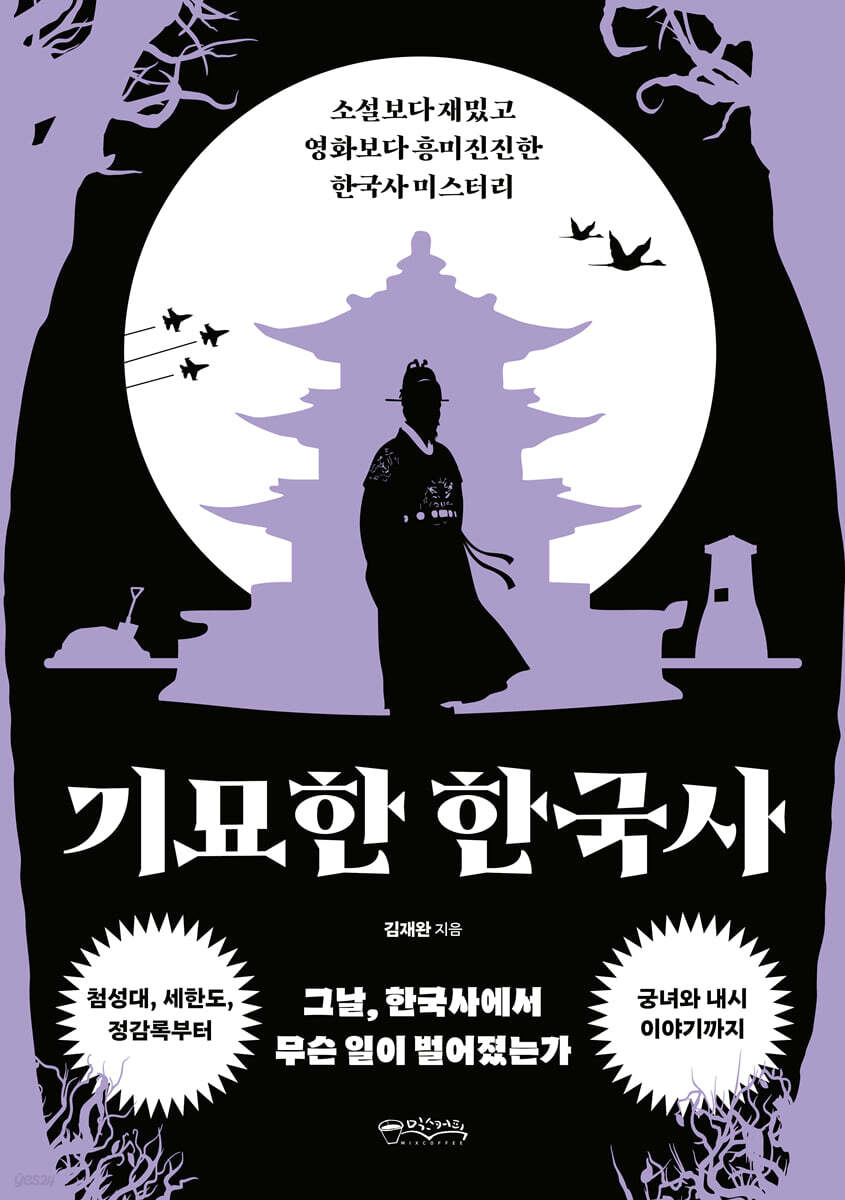
Strange Korean History
 |
Description
Book Introduction
What happened in Korean history that day!
A mystery Korean history more interesting than a novel and more exciting than a movie.
★ Popular serials from <Ttangji Ilbo> and <OhmyNews> ★
★ 'ch B tv News' [History Storytelling] Exclusive Panel ★
★ Trusted and Observed Historical Storyteller, Publication Requests Flood ★
It is said that history provides important wisdom and insight not only for remembering the past, but also for understanding the present and preparing for the future.
That's why I'm saying you have to know history.
However, such normative statements tend to distance us from history.
This is because 'history' itself is difficult because it already requires a lot of information to remember, interpretation is complex, and understanding the unfamiliar world of the past is necessary.
At times like these, you should read an engaging history book.
This is a history book that allows you to approach difficult and rigid history in an interesting and vivid way.
I think 『Strange Korean History』 would be appropriate.
It deals with 'non-mainstream' stories such as bizarre incidents, peculiar characters, and strange customs, so it can be read as enjoyably as a novel or movie.
Furthermore, history can be understood in a three-dimensional and humanistic way.
That's how you can foster interest in history.
If so, one cannot help but wonder whether the bizarre story of Korean history can have contemporary value beyond mere interest and charm. The author is convinced that it does not stop at the past but connects to the present reality, the future of the time.
For example, the stories of Chusa Kim Jeong-hui's "Sehando," the Gwanggaeto Stele, the mountain pine trees of the Papyeong Yun clan and the Cheongsong Sim clan, Woo Beom-seon's son Woo Jang-chun, and General Hong Beom-do strangely continue to this day, transcending vast time and space.
Strange historical stories not only allow us to take a step further into history, but also serve as an excellent bridge between the past and the present.
A mystery Korean history more interesting than a novel and more exciting than a movie.
★ Popular serials from <Ttangji Ilbo> and <OhmyNews> ★
★ 'ch B tv News' [History Storytelling] Exclusive Panel ★
★ Trusted and Observed Historical Storyteller, Publication Requests Flood ★
It is said that history provides important wisdom and insight not only for remembering the past, but also for understanding the present and preparing for the future.
That's why I'm saying you have to know history.
However, such normative statements tend to distance us from history.
This is because 'history' itself is difficult because it already requires a lot of information to remember, interpretation is complex, and understanding the unfamiliar world of the past is necessary.
At times like these, you should read an engaging history book.
This is a history book that allows you to approach difficult and rigid history in an interesting and vivid way.
I think 『Strange Korean History』 would be appropriate.
It deals with 'non-mainstream' stories such as bizarre incidents, peculiar characters, and strange customs, so it can be read as enjoyably as a novel or movie.
Furthermore, history can be understood in a three-dimensional and humanistic way.
That's how you can foster interest in history.
If so, one cannot help but wonder whether the bizarre story of Korean history can have contemporary value beyond mere interest and charm. The author is convinced that it does not stop at the past but connects to the present reality, the future of the time.
For example, the stories of Chusa Kim Jeong-hui's "Sehando," the Gwanggaeto Stele, the mountain pine trees of the Papyeong Yun clan and the Cheongsong Sim clan, Woo Beom-seon's son Woo Jang-chun, and General Hong Beom-do strangely continue to this day, transcending vast time and space.
Strange historical stories not only allow us to take a step further into history, but also serve as an excellent bridge between the past and the present.
- You can preview some of the book's contents.
Preview
index
Entering_
I hope you enjoy the process of learning about history.
Chapter 1: Mysteries Hidden Throughout Korean History
Sehando's Bizarre Journey Through Korean History
Why Jeonggamnok was an absolutely forbidden book in the Joseon Dynasty
Queen Seondeok's secret code hidden in Cheomseongdae
What happened to the Gwanggaeto Stele?
Chapter 2: The Story of the Tomb that Runs Through Joseon History
The 400-year-old pine tree of the Papyeong Yun clan and the Cheongsong Sim clan
The full story of the graveyard fight that led to murder
The curse passed down through generations from King Sejong's tomb
Chapter 3: On the Unfinished Independence Movement
The conflicting paths of two fathers in the unfortunate history of Korea and Japan
Our independence movement is not over yet.
From a hunter to a general, a fiery life
Chapter 4: The Truth Behind a Conspiracy Theory That Spans 1,500 Years
The unsolved mystery: the poisoning theory of King Gyeongjong
The Story of Jeong Yeo-rip, Korea's First Republican
Was Wang Geon's Ten Commandments Really Forged?
Was Tang General Su Dingfang Poisoned by Kim Yu-sin?
Chapter 5: The Amazing Lives of People with Various Occupations
The veiled private lives of Joseon court ladies
Men of the Joseon Dynasty who had families and commuted to work
It is said that Danwon Kim Hong-do was King Jeongjo's third son.
The Surprising Occupation of Joseon's Richest Man
The interpreter who solved the 200-year-old problem of Jonggye Byeonmu
A world of lowly status, called the king of the sea
I hope you enjoy the process of learning about history.
Chapter 1: Mysteries Hidden Throughout Korean History
Sehando's Bizarre Journey Through Korean History
Why Jeonggamnok was an absolutely forbidden book in the Joseon Dynasty
Queen Seondeok's secret code hidden in Cheomseongdae
What happened to the Gwanggaeto Stele?
Chapter 2: The Story of the Tomb that Runs Through Joseon History
The 400-year-old pine tree of the Papyeong Yun clan and the Cheongsong Sim clan
The full story of the graveyard fight that led to murder
The curse passed down through generations from King Sejong's tomb
Chapter 3: On the Unfinished Independence Movement
The conflicting paths of two fathers in the unfortunate history of Korea and Japan
Our independence movement is not over yet.
From a hunter to a general, a fiery life
Chapter 4: The Truth Behind a Conspiracy Theory That Spans 1,500 Years
The unsolved mystery: the poisoning theory of King Gyeongjong
The Story of Jeong Yeo-rip, Korea's First Republican
Was Wang Geon's Ten Commandments Really Forged?
Was Tang General Su Dingfang Poisoned by Kim Yu-sin?
Chapter 5: The Amazing Lives of People with Various Occupations
The veiled private lives of Joseon court ladies
Men of the Joseon Dynasty who had families and commuted to work
It is said that Danwon Kim Hong-do was King Jeongjo's third son.
The Surprising Occupation of Joseon's Richest Man
The interpreter who solved the 200-year-old problem of Jonggye Byeonmu
A world of lowly status, called the king of the sea
Detailed image

Into the book
In 1944, Son Jae-hyeong, Joseon's greatest calligrapher and then 42 years old, decided to find Chusa Kim Jeong-hui's "Sehando."
Son Jae-hyeong is credited with coining the term “calligraphy” and was a man who had such a fondness for our cultural heritage that he even owned Jeong Seon’s “Inwangjesaekdo.”
'It makes no sense that Master Chusa's "Sehando" is in Japan.
I will do whatever it takes to bring back the “Sehando.” Son Jae-hyung, who had gone to Japan, stayed near Fujitsuka’s house and visited his house frequently.
“As much money as you want! I’ll give you whatever you want.
“Please give me back at least the Sehando.” Fujitsuka vehemently rejected Son Jae-hyung’s proposal.
However, as he saw the passion and sincerity he had for Chusa in his youth in Son Jae-hyung, who sought him out every day, his heart began to open.
--- p.21
If you were to name the three most beloved historical figures among Koreans, you would probably name King Gwanggaeto the Great, along with Admiral Yi Sun-sin and King Sejong the Great.
However, not many people know that the Gwanggaeto Stele, the pride of our people, was designated as a UNESCO World Heritage Site by China in 2004 and is used as data to support the Imna Nihonfu theory, which states that Japan ruled Silla and Baekje around the 4th century.
The king who built the largest territory of our people is about to rise from his grave.
What on earth happened to the Gwanggaeto Stele?
--- p.47
The incident began with the disappearance of the tomb of General Yun Gwan, a prime minister and famous general during the Goryeo Dynasty.
General Yun Gwan is a historical figure who created the Byeolmuban to subdue the Jurchen and developed the nine provinces of the northeast.
During the reign of King Yeongjo of Joseon, the Yun family was desperate to find the lost tomb of their ancestor, General Yun Gwan.
“It is a shame for our family that we do not even know where the tomb of General Yun Gwan (died 1111), who represents our family, is located.
“We must find the general’s grave and raise the family’s honor.”
--- p.63
The new king's first exercise of his power was also over the tomb.
The new king (Yejong) carried out the burial of his grandfather, King Sejong.
It was the wish of the dead king, the instinct of the eldest son to protect the royal family, and the first step to let his subjects know that he was king.
It was the moment when the moving of the graves of the dead became the politics of the living.
The king ordered his official, An Hyo-rye, to search the 100-ri area around Hanyang to find a new tomb for his grandfather.
An Hyo-rye was one of the best geomancers of the Joseon Dynasty, having served as a geomancer during the reigns of six kings, from Sejong to Seongjong.
As he was deeply involved in the selection of King Sejo's tomb, it was natural that he would also participate in the selection of King Sejong's tomb.
--- p.98
The sailor said goodbye to his wife and young son and left home with an excited heart, saying that he would have a drink at his brother's house from Joseon for the first time in a long time.
The sailor quickly became drunk after drinking with a good person who spoke the same language.
As I got drunk, the events of that day came back to me.
I asked Younggeun out of curiosity about his thoughts.
Yunmyeong showed his anger, and Yeonggeun couldn't hide his emotions either.
Sensing the anger of his opponent, Beomseon drank cold water repeatedly to sober up.
When I concentrated, every coincidence felt like inevitability.
He blamed himself for his foolishness and pity.
The moment of death, which I had always been wary of, was shorter than expected.
It was too late to do anything, and I was intoxicated with relief.
--- p.121
In January 1949, Choi Rin was arrested.
As he entered the special courtroom, the room was in an uproar.
“How did that guy end up here?” “People who fight and win by any means necessary are prone to change their minds when they decide they have no chance of winning!” “Even so, that’s true! Isn’t that guy one of the 33?” Behind the courtroom where pro-Japanese Choi Rin had entered, there was a “Declaration of Independence” hanging, and the names of the 33 people, including Choi Rin, were clearly written on it.
Choi Rin was almost the only one of the pro-Japanese collaborators who were summoned one after another, including Park Heung-sik, to admit his guilt.
“Don’t waste time judging me here. Take me to Gwanghwamun intersection and kill me by tearing my limbs apart with four bulls.”
--- p.138
The royal physician had no choice but to bend his will in the face of the king's harsh orders.
When King Gyeongjong's eyes became calm and his nose became warm after eating ginseng and buja, and he showed signs of recovery, Prince Yeoning said.
“Look! Although I don’t know much about medicine, I know that ginseng is especially effective for those who have lost their energy.” The next morning at 3:00, King Gyeongjong died the day after taking ginseng, despite the royal physician’s objections, five days after eating dried persimmons and pickled crab.
Was it a clever poisoning, an accident caused by ignorance, or was it a fate given to King Gyeongjong regardless of the crab or ginseng?
From the year he ascended to the throne, Yeongjo was plagued by numerous rumors, including being accused of being behind the poisoning of King Gyeongjong.
--- p.178
The bloody wind of the Gichuk Oksa that had continued for three years finally stopped, but the smell of blood did not easily disappear.
And the ancestors issue an order that breaks everyone's expectations regarding the victims of the Gichuk Oksa.
Starting with the posthumous promotion of Choi Yeong-gyeong, who had been driven out by Gilsambong, to the position of Chief Inspector General of the Office of the Inspector General, most of the victims, except Jeong Yeo-rip, were restored to their original status.
As a result of the Gichuk Oksa incident, the government passed from the Dong-in to the Seo-in, and the king restored the honor of the deceased, but only Jeong Cheol, the last of the ancestors, was recorded in the Annals as a cruel and evil person.
--- p.194
The number of court ladies may have varied from period to period, but we can roughly estimate the number of court ladies in the Joseon Dynasty. We can confirm that the 3,000 court ladies of Baekje, which was smaller than Joseon, is closer to a legend.
Many professional court ladies were forced to live their entire lives as potential wives of the king, and could only leave the palace when they were dead or about to die.
They cried over the tragedy of the times, but the palace was also a place where people lived, so various life stories unfolded for them as well.
--- p.216
King Seonjo praised nineteen of the envoys who resolved the Jonggye Byeonmu issue, and Hong Sun-eon was recognized as the second most meritorious person, ahead of Jeong Cheol and Ryu Seung-ryong.
And he was appointed as the second-rank Urimwijang, a position that no commoner could attain.
Even just bestowing an official position was met with strong opposition from the nobility, but King Seonjo went one step further and even bestowed the military title of Dangneung-gun on Hong Sun-eon.
It was the highest honor a subject could receive.
When our ancestors said, “The country has been reborn,” they were not exaggerating, but sincere.
Son Jae-hyeong is credited with coining the term “calligraphy” and was a man who had such a fondness for our cultural heritage that he even owned Jeong Seon’s “Inwangjesaekdo.”
'It makes no sense that Master Chusa's "Sehando" is in Japan.
I will do whatever it takes to bring back the “Sehando.” Son Jae-hyung, who had gone to Japan, stayed near Fujitsuka’s house and visited his house frequently.
“As much money as you want! I’ll give you whatever you want.
“Please give me back at least the Sehando.” Fujitsuka vehemently rejected Son Jae-hyung’s proposal.
However, as he saw the passion and sincerity he had for Chusa in his youth in Son Jae-hyung, who sought him out every day, his heart began to open.
--- p.21
If you were to name the three most beloved historical figures among Koreans, you would probably name King Gwanggaeto the Great, along with Admiral Yi Sun-sin and King Sejong the Great.
However, not many people know that the Gwanggaeto Stele, the pride of our people, was designated as a UNESCO World Heritage Site by China in 2004 and is used as data to support the Imna Nihonfu theory, which states that Japan ruled Silla and Baekje around the 4th century.
The king who built the largest territory of our people is about to rise from his grave.
What on earth happened to the Gwanggaeto Stele?
--- p.47
The incident began with the disappearance of the tomb of General Yun Gwan, a prime minister and famous general during the Goryeo Dynasty.
General Yun Gwan is a historical figure who created the Byeolmuban to subdue the Jurchen and developed the nine provinces of the northeast.
During the reign of King Yeongjo of Joseon, the Yun family was desperate to find the lost tomb of their ancestor, General Yun Gwan.
“It is a shame for our family that we do not even know where the tomb of General Yun Gwan (died 1111), who represents our family, is located.
“We must find the general’s grave and raise the family’s honor.”
--- p.63
The new king's first exercise of his power was also over the tomb.
The new king (Yejong) carried out the burial of his grandfather, King Sejong.
It was the wish of the dead king, the instinct of the eldest son to protect the royal family, and the first step to let his subjects know that he was king.
It was the moment when the moving of the graves of the dead became the politics of the living.
The king ordered his official, An Hyo-rye, to search the 100-ri area around Hanyang to find a new tomb for his grandfather.
An Hyo-rye was one of the best geomancers of the Joseon Dynasty, having served as a geomancer during the reigns of six kings, from Sejong to Seongjong.
As he was deeply involved in the selection of King Sejo's tomb, it was natural that he would also participate in the selection of King Sejong's tomb.
--- p.98
The sailor said goodbye to his wife and young son and left home with an excited heart, saying that he would have a drink at his brother's house from Joseon for the first time in a long time.
The sailor quickly became drunk after drinking with a good person who spoke the same language.
As I got drunk, the events of that day came back to me.
I asked Younggeun out of curiosity about his thoughts.
Yunmyeong showed his anger, and Yeonggeun couldn't hide his emotions either.
Sensing the anger of his opponent, Beomseon drank cold water repeatedly to sober up.
When I concentrated, every coincidence felt like inevitability.
He blamed himself for his foolishness and pity.
The moment of death, which I had always been wary of, was shorter than expected.
It was too late to do anything, and I was intoxicated with relief.
--- p.121
In January 1949, Choi Rin was arrested.
As he entered the special courtroom, the room was in an uproar.
“How did that guy end up here?” “People who fight and win by any means necessary are prone to change their minds when they decide they have no chance of winning!” “Even so, that’s true! Isn’t that guy one of the 33?” Behind the courtroom where pro-Japanese Choi Rin had entered, there was a “Declaration of Independence” hanging, and the names of the 33 people, including Choi Rin, were clearly written on it.
Choi Rin was almost the only one of the pro-Japanese collaborators who were summoned one after another, including Park Heung-sik, to admit his guilt.
“Don’t waste time judging me here. Take me to Gwanghwamun intersection and kill me by tearing my limbs apart with four bulls.”
--- p.138
The royal physician had no choice but to bend his will in the face of the king's harsh orders.
When King Gyeongjong's eyes became calm and his nose became warm after eating ginseng and buja, and he showed signs of recovery, Prince Yeoning said.
“Look! Although I don’t know much about medicine, I know that ginseng is especially effective for those who have lost their energy.” The next morning at 3:00, King Gyeongjong died the day after taking ginseng, despite the royal physician’s objections, five days after eating dried persimmons and pickled crab.
Was it a clever poisoning, an accident caused by ignorance, or was it a fate given to King Gyeongjong regardless of the crab or ginseng?
From the year he ascended to the throne, Yeongjo was plagued by numerous rumors, including being accused of being behind the poisoning of King Gyeongjong.
--- p.178
The bloody wind of the Gichuk Oksa that had continued for three years finally stopped, but the smell of blood did not easily disappear.
And the ancestors issue an order that breaks everyone's expectations regarding the victims of the Gichuk Oksa.
Starting with the posthumous promotion of Choi Yeong-gyeong, who had been driven out by Gilsambong, to the position of Chief Inspector General of the Office of the Inspector General, most of the victims, except Jeong Yeo-rip, were restored to their original status.
As a result of the Gichuk Oksa incident, the government passed from the Dong-in to the Seo-in, and the king restored the honor of the deceased, but only Jeong Cheol, the last of the ancestors, was recorded in the Annals as a cruel and evil person.
--- p.194
The number of court ladies may have varied from period to period, but we can roughly estimate the number of court ladies in the Joseon Dynasty. We can confirm that the 3,000 court ladies of Baekje, which was smaller than Joseon, is closer to a legend.
Many professional court ladies were forced to live their entire lives as potential wives of the king, and could only leave the palace when they were dead or about to die.
They cried over the tragedy of the times, but the palace was also a place where people lived, so various life stories unfolded for them as well.
--- p.216
King Seonjo praised nineteen of the envoys who resolved the Jonggye Byeonmu issue, and Hong Sun-eon was recognized as the second most meritorious person, ahead of Jeong Cheol and Ryu Seung-ryong.
And he was appointed as the second-rank Urimwijang, a position that no commoner could attain.
Even just bestowing an official position was met with strong opposition from the nobility, but King Seonjo went one step further and even bestowed the military title of Dangneung-gun on Hong Sun-eon.
It was the highest honor a subject could receive.
When our ancestors said, “The country has been reborn,” they were not exaggerating, but sincere.
--- p.281
Publisher's Review
Why did Sehando Island change hands 10 times?
How Jeonggamnok shook Joseon
Chusa Kim Jeong-hui's masterpiece, "Sehando," is famous not only for its outstanding painting skills but also for its enormous size of 14 meters. It is also famous for its strange journey through Korea, China, and Japan to reach the present day.
Kim Jeong-hui gave it to his disciple, Lee Sang-jeok, and after his death, it passed from his disciple to the Min family, and then came into the hands of Fujitsuka Chikashi of Japan.
It then went to the Korean calligrapher Son Jae-hyung, and was later acquired by Son Se-gi, a wealthy man from Gaeseong.
After his death, his son, Son Chang-geun, kept it in his possession until he donated it to the National Museum of Korea in 2020, ending its journey.
The key phrase in the forbidden book 『Jeonggamnok』, which was passed down among the people throughout the Joseon Dynasty and was officially mentioned during the reign of King Yeongjo, is “The true man Jeong Do-ryeong will appear, destroy Joseon, and establish a new country.”
The name 'Jeong' was also the surname of figures who were taboo in the Joseon Dynasty, such as Jeong Mong-ju, Jeong Do-jeon, and Jeong Yeo-rip, and its mere existence was enough to shake Joseon to its core.
Palms sweaty
Strange Moments in Korean History
This book consists of a total of five chapters.
Chapter 1 covers the mysteries hidden throughout Korean history, including Chusa Kim Jeong-hui's peerless masterpiece "Sehando," the Joseon royal family's absolutely forbidden book "Jeonggamnok," Queen Seondeok's Cheomseongdae, and the Gwanggaeto Stele.
Chapter 2 tells the story of tombs that runs through Joseon history, including the 400-year-old dispute over a grave between the Papyeong Yun clan and the Cheongsong Sim clan that led to murder, and the curse of King Sejong's tomb.
Chapter 3 provides examples of the independence movement that is still ongoing, including the stories of Woo Beom-seon and Woo Jang-chun, the activities of the Special Committee for the Investigation of Anti-National Activities, and the story of Hong Beom-do, who went from being a hunter to a general.
Chapter 4 delves into the truth of key conspiracy theories that permeate Korean history, such as the King Gyeongjong poisoning theory that seems like it will never be solved, Jeong Yeo-rip, the first republican in Korean history, the 8th article of Wang Geon's Ten Articles of Instruction, and General Kim Yu-sin, who is said to have killed Tang general So Jeong-bang.
Chapter 5 examines the astonishing lives of people from various professions, including court ladies and eunuchs of Joseon, a painter who was said to be the king's second wife, an interpreter who was said to be the richest man in Joseon and a diplomatic problem solver, and a Silla businessman who rose from humble origins to become a world-renowned figure.
These are truly bizarre moments in Korean history that will have you on the edge of your seat.
What on earth happened that day in Korean history? This book delves into the mysteries, enigmas, and conspiracy theories hidden throughout Korean history.
How Jeonggamnok shook Joseon
Chusa Kim Jeong-hui's masterpiece, "Sehando," is famous not only for its outstanding painting skills but also for its enormous size of 14 meters. It is also famous for its strange journey through Korea, China, and Japan to reach the present day.
Kim Jeong-hui gave it to his disciple, Lee Sang-jeok, and after his death, it passed from his disciple to the Min family, and then came into the hands of Fujitsuka Chikashi of Japan.
It then went to the Korean calligrapher Son Jae-hyung, and was later acquired by Son Se-gi, a wealthy man from Gaeseong.
After his death, his son, Son Chang-geun, kept it in his possession until he donated it to the National Museum of Korea in 2020, ending its journey.
The key phrase in the forbidden book 『Jeonggamnok』, which was passed down among the people throughout the Joseon Dynasty and was officially mentioned during the reign of King Yeongjo, is “The true man Jeong Do-ryeong will appear, destroy Joseon, and establish a new country.”
The name 'Jeong' was also the surname of figures who were taboo in the Joseon Dynasty, such as Jeong Mong-ju, Jeong Do-jeon, and Jeong Yeo-rip, and its mere existence was enough to shake Joseon to its core.
Palms sweaty
Strange Moments in Korean History
This book consists of a total of five chapters.
Chapter 1 covers the mysteries hidden throughout Korean history, including Chusa Kim Jeong-hui's peerless masterpiece "Sehando," the Joseon royal family's absolutely forbidden book "Jeonggamnok," Queen Seondeok's Cheomseongdae, and the Gwanggaeto Stele.
Chapter 2 tells the story of tombs that runs through Joseon history, including the 400-year-old dispute over a grave between the Papyeong Yun clan and the Cheongsong Sim clan that led to murder, and the curse of King Sejong's tomb.
Chapter 3 provides examples of the independence movement that is still ongoing, including the stories of Woo Beom-seon and Woo Jang-chun, the activities of the Special Committee for the Investigation of Anti-National Activities, and the story of Hong Beom-do, who went from being a hunter to a general.
Chapter 4 delves into the truth of key conspiracy theories that permeate Korean history, such as the King Gyeongjong poisoning theory that seems like it will never be solved, Jeong Yeo-rip, the first republican in Korean history, the 8th article of Wang Geon's Ten Articles of Instruction, and General Kim Yu-sin, who is said to have killed Tang general So Jeong-bang.
Chapter 5 examines the astonishing lives of people from various professions, including court ladies and eunuchs of Joseon, a painter who was said to be the king's second wife, an interpreter who was said to be the richest man in Joseon and a diplomatic problem solver, and a Silla businessman who rose from humble origins to become a world-renowned figure.
These are truly bizarre moments in Korean history that will have you on the edge of your seat.
What on earth happened that day in Korean history? This book delves into the mysteries, enigmas, and conspiracy theories hidden throughout Korean history.
GOODS SPECIFICS
- Date of issue: June 10, 2025
- Page count, weight, size: 296 pages | 148*210*20mm
- ISBN13: 9791170436454
- ISBN10: 1170436455
You may also like
카테고리
korean


korean

![GQ KOREA Mark (Monthly): December [2025]](http://librairie.coreenne.fr/cdn/shop/files/8ef265dbbfbf186523ed75ba7319009d.jpg?v=1765340328&width=3840)


