

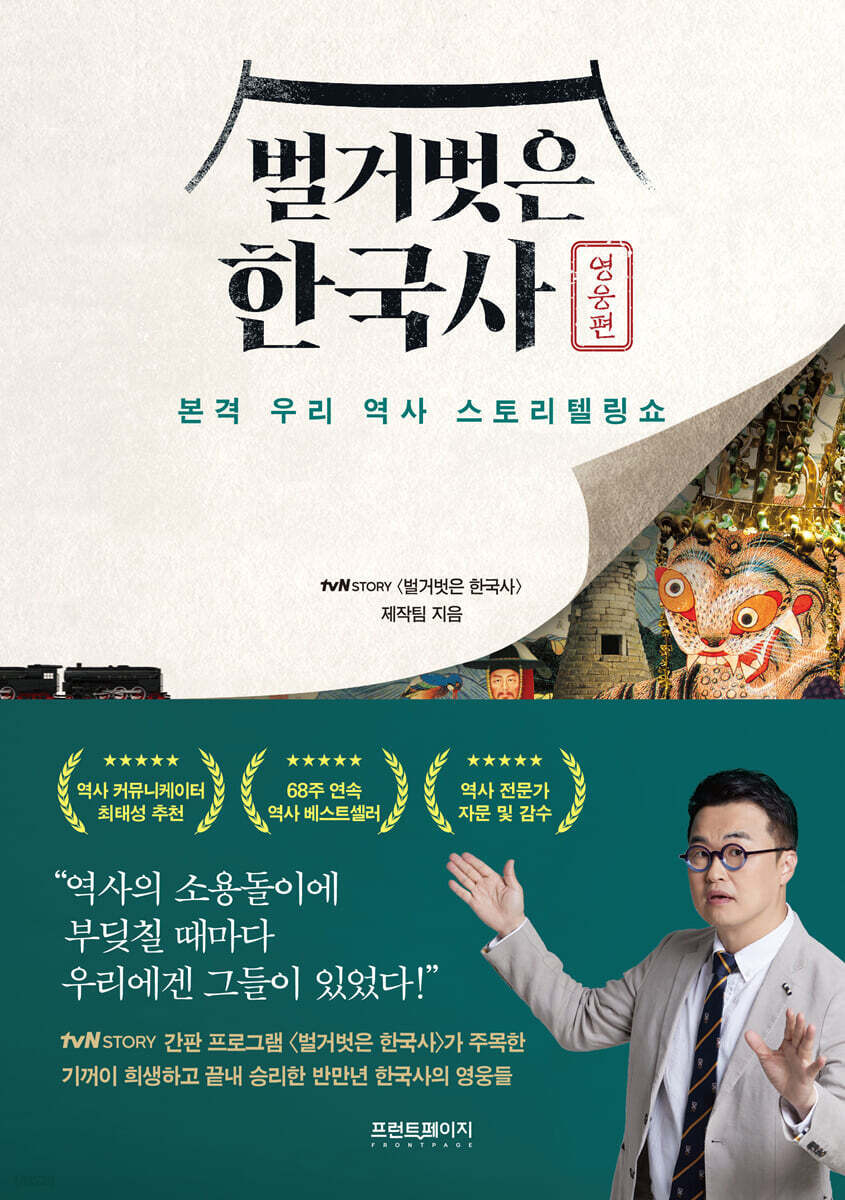
Naked Korean History: Heroes
 |
Description
Book Introduction
A history bestseller for 68 consecutive weeks! The return of the "Naked Korean History" series.
The story of the heroes who saved the Republic of Korea from adversity, a story we must know.
“Every time we hit the whirlpool of history, we had them!”
"Naked Korean History: Heroes," a collection of stories about the most beloved heroes from tvN STORY's signature program "Naked Korean History," has arrived.
With each episode, "Naked Korean History," which has been praised as the most vivid and interesting history lecture, has solidified its position as a Korean history storytelling show guided by Choi Tae-seong, Korea's leading history communicator.
"Naked Korean History: Heroes" is a history textbook that delves into the backstories of the heroes of Korean history spanning 5,000 years, who saved the nation from a life-or-death crisis and helped create the Republic of Korea we know today.
It provides a three-dimensional look at the little-known stories of heroes, such as the pain of Yi Sun-sin, a human being who had to hide behind the title of great general; how Kim Man-deok, a former gisaeng, sold all her wealth to save Jeju; and how Lee Bong-chang, who wanted to become a new Japanese, ended up attempting to assassinate the Japanese emperor.
Readers can gain a broader understanding of the events and era by becoming immersed in and moved by each character's story.
The difficult and boring history of Korea will be presented in a new way as a heart-warming drama.
What the heroes in this book have in common is that they pondered what they should do for a better era, were willing to sacrifice, and ultimately achieved victory.
We can ask ourselves, "How should I live?" and find clues to life in the history that contains the choices and consequences of those who took the lead in saving themselves, others, and even their country.
In an age without proper mentors or role models, what if we met someone who could guide our lives? Perhaps we can find the answer in the stories of those who, like us today, faced uncertainty and uncertainty, yet steadfastly walked the right path.
The story of the heroes who saved the Republic of Korea from adversity, a story we must know.
“Every time we hit the whirlpool of history, we had them!”
"Naked Korean History: Heroes," a collection of stories about the most beloved heroes from tvN STORY's signature program "Naked Korean History," has arrived.
With each episode, "Naked Korean History," which has been praised as the most vivid and interesting history lecture, has solidified its position as a Korean history storytelling show guided by Choi Tae-seong, Korea's leading history communicator.
"Naked Korean History: Heroes" is a history textbook that delves into the backstories of the heroes of Korean history spanning 5,000 years, who saved the nation from a life-or-death crisis and helped create the Republic of Korea we know today.
It provides a three-dimensional look at the little-known stories of heroes, such as the pain of Yi Sun-sin, a human being who had to hide behind the title of great general; how Kim Man-deok, a former gisaeng, sold all her wealth to save Jeju; and how Lee Bong-chang, who wanted to become a new Japanese, ended up attempting to assassinate the Japanese emperor.
Readers can gain a broader understanding of the events and era by becoming immersed in and moved by each character's story.
The difficult and boring history of Korea will be presented in a new way as a heart-warming drama.
What the heroes in this book have in common is that they pondered what they should do for a better era, were willing to sacrifice, and ultimately achieved victory.
We can ask ourselves, "How should I live?" and find clues to life in the history that contains the choices and consequences of those who took the lead in saving themselves, others, and even their country.
In an age without proper mentors or role models, what if we met someone who could guide our lives? Perhaps we can find the answer in the stories of those who, like us today, faced uncertainty and uncertainty, yet steadfastly walked the right path.
- You can preview some of the book's contents.
Preview
index
Introduction | Let's go on a special journey together.
Recommended Reading | Stories of Heroes from History That Lead to a Better Tomorrow _____ Choi Tae-seong
[Part 1] Heroes Who Overcame the Challenges of Their Times
Chapter 1: The Naked Sea King
: How did Jang Bogo, an island boy, become a trade king? _____ Im Gi-hwan
Chapter 2: The Naked Admiral Yi Sun-sin
: In 1597, why did Yi Sun-sin think about death? _____ Lee Min-woong
Chapter 3: The Naked Medal
: Why did the monk Samyeong Daesa draw his sword? _____ Kim Yong-tae
Chapter 4: The Naked Jeju Giant
: How did the parasite Kim Man-deok meet the king? _____ Noh Hye-kyung
[Part 2] Independence Heroes Who Protected the Republic of Korea
Chapter 5: The Naked Anti-Japanese Volunteer Army Leader
: Why did Ahn Jung-geun shoot Ito Hirobumi? _____ Shin Ju-baek
Chapter 6: The Naked Commander-in-Chief
: Why did hunter Hong Beom-do's gun point at the Japanese army? _____ Shin Ju-baek
Chapter 7: The Naked Young Independence Fighter
: How did Korean Lee Bong-chang throw a bomb at the Japanese emperor? _____ Conditions
Chapter 8: The Naked National Businessman
How did Bukchon, Seoul's representative landmark, come into being? _____ Yeom Bok-gyu
Recommended Reading | Stories of Heroes from History That Lead to a Better Tomorrow _____ Choi Tae-seong
[Part 1] Heroes Who Overcame the Challenges of Their Times
Chapter 1: The Naked Sea King
: How did Jang Bogo, an island boy, become a trade king? _____ Im Gi-hwan
Chapter 2: The Naked Admiral Yi Sun-sin
: In 1597, why did Yi Sun-sin think about death? _____ Lee Min-woong
Chapter 3: The Naked Medal
: Why did the monk Samyeong Daesa draw his sword? _____ Kim Yong-tae
Chapter 4: The Naked Jeju Giant
: How did the parasite Kim Man-deok meet the king? _____ Noh Hye-kyung
[Part 2] Independence Heroes Who Protected the Republic of Korea
Chapter 5: The Naked Anti-Japanese Volunteer Army Leader
: Why did Ahn Jung-geun shoot Ito Hirobumi? _____ Shin Ju-baek
Chapter 6: The Naked Commander-in-Chief
: Why did hunter Hong Beom-do's gun point at the Japanese army? _____ Shin Ju-baek
Chapter 7: The Naked Young Independence Fighter
: How did Korean Lee Bong-chang throw a bomb at the Japanese emperor? _____ Conditions
Chapter 8: The Naked National Businessman
How did Bukchon, Seoul's representative landmark, come into being? _____ Yeom Bok-gyu
Detailed image

Into the book
But 1597 was also a year of cinematic moments of triumph.
There was the Battle of Myeongnyang, which broke the momentum of the Japanese army and brought victory to Joseon.
Admiral Yi Sun-sin commanded the Joseon army in the Battle of Myeongnyang and achieved a victory that is unprecedented in history.
During the greatest war in Joseon, Joseon's seas were safe because of Admiral Yi Sun-sin.
However, for Admiral Yi Sun-sin personally, 1597 was a difficult year, with a series of painful events that made him contemplate death.
The reason why Admiral Yi Sun-sin was taken to the Uigeumbu was, surprisingly, because he disobeyed the king's orders.
At that time, King Seonjo of Joseon issued an imperial order to send Yi Sun-sin to the Uigeumbu, claiming that he had not listened to his orders to go out to sea and fight.
What on earth happened? What happened to Yi Sun-sin, the great hero who was considered undefeated?
--- p.52, from “Chapter 2: The Naked Admiral Yi Sun-sin _ 1597, Why Did Yi Sun-sin Think About Death?”
'How can I just sit back and watch when times are difficult and dangerous?'
The missionary thought that it was a greater sin to turn a blind eye to the people falling to the swords of the Japanese army right before his eyes than to break the Buddhist precepts.
So, in order to save the lives of the Joseon people, he decides to take up arms against the brutal Japanese army.
The ambassador hurriedly gathered troops, but the number of soldiers gathered was only about 200.
They were called the Righteous Monk Army, and the word 'Seung' in the middle means 'Monk', showing what kind of army they were just from their name.
The Righteous Army was also called the Righteous Army, which means it was not a typical volunteer army or volunteer army, but an army raised by monks to save the country.
The fact that monks across the country spontaneously rose up to protect the country was an extraordinary event, unprecedented not only in Joseon history but also in East Asian history.
--- p.101~102, from “Chapter 3: The Naked Monk _ Why Did Monk Samyeong Daesa Draw His Sword?”
Kim Man-deok, who was having a hard time doing business during the famine, also heard this sad news.
Then, Kim Man-deok makes a huge decision.
He decided to use his own money to set sail on a ship and bring grain directly from the mainland.
However, since there was no guarantee that the ship sent by Kim Man-deok would return safely, buying rice from the mainland was a huge risk that could lead to the loss of both money and rice.
Nevertheless, Kim Man-deok put all her savings, accumulated over 30 years of business, into saving her hometown of Jeju Island.
It was a decision that could be made because he felt that saving Jeju Island was more urgent than protecting his own property.
--- p.147, from “Chapter 4: The Naked Jeju Merchant _ How did the Gisaeng Kim Man-deok meet the King”
An Jung-geun's "Theory of Peace in the East" did not only contain the interests of the Korean Empire or anger toward Japan.
The method of peace in the East that Ahn Jung-geun proposed was a community spirit in which the three countries worked together on equal footing.
The argument that each country should cooperate with the other to create regional order while recognizing the equality of sovereignty remains a valid proposal even today.
This is all the more significant at this point in time, when the order in East Asia is rapidly being reorganized as the power struggle between the United States and China intensifies while Japan's historical distortions remain unresolved.
--- p.194~195, from “Chapter 5: The Naked Anti-Japanese Volunteer Army Leader: Why Did Ahn Jung-geun Shoot Ito Hirobumi?”
When the Righteous Army rose up, Japan enacted the 'Firearms and Gunpowder Control Act' and confiscated guns and ammunition held by Koreans and punished those who refused to give them to them.
Taking a gun away from a hunter was like taking a pickaxe away from a farmer.
For hunter Hong Beom-do, having his gun confiscated was a threat to his livelihood.
Now, Japan was an 'enemy' to Hong Beom-do that threatened his family's livelihood.
Hunter Hong Beom-do, would you have just handed over your gun? An angry Hong Beom-do said this:
“Rather than starve to death with our guns taken away, let’s fight them!”
They decided to attack the Japanese forces in the Bukcheong area before their guns were confiscated.
Hong Beom-do persuaded his fellow hunters and organized the Mountain Hunters' Volunteer Corps, gathering about 70 people to join him.
This is the moment when the guns that were aimed at the tiger were turned towards the Japanese army.
--- p.216~217, from “Chapter 6 The Naked Commander-in-Chief _ Why was the gun of the hunter Hong Beom-do pointed at the Japanese army?”
The redevelopment of Hanok Village, which began in 1933 at 33 Gahoe-dong, continued until the early 1940s, with the addition of 31 Gahoe-dong in 1936.
Jeong Se-gwon protected the land of Joseon from the control of the Japanese and pro-Japanese collaborators and built an urban hanok complex on 130 residential lots.
Just like Ikseon-dong, many Koreans settled in Bukchon.
This is Bukchon Hanok Village, a place loved by people from all over the world who visit Korea.
Not many people know that the large-scale redevelopment project of Jeong Se-kwon 90 years ago created the current Hanok Village.
If Jeong Se-kwon had not purchased the land in Bukchon and built urban hanok there, wouldn't there be Japanese-style and Western-style houses lined up in the same spot today?
There was the Battle of Myeongnyang, which broke the momentum of the Japanese army and brought victory to Joseon.
Admiral Yi Sun-sin commanded the Joseon army in the Battle of Myeongnyang and achieved a victory that is unprecedented in history.
During the greatest war in Joseon, Joseon's seas were safe because of Admiral Yi Sun-sin.
However, for Admiral Yi Sun-sin personally, 1597 was a difficult year, with a series of painful events that made him contemplate death.
The reason why Admiral Yi Sun-sin was taken to the Uigeumbu was, surprisingly, because he disobeyed the king's orders.
At that time, King Seonjo of Joseon issued an imperial order to send Yi Sun-sin to the Uigeumbu, claiming that he had not listened to his orders to go out to sea and fight.
What on earth happened? What happened to Yi Sun-sin, the great hero who was considered undefeated?
--- p.52, from “Chapter 2: The Naked Admiral Yi Sun-sin _ 1597, Why Did Yi Sun-sin Think About Death?”
'How can I just sit back and watch when times are difficult and dangerous?'
The missionary thought that it was a greater sin to turn a blind eye to the people falling to the swords of the Japanese army right before his eyes than to break the Buddhist precepts.
So, in order to save the lives of the Joseon people, he decides to take up arms against the brutal Japanese army.
The ambassador hurriedly gathered troops, but the number of soldiers gathered was only about 200.
They were called the Righteous Monk Army, and the word 'Seung' in the middle means 'Monk', showing what kind of army they were just from their name.
The Righteous Army was also called the Righteous Army, which means it was not a typical volunteer army or volunteer army, but an army raised by monks to save the country.
The fact that monks across the country spontaneously rose up to protect the country was an extraordinary event, unprecedented not only in Joseon history but also in East Asian history.
--- p.101~102, from “Chapter 3: The Naked Monk _ Why Did Monk Samyeong Daesa Draw His Sword?”
Kim Man-deok, who was having a hard time doing business during the famine, also heard this sad news.
Then, Kim Man-deok makes a huge decision.
He decided to use his own money to set sail on a ship and bring grain directly from the mainland.
However, since there was no guarantee that the ship sent by Kim Man-deok would return safely, buying rice from the mainland was a huge risk that could lead to the loss of both money and rice.
Nevertheless, Kim Man-deok put all her savings, accumulated over 30 years of business, into saving her hometown of Jeju Island.
It was a decision that could be made because he felt that saving Jeju Island was more urgent than protecting his own property.
--- p.147, from “Chapter 4: The Naked Jeju Merchant _ How did the Gisaeng Kim Man-deok meet the King”
An Jung-geun's "Theory of Peace in the East" did not only contain the interests of the Korean Empire or anger toward Japan.
The method of peace in the East that Ahn Jung-geun proposed was a community spirit in which the three countries worked together on equal footing.
The argument that each country should cooperate with the other to create regional order while recognizing the equality of sovereignty remains a valid proposal even today.
This is all the more significant at this point in time, when the order in East Asia is rapidly being reorganized as the power struggle between the United States and China intensifies while Japan's historical distortions remain unresolved.
--- p.194~195, from “Chapter 5: The Naked Anti-Japanese Volunteer Army Leader: Why Did Ahn Jung-geun Shoot Ito Hirobumi?”
When the Righteous Army rose up, Japan enacted the 'Firearms and Gunpowder Control Act' and confiscated guns and ammunition held by Koreans and punished those who refused to give them to them.
Taking a gun away from a hunter was like taking a pickaxe away from a farmer.
For hunter Hong Beom-do, having his gun confiscated was a threat to his livelihood.
Now, Japan was an 'enemy' to Hong Beom-do that threatened his family's livelihood.
Hunter Hong Beom-do, would you have just handed over your gun? An angry Hong Beom-do said this:
“Rather than starve to death with our guns taken away, let’s fight them!”
They decided to attack the Japanese forces in the Bukcheong area before their guns were confiscated.
Hong Beom-do persuaded his fellow hunters and organized the Mountain Hunters' Volunteer Corps, gathering about 70 people to join him.
This is the moment when the guns that were aimed at the tiger were turned towards the Japanese army.
--- p.216~217, from “Chapter 6 The Naked Commander-in-Chief _ Why was the gun of the hunter Hong Beom-do pointed at the Japanese army?”
The redevelopment of Hanok Village, which began in 1933 at 33 Gahoe-dong, continued until the early 1940s, with the addition of 31 Gahoe-dong in 1936.
Jeong Se-gwon protected the land of Joseon from the control of the Japanese and pro-Japanese collaborators and built an urban hanok complex on 130 residential lots.
Just like Ikseon-dong, many Koreans settled in Bukchon.
This is Bukchon Hanok Village, a place loved by people from all over the world who visit Korea.
Not many people know that the large-scale redevelopment project of Jeong Se-kwon 90 years ago created the current Hanok Village.
If Jeong Se-kwon had not purchased the land in Bukchon and built urban hanok there, wouldn't there be Japanese-style and Western-style houses lined up in the same spot today?
--- p.304, from “Chapter 8: Naked National Businessman _ How Bukchon, Seoul’s representative landmark, was born”
Publisher's Review
tvN STORY's signature program, "Naked Korean History," has caught the attention of
Heroes of Korean history who willingly sacrificed and ultimately won
The flow of half a millennium of history pierced by their choices and decisions
Every Korean has probably learned about our history at least once, but somehow, when faced with history, our voices become small and only fragmentary knowledge such as dates, events, and people come to mind.
This is because history was approached not as an interesting story, but as complex knowledge with a lot to memorize.
In order to gather scattered information and remember historical facts for a long time, we must pay attention to the essence of history as a 'story.'
tvN's STORY "Naked Korean History," which strips away key scenes from our history and tells interesting stories, also started from that very point.
Among the various stories covered on the show, the stories of major Korean historical heroes were collected and included in 『Naked Korean History: Heroes』.
By delving into the lives of those who protected the Republic of Korea through hardship and adversity, as well as the historical events that influenced their lives, the stories of these past figures are transformed from faded tales into key insights into how our country became firmly established as it is today.
Additionally, the rich collection of maps, photographs, and books helps readers understand Korean history in context, even without prior background knowledge.
Readers will discover a previously unknown side of Korean historical heroes, and through this discovery, they will be able to gain a three-dimensional understanding of the events that resulted from the heroes' choices and decisions.
I recommend this to anyone who wants to experience the flow of Korean history, which was previously vague, becoming clearer and more clearly organized just by following the story of a hero.
From Yi Sun-sin, who had to endure unknown sorrows even after achieving great victories one after another
Even Ahn Jung-geun, who cut off his finger after a defeated anti-Japanese battle...
The story behind how despair turned into hope unfolds!
1.
Naked Admiral Yi Sun-sin
1597 was the year in which Korea achieved a great victory in the Battle of Myeongnyang under the command of the famous general Yi Sun-sin against Japan, who had invaded Korea.
However, at the time, King Seonjo of Joseon issued an imperial order to send Yi Sun-sin to the Uigeumbu, and after that, Yi Sun-sin was punished by losing his position and assisting another commander.
When his mother passed away, Yi Sun-sin was not even able to hold a funeral because he was considered a sinner.
Why did this desperate crisis befall him, a man who had triumphed in numerous naval battles and enjoyed a steady rise in success? What hardships and trials lay beneath the surface of a life once thought to be filled with nothing but the glory of victory?
2.
Naked young independence fighter
After the Gyeongsul National Shame, which took away Korea's sovereignty from Japan, Lee Bong-chang, whose family fell into ruin, worked diligently at a Japanese store to support his family.
Then, after struggling to adapt to colonial Korea, he suddenly decides to travel to Shanghai, meet Kim Gu, the president of the provisional government, and plot to assassinate the emperor! Why did this man, who considered himself a "new Japanese," change his mind? How was it possible for him to throw a bomb at the emperor in the heart of Tokyo on that day, a day that shook all of Japan?
This book encompasses the stories of eight heroes who overcame the challenges of their time and protected the Republic of Korea, from the pain of Yi Sun-sin, a human being hidden behind the title of the greatest general of the Joseon Dynasty, to the unknown story of Ahn Jung-geun, who was born into a wealthy family and grew up to be a free-spirited hero, but ended up risking his life with the goal of assassinating Ito Hirobumi.
As we follow their turbulent lives, we are moved by their spirit of sacrifice, which constantly offered hope in the darkness, and we are led to think about and be enlightened about the wisdom of overcoming difficulties.
Choi Tae-seong, who has stepped forward as a history guide, recommended this book and said this.
“The common thread among the heroes who protected the Republic of Korea was that they were not confined to their own time, but had a dream of presenting a vision for the world their descendants would live in.” Just as they dedicated their lives to shouting for “freedom” during a time when they were forced to live a life of slavery as colonial subjects, we are on a journey to discover what historical gifts the heroes of Korea’s 5,000-year history have bestowed upon us.
Let's open the bookshelf with the expectation of hearing a story full of fun and meaning.
By learning about the proud history of heroes, you can have a valuable experience remembering and cherishing the sacrifices of those who struggled to provide a better era for future generations.
Moreover, you will spend time thinking about how to survive and persevere in the face of repeated crises.
Heroes of Korean history who willingly sacrificed and ultimately won
The flow of half a millennium of history pierced by their choices and decisions
Every Korean has probably learned about our history at least once, but somehow, when faced with history, our voices become small and only fragmentary knowledge such as dates, events, and people come to mind.
This is because history was approached not as an interesting story, but as complex knowledge with a lot to memorize.
In order to gather scattered information and remember historical facts for a long time, we must pay attention to the essence of history as a 'story.'
tvN's STORY "Naked Korean History," which strips away key scenes from our history and tells interesting stories, also started from that very point.
Among the various stories covered on the show, the stories of major Korean historical heroes were collected and included in 『Naked Korean History: Heroes』.
By delving into the lives of those who protected the Republic of Korea through hardship and adversity, as well as the historical events that influenced their lives, the stories of these past figures are transformed from faded tales into key insights into how our country became firmly established as it is today.
Additionally, the rich collection of maps, photographs, and books helps readers understand Korean history in context, even without prior background knowledge.
Readers will discover a previously unknown side of Korean historical heroes, and through this discovery, they will be able to gain a three-dimensional understanding of the events that resulted from the heroes' choices and decisions.
I recommend this to anyone who wants to experience the flow of Korean history, which was previously vague, becoming clearer and more clearly organized just by following the story of a hero.
From Yi Sun-sin, who had to endure unknown sorrows even after achieving great victories one after another
Even Ahn Jung-geun, who cut off his finger after a defeated anti-Japanese battle...
The story behind how despair turned into hope unfolds!
1.
Naked Admiral Yi Sun-sin
1597 was the year in which Korea achieved a great victory in the Battle of Myeongnyang under the command of the famous general Yi Sun-sin against Japan, who had invaded Korea.
However, at the time, King Seonjo of Joseon issued an imperial order to send Yi Sun-sin to the Uigeumbu, and after that, Yi Sun-sin was punished by losing his position and assisting another commander.
When his mother passed away, Yi Sun-sin was not even able to hold a funeral because he was considered a sinner.
Why did this desperate crisis befall him, a man who had triumphed in numerous naval battles and enjoyed a steady rise in success? What hardships and trials lay beneath the surface of a life once thought to be filled with nothing but the glory of victory?
2.
Naked young independence fighter
After the Gyeongsul National Shame, which took away Korea's sovereignty from Japan, Lee Bong-chang, whose family fell into ruin, worked diligently at a Japanese store to support his family.
Then, after struggling to adapt to colonial Korea, he suddenly decides to travel to Shanghai, meet Kim Gu, the president of the provisional government, and plot to assassinate the emperor! Why did this man, who considered himself a "new Japanese," change his mind? How was it possible for him to throw a bomb at the emperor in the heart of Tokyo on that day, a day that shook all of Japan?
This book encompasses the stories of eight heroes who overcame the challenges of their time and protected the Republic of Korea, from the pain of Yi Sun-sin, a human being hidden behind the title of the greatest general of the Joseon Dynasty, to the unknown story of Ahn Jung-geun, who was born into a wealthy family and grew up to be a free-spirited hero, but ended up risking his life with the goal of assassinating Ito Hirobumi.
As we follow their turbulent lives, we are moved by their spirit of sacrifice, which constantly offered hope in the darkness, and we are led to think about and be enlightened about the wisdom of overcoming difficulties.
Choi Tae-seong, who has stepped forward as a history guide, recommended this book and said this.
“The common thread among the heroes who protected the Republic of Korea was that they were not confined to their own time, but had a dream of presenting a vision for the world their descendants would live in.” Just as they dedicated their lives to shouting for “freedom” during a time when they were forced to live a life of slavery as colonial subjects, we are on a journey to discover what historical gifts the heroes of Korea’s 5,000-year history have bestowed upon us.
Let's open the bookshelf with the expectation of hearing a story full of fun and meaning.
By learning about the proud history of heroes, you can have a valuable experience remembering and cherishing the sacrifices of those who struggled to provide a better era for future generations.
Moreover, you will spend time thinking about how to survive and persevere in the face of repeated crises.
GOODS SPECIFICS
- Date of issue: December 4, 2023
- Page count, weight, size: 312 pages | 528g | 152*215*20mm
- ISBN13: 9791193401057
- ISBN10: 1193401054
You may also like
카테고리
korean


korean

![GQ KOREA Mark (Monthly): December [2025]](http://librairie.coreenne.fr/cdn/shop/files/8ef265dbbfbf186523ed75ba7319009d.jpg?v=1765340328&width=3840)


