

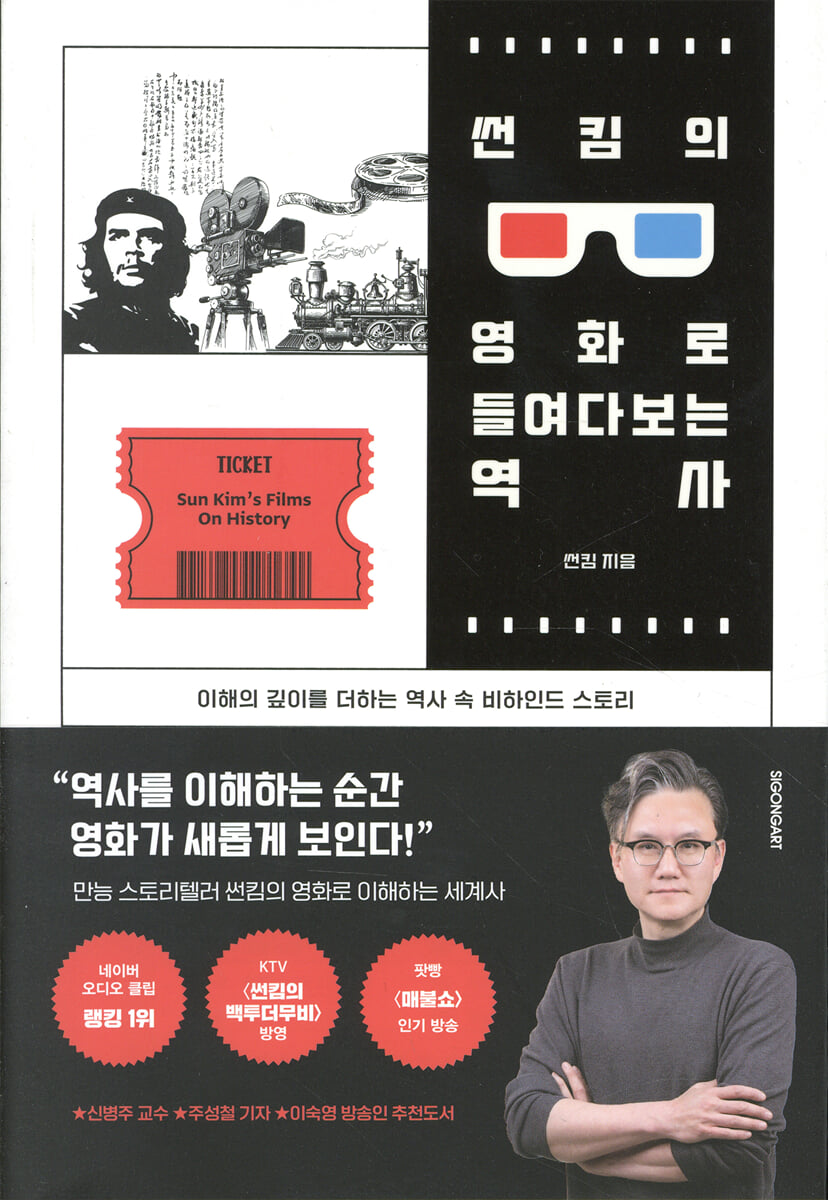
A Look into History Through Sun Kim's Films
 |
Description
Book Introduction
“Learn easily and understand deeply!”
A look into world history through the films of historical storyteller Sun Kim.
“If you watch a movie knowing the historical background,
How easily the movie can be understood,
Also, on the contrary, through the movie, the history of the time
How easily it can enter your heart
I want to show you guys.”
- Prologue -
Sun Kim, the historical storyteller chosen by countless listeners, including #1 on Naver Audio Clip Rankings and the popular Podbbang Maebul Show program [Sun Kim's Unstoppable World History].
This time he chose 'movie'.
"History Through Sun Kim's Films" is a book that makes it easy to understand the history that serves as the background for films.
We can vividly encounter the history of films familiar to us, such as the true face of King Gwanghaegun in history compared to [Gwanghae], the past and present of Hong Kong read through [Chungking Express], and the history of the French Revolution understood through [Les Misérables].
This book shows the storytelling of 'studying history through film' by embodying Sun Kim's philosophy that 'history is not memorization, but a story of people's lives.'
Sun Kim's easy-to-understand explanations and 145 rich illustrations will provide an enjoyable experience for readers who want to enjoy both film and history.
A look into world history through the films of historical storyteller Sun Kim.
“If you watch a movie knowing the historical background,
How easily the movie can be understood,
Also, on the contrary, through the movie, the history of the time
How easily it can enter your heart
I want to show you guys.”
- Prologue -
Sun Kim, the historical storyteller chosen by countless listeners, including #1 on Naver Audio Clip Rankings and the popular Podbbang Maebul Show program [Sun Kim's Unstoppable World History].
This time he chose 'movie'.
"History Through Sun Kim's Films" is a book that makes it easy to understand the history that serves as the background for films.
We can vividly encounter the history of films familiar to us, such as the true face of King Gwanghaegun in history compared to [Gwanghae], the past and present of Hong Kong read through [Chungking Express], and the history of the French Revolution understood through [Les Misérables].
This book shows the storytelling of 'studying history through film' by embodying Sun Kim's philosophy that 'history is not memorization, but a story of people's lives.'
Sun Kim's easy-to-understand explanations and 145 rich illustrations will provide an enjoyable experience for readers who want to enjoy both film and history.
- You can preview some of the book's contents.
Preview
index
prolog
Recommendation
Chapter 1 [Hero: The Beginning of a World]: The Intersection of the History of Qin Shi Huang's Unification and Modern Chinese History
Let's start from the Zhou Dynasty
King You lights a false beacon for Posa
The Spring and Autumn Period and the Warring States Period begin
The Qin Dynasty, the powerhouse of the Warring States Period, appears!
Lü Buwei makes Ying Yiren the king of Jin
Yeo Bu-wi dug his own grave
King Jin conquers neighboring countries one after another
The Jinwang Assassination Project Begins
Failed plan to assassinate the Jin King
The difference between the movie [Hero] and the truth
Chapter 2 [Roaring Currents]: Admiral Yi Sun-sin as Seen Through the Imjin War and the Battle of Myeongnyang
Why did Japan plan to invade Joseon?
Joseon underestimated Japan, underestimated it very much.
Japan launches its first continental invasion in East Asian history.
Yi Sun-sin halted the relentless advance of the Japanese army.
The Battle of Hansan, where a Japanese general barely survived by eating only seaweed
After Japan's defeat at the Battle of Hansan, everything began to go wrong.
Ming and Japanese negotiators orchestrate East Asia's largest international fraud.
The Joseon navy was brutally destroyed
Ah, the sea in front of Myeongnyang!
Chapter 3 [Queen Margot]: The Story of France's Wars of Religion
Medieval Europe was a dark age.
Why the Renaissance Began in Italy
Gutenberg's "Europe's First" Metal Type Launches the Reformation
Huguenots clash with Catholics in France
The Appearance of Princess Marguerite
Marguerite and Enrique's "Blood Wedding" Becomes the Beginning of the Massacre
Henry ascends the throne as King of France
Henry IV, who chose the unification of France
Chapter 4 [The Motorcycle Diaries]: Che Guevara's Life and Struggle for Freedom
Cuba, necessary for America's Atlantic expansion
Cuba becomes an economic colony of the United States
Guevara was born into a wealthy Argentine family.
Traveling South America on a motorcycle
A fateful meeting with Fidel Castro
The Cuban Revolution Begins
The successful Cuban revolution and the American invasion
Guevara leaving Cuba
Guevara, the star of the revolution
Chapter 5 [The Last Samurai]: Japan's Last Samurai
Samurai, who are they?
Japan signs an unequal treaty with the United States, which it forced into existence.
Samurai rise up against the humiliating sight of the shogunate
The last shogun to step down from power
Samurai being 'sold out' after the Meiji Restoration
Disappointed, Saigo leaves Tokyo
The Falling Last Samurai
Saigo Takamori and Seikanron
Chapter 6 [Gwanghae]: The True Face of Gwanghae in Joseon Dynasty History
Gwanghaegun, who became crown prince by chance during the Imjin War
The uneasy position of the crown prince
Ancestor dies suddenly
King Gwanghae kills his older brother
Gwanghaegun, who even killed the young Prince Yeongchang
Was the film's Do Seung-ji Heo Gyun (Ryu Seung-ryong) actually a great person?
King Gwanghaegun falls into ruin after falling into a shaman's trap
The relatively bright neutral diplomacy of King Gwanghaegun
Why You Should Be Careful When Adapting Historical Events into Films
Chapter 7 [Chungking Express]: Hong Kong's History and the Return of Hong Kong, told through Lovers
China doesn't care about trade with foreign countries.
Britain's awakening to tea
Britain runs into a trade deficit due to Chinese tea.
The Qing government that dispatched Lin Zexu
Britain started the war because of opium
Hong Kong becomes British territory
Hong Kong in its turbulent modern history
The heart of Hong Kong captured in film
Chapter 8 [Les Misérables]: From the French Revolution and Napoleon to "Les Misérables" 215
France began to crumble with the construction of the Palace of Versailles
Enraged citizens seize the Bastille prison
Napoleon, a hero who emerged from chaos
Napoleon ascends to the throne of France
Napoleon's downfall after the Russian expedition
The reemergence of the French kingdom
Finally, Les Misérables!
Chapter 9 [Dances with Wolves]: America's Dark History, the Story of the Genocide of Native Americans
The land that is now the United States, North America, was already inhabited by people.
America started out as a tobacco farmer.
Britain and France clashed on the North American continent
America finally becomes independent
indigenous people being driven from their lands
The transcontinental railroad was a nightmare for the native people.
The Reality of Native Americans and the Two Faces of America
Chapter 10 [Kingdom of Heaven]: "What is Religion?" Through the Eyes of the Crusades
The situation in Europe when the Crusades broke out
The Catholic Pope decides to help the Eastern Roman Empire.
Wait a minute! What kind of religion is Islam?
The First Crusade was doomed from the start.
The Crusaders finally reclaim Jerusalem.
The Crusaders broke their promise and took Jerusalem.
The Pope is furious, and another crusade begins.
What is Religion as Seen Through the Crusades?
Epilogue
Reference plate
Recommendation
Chapter 1 [Hero: The Beginning of a World]: The Intersection of the History of Qin Shi Huang's Unification and Modern Chinese History
Let's start from the Zhou Dynasty
King You lights a false beacon for Posa
The Spring and Autumn Period and the Warring States Period begin
The Qin Dynasty, the powerhouse of the Warring States Period, appears!
Lü Buwei makes Ying Yiren the king of Jin
Yeo Bu-wi dug his own grave
King Jin conquers neighboring countries one after another
The Jinwang Assassination Project Begins
Failed plan to assassinate the Jin King
The difference between the movie [Hero] and the truth
Chapter 2 [Roaring Currents]: Admiral Yi Sun-sin as Seen Through the Imjin War and the Battle of Myeongnyang
Why did Japan plan to invade Joseon?
Joseon underestimated Japan, underestimated it very much.
Japan launches its first continental invasion in East Asian history.
Yi Sun-sin halted the relentless advance of the Japanese army.
The Battle of Hansan, where a Japanese general barely survived by eating only seaweed
After Japan's defeat at the Battle of Hansan, everything began to go wrong.
Ming and Japanese negotiators orchestrate East Asia's largest international fraud.
The Joseon navy was brutally destroyed
Ah, the sea in front of Myeongnyang!
Chapter 3 [Queen Margot]: The Story of France's Wars of Religion
Medieval Europe was a dark age.
Why the Renaissance Began in Italy
Gutenberg's "Europe's First" Metal Type Launches the Reformation
Huguenots clash with Catholics in France
The Appearance of Princess Marguerite
Marguerite and Enrique's "Blood Wedding" Becomes the Beginning of the Massacre
Henry ascends the throne as King of France
Henry IV, who chose the unification of France
Chapter 4 [The Motorcycle Diaries]: Che Guevara's Life and Struggle for Freedom
Cuba, necessary for America's Atlantic expansion
Cuba becomes an economic colony of the United States
Guevara was born into a wealthy Argentine family.
Traveling South America on a motorcycle
A fateful meeting with Fidel Castro
The Cuban Revolution Begins
The successful Cuban revolution and the American invasion
Guevara leaving Cuba
Guevara, the star of the revolution
Chapter 5 [The Last Samurai]: Japan's Last Samurai
Samurai, who are they?
Japan signs an unequal treaty with the United States, which it forced into existence.
Samurai rise up against the humiliating sight of the shogunate
The last shogun to step down from power
Samurai being 'sold out' after the Meiji Restoration
Disappointed, Saigo leaves Tokyo
The Falling Last Samurai
Saigo Takamori and Seikanron
Chapter 6 [Gwanghae]: The True Face of Gwanghae in Joseon Dynasty History
Gwanghaegun, who became crown prince by chance during the Imjin War
The uneasy position of the crown prince
Ancestor dies suddenly
King Gwanghae kills his older brother
Gwanghaegun, who even killed the young Prince Yeongchang
Was the film's Do Seung-ji Heo Gyun (Ryu Seung-ryong) actually a great person?
King Gwanghaegun falls into ruin after falling into a shaman's trap
The relatively bright neutral diplomacy of King Gwanghaegun
Why You Should Be Careful When Adapting Historical Events into Films
Chapter 7 [Chungking Express]: Hong Kong's History and the Return of Hong Kong, told through Lovers
China doesn't care about trade with foreign countries.
Britain's awakening to tea
Britain runs into a trade deficit due to Chinese tea.
The Qing government that dispatched Lin Zexu
Britain started the war because of opium
Hong Kong becomes British territory
Hong Kong in its turbulent modern history
The heart of Hong Kong captured in film
Chapter 8 [Les Misérables]: From the French Revolution and Napoleon to "Les Misérables" 215
France began to crumble with the construction of the Palace of Versailles
Enraged citizens seize the Bastille prison
Napoleon, a hero who emerged from chaos
Napoleon ascends to the throne of France
Napoleon's downfall after the Russian expedition
The reemergence of the French kingdom
Finally, Les Misérables!
Chapter 9 [Dances with Wolves]: America's Dark History, the Story of the Genocide of Native Americans
The land that is now the United States, North America, was already inhabited by people.
America started out as a tobacco farmer.
Britain and France clashed on the North American continent
America finally becomes independent
indigenous people being driven from their lands
The transcontinental railroad was a nightmare for the native people.
The Reality of Native Americans and the Two Faces of America
Chapter 10 [Kingdom of Heaven]: "What is Religion?" Through the Eyes of the Crusades
The situation in Europe when the Crusades broke out
The Catholic Pope decides to help the Eastern Roman Empire.
Wait a minute! What kind of religion is Islam?
The First Crusade was doomed from the start.
The Crusaders finally reclaim Jerusalem.
The Crusaders broke their promise and took Jerusalem.
The Pope is furious, and another crusade begins.
What is Religion as Seen Through the Crusades?
Epilogue
Reference plate
Detailed image

Into the book
This book was written to show you that understanding history, the context surrounding an event, can help you understand a film more deeply.
And I wanted to show you how easy it is to understand the film if you watch it with an understanding of the historical context and background of the time.
Conversely, I would like to show you how easily the spirit of the times and history can enter your heart through film.
---From the "Prologue"
Now, I will tell you how and what special talents Qin Shi Huang had to unify the Chinese mainland, why China was torn apart and fighting each other at the time, and who specifically tried to assassinate Qin Shi Huang in real history, and whether they failed or succeeded.
---From Chapter 1 [Hero: The Beginning of the World]: The Intersection of the History of Qin Shi Huang's Unification and Modern Chinese History
Watching the movie [Roaring Currents], there are many parts where you think, “Hey, how is that possible?
You might say, “Isn’t this too nationalistic?”
But when we consider the place that Admiral Yi Sun-sin and his achievements occupy in our history, the image of Admiral Yi Sun-sin in the film is by no means an exaggeration.
---From "Chapter 2 [Roaring Currents]: Admiral Yi Sun-sin as seen through the Imjin War and the Battle of Myeongnyang"
Well, if you're interested in French history, there's one event you should pay attention to first.
Of course, Napoleon is important, and the French Revolution is important, but there is one event throughout French history that has had a profound impact on present-day France.
This is the 'Saint Bartholomew's Day Massacre' that occurred in Paris and throughout France on August 24, 1572.
It is a tragic incident in which Catholics brutally murdered Protestants.
It is the worst black history of France, with as many as 5,000 people massacred in Paris alone.
The reason this event is important is because it is a historical event that connected French history from the Middle Ages to the Renaissance, and further to the famous French Revolution.
---From "Chapter 3 [Queen Margot]: The Story of France's Wars of Religion"
The world he dreamed of, where all the oppressed are liberated and the people are the masters, a world where all people are happy, may not be realistically possible.
But Che Guevara, who sacrificed his life for that impossible goal, will forever dream of revolution in our hearts.
“Hasta la Victoria Siempre!” he cried out while he was alive, until the day of eternal victory.
---From Chapter 4 [The Motorcycle Diaries]: Che Guevara's Life and the Struggle for Freedom
Currently, there is no such class as 'samurai' or 'warrior' in Japan.
If there were, it would be funnier.
What if samurai were walking around with swords in the middle of Ginza, Tokyo?
This samurai class disappeared during the Westernization of Japan after the so-called Meiji Restoration in 1868 (which I will explain in detail shortly).
So, among the disappeared samurai, was there a 'last samurai' who was proud of being a samurai and tried to remain a samurai until the end?
---From "Chapter 5 [The Last Samurai]: Japan's Last Samurai"
Films depicting historical events require considerable care when making them.
Why? Because the general audience is more likely to accept the historical drama as a true historical fact.
And once a stereotype is formed, it is not easy to change.
The movie [Gwanghae: The Man Who Became King] is a very well-made masterpiece as an 'original story'.
However, it should not be confused with the real King Gwanghae who was driven out by the Injo Restoration.
---From "Chapter 6 [Gwanghae]: The True Appearance of Gwanghae in Joseon Dynasty History"
The movie [Chungking Express] is a movie that well depicts the feelings of Hong Kong people just before Hong Kong's return to China in 1997.
The famous line from the movie, “I wish love had no expiration date,” is a line that speaks volumes about the feelings of Hong Kong people.
Their thoughts: “I hope there is no time limit on my love for Hong Kong.”
---From Chapter 7 [Chungking Express]: Hong Kong's History and the Time of Return, Stories from Lovers
Do you know when in France Les Misérables is set? Surprisingly, many people vaguely assume it's set during the French Revolution.
Then, “The French Revolution, that painting of a woman with her breasts exposed leading the crowd.
“That picture is set against the backdrop of the French Revolution,” they say.
No, that's not true.
They are all different.
The French Revolution of 1789 is not the setting for Les Misérables.
And the painting 'A Woman with a Bared Breast Leading a Crowd' is not a painting set during the French Revolution, nor is it the setting for Les Misérables.
You might be thinking, 'Huh? What's so complicated?'
It is true that the situation in France at the time was complicated.
So, let's take a closer look at what the French Revolution was, what the circumstances were like when that bare-breasted woman led the crowd, and when exactly is Les Misérables set?
---From "Chapter 8 [Les Misérables]: From Napoleon and the French Revolution to 'Les Misérables'"
So, how did the United States come to be? Why did the small British colony on the Atlantic coast slaughter countless Native Americans in the name of "western expansion," and how did those Native Americans fight bravely against American troops, die, and become heroes? Aren't you curious? Now, let's delve into the story behind the film "Dances with Wolves."
---From Chapter 9 [Dances with Wolves]: America's Dark History, the Story of the Genocide of Native Americans
The Crusades pose the question, "What is religion?"
The question is whether it is right to massacre countless innocent men, women, and children simply because of their different religions, whether that is truly what God wants, and if God really wants such merciless conquest, is that God truly a God for humanity?
The Crusades, a war in which Christian and Islamic forces fought for dominance in world history for 200 years.
This cruel history leaves us with a word.
These are the words of Pope Urban II, who had just launched the Crusades, appealing to the Christians of Europe: “God wills this war!”
---From "Chapter 10 [Kingdom of Heaven]: 'What is Religion' as Seen Through the Crusades"
I've been thinking a lot about what I can do as someone who works in a history-related field, even though I'm not a history major.
And the conclusion I reached was to show you as much as possible the path of 'understanding history through film.'
(…) We will continue to convey to you that history is not a simple subject to memorize, but a record of the lives of people who lived through the ages, filled with tears and laughter.
And I wanted to show you how easy it is to understand the film if you watch it with an understanding of the historical context and background of the time.
Conversely, I would like to show you how easily the spirit of the times and history can enter your heart through film.
---From the "Prologue"
Now, I will tell you how and what special talents Qin Shi Huang had to unify the Chinese mainland, why China was torn apart and fighting each other at the time, and who specifically tried to assassinate Qin Shi Huang in real history, and whether they failed or succeeded.
---From Chapter 1 [Hero: The Beginning of the World]: The Intersection of the History of Qin Shi Huang's Unification and Modern Chinese History
Watching the movie [Roaring Currents], there are many parts where you think, “Hey, how is that possible?
You might say, “Isn’t this too nationalistic?”
But when we consider the place that Admiral Yi Sun-sin and his achievements occupy in our history, the image of Admiral Yi Sun-sin in the film is by no means an exaggeration.
---From "Chapter 2 [Roaring Currents]: Admiral Yi Sun-sin as seen through the Imjin War and the Battle of Myeongnyang"
Well, if you're interested in French history, there's one event you should pay attention to first.
Of course, Napoleon is important, and the French Revolution is important, but there is one event throughout French history that has had a profound impact on present-day France.
This is the 'Saint Bartholomew's Day Massacre' that occurred in Paris and throughout France on August 24, 1572.
It is a tragic incident in which Catholics brutally murdered Protestants.
It is the worst black history of France, with as many as 5,000 people massacred in Paris alone.
The reason this event is important is because it is a historical event that connected French history from the Middle Ages to the Renaissance, and further to the famous French Revolution.
---From "Chapter 3 [Queen Margot]: The Story of France's Wars of Religion"
The world he dreamed of, where all the oppressed are liberated and the people are the masters, a world where all people are happy, may not be realistically possible.
But Che Guevara, who sacrificed his life for that impossible goal, will forever dream of revolution in our hearts.
“Hasta la Victoria Siempre!” he cried out while he was alive, until the day of eternal victory.
---From Chapter 4 [The Motorcycle Diaries]: Che Guevara's Life and the Struggle for Freedom
Currently, there is no such class as 'samurai' or 'warrior' in Japan.
If there were, it would be funnier.
What if samurai were walking around with swords in the middle of Ginza, Tokyo?
This samurai class disappeared during the Westernization of Japan after the so-called Meiji Restoration in 1868 (which I will explain in detail shortly).
So, among the disappeared samurai, was there a 'last samurai' who was proud of being a samurai and tried to remain a samurai until the end?
---From "Chapter 5 [The Last Samurai]: Japan's Last Samurai"
Films depicting historical events require considerable care when making them.
Why? Because the general audience is more likely to accept the historical drama as a true historical fact.
And once a stereotype is formed, it is not easy to change.
The movie [Gwanghae: The Man Who Became King] is a very well-made masterpiece as an 'original story'.
However, it should not be confused with the real King Gwanghae who was driven out by the Injo Restoration.
---From "Chapter 6 [Gwanghae]: The True Appearance of Gwanghae in Joseon Dynasty History"
The movie [Chungking Express] is a movie that well depicts the feelings of Hong Kong people just before Hong Kong's return to China in 1997.
The famous line from the movie, “I wish love had no expiration date,” is a line that speaks volumes about the feelings of Hong Kong people.
Their thoughts: “I hope there is no time limit on my love for Hong Kong.”
---From Chapter 7 [Chungking Express]: Hong Kong's History and the Time of Return, Stories from Lovers
Do you know when in France Les Misérables is set? Surprisingly, many people vaguely assume it's set during the French Revolution.
Then, “The French Revolution, that painting of a woman with her breasts exposed leading the crowd.
“That picture is set against the backdrop of the French Revolution,” they say.
No, that's not true.
They are all different.
The French Revolution of 1789 is not the setting for Les Misérables.
And the painting 'A Woman with a Bared Breast Leading a Crowd' is not a painting set during the French Revolution, nor is it the setting for Les Misérables.
You might be thinking, 'Huh? What's so complicated?'
It is true that the situation in France at the time was complicated.
So, let's take a closer look at what the French Revolution was, what the circumstances were like when that bare-breasted woman led the crowd, and when exactly is Les Misérables set?
---From "Chapter 8 [Les Misérables]: From Napoleon and the French Revolution to 'Les Misérables'"
So, how did the United States come to be? Why did the small British colony on the Atlantic coast slaughter countless Native Americans in the name of "western expansion," and how did those Native Americans fight bravely against American troops, die, and become heroes? Aren't you curious? Now, let's delve into the story behind the film "Dances with Wolves."
---From Chapter 9 [Dances with Wolves]: America's Dark History, the Story of the Genocide of Native Americans
The Crusades pose the question, "What is religion?"
The question is whether it is right to massacre countless innocent men, women, and children simply because of their different religions, whether that is truly what God wants, and if God really wants such merciless conquest, is that God truly a God for humanity?
The Crusades, a war in which Christian and Islamic forces fought for dominance in world history for 200 years.
This cruel history leaves us with a word.
These are the words of Pope Urban II, who had just launched the Crusades, appealing to the Christians of Europe: “God wills this war!”
---From "Chapter 10 [Kingdom of Heaven]: 'What is Religion' as Seen Through the Crusades"
I've been thinking a lot about what I can do as someone who works in a history-related field, even though I'm not a history major.
And the conclusion I reached was to show you as much as possible the path of 'understanding history through film.'
(…) We will continue to convey to you that history is not a simple subject to memorize, but a record of the lives of people who lived through the ages, filled with tears and laughter.
---From the "Epilogue"
Publisher's Review
Empathetic storytelling, telling history through film!
『History Through Sun Kim's Films』 is a book that understands history through 'film', a medium that projects the times.
Why did he choose "film" as a medium for explaining history? While majoring in film studies, he began studying history following director Shin Sang-ok's teaching that "to understand a film, you must understand the era and history it was set in."
Film is a 'medium that moves people' and allows us to understand history with our hearts. By going back to the era and background, we can view the film within its context.
As he said, for Sun Kim, history could be a story of people's lives rather than something to be memorized.
The reason Sun Kim's storytelling can reach readers more truthfully is because it is based on empathy before the source material.
If you follow Sun Kim's way of looking at history through film, you will be able to broaden your perspective to view history with warmth.
Chapter 1 [Hero: The Beginning of the World]
The movie [Hero] tells the story of Qin Shi Huang, the first emperor in Chinese history to unify the continent, and the assassin, Myeong, who attempts to assassinate him.
Is "Hero" truly based on the true story of Qin Shi Huang? It delves into the history of the Spring and Autumn Period and the Warring States Period, the unification of China by Qin Shi Huang, and even reveals the connections between "Hero" and modern China.
Chapter 2 [Roaring Currents]
The movie [Roaring Currents] is based on the Battle of Myeongnyang by Admiral Yi Sun-sin during the Imjin War.
Was Admiral Yi Sun-sin truly as heroic in real life as he is portrayed in the film? Why did Toyotomi Hideyoshi launch an invasion of Joseon in the Imjin Year? We explore the Battle of Myeongnyang, a turning point in East Asian history that crushed Japan's momentum!
Chapter 3 [Queen Margot]
The film [Queen Margot] is set against the backdrop of the 'Saint Bartholomew's Day Massacre', an important turning point in French history.
What happened that day, and how significant was Queen Margot to become the film's star? Delve into the history of France's fierce religious wars, a moment that bridged France from the Middle Ages to the Renaissance!
Chapter 4 [Motorcycle Diaries]
The movie [The Motorcycle Diaries] depicts the life of Che Guevara, who travels through South America on a motorcycle, but encounters an unbalanced world and becomes a revolutionary.
How did Che Guevara, a medical student in Argentina, become a Cuban hero? A journey through the life of the revolutionary Che Guevara!
Chapter 5 [The Last Samurai]
[The Last Samurai] is a film based on the true story of the 'last samurai', who was proud of being a samurai and tried to maintain his honor until the moment of his death.
Why did all the samurai die? Who was the last samurai? Let's understand Japanese history from the Edo Shogunate to the Meiji Restoration!
Chapter 6 Gwanghae
The film [Gwanghae: The Man Who Became King] was inspired by the records of the 15 days that disappeared in the Seungjeongwon Diary.
Was King Gwanghae truly a "virtuous king who loved his people"? If not, what kind of person was he in real history, and what kind of life did he lead? Let's discover the "true" side of King Gwanghae through historical fact-checking!
Chapter 7: The Jungle Forest
[Chungking Express], a Hong Kong omnibus film produced in 1994, depicts the confusion and hopes of Hong Kongers just before the handover through the story of two couples.
Why did Hong Kong become a British colony and return to China in 1997? Discover the history of tea, the Opium Wars, and even the spirit of Hong Kong as seen in Hong Kong films!
Chapter 8: Les Misérables
Jean Valjean is sentenced to 19 years in prison for stealing a loaf of bread. The film [Les Misérables] vividly portrays the dark times in France.
When in France is Les Misérables set? From the storming of the Bastille, through Napoleon, to the French Revolution, which proclaimed complete freedom.
Dive into a story spanning French history!
Chapter 9 Dances with Wolves
The film [Dances with Wolves] is based on the true story of the massacre of Native Americans by U.S. government troops in 1890.
Why did the United States massacre so many Native Americans? What was the background behind films like "Dances with Wolves"? Understand the dark underbelly of America's founding and western expansion, all the way to the present day for Native Americans!
Chapter 10 Kingdom of Heaven
The film [Kingdom of Heaven] begins with the Christian coalition recapturing Jerusalem after the Crusades, calling it the "Kingdom of Heaven."
What were the Crusades, a journey that lasted hundreds of years? What were their consequences? A story of religion and history that follows the Crusades, the longest and most meaningless war in human history!
『History Through Sun Kim's Films』 is a book that understands history through 'film', a medium that projects the times.
Why did he choose "film" as a medium for explaining history? While majoring in film studies, he began studying history following director Shin Sang-ok's teaching that "to understand a film, you must understand the era and history it was set in."
Film is a 'medium that moves people' and allows us to understand history with our hearts. By going back to the era and background, we can view the film within its context.
As he said, for Sun Kim, history could be a story of people's lives rather than something to be memorized.
The reason Sun Kim's storytelling can reach readers more truthfully is because it is based on empathy before the source material.
If you follow Sun Kim's way of looking at history through film, you will be able to broaden your perspective to view history with warmth.
Chapter 1 [Hero: The Beginning of the World]
The movie [Hero] tells the story of Qin Shi Huang, the first emperor in Chinese history to unify the continent, and the assassin, Myeong, who attempts to assassinate him.
Is "Hero" truly based on the true story of Qin Shi Huang? It delves into the history of the Spring and Autumn Period and the Warring States Period, the unification of China by Qin Shi Huang, and even reveals the connections between "Hero" and modern China.
Chapter 2 [Roaring Currents]
The movie [Roaring Currents] is based on the Battle of Myeongnyang by Admiral Yi Sun-sin during the Imjin War.
Was Admiral Yi Sun-sin truly as heroic in real life as he is portrayed in the film? Why did Toyotomi Hideyoshi launch an invasion of Joseon in the Imjin Year? We explore the Battle of Myeongnyang, a turning point in East Asian history that crushed Japan's momentum!
Chapter 3 [Queen Margot]
The film [Queen Margot] is set against the backdrop of the 'Saint Bartholomew's Day Massacre', an important turning point in French history.
What happened that day, and how significant was Queen Margot to become the film's star? Delve into the history of France's fierce religious wars, a moment that bridged France from the Middle Ages to the Renaissance!
Chapter 4 [Motorcycle Diaries]
The movie [The Motorcycle Diaries] depicts the life of Che Guevara, who travels through South America on a motorcycle, but encounters an unbalanced world and becomes a revolutionary.
How did Che Guevara, a medical student in Argentina, become a Cuban hero? A journey through the life of the revolutionary Che Guevara!
Chapter 5 [The Last Samurai]
[The Last Samurai] is a film based on the true story of the 'last samurai', who was proud of being a samurai and tried to maintain his honor until the moment of his death.
Why did all the samurai die? Who was the last samurai? Let's understand Japanese history from the Edo Shogunate to the Meiji Restoration!
Chapter 6 Gwanghae
The film [Gwanghae: The Man Who Became King] was inspired by the records of the 15 days that disappeared in the Seungjeongwon Diary.
Was King Gwanghae truly a "virtuous king who loved his people"? If not, what kind of person was he in real history, and what kind of life did he lead? Let's discover the "true" side of King Gwanghae through historical fact-checking!
Chapter 7: The Jungle Forest
[Chungking Express], a Hong Kong omnibus film produced in 1994, depicts the confusion and hopes of Hong Kongers just before the handover through the story of two couples.
Why did Hong Kong become a British colony and return to China in 1997? Discover the history of tea, the Opium Wars, and even the spirit of Hong Kong as seen in Hong Kong films!
Chapter 8: Les Misérables
Jean Valjean is sentenced to 19 years in prison for stealing a loaf of bread. The film [Les Misérables] vividly portrays the dark times in France.
When in France is Les Misérables set? From the storming of the Bastille, through Napoleon, to the French Revolution, which proclaimed complete freedom.
Dive into a story spanning French history!
Chapter 9 Dances with Wolves
The film [Dances with Wolves] is based on the true story of the massacre of Native Americans by U.S. government troops in 1890.
Why did the United States massacre so many Native Americans? What was the background behind films like "Dances with Wolves"? Understand the dark underbelly of America's founding and western expansion, all the way to the present day for Native Americans!
Chapter 10 Kingdom of Heaven
The film [Kingdom of Heaven] begins with the Christian coalition recapturing Jerusalem after the Crusades, calling it the "Kingdom of Heaven."
What were the Crusades, a journey that lasted hundreds of years? What were their consequences? A story of religion and history that follows the Crusades, the longest and most meaningless war in human history!
GOODS SPECIFICS
- Date of issue: May 5, 2023
- Page count, weight, size: 296 pages | 496g | 148*215*18mm
- ISBN13: 9791169257442
- ISBN10: 1169257445
You may also like
카테고리
korean


korean

![ELLE 엘르 스페셜 에디션 A형 : 12월 [2025]](http://librairie.coreenne.fr/cdn/shop/files/b8e27a3de6c9538896439686c6b0e8fb.jpg?v=1766436872&width=3840)


