

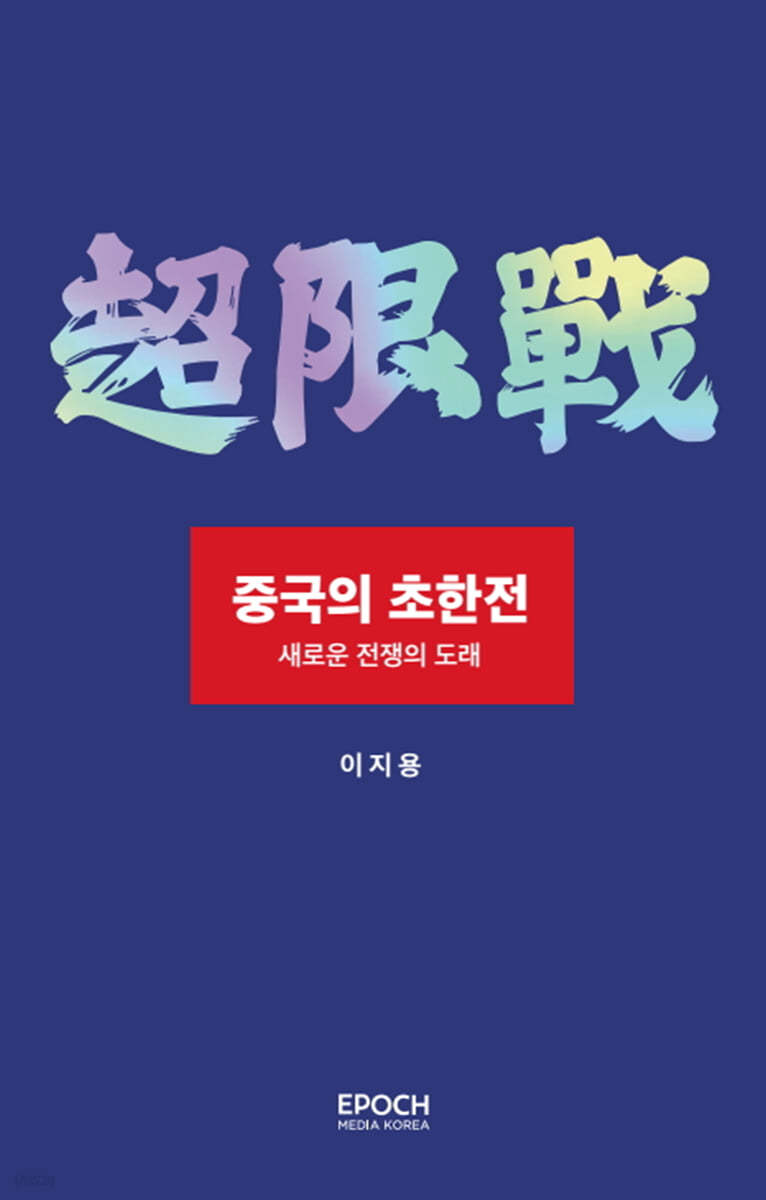
China's Chu-Han War
 |
Description
Book Introduction
China's All-New War: The Chu-Han War, Which We Must Know But Didn't The new war that China is waging against the world: the Chu-Han War! In the Chohan War, which means 'war beyond limits', there are no restrictions on time or space, and even methods are unlimited. The core of the Chu Han War is that there are no rules and no restrictions on means and methods. The strength of the Chohanjeon lies in its ability to creatively combine and develop all means and methods. It's like shaking a kaleidoscope with all its ever-changing elements. There are basic principles when conducting a battle of the first class. This is the so-called 'wise man's cocktail' principle. It is a principle that focuses on creative fusion and application by mobilizing all means and methods. For example, when conducting a battle, not only do you use the principles of spears and shields in a complex manner, but you also use swordsmen and assassins in a mixed manner. The outcome of a war depends on the combination of means and methods through fusion and application. In the Chu-Han War, China will utilize unscrupulous, unethical, unstandardized, and immoral means and methods as its foundation, creatively integrating available means in both military and non-military domains, and flexibly applying them while considering the timing and conditions, thereby launching an all-out, destructive attack across various domains. So it is not a ‘wise man’s cocktail’ but a ‘devil’s cocktail’. South Korea is defenseless against the unlimited war being waged by the Chinese Communist Party (CCP) and the People's Liberation Army (PLA). What must we do to protect liberal democracy, the market economy, and the rule of law? "China's Chu-Han War: The Advent of a New War" presents the methods. |
index
Recommendation: _Park Jae-wan, Chairman of the Korea Peninsula Advancement Foundation, Ph.D. in Policy Studies
introduction
Chapter 1 China and the Chinese Communist Party
1.
The advent of a new war
2.
People's Republic of China and the Chinese Communist Party
3.
Chinese Political System: The Chinese Communist Party's One-Party Dictatorship and the People's Liberation Army
Chapter 2: Super-limit Warfare: Concepts, Theory, and Strategy
1.
Super-limit warfare: concepts, theories, and strategies
2.
The Battle of Chuhan: Theory or Chinese Communist Strategy?
3.
Execution of the Chu-Han War: Organization of the Chinese Communist Party
Chapter 3: People's Liberation Army Military Strategy and the Trans-Korean War
1.
The Genealogy and Significance of the Chu-Han War in the Strategy of the Chinese Communist Party and the People's Liberation Army
2.
The status of Chu-Han warfare in modern new war theory
3.
Examples of military tactics in the First World War: Gray Zone Warfare and Biological Warfare
Chapter 4 Political Operations
1.
Representative method of political operations
2.
Chinese political power movement
3.
The Chinese Communist Party's political operations
4.
Political operations targeting Korea
Chapter 5: Overseas United Front Operations
1.
The Reality of the Chinese Communist Party's Overseas United Front Work
2.
Promoting Immigration: Achieving Political Objectives by Utilizing Civilians
3.
Full-scale launch of the Chohan War and overseas united front operations
4.
Building a united front with foreign progressive and leftist organizations
5.
Overseas united front operations, criminal groups, and drug cartels
6.
Chinese research institutes, foreign think tanks, and overseas united front operations
7.
United Front Work and Religious Organizations
8.
China's friendly exchanges and overseas united front work
9.
The development and characteristics of the Chu Han War
Chapter 6: The Three Wars: Education and Culture, Media, and Cognitive Wars
1.
3rd Battle: Media/Public Opinion Battle, Psychological Battle, Legal Battle
2.
Cultural Values in Korea: Cases That Became Social Issues
Chapter 7: Information and Communication Technology (ICT)
1.
2020 Mumbai Blackout in India
2.
China's investment and development, corporate expansion, and the advancement of information and communications technology
3.
Huawei, the People's Liberation Army, and the Ministry of State Security
4. Creative fusion of ICT and ultra-limited warfare tactics
5.
The Chinese Communist Party's infiltration using Chinese social media platform services and IT technology.
Chapter 8: Economic Warfare, Technology Theft Warfare, and Overseas Investment Warfare
1.
The Nortel Canada Tragedy and Huawei
2.
Technology, information, and economic warfare and overseas united front operations
3.
Chinatown and multicultural policies
4.
One Belt One Road Project and the Battle of Chuhan
Chapter 9: The Chu-Han War and Korea
1.
Korea and China: 30 Years of Diplomatic Relations
2.
America and China: What Do We Choose?
3.
New Humanity on the Korean Peninsula, the Republic of Korea and Koreans as Free People
Conclusion: What should South Korea do as it engages in a war with the Chinese Communist Party?
1.
Establishing a system to respond to extreme warfare
2.
Laws, Systems, and Organizations: Building a National Foundation for Responding to Extremely Limited Warfare
3.
Media and Education Culture
4.
Protecting the National Information and Communications Network and Introducing a "Resilience" System
5.
Strict application of the principle of 'reciprocity' to foreigners
6.
Research on ultra-limited warfare, building an education system, and establishing an international solidarity network
Epilogue
annotation
References
Author's biography
introduction
Chapter 1 China and the Chinese Communist Party
1.
The advent of a new war
2.
People's Republic of China and the Chinese Communist Party
3.
Chinese Political System: The Chinese Communist Party's One-Party Dictatorship and the People's Liberation Army
Chapter 2: Super-limit Warfare: Concepts, Theory, and Strategy
1.
Super-limit warfare: concepts, theories, and strategies
2.
The Battle of Chuhan: Theory or Chinese Communist Strategy?
3.
Execution of the Chu-Han War: Organization of the Chinese Communist Party
Chapter 3: People's Liberation Army Military Strategy and the Trans-Korean War
1.
The Genealogy and Significance of the Chu-Han War in the Strategy of the Chinese Communist Party and the People's Liberation Army
2.
The status of Chu-Han warfare in modern new war theory
3.
Examples of military tactics in the First World War: Gray Zone Warfare and Biological Warfare
Chapter 4 Political Operations
1.
Representative method of political operations
2.
Chinese political power movement
3.
The Chinese Communist Party's political operations
4.
Political operations targeting Korea
Chapter 5: Overseas United Front Operations
1.
The Reality of the Chinese Communist Party's Overseas United Front Work
2.
Promoting Immigration: Achieving Political Objectives by Utilizing Civilians
3.
Full-scale launch of the Chohan War and overseas united front operations
4.
Building a united front with foreign progressive and leftist organizations
5.
Overseas united front operations, criminal groups, and drug cartels
6.
Chinese research institutes, foreign think tanks, and overseas united front operations
7.
United Front Work and Religious Organizations
8.
China's friendly exchanges and overseas united front work
9.
The development and characteristics of the Chu Han War
Chapter 6: The Three Wars: Education and Culture, Media, and Cognitive Wars
1.
3rd Battle: Media/Public Opinion Battle, Psychological Battle, Legal Battle
2.
Cultural Values in Korea: Cases That Became Social Issues
Chapter 7: Information and Communication Technology (ICT)
1.
2020 Mumbai Blackout in India
2.
China's investment and development, corporate expansion, and the advancement of information and communications technology
3.
Huawei, the People's Liberation Army, and the Ministry of State Security
4. Creative fusion of ICT and ultra-limited warfare tactics
5.
The Chinese Communist Party's infiltration using Chinese social media platform services and IT technology.
Chapter 8: Economic Warfare, Technology Theft Warfare, and Overseas Investment Warfare
1.
The Nortel Canada Tragedy and Huawei
2.
Technology, information, and economic warfare and overseas united front operations
3.
Chinatown and multicultural policies
4.
One Belt One Road Project and the Battle of Chuhan
Chapter 9: The Chu-Han War and Korea
1.
Korea and China: 30 Years of Diplomatic Relations
2.
America and China: What Do We Choose?
3.
New Humanity on the Korean Peninsula, the Republic of Korea and Koreans as Free People
Conclusion: What should South Korea do as it engages in a war with the Chinese Communist Party?
1.
Establishing a system to respond to extreme warfare
2.
Laws, Systems, and Organizations: Building a National Foundation for Responding to Extremely Limited Warfare
3.
Media and Education Culture
4.
Protecting the National Information and Communications Network and Introducing a "Resilience" System
5.
Strict application of the principle of 'reciprocity' to foreigners
6.
Research on ultra-limited warfare, building an education system, and establishing an international solidarity network
Epilogue
annotation
References
Author's biography
Into the book
First of all, the Chu-Han War changes the concept of war.
It transcends all traditional perceptions and distinctions about war.
It is a war that abolishes all limitations, including traditional war means, methods, targets, scope, timing, and norms.
There is only one thing that has not changed in the traditional concept of war.
It is the 'essence of war'.
The essence of war is to politically subdue the enemy.
The Chu-Han War maintains only the essence and purpose of war.
It is a war that does not care about the means and methods to defeat other opposing countries.
In other words, the Chu Han War redefines the very rules of war along with the concept of war.
---p.58
The Chohanjeon demands that the enemy be attacked across all areas in accordance with this expanded national sovereignty area.
Targets of attack include both military and civilians.
The attack area is not limited to tangible and intangible, physical and non-physical areas.
---p.67
The first battle requires the 'Golden Ratio'.
It is said that by exploring and waiting for the situation and conditions, the enemy will create the best golden ratio that is beyond imagination.
In this regard, the so-called 'partial correct rule' is what decorates the end of the Chu-Han war strategy.
The final victory grammar of the Chu-Han War can be summarized as the 'golden ratio of the ratio of the balance.'
The key is to practice secretly while looking at the central (主) and overall (全) structure.
The ratio of bias is the secret composition of mutually contradictory or opposing factors into the structure of the center and the whole.
---p.70
Political warfare is a key tactic in the Chu-Han War.
The goal is to take control of the opposing country from within.
They bribe elite groups in target countries and place them under the control of the Chinese Communist Party, exerting influence in the political sphere while building alliances with progressive and leftist social groups and pro-China intellectuals and mobilizing local Chinese.
---p.120
All exchanges with China today are a means of the Chinese Communist Party's overseas united front operations.
The free world, including Korea, is mistaken in thinking that this is pure exchange.
On the other hand, the Chinese Communist Party approaches things in an organized, planned, and strategic manner.
---p.227
The purpose of the "three wars"—media, public opinion, psychological, and legal—is to manipulate and control public opinion in China's favor through media warfare, neutralize the will of the government and general public through psychological warfare, and constrain the actions of governments and individuals through legal warfare.
---p.236
Technological economic development has been used as a key means to achieve China's industrial development strategy, "Made in China 2025," since Xi Jinping came to power.
To this end, China is also implementing the 'Thousand Talents Plan'.
Although it claims to attract overseas talent to double domestic industrial competitiveness, in reality it is a tactic used to steal and seize advanced technologies from foreign universities, research institutes, and companies through the "Thousand Talents Plan."
---p.307
When the Chinese Communist Party imposes economic retaliation against South Korea on the grounds of security issues, realism, pragmatism, and compromise emerge, emphasizing the dependence of the South Korean economy on the Chinese economy.
A representative recent example is the Chinese Communist Party's retaliation for the deployment of THAAD.
---p.359
The ROK military and security agencies must urgently develop a response strategy and preparedness posture to counter the Chinese Communist Party's extreme warfare, which shares the same interests as our main enemy, North Korea.
This includes developing countermeasures that can protect Korean society from the various tactics deployed by the Chu-Han War, as well as building countermeasures that can overcome China's asymmetric warfare, such as gray zone warfare, in military strategy.
It transcends all traditional perceptions and distinctions about war.
It is a war that abolishes all limitations, including traditional war means, methods, targets, scope, timing, and norms.
There is only one thing that has not changed in the traditional concept of war.
It is the 'essence of war'.
The essence of war is to politically subdue the enemy.
The Chu-Han War maintains only the essence and purpose of war.
It is a war that does not care about the means and methods to defeat other opposing countries.
In other words, the Chu Han War redefines the very rules of war along with the concept of war.
---p.58
The Chohanjeon demands that the enemy be attacked across all areas in accordance with this expanded national sovereignty area.
Targets of attack include both military and civilians.
The attack area is not limited to tangible and intangible, physical and non-physical areas.
---p.67
The first battle requires the 'Golden Ratio'.
It is said that by exploring and waiting for the situation and conditions, the enemy will create the best golden ratio that is beyond imagination.
In this regard, the so-called 'partial correct rule' is what decorates the end of the Chu-Han war strategy.
The final victory grammar of the Chu-Han War can be summarized as the 'golden ratio of the ratio of the balance.'
The key is to practice secretly while looking at the central (主) and overall (全) structure.
The ratio of bias is the secret composition of mutually contradictory or opposing factors into the structure of the center and the whole.
---p.70
Political warfare is a key tactic in the Chu-Han War.
The goal is to take control of the opposing country from within.
They bribe elite groups in target countries and place them under the control of the Chinese Communist Party, exerting influence in the political sphere while building alliances with progressive and leftist social groups and pro-China intellectuals and mobilizing local Chinese.
---p.120
All exchanges with China today are a means of the Chinese Communist Party's overseas united front operations.
The free world, including Korea, is mistaken in thinking that this is pure exchange.
On the other hand, the Chinese Communist Party approaches things in an organized, planned, and strategic manner.
---p.227
The purpose of the "three wars"—media, public opinion, psychological, and legal—is to manipulate and control public opinion in China's favor through media warfare, neutralize the will of the government and general public through psychological warfare, and constrain the actions of governments and individuals through legal warfare.
---p.236
Technological economic development has been used as a key means to achieve China's industrial development strategy, "Made in China 2025," since Xi Jinping came to power.
To this end, China is also implementing the 'Thousand Talents Plan'.
Although it claims to attract overseas talent to double domestic industrial competitiveness, in reality it is a tactic used to steal and seize advanced technologies from foreign universities, research institutes, and companies through the "Thousand Talents Plan."
---p.307
When the Chinese Communist Party imposes economic retaliation against South Korea on the grounds of security issues, realism, pragmatism, and compromise emerge, emphasizing the dependence of the South Korean economy on the Chinese economy.
A representative recent example is the Chinese Communist Party's retaliation for the deployment of THAAD.
---p.359
The ROK military and security agencies must urgently develop a response strategy and preparedness posture to counter the Chinese Communist Party's extreme warfare, which shares the same interests as our main enemy, North Korea.
This includes developing countermeasures that can protect Korean society from the various tactics deployed by the Chu-Han War, as well as building countermeasures that can overcome China's asymmetric warfare, such as gray zone warfare, in military strategy.
---p.394
Publisher's Review
Why You Should Know "China's Chu-Han War: The Coming of a New War"
Today the Chinese Communist Party is dreaming.
This is the so-called 'Chinese Dream'.
What exactly is this dream? By 2049, the centennial of the founding of the People's Republic of China (PRC), established in 1949, the dream is for a majority of Chinese to live prosperous lives, creating a so-called "Great Harmony Society," and for China to become a truly global power, a hegemonic power, in name and reality.
It is to complete the great revival of the Chinese nation led by the Chinese Communist Party.
Can China achieve the Chinese Dream? If the gap between dream and reality is too great to overcome, it's not a dream, it's merely a delusion.
However, if you try to make your dream come true, the problem becomes more serious.
Moreover, if a nation, rather than an individual, becomes obsessed with collective delusion and attempts to realize it, it could bring about catastrophe not only for China but also for its neighbors.
We see similar examples throughout history.
Nazi Germany and militaristic Japan are representative examples of the past.
The problem is that China, under the one-party dictatorship of the Chinese Communist Party, is following the same path as Nazi Germany and militaristic Japan in the past.
Today, the Chinese Communist Party is waging a new war to overcome the great gap between dreams and reality and to make fantasy a reality.
It's the Chohanjeon.
The Trans-Korean War is a global grand strategy of the Chinese Communist Party and the People's Liberation Army, encompassing political operations, overseas United Front operations, overseas development and investment including the Belt and Road Initiative, and various information and communication technology (ICT), media, and socio-cultural operations in the United States, Europe, Australia, and Canada.
Recently, countries around the world have belatedly come to realize the true nature of the Chu-Han War that China is waging.
We are in the process of conducting a full-scale investigation and analysis of the Chohan War and launching a multifaceted response.
The problem is Korea.
South Korea, geographically adjacent to China and with deep economic and trade ties, is already being seriously under Chinese invasion.
Despite this situation, discussions about China in Korean society have been conducted entirely within a ‘frame’ that seems to have been prepared in advance by China.
There was virtually no understanding of the reality of the Chinese Communist Party and the Chu-Han War or any awareness of the problems.
The reality of Korea was that it was being invaded defenselessly without even a basic sense of the problem, let alone awareness, awakening, and investigation and analysis of the true nature of the Chohan War.
Korea does not even have a basic understanding of China's Chu-Han War.
This is not a story for the general public.
Most China experts, including military and security experts, are no exception.
"China's Chu-Han War: The Coming of a New War" introduces the Chu-Han War waged by the Chinese Communist Party and the People's Liberation Army to Korean society through case studies.
Chapter 1 introduces the People's Republic of China and the Chinese Communist Party.
To understand the Chu-Han Chronicles, basic knowledge of modern China (People's Republic of China) and the Chinese Communist Party system is required.
Meanwhile, a large number of books introducing China have been published in Korea.
The problem is that there are surprisingly few books that objectively explain the nature of China's political system, the party-state system, in which the party takes precedence over the state.
Most general readers are likely to be unaware of China's political system and character.
Without a basic knowledge of the structure and nature of Chinese politics, it is difficult to properly understand the content of the Chu-Han War explained in this book.
So, let me first briefly explain the structure and nature of China, modern China, and the Chinese Communist Party.
Chapter 2 introduces the basic concepts and contents of the Chu-Han Chronicles.
The original text of 『Super-Han Wars』 published in China was analyzed.
The Chu-Han War is the Chinese Communist Party's new concept of war and theory of war.
Although it is a new theory of war, it is a modern theory of war that inherits the characteristics and traditions of the Chinese Communist Party's military strategy.
The Chinese Communist Party's military strategy refers to the Communist Party's revolutionary strategy and tactics and Mao Zedong's military strategy.
Chapter 3 introduces the basics of the People's Liberation Army's military strategy.
The Chu-Han War follows the same lines as the new warfare methods that emerged in modern warfare.
Taking this into account, I explained the similarities and differences between today's new war theory and the Chu-Han War.
Chapter 4 analyzes the development of the Chinese Communist Party's Chu-Han War.
The Chu Han Dynasty uses unlimited tactics that do not place limits on the tactics they deploy.
However, there are still major tactics for executing the Chu-Han War.
Describes how the main tactics are deployed in reality.
The tactics introduced in Chapters 4 and 5 are political operations and overseas united front operations.
It is also the basic strategy for developing various transnational warfare tactics, such as public opinion warfare, media warfare, propaganda warfare, legal warfare, cognitive warfare, education and culture warfare, ideological warfare, information and communication technology warfare, technology and economic warfare, trade (retaliation) warfare, overseas investment warfare, drug crime warfare, biological warfare, and gray zone warfare, which are introduced from Chapter 6 onwards.
As basic tactics, political operations and overseas united front operations are deployed in various combinations with other Chu-Han warfare tactics.
Chapter 9 deals with the Chu-Han War and the Korean issue.
As its neighboring country, China, has grown economically and its status in global politics and economy has risen significantly, China's importance has grown significantly.
Reflecting this, a ‘Chinese study craze’ has occurred in Korea over the past 20 years.
Moreover, at some point, rhetoric such as ‘China’s rise and America’s decline’ and ‘Korea’s choice must be China’ became the mainstream discourse in Korean society.
In this, the reality of Korea being defenselessly exposed to China's Chu-Han War and the direction it should take are discussed.
Chapter 10 is the conclusion.
The Chinese Communist Party has been waging war against Korea to bring it under its influence.
This paper presents how South Korea, facing the Chinese Communist Party's all-out offensive, should respond to the Chu-Han War while maintaining its freedom, independence, and sovereignty and continuing friendly exchanges between South Korea and China, primarily by referring to foreign examples.
Today the Chinese Communist Party is dreaming.
This is the so-called 'Chinese Dream'.
What exactly is this dream? By 2049, the centennial of the founding of the People's Republic of China (PRC), established in 1949, the dream is for a majority of Chinese to live prosperous lives, creating a so-called "Great Harmony Society," and for China to become a truly global power, a hegemonic power, in name and reality.
It is to complete the great revival of the Chinese nation led by the Chinese Communist Party.
Can China achieve the Chinese Dream? If the gap between dream and reality is too great to overcome, it's not a dream, it's merely a delusion.
However, if you try to make your dream come true, the problem becomes more serious.
Moreover, if a nation, rather than an individual, becomes obsessed with collective delusion and attempts to realize it, it could bring about catastrophe not only for China but also for its neighbors.
We see similar examples throughout history.
Nazi Germany and militaristic Japan are representative examples of the past.
The problem is that China, under the one-party dictatorship of the Chinese Communist Party, is following the same path as Nazi Germany and militaristic Japan in the past.
Today, the Chinese Communist Party is waging a new war to overcome the great gap between dreams and reality and to make fantasy a reality.
It's the Chohanjeon.
The Trans-Korean War is a global grand strategy of the Chinese Communist Party and the People's Liberation Army, encompassing political operations, overseas United Front operations, overseas development and investment including the Belt and Road Initiative, and various information and communication technology (ICT), media, and socio-cultural operations in the United States, Europe, Australia, and Canada.
Recently, countries around the world have belatedly come to realize the true nature of the Chu-Han War that China is waging.
We are in the process of conducting a full-scale investigation and analysis of the Chohan War and launching a multifaceted response.
The problem is Korea.
South Korea, geographically adjacent to China and with deep economic and trade ties, is already being seriously under Chinese invasion.
Despite this situation, discussions about China in Korean society have been conducted entirely within a ‘frame’ that seems to have been prepared in advance by China.
There was virtually no understanding of the reality of the Chinese Communist Party and the Chu-Han War or any awareness of the problems.
The reality of Korea was that it was being invaded defenselessly without even a basic sense of the problem, let alone awareness, awakening, and investigation and analysis of the true nature of the Chohan War.
Korea does not even have a basic understanding of China's Chu-Han War.
This is not a story for the general public.
Most China experts, including military and security experts, are no exception.
"China's Chu-Han War: The Coming of a New War" introduces the Chu-Han War waged by the Chinese Communist Party and the People's Liberation Army to Korean society through case studies.
Chapter 1 introduces the People's Republic of China and the Chinese Communist Party.
To understand the Chu-Han Chronicles, basic knowledge of modern China (People's Republic of China) and the Chinese Communist Party system is required.
Meanwhile, a large number of books introducing China have been published in Korea.
The problem is that there are surprisingly few books that objectively explain the nature of China's political system, the party-state system, in which the party takes precedence over the state.
Most general readers are likely to be unaware of China's political system and character.
Without a basic knowledge of the structure and nature of Chinese politics, it is difficult to properly understand the content of the Chu-Han War explained in this book.
So, let me first briefly explain the structure and nature of China, modern China, and the Chinese Communist Party.
Chapter 2 introduces the basic concepts and contents of the Chu-Han Chronicles.
The original text of 『Super-Han Wars』 published in China was analyzed.
The Chu-Han War is the Chinese Communist Party's new concept of war and theory of war.
Although it is a new theory of war, it is a modern theory of war that inherits the characteristics and traditions of the Chinese Communist Party's military strategy.
The Chinese Communist Party's military strategy refers to the Communist Party's revolutionary strategy and tactics and Mao Zedong's military strategy.
Chapter 3 introduces the basics of the People's Liberation Army's military strategy.
The Chu-Han War follows the same lines as the new warfare methods that emerged in modern warfare.
Taking this into account, I explained the similarities and differences between today's new war theory and the Chu-Han War.
Chapter 4 analyzes the development of the Chinese Communist Party's Chu-Han War.
The Chu Han Dynasty uses unlimited tactics that do not place limits on the tactics they deploy.
However, there are still major tactics for executing the Chu-Han War.
Describes how the main tactics are deployed in reality.
The tactics introduced in Chapters 4 and 5 are political operations and overseas united front operations.
It is also the basic strategy for developing various transnational warfare tactics, such as public opinion warfare, media warfare, propaganda warfare, legal warfare, cognitive warfare, education and culture warfare, ideological warfare, information and communication technology warfare, technology and economic warfare, trade (retaliation) warfare, overseas investment warfare, drug crime warfare, biological warfare, and gray zone warfare, which are introduced from Chapter 6 onwards.
As basic tactics, political operations and overseas united front operations are deployed in various combinations with other Chu-Han warfare tactics.
Chapter 9 deals with the Chu-Han War and the Korean issue.
As its neighboring country, China, has grown economically and its status in global politics and economy has risen significantly, China's importance has grown significantly.
Reflecting this, a ‘Chinese study craze’ has occurred in Korea over the past 20 years.
Moreover, at some point, rhetoric such as ‘China’s rise and America’s decline’ and ‘Korea’s choice must be China’ became the mainstream discourse in Korean society.
In this, the reality of Korea being defenselessly exposed to China's Chu-Han War and the direction it should take are discussed.
Chapter 10 is the conclusion.
The Chinese Communist Party has been waging war against Korea to bring it under its influence.
This paper presents how South Korea, facing the Chinese Communist Party's all-out offensive, should respond to the Chu-Han War while maintaining its freedom, independence, and sovereignty and continuing friendly exchanges between South Korea and China, primarily by referring to foreign examples.
GOODS SPECIFICS
- Date of issue: March 1, 2023
- Page count, weight, size: 456 pages | 670g | 153*225*18mm
- ISBN13: 9791191675160
- ISBN10: 1191675165
You may also like
카테고리
korean


korean

![GQ KOREA Mark (Monthly): December [2025]](http://librairie.coreenne.fr/cdn/shop/files/8ef265dbbfbf186523ed75ba7319009d.jpg?v=1765340328&width=3840)


