

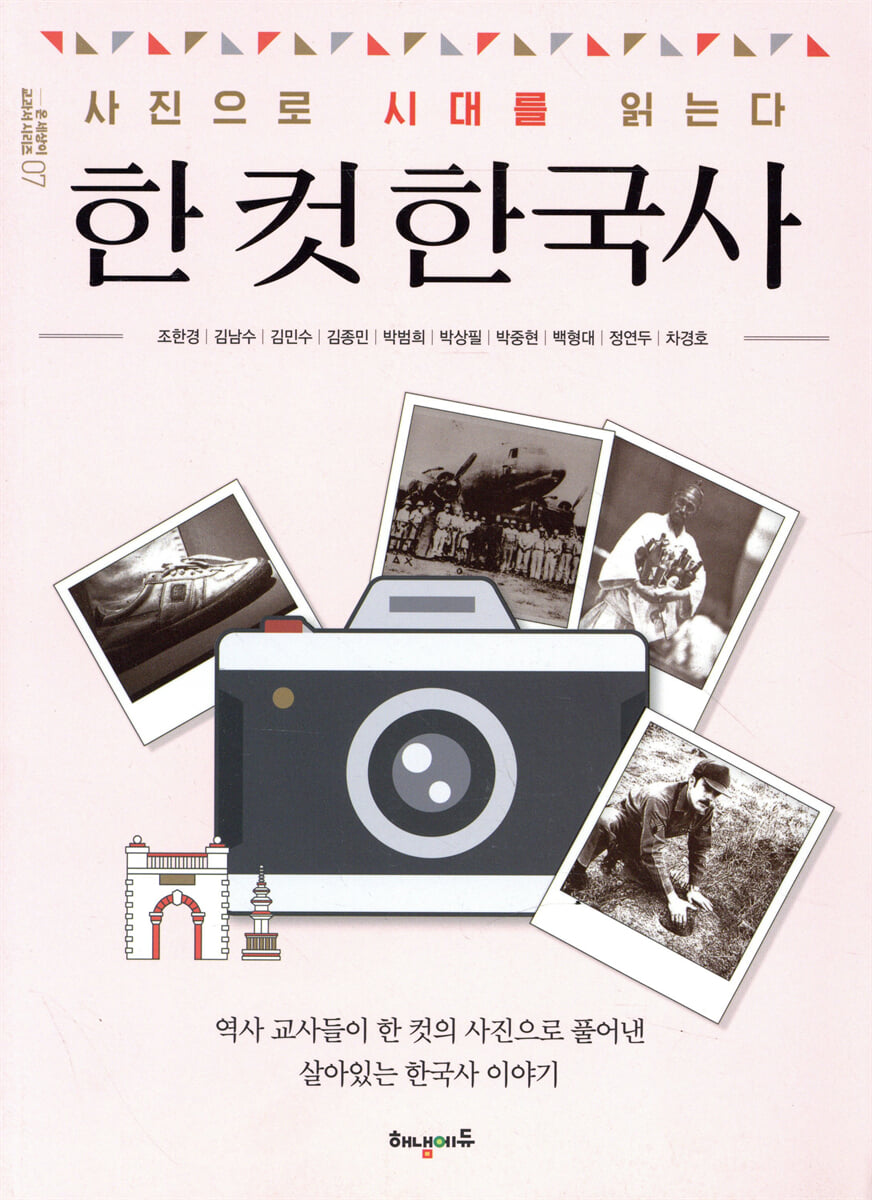
One Cut of Korean History
 |
Description
Book Introduction
A living story of Korean history told through a single photo by history teachers.
From the 'Jeongok-ri Hand Axe that Changed the World Archaeological Map'
'100 Years of Korean Cinema, Showing the Power of Culture'
145 topics are discussed with photos.
The ten history teachers who wrote “Korean History in One Cut” have experience co-writing high school Korean history textbooks.
The writing team agreed that it would be nice to have a book that interprets the era depicted in a single historical photograph from the perspective of a history teacher. After selecting 145 Korean history photographs, they completed “Korean History in One Cut” after two years of study and writing.
Let's follow the criteria that history teachers used to select the photos after a heated debate.
The authors were interested in historical materials that connect the past and present (Seokchon-dong tombs amidst skyscrapers, a Baekje landmark that has not faded / Two women who met across time, Kang Ju-ryong and Kim Jin-sook), and photographs that vividly show historical events but have hidden intentions (Why did a Joseon man holding a pipe hug a beer bottle? / Who is the barbarian? The Battle of Gwangseongbo).
Also, the selection criteria included the stories of people who were crushed by the wheels of history and disappeared without being able to raise their voices (People who died from 'finger guns', Yeosu-Suncheon October 19 Incident / People who went to 'Gol'), looking at the same incident from a different perspective than before (Rice is Heaven, The World Dreamed of by the Donghak Peasant Army), and shedding new light on events that had not been previously encountered or were previously forgotten (The Naked Emperor, The Story of the Bronze Statue of Taejo Wang Geon / The Humiliation That Was Wanted to Be Buried, Samjeondo Monument / Creating a Whirlwind in Korean Politics, Theory of the 40s as a Standard Bearer).
The photo of the Baekje gilt-bronze incense burner, half-submerged in mud, reveals the circumstances at the time of its excavation, and the gaze of Kim Jae-bong, staring at the camera at Seodaemun Prison, reveals the will of the independence activists.
By following the authors' commentary with the photos as clues, readers will be able to encounter an interesting history like a mystery novel.
From the 'Jeongok-ri Hand Axe that Changed the World Archaeological Map'
'100 Years of Korean Cinema, Showing the Power of Culture'
145 topics are discussed with photos.
The ten history teachers who wrote “Korean History in One Cut” have experience co-writing high school Korean history textbooks.
The writing team agreed that it would be nice to have a book that interprets the era depicted in a single historical photograph from the perspective of a history teacher. After selecting 145 Korean history photographs, they completed “Korean History in One Cut” after two years of study and writing.
Let's follow the criteria that history teachers used to select the photos after a heated debate.
The authors were interested in historical materials that connect the past and present (Seokchon-dong tombs amidst skyscrapers, a Baekje landmark that has not faded / Two women who met across time, Kang Ju-ryong and Kim Jin-sook), and photographs that vividly show historical events but have hidden intentions (Why did a Joseon man holding a pipe hug a beer bottle? / Who is the barbarian? The Battle of Gwangseongbo).
Also, the selection criteria included the stories of people who were crushed by the wheels of history and disappeared without being able to raise their voices (People who died from 'finger guns', Yeosu-Suncheon October 19 Incident / People who went to 'Gol'), looking at the same incident from a different perspective than before (Rice is Heaven, The World Dreamed of by the Donghak Peasant Army), and shedding new light on events that had not been previously encountered or were previously forgotten (The Naked Emperor, The Story of the Bronze Statue of Taejo Wang Geon / The Humiliation That Was Wanted to Be Buried, Samjeondo Monument / Creating a Whirlwind in Korean Politics, Theory of the 40s as a Standard Bearer).
The photo of the Baekje gilt-bronze incense burner, half-submerged in mud, reveals the circumstances at the time of its excavation, and the gaze of Kim Jae-bong, staring at the camera at Seodaemun Prison, reveals the will of the independence activists.
By following the authors' commentary with the photos as clues, readers will be able to encounter an interesting history like a mystery novel.
- You can preview some of the book's contents.
Preview
index
PART 1 Pre-modern
001 The Jeongok-ri Hand Axe That Changed the World Archaeological Map
002 In search of the secrets of comb-patterned pottery
003 A dolmen without a 'deceased' stone?
004 Bronze agricultural artifacts, from junk to treasure
005 'Prehistoric people came and went', 'Silla people visited', Ulju Cheonjeon-ri stone carvings
006 Why are you leaving Gyeongju? 'Gwanggaeto the Great's name is Hou.
007 12-Hour Missing Mystery: Gilt-bronze Standing Buddha Statue with 7 Years of Song
008 A Link Between Korea and Japan's Ancient History: Janggo-type Tombs
009 Seokchon-dong Tomb in the Skyscrapers: A Baekje Landmark That Has Not Faded
010 Baekje's smile revealed by a woodcutter, the rock-carved Buddha Triad in Yonghyeon-ri, Seosan
011 The Baekje Gilt-Bronze Incense Burner, a National Treasure Buried in Mud for 1,300 Years
012 King Muryeong's Tomb, Baekje's Treasure Trove Opens
013 Remove the Japanese cement! The stone pagoda at Mireuksa Temple in Iksan
014 A gilt-bronze crown for the man? A gold crown for the woman? Hwangnamdaechong Tomb
015 King Jinheung's Dream Spread Throughout the Mountains and Rivers, the Monument to King Jinheung of Silla on Bukhansan Mountain in Seoul
016 Why did Gayain press his head?
017 The Suffering of the Three-Story Stone Pagoda of Bulguksa Temple, Embracing the Infinitely Pure Dharani Sutra
018 Princess Jeonghyo's Tomb: Demonstrating the Diversity and Originality of Balhae Culture
019 The Naked Emperor, the Story of the Bronze Statue of King Taejo Wang Geon
020 Goryeo Special Forces Drive Out the Jurchen and Build Nine Fortresses
021 Is it comparable to the Mona Lisa? Suwolgwaneumdo
022 Metal type, why was it created?
023 Songgwangsa Temple, a Temple Where Monks Are Treasures
024 Why is the 10-story stone pagoda from Gyeongcheonsa Temple in Gaeseong located in the National Museum of Korea in Seoul?
025 Won Interference, Love and War in the Goryeo Royal Family
026 The Shinan Treasure Ship That Surprised Even Captain Hook
027 Hanyang, the capital of Joseon, where geomancy and Neo-Confucianism are combined
028 Living History Museum, Suncheon Nakan Fortress
029 A man bowing and a woman with her hands clasped, a roadside audience
030 Sky Map of the Old People, Celestial Train Map
031 The Great Operation to Create Filial Sons, Loyal Subjects, and Chaste Women: The Three Bonds and Conduct
032 Turtle Ship, the leader of the Joseon navy's assault
033 Korean Wave in the Joseon Dynasty, Tongsinsa
034 The humiliation I wanted to bury, the Samjeondo Monument
035 Are there really so many countries in the world? Is this Joseon? The Complete Works of Gonyeo Man-guk Jeon-do
036 Why did King Hyojong send a letter in Korean to the princess?
037 Choose, choose! Just write your name and you too can become a nobleman! Gongmyeong
038 'No longer a slave', the book of sokryangmun
039 Who Will Win? Late Joseon Society as Seen in Ssireumdo
040 Daedongyeojido, when unfolded, it is as tall as a three-story apartment building, and when folded, it fits in my hand.
PART 2: The Opening of Ports
041 What is the story of a Korean man holding a pipe and holding a beer bottle?
042 Joseon's Forgotten Secret Weapon, the Torpedo
043 Who is the Barbarian? The Battle of Gwangseongbo
044 The monument erected by the father and chosen by the son
045 War Without Battle, Treaty of Ganghwa Island
046 A must-read for enlightened intellectuals: Haegukdoji
047 Create a new weapon to protect Joseon!
048 Why did Bobingsa bow so deeply in the United States?
049 Kim Ok-gyun, a revolutionary or a traitor?
050 Fort Hamilton, Samsan-myeon, Yeosu-si, Jeollanam-do?
051 The Sino-Japanese War: Fishing for Joseon
052 We Are All the Masterminds, 'The Bowl of Tears'
053 When Jeon Bong-jun dreamed of the green bean flower blooming
054 Rice is Heaven, the World Dreamed of by the Donghak Peasant Army
055 Establish the Military Affairs Office in the year of Gap-o!
056 Empress Myeongseong, the mixed reviews
057 The one who cuts, the one who is cut, the one who cuts
058 Independent Newspaper Advertisement, Speaking of the Times
059 What does ‘independence’ mean in the Independence Gate?
060 The Dream and Reality of the Korean Empire, the Battleship Yangmuho
061 Korea's back is in jeopardy due to the Russia-Japan whale fight.
062 Treaty, not an agreement, the Eulsa Treaty
063 The Fourth Grave, Waiting for Ahn Jung-geun
064 Let's Pay Off Our National Debt! National Debt Redemption Movement
065 "Japanese ghosts come by train"
066 “I would rather be buried in Korea than in Westminster Abbey.”
067 Jejungwon, the first modern hospital
068 Photo Bride, They Didn't Forget Their Homeland
069 “I plead for Freedom and Justice”
070 It's not 'Jjajangmyeon', it's Korean food Jjajangmyeon
PART 3 Japanese colonial period
071 The sunset of the Korean Empire at Jungmyeongjeon Hall in Deoksugung Palace (Gyeongungung Palace)
072 Why did Japan build the Government-General of Korea building in Gyeongbokgung Palace?
073 Police or Military? Military Police Rule
074 Let Japanese settle in Joseon and develop the land!
075 Japanese political event held at Gyeongbokgung Palace
076 Was Yu Gwan-sun the only one there that day? The March 1st Movement and Women
077 The Provisional Charter of the Republic of Korea Completed in 30 Minutes
078 Uiyoldan member Kim Ji-seop throws a bomb into the heart of Japanese imperialism.
079 Meeting Kim Gu, the Young Man Who Wanted to Become Japanese
080 Unite and Win, the Amtaedo Tenancy Dispute
081 Let's Eliminate All Types of Discrimination, Joseon Hyeongpyeongsa
082 Children's Day 100th Anniversary: Are Children Happy?
083 For Whom Is Public Security? Public Security Maintenance Act
084 “Aiming for Korean independence and hoping for communism,” Kim Jae-bong
085 Photo of 'This Hae-bak House' and the June 10th Independence Movement
086 Why Don't We Know Him? Jang Jae-seong, a Key Figure in the Gwangju Student Anti-Japanese Movement
087 Two women who met across time, Kang Ju-ryong and Kim Jin-sook.
088 It's not National Treasure No. 1, Sungnyemun
089 The pinnacle of modern consumer culture: department stores
090 People shopping at department stores, people living in shantytowns
091 Seok Ju-myeong, giving our butterflies Korean names
092 1921, Whimoon High School students' school trip to Gyeongju
093 Hell Island Battleship Island, the Unfinished War
094 Unhealed Wounds, Labor Corps
095 Yang Se-bong, respected by South Korea, and Yang Se-bong, respected by North Korea
096 Korea's first female pilot, Kwon Ki-ok
097 Korean Independence Through "Due Process"? The Cairo Conference
098 What is the story behind the Korean Liberation Army that came to Seoul after liberation and returned after only 28 hours?
099 The surviving emperor, Jo Moon-sang, a young man who died as a war criminal
100 Abandoned Islands, Abandoned People, Sorok Island Leprosy Patients
PART 4 Modern
101 The Japanese flag is lowered and the Stars and Stripes, not the Taegeukgi, is raised.
102 Those Who Returned, Those Who Remained
103 The 38th parallel divides the land and people.
104 Kim Il-sung stands before the North Korean people for the first time.
105 The False Report on the Trusteeship That Changed the Fate of the Korean Peninsula
106 Now We Can Speak! The Daegu October Struggle
107 Joining Hands for a Unified Government, a Joint Committee of the Left and Right
108 Between Comrades and Rivals, Kim Gu and Syngman Rhee
The Jeju April 3 Incident: A Tragedy That Befell Jeju Island
110 "Let's go, Kim OO!", May 10th General Election
111 Why August 15, 1948 is the 'Government Establishment Day' of the Republic of Korea
112 People Killed by 'Finger Guns': The Yeosu-Suncheon October 19 Incident
113 Land Reform and Agricultural Reform
114 People who went to 'Gol'
115 Another Battlefield, Geoje Island POW Camp
116 Why did students support Syngman Rhee's "opposition to the armistice"?
117 Restoring Peace to Pigeon Forest Village
118 Korea's Robinson Crusoe, Jo Byeong-gi
The pinnacle of idolization: the removal of the Syngman Rhee statue.
120 Is Peaceful Unification at Risk? The Jo Bong-am and Progressive Party Incident
121 The Manchukuo Connection: Park Chung-hee and Kishi Nobusuke
122 Why did 10,000 nurses go to Germany?
The Tragedy of "Ppalli Ppalli": The Collapse of the Wow Apartment Complex
124 A feast for the eyes and ears, TV and radio
125 “If you keep giving birth without thinking…” Birth control policy
126 Waging War on Rats, Rat-Catching Campaign
127 “I want to see it once, see it twice, and keep seeing it” (feat.
(Forbidden Song Era)
128 Strong Sister Who Became Master of Her Own Life, Dongil Textile Worker
129 The 40-something generation theory that caused a stir in Korean politics
130 "I am honored that you have given me the death penalty", the Mincheonghakryeon incident
131 Death of a worker in the Masan Free Export Zone
132 People Who Shot Yushin's Heart
133 When that day in May comes again, the 'May Struggle'
134 The Namyeong-dong Anti-Communist Investigation Office Reborn as the Democracy and Human Rights Memorial Hall
135 A pair of sneakers, Lee Han-yeol and 1987
136 "We Are All Human", Lee Tae-young's Struggle
137 Shouting "Innocent to the Genetic, Guilty to the Uninitiated!": Ji Kang-heon and his gang's escape
138 Children Disappeared! The State Was the Culprit: The Brothers Welfare Center Case
139 College Student Lim Su-kyung Surprises North Korean Residents
140 "I am Kim Hak-sun, who was forcibly taken away as a 'comfort woman' for the Japanese military."
141 The Meaning of 1,001 Cows: Inter-Korean Economic Cooperation
142 Asking about the role and responsibility of the state: The Sewol Ferry Disaster
143 Who is the Shameless One? The Defamation Trial of President Chun Doo-hwan
144 Democratic Republic Protected by Candlelight
145 100 Years of Korean Cinema, Showing the Power of Culture!
001 The Jeongok-ri Hand Axe That Changed the World Archaeological Map
002 In search of the secrets of comb-patterned pottery
003 A dolmen without a 'deceased' stone?
004 Bronze agricultural artifacts, from junk to treasure
005 'Prehistoric people came and went', 'Silla people visited', Ulju Cheonjeon-ri stone carvings
006 Why are you leaving Gyeongju? 'Gwanggaeto the Great's name is Hou.
007 12-Hour Missing Mystery: Gilt-bronze Standing Buddha Statue with 7 Years of Song
008 A Link Between Korea and Japan's Ancient History: Janggo-type Tombs
009 Seokchon-dong Tomb in the Skyscrapers: A Baekje Landmark That Has Not Faded
010 Baekje's smile revealed by a woodcutter, the rock-carved Buddha Triad in Yonghyeon-ri, Seosan
011 The Baekje Gilt-Bronze Incense Burner, a National Treasure Buried in Mud for 1,300 Years
012 King Muryeong's Tomb, Baekje's Treasure Trove Opens
013 Remove the Japanese cement! The stone pagoda at Mireuksa Temple in Iksan
014 A gilt-bronze crown for the man? A gold crown for the woman? Hwangnamdaechong Tomb
015 King Jinheung's Dream Spread Throughout the Mountains and Rivers, the Monument to King Jinheung of Silla on Bukhansan Mountain in Seoul
016 Why did Gayain press his head?
017 The Suffering of the Three-Story Stone Pagoda of Bulguksa Temple, Embracing the Infinitely Pure Dharani Sutra
018 Princess Jeonghyo's Tomb: Demonstrating the Diversity and Originality of Balhae Culture
019 The Naked Emperor, the Story of the Bronze Statue of King Taejo Wang Geon
020 Goryeo Special Forces Drive Out the Jurchen and Build Nine Fortresses
021 Is it comparable to the Mona Lisa? Suwolgwaneumdo
022 Metal type, why was it created?
023 Songgwangsa Temple, a Temple Where Monks Are Treasures
024 Why is the 10-story stone pagoda from Gyeongcheonsa Temple in Gaeseong located in the National Museum of Korea in Seoul?
025 Won Interference, Love and War in the Goryeo Royal Family
026 The Shinan Treasure Ship That Surprised Even Captain Hook
027 Hanyang, the capital of Joseon, where geomancy and Neo-Confucianism are combined
028 Living History Museum, Suncheon Nakan Fortress
029 A man bowing and a woman with her hands clasped, a roadside audience
030 Sky Map of the Old People, Celestial Train Map
031 The Great Operation to Create Filial Sons, Loyal Subjects, and Chaste Women: The Three Bonds and Conduct
032 Turtle Ship, the leader of the Joseon navy's assault
033 Korean Wave in the Joseon Dynasty, Tongsinsa
034 The humiliation I wanted to bury, the Samjeondo Monument
035 Are there really so many countries in the world? Is this Joseon? The Complete Works of Gonyeo Man-guk Jeon-do
036 Why did King Hyojong send a letter in Korean to the princess?
037 Choose, choose! Just write your name and you too can become a nobleman! Gongmyeong
038 'No longer a slave', the book of sokryangmun
039 Who Will Win? Late Joseon Society as Seen in Ssireumdo
040 Daedongyeojido, when unfolded, it is as tall as a three-story apartment building, and when folded, it fits in my hand.
PART 2: The Opening of Ports
041 What is the story of a Korean man holding a pipe and holding a beer bottle?
042 Joseon's Forgotten Secret Weapon, the Torpedo
043 Who is the Barbarian? The Battle of Gwangseongbo
044 The monument erected by the father and chosen by the son
045 War Without Battle, Treaty of Ganghwa Island
046 A must-read for enlightened intellectuals: Haegukdoji
047 Create a new weapon to protect Joseon!
048 Why did Bobingsa bow so deeply in the United States?
049 Kim Ok-gyun, a revolutionary or a traitor?
050 Fort Hamilton, Samsan-myeon, Yeosu-si, Jeollanam-do?
051 The Sino-Japanese War: Fishing for Joseon
052 We Are All the Masterminds, 'The Bowl of Tears'
053 When Jeon Bong-jun dreamed of the green bean flower blooming
054 Rice is Heaven, the World Dreamed of by the Donghak Peasant Army
055 Establish the Military Affairs Office in the year of Gap-o!
056 Empress Myeongseong, the mixed reviews
057 The one who cuts, the one who is cut, the one who cuts
058 Independent Newspaper Advertisement, Speaking of the Times
059 What does ‘independence’ mean in the Independence Gate?
060 The Dream and Reality of the Korean Empire, the Battleship Yangmuho
061 Korea's back is in jeopardy due to the Russia-Japan whale fight.
062 Treaty, not an agreement, the Eulsa Treaty
063 The Fourth Grave, Waiting for Ahn Jung-geun
064 Let's Pay Off Our National Debt! National Debt Redemption Movement
065 "Japanese ghosts come by train"
066 “I would rather be buried in Korea than in Westminster Abbey.”
067 Jejungwon, the first modern hospital
068 Photo Bride, They Didn't Forget Their Homeland
069 “I plead for Freedom and Justice”
070 It's not 'Jjajangmyeon', it's Korean food Jjajangmyeon
PART 3 Japanese colonial period
071 The sunset of the Korean Empire at Jungmyeongjeon Hall in Deoksugung Palace (Gyeongungung Palace)
072 Why did Japan build the Government-General of Korea building in Gyeongbokgung Palace?
073 Police or Military? Military Police Rule
074 Let Japanese settle in Joseon and develop the land!
075 Japanese political event held at Gyeongbokgung Palace
076 Was Yu Gwan-sun the only one there that day? The March 1st Movement and Women
077 The Provisional Charter of the Republic of Korea Completed in 30 Minutes
078 Uiyoldan member Kim Ji-seop throws a bomb into the heart of Japanese imperialism.
079 Meeting Kim Gu, the Young Man Who Wanted to Become Japanese
080 Unite and Win, the Amtaedo Tenancy Dispute
081 Let's Eliminate All Types of Discrimination, Joseon Hyeongpyeongsa
082 Children's Day 100th Anniversary: Are Children Happy?
083 For Whom Is Public Security? Public Security Maintenance Act
084 “Aiming for Korean independence and hoping for communism,” Kim Jae-bong
085 Photo of 'This Hae-bak House' and the June 10th Independence Movement
086 Why Don't We Know Him? Jang Jae-seong, a Key Figure in the Gwangju Student Anti-Japanese Movement
087 Two women who met across time, Kang Ju-ryong and Kim Jin-sook.
088 It's not National Treasure No. 1, Sungnyemun
089 The pinnacle of modern consumer culture: department stores
090 People shopping at department stores, people living in shantytowns
091 Seok Ju-myeong, giving our butterflies Korean names
092 1921, Whimoon High School students' school trip to Gyeongju
093 Hell Island Battleship Island, the Unfinished War
094 Unhealed Wounds, Labor Corps
095 Yang Se-bong, respected by South Korea, and Yang Se-bong, respected by North Korea
096 Korea's first female pilot, Kwon Ki-ok
097 Korean Independence Through "Due Process"? The Cairo Conference
098 What is the story behind the Korean Liberation Army that came to Seoul after liberation and returned after only 28 hours?
099 The surviving emperor, Jo Moon-sang, a young man who died as a war criminal
100 Abandoned Islands, Abandoned People, Sorok Island Leprosy Patients
PART 4 Modern
101 The Japanese flag is lowered and the Stars and Stripes, not the Taegeukgi, is raised.
102 Those Who Returned, Those Who Remained
103 The 38th parallel divides the land and people.
104 Kim Il-sung stands before the North Korean people for the first time.
105 The False Report on the Trusteeship That Changed the Fate of the Korean Peninsula
106 Now We Can Speak! The Daegu October Struggle
107 Joining Hands for a Unified Government, a Joint Committee of the Left and Right
108 Between Comrades and Rivals, Kim Gu and Syngman Rhee
The Jeju April 3 Incident: A Tragedy That Befell Jeju Island
110 "Let's go, Kim OO!", May 10th General Election
111 Why August 15, 1948 is the 'Government Establishment Day' of the Republic of Korea
112 People Killed by 'Finger Guns': The Yeosu-Suncheon October 19 Incident
113 Land Reform and Agricultural Reform
114 People who went to 'Gol'
115 Another Battlefield, Geoje Island POW Camp
116 Why did students support Syngman Rhee's "opposition to the armistice"?
117 Restoring Peace to Pigeon Forest Village
118 Korea's Robinson Crusoe, Jo Byeong-gi
The pinnacle of idolization: the removal of the Syngman Rhee statue.
120 Is Peaceful Unification at Risk? The Jo Bong-am and Progressive Party Incident
121 The Manchukuo Connection: Park Chung-hee and Kishi Nobusuke
122 Why did 10,000 nurses go to Germany?
The Tragedy of "Ppalli Ppalli": The Collapse of the Wow Apartment Complex
124 A feast for the eyes and ears, TV and radio
125 “If you keep giving birth without thinking…” Birth control policy
126 Waging War on Rats, Rat-Catching Campaign
127 “I want to see it once, see it twice, and keep seeing it” (feat.
(Forbidden Song Era)
128 Strong Sister Who Became Master of Her Own Life, Dongil Textile Worker
129 The 40-something generation theory that caused a stir in Korean politics
130 "I am honored that you have given me the death penalty", the Mincheonghakryeon incident
131 Death of a worker in the Masan Free Export Zone
132 People Who Shot Yushin's Heart
133 When that day in May comes again, the 'May Struggle'
134 The Namyeong-dong Anti-Communist Investigation Office Reborn as the Democracy and Human Rights Memorial Hall
135 A pair of sneakers, Lee Han-yeol and 1987
136 "We Are All Human", Lee Tae-young's Struggle
137 Shouting "Innocent to the Genetic, Guilty to the Uninitiated!": Ji Kang-heon and his gang's escape
138 Children Disappeared! The State Was the Culprit: The Brothers Welfare Center Case
139 College Student Lim Su-kyung Surprises North Korean Residents
140 "I am Kim Hak-sun, who was forcibly taken away as a 'comfort woman' for the Japanese military."
141 The Meaning of 1,001 Cows: Inter-Korean Economic Cooperation
142 Asking about the role and responsibility of the state: The Sewol Ferry Disaster
143 Who is the Shameless One? The Defamation Trial of President Chun Doo-hwan
144 Democratic Republic Protected by Candlelight
145 100 Years of Korean Cinema, Showing the Power of Culture!
Detailed image

Into the book
The moustache could only be made when the baby was a newborn.
Because of this, it was a good way for privileged people to pass down their status.
In ancient times, the practice of wearing a hat was widespread throughout the world and was a custom that expressed the desire to maintain vested interests and differentiate oneself.
Even today, people adorn themselves with expensive cars, clothes, jewelry, and other items to emphasize their wealth and status.
The desire to show off seems similar among ancient and modern people.
--- p.43 From “Why did the Gaya people press their heads?”
Although very rare, Hangul was also used in royal edicts, official documents issued by the king. King Seonjo, who fled to Uiju during the Imjin War, issued a Hangul edict to the people who had become prisoners of war for the Japanese army and who had cooperated with them, beginning with the words, "This is a message to the people," urging them to return.
The first Hangul royal edict issued by King Seonjo shows that the king used Hangul to communicate directly with the people during a time of crisis such as war.
--- p.83 From “Why did King Hyojong send a letter in Hangul to the princess?”
The horror of the Battle of Gwangseongbo is conveyed vividly in the painting.
But there was a bit of staging involved here.
Before taking the shot, the photographer artificially positioned the bodies to give the impression of a battle with 'savages'.
It was a similar scene to when hunting a wild beast and striking a pose to commemorate it.
The idea that divides the world into civilization and barbarism, treating those different from us like animals—who, really, is a barbarian? If, upon seeing the gruesome corpses, we sense not the horrors of war but the greatness of America's triumph over barbarism, can we truly call ourselves a "civilized nation"?
--- p.97 From "Who is the Barbarian? The Battle of Gwangseongbo"
To cut off the head of a local official and go to Seoul was not just a rebellion, it was treason. Not only would the ringleader be executed, but his family would also be annihilated.
When Jeon Bong-jun suggested carrying out such a horrific act, the other comrades did not let Jeon Bong-jun alone bear the burden of being the mastermind.
To prevent anyone from knowing who was the ringleader, they drew a circle with a bowl and wrote their names around it.
In particular, Choi Gyeong-seon, one of the signatories of the Sabal Tongmun, stayed with Jeon Bong-jun until his death.
Maybe he wanted to let us all know that we are all masterminds.
The situation at the time was so dire that everyone was willing to risk their lives as the ringleader or instigator.
--- p.115 From "We Are All the Instigators, 'The Bowl of Letters'"
Quinine is the Chinese character name for the anti-malarial drug 'quinine' developed in France in 1820.
Malaria is a disease transmitted by mosquitoes and was called 'hakjil' in Joseon.
Malaria was common in Joseon, where sanitary conditions were poor. After the introduction of gold geranium, it proved to be very effective in treating malaria, and its imports skyrocketed.
Because of its unique bitter taste, it was also used as a miracle drug among women at the time to help them wean their babies.
By using cranes and turtles, which symbolize longevity, in advertisements, they are also creating an image that it is good for health.
--- p.127 From "Independent Newspaper Advertisements, Speaking of the Times"
On April 10, 29 overseas independence activists gathered in Shanghai after hearing news of the March 1st Movement, which declared that all people on the Korean Peninsula were the masters of their country.
… … First of all, the name of the country was decided as the Republic of Korea.
At the extraordinary session of the National Assembly on April 11, it was decided to create a constitution.
Jo So-ang, Lee Gwang-su, and Shin Ik-hee were selected as members of the review committee and given the responsibility of drafting the constitution.
According to the minutes of the meeting at the time, the three members of the committee were recommended on the spot and drafted the Provisional Charter of the Republic of Korea, which specified a democratic republic, in just 30 minutes.
How was this possible?
--- p.165 From “The Provisional Charter of the Republic of Korea Completed in 30 Minutes”
Amtaedo is an island off the coast of Mokpo, Jeollanam-do, and is now connected to the mainland by a bridge.
Here, the Amtaedo Tenant Farmers' Struggle Monument was erected to commemorate the tenant dispute that occurred in 1923.
A tenant dispute is a peasant movement waged by tenant farmers against landlords to improve their farming conditions.
However, the inscriptions on the left and right sides of the lower part of the tower contain the names of people representing the tenant farmers, but not the names of the landowners they dealt with.
Who was the landlord, and what was the issue that led to the Amtaedo tenant dispute?
--- p.171 From “United We Win, the Tenancy Dispute in Amtaedo”
Did this discrimination disappear after liberation? Unfortunately, the oppressive patient care policies of the Japanese colonial period persisted for some time after liberation.
Endoscopic surgery was also performed until the 1990s.
The general public also strongly opposed the idea of people with Hansen's disease moving into their neighborhood or having their children attend school with their own children.
Even after regaining their country, Hansen's disease patients had to live under discrimination for a long time.
--- p.211 From "Abandoned Island, Abandoned People, 100 Sorok Island Hansen's Disease Patients"
In his commemorative speech, Syngman Rhee said, “I believe that republicanism will stand firm, as it has taken root deeply over the past 30 years and is now bearing fruit.
… … August 15, 1930, President Syngman Rhee of the Republic of Korea said.”
General John Hodge also gave a congratulatory address, saying, “It is a testament to the great achievements of the Korean people that we are able to celebrate the establishment of the Republic of Korea government on this day, the third anniversary of Japan’s surrender.”
No one who attended the event referred to this day as the 'founding' of the Republic of Korea.
The slogan that received the highest score in the government establishment commemorative contest held by the event preparation committee at the time was 'Today is the establishment of the government, tomorrow is the unification of North and South Korea.'
--- p.233 From “Why August 15, 1948 is the ‘Government Establishment Day’ of the Republic of Korea”
On the eve of the 46th anniversary of liberation, a grandmother held a press conference with a face like the one mentioned above.
“I am Kim Hak-sun, who was forcibly taken away as a ‘comfort woman’ for the Japanese military.” Kim Hak-sun, a girl who was forcibly taken away by the Japanese military and forced into a life of sexual slavery, has now become a 68-year-old grandmother and has put her name on the line to testify that she was a ‘comfort woman’ for the Japanese military.
It was a time when, in a social atmosphere where people could not speak out about what had happened to them, they had to be made into criminals even though they were victims.
Kim Hak-sun went beyond that time and declared, “I am the evidence,” in defiance of the Japanese government’s shamelessness in denying the very existence of “comfort women” and demanding evidence.
--- p.291 From “I am Kim Hak-sun, who was forcibly taken away as a ‘comfort woman’ for the Japanese military”
There was once an atmosphere in Korea where people envied Hollywood and Hong Kong films.
But now, Korean films are gaining momentum as they are recognized for their artistic quality and box office success around the world.
Foreigners who visited Korea during the opening of its ports referred to Koreans as “a people who enjoy storytelling.”
Could it be that the power of Korean cinema is the result of the critical awareness that has developed over the course of Koreans' turbulent modern history, combined with freedom of expression?
Because of this, it was a good way for privileged people to pass down their status.
In ancient times, the practice of wearing a hat was widespread throughout the world and was a custom that expressed the desire to maintain vested interests and differentiate oneself.
Even today, people adorn themselves with expensive cars, clothes, jewelry, and other items to emphasize their wealth and status.
The desire to show off seems similar among ancient and modern people.
--- p.43 From “Why did the Gaya people press their heads?”
Although very rare, Hangul was also used in royal edicts, official documents issued by the king. King Seonjo, who fled to Uiju during the Imjin War, issued a Hangul edict to the people who had become prisoners of war for the Japanese army and who had cooperated with them, beginning with the words, "This is a message to the people," urging them to return.
The first Hangul royal edict issued by King Seonjo shows that the king used Hangul to communicate directly with the people during a time of crisis such as war.
--- p.83 From “Why did King Hyojong send a letter in Hangul to the princess?”
The horror of the Battle of Gwangseongbo is conveyed vividly in the painting.
But there was a bit of staging involved here.
Before taking the shot, the photographer artificially positioned the bodies to give the impression of a battle with 'savages'.
It was a similar scene to when hunting a wild beast and striking a pose to commemorate it.
The idea that divides the world into civilization and barbarism, treating those different from us like animals—who, really, is a barbarian? If, upon seeing the gruesome corpses, we sense not the horrors of war but the greatness of America's triumph over barbarism, can we truly call ourselves a "civilized nation"?
--- p.97 From "Who is the Barbarian? The Battle of Gwangseongbo"
To cut off the head of a local official and go to Seoul was not just a rebellion, it was treason. Not only would the ringleader be executed, but his family would also be annihilated.
When Jeon Bong-jun suggested carrying out such a horrific act, the other comrades did not let Jeon Bong-jun alone bear the burden of being the mastermind.
To prevent anyone from knowing who was the ringleader, they drew a circle with a bowl and wrote their names around it.
In particular, Choi Gyeong-seon, one of the signatories of the Sabal Tongmun, stayed with Jeon Bong-jun until his death.
Maybe he wanted to let us all know that we are all masterminds.
The situation at the time was so dire that everyone was willing to risk their lives as the ringleader or instigator.
--- p.115 From "We Are All the Instigators, 'The Bowl of Letters'"
Quinine is the Chinese character name for the anti-malarial drug 'quinine' developed in France in 1820.
Malaria is a disease transmitted by mosquitoes and was called 'hakjil' in Joseon.
Malaria was common in Joseon, where sanitary conditions were poor. After the introduction of gold geranium, it proved to be very effective in treating malaria, and its imports skyrocketed.
Because of its unique bitter taste, it was also used as a miracle drug among women at the time to help them wean their babies.
By using cranes and turtles, which symbolize longevity, in advertisements, they are also creating an image that it is good for health.
--- p.127 From "Independent Newspaper Advertisements, Speaking of the Times"
On April 10, 29 overseas independence activists gathered in Shanghai after hearing news of the March 1st Movement, which declared that all people on the Korean Peninsula were the masters of their country.
… … First of all, the name of the country was decided as the Republic of Korea.
At the extraordinary session of the National Assembly on April 11, it was decided to create a constitution.
Jo So-ang, Lee Gwang-su, and Shin Ik-hee were selected as members of the review committee and given the responsibility of drafting the constitution.
According to the minutes of the meeting at the time, the three members of the committee were recommended on the spot and drafted the Provisional Charter of the Republic of Korea, which specified a democratic republic, in just 30 minutes.
How was this possible?
--- p.165 From “The Provisional Charter of the Republic of Korea Completed in 30 Minutes”
Amtaedo is an island off the coast of Mokpo, Jeollanam-do, and is now connected to the mainland by a bridge.
Here, the Amtaedo Tenant Farmers' Struggle Monument was erected to commemorate the tenant dispute that occurred in 1923.
A tenant dispute is a peasant movement waged by tenant farmers against landlords to improve their farming conditions.
However, the inscriptions on the left and right sides of the lower part of the tower contain the names of people representing the tenant farmers, but not the names of the landowners they dealt with.
Who was the landlord, and what was the issue that led to the Amtaedo tenant dispute?
--- p.171 From “United We Win, the Tenancy Dispute in Amtaedo”
Did this discrimination disappear after liberation? Unfortunately, the oppressive patient care policies of the Japanese colonial period persisted for some time after liberation.
Endoscopic surgery was also performed until the 1990s.
The general public also strongly opposed the idea of people with Hansen's disease moving into their neighborhood or having their children attend school with their own children.
Even after regaining their country, Hansen's disease patients had to live under discrimination for a long time.
--- p.211 From "Abandoned Island, Abandoned People, 100 Sorok Island Hansen's Disease Patients"
In his commemorative speech, Syngman Rhee said, “I believe that republicanism will stand firm, as it has taken root deeply over the past 30 years and is now bearing fruit.
… … August 15, 1930, President Syngman Rhee of the Republic of Korea said.”
General John Hodge also gave a congratulatory address, saying, “It is a testament to the great achievements of the Korean people that we are able to celebrate the establishment of the Republic of Korea government on this day, the third anniversary of Japan’s surrender.”
No one who attended the event referred to this day as the 'founding' of the Republic of Korea.
The slogan that received the highest score in the government establishment commemorative contest held by the event preparation committee at the time was 'Today is the establishment of the government, tomorrow is the unification of North and South Korea.'
--- p.233 From “Why August 15, 1948 is the ‘Government Establishment Day’ of the Republic of Korea”
On the eve of the 46th anniversary of liberation, a grandmother held a press conference with a face like the one mentioned above.
“I am Kim Hak-sun, who was forcibly taken away as a ‘comfort woman’ for the Japanese military.” Kim Hak-sun, a girl who was forcibly taken away by the Japanese military and forced into a life of sexual slavery, has now become a 68-year-old grandmother and has put her name on the line to testify that she was a ‘comfort woman’ for the Japanese military.
It was a time when, in a social atmosphere where people could not speak out about what had happened to them, they had to be made into criminals even though they were victims.
Kim Hak-sun went beyond that time and declared, “I am the evidence,” in defiance of the Japanese government’s shamelessness in denying the very existence of “comfort women” and demanding evidence.
--- p.291 From “I am Kim Hak-sun, who was forcibly taken away as a ‘comfort woman’ for the Japanese military”
There was once an atmosphere in Korea where people envied Hollywood and Hong Kong films.
But now, Korean films are gaining momentum as they are recognized for their artistic quality and box office success around the world.
Foreigners who visited Korea during the opening of its ports referred to Koreans as “a people who enjoy storytelling.”
Could it be that the power of Korean cinema is the result of the critical awareness that has developed over the course of Koreans' turbulent modern history, combined with freedom of expression?
--- p.301 From “100 Years of Korean Cinema, Showing the Power of 145 Cultures!”
Publisher's Review
"A Fascinating Story of Korean History for Children and Parents to Read Together: 'A Brief History of Korea'"
Sometimes a single picture speaks louder than a thousand words.
As we listen to the countless stories contained in a single historical photograph capturing a moment in our history, we come to realize that Korean history is a meaningful, endless dialogue between people who lived in the past.
No matter which page you open to, 『Korean History in One Cut』 features photographs on the left that convey the historical scene, while the right page is filled with vivid and lively explanations of the era depicted in the photographs, told through the eyes of a history teacher.
It's great to read while leisurely enjoying a cup of tea, or to take five minutes on a trip to read comfortably.
Using a single photo as a guide, you can encounter interesting and meaningful Korean history.
"Korean History in One Cut" is an easy-to-read book for teenagers learning Korean history and for parents who learned Korean history in school.
It is recommended that children and parents read together.
From the discovery of a hand axe made by Paleolithic people in the distant past to the recent film [Parasite], reading Korean history stories comfortably told by history teachers along with 145 photos will open up conversations with children.
As you carefully read "Korean History in One Cut" with your children, I hope you'll find yourself exclaiming, "Huh? There's a photo like this?", "Huh? So this is another way to look at this incident?", and "Ah! This photo hides such history."
Sometimes a single picture speaks louder than a thousand words.
As we listen to the countless stories contained in a single historical photograph capturing a moment in our history, we come to realize that Korean history is a meaningful, endless dialogue between people who lived in the past.
No matter which page you open to, 『Korean History in One Cut』 features photographs on the left that convey the historical scene, while the right page is filled with vivid and lively explanations of the era depicted in the photographs, told through the eyes of a history teacher.
It's great to read while leisurely enjoying a cup of tea, or to take five minutes on a trip to read comfortably.
Using a single photo as a guide, you can encounter interesting and meaningful Korean history.
"Korean History in One Cut" is an easy-to-read book for teenagers learning Korean history and for parents who learned Korean history in school.
It is recommended that children and parents read together.
From the discovery of a hand axe made by Paleolithic people in the distant past to the recent film [Parasite], reading Korean history stories comfortably told by history teachers along with 145 photos will open up conversations with children.
As you carefully read "Korean History in One Cut" with your children, I hope you'll find yourself exclaiming, "Huh? There's a photo like this?", "Huh? So this is another way to look at this incident?", and "Ah! This photo hides such history."
GOODS SPECIFICS
- Date of issue: May 31, 2022
- Page count, weight, size: 312 pages | 634g | 188*257*16mm
- ISBN13: 9788964462010
- ISBN10: 8964462017
You may also like
카테고리
korean


korean

![GQ KOREA Mark (Monthly): December [2025]](http://librairie.coreenne.fr/cdn/shop/files/8ef265dbbfbf186523ed75ba7319009d.jpg?v=1765340328&width=3840)


