

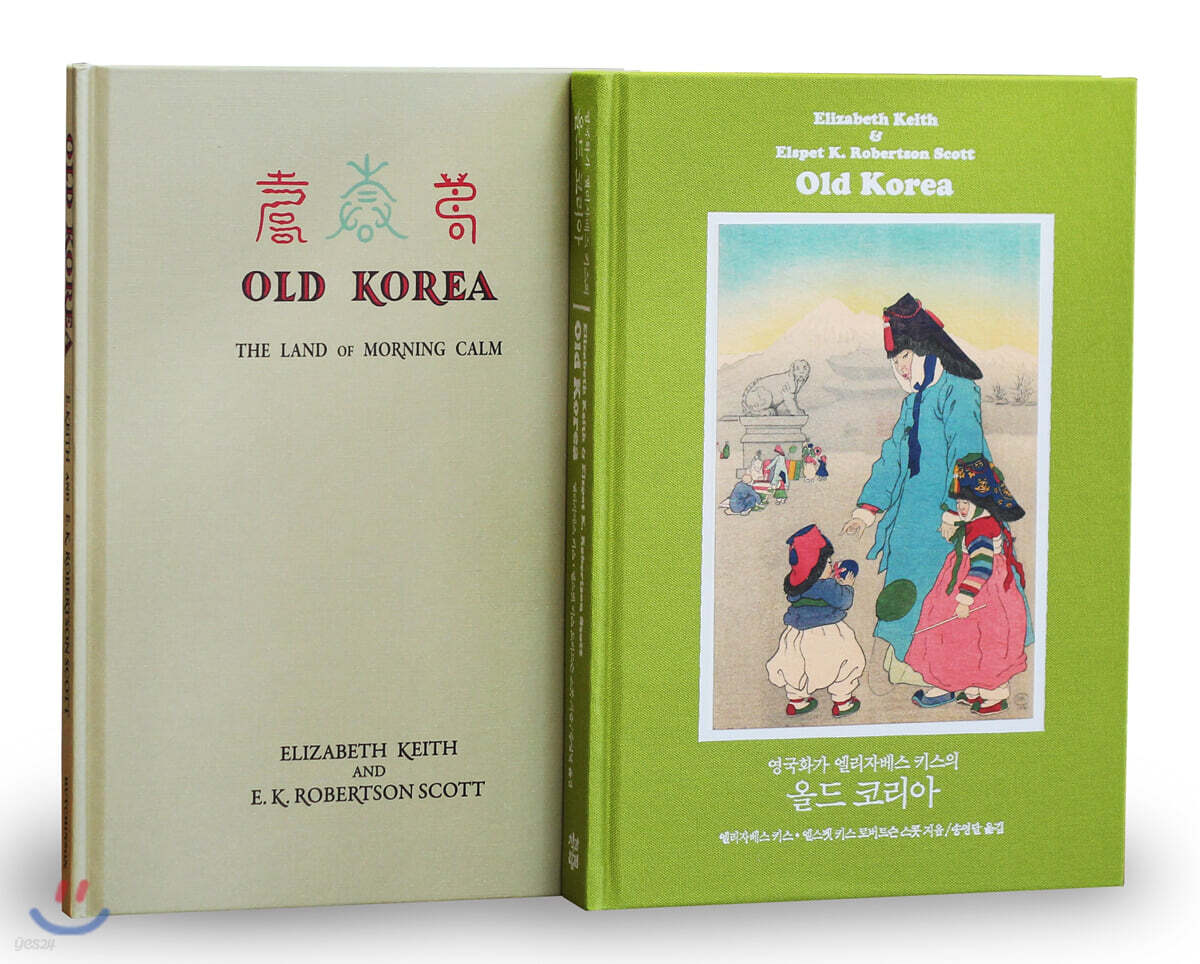
Old Korea Set by British Painter Elizabeth Keith (Fully Restored Edition + Original Book Restored Edition)
 |
Description
Book Introduction
- A word from MD
- World-renowned painter Elizabeth Keith is the subject of the first exhibition of Korean-themed works held abroad and the first exhibition of foreign artists held in Korea.
This book, which contains most of Kiss's drawings, has both historical and collector's value.
- Son Min-gyu, MD of History
Through the eyes of Elizabeth Keith, a master woodblock artist who loved Korea
A Look into 'Old Korea' 100 Years Ago
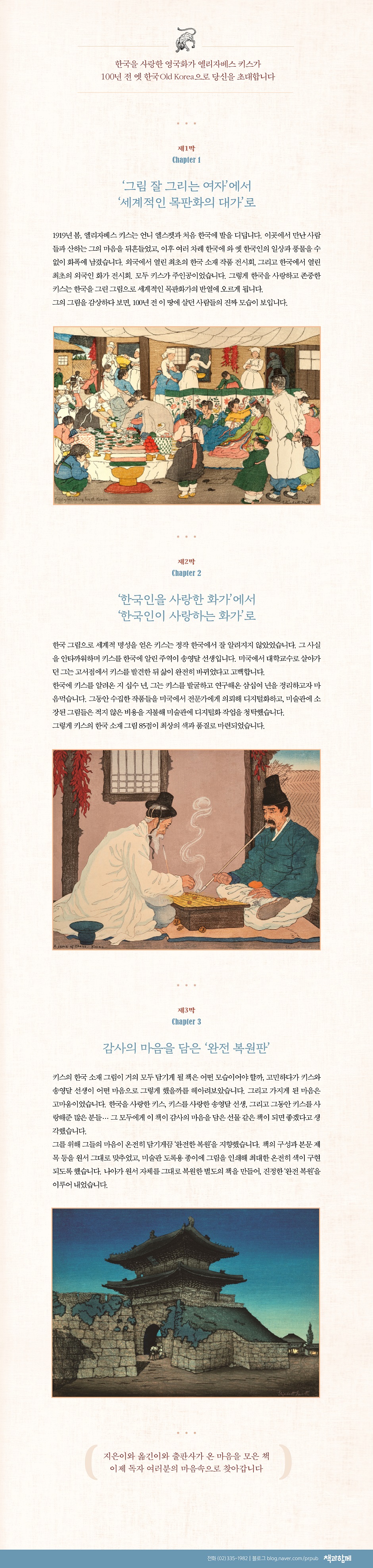
A 'complete restoration edition' of 85 of Kiss's Korean paintings
A chance to own the restored original edition of the classic 『Old Korea』!
The book "Old Korea," illustrated by world-renowned artist Elizabeth Keith and written primarily by her sister Elspet Keith, captures the daily lives and customs of Koreans in the early 20th century with greater sensitivity and honesty than anyone else.
In particular, the time they first visited Korea was right after the March 1st Movement in 1919, and it fully captures the passionate hearts of Koreans who rose up and cheered despite being persecuted by the Japanese.
Additionally, her sensibility as a woman is well expressed in the painting and its commentary.
This 'completely restored edition' is a monumental book that not only completely translates 『Old Korea』, but also compiles all of Keith's Korean paintings and research results that translator Song Young-dal, a collector and researcher of Elizabeth Keith's work, has unearthed over the past thirty years.
85 of Kiss's Korean paintings were digitized in ultra-high resolution and printed on catalog paper to ensure they were as close to the originals as possible.
The cloth-covered binding further enhances the book's quality.
In addition, a separate ‘original restoration edition’ was produced.
This book is literally a restoration of the original 『Old Korea』, and the unique antique feel of the original adds to its collection value.
A Look into 'Old Korea' 100 Years Ago
A 'complete restoration edition' of 85 of Kiss's Korean paintings
A chance to own the restored original edition of the classic 『Old Korea』!
The book "Old Korea," illustrated by world-renowned artist Elizabeth Keith and written primarily by her sister Elspet Keith, captures the daily lives and customs of Koreans in the early 20th century with greater sensitivity and honesty than anyone else.
In particular, the time they first visited Korea was right after the March 1st Movement in 1919, and it fully captures the passionate hearts of Koreans who rose up and cheered despite being persecuted by the Japanese.
Additionally, her sensibility as a woman is well expressed in the painting and its commentary.
This 'completely restored edition' is a monumental book that not only completely translates 『Old Korea』, but also compiles all of Keith's Korean paintings and research results that translator Song Young-dal, a collector and researcher of Elizabeth Keith's work, has unearthed over the past thirty years.
85 of Kiss's Korean paintings were digitized in ultra-high resolution and printed on catalog paper to ensure they were as close to the originals as possible.
The cloth-covered binding further enhances the book's quality.
In addition, a separate ‘original restoration edition’ was produced.
This book is literally a restoration of the original 『Old Korea』, and the unique antique feel of the original adds to its collection value.
- You can preview some of the book's contents.
Preview
index
Translator's Preface to the Completely Restored Edition
Bishop Cecil's letter of recommendation
Foreword by Elizabeth Keith
Foreword by Elspet Keith Robertson Scott
Chapter 1 Seoul
[Picture Collection 1] Daily Life of Koreans
Chapter 2 A Scholar
[Picture Collection 2] Beautiful Korean Women
Chapter 3 Shamans and Nuns
[Picture Collection 3] Korean Customs
Chapter 4 A certain gentleman
[Collection of Pictures 4] Impressive Korean Landscapes I
Chapter 5: Declaration of Independence Day
[Picture Collection 5] Impressive Korean Landscapes II
Chapter 6 Two Viscounts
[Picture Collection 6] Scholars and Yangban
Chapter 7: Two Wise Young Men
[Picture Collection 7] Various Korean People I
Chapter 8: An Activist
[Picture Collection 8] Various Korean People II
Chapter 9 The Governor
[Picture Collection 9] Korean Children
Chapter 10: Koreans in Hawaii
[Collection of Pictures 10] Portrait of Admiral Yi Sun-sin (estimated)
Appendix: Pictures of the same subject matter painted using different techniques.
Unpacking: The Life and Korean Paintings of Elizabeth Keith
List of Elizabeth Keith's Korean-based works
References
Find the picture
Bishop Cecil's letter of recommendation
Foreword by Elizabeth Keith
Foreword by Elspet Keith Robertson Scott
Chapter 1 Seoul
[Picture Collection 1] Daily Life of Koreans
Chapter 2 A Scholar
[Picture Collection 2] Beautiful Korean Women
Chapter 3 Shamans and Nuns
[Picture Collection 3] Korean Customs
Chapter 4 A certain gentleman
[Collection of Pictures 4] Impressive Korean Landscapes I
Chapter 5: Declaration of Independence Day
[Picture Collection 5] Impressive Korean Landscapes II
Chapter 6 Two Viscounts
[Picture Collection 6] Scholars and Yangban
Chapter 7: Two Wise Young Men
[Picture Collection 7] Various Korean People I
Chapter 8: An Activist
[Picture Collection 8] Various Korean People II
Chapter 9 The Governor
[Picture Collection 9] Korean Children
Chapter 10: Koreans in Hawaii
[Collection of Pictures 10] Portrait of Admiral Yi Sun-sin (estimated)
Appendix: Pictures of the same subject matter painted using different techniques.
Unpacking: The Life and Korean Paintings of Elizabeth Keith
List of Elizabeth Keith's Korean-based works
References
Find the picture
Detailed image
Into the book
This is a place where only men and rats come and go, and it is not a high-class restaurant, but a place where day laborers come to eat.
The smell of delicious food wafts out.
In the pot, soup with hot peppers or other seasonings is bubbling.
The man seen inside the window is kneading a large dough and putting dates into it.
Inside the tavern, copper and brass vessels used to prepare and serve food gleam.
The tavern was a very popular place for country folk who walked long distances or carried heavy loads on cold winter days.
A rich noodle broth is slowly simmering in a pot.
The noodles are thin and long, and Koreans eat them quickly, much like Italians eat macaroni.
The jars on the shelf contain various kinds of pickled foods, and rice is boiling in a large pot.
Many people prefer Korean rice because it is better than Japanese or Chinese rice.
The tavern's kitchen also has dried fish, peeled pears, and the famous kimchi.
Koreans serve their food in pretty brass bowls and eat it with brass spoons.
Chopsticks are also used.
When eating at home, it is rude to hold the bowl in your hand, but when eating at a restaurant, it is a bit more relaxed.
Maybe it's because women rarely eat out and only men eat at taverns.
The floor of the inn is made of very well-packed mud, and rats run around freely.
Also, flies constantly cling to food.
One thing that is different between Korean men and Parisians is that after a meal, Korean men usually sleep for a while, either in their rooms or on the street, but unfortunately, Parisians cannot do that.
There was another shabby inn similar to this one, and over its door was written:
“The best house for looking at the moon.”
--- p.42, from “The Inn”
Korean stores these days are not very interesting.
This is because almost all the shops are occupied by Japanese people and are usually located in the city center and decorated in a modern style.
However, the hat shop, mat shop, and brassware shop still remain in their Korean style.
Here I drew the most organized mat store I've ever seen.
The door was painted green, and a mat was rolled up in front of the store.
Korean mats have many different colors and patterns, and are laid out on floorboards in every home.
In Korea, at night, people take out the mattress, spread it out, and sleep on it, and in the morning, they open it and put it away.
The material hanging on the window is used to make straw sandals or mats.
Flat baskets are used to store grains, peppers, beans, etc., and red wooden baskets are used to carry laundry.
The woman carrying a child in the foreground of the painting is on her way to do the family's laundry.
The wooden clogs that the shoemaker just brought are still shiny and free of dust.
You can also see a pretty brass tray, used to hold rice cakes and other food, and always used at weddings.
Brass is very commonly used.
Rice and soup are often served in brass bowls.
The colorful fans have the Taegeuk pattern, which symbolizes Korea, attached to them.
Inside the store, the owner and a customer in white are talking.
--- p.56, from “Mat Shop”
The most tragic thing in Korea! On her wedding day, a Korean bride sits motionless, unable to see or eat.
It is said that in the past, people would stick Korean paper on their eyes.
The bride's family carries her in and seats her on the wedding day because her feet must not touch the ground.
Her face was painted white and red dots were placed on both sides of her cheeks and forehead.
I also put some lipstick on my lips.
A feast is held, and everyone enjoys eating delicious food, but the bride must never eat any of the delicious food placed on the large table before her.
Sometimes you can put fruit juice in your mouth, but you have to be careful not to smudge your lip balm.
All day long, the bride must sit in the bedroom, eyes closed, like a shadow, silently enduring all the compliments and comments.
The bride's mother is also too busy entertaining guests to enjoy the banquet food.
Meanwhile, the groom spends the whole day eating, drinking and playing happily with his friends in another annex.
In conservative families, it is considered shameful for a woman to not get married by the age of twenty.
Except in very special cases, it is considered shameful for a widow to remarry.
But recently, such prejudices and old customs are gradually changing.
Among the priests who have received modern education, there are some who reject such old-fashioned customs.
A modern woman, educated and fluent in English, married into an old-fashioned family, but the man, proud and stubborn, refused to follow the custom that women must wait while other families ate.
The father-in-law tried to break his daughter-in-law's stubbornness, but was unsuccessful.
When the child who had been her only comfort died, the woman defied old customs and left her in-laws.
New trends are gradually replacing outdated customs, and these days, young men are embracing new customs just as much as women.
--- p.114, from "The Bride"
Of the Pyongyang fortress walls built in 1392, only the eastern gate remains.
Although not as grand as Dongdaemun in Seoul, Pyongyang's Dongmun has a simple style and a subtle elegance that reflects its age.
Andre Eckardt commented on Korean architecture:
“Korea imported its architectural methods from China, but developed them into a simpler, more elegant, and more restrained form to suit the Korean context, creating a uniquely Korean architectural culture.” Pyongyang’s Dongmun Gate exemplifies the very essence of Korean architecture.
This painting shows a snow-covered, quiet and lonely winter gate, but the actual sketch was by no means idle.
The place where the gate is located is a path leading to the river, so in the summer there is a constant line of women going to do their laundry.
The moment I set up my canvas to paint, people came rushing in like clouds from nowhere.
Usually they were children or older men.
So sometimes my older sister Jessie would draw a line on the ground and threaten us not to go any further than that.
“Don’t come any closer.
When we shouted, “Hey, get back!” people would mimic our tone and follow suit.
We had no choice but to look at each other and smile.
There were so many people crowding around that I sometimes gave up and went home, only to return at dawn to paint again, but somehow people kept coming.
There was virtually no way for a Western traveler to travel in the East without being noticed.
--- p.150, from “Pyongyang’s East Gate”
The ingenious idea of attaching an umbrella to a hat is probably something only Koreans would come up with.
On rainy days, with an umbrella and hat on, both hands are free, so you can sit without worry and think about this and that, think about what to eat next, and savor nature!
One day, I saw this old man leaning against the wall in front of his house with a solemn expression on his face, and I got the idea to sketch him.
As a courtesy, I offered to pay him one won if he would model for me.
Although he was modeling, the inspiration was that he could just sit there like he usually did.
But this inspiration suddenly felt like he was important, and he couldn't sit still, moving his head around.
Then he kept moving and complaining, asking the interpreter how much longer he would have to sit, and giving him one won while complaining that the painting would cost much more abroad.
He even said that the Western artist would be able to get a painting of himself for as much as 100 won in the United States.
I'm sorry to be so negative about this inspiration, but in Korea, we have such a high regard for the elderly that sometimes they have a tendency to overestimate their own worth.
--- p.204, from “The Old Man with the Umbrella Hat”
This young man is a farmer who used to bring rice and vegetables to the house where I stayed when I was staying in Wonsan.
When I said I wanted to draw, he took it very seriously and came dressed up neatly.
I really wanted to draw a picture of my usual appearance, so I can't help but feel regretful...
At a loss, I decided to sketch him standing tense and serious, with his hands clasped in front of him.
This tense posture was also the same for the country gentleman and princess lady I had drawn.
In Korea, there were strict rules regarding language and behavior.
Because I know that, I never tell the model what to do, but always ask someone else, like the oldest woman there, to just fix the clothes.
The farmer stands in his smart attire as if he were going out to the city.
The fields seen behind are ready for rice planting.
The rice fields are a very peaceful sight, and tell nothing of the stench of manure rising from them or the backbreaking work that goes on there.
According to experts, Korean rice is tastier than Chinese or Japanese rice.
As is the case everywhere in Korea, the lower branches of pine trees are cut down and used as firewood.
Korea's patient oxen plow fields and transport goods.
When you carry a mountain of firewood on your back, you can't see the cow, only its four legs.
--- p.228, from “The Farmer”
The woman we called Soon stood as a model in formal attire.
Sooni's great-grandmother prepared it with great care.
It didn't seem right to me that he had hung a long white cloth like a belt down the middle of Sooni's skirt.
Suni sat motionless like a statue, like a bride on her wedding day.
Japanese women sit on the floor with their legs together and knees together, not moving at all.
On the other hand, it is customary for Korean women to sit cross-legged and, when tired, do not hesitate to straighten their legs.
When I draw Korean women coming to church, I can see their skirts suddenly rising and falling every time they sit down, which is an interesting sight.
In Korean families, women are treated worse than men, but during the March 1st Movement, women fought just as well as men.
He delivered secret documents, distributed the Joseon Independence Newspaper, participated in underground organizations, and refused to yield even when subjected to all kinds of torture.
Korean women have shown how strong they are at every opportunity.
Like women from other Asian countries, Korean women are also talented in theater and entertainment.
I once saw a group of girls at a girls' school perform a play called "Little Women" by Louisa May Alcott.
Even though the costumes were crude and the stage set was poor, I couldn't help but be amazed at how seriously the characters' emotions were expressed.
In particular, the final scene where the main character Beth dies was truly touching.
Another time I went to a Salvation Army concert, and my heart was touched when a group of twelve orphan girls sang, in broken English, “We want to be happy!”
Most of them were orphans abandoned by their poor families.
Now that they are free from Japanese oppression, I sincerely hope that those children live happily.
--- p.252, from “Sooni in a Formal Dress”
Seoul is the best city for kite flying.
When the kite flying season comes around, one day the sky is suddenly covered with colorful kites.
Most stores sell kites of all sizes, and they are cheap, so some are only available for a few days.
What I've drawn here is a typical scene of children flying kites.
A castle wall built along the ridge is visible behind.
Unfortunately, the walls are damaged and broken in many places.
The hills in Seoul are gentle, making it easy for children to climb up and fly kites.
Korean children's kite-flying skills are amazing.
Kites sometimes encounter accidents where they get caught on the tops of tall trees or the ends of telephone poles.
Korean paper is tough, so it doesn't tear easily even when hung on a tree.
A kite hung on a tree may hang like a ghost for days until the wind blows and tears it apart.
Even when it rains or the strong winds of March blow, the kite hung on the tree stubbornly clings to it.
On the first day of the lunar new year, adults also have kite-flying competitions.
Adults often play kite fighting, a game where the goal is to cut the other person's kite string.
To make kite fighting better, the kite string is coated with glass powder mixed with fish glue.
In his book, Korean Sketches, Dr. Gale said that kite flying competitions in Korea are as exciting as baseball games in the United States.
--- p.280, from "Kite Flying"
Two girls are playing seesaw, a jumping board.
It is a game played mainly in the spring, and along with swing jumping, it is one of the few games played by Korean women.
In the old days, in Korean noble families, when a girl was around eleven years old, she had to live only in the inner quarters and could only play in the courtyard surrounded by a wall.
Then, the girls could catch a glimpse of the world outside the wall by jumping on this seesaw.
Seesaw jumping is actually a dangerous sport and requires skill.
When one woman jumps up and then comes down, placing her entire body weight exactly on her spot, the force of her jump lifts the child on the other side into the sky, sometimes even higher than her own height.
This game involves repeating the movements of going up and down alternately.
If you step wrong while playing, you may hurt your feet or back.
But the girls have no such worries and just enjoy seesaw jumping.
Girls' short jackets look exactly like those worn by their mothers and grandmothers.
A wide, balloon-like undergarment is worn under a wide skirt, but if the outer skirt is made of thin material, the undergarment may be visible.
Girls are taught from a young age that they are inferior to boys.
Sometimes, they don't even give girls names, but instead call them by their birth order, such as first, second, etc.
The little girl carrying a child behind this picture has a name, but it would be better not to have one.
Because his name was 'sorry'.
This is because the girl was born as the fifth daughter in the family and became a source of disappointment to everyone in the family.
The house was located high on a hill, and the view of the distant mountains was beautiful.
The fence was made of woven reeds.
--- p.286, from "Swing Jumping"
The main character in the painting is wearing a yungbok, the uniform of soldiers in the Joseon Dynasty, and a jeollip with white feathers on his head.
He holds a baton called a deungchae in his right hand and sits on a chair, looking to the right.
His face is thin, as befitting a warrior worn down by battle, his eyes are wide and piercing, and his tightly closed mouth is soft yet determined.
Judging by his upturned eyes, erect ears, and neatly trimmed beard, it is clear that he is no ordinary warrior.
In the background, several turtle ships and panokseons are depicted advancing in one direction, waving red flags.
As is often the case with Kiss's watercolors, there is no indication of who is the artist.
However, in Korean history, the only military figure who commanded the turtle ship and achieved brilliant feats was Admiral Yi Sun-sin, who saved the country by setting a record of victory during the Imjin War.
Please refer to the following pages for details on the discovery and acquisition of this painting, as well as the specific basis for the estimate. (_Translator)
The smell of delicious food wafts out.
In the pot, soup with hot peppers or other seasonings is bubbling.
The man seen inside the window is kneading a large dough and putting dates into it.
Inside the tavern, copper and brass vessels used to prepare and serve food gleam.
The tavern was a very popular place for country folk who walked long distances or carried heavy loads on cold winter days.
A rich noodle broth is slowly simmering in a pot.
The noodles are thin and long, and Koreans eat them quickly, much like Italians eat macaroni.
The jars on the shelf contain various kinds of pickled foods, and rice is boiling in a large pot.
Many people prefer Korean rice because it is better than Japanese or Chinese rice.
The tavern's kitchen also has dried fish, peeled pears, and the famous kimchi.
Koreans serve their food in pretty brass bowls and eat it with brass spoons.
Chopsticks are also used.
When eating at home, it is rude to hold the bowl in your hand, but when eating at a restaurant, it is a bit more relaxed.
Maybe it's because women rarely eat out and only men eat at taverns.
The floor of the inn is made of very well-packed mud, and rats run around freely.
Also, flies constantly cling to food.
One thing that is different between Korean men and Parisians is that after a meal, Korean men usually sleep for a while, either in their rooms or on the street, but unfortunately, Parisians cannot do that.
There was another shabby inn similar to this one, and over its door was written:
“The best house for looking at the moon.”
--- p.42, from “The Inn”
Korean stores these days are not very interesting.
This is because almost all the shops are occupied by Japanese people and are usually located in the city center and decorated in a modern style.
However, the hat shop, mat shop, and brassware shop still remain in their Korean style.
Here I drew the most organized mat store I've ever seen.
The door was painted green, and a mat was rolled up in front of the store.
Korean mats have many different colors and patterns, and are laid out on floorboards in every home.
In Korea, at night, people take out the mattress, spread it out, and sleep on it, and in the morning, they open it and put it away.
The material hanging on the window is used to make straw sandals or mats.
Flat baskets are used to store grains, peppers, beans, etc., and red wooden baskets are used to carry laundry.
The woman carrying a child in the foreground of the painting is on her way to do the family's laundry.
The wooden clogs that the shoemaker just brought are still shiny and free of dust.
You can also see a pretty brass tray, used to hold rice cakes and other food, and always used at weddings.
Brass is very commonly used.
Rice and soup are often served in brass bowls.
The colorful fans have the Taegeuk pattern, which symbolizes Korea, attached to them.
Inside the store, the owner and a customer in white are talking.
--- p.56, from “Mat Shop”
The most tragic thing in Korea! On her wedding day, a Korean bride sits motionless, unable to see or eat.
It is said that in the past, people would stick Korean paper on their eyes.
The bride's family carries her in and seats her on the wedding day because her feet must not touch the ground.
Her face was painted white and red dots were placed on both sides of her cheeks and forehead.
I also put some lipstick on my lips.
A feast is held, and everyone enjoys eating delicious food, but the bride must never eat any of the delicious food placed on the large table before her.
Sometimes you can put fruit juice in your mouth, but you have to be careful not to smudge your lip balm.
All day long, the bride must sit in the bedroom, eyes closed, like a shadow, silently enduring all the compliments and comments.
The bride's mother is also too busy entertaining guests to enjoy the banquet food.
Meanwhile, the groom spends the whole day eating, drinking and playing happily with his friends in another annex.
In conservative families, it is considered shameful for a woman to not get married by the age of twenty.
Except in very special cases, it is considered shameful for a widow to remarry.
But recently, such prejudices and old customs are gradually changing.
Among the priests who have received modern education, there are some who reject such old-fashioned customs.
A modern woman, educated and fluent in English, married into an old-fashioned family, but the man, proud and stubborn, refused to follow the custom that women must wait while other families ate.
The father-in-law tried to break his daughter-in-law's stubbornness, but was unsuccessful.
When the child who had been her only comfort died, the woman defied old customs and left her in-laws.
New trends are gradually replacing outdated customs, and these days, young men are embracing new customs just as much as women.
--- p.114, from "The Bride"
Of the Pyongyang fortress walls built in 1392, only the eastern gate remains.
Although not as grand as Dongdaemun in Seoul, Pyongyang's Dongmun has a simple style and a subtle elegance that reflects its age.
Andre Eckardt commented on Korean architecture:
“Korea imported its architectural methods from China, but developed them into a simpler, more elegant, and more restrained form to suit the Korean context, creating a uniquely Korean architectural culture.” Pyongyang’s Dongmun Gate exemplifies the very essence of Korean architecture.
This painting shows a snow-covered, quiet and lonely winter gate, but the actual sketch was by no means idle.
The place where the gate is located is a path leading to the river, so in the summer there is a constant line of women going to do their laundry.
The moment I set up my canvas to paint, people came rushing in like clouds from nowhere.
Usually they were children or older men.
So sometimes my older sister Jessie would draw a line on the ground and threaten us not to go any further than that.
“Don’t come any closer.
When we shouted, “Hey, get back!” people would mimic our tone and follow suit.
We had no choice but to look at each other and smile.
There were so many people crowding around that I sometimes gave up and went home, only to return at dawn to paint again, but somehow people kept coming.
There was virtually no way for a Western traveler to travel in the East without being noticed.
--- p.150, from “Pyongyang’s East Gate”
The ingenious idea of attaching an umbrella to a hat is probably something only Koreans would come up with.
On rainy days, with an umbrella and hat on, both hands are free, so you can sit without worry and think about this and that, think about what to eat next, and savor nature!
One day, I saw this old man leaning against the wall in front of his house with a solemn expression on his face, and I got the idea to sketch him.
As a courtesy, I offered to pay him one won if he would model for me.
Although he was modeling, the inspiration was that he could just sit there like he usually did.
But this inspiration suddenly felt like he was important, and he couldn't sit still, moving his head around.
Then he kept moving and complaining, asking the interpreter how much longer he would have to sit, and giving him one won while complaining that the painting would cost much more abroad.
He even said that the Western artist would be able to get a painting of himself for as much as 100 won in the United States.
I'm sorry to be so negative about this inspiration, but in Korea, we have such a high regard for the elderly that sometimes they have a tendency to overestimate their own worth.
--- p.204, from “The Old Man with the Umbrella Hat”
This young man is a farmer who used to bring rice and vegetables to the house where I stayed when I was staying in Wonsan.
When I said I wanted to draw, he took it very seriously and came dressed up neatly.
I really wanted to draw a picture of my usual appearance, so I can't help but feel regretful...
At a loss, I decided to sketch him standing tense and serious, with his hands clasped in front of him.
This tense posture was also the same for the country gentleman and princess lady I had drawn.
In Korea, there were strict rules regarding language and behavior.
Because I know that, I never tell the model what to do, but always ask someone else, like the oldest woman there, to just fix the clothes.
The farmer stands in his smart attire as if he were going out to the city.
The fields seen behind are ready for rice planting.
The rice fields are a very peaceful sight, and tell nothing of the stench of manure rising from them or the backbreaking work that goes on there.
According to experts, Korean rice is tastier than Chinese or Japanese rice.
As is the case everywhere in Korea, the lower branches of pine trees are cut down and used as firewood.
Korea's patient oxen plow fields and transport goods.
When you carry a mountain of firewood on your back, you can't see the cow, only its four legs.
--- p.228, from “The Farmer”
The woman we called Soon stood as a model in formal attire.
Sooni's great-grandmother prepared it with great care.
It didn't seem right to me that he had hung a long white cloth like a belt down the middle of Sooni's skirt.
Suni sat motionless like a statue, like a bride on her wedding day.
Japanese women sit on the floor with their legs together and knees together, not moving at all.
On the other hand, it is customary for Korean women to sit cross-legged and, when tired, do not hesitate to straighten their legs.
When I draw Korean women coming to church, I can see their skirts suddenly rising and falling every time they sit down, which is an interesting sight.
In Korean families, women are treated worse than men, but during the March 1st Movement, women fought just as well as men.
He delivered secret documents, distributed the Joseon Independence Newspaper, participated in underground organizations, and refused to yield even when subjected to all kinds of torture.
Korean women have shown how strong they are at every opportunity.
Like women from other Asian countries, Korean women are also talented in theater and entertainment.
I once saw a group of girls at a girls' school perform a play called "Little Women" by Louisa May Alcott.
Even though the costumes were crude and the stage set was poor, I couldn't help but be amazed at how seriously the characters' emotions were expressed.
In particular, the final scene where the main character Beth dies was truly touching.
Another time I went to a Salvation Army concert, and my heart was touched when a group of twelve orphan girls sang, in broken English, “We want to be happy!”
Most of them were orphans abandoned by their poor families.
Now that they are free from Japanese oppression, I sincerely hope that those children live happily.
--- p.252, from “Sooni in a Formal Dress”
Seoul is the best city for kite flying.
When the kite flying season comes around, one day the sky is suddenly covered with colorful kites.
Most stores sell kites of all sizes, and they are cheap, so some are only available for a few days.
What I've drawn here is a typical scene of children flying kites.
A castle wall built along the ridge is visible behind.
Unfortunately, the walls are damaged and broken in many places.
The hills in Seoul are gentle, making it easy for children to climb up and fly kites.
Korean children's kite-flying skills are amazing.
Kites sometimes encounter accidents where they get caught on the tops of tall trees or the ends of telephone poles.
Korean paper is tough, so it doesn't tear easily even when hung on a tree.
A kite hung on a tree may hang like a ghost for days until the wind blows and tears it apart.
Even when it rains or the strong winds of March blow, the kite hung on the tree stubbornly clings to it.
On the first day of the lunar new year, adults also have kite-flying competitions.
Adults often play kite fighting, a game where the goal is to cut the other person's kite string.
To make kite fighting better, the kite string is coated with glass powder mixed with fish glue.
In his book, Korean Sketches, Dr. Gale said that kite flying competitions in Korea are as exciting as baseball games in the United States.
--- p.280, from "Kite Flying"
Two girls are playing seesaw, a jumping board.
It is a game played mainly in the spring, and along with swing jumping, it is one of the few games played by Korean women.
In the old days, in Korean noble families, when a girl was around eleven years old, she had to live only in the inner quarters and could only play in the courtyard surrounded by a wall.
Then, the girls could catch a glimpse of the world outside the wall by jumping on this seesaw.
Seesaw jumping is actually a dangerous sport and requires skill.
When one woman jumps up and then comes down, placing her entire body weight exactly on her spot, the force of her jump lifts the child on the other side into the sky, sometimes even higher than her own height.
This game involves repeating the movements of going up and down alternately.
If you step wrong while playing, you may hurt your feet or back.
But the girls have no such worries and just enjoy seesaw jumping.
Girls' short jackets look exactly like those worn by their mothers and grandmothers.
A wide, balloon-like undergarment is worn under a wide skirt, but if the outer skirt is made of thin material, the undergarment may be visible.
Girls are taught from a young age that they are inferior to boys.
Sometimes, they don't even give girls names, but instead call them by their birth order, such as first, second, etc.
The little girl carrying a child behind this picture has a name, but it would be better not to have one.
Because his name was 'sorry'.
This is because the girl was born as the fifth daughter in the family and became a source of disappointment to everyone in the family.
The house was located high on a hill, and the view of the distant mountains was beautiful.
The fence was made of woven reeds.
--- p.286, from "Swing Jumping"
The main character in the painting is wearing a yungbok, the uniform of soldiers in the Joseon Dynasty, and a jeollip with white feathers on his head.
He holds a baton called a deungchae in his right hand and sits on a chair, looking to the right.
His face is thin, as befitting a warrior worn down by battle, his eyes are wide and piercing, and his tightly closed mouth is soft yet determined.
Judging by his upturned eyes, erect ears, and neatly trimmed beard, it is clear that he is no ordinary warrior.
In the background, several turtle ships and panokseons are depicted advancing in one direction, waving red flags.
As is often the case with Kiss's watercolors, there is no indication of who is the artist.
However, in Korean history, the only military figure who commanded the turtle ship and achieved brilliant feats was Admiral Yi Sun-sin, who saved the country by setting a record of victory during the Imjin War.
Please refer to the following pages for details on the discovery and acquisition of this painting, as well as the specific basis for the estimate. (_Translator)
--- p.298, from “Portrait of General Yi Sun-sin (estimated)”
Publisher's Review
Elizabeth Keith, a Western female painter who visited Korea in March 1919
Even under Japanese surveillance, it honestly portrays the daily lives and customs of Korean people.
A comprehensive collection of 85 of Kiss's Korean paintings, including works from world-renowned art museums.
Ultra-high-definition digital work carried out in the United States to achieve colors and quality close to the original.
Through the eyes of two British sisters who loved and respected Korea
A Look into 'Old Korea' 100 Years Ago
To Westerners, Joseon has long been an unknown, secluded, and forbidden country.
Beginning with the Treaty of Amity and Commerce between Korea and the United States in 1882, Korea opened its doors to the outside world, and only after the Sino-Japanese War and the Russo-Japanese War, and after Korea became a Japanese colony, did many Westerners enter the country.
On the other hand, Japan quickly accepted Western civilization and joined the ranks of imperialists.
Westerners came to know Korea mainly through Japan, so they thought that Korea was more uncivilized, culturally backward, and lacked the ability to govern itself, and that it would be better for Koreans to be under Japanese rule.
At that time, most of the books written by Western writers describing Korea also had similar content.
In contrast, the book "Old Korea," illustrated by British painter Elizabeth Keith and written primarily by her sister Elspath Keith, captures the lives of Koreans in the early 20th century with greater sensitivity and honesty than anyone else.
In particular, the time they first visited Korea was right after the March 1st Movement in 1919, and it fully captures the passionate hearts of Koreans who rose up and cheered despite being persecuted by the Japanese.
Additionally, her sensibility as a woman is well expressed in the painting and its commentary.
This time, 『Old Korea by Elizabeth Keith, the British Painter - Completely Restored Edition』, presented by Book and Together Publishing, is a monumental book that not only completely translates 『Old Korea』, but also compiles all of Keith's Korean paintings and research results that translator Song Young-dal, a collector and researcher of Elizabeth Keith's works, has unearthed over the past thirty years.
He gained world fame for his works depicting Korea.
Elizabeth Keith, master woodcut artist
Elizabeth Keith (hereinafter referred to as 'Keith'), born in Scotland, followed her older sister Elspet, who was running a magazine company in Japan, to Japan in 1915, where she stayed for a while before deciding to travel to Korea.
Arriving in Busan on March 28, 1919, Keith felt a strong desire to create as he looked out the window of the Gyeongbu Line train at the Korean mountains and rivers, farmers walking with large oxen carrying loads of firewood, and thatched and tile-roofed houses clustered together.
At the same time, the sight of Japanese police carrying guns and swords and checking passengers made me realize the reality of Korea being occupied by Japan.
The two emotions I felt at that time were completely captured in Kiss's drawings and writings.
Even after three months, when her older sister Elspet returned to Japan, Kiss remained alone and continued to draw Korean scenery and people without rest.
Returning to Tokyo in the fall of 1919, Kiss held an exhibition at the Misukoshi Department Store Gallery, the first time in history that an exhibition of works depicting Korean people was held abroad.
Watanabe Shozaburo, who led the new print movement, came to this exhibition and strongly recommended that Keith transform his watercolors into Japanese-style woodblock prints, saying that it would be a great success.
After that, Kiss worked with the artisans of Watanabe's workshop and created many woodblock prints with Korean themes. Later, upon returning to England, he learned etching techniques and performed the entire process of printmaking himself.
In September 1921, Kiss's works were exhibited at the Seoul Bank Meeting Hall, the first solo exhibition of a foreign artist in Korean art history.
Her second exhibition was held in 1934 at the Mitsukoshi Department Store Gallery in Seoul, and the Chosun Ilbo reported that it was “the local color of Joseon recreated by the hands of a British female artist.”
This exhibition was visited not only by Westerners but also by high-ranking Japanese people, including the wife of the Japanese Governor-General.
Kiss recalled, "Many Koreans came and looked at themselves in the paintings with bewildered expressions. It was a great feeling to see older Korean gentlemen savoring each painting."
Starting in the 1920s, Keith toured the United States and Europe, holding exhibitions and gaining recognition as a world-renowned woodcut artist.
George Brockner praised Kiss's ability to capture the overall atmosphere of a scene, regardless of the time of day or night, from the point of view of his choice of subject matter.
In 1933, Studio art magazine selected Keith for its "Masters of Printmaking" series, and Sydney Colden of the British Museum praised him, saying, "There is no printmaking since the 18th century that can compare with Keith's work."
Barbara Zentner of the University of Oregon Art Museum commented, "Keith was particularly good at painting Korea, and when you look at those paintings, he's different from other artists."
In this way, Kiss and Korea have a special relationship in that he left behind the most Korean-themed paintings and was recognized as an artist through those works.
Mr. Song Young-dal, the main character who introduced kiss to Korea,
A culmination of over thirty years of collecting and researching Kiss's works.
Although Kiss loved Korea and left behind many works based on Korean themes, he was not well known in Korea compared to his worldwide fame.
But now Kiss and his work are relatively well known.
This was largely due to the efforts of Mr. Song Young-dal, a collector and researcher of Kiss's works.
Born in Korea, he graduated from college and lived in the United States as a university professor. He confesses that his life completely changed after he discovered Keith's books and works in an American used bookstore.
He felt gratitude for Kiss, who had beautifully captured his deep affection and understanding for our culture and people on canvas, but also regret that Kiss's paintings were not well known in Korea.
His efforts to introduce Kiss to Korea began in 2006 with the publication of the first Korean edition of 『Old Korea』 (『Korea 1920-1940: The Story of British Painter Elizabeth Kiss』).
Immediately after the publication, along with the great response, solo exhibitions of Keith titled “Old Korea Reflected in Blue Eyes” were held at the Jeonbuk Provincial Museum of Art, the National Museum of Modern and Contemporary Art, and the Gyeongnam Provincial Museum of Art for about two months each, and special programs on KBS and EBS also introduced Keith and his work.
And in 2012, another book by Keith, Eastern Windows, was translated into Korean and published under the title Keith Opens the Window of the East.
As a result, Kiss's works are still being shared and circulated on social media and in columns, and in 2016, Kiss's visit to Korea was made into a webtoon ([Kiss and Korea], by Kim Na-im).
Mr. Song Young-dal's painstaking efforts have shone through.
In particular, in 2019, a painting of a kiss believed to be a portrait of Admiral Yi Sun-sin was discovered and made known to the nation.
There is not a single portrait of Admiral Yi Sun-sin that remains today.
Therefore, this work is a crucial discovery in the translator's thirty-year-long collection of Kiss's works.
This painting is closest to the original appearance of Admiral Yi Sun-sin, and based on the estimated date of creation, it is the oldest of the many extant portraits.
This [Portrait of General Yi Sun-sin] (presumed) is included on pages 6 and 299 of this book. Unlike the image of the gentle man of letters we know, his strong and sturdy appearance is overwhelming.
Please refer to the detailed information provided by Professor Song Yeong-dal regarding the discovery and acquisition of this work, as well as the specific basis for his estimation (page 300).
In this article, he also expressed his ambition, saying, "I hope that this work will be seen in Korea someday."
With the excavation and domestic release of this [presumed portrait of Admiral Yi Sun-sin], Professor Song Yeong-dal published 『Old Korea by British Painter Elizabeth Keith - Completely Restored Edition』 to compile his long life of collecting and researching Keith's works.
The value of this 'complete restoration' is as follows.
1.
A Comprehensive Collection of Korean Paintings by Elizabeth Keith
Kiss's watercolors and prints depicting Korea are included without exception.
The original 『Old Korea』 contained 40 items, and the first Korean edition contained a total of 66 items.
This time, Kiss will introduce all 85 of his works depicting Korea.
There are 35 prints, 46 watercolors, and 4 drawings.
In cases where there are paintings of the same subject matter using different techniques, such as watercolor and printmaking, they are all included.
2.
Color and image quality close to the original
We tried to make it so that readers can feel as if they are viewing the original work directly.
Professor Song Young-dal had all of his paintings digitized in ultra-high definition by a professional photographer in the United States, and for paintings in museum collections, he paid a high fee to the museums to have them digitized.
Additionally, the colors of the kiss painting were preserved as fully as possible by using the paper used in the catalog.
3.
Includes a 'list of works' and a comprehensive explanation
[#232] A list of Elizabeth Keith's Korean works is included at the back of the book.
This provides a glimpse into the entire Korean picture of Kiss known to date.
Additionally, the commentary, which compiles Professor Song Yeong-dal's decades of research on kissing, helps readers appreciate and understand the work.
4.
Restoring the structure and text of the original 『Old Korea』
The first Korean edition was adjusted to make it more accessible to Korean readers, but this time, the structure and chapter titles were revised to reflect the original text.
5.
Production of a restored edition of the original 『Old Korea』
For a true 'complete restoration', the original text itself was restored as a separate book.
While reading 『Old Korea by Elizabeth Keith - Completely Restored Edition』 and appreciating Keith's paintings, readers who are curious about how the text and illustrations were published at the time are encouraged to open this 'Restored Edition of the Original Text' (sold only as a set with the main book).
A book made with the heart
In this way, this 'completely restored edition' is a book created with gratitude to the many people who loved the first Korean edition and Keith's paintings for over 10 years, respect for the Keith sisters who loved the Korean people, and the tenacity of Mr. Song Yeong-dal who struggled to introduce Keith's paintings to Korea.
In other words, it can be said that this book embodies the gratitude for all of this through ‘complete restoration.’
We also put a lot of effort into decorating the binding to match the quality of the book.
I sincerely hope that the heart of the author, translator, and publisher that was expressed in this book will resonate with the hearts of readers.
Even under Japanese surveillance, it honestly portrays the daily lives and customs of Korean people.
A comprehensive collection of 85 of Kiss's Korean paintings, including works from world-renowned art museums.
Ultra-high-definition digital work carried out in the United States to achieve colors and quality close to the original.
Through the eyes of two British sisters who loved and respected Korea
A Look into 'Old Korea' 100 Years Ago
To Westerners, Joseon has long been an unknown, secluded, and forbidden country.
Beginning with the Treaty of Amity and Commerce between Korea and the United States in 1882, Korea opened its doors to the outside world, and only after the Sino-Japanese War and the Russo-Japanese War, and after Korea became a Japanese colony, did many Westerners enter the country.
On the other hand, Japan quickly accepted Western civilization and joined the ranks of imperialists.
Westerners came to know Korea mainly through Japan, so they thought that Korea was more uncivilized, culturally backward, and lacked the ability to govern itself, and that it would be better for Koreans to be under Japanese rule.
At that time, most of the books written by Western writers describing Korea also had similar content.
In contrast, the book "Old Korea," illustrated by British painter Elizabeth Keith and written primarily by her sister Elspath Keith, captures the lives of Koreans in the early 20th century with greater sensitivity and honesty than anyone else.
In particular, the time they first visited Korea was right after the March 1st Movement in 1919, and it fully captures the passionate hearts of Koreans who rose up and cheered despite being persecuted by the Japanese.
Additionally, her sensibility as a woman is well expressed in the painting and its commentary.
This time, 『Old Korea by Elizabeth Keith, the British Painter - Completely Restored Edition』, presented by Book and Together Publishing, is a monumental book that not only completely translates 『Old Korea』, but also compiles all of Keith's Korean paintings and research results that translator Song Young-dal, a collector and researcher of Elizabeth Keith's works, has unearthed over the past thirty years.
He gained world fame for his works depicting Korea.
Elizabeth Keith, master woodcut artist
Elizabeth Keith (hereinafter referred to as 'Keith'), born in Scotland, followed her older sister Elspet, who was running a magazine company in Japan, to Japan in 1915, where she stayed for a while before deciding to travel to Korea.
Arriving in Busan on March 28, 1919, Keith felt a strong desire to create as he looked out the window of the Gyeongbu Line train at the Korean mountains and rivers, farmers walking with large oxen carrying loads of firewood, and thatched and tile-roofed houses clustered together.
At the same time, the sight of Japanese police carrying guns and swords and checking passengers made me realize the reality of Korea being occupied by Japan.
The two emotions I felt at that time were completely captured in Kiss's drawings and writings.
Even after three months, when her older sister Elspet returned to Japan, Kiss remained alone and continued to draw Korean scenery and people without rest.
Returning to Tokyo in the fall of 1919, Kiss held an exhibition at the Misukoshi Department Store Gallery, the first time in history that an exhibition of works depicting Korean people was held abroad.
Watanabe Shozaburo, who led the new print movement, came to this exhibition and strongly recommended that Keith transform his watercolors into Japanese-style woodblock prints, saying that it would be a great success.
After that, Kiss worked with the artisans of Watanabe's workshop and created many woodblock prints with Korean themes. Later, upon returning to England, he learned etching techniques and performed the entire process of printmaking himself.
In September 1921, Kiss's works were exhibited at the Seoul Bank Meeting Hall, the first solo exhibition of a foreign artist in Korean art history.
Her second exhibition was held in 1934 at the Mitsukoshi Department Store Gallery in Seoul, and the Chosun Ilbo reported that it was “the local color of Joseon recreated by the hands of a British female artist.”
This exhibition was visited not only by Westerners but also by high-ranking Japanese people, including the wife of the Japanese Governor-General.
Kiss recalled, "Many Koreans came and looked at themselves in the paintings with bewildered expressions. It was a great feeling to see older Korean gentlemen savoring each painting."
Starting in the 1920s, Keith toured the United States and Europe, holding exhibitions and gaining recognition as a world-renowned woodcut artist.
George Brockner praised Kiss's ability to capture the overall atmosphere of a scene, regardless of the time of day or night, from the point of view of his choice of subject matter.
In 1933, Studio art magazine selected Keith for its "Masters of Printmaking" series, and Sydney Colden of the British Museum praised him, saying, "There is no printmaking since the 18th century that can compare with Keith's work."
Barbara Zentner of the University of Oregon Art Museum commented, "Keith was particularly good at painting Korea, and when you look at those paintings, he's different from other artists."
In this way, Kiss and Korea have a special relationship in that he left behind the most Korean-themed paintings and was recognized as an artist through those works.
Mr. Song Young-dal, the main character who introduced kiss to Korea,
A culmination of over thirty years of collecting and researching Kiss's works.
Although Kiss loved Korea and left behind many works based on Korean themes, he was not well known in Korea compared to his worldwide fame.
But now Kiss and his work are relatively well known.
This was largely due to the efforts of Mr. Song Young-dal, a collector and researcher of Kiss's works.
Born in Korea, he graduated from college and lived in the United States as a university professor. He confesses that his life completely changed after he discovered Keith's books and works in an American used bookstore.
He felt gratitude for Kiss, who had beautifully captured his deep affection and understanding for our culture and people on canvas, but also regret that Kiss's paintings were not well known in Korea.
His efforts to introduce Kiss to Korea began in 2006 with the publication of the first Korean edition of 『Old Korea』 (『Korea 1920-1940: The Story of British Painter Elizabeth Kiss』).
Immediately after the publication, along with the great response, solo exhibitions of Keith titled “Old Korea Reflected in Blue Eyes” were held at the Jeonbuk Provincial Museum of Art, the National Museum of Modern and Contemporary Art, and the Gyeongnam Provincial Museum of Art for about two months each, and special programs on KBS and EBS also introduced Keith and his work.
And in 2012, another book by Keith, Eastern Windows, was translated into Korean and published under the title Keith Opens the Window of the East.
As a result, Kiss's works are still being shared and circulated on social media and in columns, and in 2016, Kiss's visit to Korea was made into a webtoon ([Kiss and Korea], by Kim Na-im).
Mr. Song Young-dal's painstaking efforts have shone through.
In particular, in 2019, a painting of a kiss believed to be a portrait of Admiral Yi Sun-sin was discovered and made known to the nation.
There is not a single portrait of Admiral Yi Sun-sin that remains today.
Therefore, this work is a crucial discovery in the translator's thirty-year-long collection of Kiss's works.
This painting is closest to the original appearance of Admiral Yi Sun-sin, and based on the estimated date of creation, it is the oldest of the many extant portraits.
This [Portrait of General Yi Sun-sin] (presumed) is included on pages 6 and 299 of this book. Unlike the image of the gentle man of letters we know, his strong and sturdy appearance is overwhelming.
Please refer to the detailed information provided by Professor Song Yeong-dal regarding the discovery and acquisition of this work, as well as the specific basis for his estimation (page 300).
In this article, he also expressed his ambition, saying, "I hope that this work will be seen in Korea someday."
With the excavation and domestic release of this [presumed portrait of Admiral Yi Sun-sin], Professor Song Yeong-dal published 『Old Korea by British Painter Elizabeth Keith - Completely Restored Edition』 to compile his long life of collecting and researching Keith's works.
The value of this 'complete restoration' is as follows.
1.
A Comprehensive Collection of Korean Paintings by Elizabeth Keith
Kiss's watercolors and prints depicting Korea are included without exception.
The original 『Old Korea』 contained 40 items, and the first Korean edition contained a total of 66 items.
This time, Kiss will introduce all 85 of his works depicting Korea.
There are 35 prints, 46 watercolors, and 4 drawings.
In cases where there are paintings of the same subject matter using different techniques, such as watercolor and printmaking, they are all included.
2.
Color and image quality close to the original
We tried to make it so that readers can feel as if they are viewing the original work directly.
Professor Song Young-dal had all of his paintings digitized in ultra-high definition by a professional photographer in the United States, and for paintings in museum collections, he paid a high fee to the museums to have them digitized.
Additionally, the colors of the kiss painting were preserved as fully as possible by using the paper used in the catalog.
3.
Includes a 'list of works' and a comprehensive explanation
[#232] A list of Elizabeth Keith's Korean works is included at the back of the book.
This provides a glimpse into the entire Korean picture of Kiss known to date.
Additionally, the commentary, which compiles Professor Song Yeong-dal's decades of research on kissing, helps readers appreciate and understand the work.
4.
Restoring the structure and text of the original 『Old Korea』
The first Korean edition was adjusted to make it more accessible to Korean readers, but this time, the structure and chapter titles were revised to reflect the original text.
5.
Production of a restored edition of the original 『Old Korea』
For a true 'complete restoration', the original text itself was restored as a separate book.
While reading 『Old Korea by Elizabeth Keith - Completely Restored Edition』 and appreciating Keith's paintings, readers who are curious about how the text and illustrations were published at the time are encouraged to open this 'Restored Edition of the Original Text' (sold only as a set with the main book).
A book made with the heart
In this way, this 'completely restored edition' is a book created with gratitude to the many people who loved the first Korean edition and Keith's paintings for over 10 years, respect for the Keith sisters who loved the Korean people, and the tenacity of Mr. Song Yeong-dal who struggled to introduce Keith's paintings to Korea.
In other words, it can be said that this book embodies the gratitude for all of this through ‘complete restoration.’
We also put a lot of effort into decorating the binding to match the quality of the book.
I sincerely hope that the heart of the author, translator, and publisher that was expressed in this book will resonate with the hearts of readers.
GOODS SPECIFICS
- Date of issue: June 10, 2020
- Format: Hardcover book binding method guide
- Page count, weight, size: 504 pages | 1,630g | 183*262*35mm
- ISBN13: 9791188990726
- ISBN10: 1188990721
You may also like
카테고리
korean


korean

![ELLE 엘르 스페셜 에디션 A형 : 12월 [2025]](http://librairie.coreenne.fr/cdn/shop/files/b8e27a3de6c9538896439686c6b0e8fb.jpg?v=1766436872&width=3840)


