

A Thousand Years of Medieval Europe
 |
Description
Book Introduction
The first in the country,
Everyone will admire it,
Theme World History 50 volumes planned for publication!
Sallim Publishing, which has opened new horizons in Korean intellectual culture by publishing 600 volumes of the [Salim Knowledge Series] over the past 15 years, has now put its expertise to work to produce Korea's first 50-volume themed world history series.
Following [Jin Hyeong-jun's World Literature Collection], [World History Collection] is the second planned publication in the "Power of Thinking Series."
[World History Collection] presents a grand feast of world history, with 50 themes chronologically organized from the origins of human history to the future, all collaborating to form a single work.
Among these, Volume 14, “A Thousand Years of Medieval Europe,” covers the long history of medieval Europe (c. 500–c. 1400 AD), which became the origin of modern European integration.
If we look closely at the history of mankind, we can see a repetitive flow of things coming together and tearing apart, coming together and tearing apart.
The subject could be a huge civilization or nation, or a small society or organization.
In any place where diverse people live together, integration and division are inevitable fates, regardless of size.
'Europe' has experienced this history of unity and tearing apart more desperately than anyone else.
Although they were united because of Christianity, they had to go through a history of madness where people who believed in the same god killed each other because of that very religion.
We also had to endure the pain of being torn apart into numerous countries by wars that lasted for hundreds of years.
The war that was fought to the death of you and my life was so bad that it killed everyone.
Having learned these historical 'lessons', Europe has come to feel the value of peace and unity more deeply than anyone else.
So, I want to go back to the beautiful past before the history of division.
For Europeans, that era was none other than the "Middle Ages." In this book, "A Thousand Years of Medieval Europe," the author begins with the story of Charlemagne, who reunited a divided Europe.
Charlemagne maintained a significant portion of present-day European countries as a single nation called the Frankish Kingdom, laid the foundation for the European world, and brought about the flowering of medieval culture.
So even now, in Europe, Charlemagne is regarded as a symbol of European integration, to the extent that the 'Charles Prize' is awarded to leaders who have contributed to the unity of European nations and the harmony of cultural and political consciousness.
The history of medieval Europe may seem like a distant story to us, but we must not overlook the fact that the Middle Ages transcended physical distances and still have a profound impact on the present day.
In that sense, 『A Thousand Years of Medieval Europe』 provides a clue to a new perspective on the Middle Ages.
The author suggests that we consider together what meaning we can find and reinterpret in medieval Europe.
In doing so, this book presents five themes from medieval Europe that can help in finding this meaning.
We explore various aspects of the Middle Ages, from the Frankish kingdom of Charlemagne to the Viking Age, feudalism, universities and guilds, the power relations between the Pope and the Emperor, and the Black Death.
Everyone will admire it,
Theme World History 50 volumes planned for publication!
Sallim Publishing, which has opened new horizons in Korean intellectual culture by publishing 600 volumes of the [Salim Knowledge Series] over the past 15 years, has now put its expertise to work to produce Korea's first 50-volume themed world history series.
Following [Jin Hyeong-jun's World Literature Collection], [World History Collection] is the second planned publication in the "Power of Thinking Series."
[World History Collection] presents a grand feast of world history, with 50 themes chronologically organized from the origins of human history to the future, all collaborating to form a single work.
Among these, Volume 14, “A Thousand Years of Medieval Europe,” covers the long history of medieval Europe (c. 500–c. 1400 AD), which became the origin of modern European integration.
If we look closely at the history of mankind, we can see a repetitive flow of things coming together and tearing apart, coming together and tearing apart.
The subject could be a huge civilization or nation, or a small society or organization.
In any place where diverse people live together, integration and division are inevitable fates, regardless of size.
'Europe' has experienced this history of unity and tearing apart more desperately than anyone else.
Although they were united because of Christianity, they had to go through a history of madness where people who believed in the same god killed each other because of that very religion.
We also had to endure the pain of being torn apart into numerous countries by wars that lasted for hundreds of years.
The war that was fought to the death of you and my life was so bad that it killed everyone.
Having learned these historical 'lessons', Europe has come to feel the value of peace and unity more deeply than anyone else.
So, I want to go back to the beautiful past before the history of division.
For Europeans, that era was none other than the "Middle Ages." In this book, "A Thousand Years of Medieval Europe," the author begins with the story of Charlemagne, who reunited a divided Europe.
Charlemagne maintained a significant portion of present-day European countries as a single nation called the Frankish Kingdom, laid the foundation for the European world, and brought about the flowering of medieval culture.
So even now, in Europe, Charlemagne is regarded as a symbol of European integration, to the extent that the 'Charles Prize' is awarded to leaders who have contributed to the unity of European nations and the harmony of cultural and political consciousness.
The history of medieval Europe may seem like a distant story to us, but we must not overlook the fact that the Middle Ages transcended physical distances and still have a profound impact on the present day.
In that sense, 『A Thousand Years of Medieval Europe』 provides a clue to a new perspective on the Middle Ages.
The author suggests that we consider together what meaning we can find and reinterpret in medieval Europe.
In doing so, this book presents five themes from medieval Europe that can help in finding this meaning.
We explore various aspects of the Middle Ages, from the Frankish kingdom of Charlemagne to the Viking Age, feudalism, universities and guilds, the power relations between the Pope and the Emperor, and the Black Death.
index
Preface | The Origins and Shakenness of the European Union
Chapter 1: Charlemagne, the Prelude to European Unification
01 Clovis, Founding the Frankish Kingdom
02 Charlemagne Joining Hands with the Pope
03 The Carolingian Era: The Flourishing of Medieval Culture
04 Traces of the Frankish Kingdom Remaining in Europe Today
Flipped Learning | The Frankish Kingdom marked the beginning of modern-day Europe.
World History Baccalaureate|The Great Frankish Kingdom During the Time of Charlemagne: Is It Really Good for a Country to Be Big?
Chapter 2: The Age of the Vikings
01 Vikings in everyday life
02 Vikings Swept Through Europe
03 Vikings advance to the American continent
04 Vikings Help Cities and Nations Grow
05 Some Stories About Vikings
Flipped Learning | Why can we experience Viking adventure stories so vividly?
World History Baccalaureate | How much can we trust the records in 'Saga'?
Chapter 3: Daily Life and Love in Medieval Europe
01 The Permanent Residents, the Privileges They Enjoyed
02 The daily life of a serf
03 The Life of a Knight
04 Reading the Thoughts of Medieval People
Flip Learning | What is the meaning of the emblems worn by medieval knights?
World History Baccalaureate | What connection does the logo used in our country's universities have with medieval European heraldry?
Chapter 4: Cities and Churches of Medieval Europe
01 A city that symbolizes freedom and vitality, but was it full of trash?
02 The first university appears
03 We must unite to survive, the birth of a guild
04 Conflict between the imperial and papal powers
Flip Learning | Were monasteries in medieval Europe just places for prayer?
World History Baccalaureate | The Name of the Rose: A Mystery Novel Surrounding the Books of a Medieval Monastery
Chapter 5: The Age of Disaster, the Black Death
01 Signs of a disaster starting in China
02 The Shadow of Death Spreads Across Europe
03 The Black Death: Transforming European Society and Economy
04 The Decameron, a work that confronts humans with their own choices
Flipped Learning | How did people react to the Black Death?
World History Baccalaureate|Why did a global disease suddenly break out in the 14th century?
Conclusion | The Middle Ages are a stepping stone that leads us back to the present.
References
Chronology
Chapter 1: Charlemagne, the Prelude to European Unification
01 Clovis, Founding the Frankish Kingdom
02 Charlemagne Joining Hands with the Pope
03 The Carolingian Era: The Flourishing of Medieval Culture
04 Traces of the Frankish Kingdom Remaining in Europe Today
Flipped Learning | The Frankish Kingdom marked the beginning of modern-day Europe.
World History Baccalaureate|The Great Frankish Kingdom During the Time of Charlemagne: Is It Really Good for a Country to Be Big?
Chapter 2: The Age of the Vikings
01 Vikings in everyday life
02 Vikings Swept Through Europe
03 Vikings advance to the American continent
04 Vikings Help Cities and Nations Grow
05 Some Stories About Vikings
Flipped Learning | Why can we experience Viking adventure stories so vividly?
World History Baccalaureate | How much can we trust the records in 'Saga'?
Chapter 3: Daily Life and Love in Medieval Europe
01 The Permanent Residents, the Privileges They Enjoyed
02 The daily life of a serf
03 The Life of a Knight
04 Reading the Thoughts of Medieval People
Flip Learning | What is the meaning of the emblems worn by medieval knights?
World History Baccalaureate | What connection does the logo used in our country's universities have with medieval European heraldry?
Chapter 4: Cities and Churches of Medieval Europe
01 A city that symbolizes freedom and vitality, but was it full of trash?
02 The first university appears
03 We must unite to survive, the birth of a guild
04 Conflict between the imperial and papal powers
Flip Learning | Were monasteries in medieval Europe just places for prayer?
World History Baccalaureate | The Name of the Rose: A Mystery Novel Surrounding the Books of a Medieval Monastery
Chapter 5: The Age of Disaster, the Black Death
01 Signs of a disaster starting in China
02 The Shadow of Death Spreads Across Europe
03 The Black Death: Transforming European Society and Economy
04 The Decameron, a work that confronts humans with their own choices
Flipped Learning | How did people react to the Black Death?
World History Baccalaureate|Why did a global disease suddenly break out in the 14th century?
Conclusion | The Middle Ages are a stepping stone that leads us back to the present.
References
Chronology
Into the book
Who was Charlemagne from? Both Germany and France, the two major powers that dominate the European Union, are involved.
The French, of course, call him 'Chalemagne' and say that he is their monarch.
Germans call him 'Charles the Great' and consider him German.
In Germany in the 1930s, there was an attempt to glorify Charlemagne and include him in German history by linking him to Germanic blood.
In France, too, school education links the Bourbon dynasty with the Merovingian and Carolingian dynasties that came before it, and teaches French history.
Of course, no one today cares in what language Charlemagne gave his orders.
However, seeing statues of Charlemagne still standing in many European countries, it could either be a symbol of unity or the starting point of division as people assert their own history.
It's an irony of history.
Pages 42-43
When we think of 'Western mythology', we often think of Greek and Roman mythology, but surprisingly, Norse mythology is also close to us.
Where do the current English names for the days of the week come from? The four days of the week—Tuesday, Wednesday, Thursday, and Friday—are named after gods in Norse mythology.
Tuesday is named after Tiu (also known as Tyr), the god of war, and Wednesday is named after Odin (also known as Wodan), the god of wisdom, who was a great magician and poet.
If you know this fact when you remember English words, you will know why they have a 'd' in them, even though it has nothing to do with pronunciation.
Thursday is named after Thor, the most powerful of the gods, and Friday is named after Fryja, who symbolizes love and beauty.
Pages 53-54
Professor Kim Eung-jong, a historian, says that the theory of the first-term government is incorrect.
The basis for this is the period when the term 'droit de cuissage', meaning the right of the first night, first appeared.
According to the representative French dictionaries 『Robert Dictionary』 and 『Larousse Dictionary』, this word was first used in the 16th century.
The word 'cuissage' (cuisse means thigh or buttocks) does not appear in Duverdier's 'Multiple Lectures' published in 1577.
It is only vaguely described as 'the custom of placing a leg (jambe) across the bed of a young couple.'
Moreover, the word quisage first appeared in Diderot's Encyclopédie (1755), an Enlightenment thinker, and Voltaire's De la Mortification (1756).
Ultimately, it can be seen as a term created by modern enlightenment thinkers.
Pages 98-99
Because so many people died from the Black Death, paintings from the time often depict dancing skeletons, symbolizing death.
This is called the 'Dance of Death', and it became a symbol of the Black Death.
[Danse Macabre], a piece composed by French composer Saint-Saëns, is also known to have been inspired by a poem written during the Black Death.
In the middle of the music, a xylophone sound is heard, which is said to represent the sound of skeletons' joints hitting each other.
This song was also used as Kim Yuna's own song when she won an overwhelming victory with a new world record at the 2009 World Figure Skating Championships held in Los Angeles, USA.
Kim Yuna's performance and final facial expression at the time are still talked about today.
Pages 183-184
As one historian who studied the Middle Ages said, the various aspects of medieval European society we have seen so far were the result of a long period of mixing of classical culture, Christian culture, and Germanic culture, forming the basis of a new civilization.
It was a time of disaster, with a series of human disasters, including the 14th century Black Death, the Hundred Years' War between England and France, and the Avignon Papacy, which shook the papacy.
During that period, the thinking of medieval people developed, creating the foundation for innovations such as the Renaissance and the Reformation.
Already in the 11th and 12th centuries, medieval people were innovating the Middle Ages by creating universities and cities and connecting regions through European trade networks.
Therefore, the Middle Ages are not something that has stopped and remained in the past, and so is not something unfamiliar to look back on today, but rather they serve as a good stepping stone for looking back at our present within it.
Pages 214-215
The French, of course, call him 'Chalemagne' and say that he is their monarch.
Germans call him 'Charles the Great' and consider him German.
In Germany in the 1930s, there was an attempt to glorify Charlemagne and include him in German history by linking him to Germanic blood.
In France, too, school education links the Bourbon dynasty with the Merovingian and Carolingian dynasties that came before it, and teaches French history.
Of course, no one today cares in what language Charlemagne gave his orders.
However, seeing statues of Charlemagne still standing in many European countries, it could either be a symbol of unity or the starting point of division as people assert their own history.
It's an irony of history.
Pages 42-43
When we think of 'Western mythology', we often think of Greek and Roman mythology, but surprisingly, Norse mythology is also close to us.
Where do the current English names for the days of the week come from? The four days of the week—Tuesday, Wednesday, Thursday, and Friday—are named after gods in Norse mythology.
Tuesday is named after Tiu (also known as Tyr), the god of war, and Wednesday is named after Odin (also known as Wodan), the god of wisdom, who was a great magician and poet.
If you know this fact when you remember English words, you will know why they have a 'd' in them, even though it has nothing to do with pronunciation.
Thursday is named after Thor, the most powerful of the gods, and Friday is named after Fryja, who symbolizes love and beauty.
Pages 53-54
Professor Kim Eung-jong, a historian, says that the theory of the first-term government is incorrect.
The basis for this is the period when the term 'droit de cuissage', meaning the right of the first night, first appeared.
According to the representative French dictionaries 『Robert Dictionary』 and 『Larousse Dictionary』, this word was first used in the 16th century.
The word 'cuissage' (cuisse means thigh or buttocks) does not appear in Duverdier's 'Multiple Lectures' published in 1577.
It is only vaguely described as 'the custom of placing a leg (jambe) across the bed of a young couple.'
Moreover, the word quisage first appeared in Diderot's Encyclopédie (1755), an Enlightenment thinker, and Voltaire's De la Mortification (1756).
Ultimately, it can be seen as a term created by modern enlightenment thinkers.
Pages 98-99
Because so many people died from the Black Death, paintings from the time often depict dancing skeletons, symbolizing death.
This is called the 'Dance of Death', and it became a symbol of the Black Death.
[Danse Macabre], a piece composed by French composer Saint-Saëns, is also known to have been inspired by a poem written during the Black Death.
In the middle of the music, a xylophone sound is heard, which is said to represent the sound of skeletons' joints hitting each other.
This song was also used as Kim Yuna's own song when she won an overwhelming victory with a new world record at the 2009 World Figure Skating Championships held in Los Angeles, USA.
Kim Yuna's performance and final facial expression at the time are still talked about today.
Pages 183-184
As one historian who studied the Middle Ages said, the various aspects of medieval European society we have seen so far were the result of a long period of mixing of classical culture, Christian culture, and Germanic culture, forming the basis of a new civilization.
It was a time of disaster, with a series of human disasters, including the 14th century Black Death, the Hundred Years' War between England and France, and the Avignon Papacy, which shook the papacy.
During that period, the thinking of medieval people developed, creating the foundation for innovations such as the Renaissance and the Reformation.
Already in the 11th and 12th centuries, medieval people were innovating the Middle Ages by creating universities and cities and connecting regions through European trade networks.
Therefore, the Middle Ages are not something that has stopped and remained in the past, and so is not something unfamiliar to look back on today, but rather they serve as a good stepping stone for looking back at our present within it.
Pages 214-215
--- From the text
Publisher's Review
The first in the country,
Everyone will admire it,
Theme World History 50 volumes planned for publication!
Sallim Publishing, which has opened new horizons in Korean intellectual culture by publishing 600 volumes of the [Salim Knowledge Series] over the past 15 years, has now put its expertise to work to produce Korea's first 50-volume themed world history series.
Following [Jin Hyeong-jun's World Literature Collection], [World History Collection] is the second planned publication in the "Power of Thinking Series."
[World History Collection] presents a grand feast of world history, with 50 themes chronologically organized from the origins of human history to the future, all collaborating to form a single work.
Among these, Volume 14, “A Thousand Years of Medieval Europe,” covers the long history of medieval Europe (c. 500–c. 1400 AD), which became the origin of modern European integration.
We are passing through a huge turning point in world history called the Fourth Industrial Revolution.
More than anyone else, children and youth who will live in the era of the Fourth Industrial Revolution are required to possess the "thinking power" to creatively integrate knowledge from various fields.
However, it is difficult to grow into an active global talent who will lead the future with only school studies that focus on memorization.
The [World History Collection] of the "Thinking Power Series" is a history reading program designed to solve these realistic educational problems.
For young people, the future leaders of the next generation, as well as parents and ordinary citizens living in this society, [World History Collection] will serve as an excellent guide to broaden their horizons through a global historical perspective and develop problem-solving skills within our society.
The "Thinking Power Series" is a project to raise children who are moved by reading a book, who are immersed in dreaming, who know how to think, and who are creative.
This series will continue as a classic reading project in the fields of literature, history, philosophy, and science, including [World History Collection], [World Literature Collection], [World Thought Collection], and [Science History Collection].
The thousand-year history of medieval Europe
It makes us look back on our present
It's a good 'stepping stone'!
If we look closely at the history of mankind, we can see a repetitive flow of things coming together and tearing apart, coming together and tearing apart.
The subject could be a huge civilization or nation, or a small society or organization.
In any place where diverse people live together, integration and division are inevitable fates, regardless of size.
'Europe' has experienced this history of unity and tearing apart more desperately than anyone else.
Although they were united because of Christianity, they had to go through a history of madness where people who believed in the same god killed each other because of that very religion.
We also had to endure the pain of being torn apart into numerous countries by wars that lasted for hundreds of years.
The war that was fought to the death of you and my life was so bad that it killed everyone.
Having learned these historical 'lessons', Europe has come to feel the value of peace and unity more deeply than anyone else.
So, I want to go back to the beautiful past before the history of division.
For Europeans, that era was none other than the "Middle Ages." In this book, "A Thousand Years of Medieval Europe," the author begins with the story of Charlemagne, who reunited a divided Europe.
Charlemagne maintained a significant portion of present-day European countries as a single nation called the Frankish Kingdom, laid the foundation for the European world, and brought about the flowering of medieval culture.
So even now, in Europe, Charlemagne is regarded as a symbol of European integration, to the extent that the 'Charles Prize' is awarded to leaders who have contributed to the unity of European nations and the harmony of cultural and political consciousness.
The history of medieval Europe may seem like a distant story to us, but we must not overlook the fact that the Middle Ages transcended physical distances and still have a profound impact on the present day.
In that sense, 『A Thousand Years of Medieval Europe』 provides a clue to a new perspective on the Middle Ages.
The author suggests that we consider together what meaning we can find and reinterpret in medieval Europe.
In doing so, this book presents five themes from medieval Europe that can help in finding this meaning.
We explore various aspects of the Middle Ages, from the Frankish kingdom of Charlemagne to the Viking Age, feudalism, universities and guilds, the power relations between the Pope and the Emperor, and the Black Death.
Although the Middle Ages have a strong negative image due to feudal subjugation, witch hunts, and epidemic diseases, medieval people also questioned the society of the time and laid the foundation for innovation.
This is precisely why the great changes of the Renaissance and the Reformation were not accidental.
The author also emphasizes that we, too, should not uncritically accept the challenges of our time, but rather continue to question and question ourselves. This is essential for overcoming past shortcomings and moving forward into the future.
In this respect, as the author says, the Middle Ages will serve as a good 'stepping stone' that allows us to look back on the present.
Features of the [World History Collection]
Feature 1.
A writing team comprised of field history education experts
[World History Collection] The 50 volumes are mostly composed of experts, such as teachers who teach students in history education settings or professors who research history education.
Feeling regret over the reality that world history education is being neglected compared to Korean history and the students' lack of historical awareness, history education experts have stepped forward to propose an alternative for world history education.
Feature 2.
World History Compass at a Glance
When you turn the cover, you will see a map and a chronology on the sidebar that indicate the historical coordinates of the content covered in each volume.
The infographic world map allows you to see the 'spatial location' of each region at a glance, and the main chronology allows you to see the 'time flow' of which period is covered at a glance.
Feature 3.
Rich and informative image data
The text contains various photos, maps, and statistical data necessary for reading, at appropriate locations.
Especially in the case of maps, the excellent expressiveness of an illustrator who has specialized in researching and producing historical maps for 20 years adds to the usefulness and fun of 'reading history through geography'.
Feature 4.
Flipped Learning and the World History Baccalaureate: Fostering Historical Imagination
At the end of each chapter, there are sections called ‘Flipped Learning’ and ‘World History Baccalaureate.’
We have created a forum for world history discussion, where you can choose a topic to think deeply about from among the topics covered in each chapter and discuss it in depth, or ask questions to stimulate your historical imagination.
In particular, this corner is perfect for preparing for the International Baccalaureate (IB) World History subject, which has emerged as a new educational alternative.
Feature 5.
A major timeline that summarizes the flow of history at a glance
At the end of each volume, there is a chronological table summarizing the main topics covered in the book.
A key chronology can be useful when summarizing what you've read after finishing a book, or when checking where you are in the larger flow of the book while reading.
Feature 6.
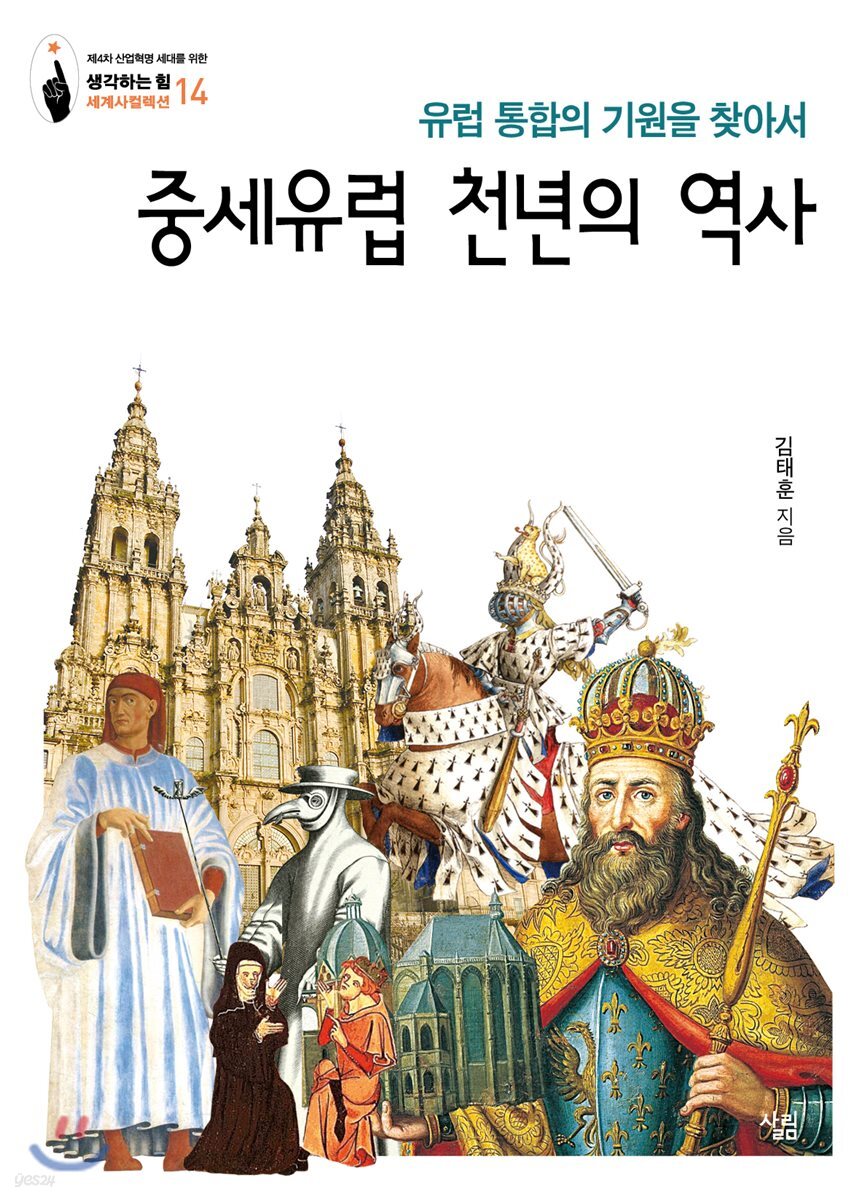
Cover description with reader consideration
The front cover was designed by combining important figures, cultural heritage, and photographic materials from each volume.
However, readers can only get an impression of the book by looking at the cover, and it is difficult to know what the specific image is.
So, to be considerate of readers, we included a brief description of the cover on the front flap to increase its visibility.
This can help you get a sneak peek of what's coming up in the book.
Everyone will admire it,
Theme World History 50 volumes planned for publication!
Sallim Publishing, which has opened new horizons in Korean intellectual culture by publishing 600 volumes of the [Salim Knowledge Series] over the past 15 years, has now put its expertise to work to produce Korea's first 50-volume themed world history series.
Following [Jin Hyeong-jun's World Literature Collection], [World History Collection] is the second planned publication in the "Power of Thinking Series."
[World History Collection] presents a grand feast of world history, with 50 themes chronologically organized from the origins of human history to the future, all collaborating to form a single work.
Among these, Volume 14, “A Thousand Years of Medieval Europe,” covers the long history of medieval Europe (c. 500–c. 1400 AD), which became the origin of modern European integration.
We are passing through a huge turning point in world history called the Fourth Industrial Revolution.
More than anyone else, children and youth who will live in the era of the Fourth Industrial Revolution are required to possess the "thinking power" to creatively integrate knowledge from various fields.
However, it is difficult to grow into an active global talent who will lead the future with only school studies that focus on memorization.
The [World History Collection] of the "Thinking Power Series" is a history reading program designed to solve these realistic educational problems.
For young people, the future leaders of the next generation, as well as parents and ordinary citizens living in this society, [World History Collection] will serve as an excellent guide to broaden their horizons through a global historical perspective and develop problem-solving skills within our society.
The "Thinking Power Series" is a project to raise children who are moved by reading a book, who are immersed in dreaming, who know how to think, and who are creative.
This series will continue as a classic reading project in the fields of literature, history, philosophy, and science, including [World History Collection], [World Literature Collection], [World Thought Collection], and [Science History Collection].
The thousand-year history of medieval Europe
It makes us look back on our present
It's a good 'stepping stone'!
If we look closely at the history of mankind, we can see a repetitive flow of things coming together and tearing apart, coming together and tearing apart.
The subject could be a huge civilization or nation, or a small society or organization.
In any place where diverse people live together, integration and division are inevitable fates, regardless of size.
'Europe' has experienced this history of unity and tearing apart more desperately than anyone else.
Although they were united because of Christianity, they had to go through a history of madness where people who believed in the same god killed each other because of that very religion.
We also had to endure the pain of being torn apart into numerous countries by wars that lasted for hundreds of years.
The war that was fought to the death of you and my life was so bad that it killed everyone.
Having learned these historical 'lessons', Europe has come to feel the value of peace and unity more deeply than anyone else.
So, I want to go back to the beautiful past before the history of division.
For Europeans, that era was none other than the "Middle Ages." In this book, "A Thousand Years of Medieval Europe," the author begins with the story of Charlemagne, who reunited a divided Europe.
Charlemagne maintained a significant portion of present-day European countries as a single nation called the Frankish Kingdom, laid the foundation for the European world, and brought about the flowering of medieval culture.
So even now, in Europe, Charlemagne is regarded as a symbol of European integration, to the extent that the 'Charles Prize' is awarded to leaders who have contributed to the unity of European nations and the harmony of cultural and political consciousness.
The history of medieval Europe may seem like a distant story to us, but we must not overlook the fact that the Middle Ages transcended physical distances and still have a profound impact on the present day.
In that sense, 『A Thousand Years of Medieval Europe』 provides a clue to a new perspective on the Middle Ages.
The author suggests that we consider together what meaning we can find and reinterpret in medieval Europe.
In doing so, this book presents five themes from medieval Europe that can help in finding this meaning.
We explore various aspects of the Middle Ages, from the Frankish kingdom of Charlemagne to the Viking Age, feudalism, universities and guilds, the power relations between the Pope and the Emperor, and the Black Death.
Although the Middle Ages have a strong negative image due to feudal subjugation, witch hunts, and epidemic diseases, medieval people also questioned the society of the time and laid the foundation for innovation.
This is precisely why the great changes of the Renaissance and the Reformation were not accidental.
The author also emphasizes that we, too, should not uncritically accept the challenges of our time, but rather continue to question and question ourselves. This is essential for overcoming past shortcomings and moving forward into the future.
In this respect, as the author says, the Middle Ages will serve as a good 'stepping stone' that allows us to look back on the present.
Features of the [World History Collection]
Feature 1.
A writing team comprised of field history education experts
[World History Collection] The 50 volumes are mostly composed of experts, such as teachers who teach students in history education settings or professors who research history education.
Feeling regret over the reality that world history education is being neglected compared to Korean history and the students' lack of historical awareness, history education experts have stepped forward to propose an alternative for world history education.
Feature 2.
World History Compass at a Glance
When you turn the cover, you will see a map and a chronology on the sidebar that indicate the historical coordinates of the content covered in each volume.
The infographic world map allows you to see the 'spatial location' of each region at a glance, and the main chronology allows you to see the 'time flow' of which period is covered at a glance.
Feature 3.
Rich and informative image data
The text contains various photos, maps, and statistical data necessary for reading, at appropriate locations.
Especially in the case of maps, the excellent expressiveness of an illustrator who has specialized in researching and producing historical maps for 20 years adds to the usefulness and fun of 'reading history through geography'.
Feature 4.
Flipped Learning and the World History Baccalaureate: Fostering Historical Imagination
At the end of each chapter, there are sections called ‘Flipped Learning’ and ‘World History Baccalaureate.’
We have created a forum for world history discussion, where you can choose a topic to think deeply about from among the topics covered in each chapter and discuss it in depth, or ask questions to stimulate your historical imagination.
In particular, this corner is perfect for preparing for the International Baccalaureate (IB) World History subject, which has emerged as a new educational alternative.
Feature 5.
A major timeline that summarizes the flow of history at a glance
At the end of each volume, there is a chronological table summarizing the main topics covered in the book.
A key chronology can be useful when summarizing what you've read after finishing a book, or when checking where you are in the larger flow of the book while reading.
Feature 6.
Cover description with reader consideration
The front cover was designed by combining important figures, cultural heritage, and photographic materials from each volume.
However, readers can only get an impression of the book by looking at the cover, and it is difficult to know what the specific image is.
So, to be considerate of readers, we included a brief description of the cover on the front flap to increase its visibility.
This can help you get a sneak peek of what's coming up in the book.
GOODS SPECIFICS
- Publication date: November 16, 2018
- Page count, weight, size: 220 pages | 152*210*20mm
- ISBN13: 9788952238580
- ISBN10: 8952238583
You may also like
카테고리
korean


korean

![GQ KOREA Mark (Monthly): December [2025]](http://librairie.coreenne.fr/cdn/shop/files/8ef265dbbfbf186523ed75ba7319009d.jpg?v=1765340328&width=3840)


