

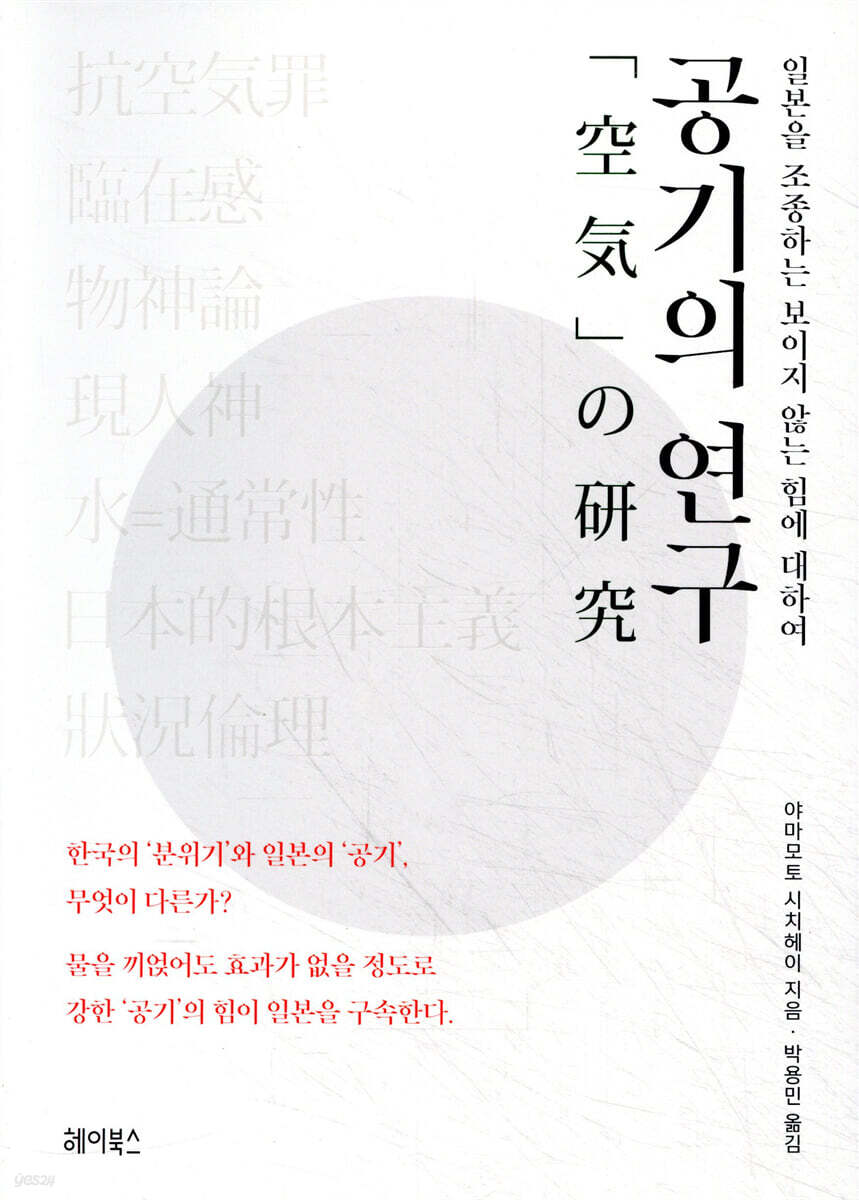
Study of air
 |
Description
Book Introduction
A textbook on "Japanism," which studies the invisible forces controlling Japan.
This book is a must-read textbook on 'Japanese people and Japanese social culture' if you want to know about Japan.
"There's nothing we can do about it now." What is "air," the invisible force that dominates reason in Japanese society? The powerful and absolute dominance and binding power of air, permeating politics, economy, society, military, culture, and even the very fabric of our beds, controls Japan.
Through this book's unique theory of Japan, we can glimpse into 'Japanese society, which seeks truth in fiction.'
This book is a must-read textbook on 'Japanese people and Japanese social culture' if you want to know about Japan.
"There's nothing we can do about it now." What is "air," the invisible force that dominates reason in Japanese society? The powerful and absolute dominance and binding power of air, permeating politics, economy, society, military, culture, and even the very fabric of our beds, controls Japan.
Through this book's unique theory of Japan, we can glimpse into 'Japanese society, which seeks truth in fiction.'
- You can preview some of the book's contents.
Preview
index
Translator's Note
Research on 'air'
Research on 'Water = Normality'
On Japanese fundamentalism
Reviews
commentary
annotation
Research on 'air'
Research on 'Water = Normality'
On Japanese fundamentalism
Reviews
commentary
annotation
Into the book
The theme of this book is to find an example of the Japanese human system, Basileia tou Anthrop, which constantly enters a new psychological order by constantly undergoing mental transformations between air and water.
--- p.5
Neighbors are the clearest mirrors in which we can see ourselves.
Comparing the "atmosphere" of Korea and the "air" of Japan will help us uncover the intangible collective pressures exerted in both countries, and will be far more helpful than comparing them to countries farther away.
Both countries.
In that respect, what Yamamoto Shichihei's "Study of Air" poses to Korean readers is not an answer, but a question.
--- p.11
Empathy is present in all peoples, but in order to establish a sense of presence, one must absolutize empathy and reach a state where it is not considered empathy.
Therefore, the premise is the normalization, unconsciousness, and even life-style of empathy.
In short, it must be a Japanese world, a world in which one cannot feel 'alive' without doing it.
--- p.50
I think this is ultimately the traditional way of acting in an animistic society.
I believe that the people we Japanese consider "pure human beings" at all times ultimately mean people who are purely faithful to their national traditions.
The catastrophic danger of this world will come when the 'air' that governs the entire nation does not collapse and change into another 'air', but is maintained by pure human beings, becoming semi-permanently fixed and permanently institutionalized.
It would be a stricter 'total air dependence' than fascism.
--- p.89
As explained in “Study of ‘Air’,” it is ‘air’ that makes decisions, and the principle by which air is created is to perceive the object with a sense of presence.
And the principle of present-sensory grasp is a mental attitude that identifies oneself with an object by unilaterally empathizing with the object and rejecting analysis of the object.
Therefore, analysis of the object cannot escape the sense of presence.
--- p.190
Needless to say, every Japanese person at the time knew that the Emperor was merely a human being.
I also knew very well that it was just and faithful not to reveal what I knew, and that revealing it would be neither just nor faithful.
In short, anyone who speaks it out becomes a non-Japanese, that is, a person who is 'not Japanese.'
--- p.195
The tradition of not looking at external funds has made it impossible to see one's own 'fundi'.
And if this continues to change three or four times, won't it eventually lose its power and enter a state of stagnation (rather than a state of peace) where 'thoughts and life are not separated', and won't it reappear as a closed-off society?
This direction clearly exists, but its realization seems impossible.
If so, we have no choice but to re-evaluate our own 'fundi'.
--- p.261
In the end, even though what was 'eliminated' in the name of democracy may seem to have disappeared for a while, its true nature has transformed into invisible air and transparent water, binding us.
How can we break free from this magical bondage and escape it? The only way to escape is to grasp it anew.
When a person grasps something, he can reverse the restraints that have been holding him back and take a step forward to a different position.
Only when one can truly grasp 'air' can one truly be free from the constraints of air.
--- p.5
Neighbors are the clearest mirrors in which we can see ourselves.
Comparing the "atmosphere" of Korea and the "air" of Japan will help us uncover the intangible collective pressures exerted in both countries, and will be far more helpful than comparing them to countries farther away.
Both countries.
In that respect, what Yamamoto Shichihei's "Study of Air" poses to Korean readers is not an answer, but a question.
--- p.11
Empathy is present in all peoples, but in order to establish a sense of presence, one must absolutize empathy and reach a state where it is not considered empathy.
Therefore, the premise is the normalization, unconsciousness, and even life-style of empathy.
In short, it must be a Japanese world, a world in which one cannot feel 'alive' without doing it.
--- p.50
I think this is ultimately the traditional way of acting in an animistic society.
I believe that the people we Japanese consider "pure human beings" at all times ultimately mean people who are purely faithful to their national traditions.
The catastrophic danger of this world will come when the 'air' that governs the entire nation does not collapse and change into another 'air', but is maintained by pure human beings, becoming semi-permanently fixed and permanently institutionalized.
It would be a stricter 'total air dependence' than fascism.
--- p.89
As explained in “Study of ‘Air’,” it is ‘air’ that makes decisions, and the principle by which air is created is to perceive the object with a sense of presence.
And the principle of present-sensory grasp is a mental attitude that identifies oneself with an object by unilaterally empathizing with the object and rejecting analysis of the object.
Therefore, analysis of the object cannot escape the sense of presence.
--- p.190
Needless to say, every Japanese person at the time knew that the Emperor was merely a human being.
I also knew very well that it was just and faithful not to reveal what I knew, and that revealing it would be neither just nor faithful.
In short, anyone who speaks it out becomes a non-Japanese, that is, a person who is 'not Japanese.'
--- p.195
The tradition of not looking at external funds has made it impossible to see one's own 'fundi'.
And if this continues to change three or four times, won't it eventually lose its power and enter a state of stagnation (rather than a state of peace) where 'thoughts and life are not separated', and won't it reappear as a closed-off society?
This direction clearly exists, but its realization seems impossible.
If so, we have no choice but to re-evaluate our own 'fundi'.
--- p.261
In the end, even though what was 'eliminated' in the name of democracy may seem to have disappeared for a while, its true nature has transformed into invisible air and transparent water, binding us.
How can we break free from this magical bondage and escape it? The only way to escape is to grasp it anew.
When a person grasps something, he can reverse the restraints that have been holding him back and take a step forward to a different position.
Only when one can truly grasp 'air' can one truly be free from the constraints of air.
--- p.284
Publisher's Review
A must-read textbook on "Japanese Studies" if you want to understand Japan.
― A classic on Japanese and Japanese socio-cultural theory, published in 1977 and still loved today.
Lee Eo-ryeong's "The Japanese Who Are Aiming for Reduction," which is considered the best study of Japan written by a domestic author, is a book that explains the cultural genetic factors of the Japanese people using the keywords "concentration" and "reduction."
Ruth Benedict's "The Chrysanthemum and the Sword," a world-renowned classic on Japan, defines the duality of the Japanese as "the Japanese with beautiful chrysanthemums in their hands and cold swords at their waists."
The former deals with the relationship between Korea and Japan, close yet distant countries that have shared the pain of history, while the latter, commissioned by the U.S. State Department during World War II, investigated the national character of the Japanese, an enemy nation, based solely on academic papers and literature, without even visiting Japan. Therefore, despite their fame, both books inevitably have limitations in their research.
This book, "A Study of Air," written in 1977 by Shichihei Yamamoto, a leading figure in Japanese studies, is a study of Japan and Japanese socio-cultural studies as seen by Japanese intellectuals themselves, and is a famous work that is still read as a textbook on Japanese studies 40 years later.
The author explained the unique reason why Japanese people are collectively dominated by an intangible atmosphere using the rhetorical expressions “air” and “water.”
In other words, Japanese society and organizations are determined by 'air' rather than logical theories or rational grounds.
The author was the first to name the "air" in the expression "KY (kuki yomenai, meaning not being able to read the air) = lack of tact," which still frequently appears in everyday Japanese society today.
What is the invisible force that governs reason in Japanese society?
― The power of 'air' is so strong that even pouring water on it has no effect, binding Japan.
The author says that in many cases, the Japanese often say things like, “There is criticism that such a decision was made, but in the atmosphere of the meeting at the time…”, “In terms of the atmosphere in the meeting room at the time…”, “If you criticize without knowing the atmosphere of society at the time…”, “Don’t act like you know everything when you don’t even know the atmosphere there”, “The atmosphere there was completely different from what I expected”, etc., and that it is “the atmosphere, not the people” that ultimately decides something.
The author explains the binding force of air in relation to national and military issues that arose during World War II.
The fact that all the experts involved in the decision to sortie the battleship Yamato thought it was reckless and had no chance of winning, yet they could not oppose it, is presented as a typical example of the dominance of 'air', and the book proves throughout that the air led by the emperor is permeating politics, economy, society, military, culture, and even under our blankets.
Yamamoto Shichihei's theory of Japan, called "air theory," is a common phenomenon that can be observed not only in Japan but also in Korea and all over the world, where decisions are made and implemented within the atmosphere and flow.
The reason why Japan is explained through the theory of air is because of the sensitive and rapid response and adaptation that only the Japanese have to air, and above all, because of the powerful and absolute dominance and binding power of air.
In other words, Japanese decision-making is governed by an unknown 'air', and just as people cannot escape from the real air, the Japanese cannot be free from 'air'.
In conversations and discussions in Japanese society, 'air' is an invisible shackle that acts on things that everyone feels or recognizes as such, but cannot be spoken of, and furthermore, it is not permitted to deny them.
Although there are opinions that point out the problems by revealing the existence of such 'air', such remarks as the author's so-called 'pouring water' are often used as a target of appropriate criticism and rather reinforce the 'air' of that place, and everyone becomes bound by the air of that place for fear of such condemnation.
The author defines the Japanese as "geniuses who perceive situations with a sense of presence and, conversely, are governed by them, and act accordingly. Even if they logically and systematically argue that a situation will arise before it happens, they don't act because of it. However, they know how to respond to situations instantly."
Citing examples such as Mao Zedong's 'Great Leap Forward' and the detergent commotion caused by the oil shock, he pointed out that while the Japanese were under the control of 'air', their mental attitudes did not change even with logical persuasion, and that scientific arguments through words were powerless.
A Society Seeking Truth in Fiction Through a Unique Theory of Japan
― Consisting of three short essays, the rich commentary of 192 translator's notes aids understanding.
This 'air', this 'unseen force' that wields power over all, not to mention trivial everyday conversations, dominates not only the crucial decisions that determine the fate of the nation, but also the process of forming public opinion regarding the nation's direction, making cool-headed and objective discussion and accurate judgment difficult.
Even in this day and age, there are many cases where this atmosphere destroys the reasoning of Japanese people and hinders rational policy decisions.
If many people cannot avoid this kind of air-dominated thinking and are bound by it in their decisions, they may again make the mistake of agreeing to and rushing into a war that everyone wants to avoid.
To avoid such a situation, the author emphasizes that it is necessary to first visualize the 'air', recognize its existence, and objectively and critically reveal its nature, thereby 'pouring cold water' on it.
This book is divided into three parts.
First, in [Study of 'Air'], we examine the perception of presence and the composition of air through several examples.
[The study of 'water = normality'] explains the method of 'pouring water' to resist the dominance of air, that is, normality, and the Japanese situational logic and situational ethics that complement the relationship between air and water.
Finally, in [On Japanese Fundamentalism], the contradiction of Japanese society, where the sage god and evolution coexist, is explained as Japanese fundamentalism.
Additionally, this Korean edition includes 192 translator's notes.
The author creates his own concepts and overlays common vocabulary with unique meanings, and there are passages where the explanations are stingy, and there are also people and events that only Japanese people would know well, but the translator researched the materials and received advice on each one to add faithful explanations to help Korean readers understand.
― A classic on Japanese and Japanese socio-cultural theory, published in 1977 and still loved today.
Lee Eo-ryeong's "The Japanese Who Are Aiming for Reduction," which is considered the best study of Japan written by a domestic author, is a book that explains the cultural genetic factors of the Japanese people using the keywords "concentration" and "reduction."
Ruth Benedict's "The Chrysanthemum and the Sword," a world-renowned classic on Japan, defines the duality of the Japanese as "the Japanese with beautiful chrysanthemums in their hands and cold swords at their waists."
The former deals with the relationship between Korea and Japan, close yet distant countries that have shared the pain of history, while the latter, commissioned by the U.S. State Department during World War II, investigated the national character of the Japanese, an enemy nation, based solely on academic papers and literature, without even visiting Japan. Therefore, despite their fame, both books inevitably have limitations in their research.
This book, "A Study of Air," written in 1977 by Shichihei Yamamoto, a leading figure in Japanese studies, is a study of Japan and Japanese socio-cultural studies as seen by Japanese intellectuals themselves, and is a famous work that is still read as a textbook on Japanese studies 40 years later.
The author explained the unique reason why Japanese people are collectively dominated by an intangible atmosphere using the rhetorical expressions “air” and “water.”
In other words, Japanese society and organizations are determined by 'air' rather than logical theories or rational grounds.
The author was the first to name the "air" in the expression "KY (kuki yomenai, meaning not being able to read the air) = lack of tact," which still frequently appears in everyday Japanese society today.
What is the invisible force that governs reason in Japanese society?
― The power of 'air' is so strong that even pouring water on it has no effect, binding Japan.
The author says that in many cases, the Japanese often say things like, “There is criticism that such a decision was made, but in the atmosphere of the meeting at the time…”, “In terms of the atmosphere in the meeting room at the time…”, “If you criticize without knowing the atmosphere of society at the time…”, “Don’t act like you know everything when you don’t even know the atmosphere there”, “The atmosphere there was completely different from what I expected”, etc., and that it is “the atmosphere, not the people” that ultimately decides something.
The author explains the binding force of air in relation to national and military issues that arose during World War II.
The fact that all the experts involved in the decision to sortie the battleship Yamato thought it was reckless and had no chance of winning, yet they could not oppose it, is presented as a typical example of the dominance of 'air', and the book proves throughout that the air led by the emperor is permeating politics, economy, society, military, culture, and even under our blankets.
Yamamoto Shichihei's theory of Japan, called "air theory," is a common phenomenon that can be observed not only in Japan but also in Korea and all over the world, where decisions are made and implemented within the atmosphere and flow.
The reason why Japan is explained through the theory of air is because of the sensitive and rapid response and adaptation that only the Japanese have to air, and above all, because of the powerful and absolute dominance and binding power of air.
In other words, Japanese decision-making is governed by an unknown 'air', and just as people cannot escape from the real air, the Japanese cannot be free from 'air'.
In conversations and discussions in Japanese society, 'air' is an invisible shackle that acts on things that everyone feels or recognizes as such, but cannot be spoken of, and furthermore, it is not permitted to deny them.
Although there are opinions that point out the problems by revealing the existence of such 'air', such remarks as the author's so-called 'pouring water' are often used as a target of appropriate criticism and rather reinforce the 'air' of that place, and everyone becomes bound by the air of that place for fear of such condemnation.
The author defines the Japanese as "geniuses who perceive situations with a sense of presence and, conversely, are governed by them, and act accordingly. Even if they logically and systematically argue that a situation will arise before it happens, they don't act because of it. However, they know how to respond to situations instantly."
Citing examples such as Mao Zedong's 'Great Leap Forward' and the detergent commotion caused by the oil shock, he pointed out that while the Japanese were under the control of 'air', their mental attitudes did not change even with logical persuasion, and that scientific arguments through words were powerless.
A Society Seeking Truth in Fiction Through a Unique Theory of Japan
― Consisting of three short essays, the rich commentary of 192 translator's notes aids understanding.
This 'air', this 'unseen force' that wields power over all, not to mention trivial everyday conversations, dominates not only the crucial decisions that determine the fate of the nation, but also the process of forming public opinion regarding the nation's direction, making cool-headed and objective discussion and accurate judgment difficult.
Even in this day and age, there are many cases where this atmosphere destroys the reasoning of Japanese people and hinders rational policy decisions.
If many people cannot avoid this kind of air-dominated thinking and are bound by it in their decisions, they may again make the mistake of agreeing to and rushing into a war that everyone wants to avoid.
To avoid such a situation, the author emphasizes that it is necessary to first visualize the 'air', recognize its existence, and objectively and critically reveal its nature, thereby 'pouring cold water' on it.
This book is divided into three parts.
First, in [Study of 'Air'], we examine the perception of presence and the composition of air through several examples.
[The study of 'water = normality'] explains the method of 'pouring water' to resist the dominance of air, that is, normality, and the Japanese situational logic and situational ethics that complement the relationship between air and water.
Finally, in [On Japanese Fundamentalism], the contradiction of Japanese society, where the sage god and evolution coexist, is explained as Japanese fundamentalism.
Additionally, this Korean edition includes 192 translator's notes.
The author creates his own concepts and overlays common vocabulary with unique meanings, and there are passages where the explanations are stingy, and there are also people and events that only Japanese people would know well, but the translator researched the materials and received advice on each one to add faithful explanations to help Korean readers understand.
GOODS SPECIFICS
- Date of issue: February 20, 2018
- Page count, weight, size: 296 pages | 458g | 148*210*20mm
- ISBN13: 9791188366057
- ISBN10: 118836605X
You may also like
카테고리
korean


korean

![GQ KOREA Mark (Monthly): December [2025]](http://librairie.coreenne.fr/cdn/shop/files/8ef265dbbfbf186523ed75ba7319009d.jpg?v=1765340328&width=3840)


