

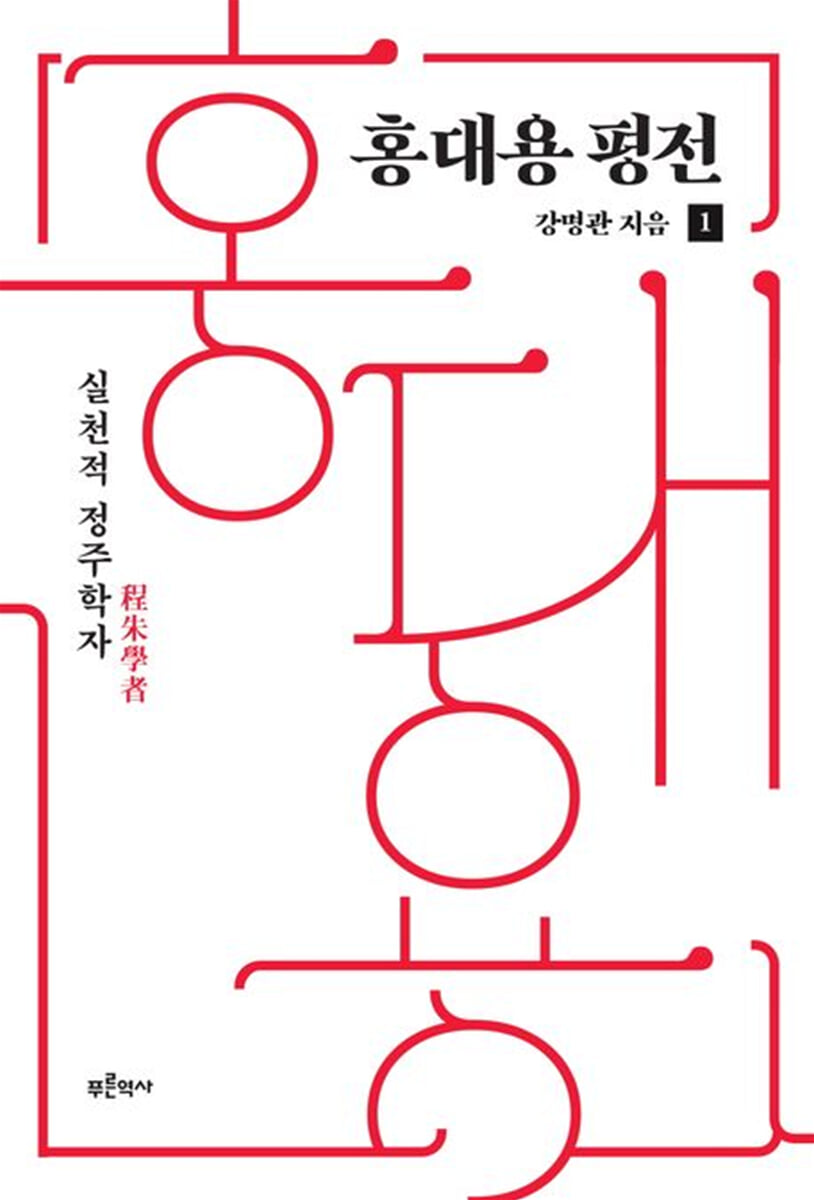
Hong Dae-yong Biography 1
 |
Description
Book Introduction
A brilliant scientist who advocated the geomantic theory?
A social thinker who advocated for the abolition of the caste system?
An internal nationalist who denies the theory of fire?
Forget the myth surrounding Silhak scholar Damheon.
The definitive critical reading of the Damheon myth
Hong Dae-yong, who was active in the late Joseon Dynasty, is a representative Silhak scholar who is also counted as one of the six scholars who ‘shine in thought for 4,000 years.’
The author meticulously reads a vast body of relevant texts and presents a compelling challenge to this prevailing view.
By studying Hong Dae-yong's representative works, such as 『Uisanmundap』 and 『Imhagyeongryun』, as well as the letters he exchanged with Qing intellectuals in Beijing and contemporary Western mathematical and scientific writings such as 『Surijeongon』, he succeeded in revealing Hong Dae-yong's true nature.
This book, which began writing the manuscript 16 years ago and took three years to edit, is approximately 5,500 pages long—in the meantime, new sources have come to light, adding approximately 1,000 pages—and is a masterpiece biography rarely seen in our publishing house just by its volume alone.
A social thinker who advocated for the abolition of the caste system?
An internal nationalist who denies the theory of fire?
Forget the myth surrounding Silhak scholar Damheon.
The definitive critical reading of the Damheon myth
Hong Dae-yong, who was active in the late Joseon Dynasty, is a representative Silhak scholar who is also counted as one of the six scholars who ‘shine in thought for 4,000 years.’
The author meticulously reads a vast body of relevant texts and presents a compelling challenge to this prevailing view.
By studying Hong Dae-yong's representative works, such as 『Uisanmundap』 and 『Imhagyeongryun』, as well as the letters he exchanged with Qing intellectuals in Beijing and contemporary Western mathematical and scientific writings such as 『Surijeongon』, he succeeded in revealing Hong Dae-yong's true nature.
This book, which began writing the manuscript 16 years ago and took three years to edit, is approximately 5,500 pages long—in the meantime, new sources have come to light, adding approximately 1,000 pages—and is a masterpiece biography rarely seen in our publishing house just by its volume alone.
index
Volume 1
ㆍAt the beginning of the book
[01] Damheon, a member of the Gyeonghwa clan
The Gyeonghwa Aristocracy of Chungcheong Province | Father Hong Yeok and Uncle Hong Eok | The Status and Economic Power of the Damheon Family
[02] A time when I was a wandering teenager
Childhood | Learning the geomungo and hanging out with singers and shamans | Conflict and anguish: past or academic?
[03] Seoksil Seowon
Master Kim Won-haeng | Seoksil Seowon | Letter to Master | Debate in Mungyeong |
Debating with Master Kim Won-haeng | Lectures on Elementary Learning, 1753-1754 | Small Things in Daily Life
[04] Studying in your youth, Confucian classics, Neo-Confucianism, and historical criticism
Even adults have questions | 〈Questions on the Great Learning〉 | 〈Questions on the Analects〉 | 〈Questions on Mencius〉 | 〈Questions on the Doctrine of the Mean〉 |
〈Preface〉 | 〈Byungui of the Book of Poetry〉 | 〈Byungui of the Book of Changes〉 | 〈In the Enlightenment Period〉 | Studying Neo-Confucianism |
〈Saron〉, Criticism of 《Zizhi Tongjian》
[05] The Birth of a Practical Sedentist
A Letter to the Editor-in-Chief | The Birth of a Practical Sedentist | Damheon, the Pyurch Theorist
[06] Encountering Western Astronomy
Following my father Hongyeok to Naju | Meeting Na Gyeongjeok | Joseon's Armillary Sphere |
The Armillary Globe Created by Damheon | The Level of Damheon's Astronomy Before His Envoy | The Hongyeok Incident
[07] The stability and prosperity of the Qing Dynasty as seen from Beijing, and the friendship that transcended borders
Departing for Beijing in the Fall of 1765 | Purpose of the Journey to Beijing | Crossing the Yalu River and Arriving in Beijing in a Month | Two Months in Beijing, January and February 1766 | Views on the Qing, Loyalty to the Ming |
Korean Clothing and Chinese Clothing | The Stability and Prosperity of the Qing Dynasty | Qing Politics | The Rationality of Chinese Civilization |
Beijing, a place where people from all over the world meet | Western devices, Japanese calendars and clocks | Ryukyu, Mongolia, Huihui, and Russian people |
A Western Catholic priest | Befriending Korean intellectuals like Eom Seong, Ban Jeong-gyun, and Yuk Bi | A final meeting and farewell | Friends made on the way home | The significance of traveling to Beijing, China
[08] Friendship through letters and the turbulent Beijing experience
A Friendship Continued Through Letters | Sending the First Letter in the Summer of 1766 |
January 1767: Receiving letters from Ban Jeong-gyun and Eom Seong | Two reactions to Damheon's Beijing experience | Debate with Kim Jong-hu in 1767 | Measles and Eom Seong's death | Letter written in the fall of 1767, written just before Eom Seong's death | Reply to Eom Seong's death, mourning his death | Second debate with Kim Jong-hu regarding the study of the Book of Rites | 1769: Continued debate with Kim Jong-hu |
In May 1769, he received letters from Yuk Bi and Ban Jeong-gyun in the return party of the Dongjisa.
Sending a letter to Kim Jong-hu refuting the accusations again | Letter sent to China in 1769
ㆍNote
ㆍSearch
ㆍAt the beginning of the book
[01] Damheon, a member of the Gyeonghwa clan
The Gyeonghwa Aristocracy of Chungcheong Province | Father Hong Yeok and Uncle Hong Eok | The Status and Economic Power of the Damheon Family
[02] A time when I was a wandering teenager
Childhood | Learning the geomungo and hanging out with singers and shamans | Conflict and anguish: past or academic?
[03] Seoksil Seowon
Master Kim Won-haeng | Seoksil Seowon | Letter to Master | Debate in Mungyeong |
Debating with Master Kim Won-haeng | Lectures on Elementary Learning, 1753-1754 | Small Things in Daily Life
[04] Studying in your youth, Confucian classics, Neo-Confucianism, and historical criticism
Even adults have questions | 〈Questions on the Great Learning〉 | 〈Questions on the Analects〉 | 〈Questions on Mencius〉 | 〈Questions on the Doctrine of the Mean〉 |
〈Preface〉 | 〈Byungui of the Book of Poetry〉 | 〈Byungui of the Book of Changes〉 | 〈In the Enlightenment Period〉 | Studying Neo-Confucianism |
〈Saron〉, Criticism of 《Zizhi Tongjian》
[05] The Birth of a Practical Sedentist
A Letter to the Editor-in-Chief | The Birth of a Practical Sedentist | Damheon, the Pyurch Theorist
[06] Encountering Western Astronomy
Following my father Hongyeok to Naju | Meeting Na Gyeongjeok | Joseon's Armillary Sphere |
The Armillary Globe Created by Damheon | The Level of Damheon's Astronomy Before His Envoy | The Hongyeok Incident
[07] The stability and prosperity of the Qing Dynasty as seen from Beijing, and the friendship that transcended borders
Departing for Beijing in the Fall of 1765 | Purpose of the Journey to Beijing | Crossing the Yalu River and Arriving in Beijing in a Month | Two Months in Beijing, January and February 1766 | Views on the Qing, Loyalty to the Ming |
Korean Clothing and Chinese Clothing | The Stability and Prosperity of the Qing Dynasty | Qing Politics | The Rationality of Chinese Civilization |
Beijing, a place where people from all over the world meet | Western devices, Japanese calendars and clocks | Ryukyu, Mongolia, Huihui, and Russian people |
A Western Catholic priest | Befriending Korean intellectuals like Eom Seong, Ban Jeong-gyun, and Yuk Bi | A final meeting and farewell | Friends made on the way home | The significance of traveling to Beijing, China
[08] Friendship through letters and the turbulent Beijing experience
A Friendship Continued Through Letters | Sending the First Letter in the Summer of 1766 |
January 1767: Receiving letters from Ban Jeong-gyun and Eom Seong | Two reactions to Damheon's Beijing experience | Debate with Kim Jong-hu in 1767 | Measles and Eom Seong's death | Letter written in the fall of 1767, written just before Eom Seong's death | Reply to Eom Seong's death, mourning his death | Second debate with Kim Jong-hu regarding the study of the Book of Rites | 1769: Continued debate with Kim Jong-hu |
In May 1769, he received letters from Yuk Bi and Ban Jeong-gyun in the return party of the Dongjisa.
Sending a letter to Kim Jong-hu refuting the accusations again | Letter sent to China in 1769
ㆍNote
ㆍSearch
Into the book
Damheon's family was a top-class Gyeongwha clan that had been affiliated with the orthodox Noron faction since the 17th century.
In particular, Damheon's great-grandfather Hong Suk and his family flourished, producing four generations of successful candidates for the civil service examination.
Moreover, Damheon's family was very wealthy economically.
The fact that Damheon was a member of a powerful Noron faction family and lived a life of economic stability would have fundamentally defined Damheon's character.
--- p.40
Damheon said that the act of learning is to practice the innate moral principle of all humans, which Jeongjuhak speaks of, not in words but in everyday life through action. In “Self-control”, we can see Damheon strictly controlling his body and mind according to Jeongjuhak’s moral concept, that is, putting Jeongjuhak’s principles into practice with his own body.
--- p.257
In 1775, when Damheon was entering the position of Crown Prince, when King Jeongjo (before ascending to the throne at this time) said that Song Siyeol's Northern Expedition was empty talk, Damheon firmly replied, "That is not empty talk."... Nevertheless, the view that the Qing was treasonous and the legitimacy of the Northern Expedition were not subject to criticism in the realm of public discourse.
Damheon… immediately accepted it because it was his conviction, but also because he could not openly deny the Northern Expedition.
--- p.272
The significance of Damheon Honcheonui was that, like Song I-yeong's Honcheonui, it utilized the principle of the driving force of the self-winding bell to accurately represent the temporal movements of celestial bodies such as the sun, moon, stars, and the Earth in a sophisticated three-dimensional form.
--- p.302
Damheon's meeting with Na Gyeong-jeok and the creation of the armillary sphere was the catalyst for his full-fledged interest in Western astronomy.
From meeting Na Gyeong-jeok in 1759 to making an armillary sphere and placing it in Nongsu-gak in 1762, Damheon devoted himself to astronomy and the sound of a bell for about four or five years.
--- p.303
For Damheon, who was absorbed in studying the scriptures and history books, the creation of Western astronomy, the chime, and the armillary sphere provided a very important turning point in his studies and thoughts.
This eventually led him to leave for Beijing in the winter of 1765.
--- p.315
Before leaving for China, Damheon learned Chinese in advance… Damheon decided to go to Beijing because, as a Huai theorist, he wanted to meet Chinese intellectuals and discuss world affairs.
On the other hand, there was also an intention to confirm the prosperity of the barbarian Qing and to explore the reasons for it.
And behind it all, there may have been a curiosity to meet Westerners and have intellectual discussions about astronomy and mathematics.
--- p.328
On February 1st, Bi Jang Lee Gi-seong went to Yurichang to buy glasses, met Eom Seong and Ban Jeong-gyun, and got the glasses for free. After being impressed by their personalities, he recommended that Damheon meet the two of them.
With the glasses as an opportunity, Damheon visited Ganjeong-dong two days later on the 3rd, and they met seven times thereafter.
--- p.350
Damheon believed that the Qing's rule over China, a 'filthy barbarian', had led to the contamination of Chinese civilization.
However, under the rule of the barbarians, China enjoyed unprecedented prosperity, with low taxes levied on the people and no forced labor.
Moreover, under Qing rule, both China and its surrounding areas enjoyed peace.
Even as a scholar who studied Chinese history, I have never seen a China this stable.
--- p.375
Damheon meticulously observed every aspect of Chinese life.… From the moment he boarded the Taepyeonggeo at Bonghwangseong on November 30th, he meticulously examined its systems and conveniences.
On December 6th, while leaving Nanga Mountain and heading to Sinyodong, he saw a donkey turning a millstone to grind wheat… On December 9th, while sightseeing in downtown Shenyang… he carefully observed how to make paper, and at the Soheuk Mountain lodge, he studied the principles of making a windmill for crushing grain and wrote about them.
On the other hand, on December 24th, while passing through Goryeobo, he observes the Yongdure Well, and on December 26th, at Jorimjang, he observes how horses are fed.
--- p.379
The convenience of carts and ships that Damheon emphasized later developed into the transportation and distribution of goods using carts and ships, and the theory of international trade by Park Je-ga.
The carts and ships became the origin of the idea of learning from Qing culture, such as that of Bak Je-ga and Bak Ji-won.
However, in the case of Damheon, there is no writing other than “Yeongi” that mentions the rationality of Chinese civilization.
His later writing, “Imha Gyeongryun,” which confirms his reformist theory, envisions a society that does not allow the distribution of goods using ships and carts, but rather prohibits the people from moving their residences and strictly prohibits excessive consumption.
--- p.385
Damheon perceives the West through mathematics, astronomy, and astronomical observation instruments.
Other than this, the West, such as religion and Christianity, was not of interest.
Western history and society were not even brought to mind.
Damheon believed that Chinese astronomy was made up of 'delusions and conjectures', while Western astronomy was made up of observations using instruments and mathematical calculations.
Western mathematics and astronomy seem to have had a shocking influence on Damheon's worldview.
--- p.402
Damheon, accompanied by Lee Deokseong and interpreter Hong Myeongbok, visits the Catholic Church.… Upon arriving at the church, he waited in the guest house before Yu Songryeong and Po Woogwan came out.
In the guest house, Damheon looked at an astronomical chart depicting the 'constellations of the sky' and a world map, and when he went inside, he saw Western paintings on the walls.
--- p.405
In the “Ganjeongdongpildam” it is written, “Although Yangming’s scholarship is truly regrettable, how could it not be as vast as heaven and earth compared to the scholarship of later generations’ Gisong?”
Damheon's criticism of 'Gisong', an academic practice that merely memorizes texts without practice or execution, comes from the basic beliefs of Damheon, a practical scholar of the Joseon Dynasty.
Damheon maintained a critical attitude toward Wang Yangming's scholarship based on the truth of Jeongjuhak, while also pointing out the evils of Jeongjuhak without practice and highly evaluating the problematic awareness of Yangminghak that prioritized practice.
--- p.428
Damheon's thoughts, language, actions, and breadth of knowledge were already overwhelming Eomseong and Banjeonggyun.
Ban Jeong-gyun said that he was not even fit to be Damheon's servant, and Eom Seong said, "It is not enough to say that he is a Confucian scholar rather than a pure Confucian scholar."
He lamented, “It’s a shame that I can’t follow in and become a student.”
--- p.465
Damheon never gave up on being a scholar of Jeongju.
Perhaps until the end of his life he never went beyond the scope of the study of the mind.
However, what he criticized was the blind worship of runners.
Damheon felt disgusted with the Joseon intellectual society that even protected and suppressed questions about Zhu Xi's interpretation of the classics.
It was difficult for Damheon to accept the criticism of Zhu Xi's doctrine preached to him by Eom Seong, Ban Jeong-gyun, and Yuk Bi, but the very presentation of such lively counterarguments was something that was difficult to find in Joseon intellectual society.
--- p.510
This debate with Kim Jong-hu appears to have been an opportunity for Damheon to think critically about the theory of fire.
And that critical thinking, combined with his experience in Beijing and his study of Western astronomy and natural science, led him to reject the theory of fire in his "Questions on Mount Yi."
Meanwhile, King Jeongjo agreed with the conservatives' claims and in 1786 (the 10th year of King Jeongjo's reign) prohibited the Joseon diplomatic mission from having personal contact with Chinese intellectuals in Beijing and also blocked the import of books.
--- p.517
Damheon says that although there are many gifted people in the world, few devote themselves to classical studies because of the burdens and harm caused by the examination of government officials, materialism, and complacency. Even fewer devote themselves to practical studies because of the obstacles of poetry, songs, and exhortations. Merit and profit have muddied the studies, Taoism and Buddhism have debauched the mind, and Yuk Sang-san and Wang Yangming have confused the truth, so few stand tall in the study of righteous studies.
--- p.534
What was most uncomfortable for Kim Jong-hu was the statement, “After Emperor Kangxi, he suppressed and subjugated an era while resting with the people.”
This meant that Damheon approved of the Qing's rule over China, a barbaric state.… This would have shaken the thinking of Kim Jong-hu, a die-hard Noron faction member who was using hatred and revenge against the Qing as a means of maintaining power.
--- p.573
Damheon first pointed out that the reason Joseon was a part of the East was because of its geographical boundaries.
Regionality is one of the factors that determines transfer.
Joseon was bound to become a traitor due to its geographical location on the periphery of China, the 'center of civilization.'
But… even if you are born in a region of migration and live in a space of migration, you can become an adult or a wise man.
The decisive basis for distinguishing between migration and centralization is civilization.
--- p.579
Damheon goes a step further and argues that no matter how long and meticulously one analyzes the text of "Etiquette," it has no connection to moral practice or the rise and fall of families and nations, and will only lead to unproductive debate.
--- p.630
Another thing to note is the metaphor that “unripe grains are not as good as ripened stone rice”, which was used to say that the study of 《Yi-rye》 is inferior to the calendar, mountains and rivers, rice cakes, and military supplies.… ‘In’ is the highest value of Confucianism.
But if you don't internalize it enough and put it into practice, it's no better than perfectly practicing a lesser value.
--- p.632
Kim Jong-hu, based on his own conclusion, says, “I have heard of cases where a country was ruined and a family was ruined because of a lack of etiquette, but I have never heard of a case where a country was lost because it did not govern the calendar, mountains, rivers, grains, and military.”
For Kim Jong-hu, the essential conditions for the establishment and maintenance of a nation were etiquette, and it could not be the calendar, mountains and rivers, grain, or military.
Kim Jong-hoo viewed it as functional and peripheral.
In particular, Damheon's great-grandfather Hong Suk and his family flourished, producing four generations of successful candidates for the civil service examination.
Moreover, Damheon's family was very wealthy economically.
The fact that Damheon was a member of a powerful Noron faction family and lived a life of economic stability would have fundamentally defined Damheon's character.
--- p.40
Damheon said that the act of learning is to practice the innate moral principle of all humans, which Jeongjuhak speaks of, not in words but in everyday life through action. In “Self-control”, we can see Damheon strictly controlling his body and mind according to Jeongjuhak’s moral concept, that is, putting Jeongjuhak’s principles into practice with his own body.
--- p.257
In 1775, when Damheon was entering the position of Crown Prince, when King Jeongjo (before ascending to the throne at this time) said that Song Siyeol's Northern Expedition was empty talk, Damheon firmly replied, "That is not empty talk."... Nevertheless, the view that the Qing was treasonous and the legitimacy of the Northern Expedition were not subject to criticism in the realm of public discourse.
Damheon… immediately accepted it because it was his conviction, but also because he could not openly deny the Northern Expedition.
--- p.272
The significance of Damheon Honcheonui was that, like Song I-yeong's Honcheonui, it utilized the principle of the driving force of the self-winding bell to accurately represent the temporal movements of celestial bodies such as the sun, moon, stars, and the Earth in a sophisticated three-dimensional form.
--- p.302
Damheon's meeting with Na Gyeong-jeok and the creation of the armillary sphere was the catalyst for his full-fledged interest in Western astronomy.
From meeting Na Gyeong-jeok in 1759 to making an armillary sphere and placing it in Nongsu-gak in 1762, Damheon devoted himself to astronomy and the sound of a bell for about four or five years.
--- p.303
For Damheon, who was absorbed in studying the scriptures and history books, the creation of Western astronomy, the chime, and the armillary sphere provided a very important turning point in his studies and thoughts.
This eventually led him to leave for Beijing in the winter of 1765.
--- p.315
Before leaving for China, Damheon learned Chinese in advance… Damheon decided to go to Beijing because, as a Huai theorist, he wanted to meet Chinese intellectuals and discuss world affairs.
On the other hand, there was also an intention to confirm the prosperity of the barbarian Qing and to explore the reasons for it.
And behind it all, there may have been a curiosity to meet Westerners and have intellectual discussions about astronomy and mathematics.
--- p.328
On February 1st, Bi Jang Lee Gi-seong went to Yurichang to buy glasses, met Eom Seong and Ban Jeong-gyun, and got the glasses for free. After being impressed by their personalities, he recommended that Damheon meet the two of them.
With the glasses as an opportunity, Damheon visited Ganjeong-dong two days later on the 3rd, and they met seven times thereafter.
--- p.350
Damheon believed that the Qing's rule over China, a 'filthy barbarian', had led to the contamination of Chinese civilization.
However, under the rule of the barbarians, China enjoyed unprecedented prosperity, with low taxes levied on the people and no forced labor.
Moreover, under Qing rule, both China and its surrounding areas enjoyed peace.
Even as a scholar who studied Chinese history, I have never seen a China this stable.
--- p.375
Damheon meticulously observed every aspect of Chinese life.… From the moment he boarded the Taepyeonggeo at Bonghwangseong on November 30th, he meticulously examined its systems and conveniences.
On December 6th, while leaving Nanga Mountain and heading to Sinyodong, he saw a donkey turning a millstone to grind wheat… On December 9th, while sightseeing in downtown Shenyang… he carefully observed how to make paper, and at the Soheuk Mountain lodge, he studied the principles of making a windmill for crushing grain and wrote about them.
On the other hand, on December 24th, while passing through Goryeobo, he observes the Yongdure Well, and on December 26th, at Jorimjang, he observes how horses are fed.
--- p.379
The convenience of carts and ships that Damheon emphasized later developed into the transportation and distribution of goods using carts and ships, and the theory of international trade by Park Je-ga.
The carts and ships became the origin of the idea of learning from Qing culture, such as that of Bak Je-ga and Bak Ji-won.
However, in the case of Damheon, there is no writing other than “Yeongi” that mentions the rationality of Chinese civilization.
His later writing, “Imha Gyeongryun,” which confirms his reformist theory, envisions a society that does not allow the distribution of goods using ships and carts, but rather prohibits the people from moving their residences and strictly prohibits excessive consumption.
--- p.385
Damheon perceives the West through mathematics, astronomy, and astronomical observation instruments.
Other than this, the West, such as religion and Christianity, was not of interest.
Western history and society were not even brought to mind.
Damheon believed that Chinese astronomy was made up of 'delusions and conjectures', while Western astronomy was made up of observations using instruments and mathematical calculations.
Western mathematics and astronomy seem to have had a shocking influence on Damheon's worldview.
--- p.402
Damheon, accompanied by Lee Deokseong and interpreter Hong Myeongbok, visits the Catholic Church.… Upon arriving at the church, he waited in the guest house before Yu Songryeong and Po Woogwan came out.
In the guest house, Damheon looked at an astronomical chart depicting the 'constellations of the sky' and a world map, and when he went inside, he saw Western paintings on the walls.
--- p.405
In the “Ganjeongdongpildam” it is written, “Although Yangming’s scholarship is truly regrettable, how could it not be as vast as heaven and earth compared to the scholarship of later generations’ Gisong?”
Damheon's criticism of 'Gisong', an academic practice that merely memorizes texts without practice or execution, comes from the basic beliefs of Damheon, a practical scholar of the Joseon Dynasty.
Damheon maintained a critical attitude toward Wang Yangming's scholarship based on the truth of Jeongjuhak, while also pointing out the evils of Jeongjuhak without practice and highly evaluating the problematic awareness of Yangminghak that prioritized practice.
--- p.428
Damheon's thoughts, language, actions, and breadth of knowledge were already overwhelming Eomseong and Banjeonggyun.
Ban Jeong-gyun said that he was not even fit to be Damheon's servant, and Eom Seong said, "It is not enough to say that he is a Confucian scholar rather than a pure Confucian scholar."
He lamented, “It’s a shame that I can’t follow in and become a student.”
--- p.465
Damheon never gave up on being a scholar of Jeongju.
Perhaps until the end of his life he never went beyond the scope of the study of the mind.
However, what he criticized was the blind worship of runners.
Damheon felt disgusted with the Joseon intellectual society that even protected and suppressed questions about Zhu Xi's interpretation of the classics.
It was difficult for Damheon to accept the criticism of Zhu Xi's doctrine preached to him by Eom Seong, Ban Jeong-gyun, and Yuk Bi, but the very presentation of such lively counterarguments was something that was difficult to find in Joseon intellectual society.
--- p.510
This debate with Kim Jong-hu appears to have been an opportunity for Damheon to think critically about the theory of fire.
And that critical thinking, combined with his experience in Beijing and his study of Western astronomy and natural science, led him to reject the theory of fire in his "Questions on Mount Yi."
Meanwhile, King Jeongjo agreed with the conservatives' claims and in 1786 (the 10th year of King Jeongjo's reign) prohibited the Joseon diplomatic mission from having personal contact with Chinese intellectuals in Beijing and also blocked the import of books.
--- p.517
Damheon says that although there are many gifted people in the world, few devote themselves to classical studies because of the burdens and harm caused by the examination of government officials, materialism, and complacency. Even fewer devote themselves to practical studies because of the obstacles of poetry, songs, and exhortations. Merit and profit have muddied the studies, Taoism and Buddhism have debauched the mind, and Yuk Sang-san and Wang Yangming have confused the truth, so few stand tall in the study of righteous studies.
--- p.534
What was most uncomfortable for Kim Jong-hu was the statement, “After Emperor Kangxi, he suppressed and subjugated an era while resting with the people.”
This meant that Damheon approved of the Qing's rule over China, a barbaric state.… This would have shaken the thinking of Kim Jong-hu, a die-hard Noron faction member who was using hatred and revenge against the Qing as a means of maintaining power.
--- p.573
Damheon first pointed out that the reason Joseon was a part of the East was because of its geographical boundaries.
Regionality is one of the factors that determines transfer.
Joseon was bound to become a traitor due to its geographical location on the periphery of China, the 'center of civilization.'
But… even if you are born in a region of migration and live in a space of migration, you can become an adult or a wise man.
The decisive basis for distinguishing between migration and centralization is civilization.
--- p.579
Damheon goes a step further and argues that no matter how long and meticulously one analyzes the text of "Etiquette," it has no connection to moral practice or the rise and fall of families and nations, and will only lead to unproductive debate.
--- p.630
Another thing to note is the metaphor that “unripe grains are not as good as ripened stone rice”, which was used to say that the study of 《Yi-rye》 is inferior to the calendar, mountains and rivers, rice cakes, and military supplies.… ‘In’ is the highest value of Confucianism.
But if you don't internalize it enough and put it into practice, it's no better than perfectly practicing a lesser value.
--- p.632
Kim Jong-hu, based on his own conclusion, says, “I have heard of cases where a country was ruined and a family was ruined because of a lack of etiquette, but I have never heard of a case where a country was lost because it did not govern the calendar, mountains, rivers, grains, and military.”
For Kim Jong-hu, the essential conditions for the establishment and maintenance of a nation were etiquette, and it could not be the calendar, mountains and rivers, grain, or military.
Kim Jong-hoo viewed it as functional and peripheral.
--- p.639
Publisher's Review
A model for biographies - Restoring a comprehensive and three-dimensional portrait
Being a 'masterpiece' is not the only virtue of this book.
By comprehensively examining the achievements of Hong Dae-yong, who had been understood in segments such as classics, historical criticism, astronomy and natural science, mathematics, musicology, and Silhak, it was revealed that he was not a ‘Silhak scholar’ as previously known, but a thorough Zhu Xi scholar who even evaluated the ‘Burning of Books’ of Qin Shi Huang as legitimate.
In addition, the book adds depth to the understanding of Hong Dae-yong by portraying his life in a three-dimensional way, such as his family being a wealthy, powerful family, his wanderings during his teenage years, his critical questions raised about his teacher Kim Won-hang, the corruption scandal involving his father, Hong Yeok, and his level of mathematics before going to Beijing.
There is no need to say more about the fact that I even looked through middle and high school math books to understand Hong Dae-yong's math book, "Annotated Commentary."
The author's writing style, which delves deeply and examines broadly, is so profound that even fellow researchers would find it difficult to find fault with it.
In this way, Hong Dae-yong succeeded in proving that he never denied the truth of Zhu Xi's teachings, but was a 'practical Zhu Xi scholar' who criticized Zhu Xi's blind faith in Zhu Xi, which neglected practice.
'Joseon's Copernicus' with clear limitations
Hong Dae-yong is often evaluated as the ‘Copernicus of Joseon’ who destroyed the pre-modern view of the universe.
This is because he proposed the theory of Earth's rotation and the theory of the infinity of the universe, which states that the Earth rotates on its own.
However, the author points out the limitations of Hong Dae-yong's natural science, as it is not a 'science' based on observation and mathematics, but is composed of declarative imagination based on the theory of Gi of Jeongjuhak.
He even brought up the traditional theory of synchronous communication, such as the theory of logistics and insignificance, and even brazenly made the absurd claim that one could travel between celestial bodies through Taoist training.
The armillary sphere that Damheon made was not an observation instrument but a model of celestial bodies, and there are also cases where he devoted himself to the study of astronomy by hanging pictures of constellations on the ceiling of his study.
Additionally, the theory of rotation only talked about the Earth's rotation and was silent about its revolution, so it is said to be different from Copernicus' heliocentric theory, which broke the geocentric theory that the Earth is the center of the universe.
Above all, because Hong Dae-yong's 『Uisan Question and Answer』, which contained the theory of the Earth's rotation, was not printed and read, its social influence was minimal.
The theory of dismantling the caste system that is separate from the people
The author also argues that the claim that Hong Dae-yong was a social thinker who emphasized equality, including the abolition of the caste system, is a 'myth.'
First of all, it is difficult to find any mention of Min in all the writings he left behind.
The assessment that he “opposed social class and status discrimination” (Encyclopedia of Korean Culture) originated from the passage in “Imha Gyeongryun” where he criticized the leisurely eating and playing savages, but this is a misreading.
Damheon himself was a landowner who owned slaves and worked as a government official.
Therefore, the statement that the children of talented and learned farmers or merchants could rise to high positions in the government and that it was okay for the children of noble families to become servants in government offices was seen as rhetoric lacking in truth or practicality.
Rather than talking about the social contradictions in which the people are exploited, he points out that when he was the governor of Yeongcheon, he embezzled the relief grain and lent it to the people in an attempt to double the amount.
Moreover, the ideal society he envisioned was a controlled society in which farmers could only move their residence and receive farmland distribution with the permission of the state.
The author claims that, unlike Dasan Jeong Yak-yong or Yeonam Park Ji-won, his 'reform measures' contained in 'Imha Gyeongryun', such as the land ownership system, are not specific and fragmentary.
The real reason and reality of the denial of the fire theory
In Joseon, the 'Hwa-iron' was a concept that contained a sense of loyalty to the Ming Dynasty, which sent reinforcements during the Imjin War.
However, Hong Dae-yong's Chinese friends, such as Eom Seong-g and Ban Jeong-gyun, whom he had cherished throughout his life after going to Beijing, had already recognized the Qing regime.
On his way back home, Damheon met Huiwonoe and criticized Damheon's attitude of trying to distinguish between fire and evil by bringing up clothing with the simple logic that everything changes.
Therefore, the author interprets that Damheon had a personal motive for asserting in his later work, “Uisanmundap,” that the distinction between Hwag and I was merely a fiction.
It is explained that in the debate that took place after returning to the country, when Kim Jong-hu branded Eom Seong and others as base people who wanted to serve in a barbarian court without any sense of loyalty to the Ming Dynasty, Damheon, who valued his relationship with them, argued that there could be no distinction between the two in order to refute this.
This is based on the theory of the roundness of the Earth, which states that the Earth is round and therefore China is not the center, but the author argues that it is unreasonable to interpret this simply as ‘national subjectivity.’
The Hong Dae-yong portrayed by the author is quite different from the Hong Dae-yong we have learned from ‘textbooks.’
However, the mainstream interpretation of Hong Dae-yong's achievements and significance is that he is a projection of the "sprout of indigenous modernization" that Koreans have longed for since the 20th century.
It is not easy to read this book, which is over 1,400 pages long, but it is not an exaggeration to say that it is the beginning and end of 'Damheonhak' - if there is one.
Additionally, if you want to see history straight, it will not be a meaningless journey.
Being a 'masterpiece' is not the only virtue of this book.
By comprehensively examining the achievements of Hong Dae-yong, who had been understood in segments such as classics, historical criticism, astronomy and natural science, mathematics, musicology, and Silhak, it was revealed that he was not a ‘Silhak scholar’ as previously known, but a thorough Zhu Xi scholar who even evaluated the ‘Burning of Books’ of Qin Shi Huang as legitimate.
In addition, the book adds depth to the understanding of Hong Dae-yong by portraying his life in a three-dimensional way, such as his family being a wealthy, powerful family, his wanderings during his teenage years, his critical questions raised about his teacher Kim Won-hang, the corruption scandal involving his father, Hong Yeok, and his level of mathematics before going to Beijing.
There is no need to say more about the fact that I even looked through middle and high school math books to understand Hong Dae-yong's math book, "Annotated Commentary."
The author's writing style, which delves deeply and examines broadly, is so profound that even fellow researchers would find it difficult to find fault with it.
In this way, Hong Dae-yong succeeded in proving that he never denied the truth of Zhu Xi's teachings, but was a 'practical Zhu Xi scholar' who criticized Zhu Xi's blind faith in Zhu Xi, which neglected practice.
'Joseon's Copernicus' with clear limitations
Hong Dae-yong is often evaluated as the ‘Copernicus of Joseon’ who destroyed the pre-modern view of the universe.
This is because he proposed the theory of Earth's rotation and the theory of the infinity of the universe, which states that the Earth rotates on its own.
However, the author points out the limitations of Hong Dae-yong's natural science, as it is not a 'science' based on observation and mathematics, but is composed of declarative imagination based on the theory of Gi of Jeongjuhak.
He even brought up the traditional theory of synchronous communication, such as the theory of logistics and insignificance, and even brazenly made the absurd claim that one could travel between celestial bodies through Taoist training.
The armillary sphere that Damheon made was not an observation instrument but a model of celestial bodies, and there are also cases where he devoted himself to the study of astronomy by hanging pictures of constellations on the ceiling of his study.
Additionally, the theory of rotation only talked about the Earth's rotation and was silent about its revolution, so it is said to be different from Copernicus' heliocentric theory, which broke the geocentric theory that the Earth is the center of the universe.
Above all, because Hong Dae-yong's 『Uisan Question and Answer』, which contained the theory of the Earth's rotation, was not printed and read, its social influence was minimal.
The theory of dismantling the caste system that is separate from the people
The author also argues that the claim that Hong Dae-yong was a social thinker who emphasized equality, including the abolition of the caste system, is a 'myth.'
First of all, it is difficult to find any mention of Min in all the writings he left behind.
The assessment that he “opposed social class and status discrimination” (Encyclopedia of Korean Culture) originated from the passage in “Imha Gyeongryun” where he criticized the leisurely eating and playing savages, but this is a misreading.
Damheon himself was a landowner who owned slaves and worked as a government official.
Therefore, the statement that the children of talented and learned farmers or merchants could rise to high positions in the government and that it was okay for the children of noble families to become servants in government offices was seen as rhetoric lacking in truth or practicality.
Rather than talking about the social contradictions in which the people are exploited, he points out that when he was the governor of Yeongcheon, he embezzled the relief grain and lent it to the people in an attempt to double the amount.
Moreover, the ideal society he envisioned was a controlled society in which farmers could only move their residence and receive farmland distribution with the permission of the state.
The author claims that, unlike Dasan Jeong Yak-yong or Yeonam Park Ji-won, his 'reform measures' contained in 'Imha Gyeongryun', such as the land ownership system, are not specific and fragmentary.
The real reason and reality of the denial of the fire theory
In Joseon, the 'Hwa-iron' was a concept that contained a sense of loyalty to the Ming Dynasty, which sent reinforcements during the Imjin War.
However, Hong Dae-yong's Chinese friends, such as Eom Seong-g and Ban Jeong-gyun, whom he had cherished throughout his life after going to Beijing, had already recognized the Qing regime.
On his way back home, Damheon met Huiwonoe and criticized Damheon's attitude of trying to distinguish between fire and evil by bringing up clothing with the simple logic that everything changes.
Therefore, the author interprets that Damheon had a personal motive for asserting in his later work, “Uisanmundap,” that the distinction between Hwag and I was merely a fiction.
It is explained that in the debate that took place after returning to the country, when Kim Jong-hu branded Eom Seong and others as base people who wanted to serve in a barbarian court without any sense of loyalty to the Ming Dynasty, Damheon, who valued his relationship with them, argued that there could be no distinction between the two in order to refute this.
This is based on the theory of the roundness of the Earth, which states that the Earth is round and therefore China is not the center, but the author argues that it is unreasonable to interpret this simply as ‘national subjectivity.’
The Hong Dae-yong portrayed by the author is quite different from the Hong Dae-yong we have learned from ‘textbooks.’
However, the mainstream interpretation of Hong Dae-yong's achievements and significance is that he is a projection of the "sprout of indigenous modernization" that Koreans have longed for since the 20th century.
It is not easy to read this book, which is over 1,400 pages long, but it is not an exaggeration to say that it is the beginning and end of 'Damheonhak' - if there is one.
Additionally, if you want to see history straight, it will not be a meaningless journey.
GOODS SPECIFICS
- Date of issue: October 29, 2025
- Page count, weight, size: 784 pages | 152*224*40mm
- ISBN13: 9791156123064
- ISBN10: 1156123062
You may also like
카테고리
korean


korean

![GQ KOREA Mark (Monthly): December [2025]](http://librairie.coreenne.fr/cdn/shop/files/8ef265dbbfbf186523ed75ba7319009d.jpg?v=1765340328&width=3840)


