

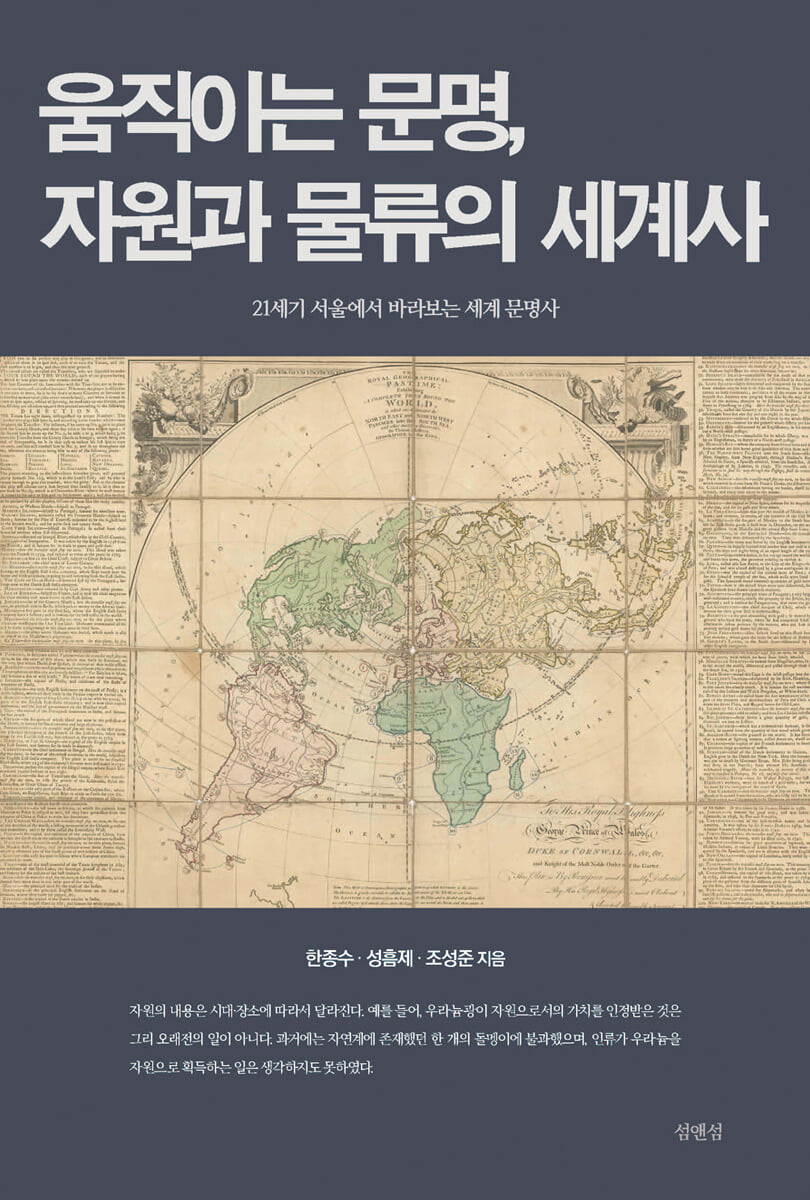
A Moving Civilization, a World History of Resources and Logistics
 |
Description
Book Introduction
It is the key driving force that determines the rise and fall of human civilization.
A History of World Civilization: A Look at Resources and Logistics, the Keys to the Future
For mankind, nature is an object of love and hate.
The overwhelming power of nature has been an object of fear and conquest, but on the other hand, nature has also been a source of opportunity and a material for building a material civilization that has enriched human life.
Human history has progressed through fierce struggles to create a 'better tomorrow than yesterday.'
The object of that struggle was nature.
Economics textbooks begin with the premise that human desires are infinite, but resources are limited.
The abyss of history, filled with the epics of heroes and the achievements of human civilization, contains the blood and tears shed to seize the limited resources bestowed by nature.
To survive, and sometimes for a better life, they had to face animals of overwhelming size and strength, plow the barren lands to sow seeds, and set sail on vast oceans with no end in sight.
That's a really cool explanation of infrastructure.
Infrastructure spans many sectors, but the first ones that come to mind are transportation and communications.
Energy, medical care, and educational facilities are meaningless without transportation and communication.
Yet, the starting point of all this important logistics is the road.
Roads started out as paths for wild animals, but humans expanded and developed them into networks.
After the Industrial Revolution, a great innovation occurred in the form of iron roads, or railroads, and ships, which had been dependent on wind and manpower, were powered by steam engines.
After the Second Industrial Revolution, with the advent of automobiles and airplanes, logistics became completely three-dimensional, and countries that did not have such a logistics network ended up relegated to the status of underdeveloped countries.
We are now about to begin the epic of humanity, woven together with resources and logistics.
A History of World Civilization: A Look at Resources and Logistics, the Keys to the Future
For mankind, nature is an object of love and hate.
The overwhelming power of nature has been an object of fear and conquest, but on the other hand, nature has also been a source of opportunity and a material for building a material civilization that has enriched human life.
Human history has progressed through fierce struggles to create a 'better tomorrow than yesterday.'
The object of that struggle was nature.
Economics textbooks begin with the premise that human desires are infinite, but resources are limited.
The abyss of history, filled with the epics of heroes and the achievements of human civilization, contains the blood and tears shed to seize the limited resources bestowed by nature.
To survive, and sometimes for a better life, they had to face animals of overwhelming size and strength, plow the barren lands to sow seeds, and set sail on vast oceans with no end in sight.
That's a really cool explanation of infrastructure.
Infrastructure spans many sectors, but the first ones that come to mind are transportation and communications.
Energy, medical care, and educational facilities are meaningless without transportation and communication.
Yet, the starting point of all this important logistics is the road.
Roads started out as paths for wild animals, but humans expanded and developed them into networks.
After the Industrial Revolution, a great innovation occurred in the form of iron roads, or railroads, and ships, which had been dependent on wind and manpower, were powered by steam engines.
After the Second Industrial Revolution, with the advent of automobiles and airplanes, logistics became completely three-dimensional, and countries that did not have such a logistics network ended up relegated to the status of underdeveloped countries.
We are now about to begin the epic of humanity, woven together with resources and logistics.
index
Recommendation ㆍ4
Prologue ㆍ5
Part 1 Resources
15 Most Important Water Resources
Civilizations Born from Water Management / Water Resources as a Means of Transportation, Power, and Power Generation / Water Resources as a Weapon / Water Resources Associations during the Japanese Colonial Period / Modern Water Resources
Wood Resource 35
Trees that created ancient civilizations / Trees that determined the rise and fall of ancient Mediterranean civilizations / Tree tribes that had a profound impact on the maritime nation of Venice and the British Empire / Trees that created the two great powers of America, the United States and Brazil / Gifts from trees / Forest resources in our country / Forest resources in modern and contemporary times
Animal Resources 53
The most important livestock: cows / A lump of protein: pigs / The most common and important, but lesser-known livestock: chickens / The first domesticated animal of mankind: sheep / The fighting and transport power of horses and camels / Other animals / By-products provided by livestock: eggs, milk, and excrement / Animals as religious sacrifices / Our people and animals / The industrialization of livestock farming and its price
Grains and Crops 82
Wheat, which changed the course of humanity / The industrialization of wheat / The imperial crop: rice / Rice in Korea and Japan / The story behind wheat and rice / Crops from the New World / Corn, the 'cosmopolitan of the plant world' / The potato, which changed world history / The global impact of crops from the New World
Marine Resources 109
Cod and Herring / High-End Fish: Tuna, Caviar, and Crustaceans / The World Changed by Whales / Seemingly Insignificant but Important Marine Resources / Marine Mineral Resources / Korea's Marine Resources / Overfishing, Climate Change, and Marine Pollution
Underground Resources 127
The New World's No-Da-Law / The Gold Rush that Created the United States, Australia, and South Africa / Gems, Including Diamonds / Other Minerals / Minerals That Moved Our Country / The Most Common Mineral Resource, 'Sand' / The Power of the Industrial Revolution, the Most Abundant Energy Reserve: Coal / The Coal Age Spreading Around the World / Byproducts from Coal / Side Effects of Coal / The Present and Future of Coal / The European Coal and Steel Community
Oil, a Key Resource of Modern Times 157
The lifeblood of modern industry / Britain, the first oil superpower / The popularization of automobiles in the United States / Challenger Germany and World War I / Oil that influenced World War II / The new hegemon, the United States / Challengers outside the market / Automobiles, petrochemicals, shipbuilding, and agricultural mechanization / The 1973 oil shock and our country / Environmental destruction caused by oil / Shale gas and natural gas / Oil still moves the world
Nuclear and Renewable Energy 182
Nuclear energy seemed 'fantastic' / The problems with nuclear energy / Wind and solar energy / Other renewable energy / The strengths of renewable energy
Part 2 Logistics
Road 201
Roman roads / Jin Dynasty's direct roads / Persian and Incan roads / Road modernization / Germany's Autobahn and the US federal highways / Our country's roads
Great Powers and Naval Power 217
The struggle for naval supremacy in ancient and medieval times / British maritime hegemony / The challenge of the emerging German Empire / The rise of the Japanese Navy and the Pacific War in South America / The maritime supremacy of the United States / The rapid rise and collapse of the Soviet Navy / The recurring struggle for naval supremacy in the 21st century
Logistics and Communications Networks of the World Empire 234
Mongolia and the Uyghurs, and the Silk Road across sea and land / A perfect network of post stations / The Song Dynasty, a trading empire / The transportation network that became three-dimensional during the Kublai Khan era / The influence on later generations and its demise / Modern China's Belt and Road Initiative / The world's first global transportation and communications network: The British Empire's three steel networks / America and the symbol of the century: The Panama Canal
Italy and the Hanseatic League's Maritime City-States 258
Amalfi and the Republic of Pisa / The Republic of Venice / The Republic of Genoa / The Hanseatic League, the hegemon of Northern Europe / The founding of Lübeck and the formation of the Hanseatic League / Favored cities / The products and industries of the Hanseatic League / The golden age of the Hanseatic League / The structure of the Hanseatic League / The decline and disappearance of the Hanseatic League / The impact of the Hanseatic League / A comparison of the Italian city-states and the Hanseatic League
The Age of Exploration: A Revolutionary History 281
First runner-up: Portugal / Second runner-up: Spain / Third runner-up: Netherlands / Fourth runner-up: England and France
The Importance of Maritime Power and Excellent Ports 295
Port cities created by imperialism / Singapore / Rotterdam / Countries that earn income from shipping and the expansion of ships / Our country's maritime power / The decline of the United States and the rise of China
The Railway That Changed the World 309
The Birth of the Railway and the Transformation of Europe / Transcontinental Railways / Railways That Changed the Face of War / Railways That Played a Crucial Role in the Development of Modern Capitalism / Why Railway Tracks Are Different / Japanese Railways / The World's Best Chinese Railways / Our Country's Railways
The United States, which dominated the world through aviation and radio, 336
The leading nation in aviation / World War II won by air power / Transition to civilian use / The continued U.S. aviation hegemony / Airports becoming larger and more islandized / The communications revolution led by the U.S. / The second industrial revolution centered on electricity and the emergence of computers / The revolution brought about by semiconductors / The emergence and rapid spread of personal computers / The emergence of the Internet / GPS technology that dominates the world / China's rise in aviation and communications / The U.S.-China struggle for hegemony, which resembles the Anglo-German struggle for hegemony
Epilogue ㆍ361
Prologue ㆍ5
Part 1 Resources
15 Most Important Water Resources
Civilizations Born from Water Management / Water Resources as a Means of Transportation, Power, and Power Generation / Water Resources as a Weapon / Water Resources Associations during the Japanese Colonial Period / Modern Water Resources
Wood Resource 35
Trees that created ancient civilizations / Trees that determined the rise and fall of ancient Mediterranean civilizations / Tree tribes that had a profound impact on the maritime nation of Venice and the British Empire / Trees that created the two great powers of America, the United States and Brazil / Gifts from trees / Forest resources in our country / Forest resources in modern and contemporary times
Animal Resources 53
The most important livestock: cows / A lump of protein: pigs / The most common and important, but lesser-known livestock: chickens / The first domesticated animal of mankind: sheep / The fighting and transport power of horses and camels / Other animals / By-products provided by livestock: eggs, milk, and excrement / Animals as religious sacrifices / Our people and animals / The industrialization of livestock farming and its price
Grains and Crops 82
Wheat, which changed the course of humanity / The industrialization of wheat / The imperial crop: rice / Rice in Korea and Japan / The story behind wheat and rice / Crops from the New World / Corn, the 'cosmopolitan of the plant world' / The potato, which changed world history / The global impact of crops from the New World
Marine Resources 109
Cod and Herring / High-End Fish: Tuna, Caviar, and Crustaceans / The World Changed by Whales / Seemingly Insignificant but Important Marine Resources / Marine Mineral Resources / Korea's Marine Resources / Overfishing, Climate Change, and Marine Pollution
Underground Resources 127
The New World's No-Da-Law / The Gold Rush that Created the United States, Australia, and South Africa / Gems, Including Diamonds / Other Minerals / Minerals That Moved Our Country / The Most Common Mineral Resource, 'Sand' / The Power of the Industrial Revolution, the Most Abundant Energy Reserve: Coal / The Coal Age Spreading Around the World / Byproducts from Coal / Side Effects of Coal / The Present and Future of Coal / The European Coal and Steel Community
Oil, a Key Resource of Modern Times 157
The lifeblood of modern industry / Britain, the first oil superpower / The popularization of automobiles in the United States / Challenger Germany and World War I / Oil that influenced World War II / The new hegemon, the United States / Challengers outside the market / Automobiles, petrochemicals, shipbuilding, and agricultural mechanization / The 1973 oil shock and our country / Environmental destruction caused by oil / Shale gas and natural gas / Oil still moves the world
Nuclear and Renewable Energy 182
Nuclear energy seemed 'fantastic' / The problems with nuclear energy / Wind and solar energy / Other renewable energy / The strengths of renewable energy
Part 2 Logistics
Road 201
Roman roads / Jin Dynasty's direct roads / Persian and Incan roads / Road modernization / Germany's Autobahn and the US federal highways / Our country's roads
Great Powers and Naval Power 217
The struggle for naval supremacy in ancient and medieval times / British maritime hegemony / The challenge of the emerging German Empire / The rise of the Japanese Navy and the Pacific War in South America / The maritime supremacy of the United States / The rapid rise and collapse of the Soviet Navy / The recurring struggle for naval supremacy in the 21st century
Logistics and Communications Networks of the World Empire 234
Mongolia and the Uyghurs, and the Silk Road across sea and land / A perfect network of post stations / The Song Dynasty, a trading empire / The transportation network that became three-dimensional during the Kublai Khan era / The influence on later generations and its demise / Modern China's Belt and Road Initiative / The world's first global transportation and communications network: The British Empire's three steel networks / America and the symbol of the century: The Panama Canal
Italy and the Hanseatic League's Maritime City-States 258
Amalfi and the Republic of Pisa / The Republic of Venice / The Republic of Genoa / The Hanseatic League, the hegemon of Northern Europe / The founding of Lübeck and the formation of the Hanseatic League / Favored cities / The products and industries of the Hanseatic League / The golden age of the Hanseatic League / The structure of the Hanseatic League / The decline and disappearance of the Hanseatic League / The impact of the Hanseatic League / A comparison of the Italian city-states and the Hanseatic League
The Age of Exploration: A Revolutionary History 281
First runner-up: Portugal / Second runner-up: Spain / Third runner-up: Netherlands / Fourth runner-up: England and France
The Importance of Maritime Power and Excellent Ports 295
Port cities created by imperialism / Singapore / Rotterdam / Countries that earn income from shipping and the expansion of ships / Our country's maritime power / The decline of the United States and the rise of China
The Railway That Changed the World 309
The Birth of the Railway and the Transformation of Europe / Transcontinental Railways / Railways That Changed the Face of War / Railways That Played a Crucial Role in the Development of Modern Capitalism / Why Railway Tracks Are Different / Japanese Railways / The World's Best Chinese Railways / Our Country's Railways
The United States, which dominated the world through aviation and radio, 336
The leading nation in aviation / World War II won by air power / Transition to civilian use / The continued U.S. aviation hegemony / Airports becoming larger and more islandized / The communications revolution led by the U.S. / The second industrial revolution centered on electricity and the emergence of computers / The revolution brought about by semiconductors / The emergence and rapid spread of personal computers / The emergence of the Internet / GPS technology that dominates the world / China's rise in aviation and communications / The U.S.-China struggle for hegemony, which resembles the Anglo-German struggle for hegemony
Epilogue ㆍ361
Into the book
Britain had been using coal for heating and manufacturing since the 13th century due to a wood shortage, but by the 18th century there was also a shortage of wood to build the fleet.
Sherwood Forest, where Robin Hood once lived, has long since disappeared.
The Navy put a lot of effort into forest conservation and even used royal forests to build its fleet, but even that had its limits.
By the end of the 16th century, it had become necessary to import from Denmark, which owned Norway, and Sweden and Russia, which had coniferous forests in Finland.
Naturally, public opinion arose against relying on foreign countries for the most important strategic materials, but this was overshadowed by realism.
However, most timber, especially the most important mast timber, had to be imported through the Skagerrak Strait, which is about 130 kilometers wide.
In fact, during the war with the Netherlands, this strait was almost blocked.
To protect these timber import lines, Britain had no choice but to further strengthen its navy, and a cycle of 'timber for the navy' and 'navy to secure timber' was established.
Fortunately, unlike Venice, England had vast American colonies, so they turned their attention to the densely forested New England colony across the Atlantic.
However, due to the limitations of shipping capacity at the time, the proportion of transportation costs was so high that it reached 95%.
For this reason, the policy of not fostering manufacturing in the colony had to be changed and lumber processing plants and shipyards had to be established.
Between 1714 and 1763, half a century later, the size of the British Navy doubled, and much of its timber came from America.
In particular, the masts that powered the huge ships of the line were all made in New England.
Thanks to the abundance of timber and iron ore, the cost of iron production was also much lower than in mainland Britain.
With such important strategic materials in New England, the British government changed its previous laissez-faire colonial policy and began to actively control timber and iron.
However, Americans rebelled against restrictions placed on exporting lumber and iron to countries other than Britain, and this conflict eventually led to the Revolutionary War, which resulted in Britain's loss of the United States.
Having lost the United States, Britain was forced to rely on Canadian and Northern European timber and iron. Fortunately, the use of coke for ironmaking became possible, and they were able to reduce their dependence on timber by making bridges and other structures out of steel.
In the United States, new cities were created along the Pacific coast as a result of western expansion, and among them, Seattle and Portland were representative cities that developed through the timber collection and processing industries.
Vancouver, in neighboring Canada, also began as a city with the construction of a sawmill in 1865, and later developed into a large city by exporting sulfur, gold, and salmon in addition to lumber.
Before being absorbed by the United States, King Kamehameha of Hawaii was able to unify the country and maintain a dynasty that lasted for a century from 1795 to 1893 because he was able to export expensive wood called sandalwood and import Western weapons and luxury goods to enhance the royal prestige.
Not many people know that the name of Brazil, a major South American country, comes from a tree.
Brazilwood is very hard wood and is used to make bows for stringed instruments, but it is also a valuable resource because it can be used to extract red dye by grinding the wood and processing the sawdust.
This dye was used as a dyeing material for high-quality fabrics such as velvet in Europe before the invention of chemical dyes.
This tree was only found in some parts of Asia until the 15th and 16th centuries, and was powdered and exported to Europe.
However, later Portuguese explorers of the New World discovered that this tree was growing abundantly in the Amazon rainforest.
This discovery brought the Amazon into the spotlight, and it became the impetus for Portugal, which had been focusing on Asia and Africa and neglecting its colonial expansion in the Americas, to expand into the interior of South America in earnest.
--- From "Tree (Wood)"
The first place where pigs were raised was Jasan in Hebei Province, China.
Excavated in 1933, the site is approximately 8,000 years old and yielded bones of pigs and dogs.
Excluding dogs, pigs are believed to be the first animals domesticated in China.
They are raised in cages rather than grazing, and perhaps because of this, the word "家", which means "house," came to mean "house," as in raising pigs inside a house.
Unlike cows and sheep, raising them in confinement must have provided a sense of security that made them feel like they were home. Pig manure, containing three times more nitrogen than cow manure, served as excellent compost.
One of the reasons why China's agriculture developed so intensively was because of pigs.
Moreover, pigs not only serve as environmental beautifiers by eating human food scraps, but their excrement also serves as excellent fertilizer.
However, dairy products were hardly developed in Chinese cuisine because they could not drink pig's milk.
Su Dongpo, a great writer of the Song Dynasty, wrote a hymn to pork called Juyuk Song and even invented Dongpo Pork, a braised pork dish that is still known today.
Of course, you can find many cases of dependence on pigs in countries other than China.
In medieval Europe, pigs were raised on forest weeds and acorns, slaughtered, and preserved foods such as ham, sausages, and bacon were made to survive the winter.
European cities released pigs into their cities to eat household waste, and New York City continued this practice until well into the 19th century.
Cincinnati, Ohio, USA, nicknamed 'Pig City Porkopolos', has pig farming as its main industry.
Candles and soap were made from lard, a type of pig fat, and everyday items such as combs were made from bones.
In many tribal societies in New Guinea, the number of pigs owned was a measure of wealth.
Serbia's main industry was pig farming, to the point that Karadjordje Petrovic, who ran a large-scale pig farming and meat trade, became king.
Most of this pork was exported to Austria-Hungary, and when Austria-Hungary, trying to tame Serbia, raised tariffs significantly, a tariff dispute called the "Pig War" broke out.
In order to reduce its economic dependence on Austria-Hungary, Serbia began importing French war supplies instead of Austrian ones in 1904, and in 1905 it formed a customs union with Bulgaria, ending the domestic sale of high-tariff Austrian goods.
Denmark, a leading country in livestock production, is also a powerhouse in pig farming, slaughtering 28 million pigs every year, and currently exports a huge amount of bacon to the UK.
--- From "Pig (Animal)"
The first resource of mankind was 'water', which is essential for sustaining life.
The scriptures of the great religions also begin their stories with water.
The Book of Genesis, the beginning of the Bible, also begins with a description of a dark and chaotic state filled with water, and the Vedas, Hindu scriptures, also contain a passage that says that in the beginning there was only water.
Sharia, the Islamic law, means "the way to the water source" in Arabic.
Purifying water was also essential in our country's folk beliefs.
More than half of the human body is water, and in newborns, it reaches 75%.
In this way, water, the source of life, also made a decisive contribution to the birth of human civilization.
Unlike underground resources, water is a renewable resource, but it is not a resource that can be used indefinitely.
The best example is the Aral Sea.
The Aral Sea has an area of 68,000 km, which is two-thirds of the area of South Korea.
It was a huge saltwater lake measuring 40,000 square kilometers, and was a source of livelihood for the surrounding residents, with fishermen catching 40,000 tons of fish each year.
However, the former Soviet government diverted the waters of the Aral Sea's sources, the Amudarya and Syrdarya rivers, to use them for irrigation when it built large-scale cotton plantations around the lake.
As a result, the current lake area has been reduced by half and the water volume has been reduced by 75% compared to the past.
Even Muynak, once a lakeside town, has been completely destroyed, now 100 kilometers from the lake.
Less well known than the Aral Sea, Lake Chad in Africa, shared by four countries—Chad, Niger, Nigeria, and Cameroon—was once a huge freshwater lake measuring approximately 26,000 square kilometers. However, due to over-irrigation and population growth, it has now shrunk to about 1,300 square kilometers, or about one-twentieth of its original size.
--- Among the “most important water resources”
The 'mineral' that became important in the 20th century is sand, which is common around us.
Sand is an essential material for making concrete, a pillar of modern civilization, as well as glass and lenses.
It is well known that glass, invented by the ancient Phoenicians, reached its peak in Venice, but less well known is that the sands of the Venetian island of Lido and its surroundings are ideal for glassmaking.
Glass allows sunlight to pass through almost completely, while blocking outside cold air and germs, greatly increasing the comfort of the home.
Currently, silica from Australia is said to be the best glass material.
One of the reasons why the average life expectancy of humans has increased so much since the modern era was the widespread use of glass.
Glass also made a huge contribution to the development of human civilization as it evolved into eyeglasses, telescopes, and microscopes.
Sand is most abundant in deserts, but ironically, its grains are too fine to be used in concrete, so Middle Eastern countries must import construction sand.
Land reclamation projects for national expansion also require a lot of sand, and since its founding, Singapore has expanded its territory by more than 200 square kilometers through reclamation.
This currently accounts for 25% of the entire country.
Because of this, it was once the country that imported the most sand in the world.
In addition, the environmental destruction is serious because a huge amount of sand is being consumed in the production of concrete and glass, which are necessary for urbanization taking place around the world, and in the hydraulic process of creating shale gas.
--- Among the "most common mineral resources: sand"
As one writer once said, humans are 'road-making animals', and the first transportation infrastructure created by humans was roads.
In any society or region, there are roads, and even if there are no proper roads, carts move.
However, on well-maintained or paved roads, carts move much faster.
Building and maintaining such roads requires a powerful and wealthy civilization.
Powerful empires are rarely the exception
It had an excellent road network.
It is said that the true road network began in Rome.
The Roman Empire's road network is so famous that everyone knows the saying, "All roads lead to Rome."
The modern Italian national road network can be said to be nothing more than an extension of the old Roman roads, paved with asphalt. Excluding the asphalt, it is so well-built that it is comparable to modern roads.
One of Hitler's few accomplishments that led Germany to the catastrophe of defeat was the construction of the Bundesautobahn.
The Autobahn is known as the world's first highway, but in fact, the world's first highway was built in Italy in 1923 under the name Autostrada, and Germany simply copied it.
However, Germany's Autobahn is much larger and more systematic, which is why it is so well known.
The United States boasted the world's highest automobile penetration rate in the early 20th century, but aside from the Pennsylvania Turnpike, which opened in 1940, it had no significant highways, especially interstate highways.
After the end of World War I in 1919, the U.S. Army conducted wartime transport operations to move troops from the Atlantic to the Pacific, but the road network was so underdeveloped that it took 62 days to travel 5,200 kilometers.
The person who participated in the operation at that time was Eisenhower, an engineer officer.
Eisenhower, who was impressed by the Autobahn while occupying Germany as the Supreme Commander of the Allied Forces during World War II, began construction of the federal highway system after being elected president after the war.
During the Joseon Dynasty, nine roads radiated out from Hanyang, including the first road (approximately 400 kilometers) connecting Donuimun, the western gate, to Uiju, and the fourth road (approximately 380 kilometers) connecting Sungnyemun and Busan.
However, most of the roads were only wide enough for one horse or one palanquin to pass.
Even in this situation, the best route in Joseon was the Gyeongui Road, the first route used by tribute envoys to China.
This road passing through Eunpyeong-gu was the lifeline of trade with China, and the merchant Im Sang-ok also amassed his wealth through this road.
The pabal, which was an important means of communication, also used this road.
In Eunpyeong-gu, there are place names such as Gupabal and Yeokchon-dong that originated from here, and the district's logo is also a pabal that resembles a horse.
Even foreigners who criticized Joseon's roads said that Gyeongui Road was not bad because it could accommodate two columns of troops.
In Nokbeon-dong, Eunpyeong-gu, there is a signpost that says, “Yangcheon-ri is a thousand li away from Uiju and a thousand li away from Dongrae, Busan.”
Britain, which succeeded in the Industrial Revolution, transformed its existing sailing fleet into a fleet made of steam engines and steel, thereby dominating the world's seas and eradicating pirates, ushering in an era when merchant ships did not need to be armed, or Pax Britannica.
The British Navy completely overwhelmed the backward Qing navy in the First Opium War, and in the Second Opium War, it captured the capital city of Beijing by sea.
Even in the Crimean War, the British Navy displayed overwhelming superiority in the Baltic Sea, Russia's front yard, blockading the Russian capital St. Petersburg, and also demonstrated remarkable power in the Far East by occupying Petropavlovsk, the capital of the Kamchatka Peninsula.
In this way, Britain won both the Opium Wars and the Crimean War with its naval power.
They even occupied Geomundo Island in Joseon in 1885 to block Russia's southward advance.
On the technological front, another innovation was made in 1866, with the development of a deadly new weapon: the torpedo.
The inventor of the steamship was an American named Fulton, and the first ironclad warship was built by France, but the country that most actively adopted these achievements was Britain.
Fulton's steamboats enjoyed great success on the Hudson River in 1807, followed by operations on the Mississippi River and the Great Lakes, among other inland waterways in the United States.
Then, in 1819, the Savannah, a steam-powered sailing ship, successfully sailed from Georgia across the Atlantic to Liverpool.
However, since it was powered by steam for only about 80 hours during its month-long voyage, it was effectively a sailing ship.
However, in 1837, Britain, the leading country in steam engines, built the 1,340-ton Great Western steamship and successfully crossed the Atlantic Ocean in just two weeks.
Also, Britain successfully sailed around the Cape of Good Hope from England to India in 113 days using a small 479-ton steamer called the Enterprise.
Then, breaking the common sense that ships should be made of wood, the 3,500-ton Himalaya made of metal was completed in 1853, and this ship played a major role in transporting troops in the Crimean War.
The British, who created the world's first steam engine and built the first railway, built Asia's first railway in Mumbai in 1853, and in less than 50 years, built a railway network of over 38,000 kilometers around the world.
This railway network created a huge market for British railway operators and locomotive manufacturers, and contributed greatly to the dominance of the empire.
In Africa and India, railways have reduced transportation costs by 90 to 97 percent compared to manpower or horse-drawn carriages.
This made possible the large-scale movement of bulky cargo such as minerals, food, and cash crops.
--- From "Logistics"
Compared to the First Industrial Revolution, which was driven by coal and the steam engine, the Second Industrial Revolution, which was driven by the combined development of electricity, internal combustion engines, and chemistry, gave Western powers near-omnipotence.
Among them, the telephone and wireless communication were tremendous new technologies that brought about the second revolution following the telegraph.
The telephone was invented by the American Graham Bell in 1876, and wireless communication was invented by the Italian Marconi 20 years later in 1896.
Radio began in 1901 when Reginald Fessenden, a Canadian but American engineer, developed the world's first technology to transmit voice over radio waves.
After further improving his transmitter, Fessenden made the first successful transatlantic voice transmission from Massachusetts to Scotland, and on Christmas Eve 1906, he made the first radio broadcast, and radio spread rapidly thereafter.
Of course, the telephone and radio were inventions that would have been impossible without industrialized electricity.
In 1962, President Kennedy declared that he would put a man on the moon, pouring in 4% of the federal budget every year and mobilizing all technological capabilities.
A key part of this was miniaturizing computers to fit inside spaceships.
Engineers have worked tirelessly to reduce the size of computers from the size of a humpback whale to the size of an armadillo.
This revolutionary change would not have been possible without the development of semiconductors called transistors.
Vacuum tubes, which convert alternating current into direct current, were a 'universal component' that went into almost all electronic products at the time, including computers, radios, TVs, and radars. However, their large size, short lifespan, and enormous power consumption were a major burden.
However, William Shockley, a Stanford University graduate, developed a prototype transistor using germanium and silicon in 1947.
However, commercialization took a long time, and the portable transistor radio did not appear until December 1954.
The name TR, short for transistor, sold like hotcakes, and not only did it completely replace vacuum tubes, but it also truly ushered in the era of information and communication.
Afterwards, the information and communications industry developed around Stanford University, and venture companies settled in rural cities such as Santa Clara, San Jose, and Palo Alto, giving birth to Silicon Valley.
"Civilization in Motion: A World History of Resources and Logistics" asks, "What is the driving force behind civilization?" in an era of resource crisis.
The authors' unique approach goes beyond the simple history of resources or transportation, and encourages us to look back on the meaning of civilization and history created by humans from our own perspective, viewing history not as "still time" but as "moving space."
Another virtue of this book is its insight into today's climate crisis and energy transition issues.
Sherwood Forest, where Robin Hood once lived, has long since disappeared.
The Navy put a lot of effort into forest conservation and even used royal forests to build its fleet, but even that had its limits.
By the end of the 16th century, it had become necessary to import from Denmark, which owned Norway, and Sweden and Russia, which had coniferous forests in Finland.
Naturally, public opinion arose against relying on foreign countries for the most important strategic materials, but this was overshadowed by realism.
However, most timber, especially the most important mast timber, had to be imported through the Skagerrak Strait, which is about 130 kilometers wide.
In fact, during the war with the Netherlands, this strait was almost blocked.
To protect these timber import lines, Britain had no choice but to further strengthen its navy, and a cycle of 'timber for the navy' and 'navy to secure timber' was established.
Fortunately, unlike Venice, England had vast American colonies, so they turned their attention to the densely forested New England colony across the Atlantic.
However, due to the limitations of shipping capacity at the time, the proportion of transportation costs was so high that it reached 95%.
For this reason, the policy of not fostering manufacturing in the colony had to be changed and lumber processing plants and shipyards had to be established.
Between 1714 and 1763, half a century later, the size of the British Navy doubled, and much of its timber came from America.
In particular, the masts that powered the huge ships of the line were all made in New England.
Thanks to the abundance of timber and iron ore, the cost of iron production was also much lower than in mainland Britain.
With such important strategic materials in New England, the British government changed its previous laissez-faire colonial policy and began to actively control timber and iron.
However, Americans rebelled against restrictions placed on exporting lumber and iron to countries other than Britain, and this conflict eventually led to the Revolutionary War, which resulted in Britain's loss of the United States.
Having lost the United States, Britain was forced to rely on Canadian and Northern European timber and iron. Fortunately, the use of coke for ironmaking became possible, and they were able to reduce their dependence on timber by making bridges and other structures out of steel.
In the United States, new cities were created along the Pacific coast as a result of western expansion, and among them, Seattle and Portland were representative cities that developed through the timber collection and processing industries.
Vancouver, in neighboring Canada, also began as a city with the construction of a sawmill in 1865, and later developed into a large city by exporting sulfur, gold, and salmon in addition to lumber.
Before being absorbed by the United States, King Kamehameha of Hawaii was able to unify the country and maintain a dynasty that lasted for a century from 1795 to 1893 because he was able to export expensive wood called sandalwood and import Western weapons and luxury goods to enhance the royal prestige.
Not many people know that the name of Brazil, a major South American country, comes from a tree.
Brazilwood is very hard wood and is used to make bows for stringed instruments, but it is also a valuable resource because it can be used to extract red dye by grinding the wood and processing the sawdust.
This dye was used as a dyeing material for high-quality fabrics such as velvet in Europe before the invention of chemical dyes.
This tree was only found in some parts of Asia until the 15th and 16th centuries, and was powdered and exported to Europe.
However, later Portuguese explorers of the New World discovered that this tree was growing abundantly in the Amazon rainforest.
This discovery brought the Amazon into the spotlight, and it became the impetus for Portugal, which had been focusing on Asia and Africa and neglecting its colonial expansion in the Americas, to expand into the interior of South America in earnest.
--- From "Tree (Wood)"
The first place where pigs were raised was Jasan in Hebei Province, China.
Excavated in 1933, the site is approximately 8,000 years old and yielded bones of pigs and dogs.
Excluding dogs, pigs are believed to be the first animals domesticated in China.
They are raised in cages rather than grazing, and perhaps because of this, the word "家", which means "house," came to mean "house," as in raising pigs inside a house.
Unlike cows and sheep, raising them in confinement must have provided a sense of security that made them feel like they were home. Pig manure, containing three times more nitrogen than cow manure, served as excellent compost.
One of the reasons why China's agriculture developed so intensively was because of pigs.
Moreover, pigs not only serve as environmental beautifiers by eating human food scraps, but their excrement also serves as excellent fertilizer.
However, dairy products were hardly developed in Chinese cuisine because they could not drink pig's milk.
Su Dongpo, a great writer of the Song Dynasty, wrote a hymn to pork called Juyuk Song and even invented Dongpo Pork, a braised pork dish that is still known today.
Of course, you can find many cases of dependence on pigs in countries other than China.
In medieval Europe, pigs were raised on forest weeds and acorns, slaughtered, and preserved foods such as ham, sausages, and bacon were made to survive the winter.
European cities released pigs into their cities to eat household waste, and New York City continued this practice until well into the 19th century.
Cincinnati, Ohio, USA, nicknamed 'Pig City Porkopolos', has pig farming as its main industry.
Candles and soap were made from lard, a type of pig fat, and everyday items such as combs were made from bones.
In many tribal societies in New Guinea, the number of pigs owned was a measure of wealth.
Serbia's main industry was pig farming, to the point that Karadjordje Petrovic, who ran a large-scale pig farming and meat trade, became king.
Most of this pork was exported to Austria-Hungary, and when Austria-Hungary, trying to tame Serbia, raised tariffs significantly, a tariff dispute called the "Pig War" broke out.
In order to reduce its economic dependence on Austria-Hungary, Serbia began importing French war supplies instead of Austrian ones in 1904, and in 1905 it formed a customs union with Bulgaria, ending the domestic sale of high-tariff Austrian goods.
Denmark, a leading country in livestock production, is also a powerhouse in pig farming, slaughtering 28 million pigs every year, and currently exports a huge amount of bacon to the UK.
--- From "Pig (Animal)"
The first resource of mankind was 'water', which is essential for sustaining life.
The scriptures of the great religions also begin their stories with water.
The Book of Genesis, the beginning of the Bible, also begins with a description of a dark and chaotic state filled with water, and the Vedas, Hindu scriptures, also contain a passage that says that in the beginning there was only water.
Sharia, the Islamic law, means "the way to the water source" in Arabic.
Purifying water was also essential in our country's folk beliefs.
More than half of the human body is water, and in newborns, it reaches 75%.
In this way, water, the source of life, also made a decisive contribution to the birth of human civilization.
Unlike underground resources, water is a renewable resource, but it is not a resource that can be used indefinitely.
The best example is the Aral Sea.
The Aral Sea has an area of 68,000 km, which is two-thirds of the area of South Korea.
It was a huge saltwater lake measuring 40,000 square kilometers, and was a source of livelihood for the surrounding residents, with fishermen catching 40,000 tons of fish each year.
However, the former Soviet government diverted the waters of the Aral Sea's sources, the Amudarya and Syrdarya rivers, to use them for irrigation when it built large-scale cotton plantations around the lake.
As a result, the current lake area has been reduced by half and the water volume has been reduced by 75% compared to the past.
Even Muynak, once a lakeside town, has been completely destroyed, now 100 kilometers from the lake.
Less well known than the Aral Sea, Lake Chad in Africa, shared by four countries—Chad, Niger, Nigeria, and Cameroon—was once a huge freshwater lake measuring approximately 26,000 square kilometers. However, due to over-irrigation and population growth, it has now shrunk to about 1,300 square kilometers, or about one-twentieth of its original size.
--- Among the “most important water resources”
The 'mineral' that became important in the 20th century is sand, which is common around us.
Sand is an essential material for making concrete, a pillar of modern civilization, as well as glass and lenses.
It is well known that glass, invented by the ancient Phoenicians, reached its peak in Venice, but less well known is that the sands of the Venetian island of Lido and its surroundings are ideal for glassmaking.
Glass allows sunlight to pass through almost completely, while blocking outside cold air and germs, greatly increasing the comfort of the home.
Currently, silica from Australia is said to be the best glass material.
One of the reasons why the average life expectancy of humans has increased so much since the modern era was the widespread use of glass.
Glass also made a huge contribution to the development of human civilization as it evolved into eyeglasses, telescopes, and microscopes.
Sand is most abundant in deserts, but ironically, its grains are too fine to be used in concrete, so Middle Eastern countries must import construction sand.
Land reclamation projects for national expansion also require a lot of sand, and since its founding, Singapore has expanded its territory by more than 200 square kilometers through reclamation.
This currently accounts for 25% of the entire country.
Because of this, it was once the country that imported the most sand in the world.
In addition, the environmental destruction is serious because a huge amount of sand is being consumed in the production of concrete and glass, which are necessary for urbanization taking place around the world, and in the hydraulic process of creating shale gas.
--- Among the "most common mineral resources: sand"
As one writer once said, humans are 'road-making animals', and the first transportation infrastructure created by humans was roads.
In any society or region, there are roads, and even if there are no proper roads, carts move.
However, on well-maintained or paved roads, carts move much faster.
Building and maintaining such roads requires a powerful and wealthy civilization.
Powerful empires are rarely the exception
It had an excellent road network.
It is said that the true road network began in Rome.
The Roman Empire's road network is so famous that everyone knows the saying, "All roads lead to Rome."
The modern Italian national road network can be said to be nothing more than an extension of the old Roman roads, paved with asphalt. Excluding the asphalt, it is so well-built that it is comparable to modern roads.
One of Hitler's few accomplishments that led Germany to the catastrophe of defeat was the construction of the Bundesautobahn.
The Autobahn is known as the world's first highway, but in fact, the world's first highway was built in Italy in 1923 under the name Autostrada, and Germany simply copied it.
However, Germany's Autobahn is much larger and more systematic, which is why it is so well known.
The United States boasted the world's highest automobile penetration rate in the early 20th century, but aside from the Pennsylvania Turnpike, which opened in 1940, it had no significant highways, especially interstate highways.
After the end of World War I in 1919, the U.S. Army conducted wartime transport operations to move troops from the Atlantic to the Pacific, but the road network was so underdeveloped that it took 62 days to travel 5,200 kilometers.
The person who participated in the operation at that time was Eisenhower, an engineer officer.
Eisenhower, who was impressed by the Autobahn while occupying Germany as the Supreme Commander of the Allied Forces during World War II, began construction of the federal highway system after being elected president after the war.
During the Joseon Dynasty, nine roads radiated out from Hanyang, including the first road (approximately 400 kilometers) connecting Donuimun, the western gate, to Uiju, and the fourth road (approximately 380 kilometers) connecting Sungnyemun and Busan.
However, most of the roads were only wide enough for one horse or one palanquin to pass.
Even in this situation, the best route in Joseon was the Gyeongui Road, the first route used by tribute envoys to China.
This road passing through Eunpyeong-gu was the lifeline of trade with China, and the merchant Im Sang-ok also amassed his wealth through this road.
The pabal, which was an important means of communication, also used this road.
In Eunpyeong-gu, there are place names such as Gupabal and Yeokchon-dong that originated from here, and the district's logo is also a pabal that resembles a horse.
Even foreigners who criticized Joseon's roads said that Gyeongui Road was not bad because it could accommodate two columns of troops.
In Nokbeon-dong, Eunpyeong-gu, there is a signpost that says, “Yangcheon-ri is a thousand li away from Uiju and a thousand li away from Dongrae, Busan.”
Britain, which succeeded in the Industrial Revolution, transformed its existing sailing fleet into a fleet made of steam engines and steel, thereby dominating the world's seas and eradicating pirates, ushering in an era when merchant ships did not need to be armed, or Pax Britannica.
The British Navy completely overwhelmed the backward Qing navy in the First Opium War, and in the Second Opium War, it captured the capital city of Beijing by sea.
Even in the Crimean War, the British Navy displayed overwhelming superiority in the Baltic Sea, Russia's front yard, blockading the Russian capital St. Petersburg, and also demonstrated remarkable power in the Far East by occupying Petropavlovsk, the capital of the Kamchatka Peninsula.
In this way, Britain won both the Opium Wars and the Crimean War with its naval power.
They even occupied Geomundo Island in Joseon in 1885 to block Russia's southward advance.
On the technological front, another innovation was made in 1866, with the development of a deadly new weapon: the torpedo.
The inventor of the steamship was an American named Fulton, and the first ironclad warship was built by France, but the country that most actively adopted these achievements was Britain.
Fulton's steamboats enjoyed great success on the Hudson River in 1807, followed by operations on the Mississippi River and the Great Lakes, among other inland waterways in the United States.
Then, in 1819, the Savannah, a steam-powered sailing ship, successfully sailed from Georgia across the Atlantic to Liverpool.
However, since it was powered by steam for only about 80 hours during its month-long voyage, it was effectively a sailing ship.
However, in 1837, Britain, the leading country in steam engines, built the 1,340-ton Great Western steamship and successfully crossed the Atlantic Ocean in just two weeks.
Also, Britain successfully sailed around the Cape of Good Hope from England to India in 113 days using a small 479-ton steamer called the Enterprise.
Then, breaking the common sense that ships should be made of wood, the 3,500-ton Himalaya made of metal was completed in 1853, and this ship played a major role in transporting troops in the Crimean War.
The British, who created the world's first steam engine and built the first railway, built Asia's first railway in Mumbai in 1853, and in less than 50 years, built a railway network of over 38,000 kilometers around the world.
This railway network created a huge market for British railway operators and locomotive manufacturers, and contributed greatly to the dominance of the empire.
In Africa and India, railways have reduced transportation costs by 90 to 97 percent compared to manpower or horse-drawn carriages.
This made possible the large-scale movement of bulky cargo such as minerals, food, and cash crops.
--- From "Logistics"
Compared to the First Industrial Revolution, which was driven by coal and the steam engine, the Second Industrial Revolution, which was driven by the combined development of electricity, internal combustion engines, and chemistry, gave Western powers near-omnipotence.
Among them, the telephone and wireless communication were tremendous new technologies that brought about the second revolution following the telegraph.
The telephone was invented by the American Graham Bell in 1876, and wireless communication was invented by the Italian Marconi 20 years later in 1896.
Radio began in 1901 when Reginald Fessenden, a Canadian but American engineer, developed the world's first technology to transmit voice over radio waves.
After further improving his transmitter, Fessenden made the first successful transatlantic voice transmission from Massachusetts to Scotland, and on Christmas Eve 1906, he made the first radio broadcast, and radio spread rapidly thereafter.
Of course, the telephone and radio were inventions that would have been impossible without industrialized electricity.
In 1962, President Kennedy declared that he would put a man on the moon, pouring in 4% of the federal budget every year and mobilizing all technological capabilities.
A key part of this was miniaturizing computers to fit inside spaceships.
Engineers have worked tirelessly to reduce the size of computers from the size of a humpback whale to the size of an armadillo.
This revolutionary change would not have been possible without the development of semiconductors called transistors.
Vacuum tubes, which convert alternating current into direct current, were a 'universal component' that went into almost all electronic products at the time, including computers, radios, TVs, and radars. However, their large size, short lifespan, and enormous power consumption were a major burden.
However, William Shockley, a Stanford University graduate, developed a prototype transistor using germanium and silicon in 1947.
However, commercialization took a long time, and the portable transistor radio did not appear until December 1954.
The name TR, short for transistor, sold like hotcakes, and not only did it completely replace vacuum tubes, but it also truly ushered in the era of information and communication.
Afterwards, the information and communications industry developed around Stanford University, and venture companies settled in rural cities such as Santa Clara, San Jose, and Palo Alto, giving birth to Silicon Valley.
"Civilization in Motion: A World History of Resources and Logistics" asks, "What is the driving force behind civilization?" in an era of resource crisis.
The authors' unique approach goes beyond the simple history of resources or transportation, and encourages us to look back on the meaning of civilization and history created by humans from our own perspective, viewing history not as "still time" but as "moving space."
Another virtue of this book is its insight into today's climate crisis and energy transition issues.
--- From "The Second Industrial Revolution Centered on Electricity and the Emergence of Computers"
Publisher's Review
For mankind, nature is an object of love and hate.
The overwhelming power of nature has been an object of fear and conquest, but on the other hand, nature has also been a source of opportunity and a material for building a material civilization that has enriched human life.
Human history has progressed through fierce struggles to create a 'better tomorrow than yesterday.'
The object of that struggle was nature.
Economics textbooks begin with the premise that human desires are infinite, but resources are limited.
The abyss of history, filled with the epics of heroes and the achievements of human civilization, contains the blood and tears shed to seize the limited resources bestowed by nature.
To survive, and sometimes for a better life, they had to face animals of overwhelming size and strength, plow the barren lands to sow seeds, and set sail on vast oceans with no end in sight.
Resources are substances obtained and produced from nature for a certain purpose.
The Korean dictionary defines resources as 'a general term for minerals, forests, marine products, etc. that serve as raw materials for human life and economic production.'
In other words, in the primary sense, resources refer to substances obtained or produced in nature for a certain purpose.
The value of these resources often varied over time and place, with the exception of rare resources such as gold and silver.
Petroleum, the most important resource in modern civilization, became important in 1859, but even then, only kerosene was used and gasoline was discarded.
As gasoline-powered cars were developed and popularized, the value of oil reached its peak.
Aluminum was also used very little until the advent of electric refining in the late 19th century.
The period in which the value of uranium was known was even shorter than these; just 80 years ago, it was nothing more than a lump of rock.
Despite being easy to cultivate and nutritious, potatoes were neglected by Europeans for nearly two centuries due to religious and cultural prejudices.
Tuna was the source of funds that enabled Portugal, a small European nation, to open the 'Age of Exploration,' a turning point in history.
Rubber, which has incredible elasticity and comes from trees in the South American tropical forests, has played a major role in the development of modern civilization as an insulator for electric lines, including submarine cables, and as a raw material for tires for bicycles and automobiles.
In other words, the value of resources is not in the material itself, but rather shines through human needs and technological advancements.
These resources have driven human civilization and played a decisive role in the rise and fall of countless nations and peoples.
Moreover, if such an important resource cannot be used in a timely manner where it is most needed, it is nothing more than a pie in the sky.
So, in order to utilize the necessary resources in a timely manner, humans have put all their efforts into developing logistics, that is, the movement (transportation) of the acquired resources, as well as competing to secure the resources.
“A country’s land is not just soil; it is the foundation of production and the vessel of life.
Infrastructure is laid on top of it and underneath it.
“Land becomes competitive only when the physical value of transportation, communication, energy, medical, water management, and education facilities built on the land can support production and improve the quality of life of the people.” Lee Geon-yeong, former president of the Korea Research Institute for Human Settlements
That's a really cool explanation of infrastructure.
Infrastructure spans many sectors, but the first ones that come to mind are transportation and communications.
Energy, medical care, and educational facilities are meaningless without transportation and communication.
Yet, the starting point of all this important logistics is the road.
Roads started out as paths for wild animals, but humans expanded and developed them into networks.
After the Industrial Revolution, a great innovation occurred in the form of iron roads, or railroads, and ships, which had been dependent on wind and manpower, were powered by steam engines.
After the Second Industrial Revolution, with the advent of automobiles and airplanes, logistics became completely three-dimensional, and countries that did not have such a logistics network ended up relegated to the status of underdeveloped countries.
We are now about to begin the epic of humanity, woven together with resources and logistics.
The overwhelming power of nature has been an object of fear and conquest, but on the other hand, nature has also been a source of opportunity and a material for building a material civilization that has enriched human life.
Human history has progressed through fierce struggles to create a 'better tomorrow than yesterday.'
The object of that struggle was nature.
Economics textbooks begin with the premise that human desires are infinite, but resources are limited.
The abyss of history, filled with the epics of heroes and the achievements of human civilization, contains the blood and tears shed to seize the limited resources bestowed by nature.
To survive, and sometimes for a better life, they had to face animals of overwhelming size and strength, plow the barren lands to sow seeds, and set sail on vast oceans with no end in sight.
Resources are substances obtained and produced from nature for a certain purpose.
The Korean dictionary defines resources as 'a general term for minerals, forests, marine products, etc. that serve as raw materials for human life and economic production.'
In other words, in the primary sense, resources refer to substances obtained or produced in nature for a certain purpose.
The value of these resources often varied over time and place, with the exception of rare resources such as gold and silver.
Petroleum, the most important resource in modern civilization, became important in 1859, but even then, only kerosene was used and gasoline was discarded.
As gasoline-powered cars were developed and popularized, the value of oil reached its peak.
Aluminum was also used very little until the advent of electric refining in the late 19th century.
The period in which the value of uranium was known was even shorter than these; just 80 years ago, it was nothing more than a lump of rock.
Despite being easy to cultivate and nutritious, potatoes were neglected by Europeans for nearly two centuries due to religious and cultural prejudices.
Tuna was the source of funds that enabled Portugal, a small European nation, to open the 'Age of Exploration,' a turning point in history.
Rubber, which has incredible elasticity and comes from trees in the South American tropical forests, has played a major role in the development of modern civilization as an insulator for electric lines, including submarine cables, and as a raw material for tires for bicycles and automobiles.
In other words, the value of resources is not in the material itself, but rather shines through human needs and technological advancements.
These resources have driven human civilization and played a decisive role in the rise and fall of countless nations and peoples.
Moreover, if such an important resource cannot be used in a timely manner where it is most needed, it is nothing more than a pie in the sky.
So, in order to utilize the necessary resources in a timely manner, humans have put all their efforts into developing logistics, that is, the movement (transportation) of the acquired resources, as well as competing to secure the resources.
“A country’s land is not just soil; it is the foundation of production and the vessel of life.
Infrastructure is laid on top of it and underneath it.
“Land becomes competitive only when the physical value of transportation, communication, energy, medical, water management, and education facilities built on the land can support production and improve the quality of life of the people.” Lee Geon-yeong, former president of the Korea Research Institute for Human Settlements
That's a really cool explanation of infrastructure.
Infrastructure spans many sectors, but the first ones that come to mind are transportation and communications.
Energy, medical care, and educational facilities are meaningless without transportation and communication.
Yet, the starting point of all this important logistics is the road.
Roads started out as paths for wild animals, but humans expanded and developed them into networks.
After the Industrial Revolution, a great innovation occurred in the form of iron roads, or railroads, and ships, which had been dependent on wind and manpower, were powered by steam engines.
After the Second Industrial Revolution, with the advent of automobiles and airplanes, logistics became completely three-dimensional, and countries that did not have such a logistics network ended up relegated to the status of underdeveloped countries.
We are now about to begin the epic of humanity, woven together with resources and logistics.
GOODS SPECIFICS
- Date of issue: November 11, 2025
- Page count, weight, size: 364 pages | 152*225*21mm
- ISBN13: 9791193566183
- ISBN10: 1193566185
You may also like
카테고리
korean


korean

![ELLE 엘르 스페셜 에디션 A형 : 12월 [2025]](http://librairie.coreenne.fr/cdn/shop/files/b8e27a3de6c9538896439686c6b0e8fb.jpg?v=1766436872&width=3840)


