

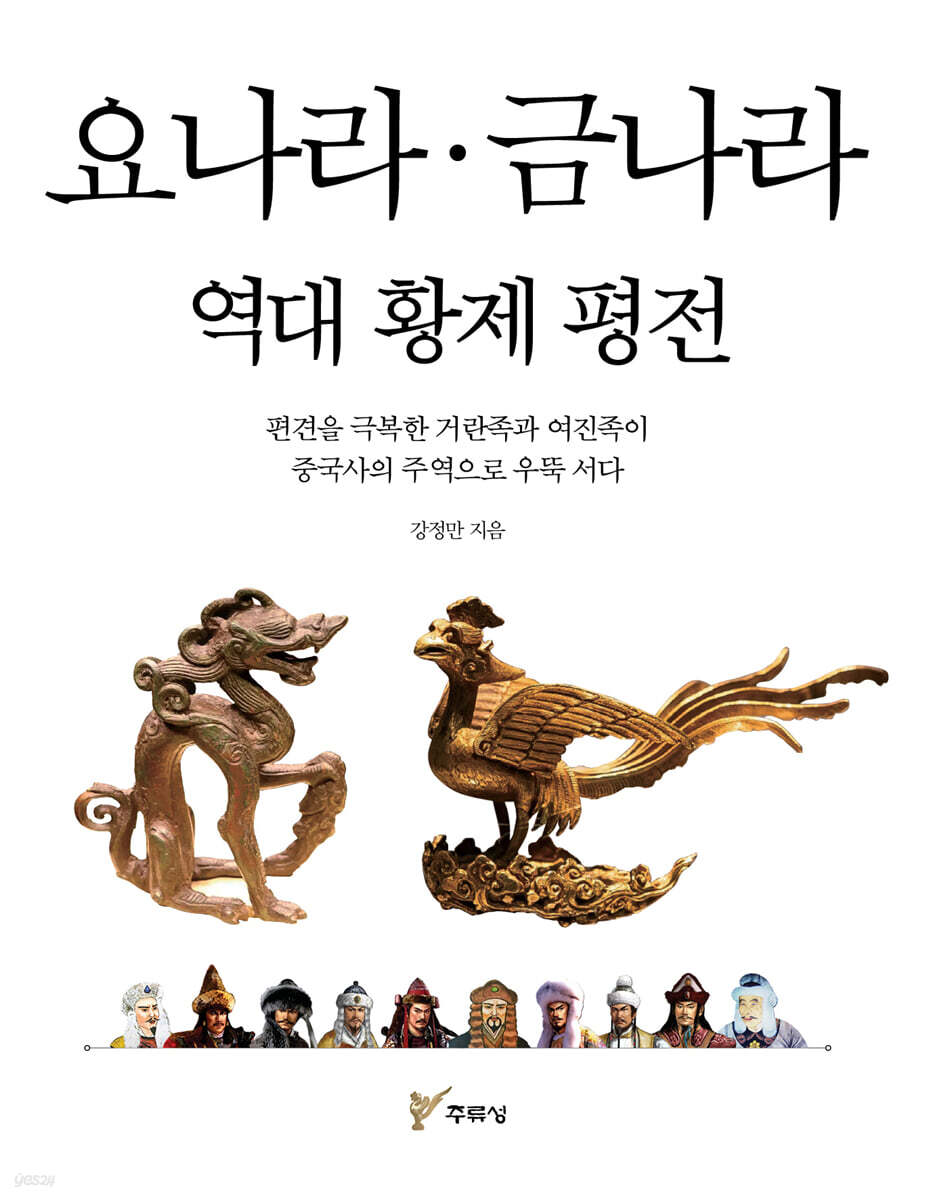
Biographies of Emperors of the Liao and Jin Dynasties
 |
Description
Book Introduction
Goryeo defended its country against the Mongols
It originated from the experience of overcoming the invasions of the nomadic Liao and Jin dynasties.
Goryeo was able to maintain its sovereignty thanks to its desperate fight against the Liao and Jin dynasties, the most powerful countries in East Asia at the time, and its fierce diplomatic campaigns.
After the successive collapse of empires such as the Liao, Jin, and Song dynasties, the unprecedentedly large Mongol (Yuan) empire invaded Goryeo.
It was very difficult to win against the Mongol cavalry that trampled the Eurasian continent.
The Mongol army was a devil who devastated the enemy if they did not surrender and resisted.
Nevertheless, Goryeo fought against the Mongols for over 30 years and ultimately defended the royal ancestral shrine.
Goryeo's ability to overcome the Mongol invasion came from its experience resisting the Liao and Jin dynasties.
Furthermore, it was unprecedented in world history that Goryeo overcame the invasions of the Liao, Jin, and Yuan dynasties, which had powerful military forces in East Asia, and protected the royal shrine for 474 years.
It originated from the experience of overcoming the invasions of the nomadic Liao and Jin dynasties.
Goryeo was able to maintain its sovereignty thanks to its desperate fight against the Liao and Jin dynasties, the most powerful countries in East Asia at the time, and its fierce diplomatic campaigns.
After the successive collapse of empires such as the Liao, Jin, and Song dynasties, the unprecedentedly large Mongol (Yuan) empire invaded Goryeo.
It was very difficult to win against the Mongol cavalry that trampled the Eurasian continent.
The Mongol army was a devil who devastated the enemy if they did not surrender and resisted.
Nevertheless, Goryeo fought against the Mongols for over 30 years and ultimately defended the royal ancestral shrine.
Goryeo's ability to overcome the Mongol invasion came from its experience resisting the Liao and Jin dynasties.
Furthermore, it was unprecedented in world history that Goryeo overcame the invasions of the Liao, Jin, and Yuan dynasties, which had powerful military forces in East Asia, and protected the royal shrine for 474 years.
- You can preview some of the book's contents.
Preview
index
preface
Emperors of the Liao Dynasty
Chapter 1.
Emperor Taizu of Yalu
1.
The origin and formation of the Khitans
2.
Born into a family of tribal chiefs, he seized military power in the tribal confederation.
3.
After being crowned Gahan, he formed an alliance with the Central Plains dynasty.
4.
Suppressing the rebellion of his younger brothers who were dissatisfied with Gahan's monopoly
5.
Founded the Khitan dynasty and ascended to the throne as emperor
6.
Laying the foundation of a dynasty and embarking on a war of conquest
Chapter 2.
King Taejong of Yoreul Deokgwang
1.
Growth Process and Succession to the Throne
2.
Destroy the Later Tang Dynasty and make Shi Jingtang a puppet emperor.
3.
Destroy the Later Jin and change the national title to Dayao
4.
Failing to suppress the resistance of the Han Chinese in the Central Plains, they withdrew north.
Chapter 3.
This is Sejong Yaluwan
1.
Growth Process and Succession to the Throne
2.
Silencing Empress Dowager Danwan's opposition with the "Oath of the Crossroads"
3.
Suppressing the rebellions of the nobles that occurred one after another
4.
The Rebellion of the Hwasinjeon: Killed during the Southern Expedition
Chapter 4.
This is the story of the famous Yalu Jing
1.
Be crowned emperor by Yelü Okjil
2.
Nobles and subjects constantly plot treason.
3.
Massacre and brutality reach their peak
4.
Defeat in the war against the Later Zhou
5.
The Black Mountain Incident: Murdered by Servants
Chapter 5.
Yeo Kyungjong Yeol-hyeon
1.
Growth Process and Succession to the Throne
2.
Laying the foundation for revival by appointing virtuous officials
3.
Victory in the war for hegemony against the Northern Song
4.
The empress governs the state on behalf of the emperor.
Chapter 6.
Emperor Yelü Yongshu of the Joseon Dynasty
1.
The Empress Dowager acts as regent for the young emperor.
2.
Signing the "Pact of Former Yan" with the Northern Song Dynasty
3.
Defeat in the 26-year war with Goryeo
4.
Success in both internal and external affairs, ushering in an era of peace
Chapter 7.
Emperor Yao Xingzong of Yalu Zongjin
1.
Growth Process and Succession to the Throne
2.
Win the power struggle with the queen mother
3.
Enjoying pleasure and hunting, neglecting state affairs
4.
Despite pressuring the Northern Song Dynasty to increase its tax revenue, the conquest of the Western Xia failed.
Chapter 8.
This is the story of the late Yelü Hongqi
1.
Growth Process and Succession to the Throne
2.
Drive out the loyal and promote the treacherous.
3.
Huang Taishu suppressed the rebellion of the Yelü Zhongyuan
4.
The Empress and Crown Prince were killed by Yelulshin
Chapter 9.
Emperor Cheonjo's Yalyuyeonhee
1.
Growth Process and Succession to the Throne
2.
He was unable to distinguish between loyal and treacherous subjects and was obsessed with hunting.
3.
The Jurchen tribe's Wanyan Aguda rises up and attacks the Liao Dynasty.
4.
Goyok, Yaluljangno, and Go Yeongchang rebelled.
5.
Deceived by So Bong-seon, he kills Moon-bi, his son, and others.
6.
He was chased by the Jin army and became a wandering monarch of a fallen nation.
Emperors of the Jin Dynasty
Chapter 1.
Wanyan Aguda, founder of the Jin Dynasty
1.
After gaining experience, he was elected as the leader of the Jurchen confederation.
2.
Conquer the Liao Dynasty and establish the Jin Dynasty
3.
Laying the foundation of the nation through a string of victories
4.
Signing a 'Maritime Pact' with the Northern Song Dynasty
5.
To ruin this country and focus on internal affairs
Chapter 2.
Emperor Taizong of Jin, Wanyan Wujimae
1.
Growth Process and Succession to the Throne
2.
Suppressing Zhang Jiao's rebellion
3.
Establishing a vassal relationship with Goryeo and promoting stability in the rear
4.
Destroy the Northern Song and advance into the Southern Song
5.
Laying the foundation for development by improving women's policies and systems.
Chapter 3.
King Heejong of Geumgang Province
1.
Growth Process and Succession to the Throne
2.
Implement Hanwha policy and eliminate the royal family
3.
Wanyan Zonggan and Wanyan Zongpil assisted in state affairs.
4.
Turned mad and killed in a palace coup
Chapter 4.
King Wanyanliang of Hailingyang
1.
He staged a coup in the palace and ascended to the throne as emperor.
2.
He committed murder and committed other acts of immorality before being murdered.
Chapter 5.
King Sejong of Jin
1.
Survived thanks to the sacrifice of his wife, Orimdap
2.
Taking advantage of the opportunity when King Hae-ryung was away on a campaign to conquer the Southern Song Dynasty, he proclaimed himself emperor.
3.
Encourage outspokenness and open up the world
4.
Reject luxury and worship substance
5.
Obtaining examples of governance throughout history
6.
Establishing the identity of the Jurchen people and solidifying the ruling class
7.
Opening a new era of "Great Justice" by promoting good governance and improving relations with neighboring countries.
Chapter 6.
Golden Jangjong Wanyan Mirror
1.
Succession to the throne upon the death of Crown Prince Wanyan Yungong
2.
Eliminate Uncle Wanyan Yingdu and Wanyan Yingzhong
3.
Governing the country based on Confucian ideology
4.
Carrying on the legacy of King Sejong, he established the "rule of the master singers"
5.
Signing the Treaty of Reconciliation with the Southern Song Dynasty
6.
Isiah and Seo Ji-guk monopolize state affairs
Chapter 7.
Emperor Wanyan Yong of the Wei Dynasty
1.
Growth Process and Succession to the Throne
2.
Eliminate the concubines of the Golden Emperor
3.
The Jin army was annihilated by the Mongol and Dongyao armies.
4.
After being driven out by the powerful Ho Sa-ho, he was poisoned to death.
Chapter 8.
Jin Seonjong Wanyanshun
1.
He was crowned emperor by his ministers, including Hosaho and Dodanil.
2.
Efforts to restore the declining national fortunes
3.
After the capital was moved to Nanjing, Zhongdu fell.
4.
Establishing nine local warlords as vassals
5.
Invade the Southern Song Dynasty to restore national fortunes
Chapter 9.
Golden Aejong Wanyan Shushu
1.
Growth Process and Succession to the Throne
2.
Desperately trying to save the country from ruin
3.
suffered a crushing defeat at the hands of the Mongols in the Battle of Sambongsan
4.
Abandon Nanjingseong and take refuge in Gwideok
5.
Being imprisoned by a police officer in Gwideok
6.
He committed suicide after making his last stand in Chaeju.
Emperors of the Liao Dynasty
Chapter 1.
Emperor Taizu of Yalu
1.
The origin and formation of the Khitans
2.
Born into a family of tribal chiefs, he seized military power in the tribal confederation.
3.
After being crowned Gahan, he formed an alliance with the Central Plains dynasty.
4.
Suppressing the rebellion of his younger brothers who were dissatisfied with Gahan's monopoly
5.
Founded the Khitan dynasty and ascended to the throne as emperor
6.
Laying the foundation of a dynasty and embarking on a war of conquest
Chapter 2.
King Taejong of Yoreul Deokgwang
1.
Growth Process and Succession to the Throne
2.
Destroy the Later Tang Dynasty and make Shi Jingtang a puppet emperor.
3.
Destroy the Later Jin and change the national title to Dayao
4.
Failing to suppress the resistance of the Han Chinese in the Central Plains, they withdrew north.
Chapter 3.
This is Sejong Yaluwan
1.
Growth Process and Succession to the Throne
2.
Silencing Empress Dowager Danwan's opposition with the "Oath of the Crossroads"
3.
Suppressing the rebellions of the nobles that occurred one after another
4.
The Rebellion of the Hwasinjeon: Killed during the Southern Expedition
Chapter 4.
This is the story of the famous Yalu Jing
1.
Be crowned emperor by Yelü Okjil
2.
Nobles and subjects constantly plot treason.
3.
Massacre and brutality reach their peak
4.
Defeat in the war against the Later Zhou
5.
The Black Mountain Incident: Murdered by Servants
Chapter 5.
Yeo Kyungjong Yeol-hyeon
1.
Growth Process and Succession to the Throne
2.
Laying the foundation for revival by appointing virtuous officials
3.
Victory in the war for hegemony against the Northern Song
4.
The empress governs the state on behalf of the emperor.
Chapter 6.
Emperor Yelü Yongshu of the Joseon Dynasty
1.
The Empress Dowager acts as regent for the young emperor.
2.
Signing the "Pact of Former Yan" with the Northern Song Dynasty
3.
Defeat in the 26-year war with Goryeo
4.
Success in both internal and external affairs, ushering in an era of peace
Chapter 7.
Emperor Yao Xingzong of Yalu Zongjin
1.
Growth Process and Succession to the Throne
2.
Win the power struggle with the queen mother
3.
Enjoying pleasure and hunting, neglecting state affairs
4.
Despite pressuring the Northern Song Dynasty to increase its tax revenue, the conquest of the Western Xia failed.
Chapter 8.
This is the story of the late Yelü Hongqi
1.
Growth Process and Succession to the Throne
2.
Drive out the loyal and promote the treacherous.
3.
Huang Taishu suppressed the rebellion of the Yelü Zhongyuan
4.
The Empress and Crown Prince were killed by Yelulshin
Chapter 9.
Emperor Cheonjo's Yalyuyeonhee
1.
Growth Process and Succession to the Throne
2.
He was unable to distinguish between loyal and treacherous subjects and was obsessed with hunting.
3.
The Jurchen tribe's Wanyan Aguda rises up and attacks the Liao Dynasty.
4.
Goyok, Yaluljangno, and Go Yeongchang rebelled.
5.
Deceived by So Bong-seon, he kills Moon-bi, his son, and others.
6.
He was chased by the Jin army and became a wandering monarch of a fallen nation.
Emperors of the Jin Dynasty
Chapter 1.
Wanyan Aguda, founder of the Jin Dynasty
1.
After gaining experience, he was elected as the leader of the Jurchen confederation.
2.
Conquer the Liao Dynasty and establish the Jin Dynasty
3.
Laying the foundation of the nation through a string of victories
4.
Signing a 'Maritime Pact' with the Northern Song Dynasty
5.
To ruin this country and focus on internal affairs
Chapter 2.
Emperor Taizong of Jin, Wanyan Wujimae
1.
Growth Process and Succession to the Throne
2.
Suppressing Zhang Jiao's rebellion
3.
Establishing a vassal relationship with Goryeo and promoting stability in the rear
4.
Destroy the Northern Song and advance into the Southern Song
5.
Laying the foundation for development by improving women's policies and systems.
Chapter 3.
King Heejong of Geumgang Province
1.
Growth Process and Succession to the Throne
2.
Implement Hanwha policy and eliminate the royal family
3.
Wanyan Zonggan and Wanyan Zongpil assisted in state affairs.
4.
Turned mad and killed in a palace coup
Chapter 4.
King Wanyanliang of Hailingyang
1.
He staged a coup in the palace and ascended to the throne as emperor.
2.
He committed murder and committed other acts of immorality before being murdered.
Chapter 5.
King Sejong of Jin
1.
Survived thanks to the sacrifice of his wife, Orimdap
2.
Taking advantage of the opportunity when King Hae-ryung was away on a campaign to conquer the Southern Song Dynasty, he proclaimed himself emperor.
3.
Encourage outspokenness and open up the world
4.
Reject luxury and worship substance
5.
Obtaining examples of governance throughout history
6.
Establishing the identity of the Jurchen people and solidifying the ruling class
7.
Opening a new era of "Great Justice" by promoting good governance and improving relations with neighboring countries.
Chapter 6.
Golden Jangjong Wanyan Mirror
1.
Succession to the throne upon the death of Crown Prince Wanyan Yungong
2.
Eliminate Uncle Wanyan Yingdu and Wanyan Yingzhong
3.
Governing the country based on Confucian ideology
4.
Carrying on the legacy of King Sejong, he established the "rule of the master singers"
5.
Signing the Treaty of Reconciliation with the Southern Song Dynasty
6.
Isiah and Seo Ji-guk monopolize state affairs
Chapter 7.
Emperor Wanyan Yong of the Wei Dynasty
1.
Growth Process and Succession to the Throne
2.
Eliminate the concubines of the Golden Emperor
3.
The Jin army was annihilated by the Mongol and Dongyao armies.
4.
After being driven out by the powerful Ho Sa-ho, he was poisoned to death.
Chapter 8.
Jin Seonjong Wanyanshun
1.
He was crowned emperor by his ministers, including Hosaho and Dodanil.
2.
Efforts to restore the declining national fortunes
3.
After the capital was moved to Nanjing, Zhongdu fell.
4.
Establishing nine local warlords as vassals
5.
Invade the Southern Song Dynasty to restore national fortunes
Chapter 9.
Golden Aejong Wanyan Shushu
1.
Growth Process and Succession to the Throne
2.
Desperately trying to save the country from ruin
3.
suffered a crushing defeat at the hands of the Mongols in the Battle of Sambongsan
4.
Abandon Nanjingseong and take refuge in Gwideok
5.
Being imprisoned by a police officer in Gwideok
6.
He committed suicide after making his last stand in Chaeju.
Detailed image

Publisher's Review
The Khitans and Jurchens, who were looked down upon as barbarians on the border, took over the Central Plains.
They accepted Han Chinese civilization, but eventually assimilated into Han Chinese culture and disappeared.
The Han Chinese, who make up the majority of the Chinese population today, established the Xia Dynasty, China's first slave-based dynasty, around 2070 BC, centered in the central plains of the middle reaches of the Yellow River. Since then, they have inherited and developed a series of Han-centered feudal dynasties, including the Shang, Zhou, Jin, Han, Wei, Jin, Southern and Northern Dynasties, Five Dynasties and Ten Kingdoms, and Sui and Tang Dynasties, creating a splendid civilization.
The Han people always regarded the Yellow River and the Central Plains as their eternal resting place and the center of the world, and treated the surrounding peoples as barbarians, calling them the "Four Barbarians" (Dongyi, Xie, Nanman, and Beiji).
However, the Han people were most afraid of the invasion of the strong and fighting northern nomadic peoples, and they treated them as unsavages, no different from beasts, and regarded them as objects of education.
After the fall of the Tang Dynasty, when the Five Dynasties and Ten Kingdoms began to compete with each other in the era of great turmoil, the great hero of the Khitan people, who had been hunting and living a nomadic life in the Liao River basin, Yelü Abaoji, the founder of the Khitan dynasty, founded the Khitan dynasty.
Since his son, Emperor Taizong of Liao, Yelü Deguang, founded the Great Liao Dynasty, the maximum territory of the Liao Dynasty reached approximately 4 million square kilometers, including the northern region of China, Mongolia, and the Maritime Province.
From the early 10th century to the 12th century, the Liao Dynasty was the most powerful nation in East Asia. In the south, it subjugated the Northern Song Dynasty and received enormous taxes every year. In the north, it subjugated the Western Xia and ruled over the Jurchen and Mongol tribes. In the east, it destroyed Balhae and expanded its power to the Yalu River basin, establishing a tributary relationship with Goryeo.
The Khitan, who were only a small nomadic people, overcame the limitations of their remote location and the prejudices of the Han Chinese and established the Liao Dynasty, the first nomadic empire in Chinese history, thereby establishing themselves as a leading figure in Chinese history.
This clearly showed that Chinese history was no longer centered around the Han people.
In order to effectively govern the multi-ethnic empire, the Liao Dynasty operated a unique dual system of government called the "South-North Myeon-Gwan-Je."
The Bukmyeon-gwan ruled over nomadic peoples such as the Khitans, Jurchens, and Mongols, while the Nammyeon-gwan ruled over agricultural peoples such as the Koreans.
The ability of the Liao Dynasty to maintain its empire for 209 years is believed to have come from accepting the feudal system and culture of the Han people based on the traditions and customs of the nomadic people.
The Khitans originally worshipped shamanism, but after founding the Liao Dynasty, they actively accepted Buddhism.
Buddhism, along with Taoism, had already taken deep root in the spiritual civilization of the Han people.
The Khitan nobles also worshipped Buddhism as they assimilated into Han Chinese civilization.
However, it is no exaggeration to say that the Yonae Dynasty was ruined because of Buddhism, as the evils of Buddhism were so serious.
In the early 12th century, when the Liao Dynasty was on the decline, the great hero Wanyan Aguda of the Wanyan Jurchen tribe emerged from the Anchu Lake basin in northeastern China.
The Jurchen people, like the Khitans, are a nomadic people, but they are the people most genetically closest to our Korean people.
After our ancestors were assimilated into Han Chinese civilization, they despised the Jurchen people and treated them as barbarians.
In fact, it is recorded in official history that Wanyan Aguda's ancestors were Koryo people, and judging by the fact that they worshipped shamanism and had similar traditional customs, the Jurchen and Korean people are inseparable.
Wanyan Agudao, the founder of the Jin Dynasty, broke the 'chains of slavery' that the Liao Dynasty had imposed on the Jurchen people, rose to power, destroyed the Liao Dynasty, and founded the Jin Dynasty.
Wanyan Aguda's younger brother, Emperor Taizong of Jin, Wanyan Wujimei, destroyed the Northern Song Dynasty and took control of the Central Plains.
This was a major historical event in which a nomadic people occupied the birthplace of Han Chinese civilization for the first time in Chinese history and directly ruled the Han Chinese.
After that, the successive emperors of the Jin Dynasty continuously pressured the Southern Song Dynasty to establish a master-vassal relationship and collect enormous taxes.
The Jin Dynasty was the true ruler of the Central Plains, having maintained the royal ancestral shrine for 119 years, and was an empire that ruled the Southern Song Dynasty as a vassal state.
In the early days of its founding, the Jin Dynasty operated a military and administrative organization system called the Menganmogeuk based on the traditional tribal organization of the Jurchen people. However, over time, it introduced the feudal systems of the Han dynasty, such as the bureaucracy, the code of laws, and the civil service examination system, and civilized the Han people.
King Wanyan Yong of the Jin Dynasty, who led the Jin Dynasty to its golden age, tried to preserve the identity of the Jurchen people out of concern that their language and customs would be absorbed into Han Chinese civilization, but in the end, he was unable to go against the trend.
After the Jin Dynasty was destroyed by the Mongols, 400 years later, the Jurchen (Manchu) people rose again and established the Qing Dynasty, the last feudal dynasty in China.
The Qing Dynasty also had a sense of superiority of the Jurchen people over the Han people, but they were eventually assimilated into Han civilization.
When the Liao and Jin dynasties were at their peak, the Khitans and Jurchens were completely different peoples from the Han Chinese. Of course, the Han Chinese also regarded the Khitans and Jurchens as foreigners.
Moreover, the Han people feared the belligerence of the two nomadic peoples and treated them with caution.
Therefore, the fight between the Song, Liao, and Jin dynasties was part of complex international relations, not a war for national unification within China.
However, the emperors of the Liao and Jin dynasties prided themselves on being the 'emperors of China' and sought to inherit the legitimacy of the previous Han dynasties.
This unexpectedly resulted in the Khitans and Jurchens losing their identity and becoming assimilated into Han Chinese civilization.
The same was true of the Mongols who founded the Yuan Dynasty.
The concept of the 'Chinese nation' in China today comes from this historical background.
Because the founders of the Liao dynasty, Yelu Abaoji, and the founder of the Jin dynasty, Wanyan Agudao, emerged as the main characters in Chinese history as leaders of nomadic peoples and commanded the Chinese world, it is believed that the great conqueror Genghis Khan of the Mongols, another nomadic people, appeared and surprised mankind.
I think that Yelü Abaoji and Wanyan Aguda opened the way for Genghis Khan.
Chinese history was not solely driven by the Han people; nomadic peoples such as the Khitans, Jurchens, and Mongols were also the main characters of history.
The dynasty that suffered the most foreign invasions in Korean history is Goryeo.
Emperor Yelü Yongxu of Liao, who led the Liao Dynasty to its peak, launched three expeditions against Goryeo over a period of 26 years.
At the time, Goryeo was absolutely inferior to the Liao Dynasty in terms of national power, including territory and population, but it was able to maintain its sovereignty through outstanding diplomatic skills and persistent resistance.
The Battle of Gwiju, in which Gang Gam-chan defeated the 100,000-strong Liao army in Gwiju, was a great feat in the history of our nation.
The Jin Dynasty also advanced to the Yalu River basin and clashed with Goryeo, but after repeated advances and retreats in the border region, they chose diplomatic compromise.
Instead of formally serving the Jin Dynasty as a superior state, Goryeo pursued a foreign policy that pursued practical gains.
Among all the dynasties in our country, the one that was best at equidistant diplomacy was none other than Goryeo.
Of course, the Jurchen people also knew that their roots lay in Goryeo and considered Goryeo a brother country, and they would have desperately needed to improve their relationship with Goryeo in order to counter the Mongol invasion.
Goryeo was able to maintain its sovereignty thanks to its desperate fight against the Liao and Jin dynasties, the most powerful countries in East Asia at the time, and its fierce diplomatic campaigns.
After the successive collapse of empires such as the Liao, Jin, and Song dynasties, the unprecedentedly large Mongol (Yuan) empire invaded Goryeo.
It was very difficult to win against the Mongol cavalry that trampled the Eurasian continent.
The Mongol army was a cruel army that devastated the enemy if they resisted and did not surrender.
Nevertheless, Goryeo managed to protect the royal family and shrine through a 30-year struggle against the Mongols.
Goryeo's ability to overcome the Mongol invasion came from its experience resisting the Liao and Jin dynasties.
Furthermore, it was unprecedented in world history that the royal family overcame the invasions of the Liao, Jin, and Yuan dynasties, which had powerful military forces in East Asia, and protected the royal family shrine for 474 years.
This book focuses on the contents of 『Yosa』 and 『Geumsa』 compiled by Toktoa (1314-1356) of the Yuan Dynasty.
In the Chinese official history, after describing the emperor's biography, there is a short commentary at the end that begins with the phrase 'Chanwal (贊曰)'.
This sentence is a concise evaluation of the emperor's character, achievements, mistakes, and historical lessons using the Spring and Autumn Annals style.
Since the content is sharp and to the point, I will introduce the original text in translation.
They accepted Han Chinese civilization, but eventually assimilated into Han Chinese culture and disappeared.
The Han Chinese, who make up the majority of the Chinese population today, established the Xia Dynasty, China's first slave-based dynasty, around 2070 BC, centered in the central plains of the middle reaches of the Yellow River. Since then, they have inherited and developed a series of Han-centered feudal dynasties, including the Shang, Zhou, Jin, Han, Wei, Jin, Southern and Northern Dynasties, Five Dynasties and Ten Kingdoms, and Sui and Tang Dynasties, creating a splendid civilization.
The Han people always regarded the Yellow River and the Central Plains as their eternal resting place and the center of the world, and treated the surrounding peoples as barbarians, calling them the "Four Barbarians" (Dongyi, Xie, Nanman, and Beiji).
However, the Han people were most afraid of the invasion of the strong and fighting northern nomadic peoples, and they treated them as unsavages, no different from beasts, and regarded them as objects of education.
After the fall of the Tang Dynasty, when the Five Dynasties and Ten Kingdoms began to compete with each other in the era of great turmoil, the great hero of the Khitan people, who had been hunting and living a nomadic life in the Liao River basin, Yelü Abaoji, the founder of the Khitan dynasty, founded the Khitan dynasty.
Since his son, Emperor Taizong of Liao, Yelü Deguang, founded the Great Liao Dynasty, the maximum territory of the Liao Dynasty reached approximately 4 million square kilometers, including the northern region of China, Mongolia, and the Maritime Province.
From the early 10th century to the 12th century, the Liao Dynasty was the most powerful nation in East Asia. In the south, it subjugated the Northern Song Dynasty and received enormous taxes every year. In the north, it subjugated the Western Xia and ruled over the Jurchen and Mongol tribes. In the east, it destroyed Balhae and expanded its power to the Yalu River basin, establishing a tributary relationship with Goryeo.
The Khitan, who were only a small nomadic people, overcame the limitations of their remote location and the prejudices of the Han Chinese and established the Liao Dynasty, the first nomadic empire in Chinese history, thereby establishing themselves as a leading figure in Chinese history.
This clearly showed that Chinese history was no longer centered around the Han people.
In order to effectively govern the multi-ethnic empire, the Liao Dynasty operated a unique dual system of government called the "South-North Myeon-Gwan-Je."
The Bukmyeon-gwan ruled over nomadic peoples such as the Khitans, Jurchens, and Mongols, while the Nammyeon-gwan ruled over agricultural peoples such as the Koreans.
The ability of the Liao Dynasty to maintain its empire for 209 years is believed to have come from accepting the feudal system and culture of the Han people based on the traditions and customs of the nomadic people.
The Khitans originally worshipped shamanism, but after founding the Liao Dynasty, they actively accepted Buddhism.
Buddhism, along with Taoism, had already taken deep root in the spiritual civilization of the Han people.
The Khitan nobles also worshipped Buddhism as they assimilated into Han Chinese civilization.
However, it is no exaggeration to say that the Yonae Dynasty was ruined because of Buddhism, as the evils of Buddhism were so serious.
In the early 12th century, when the Liao Dynasty was on the decline, the great hero Wanyan Aguda of the Wanyan Jurchen tribe emerged from the Anchu Lake basin in northeastern China.
The Jurchen people, like the Khitans, are a nomadic people, but they are the people most genetically closest to our Korean people.
After our ancestors were assimilated into Han Chinese civilization, they despised the Jurchen people and treated them as barbarians.
In fact, it is recorded in official history that Wanyan Aguda's ancestors were Koryo people, and judging by the fact that they worshipped shamanism and had similar traditional customs, the Jurchen and Korean people are inseparable.
Wanyan Agudao, the founder of the Jin Dynasty, broke the 'chains of slavery' that the Liao Dynasty had imposed on the Jurchen people, rose to power, destroyed the Liao Dynasty, and founded the Jin Dynasty.
Wanyan Aguda's younger brother, Emperor Taizong of Jin, Wanyan Wujimei, destroyed the Northern Song Dynasty and took control of the Central Plains.
This was a major historical event in which a nomadic people occupied the birthplace of Han Chinese civilization for the first time in Chinese history and directly ruled the Han Chinese.
After that, the successive emperors of the Jin Dynasty continuously pressured the Southern Song Dynasty to establish a master-vassal relationship and collect enormous taxes.
The Jin Dynasty was the true ruler of the Central Plains, having maintained the royal ancestral shrine for 119 years, and was an empire that ruled the Southern Song Dynasty as a vassal state.
In the early days of its founding, the Jin Dynasty operated a military and administrative organization system called the Menganmogeuk based on the traditional tribal organization of the Jurchen people. However, over time, it introduced the feudal systems of the Han dynasty, such as the bureaucracy, the code of laws, and the civil service examination system, and civilized the Han people.
King Wanyan Yong of the Jin Dynasty, who led the Jin Dynasty to its golden age, tried to preserve the identity of the Jurchen people out of concern that their language and customs would be absorbed into Han Chinese civilization, but in the end, he was unable to go against the trend.
After the Jin Dynasty was destroyed by the Mongols, 400 years later, the Jurchen (Manchu) people rose again and established the Qing Dynasty, the last feudal dynasty in China.
The Qing Dynasty also had a sense of superiority of the Jurchen people over the Han people, but they were eventually assimilated into Han civilization.
When the Liao and Jin dynasties were at their peak, the Khitans and Jurchens were completely different peoples from the Han Chinese. Of course, the Han Chinese also regarded the Khitans and Jurchens as foreigners.
Moreover, the Han people feared the belligerence of the two nomadic peoples and treated them with caution.
Therefore, the fight between the Song, Liao, and Jin dynasties was part of complex international relations, not a war for national unification within China.
However, the emperors of the Liao and Jin dynasties prided themselves on being the 'emperors of China' and sought to inherit the legitimacy of the previous Han dynasties.
This unexpectedly resulted in the Khitans and Jurchens losing their identity and becoming assimilated into Han Chinese civilization.
The same was true of the Mongols who founded the Yuan Dynasty.
The concept of the 'Chinese nation' in China today comes from this historical background.
Because the founders of the Liao dynasty, Yelu Abaoji, and the founder of the Jin dynasty, Wanyan Agudao, emerged as the main characters in Chinese history as leaders of nomadic peoples and commanded the Chinese world, it is believed that the great conqueror Genghis Khan of the Mongols, another nomadic people, appeared and surprised mankind.
I think that Yelü Abaoji and Wanyan Aguda opened the way for Genghis Khan.
Chinese history was not solely driven by the Han people; nomadic peoples such as the Khitans, Jurchens, and Mongols were also the main characters of history.
The dynasty that suffered the most foreign invasions in Korean history is Goryeo.
Emperor Yelü Yongxu of Liao, who led the Liao Dynasty to its peak, launched three expeditions against Goryeo over a period of 26 years.
At the time, Goryeo was absolutely inferior to the Liao Dynasty in terms of national power, including territory and population, but it was able to maintain its sovereignty through outstanding diplomatic skills and persistent resistance.
The Battle of Gwiju, in which Gang Gam-chan defeated the 100,000-strong Liao army in Gwiju, was a great feat in the history of our nation.
The Jin Dynasty also advanced to the Yalu River basin and clashed with Goryeo, but after repeated advances and retreats in the border region, they chose diplomatic compromise.
Instead of formally serving the Jin Dynasty as a superior state, Goryeo pursued a foreign policy that pursued practical gains.
Among all the dynasties in our country, the one that was best at equidistant diplomacy was none other than Goryeo.
Of course, the Jurchen people also knew that their roots lay in Goryeo and considered Goryeo a brother country, and they would have desperately needed to improve their relationship with Goryeo in order to counter the Mongol invasion.
Goryeo was able to maintain its sovereignty thanks to its desperate fight against the Liao and Jin dynasties, the most powerful countries in East Asia at the time, and its fierce diplomatic campaigns.
After the successive collapse of empires such as the Liao, Jin, and Song dynasties, the unprecedentedly large Mongol (Yuan) empire invaded Goryeo.
It was very difficult to win against the Mongol cavalry that trampled the Eurasian continent.
The Mongol army was a cruel army that devastated the enemy if they resisted and did not surrender.
Nevertheless, Goryeo managed to protect the royal family and shrine through a 30-year struggle against the Mongols.
Goryeo's ability to overcome the Mongol invasion came from its experience resisting the Liao and Jin dynasties.
Furthermore, it was unprecedented in world history that the royal family overcame the invasions of the Liao, Jin, and Yuan dynasties, which had powerful military forces in East Asia, and protected the royal family shrine for 474 years.
This book focuses on the contents of 『Yosa』 and 『Geumsa』 compiled by Toktoa (1314-1356) of the Yuan Dynasty.
In the Chinese official history, after describing the emperor's biography, there is a short commentary at the end that begins with the phrase 'Chanwal (贊曰)'.
This sentence is a concise evaluation of the emperor's character, achievements, mistakes, and historical lessons using the Spring and Autumn Annals style.
Since the content is sharp and to the point, I will introduce the original text in translation.
GOODS SPECIFICS
- Date of issue: October 20, 2025
- Page count, weight, size: 532 pages | 938g | 178*226*22mm
- ISBN13: 9788962465624
- ISBN10: 8962465620
You may also like
카테고리
korean


korean

![GQ KOREA Mark (Monthly): December [2025]](http://librairie.coreenne.fr/cdn/shop/files/8ef265dbbfbf186523ed75ba7319009d.jpg?v=1765340328&width=3840)


