

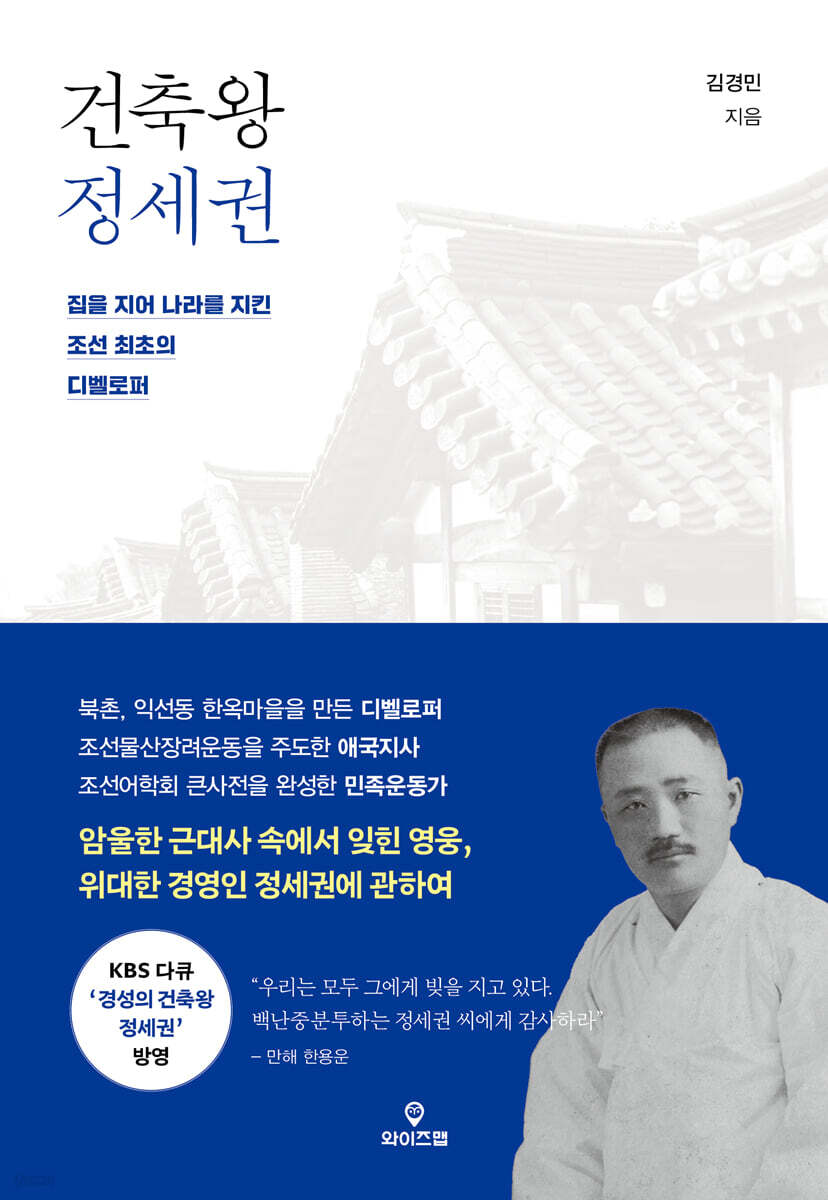
Architect Jeong Se-kwon
 |
Description
Book Introduction
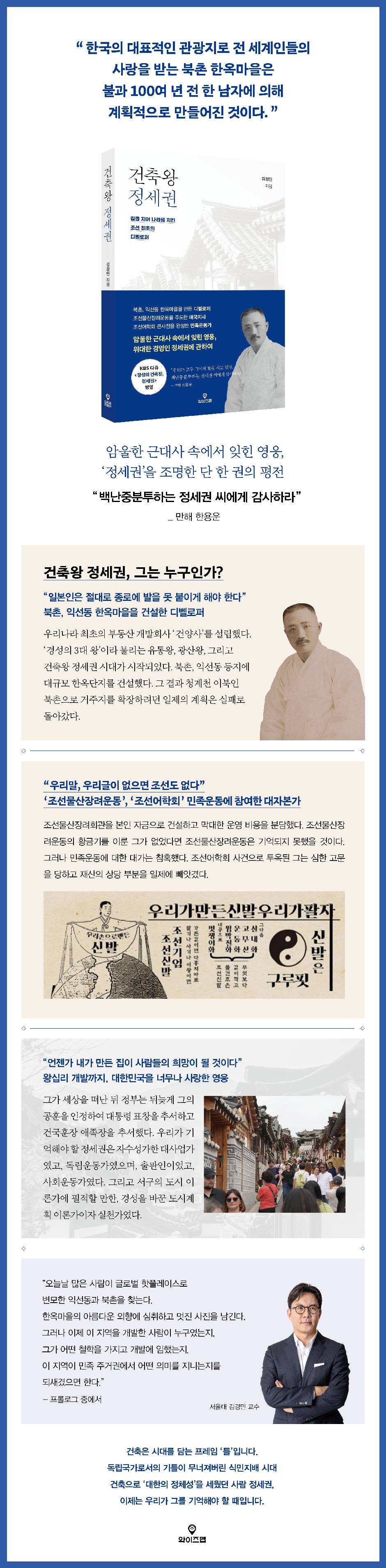
Do you know Jeong Se-kwon, Joseon's first developer who built the Bukchon and Ikseon-dong Hanok Villages, beloved by people all over the world?
The only book that sheds light on Jeong Se-gwon, a great businessman and nationalist who built a house north of the Han River during the Japanese colonial period to block Japan's advance northward, and led the Korean Products Promotion Movement and the Korean Language Society.
The large-scale Hanok villages located in Bukchon and Ikseon-dong are today Korea's representative tourist destinations and a 'hot place' visited by travelers from all over the world.
The hanok houses here, which see thousands of people coming and going every day, retain their traditional charm while also presenting a unique landscape of small houses built close together.
But when and by whom was this traditional yet unique Hanok village created? This book begins with that very question.
Through further research, the author discovered that this beautiful Hanok Village actually originated from the dream and mission of a genius developer who sought to provide a place for the powerless and impoverished common people of Gyeongseong to live during the Japanese colonial period.
At that time, Koreans were in danger of being driven out of Gyeongseong because they could not find housing.
At this time, developer Jeong Se-kwon, who appeared like a comet, purchased the large hanoks and land in Bukchon, which were in danger of being taken away by the Japanese, and developed them into a large hanok complex where multiple generations could live.
In his mind, “Numbers are strength.
There was a firm belief that “the Japanese advance northward must be stopped.”
If he had not purchased the land in Bukchon and built a hanok, the Bukchon scenery we are walking through today might have been a complex of Japanese confiscated houses.
Even after amassing great wealth through the housing business, Jeong Se-kwon took a different path from the nouveau riche.
He supported the 'Joseon Products Promotion Movement' with the belief that "Joseon people should use Joseon products" and directly participated in its management.
And he supported the Korean Language Society in both material and spiritual ways, but the price he paid was harsh.
He was brutally tortured in the 'Joseon Language Society Incident', and the Japanese took away his vast assets and blocked his development projects.
In the end, Korea's first development company, Geonyangsa, which he founded, was destined to decline, and Jeong Se-kwon was forgotten in history.
This book is unique in that it comprehensively studies fragmentary records of Jeong Se-kwon found in the fields of architecture, history, and Korean literature.
When his appearance is fully realized in three dimensions, we cannot help but wonder why we have not remembered him until now.
As you walk along the streets of the beautiful Hanok Village, anyone will now recall the three characters of the name ‘Jeong Se-kwon.’
The only book that sheds light on Jeong Se-gwon, a great businessman and nationalist who built a house north of the Han River during the Japanese colonial period to block Japan's advance northward, and led the Korean Products Promotion Movement and the Korean Language Society.
The large-scale Hanok villages located in Bukchon and Ikseon-dong are today Korea's representative tourist destinations and a 'hot place' visited by travelers from all over the world.
The hanok houses here, which see thousands of people coming and going every day, retain their traditional charm while also presenting a unique landscape of small houses built close together.
But when and by whom was this traditional yet unique Hanok village created? This book begins with that very question.
Through further research, the author discovered that this beautiful Hanok Village actually originated from the dream and mission of a genius developer who sought to provide a place for the powerless and impoverished common people of Gyeongseong to live during the Japanese colonial period.
At that time, Koreans were in danger of being driven out of Gyeongseong because they could not find housing.
At this time, developer Jeong Se-kwon, who appeared like a comet, purchased the large hanoks and land in Bukchon, which were in danger of being taken away by the Japanese, and developed them into a large hanok complex where multiple generations could live.
In his mind, “Numbers are strength.
There was a firm belief that “the Japanese advance northward must be stopped.”
If he had not purchased the land in Bukchon and built a hanok, the Bukchon scenery we are walking through today might have been a complex of Japanese confiscated houses.
Even after amassing great wealth through the housing business, Jeong Se-kwon took a different path from the nouveau riche.
He supported the 'Joseon Products Promotion Movement' with the belief that "Joseon people should use Joseon products" and directly participated in its management.
And he supported the Korean Language Society in both material and spiritual ways, but the price he paid was harsh.
He was brutally tortured in the 'Joseon Language Society Incident', and the Japanese took away his vast assets and blocked his development projects.
In the end, Korea's first development company, Geonyangsa, which he founded, was destined to decline, and Jeong Se-kwon was forgotten in history.
This book is unique in that it comprehensively studies fragmentary records of Jeong Se-kwon found in the fields of architecture, history, and Korean literature.
When his appearance is fully realized in three dimensions, we cannot help but wonder why we have not remembered him until now.
As you walk along the streets of the beautiful Hanok Village, anyone will now recall the three characters of the name ‘Jeong Se-kwon.’
- You can preview some of the book's contents.
Preview
index
Prologue: Why We Must Remember Jeong Se-kwon
Introduction to Jeong Se-kwon: Joseon's first developer and nationalist activist
Chapter 1.
The emergence of modern developers,
The prelude to a land war begins
How can Gyeongseong be the Gyeongseong of Joseon people?
People are flocking in, but there are no houses to live in.
In these dark times, the shadow of Japan looms large over Bukchon.
I will never give this area to the Japanese.
Chapter 2.
Joseon's genius becomes the king of architecture.
Modern developers who protected the land of Gyeongseong
The reason Bukchon Hanok Village was created
The King of Architecture in Gyeongseong with a Big Dream
Settling in Bukchon, the land of opportunity
Building a comprehensive real estate conglomerate
The King of Architecture's Amazing Recession-Breaking Strategy
A large-scale corporate housing rental business from 80 years ago
Efforts to develop more hygienic, more practical, and more economical housing
The shining value of the development of Gyeongseong, Gyeongsang Province
The Wangsimni Land War Against Japanese New Town Development
Chapter 3.
Protecting our home and our words
Remember the nationalist activist Jeong Se-kwon
Solidarity between emerging national capitalists and national journalists
Opening the Golden Age of the Joseon Products Promotion Movement
"Thank you to Jeong Se-kwon, who is struggling through hardships."
Even though I supported the movement to promote Joseon products at the expense of the company,
Memories of the Red Brick House at 300 Nakwon-dong
The dangerous independence movement of big capitalists
The Japanese tortured and stole their property.
Korean people become brighter with Korean culture
The king of architecture is gone, and only the beautiful Hanok village remains.
Epilogue_In memory of Gi-nong Jeong Se-kwon
References and Sources
Image source
Introduction to Jeong Se-kwon: Joseon's first developer and nationalist activist
Chapter 1.
The emergence of modern developers,
The prelude to a land war begins
How can Gyeongseong be the Gyeongseong of Joseon people?
People are flocking in, but there are no houses to live in.
In these dark times, the shadow of Japan looms large over Bukchon.
I will never give this area to the Japanese.
Chapter 2.
Joseon's genius becomes the king of architecture.
Modern developers who protected the land of Gyeongseong
The reason Bukchon Hanok Village was created
The King of Architecture in Gyeongseong with a Big Dream
Settling in Bukchon, the land of opportunity
Building a comprehensive real estate conglomerate
The King of Architecture's Amazing Recession-Breaking Strategy
A large-scale corporate housing rental business from 80 years ago
Efforts to develop more hygienic, more practical, and more economical housing
The shining value of the development of Gyeongseong, Gyeongsang Province
The Wangsimni Land War Against Japanese New Town Development
Chapter 3.
Protecting our home and our words
Remember the nationalist activist Jeong Se-kwon
Solidarity between emerging national capitalists and national journalists
Opening the Golden Age of the Joseon Products Promotion Movement
"Thank you to Jeong Se-kwon, who is struggling through hardships."
Even though I supported the movement to promote Joseon products at the expense of the company,
Memories of the Red Brick House at 300 Nakwon-dong
The dangerous independence movement of big capitalists
The Japanese tortured and stole their property.
Korean people become brighter with Korean culture
The king of architecture is gone, and only the beautiful Hanok village remains.
Epilogue_In memory of Gi-nong Jeong Se-kwon
References and Sources
Image source
Detailed image
Into the book
As a scholar analyzing the real estate market, my interest naturally led to the question, "So who on earth first developed this gem of a place?"
The investigation revealed that the developer who developed 166 Ikseon-dong is the same person who developed 31 Gahoe-dong, the center of Bukchon Hanok Village today - a popular photo spot with Namsan in the background.
Furthermore, I learned that he was the person who led the development of Hanok throughout Seoul, and I intuitively deduced that “he might be a great person.”
--- From the "Prologue"
The solution to the Japanese housing problem actually meant solving the Japanese housing shortage, and one of the strategies to achieve this was the Japanese advance northward (advancement into Bukchon).
As a result, Koreans in Gyeongseong were struggling with the housing shortage problem and were being driven out of their hometown of Bukchon.
Therefore, from the Joseon people's perspective, there was a desperate need for a force or organization that could solve these problems.
In this gloomy atmosphere of the times, a new organization emerged to serve the Korean housing market. It was a new class of Korean capitalists, including Jeong Se-kwon of Geonyangsa, that was the new modern developers.
Given the growing population, they believed that housing development and operation could be economically successful, and some entered the business with a sense of national calling to protect the country.
--- From "Chapter 1" p.47-48
Jeong Se-kwon cited the advantages of Geonyang housing as being hygienic, practical, and economical.
They attempted to solve the sanitary problems of existing Hanoks by installing plumbing facilities inside the Hanok, laying tiles on the kitchen floor, and installing a coal stove.
The south side, which receives plenty of sunlight, was designed to be spacious, and spaces such as rooms and kitchens were arranged in a hierarchical manner to ensure efficient movement within the house.
And the dining room, laundry room, and sewer were all conveniently located adjacent to the kitchen, which used water.
--- p.105 From Chapter 2
Amid the turmoil of World War II, the Japanese plan to build a large-scale Japanese residential complex along the Namsan Circular Road was never properly implemented.
If Japan had used the enormous financial power of the Oriental Development Company to purchase a large amount of land in the Wangsimni area and completed the development of Japanese residential complexes in Wangsimni and Bomun-dong, Koreans would have been forced to live in the Bukchon area within the Sadamun Gate, and the Japanese residential areas would have spatially surrounded the Korean residential areas.
This could also lead to the fragmentation of Korean residential complexes, as can be seen in the situation where poor Koreans were being driven out to areas further from Gyeongseong.
Therefore, the ‘Wangsimni Land War’ between Jeong Se-kwon and the Oriental Development Company has significant significance in the history of urban planning and development.
--- p.313 From Chapter 2
Most of the positions held by Jeong Se-kwon were those of accounting and finance director, providing financial support for the organization's activities.
During the chilling Japanese colonial period, it was extremely risky for a capitalist running a large corporation, especially a real estate businessman who needed government approval, to openly take charge of the finances of various organizations and provide financial support.
That's why his role shines even more.
In addition to these official records, there are testimonies from family members that he supported the families of independence activists in Manchuria.
--- p.136 From Chapter 3
The Great Depression that swept the world also caused a recession in Joseon, and the real estate market stagnated.
Even as his business was declining, Jeong Se-kwon was investing a huge amount of money into the Joseon Products Promotion Association.
As business stagnated due to the worsening external environment, they were pouring money into the Joseon Products Promotion Association, so even the biggest capitalists could not avoid financial losses.
In particular, in addition to a real estate development company called Geonyangsa, he also ran a separate company called Jangsansa to support the Joseon Products Promotion Association.
As the management situation worsened, it is said that Geonyangsa's capital was reduced to 80,000 won and its debt reached 100,000 won.
--- p.166 From Chapter 3
Jeong Se-kwon made various financial contributions to the activities of the Korean Language Society.
He built and donated the academic society hall at 129 Hwadong, Jongno-gu, and served as one of the five directors of the Joseon Memorial Book Publishing House, making financial contributions to various activities.
Considering the background and activities of the participants in the Korean Language Society from the Japanese perspective, the cost of establishing the Korean Language Society building and supporting various activities were on a par with supporting the independence movement.
Therefore, the price for these activities (donating the building of the Korean Language Society, serving as a director of the Joseon Memorial Book Publishing House, and supporting the Korean Standard Language Committee) was the brutal torture and theft of property due to the Korean Language Society incident.
The investigation revealed that the developer who developed 166 Ikseon-dong is the same person who developed 31 Gahoe-dong, the center of Bukchon Hanok Village today - a popular photo spot with Namsan in the background.
Furthermore, I learned that he was the person who led the development of Hanok throughout Seoul, and I intuitively deduced that “he might be a great person.”
--- From the "Prologue"
The solution to the Japanese housing problem actually meant solving the Japanese housing shortage, and one of the strategies to achieve this was the Japanese advance northward (advancement into Bukchon).
As a result, Koreans in Gyeongseong were struggling with the housing shortage problem and were being driven out of their hometown of Bukchon.
Therefore, from the Joseon people's perspective, there was a desperate need for a force or organization that could solve these problems.
In this gloomy atmosphere of the times, a new organization emerged to serve the Korean housing market. It was a new class of Korean capitalists, including Jeong Se-kwon of Geonyangsa, that was the new modern developers.
Given the growing population, they believed that housing development and operation could be economically successful, and some entered the business with a sense of national calling to protect the country.
--- From "Chapter 1" p.47-48
Jeong Se-kwon cited the advantages of Geonyang housing as being hygienic, practical, and economical.
They attempted to solve the sanitary problems of existing Hanoks by installing plumbing facilities inside the Hanok, laying tiles on the kitchen floor, and installing a coal stove.
The south side, which receives plenty of sunlight, was designed to be spacious, and spaces such as rooms and kitchens were arranged in a hierarchical manner to ensure efficient movement within the house.
And the dining room, laundry room, and sewer were all conveniently located adjacent to the kitchen, which used water.
--- p.105 From Chapter 2
Amid the turmoil of World War II, the Japanese plan to build a large-scale Japanese residential complex along the Namsan Circular Road was never properly implemented.
If Japan had used the enormous financial power of the Oriental Development Company to purchase a large amount of land in the Wangsimni area and completed the development of Japanese residential complexes in Wangsimni and Bomun-dong, Koreans would have been forced to live in the Bukchon area within the Sadamun Gate, and the Japanese residential areas would have spatially surrounded the Korean residential areas.
This could also lead to the fragmentation of Korean residential complexes, as can be seen in the situation where poor Koreans were being driven out to areas further from Gyeongseong.
Therefore, the ‘Wangsimni Land War’ between Jeong Se-kwon and the Oriental Development Company has significant significance in the history of urban planning and development.
--- p.313 From Chapter 2
Most of the positions held by Jeong Se-kwon were those of accounting and finance director, providing financial support for the organization's activities.
During the chilling Japanese colonial period, it was extremely risky for a capitalist running a large corporation, especially a real estate businessman who needed government approval, to openly take charge of the finances of various organizations and provide financial support.
That's why his role shines even more.
In addition to these official records, there are testimonies from family members that he supported the families of independence activists in Manchuria.
--- p.136 From Chapter 3
The Great Depression that swept the world also caused a recession in Joseon, and the real estate market stagnated.
Even as his business was declining, Jeong Se-kwon was investing a huge amount of money into the Joseon Products Promotion Association.
As business stagnated due to the worsening external environment, they were pouring money into the Joseon Products Promotion Association, so even the biggest capitalists could not avoid financial losses.
In particular, in addition to a real estate development company called Geonyangsa, he also ran a separate company called Jangsansa to support the Joseon Products Promotion Association.
As the management situation worsened, it is said that Geonyangsa's capital was reduced to 80,000 won and its debt reached 100,000 won.
--- p.166 From Chapter 3
Jeong Se-kwon made various financial contributions to the activities of the Korean Language Society.
He built and donated the academic society hall at 129 Hwadong, Jongno-gu, and served as one of the five directors of the Joseon Memorial Book Publishing House, making financial contributions to various activities.
Considering the background and activities of the participants in the Korean Language Society from the Japanese perspective, the cost of establishing the Korean Language Society building and supporting various activities were on a par with supporting the independence movement.
Therefore, the price for these activities (donating the building of the Korean Language Society, serving as a director of the Joseon Memorial Book Publishing House, and supporting the Korean Standard Language Committee) was the brutal torture and theft of property due to the Korean Language Society incident.
--- p.186-187 From Chapter 3
Publisher's Review
Among the three great kings of Gyeongseong, ‘the king of distribution, the king of mining, and the king of construction’
The Discovery of Jeong Se-kwon, the Great Manager Known as the "King of Construction"
Restoring the life of a developer who protected his nation through Hanok during the Japanese colonial period.
Bukchon and Ikseon-dong in Seoul are representative traditional cultural tourist destinations in Korea today, attracting millions of domestic and foreign tourists every year.
The beauty of the quiet Hanok and the unique village landscape have already garnered worldwide attention.
However, it is not well known that this space is not simply a tourist attraction, but a 'historical site' where one person dreamed and realized the existence of the nation during the Japanese colonial period.
The protagonist is none other than Jeong Se-kwon, the developer and independence activist who first developed the ‘modern Hanok complex.’
Jeong Se-kwon amassed enormous wealth through housing projects in Gyeongseong in the 1920s and 1930s, but his goal was not simply to increase his assets.
When Koreans were in danger of being driven out of Gyeongseong during the Japanese colonial period, he purchased large tracts of land in Bukchon and Ikseon-dong and created a Hanok complex.
The systematic design and construction of 'small hanoks' to allow multiple generations to live together on a small piece of land was a groundbreaking urban housing development method at the time.
Thanks to this, even Joseon people with weak economic power were able to buy their own homes without leaving Gyeongseong.
If he had not purchased and developed Bukchon, today's Bukchon would have remained a street of Japanese colonial houses.
A forgotten hero in the dark modern history,
"Thank you to Jeong Se-kwon, who is struggling through hardships." - Manhae Han Yong-un
Jeong Se-kwon generously poured all the assets he acquired through business into the nationalist movement.
With the spirit of 'Korean people should use Korean products,' he supported the movement to promote Korean products and directly participated in its operation.
Furthermore, he supported the Korean Language Society in both material and spiritual ways and devoted himself to preserving our language and writing.
However, the price paid by the big capitalists for participating in the independence movement was harsh.
He was involved in the 'Korean Language Society Incident' in 1942 and was subjected to severe torture. The Japanese confiscated his property and blocked his development projects.
Eventually, his dynasty declined, and Jeong Se-kwon was buried in the shadows of history.
Jeong Se-gwon has been studied in the architectural world as a pioneer in developing a modern Hanok complex, in the historical world as a patriotic leader responsible for the finances of the Joseon Products Promotion Association, and in the Korean literature world as a nationalist activist who supported the Joseon Language Society.
However, attempts to take a holistic view of his life have been rare.
This book is the first attempt to compile fragmentary records scattered across various fields, and restores the character of Jeong Se-kwon in a three-dimensional way.
Only now, through his name, can we shed new light on the true value of Bukchon and the historical significance of Hanok.
Through this book, readers will realize that the Hanok Village, which has become a hot spot, is not simply a tourist attraction, but a trace of the conviction and sacrifice of one man who sought to preserve the dignity of his people.
The Discovery of Jeong Se-kwon, the Great Manager Known as the "King of Construction"
Restoring the life of a developer who protected his nation through Hanok during the Japanese colonial period.
Bukchon and Ikseon-dong in Seoul are representative traditional cultural tourist destinations in Korea today, attracting millions of domestic and foreign tourists every year.
The beauty of the quiet Hanok and the unique village landscape have already garnered worldwide attention.
However, it is not well known that this space is not simply a tourist attraction, but a 'historical site' where one person dreamed and realized the existence of the nation during the Japanese colonial period.
The protagonist is none other than Jeong Se-kwon, the developer and independence activist who first developed the ‘modern Hanok complex.’
Jeong Se-kwon amassed enormous wealth through housing projects in Gyeongseong in the 1920s and 1930s, but his goal was not simply to increase his assets.
When Koreans were in danger of being driven out of Gyeongseong during the Japanese colonial period, he purchased large tracts of land in Bukchon and Ikseon-dong and created a Hanok complex.
The systematic design and construction of 'small hanoks' to allow multiple generations to live together on a small piece of land was a groundbreaking urban housing development method at the time.
Thanks to this, even Joseon people with weak economic power were able to buy their own homes without leaving Gyeongseong.
If he had not purchased and developed Bukchon, today's Bukchon would have remained a street of Japanese colonial houses.
A forgotten hero in the dark modern history,
"Thank you to Jeong Se-kwon, who is struggling through hardships." - Manhae Han Yong-un
Jeong Se-kwon generously poured all the assets he acquired through business into the nationalist movement.
With the spirit of 'Korean people should use Korean products,' he supported the movement to promote Korean products and directly participated in its operation.
Furthermore, he supported the Korean Language Society in both material and spiritual ways and devoted himself to preserving our language and writing.
However, the price paid by the big capitalists for participating in the independence movement was harsh.
He was involved in the 'Korean Language Society Incident' in 1942 and was subjected to severe torture. The Japanese confiscated his property and blocked his development projects.
Eventually, his dynasty declined, and Jeong Se-kwon was buried in the shadows of history.
Jeong Se-gwon has been studied in the architectural world as a pioneer in developing a modern Hanok complex, in the historical world as a patriotic leader responsible for the finances of the Joseon Products Promotion Association, and in the Korean literature world as a nationalist activist who supported the Joseon Language Society.
However, attempts to take a holistic view of his life have been rare.
This book is the first attempt to compile fragmentary records scattered across various fields, and restores the character of Jeong Se-kwon in a three-dimensional way.
Only now, through his name, can we shed new light on the true value of Bukchon and the historical significance of Hanok.
Through this book, readers will realize that the Hanok Village, which has become a hot spot, is not simply a tourist attraction, but a trace of the conviction and sacrifice of one man who sought to preserve the dignity of his people.
GOODS SPECIFICS
- Date of issue: October 30, 2025
- Page count, weight, size: 232 pages | 402g | 145*210*15mm
- ISBN13: 9791124011034
- ISBN10: 112401103X
You may also like
카테고리
korean


korean

![GQ KOREA Mark (Monthly): December [2025]](http://librairie.coreenne.fr/cdn/shop/files/8ef265dbbfbf186523ed75ba7319009d.jpg?v=1765340328&width=3840)


