

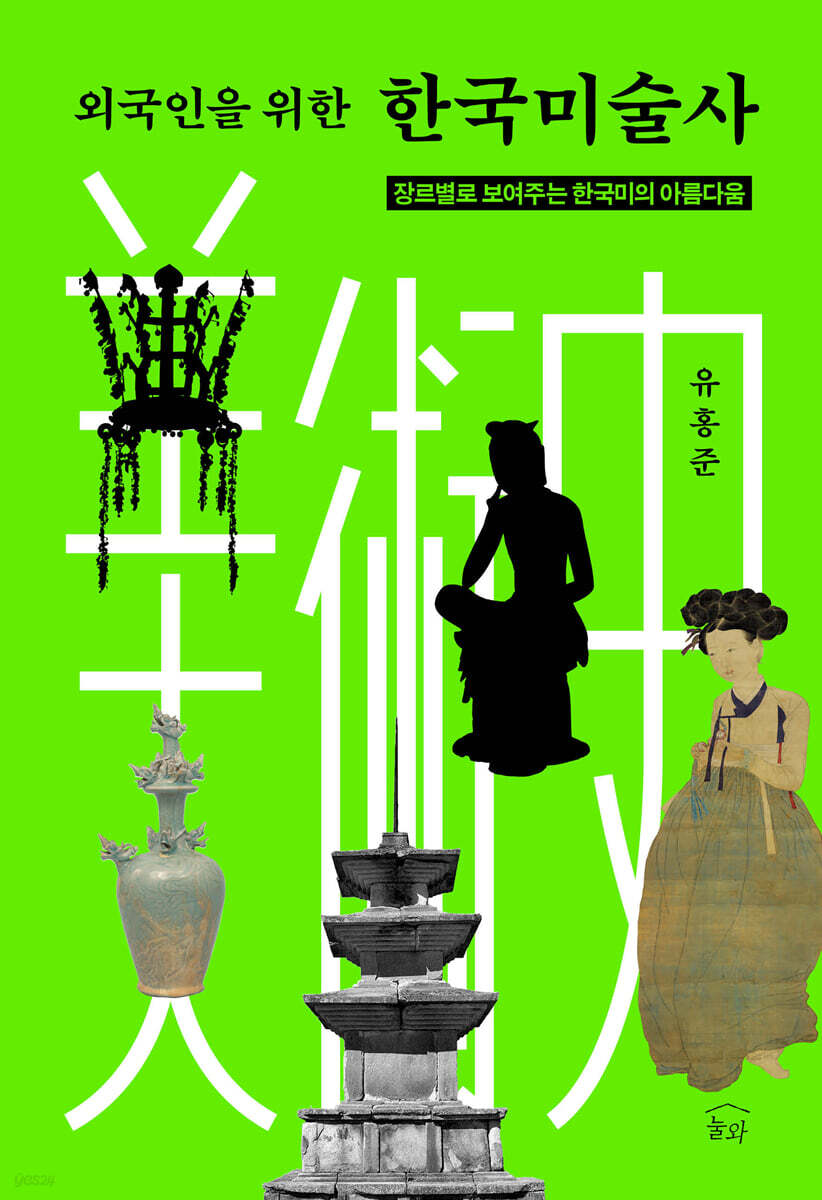
Korean Art History for Foreigners
 |
Description
Book Introduction
- A word from MD
-
Revealing the beauty and uniqueness of Korean artYu Hong-jun, who has widely spread the value and beauty of our cultural heritage, systematically organized Korean art to answer the question, “What is Korean beauty?”
It provides a fresh perspective on each genre, including painting, crafts, ceramics, and Buddhist art, and clearly demonstrates the uniqueness and originality of Korean art when compared to Chinese and Japanese art.
October 1, 2025. Producer Hyunjae Ahn of Art
The essence of Korean culture and the roots of K-culture
Revealing the beauty and uniqueness of Korean art
Today, as K-culture sweeps the world, Korea's art and cultural heritage are receiving renewed attention as its roots.
Yoo Hong-jun, who has emphasized the value and beauty of our cultural heritage, has organized Korean art by genre, including painting, crafts, ceramics, and Buddhist art, in "Korean Art History for Foreigners" to answer the world's question, "What is Korean Beauty?"
The book begins with a "Flow of Korean Art History," which allows readers to read the development of Korean art in one go. Each genre is compared with that of China and Japan, revealing the uniqueness of Korean art within East Asia and the world.
The text is written in an easy-to-understand and friendly manner, taking into consideration readers who are new to Korean art, and with future translation into foreign languages in mind.
Revealing the beauty and uniqueness of Korean art
Today, as K-culture sweeps the world, Korea's art and cultural heritage are receiving renewed attention as its roots.
Yoo Hong-jun, who has emphasized the value and beauty of our cultural heritage, has organized Korean art by genre, including painting, crafts, ceramics, and Buddhist art, in "Korean Art History for Foreigners" to answer the world's question, "What is Korean Beauty?"
The book begins with a "Flow of Korean Art History," which allows readers to read the development of Korean art in one go. Each genre is compared with that of China and Japan, revealing the uniqueness of Korean art within East Asia and the world.
The text is written in an easy-to-understand and friendly manner, taking into consideration readers who are new to Korean art, and with future translation into foreign languages in mind.
- You can preview some of the book's contents.
Preview
index
In publishing the book
Introduction: The Flow of Korean Art History
Prehistoric and Tomb Art and Crafts
Chapter 1 Prehistoric Art
-A new dawn in Korean art history
Chapter 2: Tomb Art of the Three Kingdoms Period
-The art world advancing toward an ancient nation
Chapter 3 Crafts of Unified Silla and Goryeo
-The splendid techniques of the craft kingdom
Buddhist art
Chapter 4 Temple Architecture
-The aesthetics of mountain temples
Chapter 5 Stone Art
-Stone pagodas, stone pagodas, and stone lanterns of the granite country
Chapter 6: Buddhist Sculptures
-Religious realization of the ideal human being
Chapter 7 Buddhist Crafts
- Tribute to the magnificent Buddhist world
Chapter 8: Buddhist Painting
-Praise to the Absolute
Goryeo and Joseon porcelain
Chapter 9 Goryeo Celadon
-The best Goryeo jade color in the world
Chapter 10 Buncheong Ware
-The liberation of art brought about by the autonomy of the people
Chapter 11 Joseon White Porcelain
-For the gentle lyricism of the Korean people
Joseon Dynasty paintings
Chapter 12: Decorative Paintings, Portraits, and Documentary Paintings
-The primal function of drawing
Chapter 13 Landscape Painting and Landscape Figure Painting
-From conceptual landscape to landscape figures
Chapter 14: Taoist figure drawings, ancient figures, and poetry drawings
- Observation of the manifestation of humanity and sociality
Chapter 15: True Landscape and Genre Painting
-The beauty of Joseon's mountains and rivers and the expression of life
Chapter 16: Flower and Bird Painting and Spiritual Painting
- Human lyricism toward nature
Chapter 17: The Four Gentlemen and Still Life
-Symbolism of nature and objects captured on canvas
Joseon Dynasty architecture, crafts, and folk art
Chapter 18: Architecture of Joseon
-Space management that becomes one with nature
Chapter 19: Crafts of Joseon
-Design for the fragrance of life
Chapter 20: Folk Art
-The scent of life, the beauty of unconventionality
References
Source of the illustration
Introduction: The Flow of Korean Art History
Prehistoric and Tomb Art and Crafts
Chapter 1 Prehistoric Art
-A new dawn in Korean art history
Chapter 2: Tomb Art of the Three Kingdoms Period
-The art world advancing toward an ancient nation
Chapter 3 Crafts of Unified Silla and Goryeo
-The splendid techniques of the craft kingdom
Buddhist art
Chapter 4 Temple Architecture
-The aesthetics of mountain temples
Chapter 5 Stone Art
-Stone pagodas, stone pagodas, and stone lanterns of the granite country
Chapter 6: Buddhist Sculptures
-Religious realization of the ideal human being
Chapter 7 Buddhist Crafts
- Tribute to the magnificent Buddhist world
Chapter 8: Buddhist Painting
-Praise to the Absolute
Goryeo and Joseon porcelain
Chapter 9 Goryeo Celadon
-The best Goryeo jade color in the world
Chapter 10 Buncheong Ware
-The liberation of art brought about by the autonomy of the people
Chapter 11 Joseon White Porcelain
-For the gentle lyricism of the Korean people
Joseon Dynasty paintings
Chapter 12: Decorative Paintings, Portraits, and Documentary Paintings
-The primal function of drawing
Chapter 13 Landscape Painting and Landscape Figure Painting
-From conceptual landscape to landscape figures
Chapter 14: Taoist figure drawings, ancient figures, and poetry drawings
- Observation of the manifestation of humanity and sociality
Chapter 15: True Landscape and Genre Painting
-The beauty of Joseon's mountains and rivers and the expression of life
Chapter 16: Flower and Bird Painting and Spiritual Painting
- Human lyricism toward nature
Chapter 17: The Four Gentlemen and Still Life
-Symbolism of nature and objects captured on canvas
Joseon Dynasty architecture, crafts, and folk art
Chapter 18: Architecture of Joseon
-Space management that becomes one with nature
Chapter 19: Crafts of Joseon
-Design for the fragrance of life
Chapter 20: Folk Art
-The scent of life, the beauty of unconventionality
References
Source of the illustration
Publisher's Review
A Simpler History of Korean Art for Beginners
Professor Yoo Hong-jun, who has worked hard to spread the value of our cultural heritage to the world through his six-volume Korean Art History Lectures, Eyesight, Masterpiece Pilgrimage, National Treasure Pilgrimage, and My Cultural Heritage Tour, is taking on a new challenge.
To enable even those encountering Korean art for the first time to fully appreciate its beauty, we published “Korean Art History for Foreigners” as a more easily understandable history of Korean art.
Although I included 'Foreigner' in the title in the hope that this book would be introduced overseas, it is not a book written 'only' for foreigners.
It is also an introductory and educational book for many 'Koreans' for whom Korean art may be more unfamiliar than Western art.
A new composition of Korean art history
While conventional art history has typically been written chronologically from distant to recent times, this book has chosen a structure that prioritizes genres such as prehistoric art, tomb art, crafts, Buddhist art, ceramics, and painting.
Showing the development of art over time is natural if we focus on the ‘history’ of ‘art history’, but it may not be so when viewed from the perspective of ‘art’.
Thanks to this structure, readers can focus on the characteristics and unique beauty of each genre of Korean art while reading this book.
Of course, we have carefully selected relics and photographs to convey the true nature of Korean art to readers.
Korean Beauty by Genre
Although the commentary has become more user-friendly with this new genre-based composition, the content is by no means light, and only the core of Korean art history has been extracted and included in this one volume.
The book begins by introducing prehistoric artifacts that herald the birth of Korean art, Goguryeo tomb murals full of powerful charm, Silla pure gold artifacts that are the pinnacle of splendor, Baekje King Muryeong's tomb artifacts that embody the aesthetics of 'geomibulruhwaibulchi (simple but not shabby, splendid but not extravagant)', and Goryeo's masterpiece crafts, including exquisite mother-of-pearl lacquerware, captivating readers.
The Buddhist art that was organized next is also the core of Korean art history that cannot be treated lightly in any detail, from Buddhist statues, the flower of Korean sculptural art, to Buddhist stone art represented by stone pagodas, stone lanterns, and stupas made of granite, to mountain temple architecture, a product of Buddhist culture that adapted to the natural environment of the Korean Peninsula, to Goryeo Buddhist paintings with their detailed brushwork and Joseon Dynasty Buddhist paintings that have recently attracted much attention for their narrative composition.
In the ceramics section, we introduce Goryeo celadon, which was admired by the Chinese people of the time for its beautiful colors; inlaid celadon, which is treated as the most precious due to its elaborate patterns and composition; buncheong sagi, which embodies a unique aesthetic that is hard to find anywhere else in the world; and white porcelain, which shows the aesthetic sensibility of Joseon, which particularly revered the color pure white.
Because Joseon Dynasty paintings occupy such a large portion of our art history, they are specifically divided into landscape paintings, genre paintings, and bird-and-flower paintings, and explained in more detail according to the subject matter.
Crafts, folk art, and embroidery from the Joseon Dynasty, which have not been introduced in detail in art history, are also covered in a separate chapter, allowing readers to truly experience the entire history of Korean art through this book.
An introduction that provides an overview of Korean art history.
At the beginning of the book, there is an article titled “The Flow of Korean Art History,” which briefly summarizes the development of Korean art from prehistoric times to modern times.
The overall structure of the book focuses on presenting each genre of Korean art more faithfully, but at the same time, it also provides a foundation in Korean art history that can be useful as background knowledge for understanding each genre.
Even in a short volume, it provides an easy-to-understand overview of social and cultural changes over the course of history and their impact on art, and introduces cultural heritages that represent the era.
Even readers who are new to Korean art history will be able to get a general idea of the history of our art just by reading this article.
The era of K-culture has arrived! Korean art, its roots.
As Korean dramas, movies, and music become popular, K-culture is attracting attention from around the world, and many people are paying attention to our traditional culture, which can be considered its source.
In “Korean Art History for Foreigners,” author Yoo Hong-jun responds to this demand by clearly conveying the beauty and value of our cultural heritage.
Additionally, for each genre of Korean art covered in the book, a comparison is attempted with that of Chinese and Japanese art, and the points made about Korea's exchanges with and influence on these countries are emphasized.
Through this, it was revealed that the history of Oriental art without Korean art history is bound to be incomplete, and that Korea is a cultural major shareholder with a solid stake.
Professor Yoo Hong-jun, who has worked hard to spread the value of our cultural heritage to the world through his six-volume Korean Art History Lectures, Eyesight, Masterpiece Pilgrimage, National Treasure Pilgrimage, and My Cultural Heritage Tour, is taking on a new challenge.
To enable even those encountering Korean art for the first time to fully appreciate its beauty, we published “Korean Art History for Foreigners” as a more easily understandable history of Korean art.
Although I included 'Foreigner' in the title in the hope that this book would be introduced overseas, it is not a book written 'only' for foreigners.
It is also an introductory and educational book for many 'Koreans' for whom Korean art may be more unfamiliar than Western art.
A new composition of Korean art history
While conventional art history has typically been written chronologically from distant to recent times, this book has chosen a structure that prioritizes genres such as prehistoric art, tomb art, crafts, Buddhist art, ceramics, and painting.
Showing the development of art over time is natural if we focus on the ‘history’ of ‘art history’, but it may not be so when viewed from the perspective of ‘art’.
Thanks to this structure, readers can focus on the characteristics and unique beauty of each genre of Korean art while reading this book.
Of course, we have carefully selected relics and photographs to convey the true nature of Korean art to readers.
Korean Beauty by Genre
Although the commentary has become more user-friendly with this new genre-based composition, the content is by no means light, and only the core of Korean art history has been extracted and included in this one volume.
The book begins by introducing prehistoric artifacts that herald the birth of Korean art, Goguryeo tomb murals full of powerful charm, Silla pure gold artifacts that are the pinnacle of splendor, Baekje King Muryeong's tomb artifacts that embody the aesthetics of 'geomibulruhwaibulchi (simple but not shabby, splendid but not extravagant)', and Goryeo's masterpiece crafts, including exquisite mother-of-pearl lacquerware, captivating readers.
The Buddhist art that was organized next is also the core of Korean art history that cannot be treated lightly in any detail, from Buddhist statues, the flower of Korean sculptural art, to Buddhist stone art represented by stone pagodas, stone lanterns, and stupas made of granite, to mountain temple architecture, a product of Buddhist culture that adapted to the natural environment of the Korean Peninsula, to Goryeo Buddhist paintings with their detailed brushwork and Joseon Dynasty Buddhist paintings that have recently attracted much attention for their narrative composition.
In the ceramics section, we introduce Goryeo celadon, which was admired by the Chinese people of the time for its beautiful colors; inlaid celadon, which is treated as the most precious due to its elaborate patterns and composition; buncheong sagi, which embodies a unique aesthetic that is hard to find anywhere else in the world; and white porcelain, which shows the aesthetic sensibility of Joseon, which particularly revered the color pure white.
Because Joseon Dynasty paintings occupy such a large portion of our art history, they are specifically divided into landscape paintings, genre paintings, and bird-and-flower paintings, and explained in more detail according to the subject matter.
Crafts, folk art, and embroidery from the Joseon Dynasty, which have not been introduced in detail in art history, are also covered in a separate chapter, allowing readers to truly experience the entire history of Korean art through this book.
An introduction that provides an overview of Korean art history.
At the beginning of the book, there is an article titled “The Flow of Korean Art History,” which briefly summarizes the development of Korean art from prehistoric times to modern times.
The overall structure of the book focuses on presenting each genre of Korean art more faithfully, but at the same time, it also provides a foundation in Korean art history that can be useful as background knowledge for understanding each genre.
Even in a short volume, it provides an easy-to-understand overview of social and cultural changes over the course of history and their impact on art, and introduces cultural heritages that represent the era.
Even readers who are new to Korean art history will be able to get a general idea of the history of our art just by reading this article.
The era of K-culture has arrived! Korean art, its roots.
As Korean dramas, movies, and music become popular, K-culture is attracting attention from around the world, and many people are paying attention to our traditional culture, which can be considered its source.
In “Korean Art History for Foreigners,” author Yoo Hong-jun responds to this demand by clearly conveying the beauty and value of our cultural heritage.
Additionally, for each genre of Korean art covered in the book, a comparison is attempted with that of Chinese and Japanese art, and the points made about Korea's exchanges with and influence on these countries are emphasized.
Through this, it was revealed that the history of Oriental art without Korean art history is bound to be incomplete, and that Korea is a cultural major shareholder with a solid stake.
GOODS SPECIFICS
- Date of issue: September 22, 2025
- Format: Hardcover book binding method guide
- Page count, weight, size: 572 pages | 752g | 148*216*24mm
- ISBN13: 9791189074890
- ISBN10: 1189074893
You may also like
카테고리
korean


korean

![GQ KOREA Mark (Monthly): December [2025]](http://librairie.coreenne.fr/cdn/shop/files/8ef265dbbfbf186523ed75ba7319009d.jpg?v=1765340328&width=3840)


