

A bowl of culture
 |
Description
Book Introduction
Every piece of chicken and every box of chocolate has a hidden story.
The Story of "Korean Soul Food," Filling Your Soul
In 2024, the Netflix variety show "Black and White Chef" became a craze.
New star chefs were born, and 'cooking shows' and 'eating shows' gained momentum on both terrestrial and internet broadcasting.
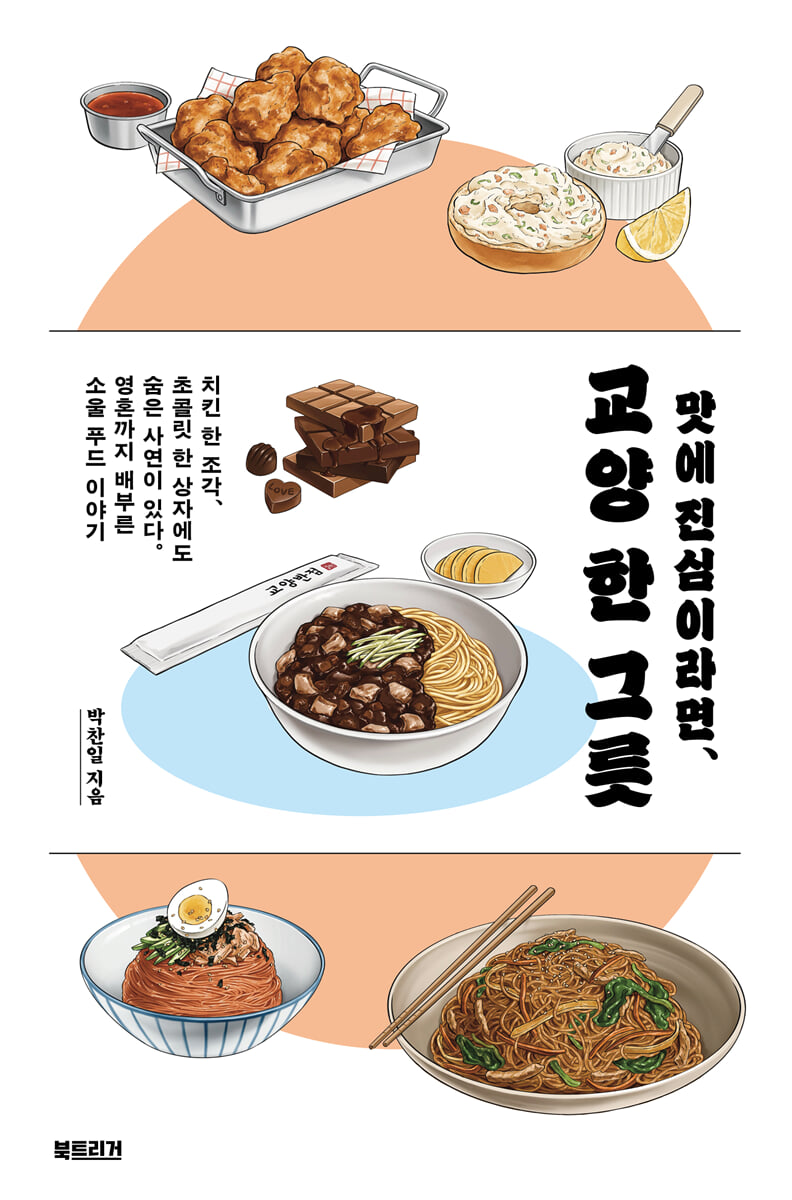
Now that food has become a true culture and a life skill that enriches our lives, how well do we truly understand the foods we eat every day? Wouldn't meals be even more enjoyable if we knew that japchae didn't originally contain this ingredient, how foreign dishes like jjajangmyeon and chicken evolved through cultural adaptation to become authentically Korean, and the difference between pasta and spaghetti? This book contains the stories of 18 dishes meticulously prepared by "chef and writer" Park Chan-il.
The menus selected by Park Chan-il are all 'Korean soul foods' that have captured our taste buds.
The author's writing, rich in flavor and aroma, allows us to savor food not just as a means of nutritious intake, but as a delicious cultural story that transcends tradition and trend.
The Story of "Korean Soul Food," Filling Your Soul
In 2024, the Netflix variety show "Black and White Chef" became a craze.
New star chefs were born, and 'cooking shows' and 'eating shows' gained momentum on both terrestrial and internet broadcasting.
Now that food has become a true culture and a life skill that enriches our lives, how well do we truly understand the foods we eat every day? Wouldn't meals be even more enjoyable if we knew that japchae didn't originally contain this ingredient, how foreign dishes like jjajangmyeon and chicken evolved through cultural adaptation to become authentically Korean, and the difference between pasta and spaghetti? This book contains the stories of 18 dishes meticulously prepared by "chef and writer" Park Chan-il.
The menus selected by Park Chan-il are all 'Korean soul foods' that have captured our taste buds.
The author's writing, rich in flavor and aroma, allows us to savor food not just as a means of nutritious intake, but as a delicious cultural story that transcends tradition and trend.
- You can preview some of the book's contents.
Preview
index
Entering
Part 1│What's on the menu for lunch today?
MENU 1 This crispy texture is cheating! _Donkatsu
MENU 2 What would I do without 'this'? _Japchae
MENU 3 Today and Tomorrow, Pulling _ Tteokbokki
MENU 4 Worldwide _Jjajang
MENU 5 A Long History Like Noodles _Pasta
MENU 6 A meeting of likes and dislikes _ Curry
Part 2│Ah, I'm hungry, I need to eat a snack
MENU 7 Want to go on a bread pilgrimage? _Bread
MENU 8 Ice cream that melts away even the heat
MENU 9 If there is a boiling secret inside _Ramen
MENU 10 Culture in a Sesame Bread _ Hamburger
MENU 11 A Bittersweet Piece of Chocolate
MENU 12 The Hidden Story Between Kim and Rice _Kimbap
Part 3│What should I eat on the weekend?
MENU 13 'Chicken God' is always right _Chicken
MENU 14 It's not just about grilling _Steak
MENU 15 A Variety of Cold Noodles for Every Season
MENU 16 Koreans' Favorite, the Superstar on the Grill _ Samgyeopsal
MENU 17 Don't miss out on a variety of flavors! _Mala Xiang Guo
MENU 18 Pizza that is fun to share
Appendix│Park Chan-il's slightly special recipe
ㆍCrispy and soft soy sauce cream tteokbokki
The Taste of Italy! _Rose Spicy Amatriciana Rigatoni
ㆍIt tastes even better when applied! _Green Onion Salmon Spread
ㆍIf I just add ○○ to the fridge? _Tuna Bibim Noodles
ㆍOne bite! _Air Fryer Boneless Chicken
ㆍThree flavors in one! _Samgyeopsal Jjamppong Ramen
Enjoy the flavors of the continent in a simple way! _Mara Pasta
Part 1│What's on the menu for lunch today?
MENU 1 This crispy texture is cheating! _Donkatsu
MENU 2 What would I do without 'this'? _Japchae
MENU 3 Today and Tomorrow, Pulling _ Tteokbokki
MENU 4 Worldwide _Jjajang
MENU 5 A Long History Like Noodles _Pasta
MENU 6 A meeting of likes and dislikes _ Curry
Part 2│Ah, I'm hungry, I need to eat a snack
MENU 7 Want to go on a bread pilgrimage? _Bread
MENU 8 Ice cream that melts away even the heat
MENU 9 If there is a boiling secret inside _Ramen
MENU 10 Culture in a Sesame Bread _ Hamburger
MENU 11 A Bittersweet Piece of Chocolate
MENU 12 The Hidden Story Between Kim and Rice _Kimbap
Part 3│What should I eat on the weekend?
MENU 13 'Chicken God' is always right _Chicken
MENU 14 It's not just about grilling _Steak
MENU 15 A Variety of Cold Noodles for Every Season
MENU 16 Koreans' Favorite, the Superstar on the Grill _ Samgyeopsal
MENU 17 Don't miss out on a variety of flavors! _Mala Xiang Guo
MENU 18 Pizza that is fun to share
Appendix│Park Chan-il's slightly special recipe
ㆍCrispy and soft soy sauce cream tteokbokki
The Taste of Italy! _Rose Spicy Amatriciana Rigatoni
ㆍIt tastes even better when applied! _Green Onion Salmon Spread
ㆍIf I just add ○○ to the fridge? _Tuna Bibim Noodles
ㆍOne bite! _Air Fryer Boneless Chicken
ㆍThree flavors in one! _Samgyeopsal Jjamppong Ramen
Enjoy the flavors of the continent in a simple way! _Mara Pasta
Detailed image

Into the book
Viewing food simply in terms of calories and nutrients is a thing of the past.
Now the role of food has expanded to become a medium for interpersonal relationships and shared emotions.
We have entered an era where food is seen as the key to creating a better world.
As seen in the popularity of mukbang and cooking shows, it is also a form of entertainment that provides enjoyment to people.
I hope that through this book, you too will be able to enjoy a more enjoyable and happy eating life in the future.
Finally, I have one thing I would like to ask you.
While enjoying a delicious meal, why not take a moment to consider the many efforts beyond the table? From farmers and fishermen to those who process and distribute food, and even chefs… each bowl of food that arrives at our table is imbued with the care and effort of countless people.
As we ponder their hearts, we will be able to feel anew the importance of food that fills our bodies and minds.
--- From "Entering"
It was through Japan that the public became aware of tonkatsu.
In Japan, meat consumption was originally prohibited since the time of Emperor Tenmu in the 7th century.
Since farming was the foundation of the country's economy, it was a measure to prevent the slaughter of cattle used for farming.
At that time, Japan was a Buddhist country, so killing was strictly prohibited.
However, after the Meiji Restoration in 1868, things changed.
At the time, the Japanese thought that the reason Westerners came to dominate the world was because of their large size.
The difference in physique is of course due to the difference in food culture.
Until then, the Japanese people's staple food had been fish and vegetables, but the country began to encourage meat consumption in an effort to build a large body like Westerners.
Finally, in 1872, the ban on eating meat was repealed.
It was the first time in over 1,200 years.
--- From "Chapter 1: This 'crispy' thing is cheating! - Tonkatsu"
It has been over half a century since the artificial seasoning commonly called MSG (monosodium glutamate) began to be added to tteokbokki in the 1970s.
At the time, MSG was expensive and couldn't be used in large quantities. However, as prices began to fall in the 1990s, the amount added gradually increased. MSG is well known as a "magic powder" that enhances the flavor of any food.
So, did the popularity of tteokbokki soar with the introduction of MSG? Ironically, tteokbokki's popularity actually faltered because of MSG.
Unlike natural seasonings, MSG (chemically produced) was perceived as bad for the body, and tteokbokki was also considered a ‘junk food’.
There was even a time when there was a claim that tteokbokki in front of schools should be eliminated.
--- From "Chapter 3: Pulling it out today and tomorrow - Tteokbokki"
Jjajangmyeon has been explosively popular since the 1950s.
Since our country has traditionally farmed rice and eaten rice as its staple food, wheat flour foods have rarely appeared on Korean tables.
Large-scale wheat cultivation requires wide, dry plains, but farmland with such conditions was relatively rare in Korea.
During the Joseon Dynasty, the price of wheat was so expensive that only the wealthy could import small quantities from China.
--- From "Chapter 4: Worldwide - Jjajang"
British curry has also had a major influence on Japan.
In the late 19th century, as Japan opened its doors to the world and built a modern military, it established diplomatic relations with Britain.
It was to introduce Britain's powerful naval force and technology, but in the process, it also ended up adopting the British Navy's curry diet.
This 'Navy Curry', originally created to provide the nutrients needed by soldiers on long sea voyages, has been reinterpreted in Japanese style and is still considered a representative barracks food.
--- From "Chapter 6: A Meeting of Likes and Dislikes - Curry"
Meanwhile, when it comes to ice cream, there is one thing that you can't leave out.
It's a cone.
The first ice cream served in a crispy cone was at the 1904 St. Louis World's Fair.
There is an anecdote that when an ice cream shop ran out of plates, they started serving ice cream on thinly-baked waffles sold nearby, and this method became extremely popular.
However, this anecdote is most likely not true.
There are records of people putting ice cream on top of waffles even before that.
However, it is clear that cone ice cream became popular in the United States in the early 20th century.
--- From "Chapter 8: Ice Cream That Melts Even the Heat"
How did chocolate become such a popular snack? There's a scientific reason for it.
Chocolate contains a substance called phenylethylamine (PEA).
It is a substance commonly called the 'love hormone'.
There's a reason chocolate is considered a love potion (though, since most of the phenylethylamine in chocolate is broken down during digestion, eating it doesn't have much of an effect).
(…) By the way, have you ever heard that chocolate is fatally poisonous to dogs and cats? Theobromine is one of the reasons.
Animals break down theobromine much more slowly than humans.
So even if your dog stares at the chocolate longingly, it's okay to eat it by yourself without feeling guilty!
--- From "Chapter 11: A Bittersweet Piece - Chocolate"
Why did our ancestors eat naengmyeon (cold noodles) in the cold winter? If you think about it, it's not a difficult question.
Buckwheat, the main ingredient in making naengmyeon noodles, was harvested only in late fall and could only be eaten in winter.
Why not just store it well and eat it the following summer? Food was scarce in the old days.
It would have been impossible to store buckwheat untouched until the following summer.
Besides, in those old days there were no refrigerators, so it was very difficult to get ice or cold broth in the summer.
Those who had access to ice year-round were limited to the royal family and the upper class.
Ice was a luxury.
Plus, making noodles was easier in the winter.
After kneading the buckwheat dough, it took a lot of work by many people to put it in a noodle mold and make noodles.
It was only in winter, when farming was less busy, that many people could work together to pull out cotton.
In many ways, naengmyeon is a food that can be eaten in winter.
--- From "Chapter 15: Various Seasons - Cold Noodles"
If you go to Yeongwol, Gangwon-do, you can see a large sign that says, “The birthplace of grilled pork belly.”
Did grilled pork belly really originate in Yeongwol? Until the 1980s, Korea used a lot of briquettes.
The coal that is the raw material for briquettes is mainly produced in Gangwon-do.
There was an unverified rumor going around among coal miners that grilled pork belly was the best way to wash away the coal dust stuck in your throat.
Thanks to this, pork belly became a regular meal for miners, and there is a theory that this is the beginning of grilled pork belly.
However, the theory that grilled pork belly was born in Yeongwol cannot be confirmed as a fact because there is no official record.
Meanwhile, there is also a claim that Cheongju, North Chungcheong Province, is the birthplace of grilled pork belly.
--- From "Chapter 16: Koreans' Favorite, Superstar on the Grill - Samgyeopsal"
So, what spices give mala tang and mala xiang guo their distinctive spiciness? While there are many ingredients involved, two are key.
Huajiao, which originated in the Sichuan region of China, is a pepper that is familiar to us.
In Korea, hwajao is often called 'sancho', but it is actually a completely different plant.
The fruit of the pepper tree, the outer bark of which is dried and used, produces a unique tingling sensation on the tongue.
Because it contains hydroxy-alpha-sanshool.
Meanwhile, the chili peppers used in mala-tang are basically close to the spicy flavor we know, but since they come from different countries of origin, they have a subtly different flavor from Korean chili peppers.
Now the role of food has expanded to become a medium for interpersonal relationships and shared emotions.
We have entered an era where food is seen as the key to creating a better world.
As seen in the popularity of mukbang and cooking shows, it is also a form of entertainment that provides enjoyment to people.
I hope that through this book, you too will be able to enjoy a more enjoyable and happy eating life in the future.
Finally, I have one thing I would like to ask you.
While enjoying a delicious meal, why not take a moment to consider the many efforts beyond the table? From farmers and fishermen to those who process and distribute food, and even chefs… each bowl of food that arrives at our table is imbued with the care and effort of countless people.
As we ponder their hearts, we will be able to feel anew the importance of food that fills our bodies and minds.
--- From "Entering"
It was through Japan that the public became aware of tonkatsu.
In Japan, meat consumption was originally prohibited since the time of Emperor Tenmu in the 7th century.
Since farming was the foundation of the country's economy, it was a measure to prevent the slaughter of cattle used for farming.
At that time, Japan was a Buddhist country, so killing was strictly prohibited.
However, after the Meiji Restoration in 1868, things changed.
At the time, the Japanese thought that the reason Westerners came to dominate the world was because of their large size.
The difference in physique is of course due to the difference in food culture.
Until then, the Japanese people's staple food had been fish and vegetables, but the country began to encourage meat consumption in an effort to build a large body like Westerners.
Finally, in 1872, the ban on eating meat was repealed.
It was the first time in over 1,200 years.
--- From "Chapter 1: This 'crispy' thing is cheating! - Tonkatsu"
It has been over half a century since the artificial seasoning commonly called MSG (monosodium glutamate) began to be added to tteokbokki in the 1970s.
At the time, MSG was expensive and couldn't be used in large quantities. However, as prices began to fall in the 1990s, the amount added gradually increased. MSG is well known as a "magic powder" that enhances the flavor of any food.
So, did the popularity of tteokbokki soar with the introduction of MSG? Ironically, tteokbokki's popularity actually faltered because of MSG.
Unlike natural seasonings, MSG (chemically produced) was perceived as bad for the body, and tteokbokki was also considered a ‘junk food’.
There was even a time when there was a claim that tteokbokki in front of schools should be eliminated.
--- From "Chapter 3: Pulling it out today and tomorrow - Tteokbokki"
Jjajangmyeon has been explosively popular since the 1950s.
Since our country has traditionally farmed rice and eaten rice as its staple food, wheat flour foods have rarely appeared on Korean tables.
Large-scale wheat cultivation requires wide, dry plains, but farmland with such conditions was relatively rare in Korea.
During the Joseon Dynasty, the price of wheat was so expensive that only the wealthy could import small quantities from China.
--- From "Chapter 4: Worldwide - Jjajang"
British curry has also had a major influence on Japan.
In the late 19th century, as Japan opened its doors to the world and built a modern military, it established diplomatic relations with Britain.
It was to introduce Britain's powerful naval force and technology, but in the process, it also ended up adopting the British Navy's curry diet.
This 'Navy Curry', originally created to provide the nutrients needed by soldiers on long sea voyages, has been reinterpreted in Japanese style and is still considered a representative barracks food.
--- From "Chapter 6: A Meeting of Likes and Dislikes - Curry"
Meanwhile, when it comes to ice cream, there is one thing that you can't leave out.
It's a cone.
The first ice cream served in a crispy cone was at the 1904 St. Louis World's Fair.
There is an anecdote that when an ice cream shop ran out of plates, they started serving ice cream on thinly-baked waffles sold nearby, and this method became extremely popular.
However, this anecdote is most likely not true.
There are records of people putting ice cream on top of waffles even before that.
However, it is clear that cone ice cream became popular in the United States in the early 20th century.
--- From "Chapter 8: Ice Cream That Melts Even the Heat"
How did chocolate become such a popular snack? There's a scientific reason for it.
Chocolate contains a substance called phenylethylamine (PEA).
It is a substance commonly called the 'love hormone'.
There's a reason chocolate is considered a love potion (though, since most of the phenylethylamine in chocolate is broken down during digestion, eating it doesn't have much of an effect).
(…) By the way, have you ever heard that chocolate is fatally poisonous to dogs and cats? Theobromine is one of the reasons.
Animals break down theobromine much more slowly than humans.
So even if your dog stares at the chocolate longingly, it's okay to eat it by yourself without feeling guilty!
--- From "Chapter 11: A Bittersweet Piece - Chocolate"
Why did our ancestors eat naengmyeon (cold noodles) in the cold winter? If you think about it, it's not a difficult question.
Buckwheat, the main ingredient in making naengmyeon noodles, was harvested only in late fall and could only be eaten in winter.
Why not just store it well and eat it the following summer? Food was scarce in the old days.
It would have been impossible to store buckwheat untouched until the following summer.
Besides, in those old days there were no refrigerators, so it was very difficult to get ice or cold broth in the summer.
Those who had access to ice year-round were limited to the royal family and the upper class.
Ice was a luxury.
Plus, making noodles was easier in the winter.
After kneading the buckwheat dough, it took a lot of work by many people to put it in a noodle mold and make noodles.
It was only in winter, when farming was less busy, that many people could work together to pull out cotton.
In many ways, naengmyeon is a food that can be eaten in winter.
--- From "Chapter 15: Various Seasons - Cold Noodles"
If you go to Yeongwol, Gangwon-do, you can see a large sign that says, “The birthplace of grilled pork belly.”
Did grilled pork belly really originate in Yeongwol? Until the 1980s, Korea used a lot of briquettes.
The coal that is the raw material for briquettes is mainly produced in Gangwon-do.
There was an unverified rumor going around among coal miners that grilled pork belly was the best way to wash away the coal dust stuck in your throat.
Thanks to this, pork belly became a regular meal for miners, and there is a theory that this is the beginning of grilled pork belly.
However, the theory that grilled pork belly was born in Yeongwol cannot be confirmed as a fact because there is no official record.
Meanwhile, there is also a claim that Cheongju, North Chungcheong Province, is the birthplace of grilled pork belly.
--- From "Chapter 16: Koreans' Favorite, Superstar on the Grill - Samgyeopsal"
So, what spices give mala tang and mala xiang guo their distinctive spiciness? While there are many ingredients involved, two are key.
Huajiao, which originated in the Sichuan region of China, is a pepper that is familiar to us.
In Korea, hwajao is often called 'sancho', but it is actually a completely different plant.
The fruit of the pepper tree, the outer bark of which is dried and used, produces a unique tingling sensation on the tongue.
Because it contains hydroxy-alpha-sanshool.
Meanwhile, the chili peppers used in mala-tang are basically close to the spicy flavor we know, but since they come from different countries of origin, they have a subtly different flavor from Korean chili peppers.
--- From "Chapter 17: A Variety of Flavors, Don't Miss a Single One! - Mala Xiang Guo"
Publisher's Review
18 foods that have captured the taste buds of Koreans!
How did it end up on our table?
How will we expand into the world in the future?
'K-food' is taking over the world's tables.
Foreign YouTubers are competing to upload videos reviewing Korean ramen, and appeals to American online communities to not hoard kimbap are even posted.
In 2021, 'mukbang' and 'chimaek' were added to the Oxford English Dictionary.
The unique taste and aroma of our food has captivated the taste buds of people around the world.
How did the foods we're familiar with become "Korean food"? Let's start with japchae, a staple at any banquet.
Japchae is a dish that has been made and eaten since the Joseon Dynasty, but at that time, it did not contain glass noodles.
It was a dish made by seasoning and stir-frying all kinds of ingredients, including vegetables, mushrooms, meat, and seafood.
Then, in the late 19th century, when noodles were introduced to the country, the fate of japchae changed.
After the Korean War, during the poverty-stricken times, people made and shared inexpensive noodles in japchae in large quantities, and noodles became an indispensable ingredient in japchae.
Now, it is difficult to even think of dumplings or sundae without noodles.
In this way, food is always closely connected to the lives of those who eat it, and furthermore, it becomes a culture in itself.
A variety of ingredients and foods cross borders, meet local traditions, and create new trends.
The new book, "A Bowl of Culture," by "Chef Writing," Chan-il Park, is full of stories like these.
This table is rich and colorful, reflecting the author's unique background: he studied creative writing in Korea, then moved to Italy to learn cooking, and then spent a long time honing his cooking and writing skills.
A mouthful of delicious stories where tradition and fashion meet!
A refined meal tailored to your taste, neither salty nor bland, has arrived.
This book is largely divided into three parts.
'Part 1: What's on the Menu Today?' features popular foods that were once unfamiliar but are now a staple in school lunches.
The popularization of 'Gyeongsangyang', originally considered a high-class cuisine, and the Koreanization of Jjajangmyeon, which was aided by American wheat flour support, are in themselves important scenes in our modern history.
Meanwhile, the complex relationship between tteokbokki and MSG (a type of artificial seasoning) shows that food cannot be approached simply in terms of taste or nutritional intake.
The long history of pasta, which we didn't know much about other than that it was 'Italian noodles', is also interesting.
After you finish this book, you'll be able to tell the difference between pasta and spaghetti.
Part 2: Ah, I'm hungry, I need to eat a snack.' contains all the enemies of dieting that melt in your mouth.
Is there any scientific basis for chocolate becoming a "love potion"? How did kimbap become a global food? Which country consumes the most instant ramen in the world? Reading this book will satisfy your natural curiosity about delicious desserts.
You can also learn how to choose the flavor you want by looking at the ice cream ingredient list, and what to watch out for when ordering 'hard' ice cream overseas.
Part 3: What to Eat on the Weekend? covers some of the most popular dining out menus.
For example, the development of 'K-chicken' was possible thanks to the government-led introduction of broiler breeds and mass supply of cooking oil to improve national nutrition.
It provides an interesting contrast to the history of the original chicken, which was a dish made by black slaves in the American South using scraps left over from their masters' meals.
Meanwhile, an anecdote related to pork belly also catches the eye.
If you're curious about why our ancestors didn't eat much pork and how we came to enjoy samgyeopsal today, this is a must-read.
Like this, this book is full of even more delicious stories about delicious foods.
In addition to appetizing illustrations, the table is also rich in photographs that provide historical context.
Vivid episodes from the author's practical experience are a bonus.
For example, when introducing 'Japanese cold noodles' localized by Koreans living in Japan, the author's interview experience makes it feel like a 'food culture tour' with greater realism.
In addition, seven special recipes prepared by Park Chan-il that make familiar dishes special are included as an appendix.
How did it end up on our table?
How will we expand into the world in the future?
'K-food' is taking over the world's tables.
Foreign YouTubers are competing to upload videos reviewing Korean ramen, and appeals to American online communities to not hoard kimbap are even posted.
In 2021, 'mukbang' and 'chimaek' were added to the Oxford English Dictionary.
The unique taste and aroma of our food has captivated the taste buds of people around the world.
How did the foods we're familiar with become "Korean food"? Let's start with japchae, a staple at any banquet.
Japchae is a dish that has been made and eaten since the Joseon Dynasty, but at that time, it did not contain glass noodles.
It was a dish made by seasoning and stir-frying all kinds of ingredients, including vegetables, mushrooms, meat, and seafood.
Then, in the late 19th century, when noodles were introduced to the country, the fate of japchae changed.
After the Korean War, during the poverty-stricken times, people made and shared inexpensive noodles in japchae in large quantities, and noodles became an indispensable ingredient in japchae.
Now, it is difficult to even think of dumplings or sundae without noodles.
In this way, food is always closely connected to the lives of those who eat it, and furthermore, it becomes a culture in itself.
A variety of ingredients and foods cross borders, meet local traditions, and create new trends.
The new book, "A Bowl of Culture," by "Chef Writing," Chan-il Park, is full of stories like these.
This table is rich and colorful, reflecting the author's unique background: he studied creative writing in Korea, then moved to Italy to learn cooking, and then spent a long time honing his cooking and writing skills.
A mouthful of delicious stories where tradition and fashion meet!
A refined meal tailored to your taste, neither salty nor bland, has arrived.
This book is largely divided into three parts.
'Part 1: What's on the Menu Today?' features popular foods that were once unfamiliar but are now a staple in school lunches.
The popularization of 'Gyeongsangyang', originally considered a high-class cuisine, and the Koreanization of Jjajangmyeon, which was aided by American wheat flour support, are in themselves important scenes in our modern history.
Meanwhile, the complex relationship between tteokbokki and MSG (a type of artificial seasoning) shows that food cannot be approached simply in terms of taste or nutritional intake.
The long history of pasta, which we didn't know much about other than that it was 'Italian noodles', is also interesting.
After you finish this book, you'll be able to tell the difference between pasta and spaghetti.
Part 2: Ah, I'm hungry, I need to eat a snack.' contains all the enemies of dieting that melt in your mouth.
Is there any scientific basis for chocolate becoming a "love potion"? How did kimbap become a global food? Which country consumes the most instant ramen in the world? Reading this book will satisfy your natural curiosity about delicious desserts.
You can also learn how to choose the flavor you want by looking at the ice cream ingredient list, and what to watch out for when ordering 'hard' ice cream overseas.
Part 3: What to Eat on the Weekend? covers some of the most popular dining out menus.
For example, the development of 'K-chicken' was possible thanks to the government-led introduction of broiler breeds and mass supply of cooking oil to improve national nutrition.
It provides an interesting contrast to the history of the original chicken, which was a dish made by black slaves in the American South using scraps left over from their masters' meals.
Meanwhile, an anecdote related to pork belly also catches the eye.
If you're curious about why our ancestors didn't eat much pork and how we came to enjoy samgyeopsal today, this is a must-read.
Like this, this book is full of even more delicious stories about delicious foods.
In addition to appetizing illustrations, the table is also rich in photographs that provide historical context.
Vivid episodes from the author's practical experience are a bonus.
For example, when introducing 'Japanese cold noodles' localized by Koreans living in Japan, the author's interview experience makes it feel like a 'food culture tour' with greater realism.
In addition, seven special recipes prepared by Park Chan-il that make familiar dishes special are included as an appendix.
GOODS SPECIFICS
- Date of issue: September 5, 2025
- Page count, weight, size: 232 pages | 356g | 136*207*19mm
- ISBN13: 9791193378601
- ISBN10: 1193378605
You may also like
카테고리
korean


korean

![GQ KOREA Mark (Monthly): December [2025]](http://librairie.coreenne.fr/cdn/shop/files/8ef265dbbfbf186523ed75ba7319009d.jpg?v=1765340328&width=3840)


