

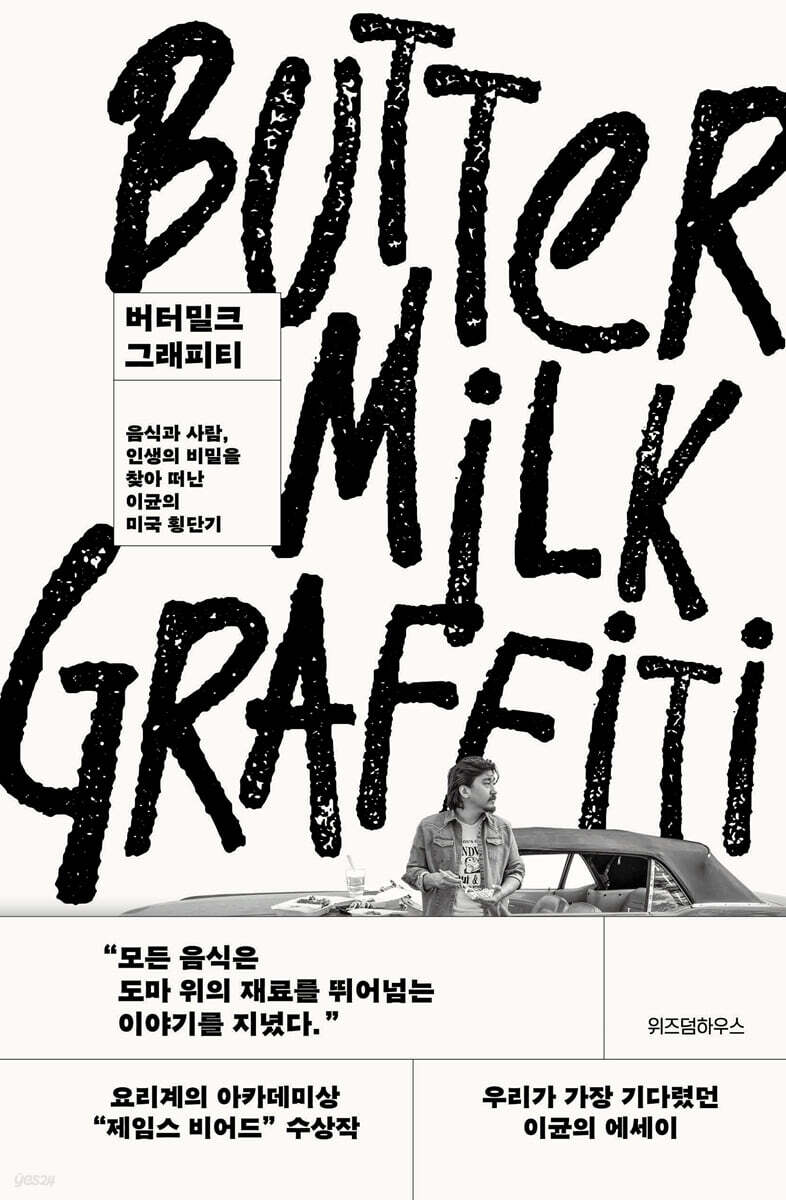
Buttermilk Graffiti
 |
Description
Book Introduction
A journey to find the secrets of food, people, and life
Lee Gyun's Cross-American Journey
“Every dish has a story that goes beyond the ingredients on the cutting board.”
James Beard Award, the Academy Award of the culinary world
Edward Lee's essay, which we have been waiting for the most
Recommended by Choi Hwa-jeong, Baek Su-rin, and Park Chan-il!
Special preface included in the Korean edition
“How many people on earth can write a book about food with such refined insight, and sometimes wit and humor?” _ Park Chan-il (author, chef)
One of the most notable people in South Korea right now is Chef Edward Lee.
The memoir, “Buttermilk Graffiti,” which contains important events for understanding the current him and has already been a hot topic in Korea, has been officially translated and published.
Not only did it win the James Beard Award, often called the Oscars of the culinary industry, in 2019, capturing the hearts of gourmets around the world, but it is also a masterpiece that has been recognized for Edward Lee's powerful storytelling, challenging artistry, and outstanding quality.
Where does Edward Lee, aka "Bibim Man," come from for his bold attempts, creative dishes, distinctive humor, and profound cooking skills, which he showcases across various channels? As a Korean-American living in the United States, he has experienced the melting pot of diverse cultures, particularly through food. He travels across the country to collect dishes that tell the true stories of lesser-known chefs.
Moments of unity at the table, despite their different nationalities and traditions, behind-the-scenes stories from the kitchens of immigrant chefs, exciting adventures in 16 historic immigrant communities, including Brooklyn, Miami, Houston, Paterson, and the Appalachian Mountains, intertwine with Edward Lee's deeply personal memories.
Also included are over 40 recipes, created with inspiration and learning directly from the kitchens of immigrant chefs.
Lee Gyun's Cross-American Journey
“Every dish has a story that goes beyond the ingredients on the cutting board.”
James Beard Award, the Academy Award of the culinary world
Edward Lee's essay, which we have been waiting for the most
Recommended by Choi Hwa-jeong, Baek Su-rin, and Park Chan-il!
Special preface included in the Korean edition
“How many people on earth can write a book about food with such refined insight, and sometimes wit and humor?” _ Park Chan-il (author, chef)
One of the most notable people in South Korea right now is Chef Edward Lee.
The memoir, “Buttermilk Graffiti,” which contains important events for understanding the current him and has already been a hot topic in Korea, has been officially translated and published.
Not only did it win the James Beard Award, often called the Oscars of the culinary industry, in 2019, capturing the hearts of gourmets around the world, but it is also a masterpiece that has been recognized for Edward Lee's powerful storytelling, challenging artistry, and outstanding quality.
Where does Edward Lee, aka "Bibim Man," come from for his bold attempts, creative dishes, distinctive humor, and profound cooking skills, which he showcases across various channels? As a Korean-American living in the United States, he has experienced the melting pot of diverse cultures, particularly through food. He travels across the country to collect dishes that tell the true stories of lesser-known chefs.
Moments of unity at the table, despite their different nationalities and traditions, behind-the-scenes stories from the kitchens of immigrant chefs, exciting adventures in 16 historic immigrant communities, including Brooklyn, Miami, Houston, Paterson, and the Appalachian Mountains, intertwine with Edward Lee's deeply personal memories.
Also included are over 40 recipes, created with inspiration and learning directly from the kitchens of immigrant chefs.
- You can preview some of the book's contents.
Preview
index
Preface to the Korean edition
Entering
Chapter 01 Pilgrimage to Bene
Chapter 02 The Boxer and the Chef
Chapter 03 Unfamiliar Noodles
Chapter 04 How to Fast
Chapter 05 Exile and Poetry
Chapter 06 Slow Dog and Pepperoni Roll
Chapter 07 Kibe on Blues Street
Chapter 08 The Maids of Montgomery
Chapter 09 Secret Butter
Chapter 10: Father's Death and Aquavit, the Water of Life
Chapter 11 The Taste of Real Shrimp
Chapter 12 The Immortal Patterson
Chapter 13 Nigerian Hustle
Chapter 14 German Mustard
Chapter 15 Pastrami Palace
Chapter 16: The Tale of Two Cornbreads
Epilogue
Acknowledgements
Entering
Chapter 01 Pilgrimage to Bene
Chapter 02 The Boxer and the Chef
Chapter 03 Unfamiliar Noodles
Chapter 04 How to Fast
Chapter 05 Exile and Poetry
Chapter 06 Slow Dog and Pepperoni Roll
Chapter 07 Kibe on Blues Street
Chapter 08 The Maids of Montgomery
Chapter 09 Secret Butter
Chapter 10: Father's Death and Aquavit, the Water of Life
Chapter 11 The Taste of Real Shrimp
Chapter 12 The Immortal Patterson
Chapter 13 Nigerian Hustle
Chapter 14 German Mustard
Chapter 15 Pastrami Palace
Chapter 16: The Tale of Two Cornbreads
Epilogue
Acknowledgements
Detailed image

Into the book
Of all the Korean heritages I inherited, the one that remains most important to me is food.
The foundation of taste that Korean food has built remains my foundation to this day.
When I was young, I remember being confused by how different my American friends' lives were from mine at school.
We ate pizza, hamburgers, and sandwiches at school.
My American friends went home and ate similar food for dinner, but I came home and ate crab and kimchi stew.
It wasn't until I became a chef that I started meeting people from different cultures and realized that they had similar lives to mine when it came to food.
--- p.11 From “To Korean Readers”
After entering New York University, I worked at the Big Apple Diner, a restaurant on the corner of Madison Avenue and 28th Street, to pay for my tuition.
For me, who was good at kitchen work, working in a restaurant was an easy way to make money.
The only time I could work was in the morning.
After all, I had to go to school.
I would come to work around 4:30 every morning, light a fire, and make pancake batter and muffin batter.
Then I took out the potatoes that had been sliced and soaked in water the night before and cut the vegetables that would be stir-fried together.
After receiving the delivered bread and bagels, I took the eggs out and left them at room temperature.
At exactly 6:15 in the morning, customers started arriving.
After work, I went to Latin class wearing a T-shirt stained with margarine and blueberry muffin mix.
Most of the students were graduates of private high schools and preparing to enter law school.
I recited the verb conjugations while enduring the glares of my classmates, who were both sympathetic and disgusted.
Then, I finally prepared a clean Oxford shirt, changed into it, and started going to class.
-- From "Donut Pilgrimage" pp.34-35
I've been making beignets in my own way for so long that I can't even remember.
My beignets are light, fluffy, and fragrant.
Always serve with fruit, try Anjou pears in winter and ripe apricots or peaches in summer.
Also sprinkle some sweetened condensed milk mixed with yuzu.
It might seem a bit excessive, but every once in a while I'll just put a little Nutella on my plate.
And of course, I always sprinkle matcha on my beignets.
It's a dessert where simplicity and elegance collide.
Unlike my relationship with my Japanese girlfriend, the diverse and disparate ingredients come together beautifully on one plate.
This dessert harmoniously sublimates the unresolved differences between the women I've met.
--- p.45 From "Donut Pilgrimage"
The more you eat Sam's cooking, the more you crave it.
As the unfamiliar scent and flavor spread throughout my body, I felt as if I was entering a new world.
Far from being addictive, it's addictive.
Even the mudfish sauce (which was initially so strong it made me a little nauseous) made me keep dipping my fingers in it.
The biggest factor is salt.
Foods high in sodium trigger cravings.
The spices mask the taste of salt while adding fragrance, so you find yourself wanting more without even realizing it.
My soaring blood pressure seems to be screaming at me to stop.
During the 45 minutes I sat there, I never put down my spoon.
Every few minutes, Denise would stop by my table, and I would greet her with sauce dripping down her chin.
--- pp.59-60 From "The Boxer and the Chef"
Where did the Brooklyn I grew up in go? When did this area become Little Odessa? Of course, it must have changed gradually.
Until recently, no one noticed.
Isn't that what immigrants do? We come to hostile lands, stealthily, as if under cover of darkness, to discover places forgotten by time and make them our own.
We simply seek comfort where it is given.
Koreatown, Little India, I Unbound 2, Little Odessa.
We accept anywhere.
Conquer anywhere.
The question is how long that period will be.
Moreover, how long can we preserve the culture we brought in, sealed away from our homeland? How long can we preserve it until it becomes diluted, until the traditions of our homeland fade into obscurity, leaving only traces? How do we measure what we lose in this way?
--- p.88 From “Unfamiliar Noodles”
I haven't eaten or drank for twenty hours.
I don't know if I can walk straight, but just sitting in the room looking at the clock is driving me crazy.
I get straight into the car and start it.
I'm looking for the Syrian restaurant I was planning to go to.
At this point, I need companionship more than food.
There are only fifteen minutes left until 'Iftar', the first meal that breaks the fast.
People start to fill the tables.
Everyone looks calm.
I talk to the owner and explain my situation.
He is from Syria and does all the cooking here.
His wife helps with serving.
His hair was half-gray and his skin was tanned black.
When I order kebabs, hummus, and even dessert, he looks at me disappointed.
Finally he opens his mouth.
It's not about fasting all day so you can overeat after the sun goes down.
You have to continue to exercise self-restraint and eat slowly and little by little.
I see.
I think to myself.
I feel like I shouldn't be eating my own arm right now, but I have to control myself.
--- p.113-114 From "Somehow Fasting"
Even now, I can't think of the words to convey exactly how I feel to Mel.
Tears well up in my eyes because of the thick smoke inside, but my heart feels full.
Something is tickling my senses.
My tongue feels rough and bitter.
It must be the taste of soil, sunlight, heat, time, and sweat.
It tastes like cherries, charred walnuts, or licorice.
These adjectives are creative but inaccurate.
The scent is so deep that it feels like my nose is burning.
I got a taste of acting, and it felt somehow savage yet very sexy.
I can't shake the primitive feeling contained there from my head.
Suddenly I feel the urge to take off my shirt.
--- p.137 From “Exile and Poetry”
I often try to guess the taste of food with the intention of writing a story that falls neatly into place, culminating in a climax of discovering great flavors and ultimately a happy ending where the chef is recognized.
But in reality, such stories are rare.
Not only in Appalachia, but in many of the small towns I traveled to write this book, the moments of greatest insight often came in quiet, unassuming moments.
And then I started to doubt myself and my assumptions.
I have no knowledge of the people and culture here.
I have no right to judge them, nor do I know the history of this place well enough to comment on them.
If a pepperoni roll tastes bland to me, it's because my taste buds can't appreciate its blandness.
I take another bite, chew, and imagine myself as someone who has been working hard all day since dawn.
For him, this pepperoni roll is the only pleasure he looks forward to all morning.
Maybe I'll just have to hold on to this one until I have a late dinner.
Now I think I understand that feeling a little.
--- p.157 From "Slow Dog and Pepperoni Roll"
It was Clementine who taught me to put freshly picked herbs in a vase on the sink and to ripen tomatoes in a wooden bowl next to them.
She taught me the vulgar pleasure of biting into a tomato like an apple.
When I met Clementine, I was already working as a chef, but she helped me apply what I learned in restaurants to real-world situations.
I also learned from her that if you leave French butter next to an open window, the butter will be gently infused with the fragrance of the flowers just blooming on the trees along West 13th Street.
She also taught me that pasta tastes much better when you eat it standing in the kitchen in a large bowl rather than eating it at the table.
We fought countless times the last summer before we broke up.
Every time she slammed the door or passed me coldly and silently, the smell of overripe, mushy tomatoes filled my nostrils.
During that summer, Clementine taught me a lot about the pain of love and the joy of tomatoes.
Since then, everything I have learned throughout my life has been so abundant that it cannot be compared to anything else.
I could write a book just from what she taught me.
But that's not what I'm talking about here.
I still can't eat ripe, raw tomatoes.
--- p.199 From "Montgomery and the Maids"
The first step in any learning process is imitation.
Amal also learned English through imitation, and I learned to cook the same way.
Nowadays, you can learn how to cook just about anything with the internet and cookbooks, but there are still some mysterious dishes that can't be mastered through text or videos alone.
Sourdough and croissants are like that.
Smendo also belongs to that category.
A dish where the taste is determined by subtle differences that cannot be explained in words.
The process of making Smen is not complicated, but it must be done entirely by hand.
There is a certain rhythm to it, a movement that can only be learned by repeating it many times.
Not everyone has the good fortune to learn it directly from a Moroccan friend.
I will now try to explain the process of making Amal Smen as best as I can.
But please keep in mind that words alone cannot fully convey the message.
--- p.255 From "Secret Butter"
When the EKG monitor came back on, my mother told me to take the kids to eat Korean barbecue and pack some for her too.
His father's death seemed imminent and he probably didn't want his children to see it.
Still, I didn't want to go.
I wanted to apologize for keeping me away for so long and for not being a good father to me.
I walked over to the bed.
The only thing that remained unchanged in my father's body was his hands.
My father's hands were always big and strong.
Even though his strength was diminished, his hands still looked manly.
I lifted my father's limp hand and placed my hand under it.
Instead of holding my palms together, I let my father's palms wrap around my knuckles.
My father didn't even have the strength to hold my hand.
I kissed his forehead and told him it was okay to go, that we would be okay.
The foundation of taste that Korean food has built remains my foundation to this day.
When I was young, I remember being confused by how different my American friends' lives were from mine at school.
We ate pizza, hamburgers, and sandwiches at school.
My American friends went home and ate similar food for dinner, but I came home and ate crab and kimchi stew.
It wasn't until I became a chef that I started meeting people from different cultures and realized that they had similar lives to mine when it came to food.
--- p.11 From “To Korean Readers”
After entering New York University, I worked at the Big Apple Diner, a restaurant on the corner of Madison Avenue and 28th Street, to pay for my tuition.
For me, who was good at kitchen work, working in a restaurant was an easy way to make money.
The only time I could work was in the morning.
After all, I had to go to school.
I would come to work around 4:30 every morning, light a fire, and make pancake batter and muffin batter.
Then I took out the potatoes that had been sliced and soaked in water the night before and cut the vegetables that would be stir-fried together.
After receiving the delivered bread and bagels, I took the eggs out and left them at room temperature.
At exactly 6:15 in the morning, customers started arriving.
After work, I went to Latin class wearing a T-shirt stained with margarine and blueberry muffin mix.
Most of the students were graduates of private high schools and preparing to enter law school.
I recited the verb conjugations while enduring the glares of my classmates, who were both sympathetic and disgusted.
Then, I finally prepared a clean Oxford shirt, changed into it, and started going to class.
-- From "Donut Pilgrimage" pp.34-35
I've been making beignets in my own way for so long that I can't even remember.
My beignets are light, fluffy, and fragrant.
Always serve with fruit, try Anjou pears in winter and ripe apricots or peaches in summer.
Also sprinkle some sweetened condensed milk mixed with yuzu.
It might seem a bit excessive, but every once in a while I'll just put a little Nutella on my plate.
And of course, I always sprinkle matcha on my beignets.
It's a dessert where simplicity and elegance collide.
Unlike my relationship with my Japanese girlfriend, the diverse and disparate ingredients come together beautifully on one plate.
This dessert harmoniously sublimates the unresolved differences between the women I've met.
--- p.45 From "Donut Pilgrimage"
The more you eat Sam's cooking, the more you crave it.
As the unfamiliar scent and flavor spread throughout my body, I felt as if I was entering a new world.
Far from being addictive, it's addictive.
Even the mudfish sauce (which was initially so strong it made me a little nauseous) made me keep dipping my fingers in it.
The biggest factor is salt.
Foods high in sodium trigger cravings.
The spices mask the taste of salt while adding fragrance, so you find yourself wanting more without even realizing it.
My soaring blood pressure seems to be screaming at me to stop.
During the 45 minutes I sat there, I never put down my spoon.
Every few minutes, Denise would stop by my table, and I would greet her with sauce dripping down her chin.
--- pp.59-60 From "The Boxer and the Chef"
Where did the Brooklyn I grew up in go? When did this area become Little Odessa? Of course, it must have changed gradually.
Until recently, no one noticed.
Isn't that what immigrants do? We come to hostile lands, stealthily, as if under cover of darkness, to discover places forgotten by time and make them our own.
We simply seek comfort where it is given.
Koreatown, Little India, I Unbound 2, Little Odessa.
We accept anywhere.
Conquer anywhere.
The question is how long that period will be.
Moreover, how long can we preserve the culture we brought in, sealed away from our homeland? How long can we preserve it until it becomes diluted, until the traditions of our homeland fade into obscurity, leaving only traces? How do we measure what we lose in this way?
--- p.88 From “Unfamiliar Noodles”
I haven't eaten or drank for twenty hours.
I don't know if I can walk straight, but just sitting in the room looking at the clock is driving me crazy.
I get straight into the car and start it.
I'm looking for the Syrian restaurant I was planning to go to.
At this point, I need companionship more than food.
There are only fifteen minutes left until 'Iftar', the first meal that breaks the fast.
People start to fill the tables.
Everyone looks calm.
I talk to the owner and explain my situation.
He is from Syria and does all the cooking here.
His wife helps with serving.
His hair was half-gray and his skin was tanned black.
When I order kebabs, hummus, and even dessert, he looks at me disappointed.
Finally he opens his mouth.
It's not about fasting all day so you can overeat after the sun goes down.
You have to continue to exercise self-restraint and eat slowly and little by little.
I see.
I think to myself.
I feel like I shouldn't be eating my own arm right now, but I have to control myself.
--- p.113-114 From "Somehow Fasting"
Even now, I can't think of the words to convey exactly how I feel to Mel.
Tears well up in my eyes because of the thick smoke inside, but my heart feels full.
Something is tickling my senses.
My tongue feels rough and bitter.
It must be the taste of soil, sunlight, heat, time, and sweat.
It tastes like cherries, charred walnuts, or licorice.
These adjectives are creative but inaccurate.
The scent is so deep that it feels like my nose is burning.
I got a taste of acting, and it felt somehow savage yet very sexy.
I can't shake the primitive feeling contained there from my head.
Suddenly I feel the urge to take off my shirt.
--- p.137 From “Exile and Poetry”
I often try to guess the taste of food with the intention of writing a story that falls neatly into place, culminating in a climax of discovering great flavors and ultimately a happy ending where the chef is recognized.
But in reality, such stories are rare.
Not only in Appalachia, but in many of the small towns I traveled to write this book, the moments of greatest insight often came in quiet, unassuming moments.
And then I started to doubt myself and my assumptions.
I have no knowledge of the people and culture here.
I have no right to judge them, nor do I know the history of this place well enough to comment on them.
If a pepperoni roll tastes bland to me, it's because my taste buds can't appreciate its blandness.
I take another bite, chew, and imagine myself as someone who has been working hard all day since dawn.
For him, this pepperoni roll is the only pleasure he looks forward to all morning.
Maybe I'll just have to hold on to this one until I have a late dinner.
Now I think I understand that feeling a little.
--- p.157 From "Slow Dog and Pepperoni Roll"
It was Clementine who taught me to put freshly picked herbs in a vase on the sink and to ripen tomatoes in a wooden bowl next to them.
She taught me the vulgar pleasure of biting into a tomato like an apple.
When I met Clementine, I was already working as a chef, but she helped me apply what I learned in restaurants to real-world situations.
I also learned from her that if you leave French butter next to an open window, the butter will be gently infused with the fragrance of the flowers just blooming on the trees along West 13th Street.
She also taught me that pasta tastes much better when you eat it standing in the kitchen in a large bowl rather than eating it at the table.
We fought countless times the last summer before we broke up.
Every time she slammed the door or passed me coldly and silently, the smell of overripe, mushy tomatoes filled my nostrils.
During that summer, Clementine taught me a lot about the pain of love and the joy of tomatoes.
Since then, everything I have learned throughout my life has been so abundant that it cannot be compared to anything else.
I could write a book just from what she taught me.
But that's not what I'm talking about here.
I still can't eat ripe, raw tomatoes.
--- p.199 From "Montgomery and the Maids"
The first step in any learning process is imitation.
Amal also learned English through imitation, and I learned to cook the same way.
Nowadays, you can learn how to cook just about anything with the internet and cookbooks, but there are still some mysterious dishes that can't be mastered through text or videos alone.
Sourdough and croissants are like that.
Smendo also belongs to that category.
A dish where the taste is determined by subtle differences that cannot be explained in words.
The process of making Smen is not complicated, but it must be done entirely by hand.
There is a certain rhythm to it, a movement that can only be learned by repeating it many times.
Not everyone has the good fortune to learn it directly from a Moroccan friend.
I will now try to explain the process of making Amal Smen as best as I can.
But please keep in mind that words alone cannot fully convey the message.
--- p.255 From "Secret Butter"
When the EKG monitor came back on, my mother told me to take the kids to eat Korean barbecue and pack some for her too.
His father's death seemed imminent and he probably didn't want his children to see it.
Still, I didn't want to go.
I wanted to apologize for keeping me away for so long and for not being a good father to me.
I walked over to the bed.
The only thing that remained unchanged in my father's body was his hands.
My father's hands were always big and strong.
Even though his strength was diminished, his hands still looked manly.
I lifted my father's limp hand and placed my hand under it.
Instead of holding my palms together, I let my father's palms wrap around my knuckles.
My father didn't even have the strength to hold my hand.
I kissed his forehead and told him it was okay to go, that we would be okay.
--- pp.249-250 From “Father’s Death and a Sip of the Water of Life”
Publisher's Review
“A feast of impressive stories.
Edward Lee is a master.” _[New York Times]
Edward Lee's soulful masterpiece unveiled for the first time in Korea
A hot bestseller that caught the attention of the entire United States
The story behind Edward Lee's endless challenges.
A bowl of food is someone's life, and the taste of a plate is the history of a place.
Chef Edward Lee, who brought us tears and emotion with his story of longing in [Black and White Chef].
“Buttermilk Graffiti,” which helped him become a writer, has been translated and published in Korea.
This book is an in-depth account of the people, food, and culture and identity he encountered while traveling across the United States for two years.
The title, a combination of 'buttermilk', a food ingredient symbolic of the American South and his favorite, and 'graffiti', which he was obsessed with during his wandering teenage years without dreams, is a concise and literary expression of American immigrant cuisine and their lives itself, where two unfamiliar things meet to create something new.
Chef Edward Lee, who discovered the diverse cultures and lives that have been transformed and recombined over generations in the immigrant cuisines of various cities in the United States, focuses on the “nameless chefs” who are inheriting identity, tradition, and techniques in their own way.
To learn directly from the "melting pot" recipes of American cuisine, which is a cuisine in which various cultures are constantly mixing and combining, just as a stove is constantly boiling, he meets food truck owners, market vendors, and chefs of small restaurants rather than star chefs, goes into their kitchens, and asks questions.
“What does food mean to you?” The answers reveal a longing for home, creativity for survival, and the surprising culinary creations born from the fusion of different cultures.
In immigrant kitchens across America
Communing through food
Discover the unique texture of Cambodian cuisine in the vibrant 'tuk prohok', a fermented fish and offal mash, and feel the touch of an old, veined chef's hand in the intense taste of 'lagman', noodles simmered in a lamb broth, a mixture of moist earth and blood.
He embarks on a culinary journey to a Muslim-majority region, where he participates in a fast, and visits Miami to write a recommendation for a book by his longtime mentor, Norman Van Aiken, who coined the term "fusion," where he finds commonalities between Cuban food and cigars.
He even goes to the kitchen of a young Moroccan woman he's never met before to learn the secret recipe for Morocco's butter, "Smen," and learn and connect with her on how to make fermented butter that can be aged for over 30 years.
Most people he meets are not very friendly, but they have warm hearts.
Edward Lee observes them, in their own way, creating a new culture while maintaining the tension between tradition and innovation in an unfamiliar land. He takes the time to taste the food and constantly records each person's story and history.
And as he recalls the foods from the other side of his memory, he connects unexpected threads of connection.
“I learned everything about food from women.”
A story about the people who taught him cooking and life.
Since my days as a student at New York University, when I worked part-time at a restaurant at dawn
A deeply personal memoir about his father's deathbed, who never accepted him as a chef.
[Black and White Chef] In the final dish of the final, Edward Lee finally stood out as a bacterium.
Lee Gyun, who said, “You always give me too much, so I can’t eat it all,” brought out a semifreddo dessert plate shaped like tteokbokki that he had left behind.
Only then could we feel that the emotion of 'longing' that he had kept throughout his life was the driving force that made him cook.
In "Buttermilk Graffiti," Edward Lee's personal anecdotes and memories that the public is curious about unfold in an interesting way, almost like a novel.
He recalls his childhood, when he would eat pizza, hamburgers, and sandwiches at school and come home to eat crab and kimchi stew, when he would work at a restaurant until dawn to pay for his tuition, when he was robbed or threatened in the middle of New York City and almost died, and when he would wear a batter-stained shirt to class and get glares from others and have to carry a clean shirt in his bag.
From his family's summer vacations at Brighton Beach in Brooklyn, a former resort for the poor, to his Japanese girlfriend who taught him a lot about Japanese food, to his love story with his current wife, whom he first met and kissed in the basement parking lot of a bar, he talks about the sweet and bitter things he has experienced in life without holding back.
He places his hand under that of his father, who passed away without speaking to him once since becoming a chef, and his image of forgiving his father, who had been blunt and had not acknowledged him for a long time, is filled with sadness and regret.
“I intentionally omitted photos from the recipes in this book.”
I sincerely hope that everyone will cook their own dishes.
At the end of each chapter, which explores American cuisine where tradition and innovation coexist, Edward Lee introduces approximately 40 melting pot recipes, without photos, that add his own touch to immigrant dishes he personally learned.
Classic recipe books that have been passed down for a long time often don't have photos, and above all, I hope that readers who try the recipes will create their own dishes so that they don't think, "My cooking failed."
Following the recipe for American Southern donut beignets, we introduce a recipe for Korean donut hotteok, and we introduce the special dishes of local restaurants that you must try, as well as the most delicious dishes discovered during your travels, so that you can easily make them at home.
Now, you can try out the precious recipes he obtained through hard work in your own kitchen.
We've included detailed instructions, accurate measurements, storage methods, tips for a more delicious meal, and helpful substitutes when necessary, so that you can follow along in your own kitchen without messing with the original recipe.
Edward Lee's cooking is full of creativity and adventure.
And his writings flow with insights and a history of humanism that cooking cannot fully explain.
This book, written with Edward Lehman's literary sensibility, is a moving journey in itself, showing how food connects people.
Edward Lee is a master.” _[New York Times]
Edward Lee's soulful masterpiece unveiled for the first time in Korea
A hot bestseller that caught the attention of the entire United States
The story behind Edward Lee's endless challenges.
A bowl of food is someone's life, and the taste of a plate is the history of a place.
Chef Edward Lee, who brought us tears and emotion with his story of longing in [Black and White Chef].
“Buttermilk Graffiti,” which helped him become a writer, has been translated and published in Korea.
This book is an in-depth account of the people, food, and culture and identity he encountered while traveling across the United States for two years.
The title, a combination of 'buttermilk', a food ingredient symbolic of the American South and his favorite, and 'graffiti', which he was obsessed with during his wandering teenage years without dreams, is a concise and literary expression of American immigrant cuisine and their lives itself, where two unfamiliar things meet to create something new.
Chef Edward Lee, who discovered the diverse cultures and lives that have been transformed and recombined over generations in the immigrant cuisines of various cities in the United States, focuses on the “nameless chefs” who are inheriting identity, tradition, and techniques in their own way.
To learn directly from the "melting pot" recipes of American cuisine, which is a cuisine in which various cultures are constantly mixing and combining, just as a stove is constantly boiling, he meets food truck owners, market vendors, and chefs of small restaurants rather than star chefs, goes into their kitchens, and asks questions.
“What does food mean to you?” The answers reveal a longing for home, creativity for survival, and the surprising culinary creations born from the fusion of different cultures.
In immigrant kitchens across America
Communing through food
Discover the unique texture of Cambodian cuisine in the vibrant 'tuk prohok', a fermented fish and offal mash, and feel the touch of an old, veined chef's hand in the intense taste of 'lagman', noodles simmered in a lamb broth, a mixture of moist earth and blood.
He embarks on a culinary journey to a Muslim-majority region, where he participates in a fast, and visits Miami to write a recommendation for a book by his longtime mentor, Norman Van Aiken, who coined the term "fusion," where he finds commonalities between Cuban food and cigars.
He even goes to the kitchen of a young Moroccan woman he's never met before to learn the secret recipe for Morocco's butter, "Smen," and learn and connect with her on how to make fermented butter that can be aged for over 30 years.
Most people he meets are not very friendly, but they have warm hearts.
Edward Lee observes them, in their own way, creating a new culture while maintaining the tension between tradition and innovation in an unfamiliar land. He takes the time to taste the food and constantly records each person's story and history.
And as he recalls the foods from the other side of his memory, he connects unexpected threads of connection.
“I learned everything about food from women.”
A story about the people who taught him cooking and life.
Since my days as a student at New York University, when I worked part-time at a restaurant at dawn
A deeply personal memoir about his father's deathbed, who never accepted him as a chef.
[Black and White Chef] In the final dish of the final, Edward Lee finally stood out as a bacterium.
Lee Gyun, who said, “You always give me too much, so I can’t eat it all,” brought out a semifreddo dessert plate shaped like tteokbokki that he had left behind.
Only then could we feel that the emotion of 'longing' that he had kept throughout his life was the driving force that made him cook.
In "Buttermilk Graffiti," Edward Lee's personal anecdotes and memories that the public is curious about unfold in an interesting way, almost like a novel.
He recalls his childhood, when he would eat pizza, hamburgers, and sandwiches at school and come home to eat crab and kimchi stew, when he would work at a restaurant until dawn to pay for his tuition, when he was robbed or threatened in the middle of New York City and almost died, and when he would wear a batter-stained shirt to class and get glares from others and have to carry a clean shirt in his bag.
From his family's summer vacations at Brighton Beach in Brooklyn, a former resort for the poor, to his Japanese girlfriend who taught him a lot about Japanese food, to his love story with his current wife, whom he first met and kissed in the basement parking lot of a bar, he talks about the sweet and bitter things he has experienced in life without holding back.
He places his hand under that of his father, who passed away without speaking to him once since becoming a chef, and his image of forgiving his father, who had been blunt and had not acknowledged him for a long time, is filled with sadness and regret.
“I intentionally omitted photos from the recipes in this book.”
I sincerely hope that everyone will cook their own dishes.
At the end of each chapter, which explores American cuisine where tradition and innovation coexist, Edward Lee introduces approximately 40 melting pot recipes, without photos, that add his own touch to immigrant dishes he personally learned.
Classic recipe books that have been passed down for a long time often don't have photos, and above all, I hope that readers who try the recipes will create their own dishes so that they don't think, "My cooking failed."
Following the recipe for American Southern donut beignets, we introduce a recipe for Korean donut hotteok, and we introduce the special dishes of local restaurants that you must try, as well as the most delicious dishes discovered during your travels, so that you can easily make them at home.
Now, you can try out the precious recipes he obtained through hard work in your own kitchen.
We've included detailed instructions, accurate measurements, storage methods, tips for a more delicious meal, and helpful substitutes when necessary, so that you can follow along in your own kitchen without messing with the original recipe.
Edward Lee's cooking is full of creativity and adventure.
And his writings flow with insights and a history of humanism that cooking cannot fully explain.
This book, written with Edward Lehman's literary sensibility, is a moving journey in itself, showing how food connects people.
GOODS SPECIFICS
- Date of issue: April 9, 2025
- Format: Hardcover book binding method guide
- Page count, weight, size: 416 pages | 666g | 138*210*27mm
- ISBN13: 9791171713868
- ISBN10: 117171386X
You may also like
카테고리
korean


korean

![GQ KOREA Mark (Monthly): December [2025]](http://librairie.coreenne.fr/cdn/shop/files/8ef265dbbfbf186523ed75ba7319009d.jpg?v=1765340328&width=3840)


