

Life Library
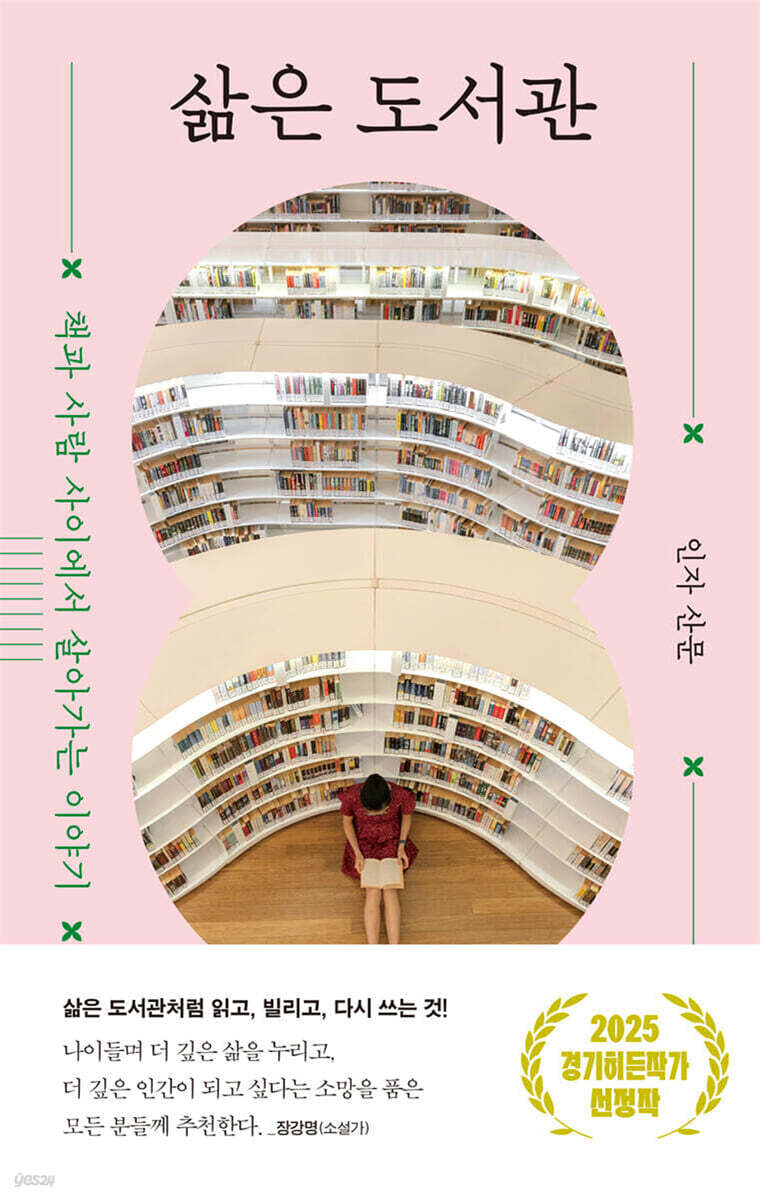 |
Description
Book Introduction
“People don’t come to the library just to learn.”
A cheerful and affectionate library worker tells the story.
A story full of laughter, comfort, and humanity
It can be this much fun! _Yoon Go-eun (novelist, DJ for Yoon Go-eun's EBS Book Cafe)
I recommend this to everyone who desires to live a deeper life and become a more profound human being as they age.
_Jang Gang-myeong (novelist)
Who knows?
Could this book be the first step toward becoming a great writer who will forever be remembered in literary history? I believe it can be.
Kim Seong-shin (publishing critic)
Meet Gyeonggi Province's Hidden Treasures: "Hidden Writers"
The essay "Life is a Library" by Inja, the winner of the prose category, has been published as part of the "Gyeonggi Hidden Writers" project, which supports writers with limitless potential to grow into the future of Korean literature.
This is a record of the author's surprising observations and reflections as he begins his "second life" as a public library worker in his mid-forties, after working as an advertising and public relations professional for 20 years.
A profound exploration of the meaning of work and life through a sometimes humorous, sometimes poignant human drama discovered behind the library bookshelves where it should be quiet.
From the sad and humorous mistake of mishearing "Chopstick Master" as "Chopstick Murder" behind a quiet bookshelf to the moment of solidarity shared in enduring public complaints, the author discovers human dignity and the warmth of relationships in all these scenes.
Having let go of his past life obsessed with speed and performance and rediscovered himself in the 'labor of slowness,' he redefines aging not as a passive decline but as a process of proactive and proud growth, or 'pride aging.'
Based on these insights, "Library of Life" goes beyond a worker's cheerful confession to become a meaningful record that sheds new light on the ways people support one another in public spaces, and the dignity and warmth that life after middle age can embrace.
A cheerful and affectionate library worker tells the story.
A story full of laughter, comfort, and humanity
It can be this much fun! _Yoon Go-eun (novelist, DJ for Yoon Go-eun's EBS Book Cafe)
I recommend this to everyone who desires to live a deeper life and become a more profound human being as they age.
_Jang Gang-myeong (novelist)
Who knows?
Could this book be the first step toward becoming a great writer who will forever be remembered in literary history? I believe it can be.
Kim Seong-shin (publishing critic)
Meet Gyeonggi Province's Hidden Treasures: "Hidden Writers"
The essay "Life is a Library" by Inja, the winner of the prose category, has been published as part of the "Gyeonggi Hidden Writers" project, which supports writers with limitless potential to grow into the future of Korean literature.
This is a record of the author's surprising observations and reflections as he begins his "second life" as a public library worker in his mid-forties, after working as an advertising and public relations professional for 20 years.
A profound exploration of the meaning of work and life through a sometimes humorous, sometimes poignant human drama discovered behind the library bookshelves where it should be quiet.
From the sad and humorous mistake of mishearing "Chopstick Master" as "Chopstick Murder" behind a quiet bookshelf to the moment of solidarity shared in enduring public complaints, the author discovers human dignity and the warmth of relationships in all these scenes.
Having let go of his past life obsessed with speed and performance and rediscovered himself in the 'labor of slowness,' he redefines aging not as a passive decline but as a process of proactive and proud growth, or 'pride aging.'
Based on these insights, "Library of Life" goes beyond a worker's cheerful confession to become a meaningful record that sheds new light on the ways people support one another in public spaces, and the dignity and warmth that life after middle age can embrace.
index
Prologue - Pride Aging, For a Deeper Life
Part 1: The Bookshelf of Laughter
"Chopstick Murder" is not in our library.
Confessions of a Library Aunt
Find the misaligned 'Yongjiho'
Civil complaints are like poop disease
Book Sealing Master, Emergency Doctor Heo
We'll find the book for you
You can vomit
Please hold your farts
C-cuts in the library
Part 2: The Bookshelf of Life
Locker 28
Is this you?
Grandmothers' Wise Library Life
The Old Man and the Sea × The Old Man and the Library
A book that crossed the sea
Life is like a piece of pork belly
Please open on holidays too
Inside the third bookcase
I'm not a loan shark, but I'm a lender.
I keep my daughter's heart in the library.
Please enter the correct gender
We are loan consultants
Dreaming of a reverse run of preservation archives
Why do you only give peppers to her?
Affectionate urging
Misconceptions and Truths About Library Workers
Part 4: The Bookshelf of Memories
1.5 tons of Jjajangmyeon
It's a good 'dry' night
Enduring with tteokbokki, holding on with your butt
He sold the gold ring while leaving the gold mine.
I just slept well
Clear File Disappearance Case
That day, we were the protagonists of a novel.
Part 5: The Bookshelf of Dreams
Library Day × Couple's Night
Our lives are still in the midst of life.
About things that were once useless
The Last Flight of the Black Butterfly
Between autumn lyricism and pain
Love in a Small Town
Epilogue - From Chance to Destiny
Part 1: The Bookshelf of Laughter
"Chopstick Murder" is not in our library.
Confessions of a Library Aunt
Find the misaligned 'Yongjiho'
Civil complaints are like poop disease
Book Sealing Master, Emergency Doctor Heo
We'll find the book for you
You can vomit
Please hold your farts
C-cuts in the library
Part 2: The Bookshelf of Life
Locker 28
Is this you?
Grandmothers' Wise Library Life
The Old Man and the Sea × The Old Man and the Library
A book that crossed the sea
Life is like a piece of pork belly
Please open on holidays too
Inside the third bookcase
I'm not a loan shark, but I'm a lender.
I keep my daughter's heart in the library.
Please enter the correct gender
We are loan consultants
Dreaming of a reverse run of preservation archives
Why do you only give peppers to her?
Affectionate urging
Misconceptions and Truths About Library Workers
Part 4: The Bookshelf of Memories
1.5 tons of Jjajangmyeon
It's a good 'dry' night
Enduring with tteokbokki, holding on with your butt
He sold the gold ring while leaving the gold mine.
I just slept well
Clear File Disappearance Case
That day, we were the protagonists of a novel.
Part 5: The Bookshelf of Dreams
Library Day × Couple's Night
Our lives are still in the midst of life.
About things that were once useless
The Last Flight of the Black Butterfly
Between autumn lyricism and pain
Love in a Small Town
Epilogue - From Chance to Destiny
Detailed image

Into the book
Sometimes the list of books on the lending shelf reads like a person's 'life narrative.'
This is the precious thought and insight that aging has gifted me.
--- p.6
It was only the next morning that they had time to search for the missing 'Yong Ji-ho' again.
In our terms, we call this 'seeing a misalignment'.
Literally, it is the task of finding a misplaced book and putting it back in its right place.
The time spent looking at misalignment is a lonely battle with the call number.
--- pp.28-29
“Books, like people, can be reused if their wounds are healed.
I feel a sense of accomplishment when it is rewritten.
“When I look at the scars, I feel affection.”
--- p.41
I was momentarily embarrassed.
I had no idea what book you read yesterday.
It is impossible to remember all the dozens of books that users have read and placed in their book carts.
But since this is the library detective agency's first mission, I decided to do my best to find it.
--- p.45
As I grew older, I began to see enjoyable and moving scenes that I had not discovered in my youth.
More interesting stories than short-form content happen every day in libraries.
--- p.66
One day, an old man who writes poetry came home with a box of cakes.
I politely declined, saying that I couldn't accept it due to regulations, but I couldn't break the old man's stubbornness.
It turned out to be a cake celebrating an 80th birthday.
He said he really wanted to share it with the library staff, who are like family to him.
--- p.90
For some, the library is more than just a shelter; it may be their last connection to society.
If so, the sigh of the elderly man who asked for the door to be opened even on holidays might have been a desperate cry for protection from a world of isolation.
--- p.114
I am a lender.
Don't be mistaken that I'm an employee of a large corporation.
I work in a library where I borrow and return books.
When I say I work at a library, people immediately ask if I'm a librarian or civil servant.
That is also a misunderstanding.
Every time that happens, I become a little bit of a whiner.
--- p.117
It is either discarded or sent to the lost and found at the discretion of the person in charge.
It's such a trivial matter that there are no separate regulations.
I had to become a censor for a moment, with a postcard of cherry blossoms in full bloom before me.
The rational brain whispered, "No rules, discardable," while the emotional brain sent a "stop for now" signal.
.
--- p.125
We spend time in the library not reading books, but 'handling' books.
(…) The plain fact is that we did not come to the library to become educated, but to go to work.
--- pp.164-165
Our past times did not disappear or scatter like that, but rather piled up and solidified a useful middle-aged life.
--- p.233
I decided not to think of the end of the black butterfly as a misfortune anymore.
Perhaps that was the most brilliant moment in the butterfly's life.
At that moment, as I flapped my wings precariously toward the opposite lane, challenge and joy finally became one.
--- pp.239-240
My interest, which had been focused solely on books, soon spread to the people who visited the library.
The scenery was as beautiful as the vines of the Chinese chrysanthemum climbing up the wall.
(…) All these people come to the library to survive in this small town, or to escape this small town someday.
The library, filled with their hot inhalation and exhalation, is always hotter than the outside temperature.
This is the precious thought and insight that aging has gifted me.
--- p.6
It was only the next morning that they had time to search for the missing 'Yong Ji-ho' again.
In our terms, we call this 'seeing a misalignment'.
Literally, it is the task of finding a misplaced book and putting it back in its right place.
The time spent looking at misalignment is a lonely battle with the call number.
--- pp.28-29
“Books, like people, can be reused if their wounds are healed.
I feel a sense of accomplishment when it is rewritten.
“When I look at the scars, I feel affection.”
--- p.41
I was momentarily embarrassed.
I had no idea what book you read yesterday.
It is impossible to remember all the dozens of books that users have read and placed in their book carts.
But since this is the library detective agency's first mission, I decided to do my best to find it.
--- p.45
As I grew older, I began to see enjoyable and moving scenes that I had not discovered in my youth.
More interesting stories than short-form content happen every day in libraries.
--- p.66
One day, an old man who writes poetry came home with a box of cakes.
I politely declined, saying that I couldn't accept it due to regulations, but I couldn't break the old man's stubbornness.
It turned out to be a cake celebrating an 80th birthday.
He said he really wanted to share it with the library staff, who are like family to him.
--- p.90
For some, the library is more than just a shelter; it may be their last connection to society.
If so, the sigh of the elderly man who asked for the door to be opened even on holidays might have been a desperate cry for protection from a world of isolation.
--- p.114
I am a lender.
Don't be mistaken that I'm an employee of a large corporation.
I work in a library where I borrow and return books.
When I say I work at a library, people immediately ask if I'm a librarian or civil servant.
That is also a misunderstanding.
Every time that happens, I become a little bit of a whiner.
--- p.117
It is either discarded or sent to the lost and found at the discretion of the person in charge.
It's such a trivial matter that there are no separate regulations.
I had to become a censor for a moment, with a postcard of cherry blossoms in full bloom before me.
The rational brain whispered, "No rules, discardable," while the emotional brain sent a "stop for now" signal.
.
--- p.125
We spend time in the library not reading books, but 'handling' books.
(…) The plain fact is that we did not come to the library to become educated, but to go to work.
--- pp.164-165
Our past times did not disappear or scatter like that, but rather piled up and solidified a useful middle-aged life.
--- p.233
I decided not to think of the end of the black butterfly as a misfortune anymore.
Perhaps that was the most brilliant moment in the butterfly's life.
At that moment, as I flapped my wings precariously toward the opposite lane, challenge and joy finally became one.
--- pp.239-240
My interest, which had been focused solely on books, soon spread to the people who visited the library.
The scenery was as beautiful as the vines of the Chinese chrysanthemum climbing up the wall.
(…) All these people come to the library to survive in this small town, or to escape this small town someday.
The library, filled with their hot inhalation and exhalation, is always hotter than the outside temperature.
--- pp.250-251
Publisher's Review
The spectrum of everyday life seen from inside the bookshelf
Not A-cuts or B-cuts, but C-cuts, the cheerful and poignant moments of our lives.
The book is divided into five bookshelves, containing laughter, life, labor, memories, and aging encountered in the library.
From unexpected commotion in a quiet space, to stories of people whose lives are more passionate than books, to the work and memories of library staff, and a new perspective on aging, the author portrays the library as a stage where days and lives intersect, an archive of life where people and stories accumulate, and a place where the texture of life is imbued.
The daily life in the library captured by the author is full of unexpected 'C cuts' rather than perfect 'A cuts'.
The unique charm of this book is the humor brought about by hearing loss.
The commotion that ensues when a child mishears the word 'chopstick master' as 'chopstick murder' and misunderstands the user's last name from 'Gwak' to 'Kang' is hilarious.
However, the author sublimates even his own mistakes and discomfort into material for human empathy, emphasizing “the value of the leeway and empathy that human mistakes provide, rather than perfect function.”
The pleasant commotion that breaks the silence of the library never ceases.
The secret grievances of colleagues about the 'fart master' who suddenly disappears leaving behind only a strong smell, the story of cracking down on the 'young couple in love' who secretly whisper sweet nothings using the blind spots of CCTV, the story of an elderly man who insisted on using a shiny 'seuden bowl' because the water purifier cup was too small, children who hid comic books in the wrong bookshelf so they could read them alone, and even the bright eyes of an old woman who reads a book upside down even though she can't read the letters, prove that the library is not a static space, but a lively 'theater of life' where all kinds of desires and stories collide.
But behind that smile, there coexists the heavy weight of life.
The back of a job seeker who has been using locker number 28 for over a year, the earnestness of an old man searching for the book “The Soul Never Dies,” and the passion of the “007 Bag Elder” who dreamed of winning the New Year’s Literary Contest even in his eighties, show the dignity of human beings who do not give up on their dreams even in loneliness.
The library is not simply a place to borrow books; it is the last refuge where people with their own stories seek out to continue their lives.
Between books and people, the place where the heart resides
About the noble labor of caring for the heart
The author's gaze delves into the inner workings of the library, 'from the inside of the bookshelf', that is, from the perspective of a worker.
Although it is not a loan business, the worker who ‘lends’ books reads the ‘life narrative’ of a person – the trajectory of illness, anxiety, and dreams – from the user’s book list.
This is not a place of ‘easy’ work, but a place of intense emotional labor that deals with the ‘heart.’
The expression “Civil complaints are like a disease of poop” shows the ethics of workers who do not want to treat the desperation of the complainant as just work.
Reflecting on my early days when I blocked people from using the restroom by setting up a wall of rules, I establish the 'deep ethics of putting people first' that library workers should have.
The essence of labor is redefined as ‘the sealing of the mind.’
The author gains a profound insight from the sight of a colleague meticulously repairing a torn book like a surgeon.
A colleague's words, "Books, like people, can be reused after their wounds are healed, and when you see their scars, you feel affection for them," suggest that library work is not simply organizing books, but rather "lending of the heart that offers comfort and empathy."
The most significant message this book raises is a reflection on the social responsibility of libraries.
The desperate pleas of a single-person householder, "Please open during the holidays," and the story of a missing senior citizen, make us realize that for some, a library can be more than just a shelter; it can also be "the last link to society."
The book's powerful social message is that libraries have a weighty responsibility to provide "emotional safety zones" in an age of isolation and disconnection.
Even in the midst of misalignment, we
Dance to your own rhythm
"Library of Life" unfolds its story through vivid and specific memories of life that have become the solid foundations that support the author.
Life proves that even the trivial and twisted experiences that once seemed to lead us astray, or even that we dismissed as useless, were never in vain.
The author strongly asserts that life is not a marathon, a breathless, straight line sprinting toward a single, predetermined goal.
Instead, he argues that life is like a dance, where you surrender to the unique rhythm of the moment and take steps.
This book, set in a symbolic space where everything is perfectly arranged, the library, warmly affirms the imperfect existence of all of us who constantly wander, "misarranged," and deviate from that orderly orbit.
This resonates deeply in the hearts of readers like a cheerful and affectionate cheering song.
What makes this book particularly shine is its new perspective on life after middle age.
Rather than a vague fear of aging and loss, it allows us to look at the latter half of life with a unique quality that has been gradually forged over time.
Also, instead of despairing or becoming frustrated with the sense of loss, it leads us to reinterpret this moment of life as a hymn to life that still blooms vividly within it.
After reading the book, readers will perceive the library, an everyday space they pass by without a second thought, as a completely different landscape and with a new, much deeper meaning.
Not A-cuts or B-cuts, but C-cuts, the cheerful and poignant moments of our lives.
The book is divided into five bookshelves, containing laughter, life, labor, memories, and aging encountered in the library.
From unexpected commotion in a quiet space, to stories of people whose lives are more passionate than books, to the work and memories of library staff, and a new perspective on aging, the author portrays the library as a stage where days and lives intersect, an archive of life where people and stories accumulate, and a place where the texture of life is imbued.
The daily life in the library captured by the author is full of unexpected 'C cuts' rather than perfect 'A cuts'.
The unique charm of this book is the humor brought about by hearing loss.
The commotion that ensues when a child mishears the word 'chopstick master' as 'chopstick murder' and misunderstands the user's last name from 'Gwak' to 'Kang' is hilarious.
However, the author sublimates even his own mistakes and discomfort into material for human empathy, emphasizing “the value of the leeway and empathy that human mistakes provide, rather than perfect function.”
The pleasant commotion that breaks the silence of the library never ceases.
The secret grievances of colleagues about the 'fart master' who suddenly disappears leaving behind only a strong smell, the story of cracking down on the 'young couple in love' who secretly whisper sweet nothings using the blind spots of CCTV, the story of an elderly man who insisted on using a shiny 'seuden bowl' because the water purifier cup was too small, children who hid comic books in the wrong bookshelf so they could read them alone, and even the bright eyes of an old woman who reads a book upside down even though she can't read the letters, prove that the library is not a static space, but a lively 'theater of life' where all kinds of desires and stories collide.
But behind that smile, there coexists the heavy weight of life.
The back of a job seeker who has been using locker number 28 for over a year, the earnestness of an old man searching for the book “The Soul Never Dies,” and the passion of the “007 Bag Elder” who dreamed of winning the New Year’s Literary Contest even in his eighties, show the dignity of human beings who do not give up on their dreams even in loneliness.
The library is not simply a place to borrow books; it is the last refuge where people with their own stories seek out to continue their lives.
Between books and people, the place where the heart resides
About the noble labor of caring for the heart
The author's gaze delves into the inner workings of the library, 'from the inside of the bookshelf', that is, from the perspective of a worker.
Although it is not a loan business, the worker who ‘lends’ books reads the ‘life narrative’ of a person – the trajectory of illness, anxiety, and dreams – from the user’s book list.
This is not a place of ‘easy’ work, but a place of intense emotional labor that deals with the ‘heart.’
The expression “Civil complaints are like a disease of poop” shows the ethics of workers who do not want to treat the desperation of the complainant as just work.
Reflecting on my early days when I blocked people from using the restroom by setting up a wall of rules, I establish the 'deep ethics of putting people first' that library workers should have.
The essence of labor is redefined as ‘the sealing of the mind.’
The author gains a profound insight from the sight of a colleague meticulously repairing a torn book like a surgeon.
A colleague's words, "Books, like people, can be reused after their wounds are healed, and when you see their scars, you feel affection for them," suggest that library work is not simply organizing books, but rather "lending of the heart that offers comfort and empathy."
The most significant message this book raises is a reflection on the social responsibility of libraries.
The desperate pleas of a single-person householder, "Please open during the holidays," and the story of a missing senior citizen, make us realize that for some, a library can be more than just a shelter; it can also be "the last link to society."
The book's powerful social message is that libraries have a weighty responsibility to provide "emotional safety zones" in an age of isolation and disconnection.
Even in the midst of misalignment, we
Dance to your own rhythm
"Library of Life" unfolds its story through vivid and specific memories of life that have become the solid foundations that support the author.
Life proves that even the trivial and twisted experiences that once seemed to lead us astray, or even that we dismissed as useless, were never in vain.
The author strongly asserts that life is not a marathon, a breathless, straight line sprinting toward a single, predetermined goal.
Instead, he argues that life is like a dance, where you surrender to the unique rhythm of the moment and take steps.
This book, set in a symbolic space where everything is perfectly arranged, the library, warmly affirms the imperfect existence of all of us who constantly wander, "misarranged," and deviate from that orderly orbit.
This resonates deeply in the hearts of readers like a cheerful and affectionate cheering song.
What makes this book particularly shine is its new perspective on life after middle age.
Rather than a vague fear of aging and loss, it allows us to look at the latter half of life with a unique quality that has been gradually forged over time.
Also, instead of despairing or becoming frustrated with the sense of loss, it leads us to reinterpret this moment of life as a hymn to life that still blooms vividly within it.
After reading the book, readers will perceive the library, an everyday space they pass by without a second thought, as a completely different landscape and with a new, much deeper meaning.
GOODS SPECIFICS
- Date of issue: November 13, 2025
- Page count, weight, size: 260 pages | 120*188*20mm
- ISBN13: 9791124128008
- ISBN10: 112412800X
You may also like
카테고리
korean


korean

![GQ KOREA Mark (Monthly): December [2025]](http://librairie.coreenne.fr/cdn/shop/files/8ef265dbbfbf186523ed75ba7319009d.jpg?v=1765340328&width=3840)


