

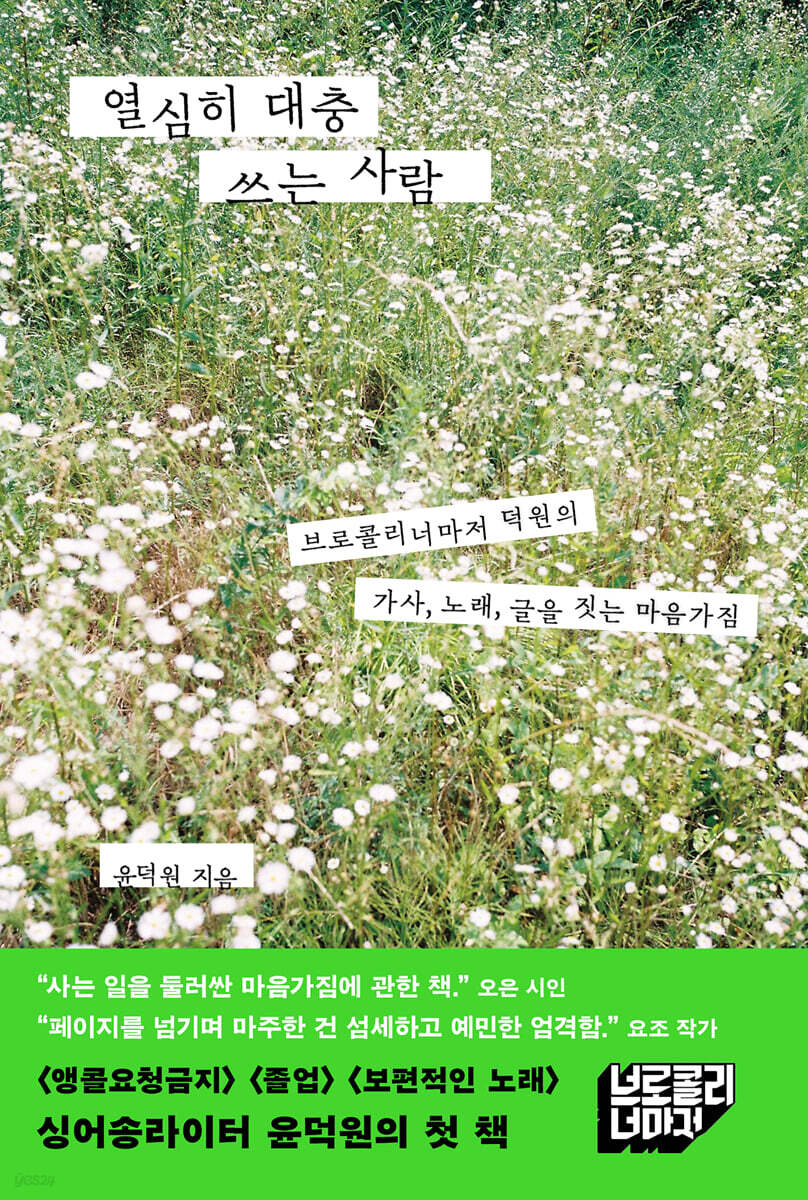
A person who writes diligently and roughly
 |
Description
Book Introduction
★★ [No Encore Requests] [Graduation] [Universal Song]
Broccoli You Too vocalist and bassist, Yoon Deok-won's first book ★★
“I will stay by your side for a long time with a relaxed mind.
“Because completing things slowly is what I do best.”
With a light and steady desire to do well,
Singer-songwriter Yoon Deok-won on the aesthetics of "hard work, roughly"
[No encore requests] [Graduation] [Universal song] [Not comforted by the words ‘I love you’]… … .
Singer-songwriter Yoon Deok-won, who has created songs that have comforted many people and have been consistently loved, presents his first book, "A Person Who Writes Hard and Roughly."
He has been active for over 20 years, writing and composing all the songs for the band Broccoli You Too and has also written columns for several media outlets.
Since all the lyrics, songs, and writings he has created were born through 'writing,' the creative act of 'writing' is his most important activity and topic.
The author's 'passion' to leave good songs and writings to the world is evident throughout the book.
However, because of the desire to create great works, there were many times when it was difficult to leave behind works.
There were times when it took five or eight years or more between albums.
It was because I decided that there was no need to leave behind anything that wasn't perfect.
The songs that were not recorded are gone.
Even the unwritten sentences flowed away.
In the process, the author repeatedly asked himself:
"What kind of songs should I write?" "What kind of musician do I want to be remembered as?" The book honestly reveals the song titles and lyrics he has written so far, along with his overlapping concerns.
After much thought, the mindset I decided on was 'work hard but do it roughly'.
It is an expression of the will to try to write something, even if it is not perfect, while still maintaining a desire to do well.
It also means that I want to break away from the state of feeling burdened and doing nothing, and collect the hesitations and sparkling things that can only be recorded at that moment.
With that determination, Yun Deok-won writes songs and poetry, his career and life.
Performing allows you to connect with your audience, encourage each other with your colleagues, and experience a sense of solidarity and connection with people through music.
The book includes 39 essays, lyrics to 14 long-time favorite songs such as [No Encore Requests] and [Graduation], and 13 album introductions that have garnered much attention, providing a variety of reading material.
In addition, the single of the same name, [The Hardworking, Rough Writer], which was created together with the book, was released at noon on August 25, 2025.
The song, which features his calm voice and gentle acoustic guitar melodies, ends with a chorus of Semicolon publishing company employees, adding to the meaning of creating the work together.
The story of 'working hard and doing it roughly' expressed through books and music will provide comfort and encouragement to everyone who is struggling to do well in what they do and live well in life.
*Listen to the song [The Hardworking Writer] and the songs featured in the book: https://bit.ly/45Kys8N
Broccoli You Too vocalist and bassist, Yoon Deok-won's first book ★★
“I will stay by your side for a long time with a relaxed mind.
“Because completing things slowly is what I do best.”
With a light and steady desire to do well,
Singer-songwriter Yoon Deok-won on the aesthetics of "hard work, roughly"
[No encore requests] [Graduation] [Universal song] [Not comforted by the words ‘I love you’]… … .
Singer-songwriter Yoon Deok-won, who has created songs that have comforted many people and have been consistently loved, presents his first book, "A Person Who Writes Hard and Roughly."
He has been active for over 20 years, writing and composing all the songs for the band Broccoli You Too and has also written columns for several media outlets.
Since all the lyrics, songs, and writings he has created were born through 'writing,' the creative act of 'writing' is his most important activity and topic.
The author's 'passion' to leave good songs and writings to the world is evident throughout the book.
However, because of the desire to create great works, there were many times when it was difficult to leave behind works.
There were times when it took five or eight years or more between albums.
It was because I decided that there was no need to leave behind anything that wasn't perfect.
The songs that were not recorded are gone.
Even the unwritten sentences flowed away.
In the process, the author repeatedly asked himself:
"What kind of songs should I write?" "What kind of musician do I want to be remembered as?" The book honestly reveals the song titles and lyrics he has written so far, along with his overlapping concerns.
After much thought, the mindset I decided on was 'work hard but do it roughly'.
It is an expression of the will to try to write something, even if it is not perfect, while still maintaining a desire to do well.
It also means that I want to break away from the state of feeling burdened and doing nothing, and collect the hesitations and sparkling things that can only be recorded at that moment.
With that determination, Yun Deok-won writes songs and poetry, his career and life.
Performing allows you to connect with your audience, encourage each other with your colleagues, and experience a sense of solidarity and connection with people through music.
The book includes 39 essays, lyrics to 14 long-time favorite songs such as [No Encore Requests] and [Graduation], and 13 album introductions that have garnered much attention, providing a variety of reading material.
In addition, the single of the same name, [The Hardworking, Rough Writer], which was created together with the book, was released at noon on August 25, 2025.
The song, which features his calm voice and gentle acoustic guitar melodies, ends with a chorus of Semicolon publishing company employees, adding to the meaning of creating the work together.
The story of 'working hard and doing it roughly' expressed through books and music will provide comfort and encouragement to everyone who is struggling to do well in what they do and live well in life.
*Listen to the song [The Hardworking Writer] and the songs featured in the book: https://bit.ly/45Kys8N
- You can preview some of the book's contents.
Preview
index
Recommendation
A person who writes prologues diligently and roughly
Chapter 1.
Remember and record
Still, it's pretty good, right?
Someday my song will be empty too
A person who uses it like sujebi
Keep writing without being perfect
cassette tape recorder
If you can skillfully take notes on your music with your Apple Watch,
Living a righteous life with my own money
2020
We are in an endless process
My goal for this year is to do it roughly
Chapter 2.
I'm a musician
Like watering a song
A song that is stuck with someone
So don't be my homework
Creative work as a profession is 'not a good thing'
Give me a beat
Your new guitar strokes
I could have done better
Let's go to spring before the barley tea gets cold
There are no sharp points
The art of idling
Sleeping in an unfamiliar place
Anything, somehow
Do you like dogtooth violets?
Without leaving anything behind
Chapter 3.
Even if the comfort ends in failure
That could have been it
Sending royalties
Everything is karma
Even if the comfort ends in failure
Desperation
Have you ever cried at work?
As long as it doesn't disturb the neighbors
T-shirt Chronicles
The taste of carefully brewed coffee
Living as a fan of a magazine that's on indefinite hiatus
You too could become extinct
Interview
10 Years with Radio
My doctor
happiness
Epilogue
Song list
A person who writes prologues diligently and roughly
Chapter 1.
Remember and record
Still, it's pretty good, right?
Someday my song will be empty too
A person who uses it like sujebi
Keep writing without being perfect
cassette tape recorder
If you can skillfully take notes on your music with your Apple Watch,
Living a righteous life with my own money
2020
We are in an endless process
My goal for this year is to do it roughly
Chapter 2.
I'm a musician
Like watering a song
A song that is stuck with someone
So don't be my homework
Creative work as a profession is 'not a good thing'
Give me a beat
Your new guitar strokes
I could have done better
Let's go to spring before the barley tea gets cold
There are no sharp points
The art of idling
Sleeping in an unfamiliar place
Anything, somehow
Do you like dogtooth violets?
Without leaving anything behind
Chapter 3.
Even if the comfort ends in failure
That could have been it
Sending royalties
Everything is karma
Even if the comfort ends in failure
Desperation
Have you ever cried at work?
As long as it doesn't disturb the neighbors
T-shirt Chronicles
The taste of carefully brewed coffee
Living as a fan of a magazine that's on indefinite hiatus
You too could become extinct
Interview
10 Years with Radio
My doctor
happiness
Epilogue
Song list
Detailed image

Into the book
In the attic of the old house, I encountered old events again.
Just as an old house, nearly lost, was reclaimed by human hands and given a new role, will things of the past be like that? As time passes, some old things disappear, while others remain. Perhaps memories are like that too.
People jokingly say that human greed is endless and that we repeat the same mistakes, but perhaps that's because memory is weaker than we think.
But sometimes, memories can be incredibly powerful, right? Just like how, even without any evidence to support that moment, something can come to mind just from someone remembering and talking about it.
(Omitted) Unrecorded songs disappear.
Songs that are not played fade away.
They say that a house where people live never grows old, but the songs and words I wrote also seem to have been passed by every time, so the parts that weren't shiny have become covered in dust and have been forgotten.
As I go about finding new stories, I find myself revisiting the traces of the past, and the more I realize things, the more I realize them.
--- pp.26-27 From "Someday, My Song Will Be Empty"
Like many creators these days, I've been wondering if I should go back to using notes.
If you have been memorizing the content of your writing by organizing it in your head because you have seen so many of your shortcomings in your writing, I think it is time to collect those hesitations.
Handwritten text will remain anyway unless you erase or tear it.
Erasing or tearing it will also be more difficult than writing it on a digital device.
My new laptop is less than a year old, but the backspace key is shiny.
Perhaps that's why the sentence that comes out of the keyboard seems to be the shortest route the navigation system tells me, not the route I actually took after hesitating.
My conclusion is that in order to write more and longer, you have to accept wandering between words and failure.
--- pp.40-41 From "Writing Without Perfection"
This year, I've decided to just do it roughly and keep busy.
Once you get used to doing it that way, you might eventually want to let go of the 'rough' part.
Who doesn't want to do well?
But I try not to get impatient.
I was worried that the moment I wanted to give up before even starting, it would become difficult to start something.
--- p.85 From “This year’s goal is to do it roughly”
If we think about it differently, isn't a song a story meant to be sung over and over again? If so, perhaps it's meaningful to create a story that never gets old no matter how many times you repeat it, even without striving for freshness, and to consistently sing it.
Even if you tell the same story, the same person won't hear it every time, and a song that you may have passed by without even knowing may seep into someone's heart much later.
'What's wrong with singing the same song a lot?
Instead, I think, 'I should just make a song that I can sing for a long time without feeling awkward.'
--- pp.90-91 From "Watering a Song"
I would like to express the phenomenon of a song naturally coming to mind when a melody and lyrics become familiar and reach a certain place, time, situation, and mind as 'the process of a song becoming absorbed into a person.'
I believe that there is a clear difference between music being played in a space and the song flowing from the heart and mouth.
So my goal is to write songs that can resonate with someone.
In the same vein, I am truly happy when I come across a song that fills me with joy.
Even if it's not a song I made.
But whether it's because times change or because everyone gets older, it seems like it's getting harder and harder for songs to stay with people.
Just because a song is good doesn't mean it will necessarily reach the people who need it, but it's a shame that those opportunities are decreasing.
--- p.98 From “A Song Remaining in Someone”
The flower language of the dogtooth violet is also wonderful.
'It makes those who are close by happy, and those who are far away come closer.' I want to make a song that is not flashy, but makes those who know you happy, and makes those who are far away come closer and get to know you, like a forget-me-not.
Could [Forget What You Need to Forget] be that kind of song?
--- p.176 From “Do you like dogtooth violets?”
The more I want to comfort and sympathize, the more I feel like I'm crumbling from the inside.
There was a time when I was at a concert where I wanted to truly comfort and empathize, but tears kept falling, and the song itself was a mess, ruining the performance.
What meaning did that stage hold, where voices had faded, lyrics and melodies became incomprehensible, and performances often stalled? The words and songs I could offer were so blunt that they struggled to fully paint the small, complex narratives within their bounds.
I cringe because of the wind that keeps blowing out roughly.
--- pp.208-209 From “Even if Comfort Ends in Failure”
At first I tried a variety of methods, but now I'm somewhat used to it and only make coffee the way I feel comfortable with.
While there are advantages to the convenience and familiarity of the usual way of getting off, there are also some drawbacks.
If you only drink coffee the way you're used to, at some point you'll forget the joy you felt when you tasted new types and methods of coffee.
That's why it's important to take the opportunity to visit a new cafe or try coffee made by someone else.
It's a way to maintain interest through stimulation through new experiences, and this also applies to your main job.
Buying and trying out new equipment or instruments while making music can be a way to have fun at work.
Just as an old house, nearly lost, was reclaimed by human hands and given a new role, will things of the past be like that? As time passes, some old things disappear, while others remain. Perhaps memories are like that too.
People jokingly say that human greed is endless and that we repeat the same mistakes, but perhaps that's because memory is weaker than we think.
But sometimes, memories can be incredibly powerful, right? Just like how, even without any evidence to support that moment, something can come to mind just from someone remembering and talking about it.
(Omitted) Unrecorded songs disappear.
Songs that are not played fade away.
They say that a house where people live never grows old, but the songs and words I wrote also seem to have been passed by every time, so the parts that weren't shiny have become covered in dust and have been forgotten.
As I go about finding new stories, I find myself revisiting the traces of the past, and the more I realize things, the more I realize them.
--- pp.26-27 From "Someday, My Song Will Be Empty"
Like many creators these days, I've been wondering if I should go back to using notes.
If you have been memorizing the content of your writing by organizing it in your head because you have seen so many of your shortcomings in your writing, I think it is time to collect those hesitations.
Handwritten text will remain anyway unless you erase or tear it.
Erasing or tearing it will also be more difficult than writing it on a digital device.
My new laptop is less than a year old, but the backspace key is shiny.
Perhaps that's why the sentence that comes out of the keyboard seems to be the shortest route the navigation system tells me, not the route I actually took after hesitating.
My conclusion is that in order to write more and longer, you have to accept wandering between words and failure.
--- pp.40-41 From "Writing Without Perfection"
This year, I've decided to just do it roughly and keep busy.
Once you get used to doing it that way, you might eventually want to let go of the 'rough' part.
Who doesn't want to do well?
But I try not to get impatient.
I was worried that the moment I wanted to give up before even starting, it would become difficult to start something.
--- p.85 From “This year’s goal is to do it roughly”
If we think about it differently, isn't a song a story meant to be sung over and over again? If so, perhaps it's meaningful to create a story that never gets old no matter how many times you repeat it, even without striving for freshness, and to consistently sing it.
Even if you tell the same story, the same person won't hear it every time, and a song that you may have passed by without even knowing may seep into someone's heart much later.
'What's wrong with singing the same song a lot?
Instead, I think, 'I should just make a song that I can sing for a long time without feeling awkward.'
--- pp.90-91 From "Watering a Song"
I would like to express the phenomenon of a song naturally coming to mind when a melody and lyrics become familiar and reach a certain place, time, situation, and mind as 'the process of a song becoming absorbed into a person.'
I believe that there is a clear difference between music being played in a space and the song flowing from the heart and mouth.
So my goal is to write songs that can resonate with someone.
In the same vein, I am truly happy when I come across a song that fills me with joy.
Even if it's not a song I made.
But whether it's because times change or because everyone gets older, it seems like it's getting harder and harder for songs to stay with people.
Just because a song is good doesn't mean it will necessarily reach the people who need it, but it's a shame that those opportunities are decreasing.
--- p.98 From “A Song Remaining in Someone”
The flower language of the dogtooth violet is also wonderful.
'It makes those who are close by happy, and those who are far away come closer.' I want to make a song that is not flashy, but makes those who know you happy, and makes those who are far away come closer and get to know you, like a forget-me-not.
Could [Forget What You Need to Forget] be that kind of song?
--- p.176 From “Do you like dogtooth violets?”
The more I want to comfort and sympathize, the more I feel like I'm crumbling from the inside.
There was a time when I was at a concert where I wanted to truly comfort and empathize, but tears kept falling, and the song itself was a mess, ruining the performance.
What meaning did that stage hold, where voices had faded, lyrics and melodies became incomprehensible, and performances often stalled? The words and songs I could offer were so blunt that they struggled to fully paint the small, complex narratives within their bounds.
I cringe because of the wind that keeps blowing out roughly.
--- pp.208-209 From “Even if Comfort Ends in Failure”
At first I tried a variety of methods, but now I'm somewhat used to it and only make coffee the way I feel comfortable with.
While there are advantages to the convenience and familiarity of the usual way of getting off, there are also some drawbacks.
If you only drink coffee the way you're used to, at some point you'll forget the joy you felt when you tasted new types and methods of coffee.
That's why it's important to take the opportunity to visit a new cafe or try coffee made by someone else.
It's a way to maintain interest through stimulation through new experiences, and this also applies to your main job.
Buying and trying out new equipment or instruments while making music can be a way to have fun at work.
--- p.238 From “The Taste of Carefully Brewed Coffee”
Publisher's Review
Crossing analog and digital
Try out various recording tools
Among them, the 'essence of records and memories' explored
“What does it mean to remain?”
Author Deokwon Yoon attempts to record things in various ways by writing lyrics and texts.
From handwritten notepads to the groundbreaking handheld PC Modia of the early 2000s, to cloud-connected laptops and smartphones.
I'm trying out both analog and digital tools one by one. This is an extension of my enthusiasm for 'would I be able to use it better if I change my equipment?' and a way of putting that question into practice.
Indeed, will recording with more expensive equipment actually improve the quality of the content? This question persists not only when recording sentences but also when recording melodies.
When working on a song with cassette tapes or when working with digital equipment with all the features.
While the latter is generally faster and easier, the author wonders whether it actually produces better results (songs).
The author explores the essence of records by experiencing two major methods of 'writing': analog and digital.
I realize that equipment is only an aid, and that ultimately, the judgment and intuition of what to record and what value it will have are more important factors in creating a satisfactory result.
The interesting point is that what looks and sounds smooth isn't necessarily a good result.
For example, when recording sound on a cassette tape, the sound quality deteriorates, but you can intentionally create some elements that are pleasant to listen to.
By examining the characteristics of such subtle records, the author reflects on the meaning of materiality and analog.
“What does it mean to remain?” “How long will this thing last?” Revealing a curiosity about memory and records, the author pledges not to miss the records of moments.
If you do that, you'll end up with one or two works that you think are pretty good.
The book contains many glimpses into the creative process of 'Broccoli You Too', which we enjoyed as a sound source, as well as the concerns and attempts made as a creator.
The more daunting and difficult the creative work is,
The fun of the process, discovered through hard work
“Within the limits of not disturbing the neighbors
“I want to do a lot of fun and enjoyable things.”
The author experiences creative struggles and exhaustion, but he also attempts to cope with these difficulties through interesting endeavors.
“It’s true that having a new instrument makes you feel like you can do something new,” he says, sharing an anecdote from a music store where he went to buy a new guitar.
The details of the song's creation are revealed in the passage where it is said that a sound can only be produced when a certain instrument is played in a certain way at a certain time.
Working alone in the quiet dawn can be overwhelming and lonely, but I sometimes turn on the rhythm machine that plays sounds according to the set beat and play various chords on the mini keyboard to come up with musical ideas.
It helps to shake off the stuffiness by being with people as well as objects.
Although the author is an introvert and shy, he actively makes plans to meet with colleagues.
And I truly feel the value of those moments when we share our work's difficulties or encourage each other by saying, "Let's do our best."
The process of a creator struggling to come up with something and trying something new behind the resulting song is sometimes pleasant and sometimes touching, adding a variety of emotional flavors to the book.
The author's pledge to "do many fun and enjoyable things without disturbing my neighbors" also fills the reader's heart with joy.
Author Deokwon Yoon expresses his wishes in his own words through various attempts.
Rather than hitting the jackpot, I hope it will be a song that stays in someone's heart for a long time, and although it doesn't get easier no matter how many times I write it, I hope the process of making it is enjoyable.
As we approach the 20th anniversary of our band activities, our concerns about the end are also the same.
The author endlessly thinks about what kind of songs he wants to leave behind in the world, what kind of musician he wants to be remembered as, and how he should live to achieve that, even if he ever leaves the stage.
The book conveys the energy of striving and constantly pursuing something, the exact opposite of helplessness.
Even if you don't work in music, anyone can gain the strength to reflect on their work and life, think about meaning, and find direction from "A Person Who Writes Hard and Roughly."
『No Encore Requests』 『Yuja Tea』
Exceptional observation and expressive power,
Behind-the-scenes stories closely related to daily life revealed!
As can be seen in works such as 『Yujacha』, 『Industrial Tower』, and 『Congratulatory Money』, the author's observational skills in expressing small objects in a unique way are also evident in the book.
In this book, the author reveals how he created the expressions that have captured the attention of many in his songs, and what thought process was behind the resulting lyrics.
I have my own method for getting ideas when writing lyrics and for verifying the lyrics I've written.
This is an attempt to express the sentence in reverse.
For example, it is like this.
Forget what you need to forget.
→ Let's not forget what we must not forget.
Please remember just one of the ten days we spent together.
→ You can probably forget nine out of ten days we spent together.
Sometimes I simply reverse the order, sometimes I reverse the cause and effect, and sometimes I use the 'contrast' principle I learned in math class to be a little more logical.
_Pages 75-76, from “We Are in an Endless Process”
The process of creating lyrics, song titles, etc. is closely related to daily life, so each step of the process is an interesting episode.
Representative stories include the process of completing a song by borrowing the title of her favorite comic book, “Narrow-minded Schoolgirl,” and the story of how she wrote the song “Right Life” while recovering from difficult times by cleaning and organizing her house, drinking water, sleeping well, and eating well.
On the way to a company outing with colleagues on Yeongjong Island, I saw an advertisement for a paid phone on the bus and wrote lyrics on the spot.
It is also impressive that he compares his writing style to the act of making dumplings, and that he uses everyday subjects such as assignments at the Korea National Open University, old houses, and coffee to solidify his mindset for music.
In particular, the author's anecdote from his elementary school days and his own interpretation of the word 'roughly' in the book's title are powerful.
The book also contains stories that express a wide range of emotions, from exciting and fun experiences to moments of despair and grief.
It also mentions social disasters that should be remembered regardless of their timeliness, and depicts what individuals and society would like to be like in the world we live in together.
I recommend this book to anyone who enjoys Broccoli You Too's songs, as well as anyone who enjoys reading books about writing and wants to experience unique observation and expressive power.
Reading "The Hardworking, Rough Writer" will make you want to write something hard, yet roughly, in your own way, and reflect on its meaning.
Try out various recording tools
Among them, the 'essence of records and memories' explored
“What does it mean to remain?”
Author Deokwon Yoon attempts to record things in various ways by writing lyrics and texts.
From handwritten notepads to the groundbreaking handheld PC Modia of the early 2000s, to cloud-connected laptops and smartphones.
I'm trying out both analog and digital tools one by one. This is an extension of my enthusiasm for 'would I be able to use it better if I change my equipment?' and a way of putting that question into practice.
Indeed, will recording with more expensive equipment actually improve the quality of the content? This question persists not only when recording sentences but also when recording melodies.
When working on a song with cassette tapes or when working with digital equipment with all the features.
While the latter is generally faster and easier, the author wonders whether it actually produces better results (songs).
The author explores the essence of records by experiencing two major methods of 'writing': analog and digital.
I realize that equipment is only an aid, and that ultimately, the judgment and intuition of what to record and what value it will have are more important factors in creating a satisfactory result.
The interesting point is that what looks and sounds smooth isn't necessarily a good result.
For example, when recording sound on a cassette tape, the sound quality deteriorates, but you can intentionally create some elements that are pleasant to listen to.
By examining the characteristics of such subtle records, the author reflects on the meaning of materiality and analog.
“What does it mean to remain?” “How long will this thing last?” Revealing a curiosity about memory and records, the author pledges not to miss the records of moments.
If you do that, you'll end up with one or two works that you think are pretty good.
The book contains many glimpses into the creative process of 'Broccoli You Too', which we enjoyed as a sound source, as well as the concerns and attempts made as a creator.
The more daunting and difficult the creative work is,
The fun of the process, discovered through hard work
“Within the limits of not disturbing the neighbors
“I want to do a lot of fun and enjoyable things.”
The author experiences creative struggles and exhaustion, but he also attempts to cope with these difficulties through interesting endeavors.
“It’s true that having a new instrument makes you feel like you can do something new,” he says, sharing an anecdote from a music store where he went to buy a new guitar.
The details of the song's creation are revealed in the passage where it is said that a sound can only be produced when a certain instrument is played in a certain way at a certain time.
Working alone in the quiet dawn can be overwhelming and lonely, but I sometimes turn on the rhythm machine that plays sounds according to the set beat and play various chords on the mini keyboard to come up with musical ideas.
It helps to shake off the stuffiness by being with people as well as objects.
Although the author is an introvert and shy, he actively makes plans to meet with colleagues.
And I truly feel the value of those moments when we share our work's difficulties or encourage each other by saying, "Let's do our best."
The process of a creator struggling to come up with something and trying something new behind the resulting song is sometimes pleasant and sometimes touching, adding a variety of emotional flavors to the book.
The author's pledge to "do many fun and enjoyable things without disturbing my neighbors" also fills the reader's heart with joy.
Author Deokwon Yoon expresses his wishes in his own words through various attempts.
Rather than hitting the jackpot, I hope it will be a song that stays in someone's heart for a long time, and although it doesn't get easier no matter how many times I write it, I hope the process of making it is enjoyable.
As we approach the 20th anniversary of our band activities, our concerns about the end are also the same.
The author endlessly thinks about what kind of songs he wants to leave behind in the world, what kind of musician he wants to be remembered as, and how he should live to achieve that, even if he ever leaves the stage.
The book conveys the energy of striving and constantly pursuing something, the exact opposite of helplessness.
Even if you don't work in music, anyone can gain the strength to reflect on their work and life, think about meaning, and find direction from "A Person Who Writes Hard and Roughly."
『No Encore Requests』 『Yuja Tea』
Exceptional observation and expressive power,
Behind-the-scenes stories closely related to daily life revealed!
As can be seen in works such as 『Yujacha』, 『Industrial Tower』, and 『Congratulatory Money』, the author's observational skills in expressing small objects in a unique way are also evident in the book.
In this book, the author reveals how he created the expressions that have captured the attention of many in his songs, and what thought process was behind the resulting lyrics.
I have my own method for getting ideas when writing lyrics and for verifying the lyrics I've written.
This is an attempt to express the sentence in reverse.
For example, it is like this.
Forget what you need to forget.
→ Let's not forget what we must not forget.
Please remember just one of the ten days we spent together.
→ You can probably forget nine out of ten days we spent together.
Sometimes I simply reverse the order, sometimes I reverse the cause and effect, and sometimes I use the 'contrast' principle I learned in math class to be a little more logical.
_Pages 75-76, from “We Are in an Endless Process”
The process of creating lyrics, song titles, etc. is closely related to daily life, so each step of the process is an interesting episode.
Representative stories include the process of completing a song by borrowing the title of her favorite comic book, “Narrow-minded Schoolgirl,” and the story of how she wrote the song “Right Life” while recovering from difficult times by cleaning and organizing her house, drinking water, sleeping well, and eating well.
On the way to a company outing with colleagues on Yeongjong Island, I saw an advertisement for a paid phone on the bus and wrote lyrics on the spot.
It is also impressive that he compares his writing style to the act of making dumplings, and that he uses everyday subjects such as assignments at the Korea National Open University, old houses, and coffee to solidify his mindset for music.
In particular, the author's anecdote from his elementary school days and his own interpretation of the word 'roughly' in the book's title are powerful.
The book also contains stories that express a wide range of emotions, from exciting and fun experiences to moments of despair and grief.
It also mentions social disasters that should be remembered regardless of their timeliness, and depicts what individuals and society would like to be like in the world we live in together.
I recommend this book to anyone who enjoys Broccoli You Too's songs, as well as anyone who enjoys reading books about writing and wants to experience unique observation and expressive power.
Reading "The Hardworking, Rough Writer" will make you want to write something hard, yet roughly, in your own way, and reflect on its meaning.
GOODS SPECIFICS
- Date of issue: September 1, 2025
- Page count, weight, size: 300 pages | 334g | 128*190*13mm
- ISBN13: 9791194087755
- ISBN10: 1194087752
You may also like
카테고리
korean


korean

![GQ KOREA Mark (Monthly): December [2025]](http://librairie.coreenne.fr/cdn/shop/files/8ef265dbbfbf186523ed75ba7319009d.jpg?v=1765340328&width=3840)


