

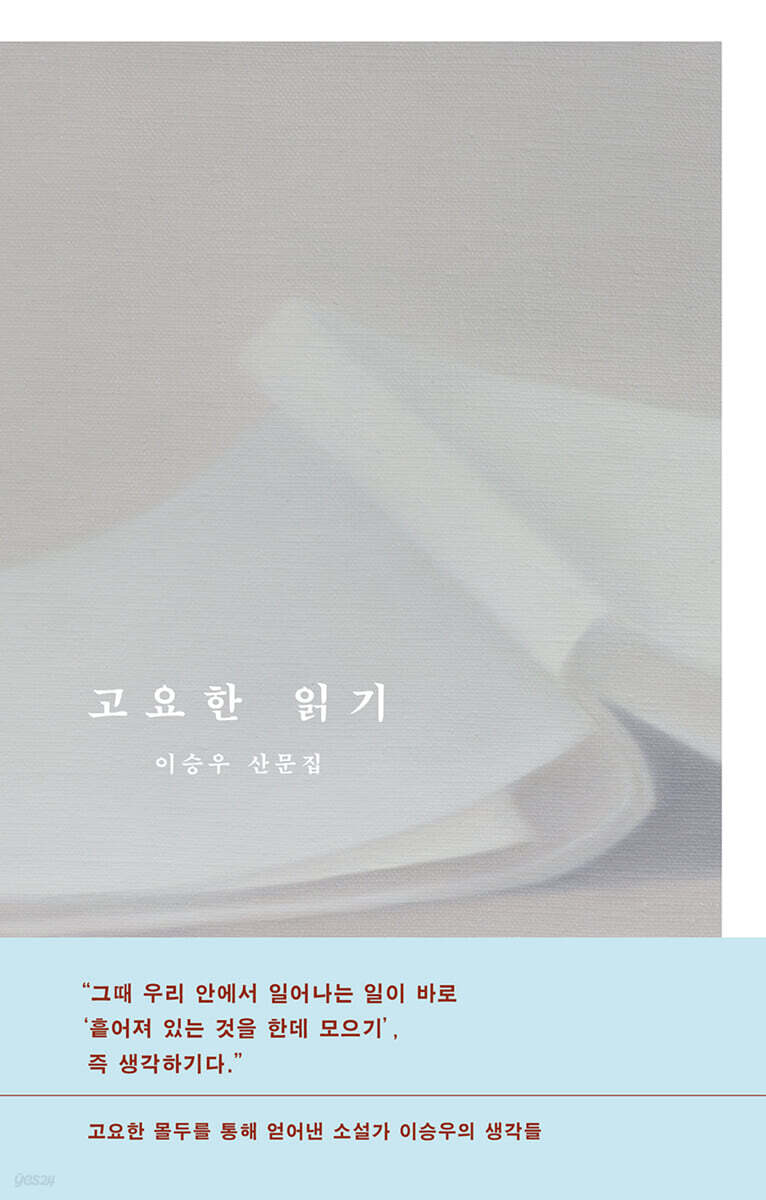
quiet reading
 |
Description
Book Introduction
- A word from MD
-
Novelist Lee Seung-woo's "Writing-Reading-Living"A collection of essays by novelist Lee Seung-woo.
The author, who has been writing novels for over 40 years, says that his writing career begins with 'quiet reading.'
We present twelve reading experiences that are quietly immersive, crossing literature, philosophy, and religion.
A book that contains deep insight into how a novelist, who reads himself, others, and the world through books, writes.
August 30, 2024. Essay PD Lee Ju-eun
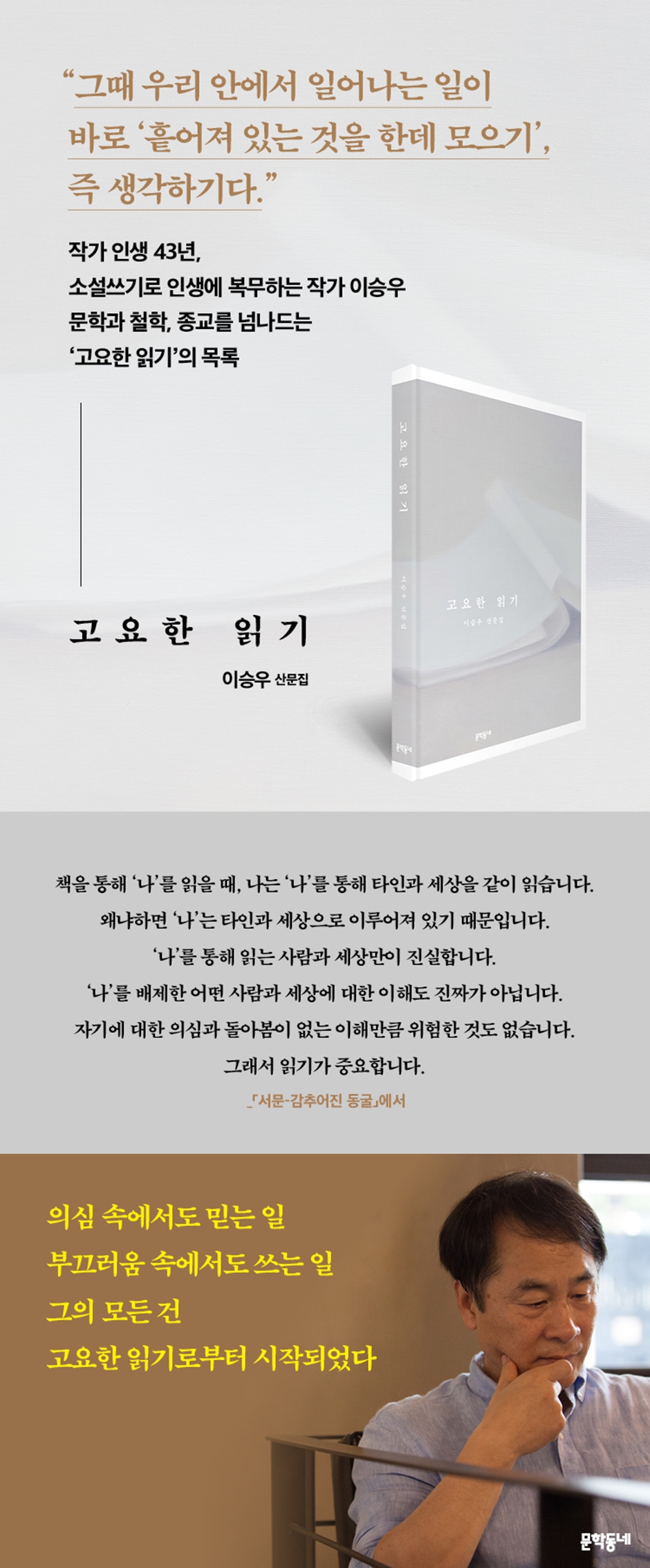
“What happens within us then is ‘gathering together what is scattered’,
That is, think.”
Novelist Lee Seung-woo's thoughts, gleaned through quiet immersion
Lee Seung-woo, a writer who has been serving his life for 43 years by writing novels.
He publishes a collection of prose that is like a house built on the two pillars that represent his world of works: ‘religious existence’ and ‘literary existence.’
"Quiet Reading" is a literary essay that organizes the reading method suggested by the author, the thoughts that this method evokes, the "subjective commentary" or creative theory that the author has attached to his novel work so far, and a book that can be said to be a portrait of an author created through "writing-reading-living."
This method, chosen by him who has devoted himself like a seeker to the question of why he writes and how to do literature, is not limited to literary works.
It can be guessed that this was an essential act to better understand the 'self-other-world' that felt infinitely unfamiliar.
What does it mean to read ‘quietly’?
It does not mean simply reading alone in a quiet place, but rather reading in a quiet place, where you choose to be alone and become absorbed in the reading.
A reading that sinks deep and explores the light and darkness within oneself.
A reading that brings up hidden thoughts scattered in fragments in the ‘Hidden Cave’ (「Preface」).
That is what author Seungwoo Lee calls ‘quiet reading.’
In short, the centripetal force that sinks into oneself and the centrifugal force that thinks about the other/world that constitutes me work simultaneously.
The author's long-time companions of 'quiet reading' include Borges, Milan Kundera, Kafka, Marquez, Hermann Hesse, and Lee Cheong-jun, as well as Levinas, Sartre, Benjamin, Simone Weil, and even the Talmud and the Bible. The 'list of quiet reading' that crosses literature, philosophy, and religion resonates with the author's long-standing questions about living as a being who pursues rather than a being who simply stays.
When I read 'myself' through a book, I read the world together with others through 'myself'.
Because ‘I’ am made up of others and the world.
Only the person and the world that reads through 'me' are true.
Any understanding of people and the world that excludes 'me' is not real.
There is nothing more dangerous than self-doubt and an understanding without reflection.
That's why reading is important.
_From "West Gate - Hidden Cave"
That is, think.”
Novelist Lee Seung-woo's thoughts, gleaned through quiet immersion
Lee Seung-woo, a writer who has been serving his life for 43 years by writing novels.
He publishes a collection of prose that is like a house built on the two pillars that represent his world of works: ‘religious existence’ and ‘literary existence.’
"Quiet Reading" is a literary essay that organizes the reading method suggested by the author, the thoughts that this method evokes, the "subjective commentary" or creative theory that the author has attached to his novel work so far, and a book that can be said to be a portrait of an author created through "writing-reading-living."
This method, chosen by him who has devoted himself like a seeker to the question of why he writes and how to do literature, is not limited to literary works.
It can be guessed that this was an essential act to better understand the 'self-other-world' that felt infinitely unfamiliar.
What does it mean to read ‘quietly’?
It does not mean simply reading alone in a quiet place, but rather reading in a quiet place, where you choose to be alone and become absorbed in the reading.
A reading that sinks deep and explores the light and darkness within oneself.
A reading that brings up hidden thoughts scattered in fragments in the ‘Hidden Cave’ (「Preface」).
That is what author Seungwoo Lee calls ‘quiet reading.’
In short, the centripetal force that sinks into oneself and the centrifugal force that thinks about the other/world that constitutes me work simultaneously.
The author's long-time companions of 'quiet reading' include Borges, Milan Kundera, Kafka, Marquez, Hermann Hesse, and Lee Cheong-jun, as well as Levinas, Sartre, Benjamin, Simone Weil, and even the Talmud and the Bible. The 'list of quiet reading' that crosses literature, philosophy, and religion resonates with the author's long-standing questions about living as a being who pursues rather than a being who simply stays.
When I read 'myself' through a book, I read the world together with others through 'myself'.
Because ‘I’ am made up of others and the world.
Only the person and the world that reads through 'me' are true.
Any understanding of people and the world that excludes 'me' is not real.
There is nothing more dangerous than self-doubt and an understanding without reflection.
That's why reading is important.
_From "West Gate - Hidden Cave"
- You can preview some of the book's contents.
Preview
index
Preface│Hidden Cave
The end of the world
Welcome to the writer
Longing and Pursuit, or Ignorance and the Unknown
That which does not belong to eternity
Words and Translation
bright darkness
Dreams and Interpretation
Cannot be said and should not be said
When absorbed as part of the whole
Where and how should the story end?
The temptation of the extraordinary
Chronic waiting
A list of quiet readings
The end of the world
Welcome to the writer
Longing and Pursuit, or Ignorance and the Unknown
That which does not belong to eternity
Words and Translation
bright darkness
Dreams and Interpretation
Cannot be said and should not be said
When absorbed as part of the whole
Where and how should the story end?
The temptation of the extraordinary
Chronic waiting
A list of quiet readings
Detailed image
Into the book
So the inside is the ultimate.
It's the last one.
It's a dead end.
You can't go any further than that.
'I' am always the last to meet.
---From "The End of the World"
The text is as large as the reader's vessel.
The size and shape of the bowl limits the text.
The infinite, which has entered the finite, is understood by and through the finite, and the eternity, which has entered time, is interpreted by and through time.
Understanding and interpretation involve a process of misunderstanding and distortion.
Doubts and ambiguity are inevitable.
---From "What Cannot Be Said and Should Not Be Said"
Humans are not drawn to evil, but to the extraordinary.
It is not that I want to do evil, but I want to possess, to claim to possess, and to be seen to possess some attribute of evil, which is extraordinary.
This desire lies at the heart of all temptations, but there are times when we are particularly vulnerable to them.
It's Emil Sinclair's time.
---From "The Temptation of the Extraordinary"
The desire to make amends that exists in a dissatisfied person cannot exist in a satisfied person.
A complacent person either stops writing or writes in the hope of greater satisfaction, fame, or reward.
Use it as you have been using it or use it carelessly.
That's why it's dangerous.
---From "Chronic Waiting"
Nostalgia longs for what was but is not, but pursuit longs for what has never been.
Ignorance is not knowing 'yet', and the unknown is not knowing 'yet'.
Two ignorances are not the same ignorance.
Ignorance is not knowing what one ought to know, and ignorance is not knowing what one ought not to know.
Ignorance contains the discontent of not knowing, and the unknown contains the expectation of knowing.
Ignorance is about the past, and the unknown is about the future.
Ignorance evokes nostalgia, and the unknown inspires pursuit.
---From “Nostalgia and Pursuit, or Ignorance and the Unknown”
The reason we are so miserable is because we do not see what is invisible.
Because you only see what you see.
Because it makes the invisible visible.
Because I don't miss what I have to 'show'.
Because I don't leave the familiar ground.
---From "When Absorbed as Part of the Whole"
The ninety-year-old seems to be saying that the reason we are so anxious when we fall in love is not because of love or human nature, but because of the nature of life.
Because I'm alive.
It seems to be emphasizing that there is nothing we can do as long as we are alive.
Why is that?
To be alive is to be above time.
Time flows, changes, and moves.
Time shakes and sways things that are above time.
Life must endure the vagaries of time.
So, as long as we are above time, we cannot expect complete peace and quiet.
Because it belongs to eternity.
So, to do that, you have to go beyond time, to a place that transcends time.
It's the last one.
It's a dead end.
You can't go any further than that.
'I' am always the last to meet.
---From "The End of the World"
The text is as large as the reader's vessel.
The size and shape of the bowl limits the text.
The infinite, which has entered the finite, is understood by and through the finite, and the eternity, which has entered time, is interpreted by and through time.
Understanding and interpretation involve a process of misunderstanding and distortion.
Doubts and ambiguity are inevitable.
---From "What Cannot Be Said and Should Not Be Said"
Humans are not drawn to evil, but to the extraordinary.
It is not that I want to do evil, but I want to possess, to claim to possess, and to be seen to possess some attribute of evil, which is extraordinary.
This desire lies at the heart of all temptations, but there are times when we are particularly vulnerable to them.
It's Emil Sinclair's time.
---From "The Temptation of the Extraordinary"
The desire to make amends that exists in a dissatisfied person cannot exist in a satisfied person.
A complacent person either stops writing or writes in the hope of greater satisfaction, fame, or reward.
Use it as you have been using it or use it carelessly.
That's why it's dangerous.
---From "Chronic Waiting"
Nostalgia longs for what was but is not, but pursuit longs for what has never been.
Ignorance is not knowing 'yet', and the unknown is not knowing 'yet'.
Two ignorances are not the same ignorance.
Ignorance is not knowing what one ought to know, and ignorance is not knowing what one ought not to know.
Ignorance contains the discontent of not knowing, and the unknown contains the expectation of knowing.
Ignorance is about the past, and the unknown is about the future.
Ignorance evokes nostalgia, and the unknown inspires pursuit.
---From “Nostalgia and Pursuit, or Ignorance and the Unknown”
The reason we are so miserable is because we do not see what is invisible.
Because you only see what you see.
Because it makes the invisible visible.
Because I don't miss what I have to 'show'.
Because I don't leave the familiar ground.
---From "When Absorbed as Part of the Whole"
The ninety-year-old seems to be saying that the reason we are so anxious when we fall in love is not because of love or human nature, but because of the nature of life.
Because I'm alive.
It seems to be emphasizing that there is nothing we can do as long as we are alive.
Why is that?
To be alive is to be above time.
Time flows, changes, and moves.
Time shakes and sways things that are above time.
Life must endure the vagaries of time.
So, as long as we are above time, we cannot expect complete peace and quiet.
Because it belongs to eternity.
So, to do that, you have to go beyond time, to a place that transcends time.
---From "Things That Do Not Belong to Eternity"
Publisher's Review
I am the furthest from myself.
I am the 'end of my world'.
In the first of twelve long prose pieces, the author first touches on the 'end'.
“Regardless of the world.
The end that we face “existentially,” so to speak.
It's 'me' myself.
“I am the ‘end of my world.’
I am the person who is the furthest from me, the person I know the least about, and the person I try the least to meet.
“I am the person I fear most.” (The End of the World) The author cites three characters from his 2019 work, Cantin, as examples.
Characters who are “demanded to reveal everything” at the “end of the world.”
Unavoidable demands from 'me'.
The author had them confess in the form of a memoir or diary.
“All writing is a kind of confession, and all confession is made to someone, and that someone is time/God, that is, ‘I.’” The situation is no different for Sinclair in 『Demian』, Borchert’s prisoner number 432 (「Dandelion」), and Oedipus, who are mentioned together.
In this way, author Seungwoo Lee borrows Pascal's words to say that the issues of pursuit and frustration, repentance and salvation that are mainly dealt with in literary works are the process by which humans achieve greatness.
“Man knows that he is miserable.
So he is miserable, because he really is.
But he is truly great because he knows that he is miserable.” (Pensees) A confession made at the ‘end of the world’.
The beginning after the end can make not only the characters in the work, but also the author and the reader, all 'converts'.
Knowing that it is possible, reading a confession that is like a prayer, has an inner impact on the 'author-work (character)-reader'.
“You have to arrive to depart, and you have to depart to arrive.
Since you are a different person, you can start over again.
“We can only start anew when we are different, only as different people.” Literature helps us with that.
Inspiration is not what starts a work, it is what completes it.
An author who debuted at the age of 22 and quietly published over 30 novels over 40 years.
If you were to ask him, who has become a "trusted and readable writer" to readers, where writers are born, or what the secret to his creations is, or what his source of inspiration is, what would he say?
First of all, an answer that reverses the direction of 'inspiration' that is commonly thought of will come back.
Inspiration is not something that pours down from above like a revelation, but something that comes from within the writer, fueled by effort and perseverance.
Let go of the superstition about inspiration.
Neither deny nor worship inspiration.
Distortion or abuse should be further avoided.
Do not blaspheme.
Just desperately 'dream'.
As if there is no such thing as inspiration, as if you do not wish for it, you will desperately strive and wait while struggling.
I'll invite you while I wait.
Know that effort is a way of invitation.
Don't even know that.
Never assume that inspiration is a natural reward for your efforts.
Remember that it is only a grace.
(…)
The names of great writers are passed down by those who read their books, those who read and wrote, that is, those who were born from their dreams.
It doesn't disappear.
Immortal.
_From "The Illusion of Being a Writer"
Inspiration as a ‘knot’ rather than a ‘clue’ of creation.
This shift in perception awakens both the writer and the reader to a new attitude toward life.
The same goes for the reflective advice that it is not special literary talent that makes a writer, but rather “the hard work of shaping oneself under the influence of intense and great reading experiences.”
A 'great book', "a book written by the Holy Spirit, to use Borges's definition," "is not completed without the breath of God.
But that god does nothing where there is no passion and effort on the part of the writer.”
Believing even in doubt
Writing even in shame
Everything for him started with quiet reading.
As a reader, it is a great pleasure to be able to fully savor the fundamental questions that captivate author Seungwoo Lee and the critical awareness that drives his writing in this book.
Just looking at the titles of the included chapters, you can guess what it is about: Nostalgia and Pursuit, Ignorance and the Unknown, What Belongs and Does Not Belong to Eternity, Dreams, What Cannot and Should Not Be Said, and The Temptation of the Extraordinary.
In addition, the author's long-standing thoughts on love and faith, life and death, and the relationship between the work and the reader.
“Nostalgia longs for what was but is not, but pursuit longs for what has never been.” “Death is lazy and at the same time impulsive.
In short, it's impossible to grasp.
“Death does not come until it has come.” “Absence is not caused by failure to acquire, but by the loss of what has been acquired.” “Blind faith is not the highest form of faith, but its opposite.” “What the reader can do is not to change the story that has already been told, but to rewrite it.
“It is about waking up sleeping stories and reviving stories that have ended.” Sentences filled with author Seungwoo Lee’s characteristically dense and deep thoughts are interwoven among the books he loves.
It is possible to have a multi-layered reading experience by reading author Seungwoo Lee, who ponders 'what to read and how to read it.'
Meanwhile, the question, “How much more of a mess would life have been if I hadn’t met someone, something, an opportunity, a book, or a sentence at a critical juncture in life?” is not unique to the writer.
What we can do as finite beings standing on the fickle time called life.
I miss and desperately need that increasingly rare act of 'quiet reading.'
It is because we are human that we must ask and pursue the questions of who we are, how we should live, and why we should live that way.
I think that's where the brilliance of literature comes from, even though it's become almost invisible to most people, and still remains visible to some.
_From "The Illusion of Being a Writer"
I am the 'end of my world'.
In the first of twelve long prose pieces, the author first touches on the 'end'.
“Regardless of the world.
The end that we face “existentially,” so to speak.
It's 'me' myself.
“I am the ‘end of my world.’
I am the person who is the furthest from me, the person I know the least about, and the person I try the least to meet.
“I am the person I fear most.” (The End of the World) The author cites three characters from his 2019 work, Cantin, as examples.
Characters who are “demanded to reveal everything” at the “end of the world.”
Unavoidable demands from 'me'.
The author had them confess in the form of a memoir or diary.
“All writing is a kind of confession, and all confession is made to someone, and that someone is time/God, that is, ‘I.’” The situation is no different for Sinclair in 『Demian』, Borchert’s prisoner number 432 (「Dandelion」), and Oedipus, who are mentioned together.
In this way, author Seungwoo Lee borrows Pascal's words to say that the issues of pursuit and frustration, repentance and salvation that are mainly dealt with in literary works are the process by which humans achieve greatness.
“Man knows that he is miserable.
So he is miserable, because he really is.
But he is truly great because he knows that he is miserable.” (Pensees) A confession made at the ‘end of the world’.
The beginning after the end can make not only the characters in the work, but also the author and the reader, all 'converts'.
Knowing that it is possible, reading a confession that is like a prayer, has an inner impact on the 'author-work (character)-reader'.
“You have to arrive to depart, and you have to depart to arrive.
Since you are a different person, you can start over again.
“We can only start anew when we are different, only as different people.” Literature helps us with that.
Inspiration is not what starts a work, it is what completes it.
An author who debuted at the age of 22 and quietly published over 30 novels over 40 years.
If you were to ask him, who has become a "trusted and readable writer" to readers, where writers are born, or what the secret to his creations is, or what his source of inspiration is, what would he say?
First of all, an answer that reverses the direction of 'inspiration' that is commonly thought of will come back.
Inspiration is not something that pours down from above like a revelation, but something that comes from within the writer, fueled by effort and perseverance.
Let go of the superstition about inspiration.
Neither deny nor worship inspiration.
Distortion or abuse should be further avoided.
Do not blaspheme.
Just desperately 'dream'.
As if there is no such thing as inspiration, as if you do not wish for it, you will desperately strive and wait while struggling.
I'll invite you while I wait.
Know that effort is a way of invitation.
Don't even know that.
Never assume that inspiration is a natural reward for your efforts.
Remember that it is only a grace.
(…)
The names of great writers are passed down by those who read their books, those who read and wrote, that is, those who were born from their dreams.
It doesn't disappear.
Immortal.
_From "The Illusion of Being a Writer"
Inspiration as a ‘knot’ rather than a ‘clue’ of creation.
This shift in perception awakens both the writer and the reader to a new attitude toward life.
The same goes for the reflective advice that it is not special literary talent that makes a writer, but rather “the hard work of shaping oneself under the influence of intense and great reading experiences.”
A 'great book', "a book written by the Holy Spirit, to use Borges's definition," "is not completed without the breath of God.
But that god does nothing where there is no passion and effort on the part of the writer.”
Believing even in doubt
Writing even in shame
Everything for him started with quiet reading.
As a reader, it is a great pleasure to be able to fully savor the fundamental questions that captivate author Seungwoo Lee and the critical awareness that drives his writing in this book.
Just looking at the titles of the included chapters, you can guess what it is about: Nostalgia and Pursuit, Ignorance and the Unknown, What Belongs and Does Not Belong to Eternity, Dreams, What Cannot and Should Not Be Said, and The Temptation of the Extraordinary.
In addition, the author's long-standing thoughts on love and faith, life and death, and the relationship between the work and the reader.
“Nostalgia longs for what was but is not, but pursuit longs for what has never been.” “Death is lazy and at the same time impulsive.
In short, it's impossible to grasp.
“Death does not come until it has come.” “Absence is not caused by failure to acquire, but by the loss of what has been acquired.” “Blind faith is not the highest form of faith, but its opposite.” “What the reader can do is not to change the story that has already been told, but to rewrite it.
“It is about waking up sleeping stories and reviving stories that have ended.” Sentences filled with author Seungwoo Lee’s characteristically dense and deep thoughts are interwoven among the books he loves.
It is possible to have a multi-layered reading experience by reading author Seungwoo Lee, who ponders 'what to read and how to read it.'
Meanwhile, the question, “How much more of a mess would life have been if I hadn’t met someone, something, an opportunity, a book, or a sentence at a critical juncture in life?” is not unique to the writer.
What we can do as finite beings standing on the fickle time called life.
I miss and desperately need that increasingly rare act of 'quiet reading.'
It is because we are human that we must ask and pursue the questions of who we are, how we should live, and why we should live that way.
I think that's where the brilliance of literature comes from, even though it's become almost invisible to most people, and still remains visible to some.
_From "The Illusion of Being a Writer"
GOODS SPECIFICS
- Date of issue: August 28, 2024
- Format: Hardcover book binding method guide
- Page count, weight, size: 260 pages | 340g | 120*188*20mm
- ISBN13: 9791141601164
- ISBN10: 1141601168
You may also like
카테고리
korean


korean

![GQ KOREA Mark (Monthly): December [2025]](http://librairie.coreenne.fr/cdn/shop/files/8ef265dbbfbf186523ed75ba7319009d.jpg?v=1765340328&width=3840)


