

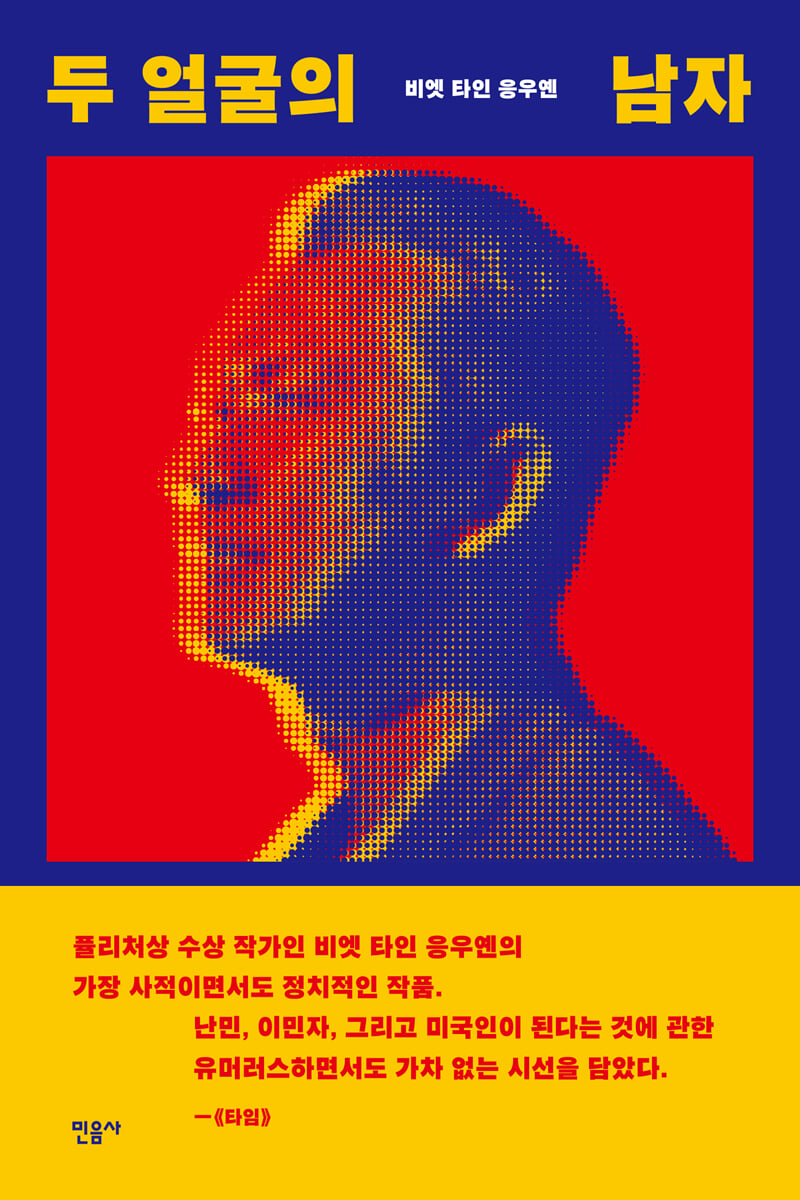
The Two-Faced Man
 |
Description
Book Introduction
The original author of director Park Chan-wook's drama "The Sympathizer"
Autobiographical essays by Pulitzer Prize-winning author Viet Thanh Nguyen
NPR, San Francisco Chronicle, Oprah, Houston Chronicle, Library Journal, Amazon Book of the Year!
“There is another name for breaking free from the shackles and breaking the curse.
It is decolonization.” - From “The Man with Two Faces”
The autobiographical essay "The Man with Two Faces" by Vietnamese-American author Viet Thanh Nguyen, who created a sensation in the American media and literary world by winning the Pulitzer Prize for his first novel, "The Sympathizer," is being published by Minumsa.
This book serves as a compass, detailing the origins of Viet Thanh Nguyen's dark and dry sense of humor, his highly satirical spirit, and his keen awareness of reality, representing the Asian immigrant writers who most sharply portray the spirit of contemporary American literature.
Autobiographical essays by Pulitzer Prize-winning author Viet Thanh Nguyen
NPR, San Francisco Chronicle, Oprah, Houston Chronicle, Library Journal, Amazon Book of the Year!
“There is another name for breaking free from the shackles and breaking the curse.
It is decolonization.” - From “The Man with Two Faces”
The autobiographical essay "The Man with Two Faces" by Vietnamese-American author Viet Thanh Nguyen, who created a sensation in the American media and literary world by winning the Pulitzer Prize for his first novel, "The Sympathizer," is being published by Minumsa.
This book serves as a compass, detailing the origins of Viet Thanh Nguyen's dark and dry sense of humor, his highly satirical spirit, and his keen awareness of reality, representing the Asian immigrant writers who most sharply portray the spirit of contemporary American literature.
- You can preview some of the book's contents.
Preview
index
Part 1
Do you know how to get to San Jose? 11
Hello, Hollywood? 34
The Beginning of Memory 45
The Only Example You Can Be 73
Colonizers and the Colonized 98
White People and Other Saviors 120
Part 2
Mixed Emotions 131
So... where is your real hometown? 151
Drifting Away 164
America's Problem 180
The Good, the Bad, and the Ugly 191
Ronald Reagan Room 208
War Stories, or Your 1980s: Episode 1, Part 224
Say My Name, or Your 1980s: Episode 2, Part 245
All About Your Mother, or Your 1980s: Episode 3, Part 253
Memory Therapy 267
Your Education 277
Portrait of a Young and Foolish Writer 288
Your Own Archive 311
What's Left for You 325
Pilgrimage 341
Part 3
Oblivion, intentionally or accidentally 341
Obituary 359
Eulogy 385
Open Secret 385
My End 407
Vietnamese Holy Land 414
Acknowledgments 431
Source 435
Permission to quote 462
Do you know how to get to San Jose? 11
Hello, Hollywood? 34
The Beginning of Memory 45
The Only Example You Can Be 73
Colonizers and the Colonized 98
White People and Other Saviors 120
Part 2
Mixed Emotions 131
So... where is your real hometown? 151
Drifting Away 164
America's Problem 180
The Good, the Bad, and the Ugly 191
Ronald Reagan Room 208
War Stories, or Your 1980s: Episode 1, Part 224
Say My Name, or Your 1980s: Episode 2, Part 245
All About Your Mother, or Your 1980s: Episode 3, Part 253
Memory Therapy 267
Your Education 277
Portrait of a Young and Foolish Writer 288
Your Own Archive 311
What's Left for You 325
Pilgrimage 341
Part 3
Oblivion, intentionally or accidentally 341
Obituary 359
Eulogy 385
Open Secret 385
My End 407
Vietnamese Holy Land 414
Acknowledgments 431
Source 435
Permission to quote 462
Detailed image

Into the book
Every parent should make a movie of their life.
At least that's what our parents should do.
Their epic journey is worthy of being portrayed by star actors.
Even an independent, low-budget film would be fine.
I would love to see the beautiful Joan Chen in her prime playing my mother, and the young and charming Russell Wong playing my father.
Neither actor is Vietnamese, but so what.
Because here we are all 'Asians'.
--- pp.11-12
It was a red brick house, and the upstairs tenants were a white family, and I played with their daughter on a sofa that the previous owners had left in the yard.
My brother and I share a room.
My brother listens to 1970s hits, including “Hotel California,” that Vietnamese teenagers his age had to memorize by heart.
I make my dad laugh by calling kitchen chicken.
There was a brief period when my father's English skills were better than mine.
--- p.17
Our store on East Santa Clara Street is the heart of the city.
My parents named their store 'SaiGon M?i (New Saigon)'.
It is a compromise between the westernized 'Saigon' and the original spelling 'Sai Gon'.
The use of Vietnamese names instead of English is a declaration that we are here because Americans came there.
Maybe it's even a sign of resistance, but I haven't thought about it that far yet.
We just have to accept that this store is the place for us.
We don't need an interpreter for each other, but when we meet the Americans who surround us, we are people who can only exist through an interpreter. (21-22)
My brother leaves me in the living room watching cartoons and goes to answer the phone.
While I was laughing out loud, my brother came back.
My brother says, "Mom and Dad got shot."
I'm probably now
My nine-year-old son
Like watching a cartoon
He must have been laughing.
Mom and Dad got shot, my brother says again.
What are you doing?
Why aren't you saying anything?
Don't you feel anything?
I am
Laughter
Stop.
To be honest, yes.
Numbness
Could you call it a feeling?
--- pp.30-31
According to the UN High Commissioner for Refugees, it is a horrific experience to join the ranks of 130 million forcibly displaced people worldwide.
Ukrainians who became refugees due to the Russian invasion are welcomed warmly because of their unique white ethnicity.
The shabby but still beautiful story of Ukrainian refugees fleeing to Mexico and seeking asylum at the U.S. border could perhaps be made into a Hollywood film starring Angelina Jolie.
But Central American refugees waiting patiently while Ukrainian whites cross the U.S. border, or African refugees facing violence while trying to cross from Ukraine to Poland, will not be featured in Hollywood films.
A country made up of immigrants.
A country larger than New Zealand or Ireland, Norway or Denmark, Singapore or Hong Kong, Switzerland or Austria, Portugal or Greece, Belgium or the Netherlands, Taiwan or Australia, South Korea or the United Kingdom, Saudi Arabia or Spain, Italy or France, Cambodia or Thailand, Germany or Iran, appears in the distance.
But why do you insist on comparing yourselves to a country?
People hate you and define you as their enemy,
Not a member of any country
It reminds us of how vulnerable the home and the nation are.
Defined as those who threaten the existence of the nation,
Even if I don't hate you by any chance
It is considered a crisis signal.
You, refugees.
--- pp.36-37
Decades later, I found myself in the suburbs of San Gabriel Valley, California.
I'm at a party hosted by someone I don't know.
The host
He takes out an AK-47 rifle and shoots it at the ground, saying he is celebrating the New Year.
There is a loud noise and my ears start to ring.
The shooter fires the gun until the magazine is empty.
While firing, the vibration of the bullet hitting the ground is transmitted as is.
Multiplying that by 1000 gives you the volume and speed of the flying metal,
And I can imagine the fear my mother must have felt.
people in their twenties
While the host was walking around with an AK-47 and shaking hands with people,
You leave the party as quickly as possible.
When you leave
My friends say the host frowned
It doesn't matter.
Because you are a coward and you intend to continue living that way.
--- p.43
When Ellison was four years old, ■■■ was elected President of the United States.
He pledges to prevent the so-called "American Holocaust," promising:
You will never be ignored again.
In this 'you', under the only God
Of course you, an insignificant being,
Not included, and probably your son too
It will not be included.
In the country of ■■■, you, an Asian, are the other, the one who is nothing to anyone, the one who was once invisible, but now you are seen everywhere and are condemned.
However, he is not yet the number one 'Other' as thought by ■■■ and his followers.
As will soon come the fourth time, the harassment and incitement begins with the most vulnerable, the undocumented immigrants coming north from other continental nations overshadowed by AmericaTM.
These too, once invisible, have now become all too visible.
■■■ separates parents and children and detains them in detention centers to prevent such immigrants.
Some immigrants and refugees, namely
Atrocities against dark-skinned immigrants and refugees
It happens whether the president is a Democrat or a Republican,
■■■ is the cruelty of bureaucracy
Obsessed with turning it into a political and theatrical spectacle.
--- pp.62-63
Baba Ma sent you to the best elite private high school in San Jose.
You repay this by being rejected by all but one of the universities you applied to.
On the first night of college, a time when I really didn't want to go, my classmates gathered around, looked at each other gloomily, and asked, "What did I do wrong to get here?"
In short, you're screwed
'Failed' is a relative term.
Because you got a B+ average!
B+ is also called F for Asians.
F stands for 'fuckup' and A stands for 'Asian'.
--- pp.73-74
You watch the movie until its embarrassing final scene.
Set in Cambodia, Marlon Brando plays Kurtz, a white man who becomes a native and a savage.
Even if he is a savage, he is still a white man.
He is the king of the natives.
Willard stabs him to death with a machete as he rubs his bald head and mutters, “Horror, horror...”
As Kurtz lies dying, the Cambodian natives (played by Igorots from the Philippines, where the film was shot) slaughter a water buffalo.
The poor buffalo was actually slaughtered! The scene where they were chopping up chunks of buffalo flesh with a machete is so fucking real.
Movies like this aren't made anymore.
Blame the progressive animal lovers.
--- p.86
You are a writer, not a film director.
So I wrote that damn thing, The Sympathizer.
The book features a film director who is as self-conscious as he is talented, who subtly resembles Coppola, but who is not Coppola.
Whoever the director is, many Hollywood insiders have read your book and no one disputes his characterization.
Maybe he's another famous film director who made another war hit set in Vietnam.
You reluctantly signed a copy of the Pulitzer Prize-winning limited edition of The Sympathizer at the request of a friend who knew the film director, including a written tribute to him, only to find that autographed copy selling for $499 on eBay.
--- p.91
American soldiers who came to Vietnam called the area outside their launching bases "Indian country."
In the imagination of American colonizers, all native peoples are Indians.
General Philip Sheridan, surrounded by Indians in 1869, said, “The only good Indian is a dead Indian.”
You play the role of both the good Indian and the bad Indian who surrounds the white people.
Theodore Roosevelt, who later became president, offered a more generous statement in 1886.
“I don’t believe that only dead Indians are good Indians, but I think nine times out of ten they are.”
At least that's what our parents should do.
Their epic journey is worthy of being portrayed by star actors.
Even an independent, low-budget film would be fine.
I would love to see the beautiful Joan Chen in her prime playing my mother, and the young and charming Russell Wong playing my father.
Neither actor is Vietnamese, but so what.
Because here we are all 'Asians'.
--- pp.11-12
It was a red brick house, and the upstairs tenants were a white family, and I played with their daughter on a sofa that the previous owners had left in the yard.
My brother and I share a room.
My brother listens to 1970s hits, including “Hotel California,” that Vietnamese teenagers his age had to memorize by heart.
I make my dad laugh by calling kitchen chicken.
There was a brief period when my father's English skills were better than mine.
--- p.17
Our store on East Santa Clara Street is the heart of the city.
My parents named their store 'SaiGon M?i (New Saigon)'.
It is a compromise between the westernized 'Saigon' and the original spelling 'Sai Gon'.
The use of Vietnamese names instead of English is a declaration that we are here because Americans came there.
Maybe it's even a sign of resistance, but I haven't thought about it that far yet.
We just have to accept that this store is the place for us.
We don't need an interpreter for each other, but when we meet the Americans who surround us, we are people who can only exist through an interpreter. (21-22)
My brother leaves me in the living room watching cartoons and goes to answer the phone.
While I was laughing out loud, my brother came back.
My brother says, "Mom and Dad got shot."
I'm probably now
My nine-year-old son
Like watching a cartoon
He must have been laughing.
Mom and Dad got shot, my brother says again.
What are you doing?
Why aren't you saying anything?
Don't you feel anything?
I am
Laughter
Stop.
To be honest, yes.
Numbness
Could you call it a feeling?
--- pp.30-31
According to the UN High Commissioner for Refugees, it is a horrific experience to join the ranks of 130 million forcibly displaced people worldwide.
Ukrainians who became refugees due to the Russian invasion are welcomed warmly because of their unique white ethnicity.
The shabby but still beautiful story of Ukrainian refugees fleeing to Mexico and seeking asylum at the U.S. border could perhaps be made into a Hollywood film starring Angelina Jolie.
But Central American refugees waiting patiently while Ukrainian whites cross the U.S. border, or African refugees facing violence while trying to cross from Ukraine to Poland, will not be featured in Hollywood films.
A country made up of immigrants.
A country larger than New Zealand or Ireland, Norway or Denmark, Singapore or Hong Kong, Switzerland or Austria, Portugal or Greece, Belgium or the Netherlands, Taiwan or Australia, South Korea or the United Kingdom, Saudi Arabia or Spain, Italy or France, Cambodia or Thailand, Germany or Iran, appears in the distance.
But why do you insist on comparing yourselves to a country?
People hate you and define you as their enemy,
Not a member of any country
It reminds us of how vulnerable the home and the nation are.
Defined as those who threaten the existence of the nation,
Even if I don't hate you by any chance
It is considered a crisis signal.
You, refugees.
--- pp.36-37
Decades later, I found myself in the suburbs of San Gabriel Valley, California.
I'm at a party hosted by someone I don't know.
The host
He takes out an AK-47 rifle and shoots it at the ground, saying he is celebrating the New Year.
There is a loud noise and my ears start to ring.
The shooter fires the gun until the magazine is empty.
While firing, the vibration of the bullet hitting the ground is transmitted as is.
Multiplying that by 1000 gives you the volume and speed of the flying metal,
And I can imagine the fear my mother must have felt.
people in their twenties
While the host was walking around with an AK-47 and shaking hands with people,
You leave the party as quickly as possible.
When you leave
My friends say the host frowned
It doesn't matter.
Because you are a coward and you intend to continue living that way.
--- p.43
When Ellison was four years old, ■■■ was elected President of the United States.
He pledges to prevent the so-called "American Holocaust," promising:
You will never be ignored again.
In this 'you', under the only God
Of course you, an insignificant being,
Not included, and probably your son too
It will not be included.
In the country of ■■■, you, an Asian, are the other, the one who is nothing to anyone, the one who was once invisible, but now you are seen everywhere and are condemned.
However, he is not yet the number one 'Other' as thought by ■■■ and his followers.
As will soon come the fourth time, the harassment and incitement begins with the most vulnerable, the undocumented immigrants coming north from other continental nations overshadowed by AmericaTM.
These too, once invisible, have now become all too visible.
■■■ separates parents and children and detains them in detention centers to prevent such immigrants.
Some immigrants and refugees, namely
Atrocities against dark-skinned immigrants and refugees
It happens whether the president is a Democrat or a Republican,
■■■ is the cruelty of bureaucracy
Obsessed with turning it into a political and theatrical spectacle.
--- pp.62-63
Baba Ma sent you to the best elite private high school in San Jose.
You repay this by being rejected by all but one of the universities you applied to.
On the first night of college, a time when I really didn't want to go, my classmates gathered around, looked at each other gloomily, and asked, "What did I do wrong to get here?"
In short, you're screwed
'Failed' is a relative term.
Because you got a B+ average!
B+ is also called F for Asians.
F stands for 'fuckup' and A stands for 'Asian'.
--- pp.73-74
You watch the movie until its embarrassing final scene.
Set in Cambodia, Marlon Brando plays Kurtz, a white man who becomes a native and a savage.
Even if he is a savage, he is still a white man.
He is the king of the natives.
Willard stabs him to death with a machete as he rubs his bald head and mutters, “Horror, horror...”
As Kurtz lies dying, the Cambodian natives (played by Igorots from the Philippines, where the film was shot) slaughter a water buffalo.
The poor buffalo was actually slaughtered! The scene where they were chopping up chunks of buffalo flesh with a machete is so fucking real.
Movies like this aren't made anymore.
Blame the progressive animal lovers.
--- p.86
You are a writer, not a film director.
So I wrote that damn thing, The Sympathizer.
The book features a film director who is as self-conscious as he is talented, who subtly resembles Coppola, but who is not Coppola.
Whoever the director is, many Hollywood insiders have read your book and no one disputes his characterization.
Maybe he's another famous film director who made another war hit set in Vietnam.
You reluctantly signed a copy of the Pulitzer Prize-winning limited edition of The Sympathizer at the request of a friend who knew the film director, including a written tribute to him, only to find that autographed copy selling for $499 on eBay.
--- p.91
American soldiers who came to Vietnam called the area outside their launching bases "Indian country."
In the imagination of American colonizers, all native peoples are Indians.
General Philip Sheridan, surrounded by Indians in 1869, said, “The only good Indian is a dead Indian.”
You play the role of both the good Indian and the bad Indian who surrounds the white people.
Theodore Roosevelt, who later became president, offered a more generous statement in 1886.
“I don’t believe that only dead Indians are good Indians, but I think nine times out of ten they are.”
--- pp.122-123
Publisher's Review
The story of a man who “belongs to two countries and none at the same time.”
Viet Thanh Nguyen was born in northern Vietnam in 1971, the second son of immigrants who fled Vietnam to the United States in 1975 after the fall of Saigon, now Ho Chi Minh City.
His present is shaped by the relationship between two countries, Vietnam and the United States.
One misconception many Americans have is that his family came to the United States because 'America went to Vietnam first.'
They were there, that's why they are here.
This applies not only to the Nguyen family, but also to many immigrants and refugees in the United States today.
The Nguyen family, who had been doing business in northern Vietnam, first fled to Saigon in the south when North Vietnam became communist.
The diaspora had already begun before coming to America.
When the withdrawal of American troops was confirmed and they left Vietnam, the Nguyen family's father and mother left their teenage adopted daughter in Vietnam to protect their property and home, and took only their two biological sons on a journey from which they could not return.
The author has few detailed memories of their arduous journey, but they arrived in Pennsylvania, USA, where they settled in a refugee camp.
However, after this, these families cannot leave the camp as full members.
If the parents want to leave the camp and become independent, they must send their children to other places for temporary adoption.
So Viet and his older brother Anh Tung are each placed in the care of different white families.
Although the younger Viet was reunited with his parents after a few months, his older brother was separated from them for two years.
The place where they met again as a complete family and settled down was San Jose, California.
His parents opened a grocery store here called 'Saigon Moi'.
Already self-made businessmen in Vietnam, they did not arrive in the United States completely empty-handed, and thanks to this, the family began to successfully settle down by opening a store and purchasing a home.
Vietnam and the United States: a bloody history and colonial memories
As with most "model minority" Asian immigrant families, their lives follow a formula for the "American Dream."
First-generation immigrant parents work tirelessly without holidays, hoping that their children will become doctors or professors and rise in the social class of second-generation immigrants.
And the Nguyen family's wish came true.
His older brother, Anh Tung, became a doctor who served as President Obama's personal physician, and Viet became a professor of American literature at USC.
But everything they went through along the way made Viet Thanh Nguyen a novelist.
One day, as a child, he rented a videotape on a holiday and started watching the movie alone in his empty house.
It's a war movie that young boys would like.
On the screen, his fellow countrymen with the same skin color and the same language appear, and the white protagonist he identifies with opens fire on them.
At that moment, he splits into two.
Am I the one getting shot and dying, or am I the white guy with the gun?
The film was Francis Ford Coppola's Apocalypse Now, and it depicted the very war that brought his family here to America.
There is the devoted care of parents who work without holidays and come home to prepare meals for their children, but that alone cannot prevent all the discrimination, insults, and absurdities that minority and immigrant children experience.
Graffiti like "Another American Loses His Job Because of the Vietnamese" appears on my parents' store, gun-wielding robbers break into stores and homes, and the main characters in all the movies and dramas I watch as a teenager are all white.
If he and his brother were to appear on television, it would be in a documentary about the success of a model minority, not a fun romantic drama.
Viet spends her formative years sensitively and acutely reflecting on where she fits within the invasive and exclusive white-centric narrative that dominates American popular culture.
After entering the liberal arts school of Berkeley, he became an English literature student who paid attention to the stories of ethnic minorities and the historical and political contexts in which they lived.
Although the English Department is also exclusive in that it focuses on the history of English literature, which is dominated by white people, he continued his studies through the teachings of Asian professors such as Maxine Hong Kingston and his interest in modern and contemporary American literature, and became a professor teaching ethnic studies.
But even after becoming a professor, his hidden desire was still to write novels, and he won the Pulitzer Prize for writing The Sympathizer, a novel featuring a "two-faced man" like himself as the main character.
Because it's the most private
The most political story
In an interview, he said that he was able to write "The Sympathizer" because he lived a double agent-like life, observing the lives of his Vietnamese parents at home and Americans outside.
He is a 'two-faced man' who moves between two worlds, but cannot claim his place in either.
It's a daily occurrence for me to tell a Vietnamese scholar I met at an academic conference that I'm also Vietnamese, only to be flatly denied with a "no," and for Americans to tell me that "all Asians look the same."
Racism still exists, it's just more diverse. When the nation was suffering from COVID-19, then-President Donald Trump called it not just the Chinese virus, but "Kung Flu," a portmanteau of "kung fu" and "virus."
As the history of immigration has lengthened, the socio-historical context of immigrants and refugees in the United States has become more complex and diverse.
In the case of George Floyd's murder by an American police officer that stirred up the African-American community, the Asian police officer who protected the white officer who committed the crime was Thu Thao, who is of Muong ethnicity in Vietnam.
Looking at this incident, the author recalls that the Muong people, the ethnic group of the perpetrator, Thu Thao, were an ethnic minority that suffered under the rule of the Kinh people, the majority ethnic group to which the Nguyen family belonged, when they lived in Vietnam.
In this way, the history of perpetrators and victims mix and intersect, giving birth to new rulers and ruled.
The author calls the way to escape the shackles of this oppression 'decolonialism.'
Moreover, this book is not only political but also deeply personal.
His mother, who had been a resilient businesswoman in Vietnam, lived a life without escape beyond her store and home after coming to the United States. She was unable to shake off the scars of war and eventually passed away from depression and dementia.
As the author reminisces about his childhood and adolescence, he feels pain at the different possibilities that might have existed in his mother's life, and also blames himself for being insensitive.
It also conveys the dynamics and hidden warmth of Asian immigrant family relationships, where the father never says "I love you" to one another, but conveys it through actions, endless care and sacrifice.
Like his parents, Viet Thanh Nguyen wants to pass on this immigrant identity and spiritual legacy to his son, Ellison (named after the African-American writer Ralph Ellison) and daughter, Simone (named after the singer Nina Simone).
From the moment we recognize our own identity, everything personal becomes political, and from this, the true possibilities of life open up.
These stories of war, refugees, and diaspora are not just stories of distant lands; they are also our stories, past, present, and future.
Furthermore, this book, written during the first term of Trump's administration and published in Korea during the second term, is perfectly suited to diagnosing the current state of the United States, which is marred by various ideological conflicts and terrorism.
Viet Thanh Nguyen was born in northern Vietnam in 1971, the second son of immigrants who fled Vietnam to the United States in 1975 after the fall of Saigon, now Ho Chi Minh City.
His present is shaped by the relationship between two countries, Vietnam and the United States.
One misconception many Americans have is that his family came to the United States because 'America went to Vietnam first.'
They were there, that's why they are here.
This applies not only to the Nguyen family, but also to many immigrants and refugees in the United States today.
The Nguyen family, who had been doing business in northern Vietnam, first fled to Saigon in the south when North Vietnam became communist.
The diaspora had already begun before coming to America.
When the withdrawal of American troops was confirmed and they left Vietnam, the Nguyen family's father and mother left their teenage adopted daughter in Vietnam to protect their property and home, and took only their two biological sons on a journey from which they could not return.
The author has few detailed memories of their arduous journey, but they arrived in Pennsylvania, USA, where they settled in a refugee camp.
However, after this, these families cannot leave the camp as full members.
If the parents want to leave the camp and become independent, they must send their children to other places for temporary adoption.
So Viet and his older brother Anh Tung are each placed in the care of different white families.
Although the younger Viet was reunited with his parents after a few months, his older brother was separated from them for two years.
The place where they met again as a complete family and settled down was San Jose, California.
His parents opened a grocery store here called 'Saigon Moi'.
Already self-made businessmen in Vietnam, they did not arrive in the United States completely empty-handed, and thanks to this, the family began to successfully settle down by opening a store and purchasing a home.
Vietnam and the United States: a bloody history and colonial memories
As with most "model minority" Asian immigrant families, their lives follow a formula for the "American Dream."
First-generation immigrant parents work tirelessly without holidays, hoping that their children will become doctors or professors and rise in the social class of second-generation immigrants.
And the Nguyen family's wish came true.
His older brother, Anh Tung, became a doctor who served as President Obama's personal physician, and Viet became a professor of American literature at USC.
But everything they went through along the way made Viet Thanh Nguyen a novelist.
One day, as a child, he rented a videotape on a holiday and started watching the movie alone in his empty house.
It's a war movie that young boys would like.
On the screen, his fellow countrymen with the same skin color and the same language appear, and the white protagonist he identifies with opens fire on them.
At that moment, he splits into two.
Am I the one getting shot and dying, or am I the white guy with the gun?
The film was Francis Ford Coppola's Apocalypse Now, and it depicted the very war that brought his family here to America.
There is the devoted care of parents who work without holidays and come home to prepare meals for their children, but that alone cannot prevent all the discrimination, insults, and absurdities that minority and immigrant children experience.
Graffiti like "Another American Loses His Job Because of the Vietnamese" appears on my parents' store, gun-wielding robbers break into stores and homes, and the main characters in all the movies and dramas I watch as a teenager are all white.
If he and his brother were to appear on television, it would be in a documentary about the success of a model minority, not a fun romantic drama.
Viet spends her formative years sensitively and acutely reflecting on where she fits within the invasive and exclusive white-centric narrative that dominates American popular culture.
After entering the liberal arts school of Berkeley, he became an English literature student who paid attention to the stories of ethnic minorities and the historical and political contexts in which they lived.
Although the English Department is also exclusive in that it focuses on the history of English literature, which is dominated by white people, he continued his studies through the teachings of Asian professors such as Maxine Hong Kingston and his interest in modern and contemporary American literature, and became a professor teaching ethnic studies.
But even after becoming a professor, his hidden desire was still to write novels, and he won the Pulitzer Prize for writing The Sympathizer, a novel featuring a "two-faced man" like himself as the main character.
Because it's the most private
The most political story
In an interview, he said that he was able to write "The Sympathizer" because he lived a double agent-like life, observing the lives of his Vietnamese parents at home and Americans outside.
He is a 'two-faced man' who moves between two worlds, but cannot claim his place in either.
It's a daily occurrence for me to tell a Vietnamese scholar I met at an academic conference that I'm also Vietnamese, only to be flatly denied with a "no," and for Americans to tell me that "all Asians look the same."
Racism still exists, it's just more diverse. When the nation was suffering from COVID-19, then-President Donald Trump called it not just the Chinese virus, but "Kung Flu," a portmanteau of "kung fu" and "virus."
As the history of immigration has lengthened, the socio-historical context of immigrants and refugees in the United States has become more complex and diverse.
In the case of George Floyd's murder by an American police officer that stirred up the African-American community, the Asian police officer who protected the white officer who committed the crime was Thu Thao, who is of Muong ethnicity in Vietnam.
Looking at this incident, the author recalls that the Muong people, the ethnic group of the perpetrator, Thu Thao, were an ethnic minority that suffered under the rule of the Kinh people, the majority ethnic group to which the Nguyen family belonged, when they lived in Vietnam.
In this way, the history of perpetrators and victims mix and intersect, giving birth to new rulers and ruled.
The author calls the way to escape the shackles of this oppression 'decolonialism.'
Moreover, this book is not only political but also deeply personal.
His mother, who had been a resilient businesswoman in Vietnam, lived a life without escape beyond her store and home after coming to the United States. She was unable to shake off the scars of war and eventually passed away from depression and dementia.
As the author reminisces about his childhood and adolescence, he feels pain at the different possibilities that might have existed in his mother's life, and also blames himself for being insensitive.
It also conveys the dynamics and hidden warmth of Asian immigrant family relationships, where the father never says "I love you" to one another, but conveys it through actions, endless care and sacrifice.
Like his parents, Viet Thanh Nguyen wants to pass on this immigrant identity and spiritual legacy to his son, Ellison (named after the African-American writer Ralph Ellison) and daughter, Simone (named after the singer Nina Simone).
From the moment we recognize our own identity, everything personal becomes political, and from this, the true possibilities of life open up.
These stories of war, refugees, and diaspora are not just stories of distant lands; they are also our stories, past, present, and future.
Furthermore, this book, written during the first term of Trump's administration and published in Korea during the second term, is perfectly suited to diagnosing the current state of the United States, which is marred by various ideological conflicts and terrorism.
GOODS SPECIFICS
- Date of issue: October 31, 2025
- Page count, weight, size: 464 pages | 598g | 140*210*23mm
- ISBN13: 9788937422812
- ISBN10: 8937422816
You may also like
카테고리
korean


korean

![GQ KOREA Mark (Monthly): December [2025]](http://librairie.coreenne.fr/cdn/shop/files/8ef265dbbfbf186523ed75ba7319009d.jpg?v=1765340328&width=3840)


