

Pata
 |
Description
Book Introduction
- A word from MD
-
The secret records of Moon Ga-young, the person, not the actress.Actress Moon Ga-young's first collection of essays.
In this essay, Moon Ga-young reveals her intimate language through a new face called 'Pata'.
He defines himself as a borderline person, and experimentally deals with his honest thoughts and experiences beyond form and time and space.
An essay filled with moments that make you look forward to her future.
March 29, 2024. Essay PD Kim Yu-ri
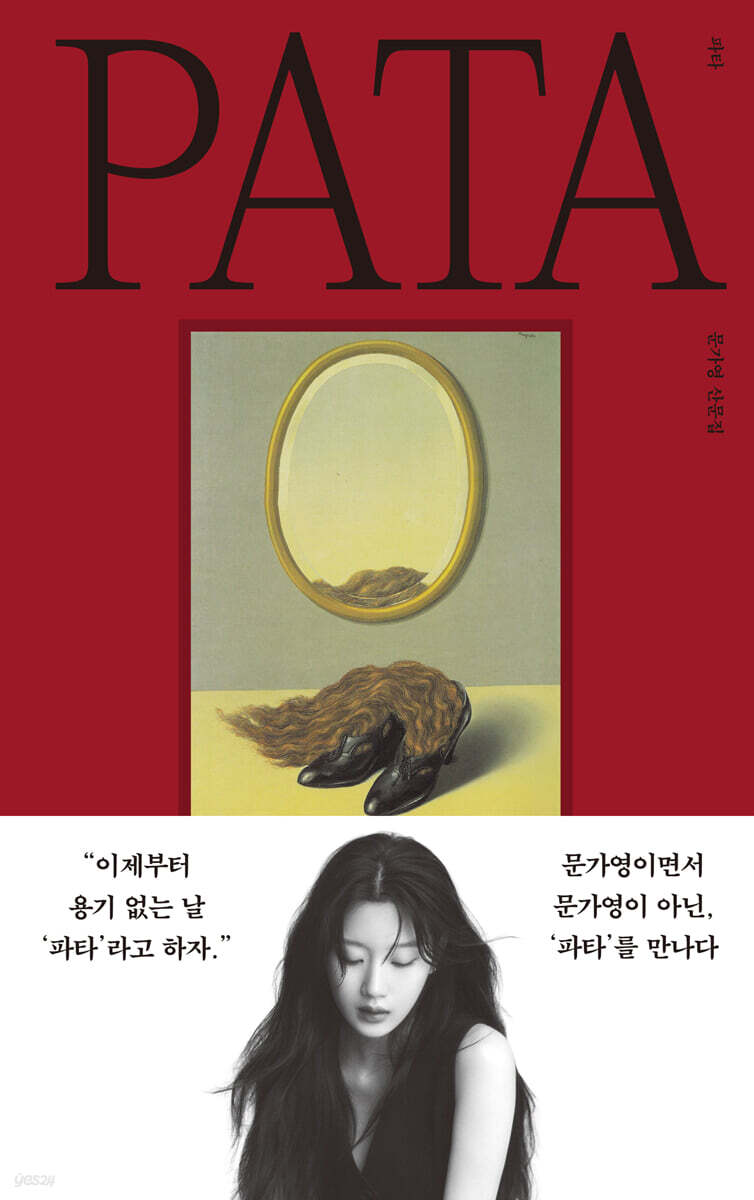
“From now on, let’s call days without courage ‘pata.’”
Meet 'Pata', who is Moon Ga-young but not Moon Ga-young.
Actress Moon Ga-young's first prose collection
Layers of records to preserve my truest self
Recommended by lyricist Kim Ina and novelist Lee Hyuk-jin!
“Is the life of an actor who has lived many roles one life, or is it the life of many people?
It's not a very important question.
“What matters in life is not the number of things, but how true they are.” - Lee Hyuk-jin (novelist, author of ‘Understanding Love’)
Actress Moon Ga-young, who captured the attention of fans around the world with [True Beauty] (2020) and [Understanding Love] (2023), has published her first collection of essays.
Having played a variety of roles for 18 years and leaving a distinct impression in each work with her own unique mood, she has now appeared before the public as 'Writer Moon Ga-young'.
This book contains the intimate language of Moon Ga-young, who seeks to fiercely confront herself and the world around her by building up deep thoughts.
For those who already know her, who displays the solid inner strength characteristic of someone who meticulously crafts her thoughts over a long period of time in each interview, the news of this publication will be extremely welcome.
With a childhood spent in Germany, a reading habit that has persisted since childhood, and a special love for classical literature, she tells stories that are both her and not her through a new face called 'Pata'.
Part 1, "Record of Existence," constantly poses questions about life through extremely everyday events, which ultimately leads to a process of intense self-exploration to face one's true self.
Part 2, 'Record of Thoughts', is where actress Moon Ga-young's more honest desires are revealed, and her sharp and deep perspective on herself and the outside world stands out among the racing thoughts.
As an appendix, we have included excerpts from the actual parenting diary written by Moon Ga-young's father, which connect to episodes from Parts 1 and 2.
When you realize that scattered episodes are organically connected, or when you discover Pata's hidden message in the suggestive dialogue, you will not be able to easily put the book down.
Let's follow the gaze of Moon Ga-young, or rather Pata, who stares at the world with both eyes wide open in pursuit of the truth, so as not to be 'eaten up' by personal emotions.
Meet 'Pata', who is Moon Ga-young but not Moon Ga-young.
Actress Moon Ga-young's first prose collection
Layers of records to preserve my truest self
Recommended by lyricist Kim Ina and novelist Lee Hyuk-jin!
“Is the life of an actor who has lived many roles one life, or is it the life of many people?
It's not a very important question.
“What matters in life is not the number of things, but how true they are.” - Lee Hyuk-jin (novelist, author of ‘Understanding Love’)
Actress Moon Ga-young, who captured the attention of fans around the world with [True Beauty] (2020) and [Understanding Love] (2023), has published her first collection of essays.
Having played a variety of roles for 18 years and leaving a distinct impression in each work with her own unique mood, she has now appeared before the public as 'Writer Moon Ga-young'.
This book contains the intimate language of Moon Ga-young, who seeks to fiercely confront herself and the world around her by building up deep thoughts.
For those who already know her, who displays the solid inner strength characteristic of someone who meticulously crafts her thoughts over a long period of time in each interview, the news of this publication will be extremely welcome.
With a childhood spent in Germany, a reading habit that has persisted since childhood, and a special love for classical literature, she tells stories that are both her and not her through a new face called 'Pata'.
Part 1, "Record of Existence," constantly poses questions about life through extremely everyday events, which ultimately leads to a process of intense self-exploration to face one's true self.
Part 2, 'Record of Thoughts', is where actress Moon Ga-young's more honest desires are revealed, and her sharp and deep perspective on herself and the outside world stands out among the racing thoughts.
As an appendix, we have included excerpts from the actual parenting diary written by Moon Ga-young's father, which connect to episodes from Parts 1 and 2.
When you realize that scattered episodes are organically connected, or when you discover Pata's hidden message in the suggestive dialogue, you will not be able to easily put the book down.
Let's follow the gaze of Moon Ga-young, or rather Pata, who stares at the world with both eyes wide open in pursuit of the truth, so as not to be 'eaten up' by personal emotions.
- You can preview some of the book's contents.
Preview
index
Part 1: Records of Existence
1 ~ 49
Part 2: Record of Thoughts
The Easiest Thing | P.69 | Confession | Red Speech Bubble | The Most Frequently Asked Questions | The Rules of Success | The Taste of Metaphor | Dark Chocolate / White Chocolate | Truth | Aim | Eye Contact | Homesickness | Next Life | Palmistry | Fermentation | ― | Hurdles | Lucky Letter | Question | Something Extra | Incomplete | Standing High | I Think of It Again | Countless Rooms of the Heart | Sincerity Doesn't Work | Source | The Beginning of a Story | Someone Else's House | Reading Notes | Meditations, Chapter 1 | Implicit Promise | Failure of Empathy Learning | Chupa Chups | Reality | Everything That Has Left My Hand | September | Harmony of Scents | Consistency | Slowly Slowly | Note | Full of Words | Fortune Cookie | Evidence of Humanity | Indeed | Bristling Flexibility | A Clutched Spoon | A White Lump | Protective Shield | Astigmatism | Piano Practice | Pendulum | One Person | Test Drive | Blue Pen | Your Value | A Mole on a Sheet of Paper | A Dot | Spring Water | What is a Good Quote? | Let's Look Quietly | Red Radish | Qed
Appendix Pata Parenting Diary
18 months and 15 days old _ Baby Pata
108 months _ A perfect gift
000 months _ Benji's story
48 months _ Learning to ride a bike
000 months _ One lollipop
000 months _ Secret ballot
60 months _ Ballet recital
1 ~ 49
Part 2: Record of Thoughts
The Easiest Thing | P.69 | Confession | Red Speech Bubble | The Most Frequently Asked Questions | The Rules of Success | The Taste of Metaphor | Dark Chocolate / White Chocolate | Truth | Aim | Eye Contact | Homesickness | Next Life | Palmistry | Fermentation | ― | Hurdles | Lucky Letter | Question | Something Extra | Incomplete | Standing High | I Think of It Again | Countless Rooms of the Heart | Sincerity Doesn't Work | Source | The Beginning of a Story | Someone Else's House | Reading Notes | Meditations, Chapter 1 | Implicit Promise | Failure of Empathy Learning | Chupa Chups | Reality | Everything That Has Left My Hand | September | Harmony of Scents | Consistency | Slowly Slowly | Note | Full of Words | Fortune Cookie | Evidence of Humanity | Indeed | Bristling Flexibility | A Clutched Spoon | A White Lump | Protective Shield | Astigmatism | Piano Practice | Pendulum | One Person | Test Drive | Blue Pen | Your Value | A Mole on a Sheet of Paper | A Dot | Spring Water | What is a Good Quote? | Let's Look Quietly | Red Radish | Qed
Appendix Pata Parenting Diary
18 months and 15 days old _ Baby Pata
108 months _ A perfect gift
000 months _ Benji's story
48 months _ Learning to ride a bike
000 months _ One lollipop
000 months _ Secret ballot
60 months _ Ballet recital
Detailed image

Into the book
“You deserve to be punished.
“The punishment of living in a world without me.”
Pata, standing facing each other, spoke.
All I can do to remember her who disappeared like that is to remember, chase after her, and write.
That is, to record.
--- p.13
“Let’s break up.”
“Give me the letter I wrote.”
As this conversation shows, Pata's letter was more important than the ending.
The letters placed on the white paper represent her emotions, and her overflowing love drips from the end of the vowels.
That's why Pata likes to reread the letters he writes over and over again.
Because the love letter you wrote is enough to make your heart flutter.
It would be great if someone would just write something like this.
I arrived home holding a beautiful letter.
I felt relieved.
'I got my heart back.
I haven't lost anything.'
--- p.21 From 「6」
“I’m looking for my identity.”
“It’s a very good time.”
“But I can’t see anything.”
Pata smiled awkwardly, and the guard spoke without looking at Pata.
“The stairs we have to climb every year are different in height and depth.
It seems like the stairs this year are particularly higher than last year.
So I guess I'm adapting.
It is not a time of chaos, but rather a blessing that has come quickly.
I need to find my identity.
That's what's going to take care of the next few years.
Don't try to clean up, just make bibimbap.
“It is a very good blessing, so don’t keep studying it, just observe it.”
--- p.32 From 「11」
The vibration rings.
Again, Pata's eyes see just an ordinary riverbank.
“How is it? Are you happy because you’re traveling?”
Pata, who was looking at his phone, brought forward his flight back to Korea instead of replying.
This choice had a clearer meaning than any answer.
I ran my tongue across the roof of my mouth and it was cracked.
It's definitely because of the baguette sandwich.
I once asked Pata what he was running from at that time.
Pata, who had been silent for a while, rolled his eyes for a long time before starting to speak.
“Thank you for always wishing me happiness…”
“People keep wishing me happiness.
“Their wishes are stuck to my body and won’t come off.” When asked if he knew it was because he loved me, he replied, “I know.
I know I'm bad.
No, I don't like this.
You keep making me look like a bad person.
They keep telling me to be happy, even though I'm just living! I guess people don't realize that's wrong.
“How selfish that heart is.”
“I ran away from that heavy mission, and they asked me again after I left.
Are you happy when you travel?
When I came back, he asked me again.
How was it?
Aren't you happy to be back?
So what did I say?”
“I said I was happy and relieved.
“I ended up giving you the answer you wanted.”
She ended her story by saying that only then did their expressions become satisfied with Pata's recognition, and then she closed her mouth and muttered something barely audible.
“I won.”
--- p.39~40 from 「13」
“Doing well means”
.
.
.
“It’s like feeding a piece of shit.
How can he ever meet someone who will treat him as well as I do until he dies?
“How uncomfortable would the world be without me?” Her friend was still looking at her, and this time Pata continued.
“Doing something well is a good thing, but there is another hidden meaning that no one knows about.
The saying goes that there is nothing to lose by being kind to everyone.
Don't doubt my sincerity.
“It just follows the shit.”
She was cheerful.
--- p.53 From 「18」
“Pattaya.
Don't run half-heartedly while warming up.
Run when you need to run, stop when you need to stop, regroup before the warning sounds, and turn every opportunity around when you're warming up.
And when it's over, I promise to leave everything in its place without any regrets.”
Just as he was about to make a promise with his grandfather, whom he had never met before, Pata woke up from his nap.
She only took a nap when she wasn't feeling well.
--- p.92 From 「33」
Suddenly, Pata spreads out his ten fingers and starts counting.
'How many books will I be able to read before I die, given the time limit?'
I can't even read as many books as there are in the bookstore...
'How many more people can I hug within the allotted time?'
I'd rather hug someone I know two or three times than hug someone new...
'How many trips can I take within a given time limit?'
Even if I go once a year, I still don't know half of the world...
--- p.109 From "40"
They say love begins with a metaphor.
The very beginning stages of a relationship where tastes change and you even create hobbies you never had before to find common ground.
I say this quite often, when I really listen to everything the other person says.
“I like rainy days.” Then every rainy day becomes a day for me.
--- p.155 From “The Taste of Metaphor”
“What will you be in your next life?”
"tree!"
My answer to my sister's question, which I gave without much difficulty, ended up making her cry.
I couldn't figure out why she was crying, but I figured it was because she loved me so much.
--- p.169 From "The Next Life"
There are people who keep saying they will support my success.
From the beginning, there was no such thing as normal for me.
Is there a place called normal that only they can see?
Are you thinking of putting me on top and then letting me fall?
I always stand still in this place, in a place where there is no height or height.
Everything passes me by, I don't move.
--- p.189 From "Tall"
Sincerity doesn't work.
--- p.197 From “Truth Doesn’t Work”
“Dad, I told you not to let go of my hand!”
It's a bold statement.
The face is flushed brightly.
The eyes looking at me were filled with fear.
“Dad is here.
“If you’re about to fall, they catch you right away.”
I felt sorry and muttered in a small voice.
'What are you afraid of when you're in my hands?'
I couldn't say these words out loud, but swallowed them inside.
The second child, Pata, must have been completely convinced that her father would be right behind her.
‘You are in my hands…’ I kept muttering.
In the frightened eyes of my four-year-old second daughter, I see absolute trust in her father.
An absolute relationship between two people in which they can freely express their anger.
This little boy leaves everything to his father and goes on a bike ride.
I grab the kid and say I'll take responsibility for everything.
“The punishment of living in a world without me.”
Pata, standing facing each other, spoke.
All I can do to remember her who disappeared like that is to remember, chase after her, and write.
That is, to record.
--- p.13
“Let’s break up.”
“Give me the letter I wrote.”
As this conversation shows, Pata's letter was more important than the ending.
The letters placed on the white paper represent her emotions, and her overflowing love drips from the end of the vowels.
That's why Pata likes to reread the letters he writes over and over again.
Because the love letter you wrote is enough to make your heart flutter.
It would be great if someone would just write something like this.
I arrived home holding a beautiful letter.
I felt relieved.
'I got my heart back.
I haven't lost anything.'
--- p.21 From 「6」
“I’m looking for my identity.”
“It’s a very good time.”
“But I can’t see anything.”
Pata smiled awkwardly, and the guard spoke without looking at Pata.
“The stairs we have to climb every year are different in height and depth.
It seems like the stairs this year are particularly higher than last year.
So I guess I'm adapting.
It is not a time of chaos, but rather a blessing that has come quickly.
I need to find my identity.
That's what's going to take care of the next few years.
Don't try to clean up, just make bibimbap.
“It is a very good blessing, so don’t keep studying it, just observe it.”
--- p.32 From 「11」
The vibration rings.
Again, Pata's eyes see just an ordinary riverbank.
“How is it? Are you happy because you’re traveling?”
Pata, who was looking at his phone, brought forward his flight back to Korea instead of replying.
This choice had a clearer meaning than any answer.
I ran my tongue across the roof of my mouth and it was cracked.
It's definitely because of the baguette sandwich.
I once asked Pata what he was running from at that time.
Pata, who had been silent for a while, rolled his eyes for a long time before starting to speak.
“Thank you for always wishing me happiness…”
“People keep wishing me happiness.
“Their wishes are stuck to my body and won’t come off.” When asked if he knew it was because he loved me, he replied, “I know.
I know I'm bad.
No, I don't like this.
You keep making me look like a bad person.
They keep telling me to be happy, even though I'm just living! I guess people don't realize that's wrong.
“How selfish that heart is.”
“I ran away from that heavy mission, and they asked me again after I left.
Are you happy when you travel?
When I came back, he asked me again.
How was it?
Aren't you happy to be back?
So what did I say?”
“I said I was happy and relieved.
“I ended up giving you the answer you wanted.”
She ended her story by saying that only then did their expressions become satisfied with Pata's recognition, and then she closed her mouth and muttered something barely audible.
“I won.”
--- p.39~40 from 「13」
“Doing well means”
.
.
.
“It’s like feeding a piece of shit.
How can he ever meet someone who will treat him as well as I do until he dies?
“How uncomfortable would the world be without me?” Her friend was still looking at her, and this time Pata continued.
“Doing something well is a good thing, but there is another hidden meaning that no one knows about.
The saying goes that there is nothing to lose by being kind to everyone.
Don't doubt my sincerity.
“It just follows the shit.”
She was cheerful.
--- p.53 From 「18」
“Pattaya.
Don't run half-heartedly while warming up.
Run when you need to run, stop when you need to stop, regroup before the warning sounds, and turn every opportunity around when you're warming up.
And when it's over, I promise to leave everything in its place without any regrets.”
Just as he was about to make a promise with his grandfather, whom he had never met before, Pata woke up from his nap.
She only took a nap when she wasn't feeling well.
--- p.92 From 「33」
Suddenly, Pata spreads out his ten fingers and starts counting.
'How many books will I be able to read before I die, given the time limit?'
I can't even read as many books as there are in the bookstore...
'How many more people can I hug within the allotted time?'
I'd rather hug someone I know two or three times than hug someone new...
'How many trips can I take within a given time limit?'
Even if I go once a year, I still don't know half of the world...
--- p.109 From "40"
They say love begins with a metaphor.
The very beginning stages of a relationship where tastes change and you even create hobbies you never had before to find common ground.
I say this quite often, when I really listen to everything the other person says.
“I like rainy days.” Then every rainy day becomes a day for me.
--- p.155 From “The Taste of Metaphor”
“What will you be in your next life?”
"tree!"
My answer to my sister's question, which I gave without much difficulty, ended up making her cry.
I couldn't figure out why she was crying, but I figured it was because she loved me so much.
--- p.169 From "The Next Life"
There are people who keep saying they will support my success.
From the beginning, there was no such thing as normal for me.
Is there a place called normal that only they can see?
Are you thinking of putting me on top and then letting me fall?
I always stand still in this place, in a place where there is no height or height.
Everything passes me by, I don't move.
--- p.189 From "Tall"
Sincerity doesn't work.
--- p.197 From “Truth Doesn’t Work”
“Dad, I told you not to let go of my hand!”
It's a bold statement.
The face is flushed brightly.
The eyes looking at me were filled with fear.
“Dad is here.
“If you’re about to fall, they catch you right away.”
I felt sorry and muttered in a small voice.
'What are you afraid of when you're in my hands?'
I couldn't say these words out loud, but swallowed them inside.
The second child, Pata, must have been completely convinced that her father would be right behind her.
‘You are in my hands…’ I kept muttering.
In the frightened eyes of my four-year-old second daughter, I see absolute trust in her father.
An absolute relationship between two people in which they can freely express their anger.
This little boy leaves everything to his father and goes on a bike ride.
I grab the kid and say I'll take responsibility for everything.
--- p.294 From "Learning to Ride a Bike at 48 Months"
Publisher's Review
Moon Ga-young's first book
It has never been made public before
I wrote it with the intention of not showing it to anyone
Actress Moon Ga-young's first collection of prose, filled with her language, thoughts, and free-spirited reflections.
Moon Ga-young, an actress in her 18th year since her debut, has captured the public's attention with her delicate and deep acting skills in numerous dramas, including MBC's [The Man's Memory], tvN's [True Beauty], [Link: Eat, Love, Kill], and JTBC's [Understanding Love].
He has published his first collection of prose, challenging new genres with each work and showcasing his diverse charms.
As this is his first encounter with the public through writing, as he never ceases to challenge himself with new genres, the mere news of its publication has already generated a fervent response.
In particular, the story of being born to a physicist father who was studying abroad in Germany and a musician mother, and spending her childhood in Germany with her older sister, and the love for classical literature that she has read since childhood with her family always having books close by, have been shown in book-related programs and interviews such as tvN's [Problematic Men] and [Today's Bookstore: We Read Books], so this publication is even more anticipated.
From a reader to a writer, writer Moon Ga-young is ready to make a new leap forward not only in acting but also in the world of literature, and to show her fans even more diverse charms.
This collection of essays, which combines his literary and artistic sensibilities, is expected to deliver new emotions and inspiration to fans who have been waiting for news of Moon Ga-young, as well as to a wide range of readers.
“Not a single word is empty, not a single sentence is insincere.”
Moon Ga-young, but not Moon Ga-young,
Meet Pata
In the book, Moon Ga-young freely wrote stories that were both Moon Ga-young and not her, through a new face called 'Pata'.
Intimate language, never revealed anywhere, explores the self as it races inside and outside the text, fiercely confronting the world around it.
The first part of the book, Part 1, “Record of Existence,” begins with the protagonist Pata leaving for somewhere, “punishing himself by living in a world without me.”
The record of the world Pata lived in unfolds as he searches for her who left him.
Through the personal events Pata experienced and conversations about his family, friends, and others surrounding him, we gradually come to understand Pata as a person and gradually get closer to finding him.
Pata, who considers himself a 'borderline person' who does not belong anywhere.
He never puts a period in his letters, and to a friend who wants to hear his inner story, he gives a tiny piece of his Jenga-like secret tower, and even when he returns from a trip, he suddenly moves up his flight back to Korea because of the wishes of those who wished him happiness, and on December 31st, he accidentally walked into a cafe and pretended to be a dance student, and even had a dizzying moment where he went in and out of a secret space guided by the owner.
Pata's bold and honest thoughts and experiences are told in a fragmented, episodic format, out of chronological order.
In Part 2, 'Record of Thoughts', it seems as if Pata's secret notes have been copied as they are, and the thoughts written down from time to time are collected and woven together like poetry.
As you read, you will discover parts that are organically connected to the episodes in Part 1, and the scattered stories will eventually naturally flow together into one, adding to the enjoyment of reading.
This is a part where we can see the excellence of author Moon Ga-young, who flexibly uses these literary devices even in her first book.
Pata's image of constantly observing the world from a certain distance, even as he feels he is getting closer and then moving away again, and encountering himself within it, sometimes overlaps with a certain scene from a certain period in our lives.
This is a powerful experience that allows one to most directly feel the philosophical thoughts of Moon Ga-young, who lives in a contemporary place, rather than as an actress.
She constantly moves between the ambiguous space of reality, dreams, and fantasy, leading us deeper into Pata's story.
'Patah's Parenting Diary', an appendix based on the father's actual diary
in the end
A story that is somewhat true
Long-ago memories of my older sister Kari, who walked fast, was tall, and ate ice cream so quickly that she would sink her spoon deep into Pata's cup, but who was never anything but a hero in my heart.
The conversation between the mother and Pata, who sits next to the driver, and the father who is the narrator of 'Pata's Parenting Diary' included as an appendix to the book, who teaches Pata that "you must be honest with the people in front of you."
The story about Pata's family is also connected to Moon Ga-young's childhood, which makes it even more fun to read.
Reading Pata's father's writings, which are quite different from Pata's perspective shown in parts 1 and 2, we once again realize the love he had for those who allowed him to freely explore the world.
Even though it seemed like I was living in a world that no one could understand or be understood, there was still the love of those who supported me, like silently holding a bicycle saddle from behind.
We also learn that Pata's constant disappointments, yet she observes the world, gives half of her luck to those she dislikes, takes pictures of hearts left on taxi windows with her phone, writes letters that never get answered, and is the first to recognize those wandering near the border. This is also Pata's love that she gives to the world.
This book is the purest record of Moon Ga-young's love for those who are going through a desperate, painful, and sometimes lonely time to find their true selves, and of a person who has finally decided to forgive herself.
It has never been made public before
I wrote it with the intention of not showing it to anyone
Actress Moon Ga-young's first collection of prose, filled with her language, thoughts, and free-spirited reflections.
Moon Ga-young, an actress in her 18th year since her debut, has captured the public's attention with her delicate and deep acting skills in numerous dramas, including MBC's [The Man's Memory], tvN's [True Beauty], [Link: Eat, Love, Kill], and JTBC's [Understanding Love].
He has published his first collection of prose, challenging new genres with each work and showcasing his diverse charms.
As this is his first encounter with the public through writing, as he never ceases to challenge himself with new genres, the mere news of its publication has already generated a fervent response.
In particular, the story of being born to a physicist father who was studying abroad in Germany and a musician mother, and spending her childhood in Germany with her older sister, and the love for classical literature that she has read since childhood with her family always having books close by, have been shown in book-related programs and interviews such as tvN's [Problematic Men] and [Today's Bookstore: We Read Books], so this publication is even more anticipated.
From a reader to a writer, writer Moon Ga-young is ready to make a new leap forward not only in acting but also in the world of literature, and to show her fans even more diverse charms.
This collection of essays, which combines his literary and artistic sensibilities, is expected to deliver new emotions and inspiration to fans who have been waiting for news of Moon Ga-young, as well as to a wide range of readers.
“Not a single word is empty, not a single sentence is insincere.”
Moon Ga-young, but not Moon Ga-young,
Meet Pata
In the book, Moon Ga-young freely wrote stories that were both Moon Ga-young and not her, through a new face called 'Pata'.
Intimate language, never revealed anywhere, explores the self as it races inside and outside the text, fiercely confronting the world around it.
The first part of the book, Part 1, “Record of Existence,” begins with the protagonist Pata leaving for somewhere, “punishing himself by living in a world without me.”
The record of the world Pata lived in unfolds as he searches for her who left him.
Through the personal events Pata experienced and conversations about his family, friends, and others surrounding him, we gradually come to understand Pata as a person and gradually get closer to finding him.
Pata, who considers himself a 'borderline person' who does not belong anywhere.
He never puts a period in his letters, and to a friend who wants to hear his inner story, he gives a tiny piece of his Jenga-like secret tower, and even when he returns from a trip, he suddenly moves up his flight back to Korea because of the wishes of those who wished him happiness, and on December 31st, he accidentally walked into a cafe and pretended to be a dance student, and even had a dizzying moment where he went in and out of a secret space guided by the owner.
Pata's bold and honest thoughts and experiences are told in a fragmented, episodic format, out of chronological order.
In Part 2, 'Record of Thoughts', it seems as if Pata's secret notes have been copied as they are, and the thoughts written down from time to time are collected and woven together like poetry.
As you read, you will discover parts that are organically connected to the episodes in Part 1, and the scattered stories will eventually naturally flow together into one, adding to the enjoyment of reading.
This is a part where we can see the excellence of author Moon Ga-young, who flexibly uses these literary devices even in her first book.
Pata's image of constantly observing the world from a certain distance, even as he feels he is getting closer and then moving away again, and encountering himself within it, sometimes overlaps with a certain scene from a certain period in our lives.
This is a powerful experience that allows one to most directly feel the philosophical thoughts of Moon Ga-young, who lives in a contemporary place, rather than as an actress.
She constantly moves between the ambiguous space of reality, dreams, and fantasy, leading us deeper into Pata's story.
'Patah's Parenting Diary', an appendix based on the father's actual diary
in the end
A story that is somewhat true
Long-ago memories of my older sister Kari, who walked fast, was tall, and ate ice cream so quickly that she would sink her spoon deep into Pata's cup, but who was never anything but a hero in my heart.
The conversation between the mother and Pata, who sits next to the driver, and the father who is the narrator of 'Pata's Parenting Diary' included as an appendix to the book, who teaches Pata that "you must be honest with the people in front of you."
The story about Pata's family is also connected to Moon Ga-young's childhood, which makes it even more fun to read.
Reading Pata's father's writings, which are quite different from Pata's perspective shown in parts 1 and 2, we once again realize the love he had for those who allowed him to freely explore the world.
Even though it seemed like I was living in a world that no one could understand or be understood, there was still the love of those who supported me, like silently holding a bicycle saddle from behind.
We also learn that Pata's constant disappointments, yet she observes the world, gives half of her luck to those she dislikes, takes pictures of hearts left on taxi windows with her phone, writes letters that never get answered, and is the first to recognize those wandering near the border. This is also Pata's love that she gives to the world.
This book is the purest record of Moon Ga-young's love for those who are going through a desperate, painful, and sometimes lonely time to find their true selves, and of a person who has finally decided to forgive herself.
GOODS SPECIFICS
- Date of issue: March 6, 2024
- Format: Hardcover book binding method guide
- Page count, weight, size: 308 pages | 448g | 115*190*24mm
- ISBN13: 9791171711581
- ISBN10: 1171711581
You may also like
카테고리
korean


korean

![GQ KOREA Mark (Monthly): December [2025]](http://librairie.coreenne.fr/cdn/shop/files/8ef265dbbfbf186523ed75ba7319009d.jpg?v=1765340328&width=3840)


