

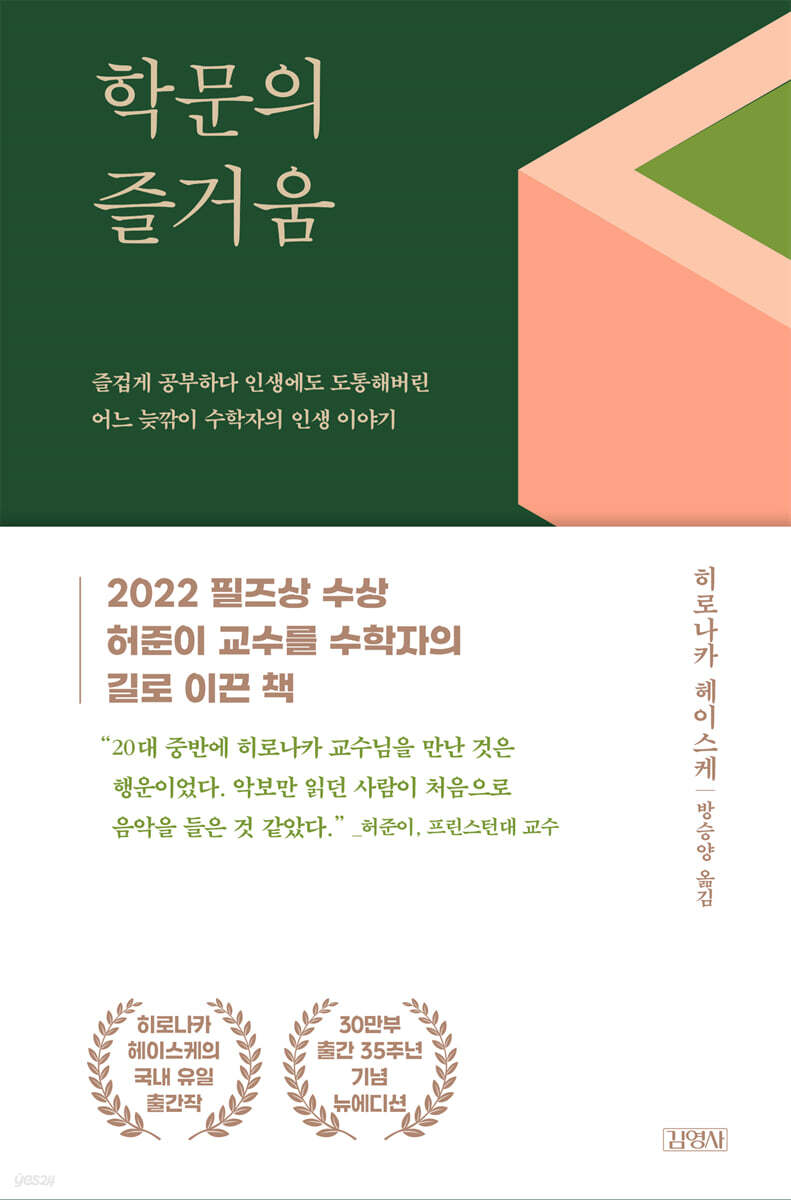
The Joy of Learning (New Edition of 300,000 Copies)
 |
Description
Book Introduction
★★★ New edition commemorating the 35th anniversary of publication, surpassing 300,000 copies sold
★★★ The book that led Professor Heo Jun, winner of the 2022 Fields Medal, to become a mathematician.
★★★ Hironaka Heisuke's only published work in Korea
“Learning is fun.
Thinking is more fun.
“A creative life is the best life!” _From the author’s words
I gained enlightenment from the headache of mathematics,
The story of an ordinary and extraordinary mathematician who enjoyed studying and found success in life.
The seventh son of a village merchant's fifteen siblings.
A boy with many twists and turns who failed the entrance exam for elementary school and once dreamed of becoming a pianist.
A late bloomer mathematician who carried manure buckets in the fields until a week before the college entrance exam, and finally chose the path of mathematics in his third year of college.
A person who received a doctorate from Harvard University in the United States with only perseverance as his sole asset, and eventually won the Fields Medal, which is called the 'Nobel Prize of Mathematics'.
This book is a true confession of an ordinary mathematician who gained life's enlightenment from the headache of mathematics and reached the true meaning of life through enjoyable study.
His journey, which achieved a miracle of scholarship even amidst a field of outstanding geniuses, goes beyond mere academic achievement; it demonstrates the perseverance to see things through to the end and the joy of creation that comes from forging one's own path.
The reason why "The Joy of Learning" has been loved for so long is because it makes us view learning not as a tool for exams or a career, but as "discovering myself."
His words, “A creative life is the best life,” still resonate deeply with readers today.
★★★ The book that led Professor Heo Jun, winner of the 2022 Fields Medal, to become a mathematician.
★★★ Hironaka Heisuke's only published work in Korea
“Learning is fun.
Thinking is more fun.
“A creative life is the best life!” _From the author’s words
I gained enlightenment from the headache of mathematics,
The story of an ordinary and extraordinary mathematician who enjoyed studying and found success in life.
The seventh son of a village merchant's fifteen siblings.
A boy with many twists and turns who failed the entrance exam for elementary school and once dreamed of becoming a pianist.
A late bloomer mathematician who carried manure buckets in the fields until a week before the college entrance exam, and finally chose the path of mathematics in his third year of college.
A person who received a doctorate from Harvard University in the United States with only perseverance as his sole asset, and eventually won the Fields Medal, which is called the 'Nobel Prize of Mathematics'.
This book is a true confession of an ordinary mathematician who gained life's enlightenment from the headache of mathematics and reached the true meaning of life through enjoyable study.
His journey, which achieved a miracle of scholarship even amidst a field of outstanding geniuses, goes beyond mere academic achievement; it demonstrates the perseverance to see things through to the end and the joy of creation that comes from forging one's own path.
The reason why "The Joy of Learning" has been loved for so long is because it makes us view learning not as a tool for exams or a career, but as "discovering myself."
His words, “A creative life is the best life,” still resonate deeply with readers today.
- You can preview some of the book's contents.
Preview
index
preface
Chapter 1: The Path of Learning
To create, you must first learn.
My ordinary and friendly teachers
Hardworking and independent businessman, father
The joy of thinking awakened by my mother
Think deeply
Why should you learn?
It's important to see it through to the end
Turning my passion for music into mathematics
Finally on the path of mathematics
Chapter 2: The Journey of Creation
The joy and pain of creation
Casually, but with a distance
“Teacher!” With one word, the wandering ended.
Well begun is half done
Resignation is also necessary
Simple heart
Let's distinguish between fact and speculation.
Independent goals, ambitious hypotheses
To see the trees and the forest together
Simply and clearly
Let's put ourselves in the other person's shoes
Let's welcome adversity
Booms and busts are both good.
Let's do what we want to do
Towards ‘Singularity Resolution’
Sleep with the problem
Three Lessons
My wealth is perseverance
Chapter 4: Self-Discovery
Discovering a new 'me'
Ask, listen, and ask again
Broad perspective, diverse thoughts
Mathematical Scientist Training Program
Awaken your sleeping potential
Recommendation_ Hironaka, His Life Consistently Focused on Learning / Seiji Ozawa
A Word of Recommendation: The Joy of Learning Completed with Perseverance and Humility / Lee Jeong-rim
After Moving_ The Power of Ordinariness Awakened by a Mathematician / Seungyang Bang
Chapter 1: The Path of Learning
To create, you must first learn.
My ordinary and friendly teachers
Hardworking and independent businessman, father
The joy of thinking awakened by my mother
Think deeply
Why should you learn?
It's important to see it through to the end
Turning my passion for music into mathematics
Finally on the path of mathematics
Chapter 2: The Journey of Creation
The joy and pain of creation
Casually, but with a distance
“Teacher!” With one word, the wandering ended.
Well begun is half done
Resignation is also necessary
Simple heart
Let's distinguish between fact and speculation.
Independent goals, ambitious hypotheses
To see the trees and the forest together
Simply and clearly
Let's put ourselves in the other person's shoes
Let's welcome adversity
Booms and busts are both good.
Let's do what we want to do
Towards ‘Singularity Resolution’
Sleep with the problem
Three Lessons
My wealth is perseverance
Chapter 4: Self-Discovery
Discovering a new 'me'
Ask, listen, and ask again
Broad perspective, diverse thoughts
Mathematical Scientist Training Program
Awaken your sleeping potential
Recommendation_ Hironaka, His Life Consistently Focused on Learning / Seiji Ozawa
A Word of Recommendation: The Joy of Learning Completed with Perseverance and Humility / Lee Jeong-rim
After Moving_ The Power of Ordinariness Awakened by a Mathematician / Seungyang Bang
Detailed image

Into the book
I believe in 'persistence' when studying mathematics.
Even though it may take me longer than others to solve a problem, I believe that my tenacity to see it through to the end is second to none.
Even if it takes two hours to solve a problem that others solve in one hour, or two years to do what others finish in one year, you will still end up doing it.
For me, it's more important to see it through to the end than how long it takes.
Perhaps because this belief is ingrained in me, whenever I choose a problem, I start from the beginning with the determination to spend two or three times more time than others.
--- p.59
Nothing gives people as much satisfaction as creation.
There is nothing more precious than the joy of creation.
When I look back on my life of half a century, this thought becomes even more urgent.
Creation involves more pain than learning, but it also brings greater joy.
So what is creation? When we think of creation, we often think of it as a special activity, something far removed from our daily lives, like art or scholarship. But that's not necessarily the case.
Creativity is an essential part of our daily lives, and in fact, people are constantly creating small and trivial things in their daily lives.
--- p.77
When studying math, there are often times when you solve 90 percent of the problems but still get stuck on the remaining 10 percent.
This is a frustrating situation that could drive a mathematician to a nervous breakdown, but it is not something that can be given up on because of 10 percent.
In times like these, you need to be persistent and not back down.
Whenever I encounter such situations, I sometimes say that child's famous quote out loud.
“Because I’m an idiot.” Then my head feels much lighter.
Your eyes will brighten and your mind will feel at ease.
Anyway, I'm stupid, so it's natural that I can't do it, and I think it's fortunate if I can.
If you console yourself by saying, 'I am an idiot', you will be freed from the rigid state.
--- pp.108~109
I think that in situations like this, it is important to think from the other person's perspective, that is, to have a humble attitude and a humble mind that thinks as one with the other person.
This is because when you think as one with the other person, you sometimes discover the cause of a problem that you were not aware of, either within yourself or within the other person.
Once you find the cause, most of the rest can be solved through your own efforts.
Timidity is the most basic condition not only in daily life but also in the process of pursuing academic studies.
Even in the process of solving a math problem, you must think from the perspective of the 'problem', and ultimately, only when you reach a point where you cannot tell whether the problem is you or you are the problem, do you come up with an idea or find a law that provides a clue to the solution.
--- p.148
It was the middle of the night.
The official title of the completed paper was “Resolution of singularities of algebraic varieties over fields with number 0.”
The manuscript was so long that it could have filled two Massachusetts telephone books.
That was also the reason why this paper was later called 'Hironaka's Phone Book'.
It is said to be the longest paper in the history of mathematics proving a single theorem.
This paper was published in two parts in the American mathematics journal Annals of Mathematics.
It was not long after this paper was published that Professor Zarysky, in a commemorative lecture he gave as he was retiring from his post as president of the American Mathematical Society, said this:
“Hironaka won.”
--- pp.183~184
I believe that what will be most required of us in the future is our own judgment (the wisdom to make choices in living various lives) and the power of thought.
Blind adherence to principles or rules cannot cope with diversity or change.
There is no textbook for dealing with change and diversity.
I think the only way left for us is to return to our own timidity, think deeply, and then make the wisest choice.
Saying this makes it sound like we're living in difficult times, but I actually think we're living in good times.
This is because a changing and diversifying era is a good time for individuals to realize their potential.
Even though it may take me longer than others to solve a problem, I believe that my tenacity to see it through to the end is second to none.
Even if it takes two hours to solve a problem that others solve in one hour, or two years to do what others finish in one year, you will still end up doing it.
For me, it's more important to see it through to the end than how long it takes.
Perhaps because this belief is ingrained in me, whenever I choose a problem, I start from the beginning with the determination to spend two or three times more time than others.
--- p.59
Nothing gives people as much satisfaction as creation.
There is nothing more precious than the joy of creation.
When I look back on my life of half a century, this thought becomes even more urgent.
Creation involves more pain than learning, but it also brings greater joy.
So what is creation? When we think of creation, we often think of it as a special activity, something far removed from our daily lives, like art or scholarship. But that's not necessarily the case.
Creativity is an essential part of our daily lives, and in fact, people are constantly creating small and trivial things in their daily lives.
--- p.77
When studying math, there are often times when you solve 90 percent of the problems but still get stuck on the remaining 10 percent.
This is a frustrating situation that could drive a mathematician to a nervous breakdown, but it is not something that can be given up on because of 10 percent.
In times like these, you need to be persistent and not back down.
Whenever I encounter such situations, I sometimes say that child's famous quote out loud.
“Because I’m an idiot.” Then my head feels much lighter.
Your eyes will brighten and your mind will feel at ease.
Anyway, I'm stupid, so it's natural that I can't do it, and I think it's fortunate if I can.
If you console yourself by saying, 'I am an idiot', you will be freed from the rigid state.
--- pp.108~109
I think that in situations like this, it is important to think from the other person's perspective, that is, to have a humble attitude and a humble mind that thinks as one with the other person.
This is because when you think as one with the other person, you sometimes discover the cause of a problem that you were not aware of, either within yourself or within the other person.
Once you find the cause, most of the rest can be solved through your own efforts.
Timidity is the most basic condition not only in daily life but also in the process of pursuing academic studies.
Even in the process of solving a math problem, you must think from the perspective of the 'problem', and ultimately, only when you reach a point where you cannot tell whether the problem is you or you are the problem, do you come up with an idea or find a law that provides a clue to the solution.
--- p.148
It was the middle of the night.
The official title of the completed paper was “Resolution of singularities of algebraic varieties over fields with number 0.”
The manuscript was so long that it could have filled two Massachusetts telephone books.
That was also the reason why this paper was later called 'Hironaka's Phone Book'.
It is said to be the longest paper in the history of mathematics proving a single theorem.
This paper was published in two parts in the American mathematics journal Annals of Mathematics.
It was not long after this paper was published that Professor Zarysky, in a commemorative lecture he gave as he was retiring from his post as president of the American Mathematical Society, said this:
“Hironaka won.”
--- pp.183~184
I believe that what will be most required of us in the future is our own judgment (the wisdom to make choices in living various lives) and the power of thought.
Blind adherence to principles or rules cannot cope with diversity or change.
There is no textbook for dealing with change and diversity.
I think the only way left for us is to return to our own timidity, think deeply, and then make the wisest choice.
Saying this makes it sound like we're living in difficult times, but I actually think we're living in good times.
This is because a changing and diversifying era is a good time for individuals to realize their potential.
--- p.244
Publisher's Review
Why do people learn? Knowledge is forgotten, but wisdom remains!
The life story of a mathematician who spent his life exploring the joys of learning, thinking, and creating.
The book that led Professor Heo Jun to the path of mathematics, loved by 300,000 readers!
World-renowned mathematician Heisuke Hironaka, who won the Fields Medal for proving the difficult mathematical problem of "singularity resolution theorem," explores in this book what learning is and why we must learn it through his lifelong experiences.
He says, “Learning is a process of increasing the breadth, depth, and power of wisdom,” and that forgetting what you have learned does not mean that it disappears.
Knowledge may disappear, but what remains are ways of thinking, perspectives on problems, and a desire to learn again.
Hironaka recalls that he learned the "joy of thinking" through the teachings of his ordinary parents and conversations with his friends.
From my father, I learned the independence to stand on my own two feet, and from my mother, I learned the attitude of thinking together with my child instead of saying, “I don’t know.”
He realizes that thoughts and questions themselves have meaning, and says that the 'power to think deeply' is the only asset that can help us overcome life's crises.
At the heart of the book is a relentless challenge to a mathematical problem once thought impossible.
In his youth, he dedicated his life to solving the difficult problem of algebraic geometry, 'singularity resolution', and eventually found the answer, rewriting a page in the history of mathematics.
The journey goes beyond mere academic achievement, demonstrating what it means to have the "perseverance to see things through to the end" and the "joy of creation in forging one's own path."
《The Joy of Learning》 has been a steady seller, selling over 300,000 copies since its publication in Korean in 1992, and has once again received attention when Professor Heo Jun-i revealed that “Professor Hironaka led me to the path of becoming a mathematician.”
The reason this book has been consistently loved for over 30 years is because it allows readers to view academics not as a tool for exams or careers, but as a way to "discover myself."
“A creative life is the best life.” This quote from Hironaka still resonates deeply with readers today.
The life story of a mathematician who spent his life exploring the joys of learning, thinking, and creating.
The book that led Professor Heo Jun to the path of mathematics, loved by 300,000 readers!
World-renowned mathematician Heisuke Hironaka, who won the Fields Medal for proving the difficult mathematical problem of "singularity resolution theorem," explores in this book what learning is and why we must learn it through his lifelong experiences.
He says, “Learning is a process of increasing the breadth, depth, and power of wisdom,” and that forgetting what you have learned does not mean that it disappears.
Knowledge may disappear, but what remains are ways of thinking, perspectives on problems, and a desire to learn again.
Hironaka recalls that he learned the "joy of thinking" through the teachings of his ordinary parents and conversations with his friends.
From my father, I learned the independence to stand on my own two feet, and from my mother, I learned the attitude of thinking together with my child instead of saying, “I don’t know.”
He realizes that thoughts and questions themselves have meaning, and says that the 'power to think deeply' is the only asset that can help us overcome life's crises.
At the heart of the book is a relentless challenge to a mathematical problem once thought impossible.
In his youth, he dedicated his life to solving the difficult problem of algebraic geometry, 'singularity resolution', and eventually found the answer, rewriting a page in the history of mathematics.
The journey goes beyond mere academic achievement, demonstrating what it means to have the "perseverance to see things through to the end" and the "joy of creation in forging one's own path."
《The Joy of Learning》 has been a steady seller, selling over 300,000 copies since its publication in Korean in 1992, and has once again received attention when Professor Heo Jun-i revealed that “Professor Hironaka led me to the path of becoming a mathematician.”
The reason this book has been consistently loved for over 30 years is because it allows readers to view academics not as a tool for exams or careers, but as a way to "discover myself."
“A creative life is the best life.” This quote from Hironaka still resonates deeply with readers today.
GOODS SPECIFICS
- Date of issue: November 15, 2025
- Format: Hardcover book binding method guide
- Page count, weight, size: 260 pages | 124*190*20mm
- ISBN13: 9791173322716
You may also like
카테고리
korean


korean

![GQ KOREA Mark (Monthly): December [2025]](http://librairie.coreenne.fr/cdn/shop/files/8ef265dbbfbf186523ed75ba7319009d.jpg?v=1765340328&width=3840)


