

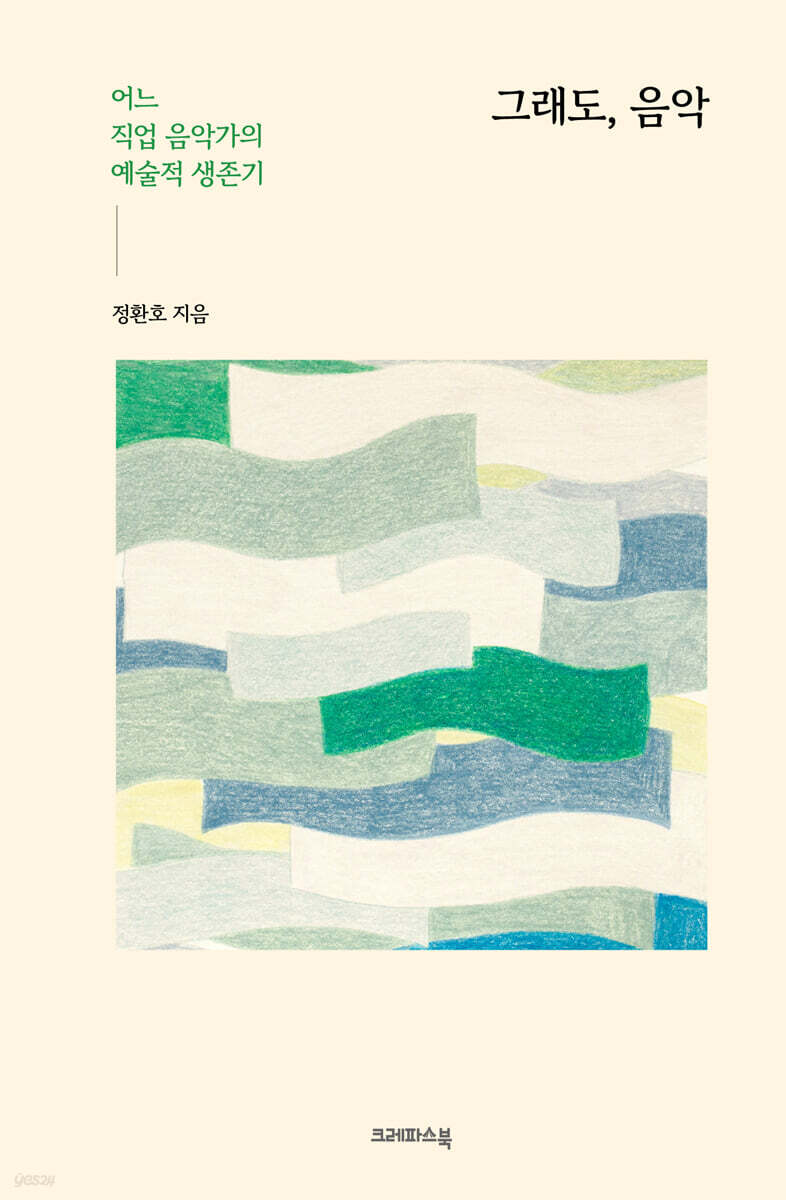
Still, music
 |
Description
Book Introduction
Working to make a living is a task that must be solved in life.
The difficulty of the task will vary depending on each individual's circumstances, but if I had to pick the most challenging profession, it would undoubtedly be the artist. The difficulty is even greater in music, especially classical music.
"Still, Music - The Artistic Survival of a Professional Musician" is a survival essay by a professional musician who works in various fields, including pianist, composer, music director, concert guide, and university lecturer.
The author, who majored in piano, thought it would be difficult to make a living from music, so he studied business administration and even started a business, but eventually returned to his original path of music.
In the process, the author calmly and sometimes humorously unfolds the experiences and realizations he had.
This book vividly portrays what it's like to live as a professional musician and struggle to prove one's worth in the pure arts.
In addition to the issues of making a living, you can also get a glimpse into the author's outlook on life and attitude toward music and life.
The book contains various episodes surrounding music and the world, including stories of his childhood when he first encountered music, memories of ruining the stage during a performance, his attitude toward music, the journey of creating a single song, and even stories of great musicians such as Bach, Beethoven, and Schubert.
No matter what profession we have, we all have the freedom and right to survive artistically.
"Still, Music - A Professional Musician's Artistic Survival Story" will provide hints on "artistic survival" to all those who dream of making a living doing what they love.
The difficulty of the task will vary depending on each individual's circumstances, but if I had to pick the most challenging profession, it would undoubtedly be the artist. The difficulty is even greater in music, especially classical music.
"Still, Music - The Artistic Survival of a Professional Musician" is a survival essay by a professional musician who works in various fields, including pianist, composer, music director, concert guide, and university lecturer.
The author, who majored in piano, thought it would be difficult to make a living from music, so he studied business administration and even started a business, but eventually returned to his original path of music.
In the process, the author calmly and sometimes humorously unfolds the experiences and realizations he had.
This book vividly portrays what it's like to live as a professional musician and struggle to prove one's worth in the pure arts.
In addition to the issues of making a living, you can also get a glimpse into the author's outlook on life and attitude toward music and life.
The book contains various episodes surrounding music and the world, including stories of his childhood when he first encountered music, memories of ruining the stage during a performance, his attitude toward music, the journey of creating a single song, and even stories of great musicians such as Bach, Beethoven, and Schubert.
No matter what profession we have, we all have the freedom and right to survive artistically.
"Still, Music - A Professional Musician's Artistic Survival Story" will provide hints on "artistic survival" to all those who dream of making a living doing what they love.
- You can preview some of the book's contents.
Preview
index
1 _ Slow tempo from birth
Room of Thought
Stop and Go
Ask the Moonlight
When my dad was young
Pilot and Three Codes
Thus spoke Zarathustra
Window of Numbers
2 _ I'll listen to music again, no matter what
Sangdo Salon
10-5 Nonhyeon-dong
hardware store owner
In search of an awl
The Bard: A Vertical Tale
When poverty opens the door
Please, Demon King
3 _ Notes that grow every day
A Voyage Called Music
A pianist at the plate
Garden of the Heart
A Walk on the Keyboard
Don't be foolish
The problem is timing
I see you
4 _ Our hearts are in the same direction
Counterpoint or Survival: Bach
Love Never Fails: Beethoven
Sorrow that comforts sorrow: Schubert
It's Okay to Be Nobody: Grieg
Still at War: Prokofiev
A Heart That Hears Music: Lim Yun-chan
The Next Most Beautiful Sound: A Northern European Journey Part 1
A Strange Night in Oslo: A Northern European Journey Part 2
Star of the North: Northern Europe Travelogue Part 3
5_ Breathing Today
I am
Bloom beautifully
How many seasons are left?
The courage to receive
While we meet, meet, and meet
I'm not scared when I have a light
Room of Thought
Stop and Go
Ask the Moonlight
When my dad was young
Pilot and Three Codes
Thus spoke Zarathustra
Window of Numbers
2 _ I'll listen to music again, no matter what
Sangdo Salon
10-5 Nonhyeon-dong
hardware store owner
In search of an awl
The Bard: A Vertical Tale
When poverty opens the door
Please, Demon King
3 _ Notes that grow every day
A Voyage Called Music
A pianist at the plate
Garden of the Heart
A Walk on the Keyboard
Don't be foolish
The problem is timing
I see you
4 _ Our hearts are in the same direction
Counterpoint or Survival: Bach
Love Never Fails: Beethoven
Sorrow that comforts sorrow: Schubert
It's Okay to Be Nobody: Grieg
Still at War: Prokofiev
A Heart That Hears Music: Lim Yun-chan
The Next Most Beautiful Sound: A Northern European Journey Part 1
A Strange Night in Oslo: A Northern European Journey Part 2
Star of the North: Northern Europe Travelogue Part 3
5_ Breathing Today
I am
Bloom beautifully
How many seasons are left?
The courage to receive
While we meet, meet, and meet
I'm not scared when I have a light
Into the book
So, even if there's a pause, remember that the music isn't over yet.
I decide not to forget that I have the heart to start again.
… (omitted)… Just like my stage was.
We can start over at any time.
--- p.22
The simple melody of the five instruments, resembling the breath of a tree, always filled me with a sense of fullness, and within it was something like a hand welcoming me.
At ten years old, I was not good at expressing myself verbally, but music was an easier language for me.
I feel more understood when I listen to music than when I talk to someone.
--- p.44
A FUGA is like an intersection designed with precise traffic engineering.
The four melodies start at different points and intertwine, but there is not a single clash.
Some melodies pause, others surge forward, and they flow in an orderly manner, avoiding and overlapping each other.
When we consider that these complex movements are designed and controlled by a single hand, we might think that the composer is perhaps closer to being both an artist and an engineer.
--- p.51
I believe there are sounds that only old instruments can produce.
There is a resonance that only an instrument that has been shaken countless times by unfamiliar hands can contain.
There are melodies that can only be understood after experiencing the rolling waves.
Sometimes there are things you have to take a long way to find.
Even if the place you return to is the starting line again, it is no longer the same place as before.
Just as the protagonist in the story grows through his journey and returns to his place, perhaps I too began my journey toward the piano the moment I left it.
--- p.69
If you just leave it alone because it's annoying, it'll just harden, whether it's the ground or your heart.
Maybe that's why I keep trying to open my heart and embrace something, whether it's words or music.
If you turn it over like that, at least it won't become hard.
--- p.122
Music is a longer journey than you think.
There are times when you have to run fast, and there are times when you have to stop for a moment.
There are times when you need to run hard, and times when you get tired, you need to take a break to catch your breath.
For some people, running is difficult, and for others, resting is difficult.
Some people are good at everything from the start, while others take time to figure it out.
Each different time and tempo come together to create the rhythm of the music.
So how wise is the man who runs when he should run and walks when he should walk.
Or how musical is the person who does it the other way around?
--- p.127
So there's no need to rush too much.
Just as 'Romanticism' was born from the mixture of Chopin, who wanted to move forward, and Brahms, who wanted to move backward, perhaps romanticism is created in the gap between push and pull.
… (omitted) … So, it’s okay to miss the timing sometimes.
As life always is, we are destined to meet again at a similar pace at some point.
--- p.136
On a quiet night, I want to play Schubert's music to you, who is still crouching in a corner.
In the end, what can comfort sadness is sadness itself, and it must be sadness itself.
--- p.173
Since my trip, I've always wanted to be the voice that gives space to someone.
Music that stays with you rather than speaking to you.
Like light quietly settling on the edge, I just want to be the next beautiful sound after silence.
If that sound can help someone endure winter, then that's enough for me.
--- p.201
When the following autumn arrived, I finally began to understand this song little by little.
The lyrics that I thought I wrote without thinking were actually ones that arrived a year earlier.
A few words and melodies that had been left blank like an unsolved puzzle have now found their place.
The autumn wind blew through the melody, and the black and white landscape was filled with colors like watercolor.
After a season like that, [autumn] finally came to me.
I decide not to forget that I have the heart to start again.
… (omitted)… Just like my stage was.
We can start over at any time.
--- p.22
The simple melody of the five instruments, resembling the breath of a tree, always filled me with a sense of fullness, and within it was something like a hand welcoming me.
At ten years old, I was not good at expressing myself verbally, but music was an easier language for me.
I feel more understood when I listen to music than when I talk to someone.
--- p.44
A FUGA is like an intersection designed with precise traffic engineering.
The four melodies start at different points and intertwine, but there is not a single clash.
Some melodies pause, others surge forward, and they flow in an orderly manner, avoiding and overlapping each other.
When we consider that these complex movements are designed and controlled by a single hand, we might think that the composer is perhaps closer to being both an artist and an engineer.
--- p.51
I believe there are sounds that only old instruments can produce.
There is a resonance that only an instrument that has been shaken countless times by unfamiliar hands can contain.
There are melodies that can only be understood after experiencing the rolling waves.
Sometimes there are things you have to take a long way to find.
Even if the place you return to is the starting line again, it is no longer the same place as before.
Just as the protagonist in the story grows through his journey and returns to his place, perhaps I too began my journey toward the piano the moment I left it.
--- p.69
If you just leave it alone because it's annoying, it'll just harden, whether it's the ground or your heart.
Maybe that's why I keep trying to open my heart and embrace something, whether it's words or music.
If you turn it over like that, at least it won't become hard.
--- p.122
Music is a longer journey than you think.
There are times when you have to run fast, and there are times when you have to stop for a moment.
There are times when you need to run hard, and times when you get tired, you need to take a break to catch your breath.
For some people, running is difficult, and for others, resting is difficult.
Some people are good at everything from the start, while others take time to figure it out.
Each different time and tempo come together to create the rhythm of the music.
So how wise is the man who runs when he should run and walks when he should walk.
Or how musical is the person who does it the other way around?
--- p.127
So there's no need to rush too much.
Just as 'Romanticism' was born from the mixture of Chopin, who wanted to move forward, and Brahms, who wanted to move backward, perhaps romanticism is created in the gap between push and pull.
… (omitted) … So, it’s okay to miss the timing sometimes.
As life always is, we are destined to meet again at a similar pace at some point.
--- p.136
On a quiet night, I want to play Schubert's music to you, who is still crouching in a corner.
In the end, what can comfort sadness is sadness itself, and it must be sadness itself.
--- p.173
Since my trip, I've always wanted to be the voice that gives space to someone.
Music that stays with you rather than speaking to you.
Like light quietly settling on the edge, I just want to be the next beautiful sound after silence.
If that sound can help someone endure winter, then that's enough for me.
--- p.201
When the following autumn arrived, I finally began to understand this song little by little.
The lyrics that I thought I wrote without thinking were actually ones that arrived a year earlier.
A few words and melodies that had been left blank like an unsolved puzzle have now found their place.
The autumn wind blew through the melody, and the black and white landscape was filled with colors like watercolor.
After a season like that, [autumn] finally came to me.
--- p.227
Publisher's Review
“One day, while I was building a world of efficiency and logic in graduate school, an incident occurred where our different worldviews collided head-on.
I bought a grand piano out of nowhere.
It was my first grand piano in my life.
“I barely escaped the piano, but then suddenly there’s another piano.”
- From "Sangdo Salon"
Author Jeong Hwan-ho is a young musician who is active in various fields in the classical music world.
Since releasing his first composition album through Universal Music in 2012, he has released over 100 piano pieces and has also composed several Korean songs, including “Flowering Days.”
He is quite a veteran in the music industry.
Still, the author says that making a living through music is not easy.
As mentioned in the book, in our country, making music is considered a luxury hobby enjoyed by people with jobs, like knitting or coloring.
There is no such thing as 'artist' in the occupation section of bank loan applications.
The author describes himself as a 'music-related service industry worker.'
Although he is currently making a living on the fringes of music, he once studied business administration and even started a business and became a manager.
And after failing, we returned to where the original music was.
The process of that wandering is recorded in the second chapter, ‘Gearco Again, Music’.
# Finally, meeting music again
While studying business administration in graduate school, the author opened an artist studio in a nearby residential area.
I happened to buy a used grand piano and needed a place to put it.
The 'Sangdo Salon' he prepared in this way was the only space where he, a business administration student, could breathe.
A place where you can play the piano all night long and talk about art with people.
But the business that started in a small workshop grew like a snowball.
And the closer I got to business, the more I drifted away from the music I loved.
“Looking back, my wish was simple from the beginning.
I just needed a place in my space where I could play the piano comfortably.
But before I knew it, I was wrestling with contracts and tax bills instead of the piano.” (p. 65)
The business he had been developing with great interest completely failed, and the author, who had run away from the piano, ended up facing the piano again at a dead end.
And then he remembered that his music wasn't over yet.
“At that time, I was trying to break away from the black and white keyboard and find a different meaning, but deep down, there was a cowardly black and white logic that said, ‘If I can’t be the best, I might as well quit.’
I was afraid to face the piano again, for fear of revealing my feelings.
I'm afraid it will show that I'm lacking something and have failed somewhere.
“In the end, sitting down at the piano was an encounter with myself.” (p. 69)
Of course, the business process wasn't all about the pain of failure.
The author says that through various experiences, he was able to understand the world a little better.
The scenery of the alleys of Nonhyeon-dong, where everyone dreamed of success during their time as managers, is quite interesting.
The author's experience of laughing at names like 'Girlfriend' and 'BTS' from nearby entertainment companies...
“After about a year, I realized firsthand how great that name was.
The agency that launched BTS leased the entire building next door, and the cramped Nonhyeon-dong hill began to fill up with foreigners from all over the world on a pilgrimage.
That's when I realized for sure.
“If you do exactly the opposite of what I feel, anything will work out.” (p. 67)
# A message to those who live at a slow pace
If you read the first chapter, you can guess what kind of person the author is.
Bringing up the story of the elementary school fall sports day, the author confesses that he has been “slow-tempo since birth.”
Besides, there are so many random thoughts in my head.
I'm the type of person who finds it difficult to survive without deadlines, and this isn't just my struggle.
One can only imagine how difficult it must have been for someone like this to navigate the competitive and efficient world of both musician and businessman.
The author, who lives at a slow pace, sends messages of encouragement throughout the book to people who live at a similar pace.
“I know people who love hilltop scenery more than the complexities of the city.
A person who loves sunsets, sees flowers once a day, reads a book, pets a cat, and takes a two-hour nap to barely survive.
A person who, at a book club, grabs a single sentence they like and talks about it for hours.
When the time comes for me to play for the last time, I will invite you.
“I promise, the first song will be Arietta, and the last song will be Remembrance.” (Main text, p. 181)
If you are someone who lives at a different pace from the world, you may find some solace in this book.
The following episodes tell the author's childhood story of his first encounter with music and the piano.
A view of the alley leading to the piano academy, past the town market.
And there, as if by fate, I found the chord score for the drama 『Pilot』.
I even remember listening to Deutsche Grammophon albums on a record player in an empty house.
Those hazy memories of music from back then make us look back on how we encountered the things we once loved and in what direction each of our lives was led.
“The simple melody of the five instruments, resembling the breath of a tree, always filled me with a sense of fullness, and within it was something like a hand welcoming me.
At ten years old, I was not good at expressing myself verbally, but music was an easier language for me.
“I felt more understood when I listened to music than when I was talking to someone.” (p. 44)
# Living while making music
The book also offers a glimpse into the author's attitude toward music and life.
Recalling the time when he was making the album "Garden of the Heart," the author says that making music is similar to tending a garden.
The work of selecting and refining the notes that grow every day is the work of making music.
So, to prevent the ground of the mind from hardening, he always digs it out and embraces it.
“If you just leave it alone because it’s bothersome, it’ll just harden, whether it’s the ground or your heart.
Maybe that's why I keep trying to open my heart and embrace something, whether it's words or music.
“If you turn it over like that, at least it won’t become hard.” (Main text, p. 122)
It is also interesting to talk about why the slow movement with andante is difficult by connecting it to 'stroll'.
Andante means 'to walk'.
Since everyone's foot size and stride length are different, asking exactly what speed is is not very meaningful.
According to the author, it is about continuing to move forward without stopping, but without running, and the word that best describes this movement is 'walking'.
Ultimately, the reason the author was unable to play andante properly in college was because he lived in a time of rapid pace.
The author emphasizes that each person has a different time and tempo in life.
“Music is a longer journey than you think.
There are times when you have to run fast, and there are times when you have to stop for a moment.
There are times when you need to run hard, and times when you get tired, you need to take a break to catch your breath.
For some people, running is difficult, and for others, resting is difficult.
Some people are good at everything from the start, while others take time to figure it out.
Each different time and tempo come together to create the rhythm of the music.
So how wise is the man who runs when he should run and walks when he should walk.
Or how musical is the person who does the opposite?” (p. 127)
These reflections and insights on music are naturally connected to the stories of great musicians in the fourth chapter.
In this chapter, we look back on the present through the lives and music of musicians such as Bach, Beethoven, and Schubert.
The author introduces the stories of Bach, a 'professional N-jobber' who suffered from financial hardship but nevertheless walked his own path; Beethoven, who endured pain and moved on to the song of joy; and Schubert, who comforted sorrow with sorrow, all with the author's musical knowledge.
Even readers unfamiliar with music will gain some understanding of the lives and music of these masters through this book.
“I am still finding my way.
Sometimes, like Handel, I want to be in the spotlight and gain fame and money, but there are also times when I want to quietly go my own way like Bach.
I find a strange comfort in the thought that centuries ago, you too must have faced similar struggles.
Although the depth of the music may be different, the heart flows in the same direction.
“I believe that someday I will be able to reach it at my own pace.” (p. 155)
# Sentences on the keyboard that offer comfort
Although he is a music major who has just published his first book, his writing skills are extraordinary.
The writing, which is as comfortable as one's own music, has a deep resonance, like a long-used instrument.
As a musician, he ponders his own identity and his perspective on the world and people, which contains insights no less than those of any established writer.
“I believe that there are sounds that only old instruments can produce.
There is a resonance that only an instrument that has been shaken countless times by unfamiliar hands can contain.
There are melodies that can only be understood after experiencing the rolling waves.
Sometimes there are things you have to take a long way to find.
Even if the place you return to is the starting line again, it is no longer the same place as before.
Just as the protagonist in the story grows through his journey and returns to his place, perhaps I too began my journey toward the piano the moment I left it.” (p. 69)
“So there is no need to rush too much.
Just as 'Romanticism' was born from the mixture of Chopin, who wanted to move forward, and Brahms, who wanted to move backward, perhaps romanticism is created in the gap between push and pull.
… (omitted) … So, it’s okay to miss the timing sometimes.
As life always is, we are destined to meet again at a similar pace at some point.” (Main text, p. 136)
However, this is not an entirely serious article.
There are wit hidden throughout the book that will make the reader laugh.
“The first time I wrote a song was in 2012.
The first settlement I received from the Copyright Association about 3 months after releasing the album was 390 won.
“It wasn’t even enough to buy a cup of vending machine coffee, but it was enough to break the musician’s will.” (p. 91)
“After a long voyage, when the ship anchored at our destination, the remote area, we carried out an unwelcome landing operation.
After setting up the instruments, turning on the electricity, and starting to play, a male vocalist sang Jang Yoon-jeong's "Oh My God" to the accompaniment.
“I really think it was fortunate that no bullets flew.” (p. 106)
The author constantly ponders the issue of 'making a living' and seeks alternatives within the diverse musical landscape.
This is precisely what the subtitle refers to as ‘artistic survival.’
This expression has two meanings at the same time.
'Survival through art', and 'survival itself is art'.
No matter what profession we have, we all have the freedom and right to survive artistically.
The author says:
There are times when I feel lonely and in pain, but what protects me till the end is 'still, music'.
This book will provide hints for artistic survival to those who dream of making a living doing what they love.
I bought a grand piano out of nowhere.
It was my first grand piano in my life.
“I barely escaped the piano, but then suddenly there’s another piano.”
- From "Sangdo Salon"
Author Jeong Hwan-ho is a young musician who is active in various fields in the classical music world.
Since releasing his first composition album through Universal Music in 2012, he has released over 100 piano pieces and has also composed several Korean songs, including “Flowering Days.”
He is quite a veteran in the music industry.
Still, the author says that making a living through music is not easy.
As mentioned in the book, in our country, making music is considered a luxury hobby enjoyed by people with jobs, like knitting or coloring.
There is no such thing as 'artist' in the occupation section of bank loan applications.
The author describes himself as a 'music-related service industry worker.'
Although he is currently making a living on the fringes of music, he once studied business administration and even started a business and became a manager.
And after failing, we returned to where the original music was.
The process of that wandering is recorded in the second chapter, ‘Gearco Again, Music’.
# Finally, meeting music again
While studying business administration in graduate school, the author opened an artist studio in a nearby residential area.
I happened to buy a used grand piano and needed a place to put it.
The 'Sangdo Salon' he prepared in this way was the only space where he, a business administration student, could breathe.
A place where you can play the piano all night long and talk about art with people.
But the business that started in a small workshop grew like a snowball.
And the closer I got to business, the more I drifted away from the music I loved.
“Looking back, my wish was simple from the beginning.
I just needed a place in my space where I could play the piano comfortably.
But before I knew it, I was wrestling with contracts and tax bills instead of the piano.” (p. 65)
The business he had been developing with great interest completely failed, and the author, who had run away from the piano, ended up facing the piano again at a dead end.
And then he remembered that his music wasn't over yet.
“At that time, I was trying to break away from the black and white keyboard and find a different meaning, but deep down, there was a cowardly black and white logic that said, ‘If I can’t be the best, I might as well quit.’
I was afraid to face the piano again, for fear of revealing my feelings.
I'm afraid it will show that I'm lacking something and have failed somewhere.
“In the end, sitting down at the piano was an encounter with myself.” (p. 69)
Of course, the business process wasn't all about the pain of failure.
The author says that through various experiences, he was able to understand the world a little better.
The scenery of the alleys of Nonhyeon-dong, where everyone dreamed of success during their time as managers, is quite interesting.
The author's experience of laughing at names like 'Girlfriend' and 'BTS' from nearby entertainment companies...
“After about a year, I realized firsthand how great that name was.
The agency that launched BTS leased the entire building next door, and the cramped Nonhyeon-dong hill began to fill up with foreigners from all over the world on a pilgrimage.
That's when I realized for sure.
“If you do exactly the opposite of what I feel, anything will work out.” (p. 67)
# A message to those who live at a slow pace
If you read the first chapter, you can guess what kind of person the author is.
Bringing up the story of the elementary school fall sports day, the author confesses that he has been “slow-tempo since birth.”
Besides, there are so many random thoughts in my head.
I'm the type of person who finds it difficult to survive without deadlines, and this isn't just my struggle.
One can only imagine how difficult it must have been for someone like this to navigate the competitive and efficient world of both musician and businessman.
The author, who lives at a slow pace, sends messages of encouragement throughout the book to people who live at a similar pace.
“I know people who love hilltop scenery more than the complexities of the city.
A person who loves sunsets, sees flowers once a day, reads a book, pets a cat, and takes a two-hour nap to barely survive.
A person who, at a book club, grabs a single sentence they like and talks about it for hours.
When the time comes for me to play for the last time, I will invite you.
“I promise, the first song will be Arietta, and the last song will be Remembrance.” (Main text, p. 181)
If you are someone who lives at a different pace from the world, you may find some solace in this book.
The following episodes tell the author's childhood story of his first encounter with music and the piano.
A view of the alley leading to the piano academy, past the town market.
And there, as if by fate, I found the chord score for the drama 『Pilot』.
I even remember listening to Deutsche Grammophon albums on a record player in an empty house.
Those hazy memories of music from back then make us look back on how we encountered the things we once loved and in what direction each of our lives was led.
“The simple melody of the five instruments, resembling the breath of a tree, always filled me with a sense of fullness, and within it was something like a hand welcoming me.
At ten years old, I was not good at expressing myself verbally, but music was an easier language for me.
“I felt more understood when I listened to music than when I was talking to someone.” (p. 44)
# Living while making music
The book also offers a glimpse into the author's attitude toward music and life.
Recalling the time when he was making the album "Garden of the Heart," the author says that making music is similar to tending a garden.
The work of selecting and refining the notes that grow every day is the work of making music.
So, to prevent the ground of the mind from hardening, he always digs it out and embraces it.
“If you just leave it alone because it’s bothersome, it’ll just harden, whether it’s the ground or your heart.
Maybe that's why I keep trying to open my heart and embrace something, whether it's words or music.
“If you turn it over like that, at least it won’t become hard.” (Main text, p. 122)
It is also interesting to talk about why the slow movement with andante is difficult by connecting it to 'stroll'.
Andante means 'to walk'.
Since everyone's foot size and stride length are different, asking exactly what speed is is not very meaningful.
According to the author, it is about continuing to move forward without stopping, but without running, and the word that best describes this movement is 'walking'.
Ultimately, the reason the author was unable to play andante properly in college was because he lived in a time of rapid pace.
The author emphasizes that each person has a different time and tempo in life.
“Music is a longer journey than you think.
There are times when you have to run fast, and there are times when you have to stop for a moment.
There are times when you need to run hard, and times when you get tired, you need to take a break to catch your breath.
For some people, running is difficult, and for others, resting is difficult.
Some people are good at everything from the start, while others take time to figure it out.
Each different time and tempo come together to create the rhythm of the music.
So how wise is the man who runs when he should run and walks when he should walk.
Or how musical is the person who does the opposite?” (p. 127)
These reflections and insights on music are naturally connected to the stories of great musicians in the fourth chapter.
In this chapter, we look back on the present through the lives and music of musicians such as Bach, Beethoven, and Schubert.
The author introduces the stories of Bach, a 'professional N-jobber' who suffered from financial hardship but nevertheless walked his own path; Beethoven, who endured pain and moved on to the song of joy; and Schubert, who comforted sorrow with sorrow, all with the author's musical knowledge.
Even readers unfamiliar with music will gain some understanding of the lives and music of these masters through this book.
“I am still finding my way.
Sometimes, like Handel, I want to be in the spotlight and gain fame and money, but there are also times when I want to quietly go my own way like Bach.
I find a strange comfort in the thought that centuries ago, you too must have faced similar struggles.
Although the depth of the music may be different, the heart flows in the same direction.
“I believe that someday I will be able to reach it at my own pace.” (p. 155)
# Sentences on the keyboard that offer comfort
Although he is a music major who has just published his first book, his writing skills are extraordinary.
The writing, which is as comfortable as one's own music, has a deep resonance, like a long-used instrument.
As a musician, he ponders his own identity and his perspective on the world and people, which contains insights no less than those of any established writer.
“I believe that there are sounds that only old instruments can produce.
There is a resonance that only an instrument that has been shaken countless times by unfamiliar hands can contain.
There are melodies that can only be understood after experiencing the rolling waves.
Sometimes there are things you have to take a long way to find.
Even if the place you return to is the starting line again, it is no longer the same place as before.
Just as the protagonist in the story grows through his journey and returns to his place, perhaps I too began my journey toward the piano the moment I left it.” (p. 69)
“So there is no need to rush too much.
Just as 'Romanticism' was born from the mixture of Chopin, who wanted to move forward, and Brahms, who wanted to move backward, perhaps romanticism is created in the gap between push and pull.
… (omitted) … So, it’s okay to miss the timing sometimes.
As life always is, we are destined to meet again at a similar pace at some point.” (Main text, p. 136)
However, this is not an entirely serious article.
There are wit hidden throughout the book that will make the reader laugh.
“The first time I wrote a song was in 2012.
The first settlement I received from the Copyright Association about 3 months after releasing the album was 390 won.
“It wasn’t even enough to buy a cup of vending machine coffee, but it was enough to break the musician’s will.” (p. 91)
“After a long voyage, when the ship anchored at our destination, the remote area, we carried out an unwelcome landing operation.
After setting up the instruments, turning on the electricity, and starting to play, a male vocalist sang Jang Yoon-jeong's "Oh My God" to the accompaniment.
“I really think it was fortunate that no bullets flew.” (p. 106)
The author constantly ponders the issue of 'making a living' and seeks alternatives within the diverse musical landscape.
This is precisely what the subtitle refers to as ‘artistic survival.’
This expression has two meanings at the same time.
'Survival through art', and 'survival itself is art'.
No matter what profession we have, we all have the freedom and right to survive artistically.
The author says:
There are times when I feel lonely and in pain, but what protects me till the end is 'still, music'.
This book will provide hints for artistic survival to those who dream of making a living doing what they love.
GOODS SPECIFICS
- Date of issue: November 13, 2025
- Page count, weight, size: 256 pages | 120*183*20mm
- ISBN13: 9791189586911
- ISBN10: 1189586916
You may also like
카테고리
korean


korean

![GQ KOREA Mark (Monthly): December [2025]](http://librairie.coreenne.fr/cdn/shop/files/8ef265dbbfbf186523ed75ba7319009d.jpg?v=1765340328&width=3840)


