

Nietzsche for the Stressed Out
 |
Description
Book Introduction
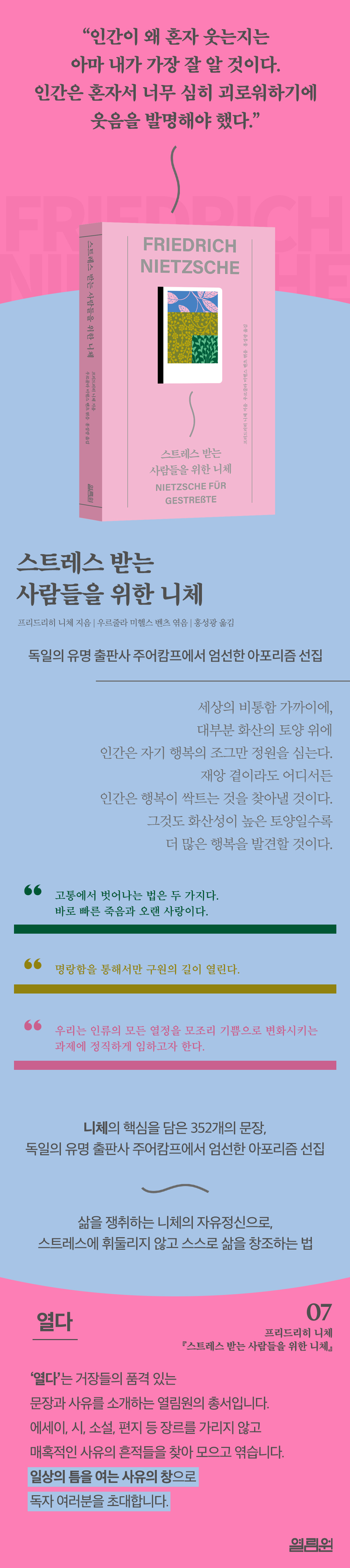
“Why do humans laugh alone?
I probably know best.
Because humans suffer too much alone
“We had to invent laughter.”
Nietzsche for the Stressed Out is a collection of aphorisms compiled and edited by Openwon for the public in Germany, Nietzsche's birthplace.
The editor of this book, Ursula Michels Benz, is a former editor at the renowned German publishing house Surkamp, which has introduced the works of world-renowned intellectuals such as Brecht, Adorno, and Benjamin. She has compiled Nietzsche's entire thought into eight chapters and carefully selected 352 sentences from his works.
The eight keywords that cover each chapter, ‘self, happiness, love, talent, politics, thought, reputation, and freedom,’ are like a skeleton that cannot be dropped from life, and Nietzsche suggests a direction to strengthen oneself and escape from stress by penetrating the sentences related to the above.
The translation was done by Hong Seong-gwang, who has translated many original works of Nietzsche and German philosophy, including Thus Spoke Zarathustra, On the Genealogy of Morality, and The Birth of Tragedy.
Following short and concise aphorisms that extract only the core of Nietzsche's works, Hong Seong-gwang's detailed and in-depth commentary helps us read Nietzsche's unique thinking more richly.
I probably know best.
Because humans suffer too much alone
“We had to invent laughter.”
Nietzsche for the Stressed Out is a collection of aphorisms compiled and edited by Openwon for the public in Germany, Nietzsche's birthplace.
The editor of this book, Ursula Michels Benz, is a former editor at the renowned German publishing house Surkamp, which has introduced the works of world-renowned intellectuals such as Brecht, Adorno, and Benjamin. She has compiled Nietzsche's entire thought into eight chapters and carefully selected 352 sentences from his works.
The eight keywords that cover each chapter, ‘self, happiness, love, talent, politics, thought, reputation, and freedom,’ are like a skeleton that cannot be dropped from life, and Nietzsche suggests a direction to strengthen oneself and escape from stress by penetrating the sentences related to the above.
The translation was done by Hong Seong-gwang, who has translated many original works of Nietzsche and German philosophy, including Thus Spoke Zarathustra, On the Genealogy of Morality, and The Birth of Tragedy.
Following short and concise aphorisms that extract only the core of Nietzsche's works, Hong Seong-gwang's detailed and in-depth commentary helps us read Nietzsche's unique thinking more richly.
- You can preview some of the book's contents.
Preview
index
Entering
Part 1: Read Only Your Own Life
The reason for living must be found entirely within oneself.
Part 2: Inventing Laughter
Humans forget time through the happiness created in sorrow.
Part 3: Have a compassionate passion
Love for others makes you valuable.
Part 4: Do not rely on other people's strength to climb.
You can achieve greatness through your own true talent and effort.
Part 5: Don't Become a Hamster Wheel of Political Power
What matters is individual humanity, not national idols.
Part 6: Believe that you are the master of your brain and think independently.
It's not the brain that thinks, it's ourselves.
Part 7: Free Yourself from Reputation
You must follow your own experiences and passions, even if it means enduring hardships.
Part 8: Become your own teacher and creator.
Life is neither fate nor deception, but an endless experiment in enlightenment.
Commentary: Who are Nietzsche and the Superman?_Hong Seong-gwang
source
annual report
Part 1: Read Only Your Own Life
The reason for living must be found entirely within oneself.
Part 2: Inventing Laughter
Humans forget time through the happiness created in sorrow.
Part 3: Have a compassionate passion
Love for others makes you valuable.
Part 4: Do not rely on other people's strength to climb.
You can achieve greatness through your own true talent and effort.
Part 5: Don't Become a Hamster Wheel of Political Power
What matters is individual humanity, not national idols.
Part 6: Believe that you are the master of your brain and think independently.
It's not the brain that thinks, it's ourselves.
Part 7: Free Yourself from Reputation
You must follow your own experiences and passions, even if it means enduring hardships.
Part 8: Become your own teacher and creator.
Life is neither fate nor deception, but an endless experiment in enlightenment.
Commentary: Who are Nietzsche and the Superman?_Hong Seong-gwang
source
annual report
Detailed image
Into the book
It doesn't matter to us what the world is for, what humanity is for.
But ask yourself what each of you exists for.
--- p.15
Whatever you are, serve yourself as a source of experience!
--- p.16
Children do not take flowers, grass, or butterflies lightly.
We must approach flowers, grass, and butterflies like children.
If you want to participate in all that is good, you must learn to be small sometimes.
--- pp.33-34
We must have some understanding that we are creators of our own values and self-esteem.
That is, we must know that we can give history a certain degree of meaning.
--- p.35
The first question we must ask ourselves is not whether we are satisfied with ourselves, but whether we are satisfied with anything.
If you answer yes for even a moment, you have answered yes not only to yourself but to all other beings.
Because neither we nor any thing exists by itself.
If our souls had trembled and resonated like strings in the face of happiness even once, it would have taken an entire eternity to bring about that one event.
And all eternity was saved and affirmed in that one moment when we said yes.
--- p.35
There are two ways to escape from suffering.
It's a quick death and a long love.
--- p.39
It is not the getting ahead that is important (which at best makes one a shepherd, and at best a helper to the flock), but the getting ahead for oneself, the ability to change for oneself.
--- p.41
There is one path in this world that no one can take except you.
Where does the path lead? Don't ask, just follow it!
--- p.65
No river is great and rich in itself, but it becomes so because it absorbs and flows through countless tributaries.
All great minds are like this.
--- pp.67-68
A snake that cannot shed its skin is doomed.
The same goes for the spirit that cannot change itself.
--- pp.70-71
Bad habits are never the cause.
Bad habits are consequences.
--- p.116
Instead of wanting others to know us as we are, we want them to think of us as positively as possible.
So they desperately want us to be fooled.
That is, we do not take pride in being unique.
--- p.127
Just as a snake that cannot shed its skin is doomed, so too is a spirit that cannot change its opinions.
But it is important not to just move forward blindly, but to move forward for yourself and be able to change and be different.
--- p.164 From the Commentary
Nietzsche, who failed in love, overcomes his pain and depression by blessing himself with joy over his painful fate and loving his own fate.
It is about affirming life while facing the most unfamiliar and harsh problems of life.
He knows how to love even his own downfall.
For him, love is loving life, and at its core, it is knowing how to sing, dance, and laugh.
Nietzsche vows to live this life again and again, countless times.
Fate is something that is the same, something that returns to one's life forever, something from which one cannot escape.
--- p.183 From the Commentary
Nietzsche is a wanderer who is not bound by anything, and he carries on a free conversation with himself, using only his own shadow as a companion.
By doing so, he denies the base human desires entrenched in existing authority and prejudice, seeks liberation from them, and finally reaches the spirit of freedom.
--- From the commentary on p.210
The term “common people” does not refer to common people in the sense of social status, but rather to modern people who are unable to create value on their own, that is, they are slaves who pursue power, fame, money, and pleasure.
Therefore, the strong or noble that Nietzsche speaks of are people who know how to give value to things and actions, not nobles or those who are simply physically strong.
But ask yourself what each of you exists for.
--- p.15
Whatever you are, serve yourself as a source of experience!
--- p.16
Children do not take flowers, grass, or butterflies lightly.
We must approach flowers, grass, and butterflies like children.
If you want to participate in all that is good, you must learn to be small sometimes.
--- pp.33-34
We must have some understanding that we are creators of our own values and self-esteem.
That is, we must know that we can give history a certain degree of meaning.
--- p.35
The first question we must ask ourselves is not whether we are satisfied with ourselves, but whether we are satisfied with anything.
If you answer yes for even a moment, you have answered yes not only to yourself but to all other beings.
Because neither we nor any thing exists by itself.
If our souls had trembled and resonated like strings in the face of happiness even once, it would have taken an entire eternity to bring about that one event.
And all eternity was saved and affirmed in that one moment when we said yes.
--- p.35
There are two ways to escape from suffering.
It's a quick death and a long love.
--- p.39
It is not the getting ahead that is important (which at best makes one a shepherd, and at best a helper to the flock), but the getting ahead for oneself, the ability to change for oneself.
--- p.41
There is one path in this world that no one can take except you.
Where does the path lead? Don't ask, just follow it!
--- p.65
No river is great and rich in itself, but it becomes so because it absorbs and flows through countless tributaries.
All great minds are like this.
--- pp.67-68
A snake that cannot shed its skin is doomed.
The same goes for the spirit that cannot change itself.
--- pp.70-71
Bad habits are never the cause.
Bad habits are consequences.
--- p.116
Instead of wanting others to know us as we are, we want them to think of us as positively as possible.
So they desperately want us to be fooled.
That is, we do not take pride in being unique.
--- p.127
Just as a snake that cannot shed its skin is doomed, so too is a spirit that cannot change its opinions.
But it is important not to just move forward blindly, but to move forward for yourself and be able to change and be different.
--- p.164 From the Commentary
Nietzsche, who failed in love, overcomes his pain and depression by blessing himself with joy over his painful fate and loving his own fate.
It is about affirming life while facing the most unfamiliar and harsh problems of life.
He knows how to love even his own downfall.
For him, love is loving life, and at its core, it is knowing how to sing, dance, and laugh.
Nietzsche vows to live this life again and again, countless times.
Fate is something that is the same, something that returns to one's life forever, something from which one cannot escape.
--- p.183 From the Commentary
Nietzsche is a wanderer who is not bound by anything, and he carries on a free conversation with himself, using only his own shadow as a companion.
By doing so, he denies the base human desires entrenched in existing authority and prejudice, seeks liberation from them, and finally reaches the spirit of freedom.
--- From the commentary on p.210
The term “common people” does not refer to common people in the sense of social status, but rather to modern people who are unable to create value on their own, that is, they are slaves who pursue power, fame, money, and pleasure.
Therefore, the strong or noble that Nietzsche speaks of are people who know how to give value to things and actions, not nobles or those who are simply physically strong.
--- From the commentary on p.224
Publisher's Review
“Why do humans laugh alone?
I probably know best.
Because humans suffer too much alone
“We had to invent laughter.”
Nietzsche for the Stressed Out is a collection of aphorisms compiled and edited by Openwon for the public in Germany, Nietzsche's birthplace.
The editor of this book, Ursula Michels Benz, is a former editor at the renowned German publishing house Surkamp, which has introduced the works of world-renowned intellectuals such as Brecht, Adorno, and Benjamin. She has compiled Nietzsche's entire thought into eight chapters and carefully selected 352 sentences from his works.
The eight keywords that cover each chapter, 'Self - Happiness - Love - Talent - Politics - Reason - Reputation - Freedom', are like a skeleton that cannot be dropped from life, and Nietzsche suggests a direction to strengthen oneself and escape from stress by penetrating sentences related to the above.
The translation was done by Hong Seong-gwang, who has translated many original works of Nietzsche and German philosophy, including Thus Spoke Zarathustra, On the Genealogy of Morality, and The Birth of Tragedy.
Following short and concise aphorisms that extract only the core of Nietzsche's works, Hong Seong-gwang's detailed and in-depth commentary helps us read Nietzsche's unique thinking more richly.
“Even if it is next to a disaster, humans are
You will find happiness sprouting.
The more volcanic the soil, the more
“You will find more happiness.”
The Open Garden's Aphorisms series consists solely of the philosopher's original sentences, unedited by the translator. It offers a comprehensive selection of Nietzsche's works, posthumous writings, and letters, spanning over twenty volumes, allowing readers to delve into his worldview in detail.
Editor Ursula Michels-Benz asks how we can free ourselves from unnecessary stress and become more joyful.
He calls on the stressed-out masses, borrowing Nietzsche's words, to "strengthen themselves above all else to cope with the burdens of life's circumstances" and to continually train themselves to overcome "the habitual impulse to make themselves comfortable."
At the same time, like Nietzsche, we say that when we are able to “see the necessary as beautiful,” we “let go of all dissatisfaction with our own existence and learn to rejoice better.”
Through this spirit of 'Amor Fati', of loving one's own destiny and endless self-overcoming, we can love life and affirm our destiny "without having to give up the joy of life and our own uniqueness."
“Nietzsche’s motto for overcoming stress is
It's 'Smile, sing and dance'.
“The path to salvation opens only through cheerfulness.”
The carefully selected aphorisms are followed by a faithful commentary by the translator of this book, Hong Seong-gwang, titled "Who is Nietzsche and the Superman?", allowing readers to gain a deeper understanding of Nietzsche's core philosophical world.
Through the traces of Nietzsche's life and attitude, his relationships with the teachers who had a great influence on his philosophy, the detailed context of how Nietzsche's major works intertwined with his life at the time they were written, and the changes in the philosophical world he considered important over time, we come closer to Nietzsche's motto.
In "Entering," editor Ursula Michels-Benz asks:
“Didn’t Nietzsche further strengthen the factors that cause stress by demanding an enormous effort toward the ‘superman,’ which is generally impossible to achieve?” Here, Hong Seong-gwang emphasizes that the ‘superman,’ which is the core concept of Nietzsche’s philosophy, is “not a person with superhuman abilities like Superman or a dictatorial hero, but a free and creative human being who gives value to himself.”
"A superman is a free-spirited person who creates new values from his own subjective standpoint and returns to them with strength, the same but slightly changed form." The power to create one's own life without being swayed by stress is ultimately what this book seeks to convey, and by following Nietzsche's original voice, we will learn how to conquer life.
I probably know best.
Because humans suffer too much alone
“We had to invent laughter.”
Nietzsche for the Stressed Out is a collection of aphorisms compiled and edited by Openwon for the public in Germany, Nietzsche's birthplace.
The editor of this book, Ursula Michels Benz, is a former editor at the renowned German publishing house Surkamp, which has introduced the works of world-renowned intellectuals such as Brecht, Adorno, and Benjamin. She has compiled Nietzsche's entire thought into eight chapters and carefully selected 352 sentences from his works.
The eight keywords that cover each chapter, 'Self - Happiness - Love - Talent - Politics - Reason - Reputation - Freedom', are like a skeleton that cannot be dropped from life, and Nietzsche suggests a direction to strengthen oneself and escape from stress by penetrating sentences related to the above.
The translation was done by Hong Seong-gwang, who has translated many original works of Nietzsche and German philosophy, including Thus Spoke Zarathustra, On the Genealogy of Morality, and The Birth of Tragedy.
Following short and concise aphorisms that extract only the core of Nietzsche's works, Hong Seong-gwang's detailed and in-depth commentary helps us read Nietzsche's unique thinking more richly.
“Even if it is next to a disaster, humans are
You will find happiness sprouting.
The more volcanic the soil, the more
“You will find more happiness.”
The Open Garden's Aphorisms series consists solely of the philosopher's original sentences, unedited by the translator. It offers a comprehensive selection of Nietzsche's works, posthumous writings, and letters, spanning over twenty volumes, allowing readers to delve into his worldview in detail.
Editor Ursula Michels-Benz asks how we can free ourselves from unnecessary stress and become more joyful.
He calls on the stressed-out masses, borrowing Nietzsche's words, to "strengthen themselves above all else to cope with the burdens of life's circumstances" and to continually train themselves to overcome "the habitual impulse to make themselves comfortable."
At the same time, like Nietzsche, we say that when we are able to “see the necessary as beautiful,” we “let go of all dissatisfaction with our own existence and learn to rejoice better.”
Through this spirit of 'Amor Fati', of loving one's own destiny and endless self-overcoming, we can love life and affirm our destiny "without having to give up the joy of life and our own uniqueness."
“Nietzsche’s motto for overcoming stress is
It's 'Smile, sing and dance'.
“The path to salvation opens only through cheerfulness.”
The carefully selected aphorisms are followed by a faithful commentary by the translator of this book, Hong Seong-gwang, titled "Who is Nietzsche and the Superman?", allowing readers to gain a deeper understanding of Nietzsche's core philosophical world.
Through the traces of Nietzsche's life and attitude, his relationships with the teachers who had a great influence on his philosophy, the detailed context of how Nietzsche's major works intertwined with his life at the time they were written, and the changes in the philosophical world he considered important over time, we come closer to Nietzsche's motto.
In "Entering," editor Ursula Michels-Benz asks:
“Didn’t Nietzsche further strengthen the factors that cause stress by demanding an enormous effort toward the ‘superman,’ which is generally impossible to achieve?” Here, Hong Seong-gwang emphasizes that the ‘superman,’ which is the core concept of Nietzsche’s philosophy, is “not a person with superhuman abilities like Superman or a dictatorial hero, but a free and creative human being who gives value to himself.”
"A superman is a free-spirited person who creates new values from his own subjective standpoint and returns to them with strength, the same but slightly changed form." The power to create one's own life without being swayed by stress is ultimately what this book seeks to convey, and by following Nietzsche's original voice, we will learn how to conquer life.
GOODS SPECIFICS
- Date of issue: September 17, 2025
- Page count, weight, size: 280 pages | 274g | 115*185*18mm
- ISBN13: 9791170403661
- ISBN10: 1170403662
You may also like
카테고리
korean


korean

![GQ KOREA Mark (Monthly): December [2025]](http://librairie.coreenne.fr/cdn/shop/files/8ef265dbbfbf186523ed75ba7319009d.jpg?v=1765340328&width=3840)


