

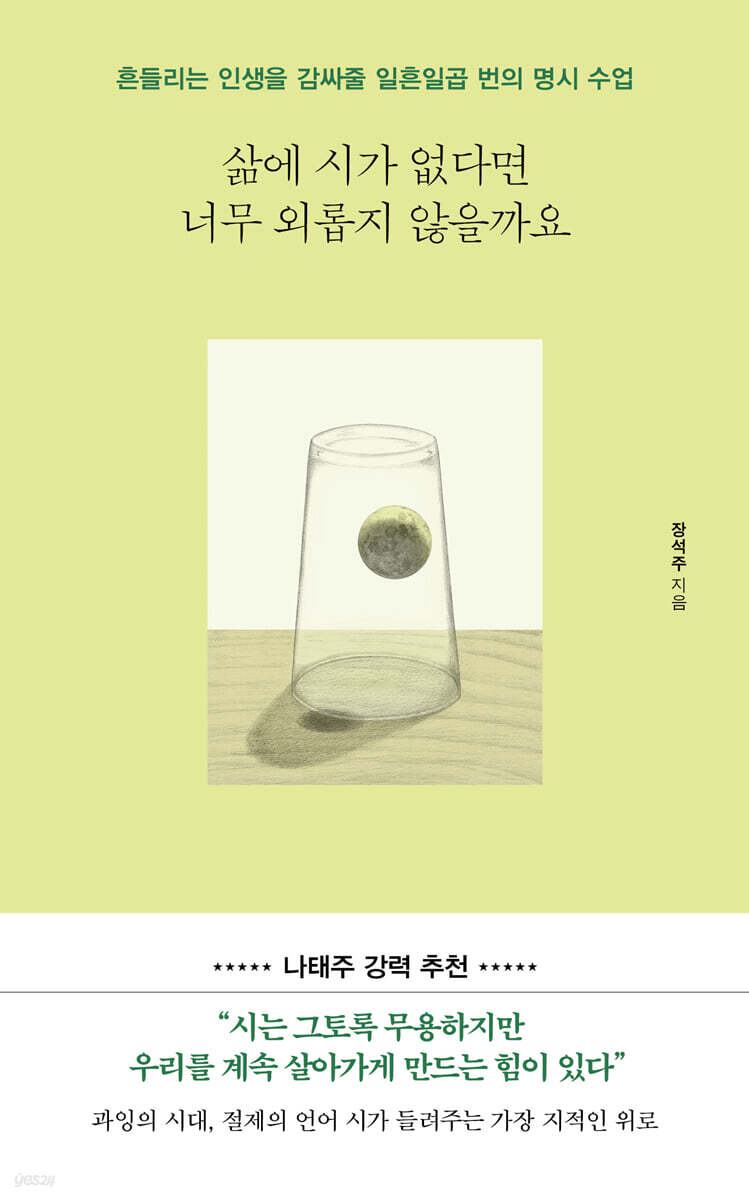
Wouldn't life be so lonely without poetry?
 |
Description
Book Introduction
- A word from MD
-
The deep and profound comfort conveyed by 'poetry'A story about poetry told by author Jang Seok-ju.
As a poet and writer, he has been reading and writing for nearly 50 years, and he shares 77 famous poems he loved and the writings he wrote about them.
In an age of excess, let's encounter the restrained pleasure of poetry, a short piece of literature that offers the aesthetics of subtraction, and the author's unique, resonant insights.
November 5, 2024. Essay PD Lee Ju-eun
“This is a life lesson using poetry as a textbook,
“These will be surprises you have never experienced before.”
"A Jujube": Sentences from the poems loved and admired by poet Jang Seok-ju
* Highly recommended by poet Na Tae-ju
* 77 life quotes from Baek Seok to Kahlil Gibran
* In an age of excess, the deep and profound resonance of poetry, the language of restraint.
'There are a thousand cliffs before us, and to overcome a thousand cliffs, we will need a thousand hopes.
But time is of no use in reality.
Poetry is so useless, yet it has the power to keep us going.' (From the text)
This book, "Wouldn't Life Be Too Lonely Without Poetry?", doesn't promise material abundance, nor can it change the world, but it talks about poetry, the only language that whispers hope even in despair, saying, "Only when you no longer know what to do can you truly do something," and quietly hums that you can live even when you are broken and damaged, saying, "If you are shattered, you can live in shattered pieces."
Author Seok-ju Jang, a poet of poets and literary critic who has published over 100 books and has been reading and writing poetry for nearly 50 years, has returned with 77 essential poems for wavering adults.
We have carefully selected works admired by all generations, including those by Na Tae-joo, Baek Seok, Kahlil Gibran, and Mary Oliver, and added the author's thoughts and insights to help readers understand.
Perhaps we have been so lonely because we have forgotten poetry.
Additionally, it is okay to put aside concerns such as ‘it is unfamiliar’, ‘it is difficult to understand’, or ‘I am afraid that I will not understand the poet’s intention’.
There is no need to treat it like the entrance exam days when it was solely an object of conquest and no other interpretations could be applied; it is enough to simply read and savor it.
The harsher reality becomes and the more we feel uneasy, the closer we should get to poetry.
If you reflect on one or two poems every day, you will receive a deeper and more profound comfort than someone telling you, "It's okay."
“These will be surprises you have never experienced before.”
"A Jujube": Sentences from the poems loved and admired by poet Jang Seok-ju
* Highly recommended by poet Na Tae-ju
* 77 life quotes from Baek Seok to Kahlil Gibran
* In an age of excess, the deep and profound resonance of poetry, the language of restraint.
'There are a thousand cliffs before us, and to overcome a thousand cliffs, we will need a thousand hopes.
But time is of no use in reality.
Poetry is so useless, yet it has the power to keep us going.' (From the text)
This book, "Wouldn't Life Be Too Lonely Without Poetry?", doesn't promise material abundance, nor can it change the world, but it talks about poetry, the only language that whispers hope even in despair, saying, "Only when you no longer know what to do can you truly do something," and quietly hums that you can live even when you are broken and damaged, saying, "If you are shattered, you can live in shattered pieces."
Author Seok-ju Jang, a poet of poets and literary critic who has published over 100 books and has been reading and writing poetry for nearly 50 years, has returned with 77 essential poems for wavering adults.
We have carefully selected works admired by all generations, including those by Na Tae-joo, Baek Seok, Kahlil Gibran, and Mary Oliver, and added the author's thoughts and insights to help readers understand.
Perhaps we have been so lonely because we have forgotten poetry.
Additionally, it is okay to put aside concerns such as ‘it is unfamiliar’, ‘it is difficult to understand’, or ‘I am afraid that I will not understand the poet’s intention’.
There is no need to treat it like the entrance exam days when it was solely an object of conquest and no other interpretations could be applied; it is enough to simply read and savor it.
The harsher reality becomes and the more we feel uneasy, the closer we should get to poetry.
If you reflect on one or two poems every day, you will receive a deeper and more profound comfort than someone telling you, "It's okay."
- You can preview some of the book's contents.
Preview
index
Recommendation
Introduction
Chapter 1: When you need deeper and more profound comfort than just saying "It's okay"
From the preface to Leaves of Grass_ Walt Whitman
The Goose_ Mary Oliver
Do not leave yourself to sorrow_ Omar Khayyam
Flowers bloom on a warm spring day facing the sea_ Heize
Lyric Poetry_ Joseph Brodsky
Me, Natasha, and the White Donkey_ Baek Seok
Boy_ Yun Dong-ju
Kim Young-rang, the one who knows my heart
New_ Francis Ponge
When I Was the Prettiest_ Noriko Ibaragi
Hospital_ Yun Dong-ju
Spring Rain_ Kim So-wol
Longing_ Lee Yong-ak
Bluebird_ Han Ha-un
I lived without knowing the world_ Kim So-wol
Autumn River with Tears_ Park Jae-sam
Chapter 2: One day, I read sentences that came creeping up on me like a cat.
True Journey_ Nazm Hikmet
On Love_ Kahlil Gibran
Thirty Years Old_ Ingeborg Bachmann
Solitude_ Ella Wheeler Wilcox
Spring_ Vincent Millay
July Poppies_ Sylvia Plath
Solemn Time_ Rainer Maria Rilke
Memories of the Day I Gave Birth to My Daughter_ Kim Hye-soon
I don't know_ Han Yong-un
Reason for Loneliness_ Kim Hyun-seung
Tiger_ William Blake
Spring is a Cat_ Lee Jang-hee
Gongmu Dohaga_ Baek Su-gwangbu's wife
Daecheongbong Watermelon Field_ Goh Hyeong-ryeol
Song of Fire_ Pablo Neruda
Happiness_ Yoo Chi-hwan
Chapter 3: Poetry is so useless, yet it keeps us going.
I will be born as a cat_ Hwang In-sook
Rice_ Jang Seok-ju
On Marriage_ Kahlil Gibran
The Words of Spring_ Hermann Hesse
Death Fugue_ Paul Celan
Collection_Arthur Rimbaud
The Book of Questions_ Pablo Neruda
Duino Elegy - First Elegy_ Rainer Maria Rilke
Inn_ Jalaluddin Rumi
The Wind's Words_ Ma Jong-gi
Hymn to the House_ Kim Soo-young
When You Are Old_ William Butler Yeats
Standing on a hill with a view of the sea_ George Hoon
Gil_ Kim Ki-rim
Thirty years old_ Choi Seung-ja
Cat_ Charles Baudelaire
Chapter 4: Perhaps I was so lonely because I had forgotten poetry.
How happy are those little stones_ Emily Dickinson
Gardenia Flower Tale_ Park Gyu-ri
This Love_ Jacques Prévert
Under the Bamboo Grove_ Na Tae-joo
There is no second time_ Wisława Szymborska
Sunflower's Scream_ Ham Hyeong-su
Winter Fish_ Joseph Brodsky
Jeonju_ Kim Sa-in
Couple_ Ham Min-bok
The Bird in the Cage_ Maya Angelou
Daily Bread_César Vallejo
Climax_ Lee Yuk-sa
Pomegranate_ Paul Valéry
Winter Night_ Park Yong-rae
Chapter 5: So Every Day, Every Moment Should Have Its Own Poem
Think of Others_ Mahmoud Darwish
The Game is Over_ Ingeborg Bachmann
Fallen Flowers_ Lee Hyeong-gi
Fallen Flowers_ George Hoon
Don't stand on the top of the hill and shout_ Olav H.
Howe
By the Sea_ Rabindranath Tagore
Black Snake_ Mary Oliver
Mom, Sister_ Kim So-wol
The Evening When the Cat Returns_ Song Chan-ho
The Seventh Man_ Attila Joseph
Do you know that distant country?_ Shin Seok-jeong
Pomegranate_Joun
Stones on the Ground_ Joseph Brodsky
Bukcheong Water Merchant_ Kim Dong-hwan
Autumn Evening Words_ Jang Seok-nam
source
Introduction
Chapter 1: When you need deeper and more profound comfort than just saying "It's okay"
From the preface to Leaves of Grass_ Walt Whitman
The Goose_ Mary Oliver
Do not leave yourself to sorrow_ Omar Khayyam
Flowers bloom on a warm spring day facing the sea_ Heize
Lyric Poetry_ Joseph Brodsky
Me, Natasha, and the White Donkey_ Baek Seok
Boy_ Yun Dong-ju
Kim Young-rang, the one who knows my heart
New_ Francis Ponge
When I Was the Prettiest_ Noriko Ibaragi
Hospital_ Yun Dong-ju
Spring Rain_ Kim So-wol
Longing_ Lee Yong-ak
Bluebird_ Han Ha-un
I lived without knowing the world_ Kim So-wol
Autumn River with Tears_ Park Jae-sam
Chapter 2: One day, I read sentences that came creeping up on me like a cat.
True Journey_ Nazm Hikmet
On Love_ Kahlil Gibran
Thirty Years Old_ Ingeborg Bachmann
Solitude_ Ella Wheeler Wilcox
Spring_ Vincent Millay
July Poppies_ Sylvia Plath
Solemn Time_ Rainer Maria Rilke
Memories of the Day I Gave Birth to My Daughter_ Kim Hye-soon
I don't know_ Han Yong-un
Reason for Loneliness_ Kim Hyun-seung
Tiger_ William Blake
Spring is a Cat_ Lee Jang-hee
Gongmu Dohaga_ Baek Su-gwangbu's wife
Daecheongbong Watermelon Field_ Goh Hyeong-ryeol
Song of Fire_ Pablo Neruda
Happiness_ Yoo Chi-hwan
Chapter 3: Poetry is so useless, yet it keeps us going.
I will be born as a cat_ Hwang In-sook
Rice_ Jang Seok-ju
On Marriage_ Kahlil Gibran
The Words of Spring_ Hermann Hesse
Death Fugue_ Paul Celan
Collection_Arthur Rimbaud
The Book of Questions_ Pablo Neruda
Duino Elegy - First Elegy_ Rainer Maria Rilke
Inn_ Jalaluddin Rumi
The Wind's Words_ Ma Jong-gi
Hymn to the House_ Kim Soo-young
When You Are Old_ William Butler Yeats
Standing on a hill with a view of the sea_ George Hoon
Gil_ Kim Ki-rim
Thirty years old_ Choi Seung-ja
Cat_ Charles Baudelaire
Chapter 4: Perhaps I was so lonely because I had forgotten poetry.
How happy are those little stones_ Emily Dickinson
Gardenia Flower Tale_ Park Gyu-ri
This Love_ Jacques Prévert
Under the Bamboo Grove_ Na Tae-joo
There is no second time_ Wisława Szymborska
Sunflower's Scream_ Ham Hyeong-su
Winter Fish_ Joseph Brodsky
Jeonju_ Kim Sa-in
Couple_ Ham Min-bok
The Bird in the Cage_ Maya Angelou
Daily Bread_César Vallejo
Climax_ Lee Yuk-sa
Pomegranate_ Paul Valéry
Winter Night_ Park Yong-rae
Chapter 5: So Every Day, Every Moment Should Have Its Own Poem
Think of Others_ Mahmoud Darwish
The Game is Over_ Ingeborg Bachmann
Fallen Flowers_ Lee Hyeong-gi
Fallen Flowers_ George Hoon
Don't stand on the top of the hill and shout_ Olav H.
Howe
By the Sea_ Rabindranath Tagore
Black Snake_ Mary Oliver
Mom, Sister_ Kim So-wol
The Evening When the Cat Returns_ Song Chan-ho
The Seventh Man_ Attila Joseph
Do you know that distant country?_ Shin Seok-jeong
Pomegranate_Joun
Stones on the Ground_ Joseph Brodsky
Bukcheong Water Merchant_ Kim Dong-hwan
Autumn Evening Words_ Jang Seok-nam
source
Detailed image
.jpg)
Into the book
There is no reason for poetry to impart morals or to be loud.
The voice of poetry should be a whisper, and the smaller the scale of poetry, the better.
I'm not saying that poetry has to be an extraordinary insight into life and the universe or an invention of language.
Poetry must pierce through poverty and misery like steel, and train us to be manly.
Poetry must sprout, grow, soar, and dance, overcoming the routine and the old to open up the future.
I gathered together the poems I loved and admired.
This is a life lesson in poetry, a rare delight for the heart, and a surprise you have never experienced before.
--- pp.7~8
When I first read "The Goose," my eyes lit up.
It was like that every time I discovered a good poem.
It seemed like he was patting me on the shoulder and encouraging me, saying, “No matter who you are or how lonely you are, don’t give up and live.”
There are a thousand cliffs before us, and to overcome a thousand cliffs, we will need a thousand hopes.
But poetry is of no use in reality.
Poetry is so useless, yet it has the power to keep us going.
--- p.25
"Me, Natasha, and the White Donkey" is one of Baekseok's best songs, made up of words such as Natasha, donkey, mountain village, Magari, Gojogonhi, and Eungang Eungang.
This poem is perfect for reciting out loud to yourself when the first snow falls.
The last line, “Wherever the white donkey is, it will bray tonight because it is so good,” which my ears love to hear, is both sad and beautiful.
--- p.38
On a tray with a fallen ear
I take a bowl of rice and think about it.
Why do people eat?
If you eat to live, why live?
To get a bowl of hot rice
How many times have I sinned
How many times have you lied to yourself?
--- p.135
"Under the Bamboo Grove" is a poem filled with the true thoughts of a person who lives a self-sufficient life in a simple mountain village.
As I read the poem, which combines moonlight, bamboo forest, night fog, moon, and well, I too wanted to become a true person.
Poetry that is not permeated by even a single evil thought, poetry that is not tainted by even a speck of shame or dust, such impure poetry can only be written by those who are pure.
This is a poem that, after reading it, clears your mind as if you had rinsed it with cold water, and it is a poem that leads you to the righteousness of life.
If this isn't good poetry, then what is? I was deeply moved by this poem when I was twenty.
It was because I suddenly realized that good poetry comes from a good life.
--- pp.214~215
In Szymborska's poetry, observations of objects and phenomena are unambiguous.
Even when dealing with ordinary material, he creates clear poetry with transparent observation.
The verse that sings, “Born without any practice / Die without any training,” is so clear that it leaves no room for even a single ambiguity.
“There is no second chance” cuts to the heart of life.
Who dreams of living twice? No day in our lives is ever repeated.
From the moment we are born to the moment we live, we cannot meet the same kiss or the same gaze.
Our existence is solid only as an irreversible, one-time event.
What makes our existence so sublime, poignant, and beautiful is that it is fleeting and fleeting.
So the poet might have written, “You disappear—and therefore you are beautiful.”
--- p.218
Poetry is the extraordinary discovery of the ordinary.
A poem that contains no discoveries would be nothing more than a heap of dull and meaningless words.
A poet is someone who draws out unfamiliar thoughts from familiar things that are passed by without a second thought.
An imagination as elastic as a spring is what gives the poet the status of discoverer of things.
The voice of poetry should be a whisper, and the smaller the scale of poetry, the better.
I'm not saying that poetry has to be an extraordinary insight into life and the universe or an invention of language.
Poetry must pierce through poverty and misery like steel, and train us to be manly.
Poetry must sprout, grow, soar, and dance, overcoming the routine and the old to open up the future.
I gathered together the poems I loved and admired.
This is a life lesson in poetry, a rare delight for the heart, and a surprise you have never experienced before.
--- pp.7~8
When I first read "The Goose," my eyes lit up.
It was like that every time I discovered a good poem.
It seemed like he was patting me on the shoulder and encouraging me, saying, “No matter who you are or how lonely you are, don’t give up and live.”
There are a thousand cliffs before us, and to overcome a thousand cliffs, we will need a thousand hopes.
But poetry is of no use in reality.
Poetry is so useless, yet it has the power to keep us going.
--- p.25
"Me, Natasha, and the White Donkey" is one of Baekseok's best songs, made up of words such as Natasha, donkey, mountain village, Magari, Gojogonhi, and Eungang Eungang.
This poem is perfect for reciting out loud to yourself when the first snow falls.
The last line, “Wherever the white donkey is, it will bray tonight because it is so good,” which my ears love to hear, is both sad and beautiful.
--- p.38
On a tray with a fallen ear
I take a bowl of rice and think about it.
Why do people eat?
If you eat to live, why live?
To get a bowl of hot rice
How many times have I sinned
How many times have you lied to yourself?
--- p.135
"Under the Bamboo Grove" is a poem filled with the true thoughts of a person who lives a self-sufficient life in a simple mountain village.
As I read the poem, which combines moonlight, bamboo forest, night fog, moon, and well, I too wanted to become a true person.
Poetry that is not permeated by even a single evil thought, poetry that is not tainted by even a speck of shame or dust, such impure poetry can only be written by those who are pure.
This is a poem that, after reading it, clears your mind as if you had rinsed it with cold water, and it is a poem that leads you to the righteousness of life.
If this isn't good poetry, then what is? I was deeply moved by this poem when I was twenty.
It was because I suddenly realized that good poetry comes from a good life.
--- pp.214~215
In Szymborska's poetry, observations of objects and phenomena are unambiguous.
Even when dealing with ordinary material, he creates clear poetry with transparent observation.
The verse that sings, “Born without any practice / Die without any training,” is so clear that it leaves no room for even a single ambiguity.
“There is no second chance” cuts to the heart of life.
Who dreams of living twice? No day in our lives is ever repeated.
From the moment we are born to the moment we live, we cannot meet the same kiss or the same gaze.
Our existence is solid only as an irreversible, one-time event.
What makes our existence so sublime, poignant, and beautiful is that it is fleeting and fleeting.
So the poet might have written, “You disappear—and therefore you are beautiful.”
--- p.218
Poetry is the extraordinary discovery of the ordinary.
A poem that contains no discoveries would be nothing more than a heap of dull and meaningless words.
A poet is someone who draws out unfamiliar thoughts from familiar things that are passed by without a second thought.
An imagination as elastic as a spring is what gives the poet the status of discoverer of things.
--- p.230
Publisher's Review
“To you who have lost your peace of mind,
I recommend ‘poetry,’ the ‘shortest form of literature.’
The beauty of language that is useless but never useless
Many people are not satisfied with what they have and only dwell on what they do not have.
And they are only eager to get more valuable things and higher positions, and at the same time, they cannot let go of comparing themselves to others and show off what they have for fear of falling behind or appearing inadequate.
Despite all our efforts, life is always hungry and thirsty, and we are losing more and more of our inner reflection.
In such a world, the author of this book, “Wouldn’t Life Be Too Lonely Without Poetry?” believes in the power of ‘poetry.’
“Whenever life feels lonely and empty, we must actively enter into poetry.” A poem we encounter in difficult times offers deeper and more profound comfort than someone’s words, “It’s okay.” As we read each line, it expands our thoughts and emotions that were buried in our busy daily lives. In an age of excess where everything is overflowing, it presents the aesthetics of subtraction, which is revealed in the very nature of poetry as the shortest form of literature.
All this is possible only through poetry.
The book also includes the works of Jalaluddin Rumi, William Butler Yeats, Na Tae-ju, Kim Su-young, and the author's own writings. In particular, the author's writings delicately illustrate how to understand poetry woven with implication and metaphor and how to become closer to poetry.
Poetry is the only language that finds light even in the darkest of darkness.
Living with the poet's eyes, seeing the universe even from a small seed
“If a poet had made a dictionary / The words of the world would have been different / (…) / Violet is ‘everything that purple means’ / One day is ‘a synonym for eternity’”, among the poems of poet Ryu Si-hwa, there is a piece titled “If a poet had made a dictionary.”
Just reading the title of this poem makes familiar language feel unfamiliar and brings to mind the poet's gaze that rescues the universe from even the smallest seed.
Vincent Millais' poem "Spring" included in the book commands us to face not the spring of sprouting buds, which symbolizes a new beginning, but the spring of "maggots gnawing on the heads of the dead."
It redefines spring by asking us to reflect on death even in the season of new life.
Meanwhile, in poet Jang Seok-ju's "Rice," there is a line that goes, "How many times have I sinned and how many times have I deceived myself / to get a bowl of hot rice?"
The hardships of making a living, the absurd compromises made to survive and the complacency with reality, are expressed exquisitely by using the metaphor of a bowl of rice.
The loneliness and beauty of love cannot be left out either. In “The Tale of the Gardenia,” through the line, “As I watched the woman’s shoulder moving away / I thought I knew that loving / was the most difficult thing of all,” we realize that greater sadness can spread through emotional restraint rather than emotional excess.
Moreover, poetry does not necessarily provide only poetic meaning or enlightenment.
If you repeat the line “When I look up at the sky, blue paint appears on my eyebrows” from Yun Dong-ju’s “Boy,” which is relatively less well-known, you will feel the extreme beauty of color beyond simple reading, and if you chew on the line “Somewhere, the white donkey will cry because it likes tonight” from Baek Seok’s “Natasha, Me, and the White Donkey,” you will come to understand the mystery of the sounds and expressions that our language can produce.
As I recite the poems that touch my heart, the hustle and bustle will naturally turn into tranquility, anxiety into peace, and the senses that had been at a standstill in everyday life will be tinged with newness.
I recommend ‘poetry,’ the ‘shortest form of literature.’
The beauty of language that is useless but never useless
Many people are not satisfied with what they have and only dwell on what they do not have.
And they are only eager to get more valuable things and higher positions, and at the same time, they cannot let go of comparing themselves to others and show off what they have for fear of falling behind or appearing inadequate.
Despite all our efforts, life is always hungry and thirsty, and we are losing more and more of our inner reflection.
In such a world, the author of this book, “Wouldn’t Life Be Too Lonely Without Poetry?” believes in the power of ‘poetry.’
“Whenever life feels lonely and empty, we must actively enter into poetry.” A poem we encounter in difficult times offers deeper and more profound comfort than someone’s words, “It’s okay.” As we read each line, it expands our thoughts and emotions that were buried in our busy daily lives. In an age of excess where everything is overflowing, it presents the aesthetics of subtraction, which is revealed in the very nature of poetry as the shortest form of literature.
All this is possible only through poetry.
The book also includes the works of Jalaluddin Rumi, William Butler Yeats, Na Tae-ju, Kim Su-young, and the author's own writings. In particular, the author's writings delicately illustrate how to understand poetry woven with implication and metaphor and how to become closer to poetry.
Poetry is the only language that finds light even in the darkest of darkness.
Living with the poet's eyes, seeing the universe even from a small seed
“If a poet had made a dictionary / The words of the world would have been different / (…) / Violet is ‘everything that purple means’ / One day is ‘a synonym for eternity’”, among the poems of poet Ryu Si-hwa, there is a piece titled “If a poet had made a dictionary.”
Just reading the title of this poem makes familiar language feel unfamiliar and brings to mind the poet's gaze that rescues the universe from even the smallest seed.
Vincent Millais' poem "Spring" included in the book commands us to face not the spring of sprouting buds, which symbolizes a new beginning, but the spring of "maggots gnawing on the heads of the dead."
It redefines spring by asking us to reflect on death even in the season of new life.
Meanwhile, in poet Jang Seok-ju's "Rice," there is a line that goes, "How many times have I sinned and how many times have I deceived myself / to get a bowl of hot rice?"
The hardships of making a living, the absurd compromises made to survive and the complacency with reality, are expressed exquisitely by using the metaphor of a bowl of rice.
The loneliness and beauty of love cannot be left out either. In “The Tale of the Gardenia,” through the line, “As I watched the woman’s shoulder moving away / I thought I knew that loving / was the most difficult thing of all,” we realize that greater sadness can spread through emotional restraint rather than emotional excess.
Moreover, poetry does not necessarily provide only poetic meaning or enlightenment.
If you repeat the line “When I look up at the sky, blue paint appears on my eyebrows” from Yun Dong-ju’s “Boy,” which is relatively less well-known, you will feel the extreme beauty of color beyond simple reading, and if you chew on the line “Somewhere, the white donkey will cry because it likes tonight” from Baek Seok’s “Natasha, Me, and the White Donkey,” you will come to understand the mystery of the sounds and expressions that our language can produce.
As I recite the poems that touch my heart, the hustle and bustle will naturally turn into tranquility, anxiety into peace, and the senses that had been at a standstill in everyday life will be tinged with newness.
GOODS SPECIFICS
- Date of issue: October 25, 2024
- Page count, weight, size: 308 pages | 400g | 127*203*15mm
- ISBN13: 9791193506776
- ISBN10: 1193506778
You may also like
카테고리
korean


korean

![GQ KOREA Mark (Monthly): December [2025]](http://librairie.coreenne.fr/cdn/shop/files/8ef265dbbfbf186523ed75ba7319009d.jpg?v=1765340328&width=3840)


