

How to Talk About Death with a Laugh
 |
Description
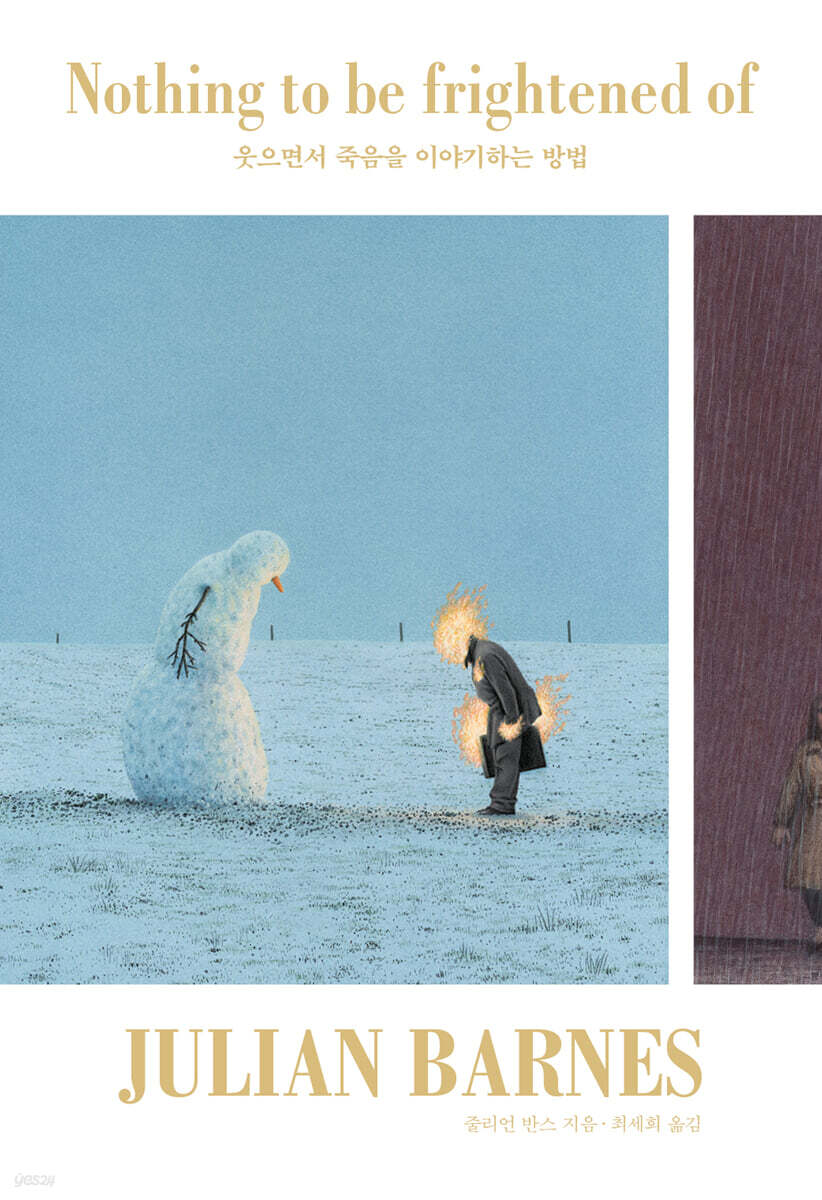
Book Introduction
A living legend of modern British literature A special edition of five of Julian Barnes' masterpieces, revised and expanded! “We live, we die, we are remembered, we are forgotten.” The Julian Barnes Best Collection: Panorama of Memory Special cover by Bologna Ragazzi Award-winning author Quint Buchholz Translator Choi Se-hee's revision and translation review Julian Barnes' Commentary & Message to Korean Readers Julian Barnes, the king of British literature. He presents five of his representative works on the theme of 'memory', a subject he has explored throughout his life, in a revised and expanded special edition. 『Premonitions Are Never Wrong』, which deals with distorted memories with a sharp pen; 『The Noise of the Times』, which depicts those who are remembered ironically in history; 『Memories of Love』, which reminds us of the only memory we want to leave behind; 『Love Doesn't End That Way』, which describes how to remember the departed; and 『How to Talk About Death with a Smile』, which contemplates death by mobilizing all of our memories and records. It's a story about interesting memories that you can't miss. This book, reborn with a special cover by Bologna Ragazzi Award-winning author Quint Buchholz, unfolds as a veritable "panorama of memory" when all five volumes are placed together. Wherever it is placed, it will become a beautiful object in itself and a wonderful medium for recalling 'memories'. "How to Talk About Death with a Smile" is an essay in which Julian Barnes honestly confesses his fear of death. Barnes is a writer who is extremely reluctant to reveal his private life, but this book is different. A philosophy professor who scolded his attitude of longing for God as being sleazy, an atheist and communist mother, and a father who died alone in a hospital bed after fighting a disease that took over his entire body… As an agnostic who believed in "believing what you don't see," he had no hope or expectation for the afterlife. This unique essay, in which he engages in a lively discussion about death with those around him, provides us with an opportunity to think deeply about death, the eternal homework of humanity. |
- You can preview some of the book's contents.
Preview
index
How to Talk About Death with a Laugh - 9
Translator's Note - 504
Recommendation - 511
Special Appendix - 513
Detailed image

Into the book
I don't believe in God, but I miss God.
When someone asks me about God, I answer like this.
I asked my brother, who has taught philosophy at Oxford, Geneva, and the Sorbonne, what he thought of my remarks.
My brother only said one thing.
“It’s sticky.”
--- p.9
It's like being woken up suddenly at an unfamiliar hotel room at an unfamiliar hour by the alarm clock set by a previous guest, being thrust into darkness and fear, and being starkly reminded that this world is a temporary place to live.
Recently, my friend R asked me how often and under what circumstances I think about death.
I answered that I think about it at least once during the day when I am awake.
He also said that there were occasional nighttime intrusions.
When the outside world draws a sharp parallel, when evening approaches, when the days grow shorter, or when a long day's hike comes to an end, the inevitability of death often intrudes upon my consciousness like an uninvited guest.
--- p.55
Would you rather fear death or not fear it? At first glance, it sounds like an easy question.
So what if this happened? You never considered death, lived as if there was no tomorrow (which, incidentally, there is no tomorrow), pursuing pleasures, fulfilling your duties, loving your family, and then finally, you were forced to accept the imminence of death.
But what if, as you were putting a period to the previous sentence, you were suddenly awakened to the realization that your entire life story up to this point had been a complete lie? Had you truly grasped the fact that you would die someday, and the significance of that reality, would you have lived a different life?
--- p.231
On Monday, March 6, 1882, at a dinner with Daudet, Turgenev, and Edmond de Goncourt, Zola confided in Goncourt about these influences on Le Réveille Mortel, and Goncourt wrote down his account in detail.
That evening, the four of them (one of them was missing from Diner des Cinq, since Flaubert was absent) talked about death.
(……) Turgenev said that he shook off the thought like this (while demonstrating with a slight gesture).
He explained that Russians know how to make trouble disappear into the 'Slavic fog'.
Russians are said to have summoned this fog to protect themselves from logical but annoyingly persistent thoughts.
For example, if you are caught in a snow storm where you can't see an inch ahead, you have to deliberately not think about the cold, or you will freeze to death.
We could apply this same method to bigger issues and overcome them.
You can shake it off 'like this'.
--- p.359~360
We live, we die, we are remembered, we are forgotten.
It is not forgotten immediately, but rather layer by layer.
The parents we remember are usually those we remember through their adult years.
The grandparents we remember are those we remember in their later years, the last third of their lives.
If there was anything else I could remember, it would probably be my great-grandfather, who had a scratchy beard and a foul odor, probably something fishy.
What's next? Photos, and perhaps some random finds.
In the future, there will be some technological update, rather than keeping records in shallow drawers like I do.
Then, generations of our ancestors will live on through films, tapes, and discs, moving, talking, smiling, and proving that they were here too.
--- p.440~441
Publisher's Review
The king of British literature, the Man Booker Prize-winning author
Julian Barnes' most honest essay on death
Revised and Expanded Edition of "How to Talk About Death with a Smile"
The eternal homework of mankind,
A delightful chat about death!
Julian Barnes, who must be human before being a writer.
When he turned sixty, he fell into trouble.
About death, a conclusion that every human being must face.
For him, the fear of death is a fact.
He thinks about death every day, and sometimes wakes up crying from nightmares in which death is dramatized.
"How to Talk About Death with a Smile" is an essay written by Julian Barnes, someone's son and brother, and Julian Barnes, who closely examined the deaths of renowned writers as the king of British literature, recording the final appearance of a human being facing death.
The harsh and daunting subject of death is explored in a broad way, encompassing ethics, art, and science, based on the personal experiences of Julian Barnes and those around him.
In particular, his parents are cases of death that he has 'clinically' observed and experienced.
Barnes depicts their journey to death with a humorous and devastating eye, like an absurdist playwright.
Julian Barnes' family appears ordinary from a distance, and to some, even admirable.
My grandfather was a schoolmaster, my grandmother had a French, genteel, and refined demeanor, my father was gentle and generous, my mother was a Labour Party member, and my older brother was a philosophy professor.
But a closer look reveals that the Barnes family is also eccentric, petty, and twisted.
Just like our family.
He coldly described his own family lineage as "a family that seemed respectable but inferior," and though he spent his life trying to escape them, he also realized that he was one of them as he approached death.
Another example of death that Barnes collected with his family was that of artists.
Philip Larkin, who would have died babbling nonsense if it weren't for an overdose of tranquilizers; Somerset Maugham, who was so thorough in his belief that there was no afterlife that he even had a leading philosopher certify it, but in his later years surrendered to the fear of extinction by pulling down his trousers and defecating behind the sofa; Ravel, who died without being able to understand the music he composed; and other writers he particularly admired, such as Jules Renard, Stendhal, Flaubert, Goethe, Shostakovich, Stravinsky, and Rossini. He emphasizes that no one can fundamentally cure the fear of death by presenting a variety of anecdotes and quotes.
Jules Renard, Shostakovich, Montaigne, Flaubert, Stendhal… …
Our attitude toward death, as seen through the words of great figures in history.
In "How to Talk About Death with a Smile," Julian Barnes recalls quotes from historical figures such as writers and composers.
A word that I uttered after much thought, not as a writer or composer, but as a human being destined to complete a certain cycle of life, about death, something to say when facing death itself.
He substitutes the reason for his work with the words of Jules Renard, the French writer famous for his book, “The Red Radish.”
“When we face death, we turn to books more than ever.” That’s why Barnes delves into the records left behind by writers and composers.
As an example of the fear of death, Julian Barnes cites a scene from Arthur Koestler's Conversations with Death:
When the pilot asked why humans fear death, Kestler replied, “I have never been afraid of death.
“I was just afraid of dying,” he replies.
Barnes also confesses that he is afraid that he will end up like his parents, who were mentally unstable and unable to control their bodies before they died.
Barnes translates Charles Dubos's phrase 'le revail mortel' as 'the morning call of death'.
It's like being woken up in an unfamiliar hotel room at an incredibly early hour by the alarm clock set by a previous guest, and being thrown into darkness and fear, sharply realizing that this world is a temporary place to live.
Montaigne said, “The best way to fight back against death is to never let go of the thought of it.”
Julian Barnes says, “If you teach someone how to die, you are in fact teaching them how to live.”
Never letting go of the thought of death is the only thing we can do as we live our lives now.
In the past, people were more open about talking about death.
It is not a story about death and the life that will come, but a story about death and extinction.
Here, Barnes borrows a phrase from Flaubert:
“People like us must have a religion of despair.
A person must take responsibility for his own destiny.
In other words, you have to become indifferent to your own fate.
“By saying, ‘I see! That’s how it is!’ and by gazing at the black pit beneath one’s feet, one maintains one’s composure.”
_In the text
Death comes like a sudden phone call in the middle of the night.
Julian Barnes' most honest essay on death
Death is a subject that has long been preoccupied with Julian Barnes.
Death has preoccupied his consciousness as a writer since his first novel, Metroland, which features a boy who is gripped by a "paralyzing fear" at the thought of extinction.
It is not difficult to confirm that death has become a major principle that runs through his works, as he continued with short story collections on the subject of old age, such as 『Lemon Table』, 『Premonitions Are Not Wrong』, which deals with the issues of suicide and memory, and 『Love Doesn't End That Way』, an essay dealing with the sorrow of bereavement and surviving life.
And the essay, “How to Talk About Death with a Laugh,” also has a special meaning in Barnes’ “Genealogy of Death.”
In that the horizon of thinking about death encompasses not only the writer but also the individual and those around him.
In "How to Talk About Death with a Smile," Julian Barnes deeply contemplates the moment of death as a writer.
Is the reason we create art to bring death to its knees, or at least to rebel against it? To transcend it? To teach death its place? (……) Tastes change.
Even the truth becomes a cliché.
All art forms disappear.
Even the triumph of art, the great triumph that transcends death, is laughably short-lived.
The novelist may place his hopes on the next generation of readers (or, if he's lucky, the second or third generation), and in doing so he may feel like he's mocking death.
But in reality, it's nothing more than scratching the wall of a death row inmate's cell.
The reason we do this is because we want to say something.
I was here too, he said.
_In the text
He is called the king of British literature and has won a string of prestigious awards, including the Man Booker Prize, the Medici Prize, and the Gutenberg Prize. But he is ultimately a human being before he is a writer.
It is said that writers live forever through their works, but it is equally frightening for writers to imagine the extinction that will come one day.
As a writer and as a human being, Julian Barnes has never let go of the subject of death.
His first honest essay on death, "How to Talk About Death with a Smile," is cheerful and elegant rather than gloomy and heavy.
GOODS SPECIFICS
- Date of issue: October 27, 2023
- Format: Hardcover book binding method guide
- Page count, weight, size: 516 pages | 127*188*35mm
- ISBN13: 9791130646169
- ISBN10: 1130646165
You may also like
카테고리
korean


korean


