

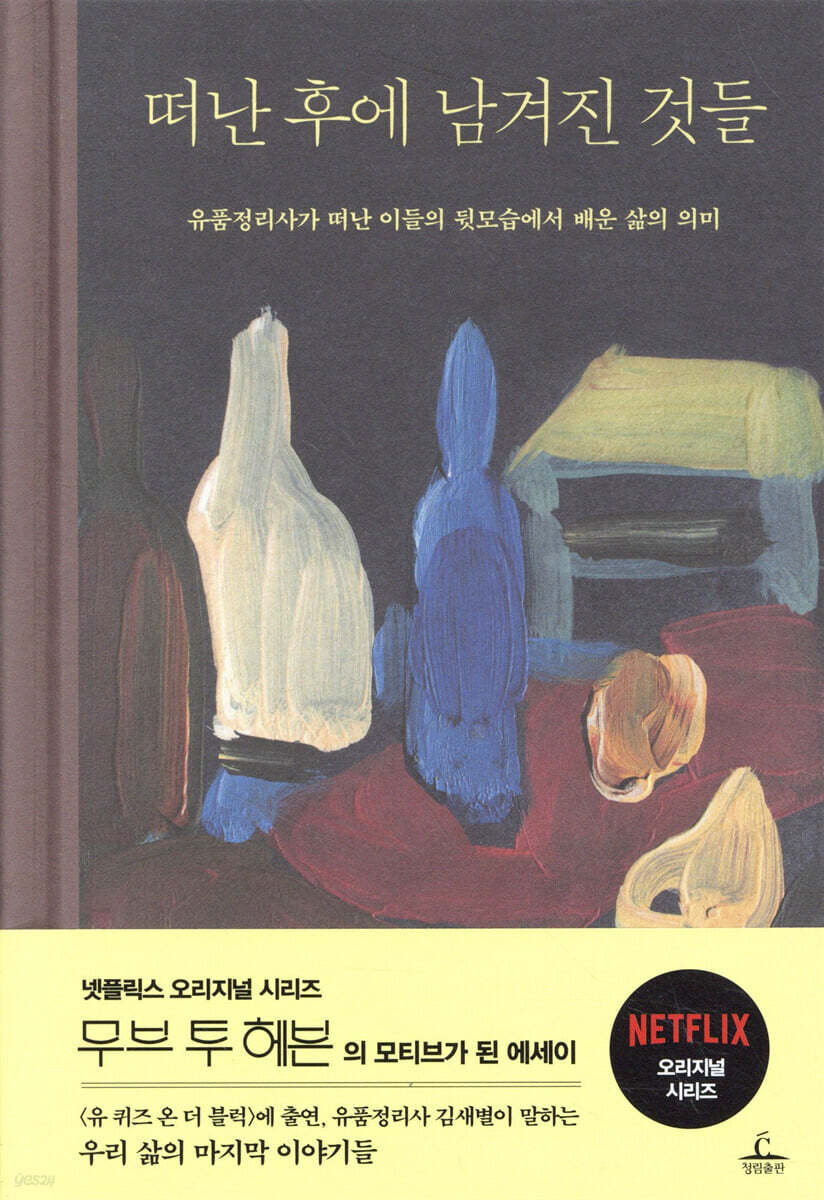
Things left behind after leaving
 |
Description
Book Introduction
A person who erases the traces of life and tells the last story
“We are the ones who help you move to heaven.”
Kim Sae-byeol, a funeral director, says that even though she has faced death more than 1,000 times in 25 years, she still feels heartbroken when she meets the deceased who have heartbreaking stories.
Jeon Ae-won says that living each day with the people around her in the midst of life and death is the greatest strength.
The book "Things Left Behind," which collects the last moments of our neighbors that they raised, has been revised and published.
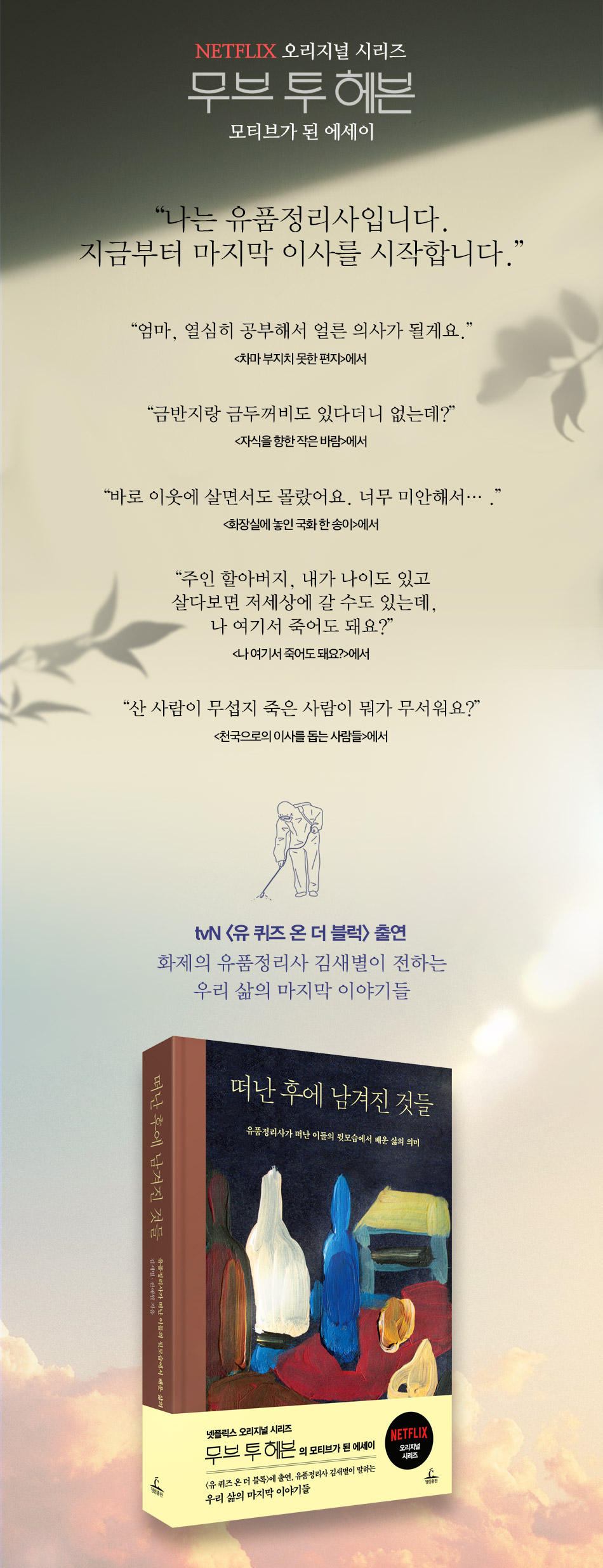
This book, which was recently introduced on tvN's [You Quiz on the Block] and conveys the meaning and reflections on death, provides a warm time for lonely modern people who live while hiding their expressions and feelings from each other to reflect on their lives.
This book is a record of the traces of life discovered by a relic organizer in the backs of the departed, and the final stories they left behind in the world.
It is also a sad self-portrait of ours, making us feel pain, sighs, and hope all at once by involving ourselves in the lonely lives of our neighbors, whom everyone has turned away from.
I hope that this book, which conveys the preciousness of everyday life along with the '7 Commandments for a Beautiful Ending', will be a small hope for a peaceful death for those who sacrifice today for tomorrow and regret yesterday, and for all those who are having a hard time without the will to live.
“We are the ones who help you move to heaven.”
Kim Sae-byeol, a funeral director, says that even though she has faced death more than 1,000 times in 25 years, she still feels heartbroken when she meets the deceased who have heartbreaking stories.
Jeon Ae-won says that living each day with the people around her in the midst of life and death is the greatest strength.
The book "Things Left Behind," which collects the last moments of our neighbors that they raised, has been revised and published.
This book, which was recently introduced on tvN's [You Quiz on the Block] and conveys the meaning and reflections on death, provides a warm time for lonely modern people who live while hiding their expressions and feelings from each other to reflect on their lives.
This book is a record of the traces of life discovered by a relic organizer in the backs of the departed, and the final stories they left behind in the world.
It is also a sad self-portrait of ours, making us feel pain, sighs, and hope all at once by involving ourselves in the lonely lives of our neighbors, whom everyone has turned away from.
I hope that this book, which conveys the preciousness of everyday life along with the '7 Commandments for a Beautiful Ending', will be a small hope for a peaceful death for those who sacrifice today for tomorrow and regret yesterday, and for all those who are having a hard time without the will to live.
- You can preview some of the book's contents.
Preview
index
Preface to the Revised Edition: A Changing World, Things That Have Not Changed
Prologue: What the Departed Taught Us
Chapter 1 If only we knew how to love each other a little more
- A letter I couldn't bring myself to send
- A small wish for my child
- A chrysanthemum placed in the bathroom
- Shin Saimdang, who made her son a criminal
- Can I die here?
- Addiction created by longing
- From loneliness to friendship
Chapter 2 No matter what kind of life we live, we are precious people.
- The courage to endure reality
- The son who cannot see
- Life is about overcoming the heavy burden of fate.
- On the way, thinking about what happened after I left
- People who help move to heaven
- Even if I give everything I have
- When you lose your will to live
Chapter 3: What Blooms from the Lowest Places: Hope
- A devil in human skin
- The worst choice in the world
- The day when a lifelong wish comes true
- Pain, the monthly rent paid for life
- The death everyone wants
- How that family lives
- The power to change the world
- Blinded by longing
Chapter 4: What We Really Have Left
- How to love life and people more
- When you can't express your sadness
- Who is my real family?
- Love that doesn't burden
- As flowers bloom when spring comes
- Choco who gave love and left
- A death that no one mourns
Epilogue: Love and Love Again
Appendix: 7 Commandments for a Beautiful Finish, from an Estate Organizer
Prologue: What the Departed Taught Us
Chapter 1 If only we knew how to love each other a little more
- A letter I couldn't bring myself to send
- A small wish for my child
- A chrysanthemum placed in the bathroom
- Shin Saimdang, who made her son a criminal
- Can I die here?
- Addiction created by longing
- From loneliness to friendship
Chapter 2 No matter what kind of life we live, we are precious people.
- The courage to endure reality
- The son who cannot see
- Life is about overcoming the heavy burden of fate.
- On the way, thinking about what happened after I left
- People who help move to heaven
- Even if I give everything I have
- When you lose your will to live
Chapter 3: What Blooms from the Lowest Places: Hope
- A devil in human skin
- The worst choice in the world
- The day when a lifelong wish comes true
- Pain, the monthly rent paid for life
- The death everyone wants
- How that family lives
- The power to change the world
- Blinded by longing
Chapter 4: What We Really Have Left
- How to love life and people more
- When you can't express your sadness
- Who is my real family?
- Love that doesn't burden
- As flowers bloom when spring comes
- Choco who gave love and left
- A death that no one mourns
Epilogue: Love and Love Again
Appendix: 7 Commandments for a Beautiful Finish, from an Estate Organizer
Detailed image
Into the book
I simply hope that readers of this book will understand that while smartphones, which connect us to the world through invisible lines, bring joy to some, they also bring loneliness to others.
At the very least, I hope that we can prevent someone around us from going down a different path from us just because they are 'lonely'.
--- p.7, from “Preface to the Revised Edition: A Changing World, Things That Have Not Changed”
It was also quite shocking to learn that not everyone faces death completely.
I also learned that overcoming the fear of death and facing one's final moments peacefully, thanks to the love of family members who are by one's side like in the drama, is an incredible fortune that may be given to only one in a thousand people.
There were so many lonely and desolate deaths that no one took care of.
--- p.10~11, from “Prologue: What Those Who Left Taught Us”
How can a child understand his parents' feelings?
When I worked as a funeral director, I saw countless deaths, but I rarely saw children crying while holding their deceased parents.
But parents must always hold their children in their arms.
--- p.27, from “Chapter 1: If We Had Known How to Love Each Other a Little More”
Washing dishes, wiping dusty furniture, and mopping the floor are trivial tasks.
But these insignificant things sustain our daily lives.
These are the first things we let go of when we lose our will to live.
--- p.114, from “Chapter 2: No matter what kind of life we live, we are precious people”
When we hear of a tragic death on the news, we feel sad and mourn, but when someone dies next door, we feel scared and offended.
Such thoughts and feelings may be what is causing someone to give up on life.
Strictly speaking, suicide and death from loneliness are another murder created by our cruelty and indifference.
--- p.174, from “Chapter 3: What Blooms in the Lowest Place, Hope”
How many more days will the child have to cry alone?
How long must I swallow that sadness and pain?
Whenever I think about that day, I still feel a pang in my heart as I recall the image of the child crying with his face buried in his mother's clothes.
But we also know.
That our lives are about getting up again and continuing to live even when unbearable hardships come.
At the very least, I hope that we can prevent someone around us from going down a different path from us just because they are 'lonely'.
--- p.7, from “Preface to the Revised Edition: A Changing World, Things That Have Not Changed”
It was also quite shocking to learn that not everyone faces death completely.
I also learned that overcoming the fear of death and facing one's final moments peacefully, thanks to the love of family members who are by one's side like in the drama, is an incredible fortune that may be given to only one in a thousand people.
There were so many lonely and desolate deaths that no one took care of.
--- p.10~11, from “Prologue: What Those Who Left Taught Us”
How can a child understand his parents' feelings?
When I worked as a funeral director, I saw countless deaths, but I rarely saw children crying while holding their deceased parents.
But parents must always hold their children in their arms.
--- p.27, from “Chapter 1: If We Had Known How to Love Each Other a Little More”
Washing dishes, wiping dusty furniture, and mopping the floor are trivial tasks.
But these insignificant things sustain our daily lives.
These are the first things we let go of when we lose our will to live.
--- p.114, from “Chapter 2: No matter what kind of life we live, we are precious people”
When we hear of a tragic death on the news, we feel sad and mourn, but when someone dies next door, we feel scared and offended.
Such thoughts and feelings may be what is causing someone to give up on life.
Strictly speaking, suicide and death from loneliness are another murder created by our cruelty and indifference.
--- p.174, from “Chapter 3: What Blooms in the Lowest Place, Hope”
How many more days will the child have to cry alone?
How long must I swallow that sadness and pain?
Whenever I think about that day, I still feel a pang in my heart as I recall the image of the child crying with his face buried in his mother's clothes.
But we also know.
That our lives are about getting up again and continuing to live even when unbearable hardships come.
--- p.198, from “Chapter 4: What Really Remains for Us”
Publisher's Review
“I am a relic organizer who tells the final story.”
What the departed taught us
Life and death, neither is beautiful nor ugly.
Kim Sae-byeol, a funeral director, says that even though she has faced death more than 1,000 times in 25 years, she still feels heartbroken when she meets the deceased who have heartbreaking stories.
Jeon Ae-won says that living each day with the people around her in the midst of life and death is the greatest strength.
The book "What's Left Behind," which collects the last moments of our neighbors that they raised, has been revised and published.
This book, which was recently introduced on tvN's "You Quiz on the Block" and conveys the meaning and reflections on death, will provide a warm time to reflect on one's own life to lonely modern people who live while hiding their expressions and feelings from each other.
A person who erases the traces of life and tells the last story
“We are the ones who help you move to heaven.”
Author Kim Sae-byeol became interested in 'life and death' after the sudden death of a friend, and was impressed by the funeral director's sincere care for her friend's final moments, so she began working as a funeral director.
And by chance, I started helping the bereaved families organize their belongings at their request, and now I have been working as an estate organizer for 15 years.
The author, who says that his job is sometimes sad because he is often kicked out of restaurants and gets glares from people, introduces the people he works with as follows.
They are said to be people who help people move to heaven by clearing away the traces of those who have died lonely and desolate deaths with no one to take them in.
“Today, my dad was working, and the restaurant smelled so bad that they wouldn’t let him eat, and people hated him because of an invisible ghost.
"Daddy, doesn't your daughter smell like you? What if you have a ghost? Aren't you scared?"
"Dad, when people die, they all go somewhere, right? You help them find their way back safely, right? Then those people must be really grateful to you.
It's scary and I hate getting lost, but my dad finds the way.
But why are you afraid of Dad?” (_Main text, pages 37-38)
The many faces of death I witnessed before my eyes
“There is no death in this world without a reason.”
This book is a record of the traces of life discovered by a relic organizer in the backs of the departed, and the final stories they left behind in the world.
It is also our sad self-portrait, making us feel pain, sighs, and hope all at once by involving ourselves in the lonely lives of our neighbors, whom everyone has turned away from.
A middle-aged man who died alone because he couldn't live anymore because he was lonely; a young man who suddenly died while nurturing his dreams in a single room in a goshiwon, facing the bleak reality; parents who cry while holding the body of their child, whose face was so mutilated that it was unrecognizable.
The author goes to work at the scene of death every day and encounters various reasons for death.
“An old lady came to see the house alone.
She was a clean and pretty old woman.
I signed the contract the day I came to see the house.
A few days later, on the day I moved in, I went down to check if the move was done well.
At that time, my grandmother said quietly:
'Grandpa, I'm old and I might go to the next world if I live here... ... Can I die here?'
That's what all old people like us are like.
Should I die now or later? I guess I should just die quietly in my sleep.
So I said it was okay without meaning to.
But who knew I would die so quickly… … .” (_Main text, pages 50-51)
To us who spend our daily lives dreaming of a beautiful ending
“May you find a peaceful and peaceful death.”
When we see people who have lost their families in a major accident or hear about a tragic incident on the news, we shed tears and express our condolences.
And I take a moment to imagine the end for myself and my loved ones.
In this way, 'death' allows us, who live hectic lives caught up in our busy daily lives, a moment to stop and reflect on our lives.
That's how Grandma prepared for tomorrow.
Instead of feeling discouraged by the children I didn't contact and the impoverished life I didn't have, and regretting the days gone by, I woke up at dawn to pick up scrap paper, copied the Bible in the evening, and occasionally went to a welfare center to learn origami. I lived each day diligently and prepared for a tomorrow without regrets.
I suddenly felt embarrassed.
I saw myself regretting yesterday, unable to live today under the pretext of living for tomorrow.
I met a wonderful grandmother that day.
(_Main text, pages 97-98)
Having faced countless deaths, the author has realized that facing one's final moments with peace is an incredible stroke of luck, a gift that only one in a thousand can receive.
I hope that this book, which conveys the preciousness of everyday life along with the '7 Commandments for a Beautiful Ending', will be a small hope for a peaceful death for those who sacrifice today for tomorrow and regret yesterday, and for all those who are having a hard time without the will to live.
What the departed taught us
Life and death, neither is beautiful nor ugly.
Kim Sae-byeol, a funeral director, says that even though she has faced death more than 1,000 times in 25 years, she still feels heartbroken when she meets the deceased who have heartbreaking stories.
Jeon Ae-won says that living each day with the people around her in the midst of life and death is the greatest strength.
The book "What's Left Behind," which collects the last moments of our neighbors that they raised, has been revised and published.
This book, which was recently introduced on tvN's "You Quiz on the Block" and conveys the meaning and reflections on death, will provide a warm time to reflect on one's own life to lonely modern people who live while hiding their expressions and feelings from each other.
A person who erases the traces of life and tells the last story
“We are the ones who help you move to heaven.”
Author Kim Sae-byeol became interested in 'life and death' after the sudden death of a friend, and was impressed by the funeral director's sincere care for her friend's final moments, so she began working as a funeral director.
And by chance, I started helping the bereaved families organize their belongings at their request, and now I have been working as an estate organizer for 15 years.
The author, who says that his job is sometimes sad because he is often kicked out of restaurants and gets glares from people, introduces the people he works with as follows.
They are said to be people who help people move to heaven by clearing away the traces of those who have died lonely and desolate deaths with no one to take them in.
“Today, my dad was working, and the restaurant smelled so bad that they wouldn’t let him eat, and people hated him because of an invisible ghost.
"Daddy, doesn't your daughter smell like you? What if you have a ghost? Aren't you scared?"
"Dad, when people die, they all go somewhere, right? You help them find their way back safely, right? Then those people must be really grateful to you.
It's scary and I hate getting lost, but my dad finds the way.
But why are you afraid of Dad?” (_Main text, pages 37-38)
The many faces of death I witnessed before my eyes
“There is no death in this world without a reason.”
This book is a record of the traces of life discovered by a relic organizer in the backs of the departed, and the final stories they left behind in the world.
It is also our sad self-portrait, making us feel pain, sighs, and hope all at once by involving ourselves in the lonely lives of our neighbors, whom everyone has turned away from.
A middle-aged man who died alone because he couldn't live anymore because he was lonely; a young man who suddenly died while nurturing his dreams in a single room in a goshiwon, facing the bleak reality; parents who cry while holding the body of their child, whose face was so mutilated that it was unrecognizable.
The author goes to work at the scene of death every day and encounters various reasons for death.
“An old lady came to see the house alone.
She was a clean and pretty old woman.
I signed the contract the day I came to see the house.
A few days later, on the day I moved in, I went down to check if the move was done well.
At that time, my grandmother said quietly:
'Grandpa, I'm old and I might go to the next world if I live here... ... Can I die here?'
That's what all old people like us are like.
Should I die now or later? I guess I should just die quietly in my sleep.
So I said it was okay without meaning to.
But who knew I would die so quickly… … .” (_Main text, pages 50-51)
To us who spend our daily lives dreaming of a beautiful ending
“May you find a peaceful and peaceful death.”
When we see people who have lost their families in a major accident or hear about a tragic incident on the news, we shed tears and express our condolences.
And I take a moment to imagine the end for myself and my loved ones.
In this way, 'death' allows us, who live hectic lives caught up in our busy daily lives, a moment to stop and reflect on our lives.
That's how Grandma prepared for tomorrow.
Instead of feeling discouraged by the children I didn't contact and the impoverished life I didn't have, and regretting the days gone by, I woke up at dawn to pick up scrap paper, copied the Bible in the evening, and occasionally went to a welfare center to learn origami. I lived each day diligently and prepared for a tomorrow without regrets.
I suddenly felt embarrassed.
I saw myself regretting yesterday, unable to live today under the pretext of living for tomorrow.
I met a wonderful grandmother that day.
(_Main text, pages 97-98)
Having faced countless deaths, the author has realized that facing one's final moments with peace is an incredible stroke of luck, a gift that only one in a thousand can receive.
I hope that this book, which conveys the preciousness of everyday life along with the '7 Commandments for a Beautiful Ending', will be a small hope for a peaceful death for those who sacrifice today for tomorrow and regret yesterday, and for all those who are having a hard time without the will to live.
GOODS SPECIFICS
- Date of issue: September 29, 2020
- Format: Hardcover book binding method guide
- Page count, weight, size: 244 pages | 384g | 135*194*18mm
- ISBN13: 9788935213283
- ISBN10: 8935213284
You may also like
카테고리
korean


korean

![GQ KOREA Mark (Monthly): December [2025]](http://librairie.coreenne.fr/cdn/shop/files/8ef265dbbfbf186523ed75ba7319009d.jpg?v=1765340328&width=3840)


