

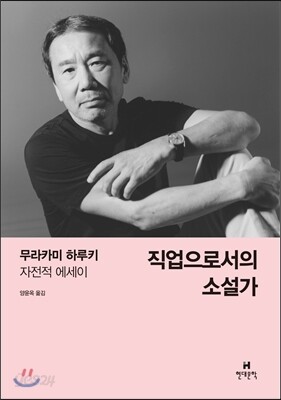
Novelist as a profession
 |
Description
Book Introduction
For whom are you writing,
How to write,
And why do you continue to write novels?
A strong will to write a novel.
A novelist as a profession,
Thirty-five years of living as 'Haruki Murakami'
A compilation of theories on authorship, paragraphs, literature, and life
Haruki Murakami invented the 21st century novel.
The New York Times Book Review
Haruki Murakami, who has consistently maintained silence except when publishing his works, has, for the first time since his literary debut in 1979, opened up about his writing practice and his thoughts on the literature that supports it and the world.
What do you think about the existence of literary awards that sometimes cause a stir in the surroundings?
For what reason and when did you leave Japan, and what trials and errors and struggles did you endure before embarking on your journey to the world?
What problems does Japan face as seen through school education and the March 11th Incident?
Why did he choose the strange profession of a novelist in the first place, and why did he continue to write with unwavering creativity for so many years? All these questions are answered here by Haruki Murakami's honest and powerful thought process.
- You can preview some of the book's contents.
Preview
index
Is the first novelist an inclusive race?
The Second Time I Became a Novelist
About the 3rd Literary Award
About the 4th Originality
5th So, what should I write?
Part 6: Making Time Work for Me? Writing a Novel
The 7th Infinitely Personal and Physical Upwork
About the 8th School
What kind of character will appear in Episode 9?
10th Who is this for?
The 11th time going abroad.
New Frontier
12th Storytelling Place: Memories of Hayao Kawai
Reviews
Into the book
[…] No matter how correct the slogan or how beautiful the message, if there is no spiritual or moral power to support the correctness or beauty, everything is nothing more than a list of empty words.
What I learned firsthand then, and what I am still convinced of now, is this.
Words have definite power.
But that power must not be unjust.
At least it shouldn't be unfair.
Words should not be distorted to their original meaning.
--- p.
40~41
The Yakult leadoff hitter was a lanky unknown player from the United States named Dave Hilton.
He was number one in the batting order.
Number 4 is Charlie Manual.
He later became famous as the manager of the Phillies, and at the time he was a truly powerful and fearsome hitter, earning him the nickname "Red Goblin" among Japanese baseball fans.
I understand that Hiroshima's starting pitcher was definitely Takahashi.
Yakult's starting pitcher was Yasuda.
In the bottom of the first, when Takahashi threw the first pitch, Hilton hit it cleanly to left-center for a double.
The refreshing sound of the bat hitting the ball echoed throughout Jingu Stadium.
There was occasional applause all around.
At that time, without any context or basis, I suddenly thought this.
'Yeah, maybe I can write a novel too.'
I still remember the feeling at that time clearly.
It felt like something was slowly descending from the sky and I was catching it with both hands.
I don't know why it fell into my hands at that time.
I didn't know then and I still don't know now.
But whatever the reason, it happened anyway.
It was, what should I say, a kind of revelation.
There is a word in English called epiphany.
Translated into Japanese, it is a difficult word meaning 'sudden manifestation of essence' or 'intuitive grasp of truth'.
To put it simply, it's the feeling of 'one day something suddenly appears before your eyes and everything changes because of it.'
That's exactly what happened to me that afternoon.
That incident completely changed the course of my life.
At that moment, Dave Hilton hit a beautiful, sharp double as the leadoff hitter at Jingu Stadium.
--- p.
45~46
Sometimes I hear people say, 'Haruki Murakami's sentences sound like translations.'
I'm not sure exactly what you mean by translation two, but I think it's true in some ways and false in others.
In the literal sense of the word, that the first page was actually 'translated' into Japanese, there is some truth to that point, but that is merely a matter of practical process.
What I aimed for there was rather a 'neutral', active writing style that eliminated unnecessary formalism.
What I pursued was not writing sentences in "Japanese that has diluted its Japaneseness," but rather, "speaking" the novel in my own natural tone, using Japanese that was as far removed as possible from the so-called "novel language" or "pure literature system."
To do that, I had to be willing to let go of everything.
To put it in extreme terms, it could be said that at that time, Japanese was nothing more than a functional tool for me.
--- p.
51~52
Since I am not the type of person who likes conflict or fighting (I really am), I never had any intention of going against such 'customs' or 'unwritten rules of the literary world'.
However, since I am a person with an extremely individualistic way of thinking, I managed to become a novelist (for now) with great difficulty, and since I only live once, I decided from the beginning to do what I wanted to do, the way I wanted to do it.
The system can do what it wants, and I can do what I want.
I think I belong to the generation that lived through the so-called "age of rebellion" in the late 1960s, so I had a strong sense of not wanting to get caught up in the system.
But at the same time, or rather, first of all, as a so-called expresser, I wanted to be mentally free above all else.
I want to write the novel I want to write, the way I want to write, on a schedule that suits me.
I thought that was the minimum freedom I, as a writer, should have.
And the outline of what kind of novel I wanted to write was pretty clear from the beginning.
I had a reasonable idea in my head: 'I'm not good at writing yet, but when I get better, I actually want to write this or that kind of novel.'
That image was always shining like the North Star in the middle of the sky.
If anything happens, just look up.
Then I could clearly see where I was standing and the direction I should go.
If I hadn't had that kind of starting point, I think I would have wandered around quite a bit.
--- p.104~105
So how do we determine what is absolutely necessary, what is not so necessary, or what is completely unnecessary?
Speaking from my own experience, this is a very simple question, but I think one criterion is, 'Are you having fun while doing it?'
If you're engaging in something that you find important to you and you don't find natural joy or pleasure in it, if your heart doesn't race as you do it, then there's something wrong or out of sync.
At such times, we must go back to the beginning and completely eliminate all the unnecessary parts and unnatural elements that interfere with the enjoyment.
--- p.106
That's not something an artist would do.
Some people might say, “Isn’t that the same as a factory?”
Yeah, that's probably not something an artist would do.
But why shouldn't a novelist be an artist?
Who on earth decided that and when?
No one has decided.
We can write novels the way we want to.
First of all, if you think, 'It's okay even if I'm not an artist,' you'll feel much more at ease.
A novelist must be a free man before being an artist.
Doing what I like, when I like, how I like, that to me is the definition of a free person.
Rather than becoming an artist who is conscious of the world's gaze or wears a lot of formality, you can be an extremely ordinary person, just hanging around.
--- p.
150~151
I also think there was probably a 'self-healing' meaning to it.
Because every creative act contains, to a greater or lesser extent, the intention to correct oneself.
That is, by relativizing oneself, by fitting one's soul into a form different from the one in which it currently exists, one resolves—or sublimates—the various contradictions, distortions, and distortions that inevitably arise in the course of life.
If that works, it's about sharing that effect with your readers.
Although I wasn't particularly conscious of it, my mind may have instinctively pursued such self-purification at that time.
That's why I felt like writing a novel so naturally.
--- p.
260
Publisher's Review
Haruki Murakami invented the 21st century novel.
_ The New York Times Book Review
A novelist as a profession,
Thirty-five years of living as 'Haruki Murakami'
A compilation of theories on authorship, paragraphs, literature, and life
I don't remember exactly when I began writing the series of manuscripts that make up this book, but it was probably five or six years ago.
I've always wanted to talk about writing novels and the situation I'm in as a novelist, so I've been collecting these pieces, piecemeal and thematic, in my spare time between work.
In other words, this is not a piece I wrote at the request of a publisher, but rather something I started writing voluntarily, so to speak, for myself.
_ From the “Postscript” of “The Novelist as a Profession”
There is probably no author who has been as misunderstood as Haruki Murakami.
Although he has a large readership worldwide, to the point that the term 'Harukist' was coined, he also receives harsh reviews from many critics.
He, who had consistently maintained silence even in the face of strong criticism such as 'socially irresponsible' and 'imperialist', has now, for the first time since his debut in 1979, expressed his views on writers, literary circles, and literary arts in a simple format as if addressing the audience.
This book summarizes the writing and its field, which I have occasionally mentioned through interviews and essays, as well as my thoughts on literature and the world that support them.
"Novelist as a Profession" is a book that answers the question, "What should I do to become 'like Haruki Murakami'?"
It sheds the outdated illusion of a writer and talks about a novelist as a true profession.
Through twelve chapters, he specifically reveals the daily practices of writing novels consistently for thirty-five years, his adventures and successes as a pioneer who challenged the overseas market with sound ambition, and the qualities and attitudes a writer must have toward his profession to make a living from novels.
This book will be a practical guide to literary management, offering a friendly explanation of the fierce attacks on literary power and the widespread misunderstandings about literature. It will also be filled with hints for novelists and aspiring novelists to transcend the boundaries of domestic literature and become world-renowned bestselling authors.
Moreover, as we trace the thirty-five years of professional novelist Haruki Murakami's career, we come to feel that his stories ultimately touch on the question of how we should live.
Meanwhile, the first thing that became a hot topic when the book was published in Japan was its unusual sales method.
Of the 100,000 copies of the first edition, 90,000 copies were purchased from Kinokuniya, Japan's largest offline bookstore, and some were sold in their own stores, while the rest were supplied to other bookstores. In short, to obtain "Novelist as a Profession," one had to look for offline bookstores rather than online bookstores.
This was not only a countermeasure against online bookstores, but also an attempt to reform the traditional publishing distribution system, which had been in place for many years, in which publishers distributed new books to bookstores nationwide through intermediaries.
Is the first novelist an inclusive race?
But while it's easy to get into the ring, it's not easy to stay there for long.
The novelist, of course, knows that very well.
It's not that difficult to write a novel or two.
But writing novels for a long time, making a living from them, surviving as a novelist—these are extremely difficult things.
It might be okay to just say that it's something that an ordinary person wouldn't be able to do.
Because there is a growing need for something 'special'.
Of course, you need your own talent, but you also need a certain amount of spirit.
Also, as with many other things in life, luck and fate are important factors.
But in addition to that, some kind of 'qualification' is required.
This is available to those who are equipped, and not available to those who are not equipped.
Some people are born with it, while others acquire it through hardship.
The Second Time I Became a Novelist
The 'feeling good' and 'joy' of creating sentences that I felt when I wrote my first novel remain essentially unchanged.
Every day, I wake up at dawn, heat up some coffee in the kitchen, pour it into a large mug, sit down at my desk with the mug in hand, and turn on my computer (though sometimes I miss my manuscript paper and my long-time favorite bold Montblanc fountain pen).
And then I start thinking, 'Okay, what should I write from now on?'
I'm really happy then.
To be honest, I've never felt like writing something was painful.
I have never (thankfully) had an experience where I suffered because I couldn't write a novel.
No, rather, in my opinion, if it's not fun, there's no point in writing a novel in the first place.
I can't seem to get used to the mindset of writing a novel as a difficult task.
I think that a novel is basically something that is written in a fountain-like manner.
About the 3rd Literary Award
Of course, these two may be extreme exceptions.
Because they are people who have lived their lives with their own unique style and consistent rebellious spirit.
But what they had in common, or what they wanted to express as an attitude, was probably that 'there are many things more important to a true writer than literary awards.'
One is the realization that you are creating something meaningful, and the other is the realization that there are readers—regardless of their number—who will properly evaluate that meaning.
As long as you have those two solid realities, it doesn't matter to the writer what the award is.
Such things are nothing more than social or literary formal recognition.
About the 4th Originality
I think (or rather, I hope) that kind of free and natural sensibility is what underpins the novels I write.
That was the mobility.
If we use a car analogy, it's the engine.
At the root of all expressive work must always be a rich and spontaneous joy.
Originality is nothing other than the natural desire and impulse to convey that freedom of thought, that unfettered joy, as vividly as possible to as many people as possible.
5th So, what should I write?
Back to the movie, Steven Spielberg's "E.
E. in T.》
There's a scene where T. gathers up junk from a warehouse and creates an improvised communication device out of it.
Do you remember?
It was a long time ago that I saw the movie, so I forgot the details, but it was about making things by combining various household items that were there. Things like umbrellas, electric stands, dishes, record players, etc.
Although it was made on the spot, it is actually a full-fledged communication device that can contact its mother star thousands of light years away.
I was so impressed by that scene when I saw it in the cinema, and that's definitely how great novels are made.
The quality of the material itself is not very important.
Above all, what must be there is ‘magic’.
Even if we only have everyday, humble materials, and use only simple, plain words, if there is magic in it, we can create amazingly sophisticated devices from them.
But anyway, we each need our own 'warehouse'.
No matter how much magic you use, you can't create something out of nothing.
When ET comes knocking and says, "Excuse me, but can I use a few things from your closet?", you need to keep a stockpile of "junk" that you can rattle open and say, "Okay, whatever you want."
Part 6: Making Time My Ally - Writing a Novel
In other words, what is important is the act of tearing down and fixing itself.
The very fact that a writer decides to "fix this part a little better" and sits down at his desk to revise his sentences is of paramount importance.
Compared to that, the direction of 'how to fix it' may actually be a secondary issue.
In many cases, a writer's instinct or intuition is more effectively guided by determination than by logic.
It's like hitting the forest with a club to make the birds hiding inside fly.
It doesn't matter what club you use or how you hit it, the result doesn't make much difference.
Anyway, if you can make the bird fly, that's good.
The dynamism of the birds' movements shakes up our fixed vision.
That's my opinion.
Well, this may be a rather violent opinion.
Anyway, I spend as much time as possible rewriting it.
Listen to the advice of those around you (whether you're angry or not), take it to heart, and work towards improvement.
Advice is important.
Most writers who have just finished writing a novel are half-mad, their brains racing with excitement.
Because no one in their right mind would ever write something like a long novel.
So, there's nothing wrong with being insane per se, but you still have to be aware that 'I'm not insane to some extent.'
And to a sane person, the opinion of a sane person is generally important.
The 7th Infinitely Personal and Physical Upwork
But if that's not the case, if you're not a rare genius (unfortunately), but rather a person who wants to spend time developing and enhancing the talents (which are limited, however much) you have, then I think my theory holds some validity.
Strengthen your will as much as possible, and at the same time, maintain and maintain your body, the seat of that will, as healthy, strong, and undisturbed as possible—this will lead to a comprehensive and balanced improvement in the quality of your lifestyle itself.
My basic belief is that if you don't spare any effort, the quality of the work you create will naturally improve (I feel like I'm repeating myself, but this theory doesn't apply to artists with genius qualities).
About the 8th School
In any era and in any world, imagination has a significant meaning.
One of the things that is opposite to imagination is 'efficiency'.
If we look at the original cause of driving tens of thousands of Fukushima residents from their homeland, it is precisely this "efficiency."
The idea that "nuclear power is a highly efficient energy source and therefore good"—and the resulting fabrication of the "safety myth"—has brought this tragic situation, this irreversible disaster, to this country.
It might be safe to say that this is precisely the defeat of our imagination.
It's not too late, even from now.
We must establish within each of us a foundation of free thought and imagination that can counter such hasty and dangerous values of "efficiency."
And we need to develop that axis into a community.
What kind of character will appear in Episode 9?
Someday I might be a twenty year old woman with lesbian tendencies.
Someday I might be a thirty-year-old unemployed house husband.
Then I put on the shoes that were given to me at that time and go into action with my feet sized accordingly.
That's all.
It's not about fitting shoes to your foot size, it's about fitting your foot to your shoe size.
Realistically, it's impossible, but if you live long enough as a novelist, it will naturally become possible.
Because it's fictional.
And the fictional thing is the same thing that happens in a dream.
Dreams—whether we dream while we're asleep or awake—are something we have little choice about.
I basically have no choice but to go with the flow.
And as long as you follow that flow naturally, all kinds of 'impossible things' become freely possible.
That's the great joy of writing a novel.
10th Who is this for?
Of course, it would be nice if there were books for male readers and books for female readers.
That's also necessary.
However, I personally hope that the books I write can inspire and move the hearts of readers, regardless of gender.
And there's nothing more gratifying than when couples, groups of men and women, couples, parents and children have a lively conversation about my book.
Because I always think that novels and stories have the function of softening the sharp edges of conflicts between men and women, between generations, and various other stereotypes.
This is a great feature, no doubt about it.
I secretly hope that the novel I wrote will play a positive role in this world, even if only a little.
The 11th time going abroad.
New Frontier
Stories originally existed as metaphors for reality, and people need new stories = new metaphor systems to situate themselves in their inner space in order to keep up with the changing system of the surrounding reality, or not to be pushed out by it.
By properly connecting these two systems (the system of real society and the system of metaphor), that is, by properly adapting the subjective and objective worlds as they move back and forth, people can barely accept the uncertain reality and maintain their composure.
The reality of the story my novels offer is not something that happens to function globally as a cog in that adaptation—I don't get that feeling.
I feel like I'm repeating myself, but of course this is just my personal experience.
Still, I don't think it's completely wrong.
12th Storytelling Place: Memories of Hayao Kawai
I said earlier that we met and talked often, but I can't remember much of what we talked about. Actually, I don't think that really matters.
Because I think the most important thing about being there is not the content of the story, but rather the 'physical presence' of having shared something there.
What did we share?
In a word, I think it was probably the concept of a story.
Story = Story is something that exists at the bottom of the human soul.
It must be at the bottom of the human soul.
Because it lies in the deepest part of the soul, it connects people to each other from the very foundation.
I go down to that place on a daily basis while writing a novel.
As a clinician, Dr. Kawai goes down there on a daily basis to meet clients.
Or else you have to go down.
I think Mr. Kawai and I probably understood it 'clinically'.
Although we didn't say it out loud, we both knew it well.
As if they recognize each other by smell.
Of course, this may just be my own thought.
But I still feel clearly that there was something close to that empathy.
GOODS SPECIFICS
- Date of issue: April 25, 2016
- Format: Hardcover book binding method guide
- Page count, weight, size: 336 pages | 484g | 136*194*30mm
- ISBN13: 9788972757719
- ISBN10: 8972757713
You may also like
카테고리
korean


korean


